ISSN Print: 2165-3917
DOI: 10.4236/ojapps.2019.91002 Jan. 18, 2019 10 Open Journal of Applied Sciences
A Study of Ferrospheres in the Coal Fly Ash
Danzandorj Sunjidmaa
1, Ganbat Batdemberel
2*, Shaikhslam Takibai
31Department of Environmental Engineering, School of Civil Engineering and Architecture, MUST, Ulaanbaatar, Mongolia 2Department of Physics, School of Applied Sciences, MUST, Ulaanbaatar, Mongolia
3Pavlodar State University, Pavlodar, Republic of Kazakhstan
Abstract
Coal fly ash is an industrial by-product, produced from coal combustion in thermal power plants. It is the most complex anthropogenic materials, which consists of combination of minerals originated from different sources. Coal fly ash and its byproduct has become an environmental concern over the World. Therefore, there is a pressing and ongoing need to investigate the structures and some properties of coal fly ash and develop new recycling methods for it. The amount of silica, aluminum, calcium, potassium, magne-sium, sodium, titanium and phosphorus oxides contained in power plant fly ash was determined by X-ray flouresecence (XRF) analysis. Concentration of heavy metals in fly ash was in sequence of Pb > Zn > Cu > Cr > Ni. As results of Scanning Electron Microscopy (SEM), except for porous and hollow par-ticles, large and small microspheres were observed. These particles are classi-fied as ferrospheres. X-ray diffraction (XRD) analysis show that fly ash con-sists of the following crystal phases: quartz, albite, anorthite and hematite.
Keywords
Fly Ash, Ferrospheres, Quartz, Albite, Anorthite, Hematite
1. Introduction
Fly ash was firstly used as mineral filler in road pavement in 1930. The “Fly ash” contained in concrete was published in a research paper of Concrete Institute of USA in 1937. Today, electric utilities in the US annually burn billion tons of coal and generate over 100 million tons of large-volume coal combustion products. Only a quarter of these coal combustion products are used and others are stored underground. Utilization of coal combustion products have following results: 1) Reducing land degradation, 2) Saving environmental resource, 3) Harmless ef-fect in environment, 4) Decreasing carbon dioxide, 5) User-saving, 6)
Decreas-How to cite this paper: Sunjidmaa, D., Batdemberel, G. and Takibai, S. (2019) A Study of Ferrospheres in the Coal Fly Ash. Open Journal of Applied Sciences, 9, 10-16.
https://doi.org/10.4236/ojapps.2019.91002 Received: December 14, 2018
Accepted: January 15, 2019 Published: January 18, 2019 Copyright © 2019 by author(s) and Scientific Research Publishing Inc. This work is licensed under the Creative Commons Attribution International License (CC BY 4.0).
http://creativecommons.org/licenses/by/4.0/
DOI: 10.4236/ojapps.2019.91002 11 Open Journal of Applied Sciences ing price of electricity. These results are the world tendencies to use coal com-bustion products and slag [1]. The chemical elements, mineral composition, particle forming condition and physical chemical properties of fly ash have been studied by SEM [2] [3]. The fly ash container of Thermal Power Plant III, Ulaanbaatar city, Mongolia will be filled to capacity in the coming years; thefore it is a good opportunity to study for ways to reuse the fly ash as a raw re-source for roads, building material or agriculture and to verify if the power plant has changed its combustion procedure. Power Plant III burns brown coal from Baganuur, this coals general properties are: humidity: 28% - 33%, ash-flow: 15% - 20%, calorie: 3300 - 44,200 kcal/kg, sulfur: 0.7% - 0.8%. The physical and chemical properties of Baganuur coal deposit make it usable exclusively for Thermal Power Plants and also with processing it has been proven through re-search that it can be used for syngas, liquid and patent fuel, and raw materials for the chemical industry. The properties of fly ash depend heavily on the coal mine, mode of operation and other parameters.
The main objective of this research is focused on the obtaining new types of materials with the use of modern technological methods (for example, bricks, lightweight concrete, geopolymer and etc.) based on the detailed structural analysis of the ferrospheres from coal fly ash-industrial byproduct materials and further develop technological backgrounds of it.
2. Experimental
2.1. XRF Analysis
Sample was measured by X-ray Fluorescence Spectrometer (Rigaku, ZXS Primus II). Results of the analysis are shown in Table 1.
As can be seen in Table 1, fly ash contains silicon dioxide (62.53%), alumi-num oxide (15.36%), calcium oxide (8.84), ferric oxide (5.84%), potassium oxide (2.26%), magnesium oxide (1.33%), sodium oxide (1.04%), titanium dioxide (0.61%), manganese oxide (0.11%), phosphorus oxide (0.08%) respectively. Ex-cept for these elements, low content of (ppm) Sr, Ba, Zr, Pb, Rb, Zn, Cu, Cr, Y, Ni, Co, Th, Ga and Nb were observed. Among these elements, Pb, Zn, Cu, Cr, Co, Ni are considered seriously. On the other hand, a sample of the fly ash is classified as F class, because silicon oxide, aluminum oxide and iron oxide are contained more than 70% of the ash (according to the ASTM C 618 standard).
Table 1. Chemical composition of coal fly ash.
(a)
Compounds SiO2 Al2O3 CaO K2O MgO Na2O TiO2 MnO P2O5
Value, wt. % 62.53 15.36 8.84 2.26 1.33 1.04 0.61 0.11 0.08 (b)
DOI: 10.4236/ojapps.2019.91002 12 Open Journal of Applied Sciences This fly ash is pozzolanic in nature, and contains less than 7% lime (CaO). Since the calcium oxide content of this sample was higher than 7% (CaO, 8.84 wt.%) this sample is might to be defined to be the C Class fly ash. This class is formed when burning younger lignite or sub-bituminouscoal [4].
2.2. SEM Analysis
SEM (Energy dispersive x-ray spectroscopy (EDX)) was applied to characterize the form of the fly ash particles. Results are depicted in Figures 1-3.
Except for porous large particles, individual large and small microspheres were observed in fly ash (Figure 1). As a result of analysis of microsphere A (marked red in Figure 1), following elements were determined (Figure 2).
As can be seen in Figure 2, microsphere A contains Ca (11.5 wt. %), Si (34.8 wt. %), Al (10.3 wt. %), Fe (43.4 wt. %). Therefore this sphere can be called a ferroshperes.
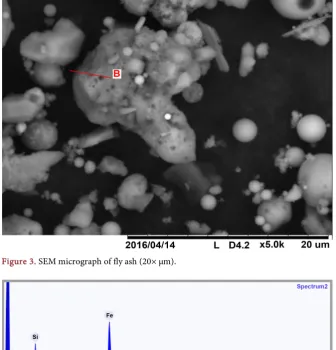
Except for porous large particles, individual large and small microspheres and hollow microspheres were observed in fly ash (Figure 3). As a result of analysis of porous sphere B (marked red in Figure 3), following elements were deter-mined (Figure 4).
As can be seen in Figure 4, porous sphere B contains Fe (75.3 wt. %), Si (11.1 wt. %), Ca (4.1 wt. %), Br (9.4 wt. %).
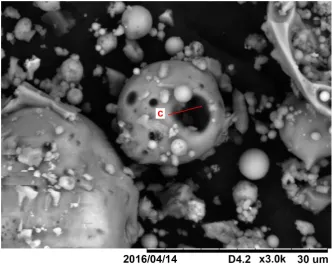
Except for hollow large particles, individual large and small microspores were observed in fly ash (Figure 5). As a result of analysis of hollow particles C (marked red in Figure 5), following elements were determined (Figure 6).
As can be seen in Figure 6, hollow particle C contains Fe (47.1 wt. %), Si (30.3 wt. %), Ca (13.6 wt. %), Al (9.0 wt. %). As mentioned before this sphere can be
DOI: 10.4236/ojapps.2019.91002 13 Open Journal of Applied Sciences
[image:4.595.205.542.229.580.2]Figure 2. Chemical elements of individual microsphere A.
Figure 3. SEM micrograph of fly ash (20× μm).
Figure 4. Chemical elements of porous sphere B.
DOI: 10.4236/ojapps.2019.91002 14 Open Journal of Applied Sciences
[image:5.595.206.539.70.334.2]Figure 5. SEM micrograph of fly ash (20× μm).
Figure 6. Chemical elements of hollow sphere C.
2.3. XRD Measurements
XRD measurements were carried out at ambient conditions on a X-ray powder diffractometer (Enraf Nonius Delft Diffractis 583). A step size of 0.05˚ 2Θ, an integration time of was 2 s per step and scan range from 13˚ to 80˚ were used. Phase analysis was done by < Match! Crystal Impact > program [5]. The x-ray powder diffraction pattern of samples is shown in Figure 7.
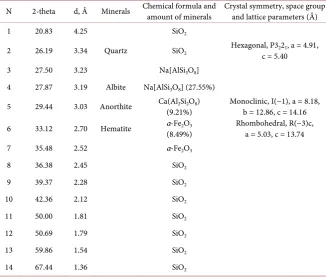
The interatomic distances was calculated by using equation 2dsinΘ = nλ and compared to International Powder Diffraction File (ICSD, PDF-4). Then types of minerals and amounts were determined (Table 2).
As can be noticed (Table 2), crystal phase of fly ash consists of 54.74% of
DOI: 10.4236/ojapps.2019.91002 15 Open Journal of Applied Sciences
Figure 7. X-ray pattern of burned coal.
Table 2. Phase composition and crystal structural parameters of coal fly ash.
N 2-theta d, Å Minerals Chemical formula and amount of minerals Crystal symmetry, space group and lattice parameters (Å) 1 20.83 4.25 SiO2
2 26.19 3.34 Quartz SiO2 Hexagonal, P3c = 5.40 221, a = 4.91,
3 27.50 3.23 Na[AlSi3O8]
4 27.87 3.19 Albite Na[AlSi3O8] (27.55%)
5 29.44 3.03 Anorthite Ca(Al2Si2O8)
(9.21%) Monoclinic, I(−1), a = 8.18, b = 12.86, c = 14.16 6 33.12 2.70 Hematite α-Fe2O3
(8.49%) Rhombohedral, R(−3)c, a = 5.03, c = 13.74 7 35.48 2.52 α-Fe2O3
8 36.38 2.45 SiO2
9 39.37 2.28 SiO2
10 42.36 2.12 SiO2
11 50.00 1.81 SiO2
12 50.69 1.79 SiO2
13 59.86 1.54 SiO2
14 67.44 1.36 SiO2
2-theta—scattering angle, d—interatomic distances.
P, Sr, Ba, Zr, Pb, Rb, Zn, Cu, Y, Ni, Co, Th, Ga and Nb elements were observed in results of XRF analysis, these elements does not form crystal phase in results of XRD analysis, because of equipment resolution. The results of XRD mea-surements are in agreement with chemical analysis (Table 1).
[image:6.595.210.537.311.588.2]DOI: 10.4236/ojapps.2019.91002 16 Open Journal of Applied Sciences concrete. The results of x-ray phase analysis made on coal fly ash were in good agreement with the results from the investigations within the frame of the Project “Utilization of Coal Fly Ash” realized at Florida University in 1992 [1].
3. Conclusions
As a result, it can be concluded that
Baganuur coal ash that are used at the Thermal Power Plant III of Ulaanbaatar city, Mongolia contains 8.84 wt% of calcium oxide (CaO), it can be classified as C Class fly ash. Therefore, due to its low content of calcium this type of fly ash is possible for use of the production of geopolymer material.
However, according the US standard ASTM C 618, this type of fly ash is defined to be classified to be F Class fly ash.
Microspheres in the coal fly ash samples were successfully observed by the SEM method. Since these microspheres contain a large amount of iron (Fe, 43 - 75 wt%) it is possible to separate them with magnetic separation method. X-ray diffraction analysis shows that the major compound, which represents the iron phase in microspheres are the hematites (α-Fe2O3, 8.49 wt%).
Conflicts of Interest
The authors declare no conflicts of interest regarding the publication of this pa-per.
References
[1] Openshaw, S.C., Miller, W.L., Bolch, W.E. and Bloomquist, D. (1992) Utilization of Coal Fly Ash. State University System of Florida, Florida Center for Solid and Hazardous Management, Gainesville.
[2] Sokol, E.V., Maksimova, N.V., Volkova, N.I., Nigmatulina, E.N. and Frenkel, A.E. (2000) Hollow Silicate Microspheres from Fly Ashes of the Chelyabinsk Brown Coals (South Urals, Russia). Fuel Processing Technology, 67, 35-52.
https://doi.org/10.1016/S0378-3820(00)00084-9
[3] Sokol, E.V., Kalugin, V.M., Nigmatulina, E.N., Volkova, N.I., Frenkel, A.E. and Maksimova, N.V. (2002) Ferrosphers from Fly Ashes of Chelyabinsk Coals: Chemical Composition, Morphology and Formation Conditions. Fuel, 81, 867-876.
https://doi.org/10.1016/S0016-2361(02)00005-4
[4] Schert, J., Townsend, T. and Wu, C.-Y. (2012) Identification of Potential Concerns Associated with FDOT Use of Ammoniated Fly Ash. Hinkley Center for Solid and Hazardous Waste Management, Gainesville.