2012. Vol.2, No.1, 30-36
Published Online March 2012 in SciRes (http://www.SciRP.org/journal/aasoci) http://dx.doi.org/10.4236/aasoci.2012.21004
The Effectiveness of Skill-Based Intervention for Female Victims
of Intimate Partner Violence: A Critical Review
Fong Lopaschuk
1, Cary A. Brown
21Crisis Response Team, Alberta Health Services, Edmonton, Canada 2
Faculty of Rehabilitation Medicine, University of Alberta, Edmonton, Canada Email: [email protected]
Received January 25th,2012; revised February 27th, 2012; accepted March 11th, 2012
Intimate Partner Violence (IPV) is associated with limitations in Activities of Daily Living (ADL). This paper critically reviews the methodological quality of evidence for life skills interventions provided for women who have experienced IPV. A comprehensive search was carried out for all relevant studies and the McMaster critical appraisal tools used to determine methodological quality of selected articles. Three studies met the inclusion criteria for the review. Findings indicate there is limited evidence available to inform practitioners as to benefits or weaknesses of current life skills interventions. IPV has serious indi-vidual and social consequences and methodologically rigorous research is urgently needed.
Keywords: Intimate Partner Violence; Intervention; Activities of Daily Living (ADL); Spousal Abuse; Critical Review
Introduction
Intimate Partner Violence (IPV) is a recognized social epi- demic with devastating individual and societal consequences (PHAC, 2009). IPV is a term used to depict violence occurring between people in intimate relationships. While there is no standard definition of IPV, it is generally agreed IPV includes physical aggression, psychological abuse, economic abuse, forced intercourse and other forms of sexual coercion resulting in physical, psychological or sexual harm (PHAC, 2009; Statistics Canada, 1995; Statistics Canada, 2008). Unlike other types of violence, the people involved in intimate relationships may share children and economic ties in addition to emotional attachments.
IPV not only directly affects victims’ emotional and physical well-being but also affects the children exposed and in turn, has a far-reaching impact on the society as a whole. In almost 40% of domestic abuse cases, children are exposed to violence against their mothers, often of a very serious nature (Statistics Canada, 2008). Children of mothers who are exposed to IPV experience a variety of negative emotional and/or somatic symptoms often accompanied by multiple impairments in their own interper-sonal relationships, as well as in many other aspects of their lives (Suglia, Enlow, Kullowatz, & Wright, 2009). These im-pairments include distress that mirrors their mothers’ symptoms (Lang & Stover, 2008), higher vulnerability to abuse (Taylor, Guterman, Lee, & Rathouz, 2009), and maladaptive peer rela-tions (Katz, Hunterm, & Klowden, 2008). Additionally, of sig-nificant concern is that research demonstrates exposure to pa-rental violence is associated with violent interactions in adult-hood (Ireland & Smith, 2009).
While IPV can be perpetrated by both men and women, in both homosexual and heterosexual relationships, women are particularly vulnerable to abuse, especially women with dis-abilities (Forte, Cohen, DuMont, Hyman, & Omans, 2005). As op- posed to men, who are more likely to be attacked by a stranger or an acquaintance, violence against women is frequently
per-petrated by a husband or an intimate male partner (Forte et al., 2005). In Canada, women are consistently more vulnerable to IPV across all provinces and territories, accounting for 83% of all reported cases of domestic violence (Statistics Canada, 2008). Female victims of IPV sustain more frequent and more severe injuries and are more likely to fear for their lives than their male counterparts (Statistics Canada, 2005). In the cases of violence analyzed in Mechanic, Weaver and Resick’s (2008) study of 362 battered women from residential and non-residen- tial community agencies, nearly half of the sample reported be- ing hit repeatedly on the head, or sustaining injuries resulting in loss of consciousness. Nearly three quarters of the women in this study reported strangulation. It follows that for some women this repeated head and neck trauma and partial or complete loss of consciousness may have enduring neuropsychological and psychological sequels, such as diminished cognitive function-ing and post-traumatic stress disorder.
Given the sensitive and personal nature of this type of vio-lence, victims do not always report all incidents of abuse (Span-garo, Zwi, Poulos, & Man, 2012), and the majority of violence experienced in spousal relationships is believed to be recurrent in nature. Half of self-reported IPV victims state that the vio-lence has occurred on more than one occasion, and only 27% of victims report the incident to police (Statistics Canada, 2005).
While not all incidences of IPV are reported, IPV represents a reality for many couples around the world. According to the World Health Organization, 10% to 69% of adult women report having been physically abused by a partner at least once in their lives, while 6% to 47% report sexual abuse in their intimate relationships (Krug, Dahlberg, Mercy, Zwi, & Lorano, 2002). In Canada, over 38,000 incidents of spousal violence were re-ported across the country in 2006, representing 15% of all po-licereported violent incidents (Statistics Canada, 2008).
more likely to report poor or very poor health than women who had not experienced IPV (Krug et al., 2002). Long-term nega-tive health consequences for women exposed to IPV are docu-mented extensively in the literature (Bonomi, Anderson, Rivara, & Thompson, 2007; Campbell, 2002; Forte et al., 2005; Mc- Nutt, Carlson, Persaud, & Postmus, 2002; Plichta, 2004).
Victims of IPV experience a range of physical problems. In the Canadian National Survey on Violence against Women, 45% of wife assault cases resulted in physical injury, the most frequent type being bruises (90%), followed by burns (33%), and broken bones (12%), with almost 10% of injured women reporting internal injuries and miscarriages (Statistics Canada 1994). Gynecological problems are reported to be the most consistent, enduring, and largest physical health difference between battered and non-battered women (Campbell, 2002). Abused women have 50% to 70% increase in gynecological, central nervous system and stress-related problems, such as sexually transmitted diseases, vaginal bleeding, vaginal infec-tions, pelvic pain, painful intercourse, urinary tract infecinfec-tions, headaches, back pain, appetite loss, abdominal pain, and diges-tive problems (Campbell, Jones, Dienemann, Kub, Schollen-berger, O’Campo et al., 2002). It is not surprising that IPV is also related to a signifycantly high user rate for healthcare and social services, unmet needs for medical care, and to increased medical costs (Plichta 2004, Wood, Hall, Campbell, & Angott, 2008, Wuest, MerrittGray, Ford-Gilboe, Lent, Varcoe, & Camp-bell, 2008). Women exposed to IPV also experience long term mental health conesquences such as depression and posttrau-matic stress disorders (Bonomi et al., 2007). In addition, in all settings, victims of IPV report significantly higher levels of emotional distress, thoughts of suicide and suicide attempts than women who have never experienced IPV (Krug et al., 2002).
IPV victims’ occupational performance is adversely affected by their poor mental and physical health. Occupational per-formance is generally defined as the ability to engage in activi-ties of everyday living in a manner that the individual perceives as both successful and satisfying (Brown, 2009; CAOT, 2007). Victims of IPV experience more activities limitations than av-erage Canadian women (Krug et al., 2002), due to the fact that they are more likely to have problems walking, and because they often experience memory loss, dizziness and chronic pain (Wuest et al., 2008).
As a result of activities limitations, IPV adversely impacts numerous occupational performance areas in the Instrumental Activities of Daily Living (IADL). IADL differs significantly from Basic Activities of Daily Living (BADL), which focuses primarily on self-care tasks such as feeding and dressing: IADL is defined as activities requiring cognitive and physical skills for independent living, such as budgeting and parenting (CAOT, 2007). As performance in IADL decreases for victims of IPV, their roles as mothers and workers are the most notably affected. Poor health and chronic pain in survivors of IPV interfere with employment and child rearing (Wuest et al., 2008). Mothers currently experiencing IPV, or having experienced IPV in the past, are significantly and definitively associated with maternal depression (Casanueva, Foshee, & Barth, 2005; Hazen, Con-nelly, Kelleher, Barth & Landsverk 2006). There is a positive association between children whose mothers experience severe intimate partner violence and these children’s injuries, largely due to a lack of adult supervision, resulting in use of emergency room facilities (Casaneueva et al., 2005). These children are also more likely to experience maltreatment (Ireland & Smith,
2009). However, maternal ability to maintain positive care giv-ing processes in an abusive context may buffer the effects of domestic violence on children. These findings underline that the difficulties inherent to the occupation of motherhood are exac-erbated for victims of IPV (Krane & Davies, 2007) and provide insight as to why women who experience IPV struggle with the parenting skills that are needed for a child’s physical and emo-tional well-being and development. Some research suggests the best way to promote positive health in toddlers may be to help their mothers deal with relationships involving IPV (Suglia et al., 2009).
Due to the traumatic nature of intimate partner violence and its negative impact on the occupational performance aspects required for successful independent living skills, women expe- riencing IPV are at an increased risk of becoming homeless and/or dependent on their abusers (Helfrich & Aviles, 2001). The results from Kimerling, Alvarez, Pavao, Mack, Smith, and Baumrind’s (2009) study of 6698 battered women indicated substantial rates of unemployment. IPV is also linked to poor employment stability, and a high use of welfare (Busch & Wol- fer, 2002; Kimmerling et al., 2009). Researchers found that both victims of IPV and emergency shelter staff members con-sidered that increasing abused women’s IADL skills, (such as seeking and retaining employment, parenting, budgeting, time management, social navigation skills to locate community re-sources for housing, child care services and employment ser-vices) were the most urgent intervention priority (Gorde, Hel-frich, & Finlayson, 2004).
While there has been an explosion of studies in the past few decades describing the short and long term harm of IPV result- ing in numerous endeavors to assist victims of family violence, there is a paucity of outcome research evaluating the effective- ness of these interventions (Plichta, 2004; Wathen & MacMillan, 2003). Most, if not all, interventions appear to have occurred in the absence of scientific evidence on the benefits to be gained by the use of these programs (Wathern & MacMillan, 2003). According to Plichta (2004) there are few, if any, studies in the interrelated fields of health, occupational therapy, dentistry, health care administration, and pharmacy on the effectiveness of services being provided to victims of IPV. A scientific re-view of interventions for violence against women revealed that no studies have evaluated the usefulness of screening to reduce violence or improve women’s health, nor were there any studies evaluating the success rate of shelter stay as a means to de-crease incidences of violence (Helfrich, et al., 2006). While a systematic review (Helfrich & Rivera, 2006) revealed advocacy, career counseling plus conscious awareness, cognitive behav-ioral counseling, cognitive trauma therapy, peer support groups, and safety planning as being beneficial for female victims of IPV, little information is available as to the efficacy and rele-vance of life skills interventions for this population (Gorde et al., 2004; Helfrich et al., 2006; Helfrich & Rivera, 2006).
skills for self-management, and social and occupational justice, occupational therapy have the capacity to assume not only di-rect therapeutic intervention but also activism and advocacy activities on behalf of those who are vulnerable and marginal-ized (Cage, 2007).
Occupational therapy has a social vision with its core mis-sion to enable occupations through therapeutic use of activity in promotion of function. Occupational therapists specialize in promoting engagement in daily life activities, and can play a vital role in increasing occupational participation (CAOT, 2007). IPV hinders victims from engaging in daily activities in a healthy, competent and satisfying manner. Occupational Therapists can play a role in restoring and enhancing the ability of those women experiencing IVP to participate in their chosen ADL by focusing on facilitating the acquisition of skills for healthy, independent lifestyles and the subsequent improvement of quality of life (Javaherian, Underwood, & Delany, 2007; Olivas-De La, 2008).
Recognizing that outcome assessment of interventions is ne-cessary in order to deliver quality programming, research and theory is beginning to emerge to assist those who experience IPV to develop or restore their abilities to engage in daily life occupations. One example is Helfrich and Avile’s (2001) rec-ommendation for a theory-based outline of assessment and treat- ment procedures for occupational therapists working with those who have experienced IPV.
Our background search revealed a gap between the theory-based discussion of IPV and the apparent lack of findings for intervention results. To better guide both best-practice and fu-ture research, a systematic review of all outcome studies to clarify the benefits of IADL intervention for victims of IP is required. With that goal, this paper provides a critical review of the different IADL treatment program research to enhance women’s participation in their instrumental activities of daily living.
Research Question and Aim
The research question this paper intends to address is the following: What is the strength of evidence in favor of ADL skills intervention for female victims of heterosexual IPV? The aim of this paper is to analyze studies concerning interventions geared towards increasing ADL skills in the areas of self-care, leisure and productivity.
Methods
The first author (FL) carried out a Critical Literature Review (CR) following the standardized approach defined by Law and MacDermid (2008). Critical Reviews following these protocols include qualitative, quantitative and mixed methods studies. This approach was selected so as to ensure the identification and as- sessment of the range of relevant research methodologies. This broad scoping is important when addressing complex, non-linear social and health-care issues like IPV directed at Canadian wo- men. The McMaster Protocols were first published on-line in 1998 and updated in 2008 (Law, 2008). They are extensively used within rehabilitation research and are now translated into four languages. The Critical Review process result in a system-atic synthesis of published research findings on ADL interven-tions based on an explicit search strategy and evaluation of this literature against quality indicators as identified in the McMas-ter protocols (Law, 2008). The steps are outlined below.
Search Strategy
The following databases were searched: AMED (Ovid), CINAHL (EBSCO), MEDLINE (Ovid), PsychInfo (Ovid), OTD- base and OTSeeker. A researcher in the field of Family Studies and a medical librarian were consulted to validate the accept-ability and the comprehensiveness of the search strategies. De-tails of the search are available from the corresponding author.
Inclusion and Exclusion Criteria
For this review, IPV was defined as the physical and psy-chological abuse of women perpetrated by their male partners. This Critical Review focuses on the effectiveness of interve-netions to enhance engagement in ADL. Therefore, publications were included if they had been peer-reviewed and reported on a therapeutic intervention that addressed ADL interventions in the area of self-care, leisure or productivity for women who had experienced IPV. The Critical Review included only outcome-based research. All articles, irrespective of research design, were included. Studies on substance abuse; prevention of IPV, pro-grams addressing sexual assault by strangers or acquaintances, childhood sexual abuse, or studies concerning interventions not geared towards increasing ADL skills were excluded. The re-search question focused on outcomes with clinically relevance to healthcare providers, such as occupational therapists, who specialize in ADL and increasing the occupational performance of women who have experienced IPV. Therefore, studies that evaluate specialized psychological intervention, psychoanalytic therapy or counseling alone were excluded.
Study Selection
The preliminary search resulted in 494 citations. Review of the abstracts and application of the exclusion/inclusion criteria resulted in four articles. The first author (FL), examined the full text of these and manually searched the reference lists of these articles. Subsequently three articles(Gutman et al., 2004; Hel-frich & Avileo, 2001; McFarlane et al., 2002). were retained for full review and critical analysis (Table 1). The most frequent reason for the exclusion of a given paper was the focus on top-ics other than interventions for female victims of IPV, such as drug abuse, childhood sexual abuse, and interventions for the perpetrators of IPV.
Quality Rating
The Critical Review protocols (Law, 2008) rate the research quality of individual studies and are based on a determined set of operational parameters including the following 12 categories: study purpose, literature, design, design types, appropriateness of study design, biases, sample, outcomes, intervention, results, drop outs and conclusions and clinical implications. The Jadad scoring system was also used to assess the quality of randomi-zation achieved in the one randomized control trial (RCT) re-trieved in the search (Jadad, Moore, Carrolee, Jenkison, Rey-nolds et al., 1996). The Jadad Scale is a simple, valid, reliable instrument that assists in critical evaluation of randomization in RCTs (Jadad et al., 1996).
Findings
Table 1.
Descriptions of studies included in the review of ADL interventions for victims of IPV.
Study Aims Intervention Outcome Assessments Outcome
Gutman et al. (2004)
Assess effectiveness of an intervention for women experiencing IPV and/or homelessness, whose cognitive impairments may have contributed to their inability to leave an abusive situation
1 hr/week for six months via group and individual 1:1 sessions on 12 IADL areas
GAS scores, pre-post tests chart review, OT students logs, acceptability question naires
99% of the participants expressed a high degree of satisfaction regarding the interventions. All but one participant achieved expected outcome or greater in all intervention areas.
Helfrich et al. (2006)
Enhance employment knowledge and skills in a group of IPV survivors residing in a shelter
8 sessions in 4 weeks via group and 1:1 sessions on vocational skills
Individual knowledge base and client satisfactions
Clinical intervention was effective in providing opportunity to develop skills critical to obtain and maintain employment. Article did not address results from weekly quizzes and pre/post Ax designed to evaluate information that had been reviewed.
McFarlane et al. (2002)
Increase the number of “safety promoting” behaviours practiced by abused women.
Six safety intervention phone calls, first within 48 - 72 hrs of initial visit, then remaining calls at 1, 2, 3, 5, 8 weeks, with discussion of safety behaviour strategies
Safety Behaviour Checklist Checklist completed at each phone call and at 3 and 6 month follow up phone calls to assess women on the use of safety behaviours
Participant from intervention group practiced significantly higher number of safety behaviours at 3 and 6 months.
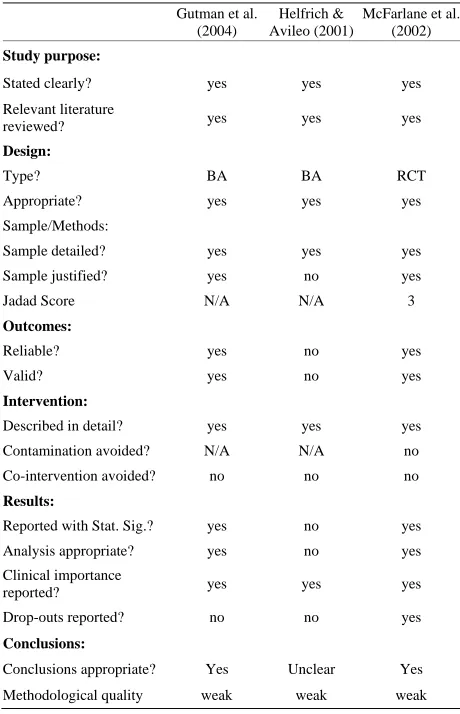
papers dealing specifically with increasing ADL skills, Helfrich and Rivera (2006) focused on vocational skills. Gutman et al. (2004) addressed twelve different IADL interventions, include- ing, safety planning, vocational skills, practical life skills and controlling risky behaviours, and McFarlane et al. (2002) fo- cused on safety behaviours. Only Gutman et al. (2004) explored leisure as a topic for ADL intervention. Table 2 contain a de- scriptive summary of each study included in the critical review and Table 1 presents a descriptive summary and Table 2 pre-sents the comparative findings of the quality critique for each of the three studies.
Study 1: Gutman et al.’s (2004) study of 26 women employed a cohort design and evaluated a program that addresses possible cognitive deficits in women who had experienced IPV as com- pared to what Gutman et al identified as traditional treatment based on a psychological perspective. Their study utilizes a mixed- method design and a convenience sample comprised of 26 women, who all reported having a disability. The intervention targeted ADL needs congruent with those highlighted in the literature and also focused on the participants’ needs as identi- fied in initial assessments. The specific ADL skills intervention focused on the following areas: safety planning, drug and alco- hol awareness, safe sex practices, assertiveness and advocacy skill training, anger management, stress management, boundary establishment and limit-setting, vocational and educational skill training, money management, housing application, leisure ex- ploration and hygiene, medication routine and nutrition. Par- ticipants received intervention for one hour per week over the course of 6 months via group and one-to-one sessions provided by four OT students who were supervised by two OTs.
An analysis of the strengths and weaknesses of the study re-veals several methodological shortcomings. Specifically, co-in- terventions may have been present because some of the partici-pants were living in local shelters, where they may have recei- ved other similar life skills programs. Also, the assessment tools utilized to determine if participants increased their knowledge were not validated nor psychometrically tested for reliability and validity. Strengths of this research include the utilization of a mixed-method approach with qualitative and quantitative data collection, which increases internal validity via methodological triangulation. Triangulation of multiple data sources (background
Table 2.
Methodological quality indicators for reviewed studies.
Gutman et al. (2004)
Helfrich & Avileo (2001)
McFarlane et al. (2002)
Study purpose:
Stated clearly? yes yes yes
Relevant literature
reviewed? yes yes yes
Design:
Type? BA BA RCT
Appropriate? yes yes yes
Sample/Methods:
Sample detailed? yes yes yes
Sample justified? yes no yes
Jadad Score N/A N/A 3
Outcomes:
Reliable? yes no yes
Valid? yes no yes
Intervention:
Described in detail? yes yes yes
Contamination avoided? N/A N/A no
Co-intervention avoided? no no no
Results:
Reported with Stat. Sig.? yes no yes
Analysis appropriate? yes no yes
Clinical importance
reported? yes yes yes
Drop-outs reported? no no yes
Conclusions:
Conclusions appropriate? Yes Unclear Yes
Methodological quality weak weak weak
literature, the thematic analysis and the data mining results) strengthens the identification of patterns within the phenomena being examined (Denzin & Lincoln, 1994).
[image:4.595.307.537.328.685.2](GAS) (Kiresuk & Sherman, 1968) for pre- and post-tests, chart reviews, occupational therapy student logs and a review of progress notes in the medical record. The use of GAS was ap- propriate, because this criterion-referenced measure allows the researcher to quantify specific changes in behaviours and to de- tect small changes over time (Ottenbacher & Cusick, 1993). Statistical analysis was also appropriate for this study. Gutman et al. (2004) performed a t test by converting the raw scores from the GAS into a standardized T score. The t test is useful because it can be applied to a small sample size in order to infer treatment effectiveness (Law, 2008). The results suggest a high level of success in attaining goals. Based on the methodologies used and valid outcome measures, this study has an acceptable level of internal validity.
Study 2: Helfrich and Rivera (2006) studied a vocational pro- gram for women who had left relationships with IPV for the safety of an emergency shelter. Their life skills intervention fo- cused on enhancing employment knowledge and skills. The researchers utilizing a before and after research design and pre and post self-assessment.
The sample consisted of only 11 women, and the process of sample recruitment and the consent process are not clear from the report. It also appears that participants were not necessarily aware they were involved in a research study as opposed to the routine interventions offered at the shelter. Additionally, the sample size was not justified, no power calculation was pro-vided, and only anecdotal results were reported with no statis-tical analysis provided. Intervention consisted of 8 sessions of 4 weeks in duration, via group and one-to-one sessions. Trans-parency in the intervention process was poor. According to Siebes et al. (2007), transparency is comprised of both open-ness and accountability, and all parties involved should have been clear on the identified occupational performance issues, the treatment process, activities and goals. Upon program comple-tion, participants voiced frustration with the facilitators’ inabil-ity to secure employment for them. Attendance to the program was inconsistent and attrition was not addressed. Other possible methodological shortcomings were that while pre/post-test self- assessments and weekly quizzes were administered to deter-mine knowledge retention, validity of these assessments and quizzes was not presented, and no standardized, quantifiable measures of change were employed. Secondly, statistical analy-sis of these outcome measures was not conducted to infer treat- ment effecttiveness, nor was this discussed in the results section. Additionally, the group leader and the recorder alternated weekly, creating possible bias resulting from experimenter expectancies and attention bias. Finally, co-intervention was possible since participants likely attended other required pro-grams at the shelter on other aspects of life skills. No mention of control for this was made in the paper.
While it may be feasible to repeat these types of intervene- tions in other primary care settings, Helfrich and Rivera’s re- port raises the point that IPV victims often require a multidi- mensional approach from the community, as women living in emergency shelter may have different needs than women living in transitional housing. While this study concluded that the intervention was effective, the limitations presented in the re- search methods reduce the trustworthiness of this article.
Study 3: McFarlane et al., (2002) conducted a Randomized Control Trial (RCT) to determine the effectiveness of a tele- phone intervention promoting safety behaviours for victims of IPV. This paper utilizes two conceptual models to guide an 18-
month clinical trial. A power analysis was conducted to ensure statistical power, and 150 participants agreed to participate in this study. A systematic allocation of 75 women in the control group and 75 women in the treatment group was utilized to pre- vent sampling bias. When the researchers calculated descriptive statistics for study variables they found no significant demo- graphic differences between groups with the exception of age, which they then treated as a covariate in further analysis where they found age did not to affect the outcome measure. This stu- dy also employs Safety Behaviour Checklist, a measure previ- ously used by the study authors (McFarlane & Parker, 1994). The author stated the measure had been tested and proven ef-fective, but no psychometric data were reported.
Six intervention phone calls were provided for the treatment group, where the investigator discussed specific safety-promot- ing behaviours. Paired t test and Repeated Measures of Analy- sis of Variance were conducted to calculate any differences in knowledge retention between the two study groups. This paper reported that participants from the intervention group practiced a significantly higher number of safety behaviours after 3 and 6 months. There was an excellent retention rate: only one par-ticipant from the control group was unable to complete the pro- gram due to suicide. This study scored a 3/5 on the Jadad scale as neither the participants, nor those workers providing inter- vention, were blind to the group allocation.
Discussion
In general all three studies were methodologically weak, non- replicable, and the results therefore not strongly reliable. Also, none of the studies evaluated the potential harms of the inter-ventions provided. Consequently it remains unclear how these intervention affect women who may still be involved in violent relationships.
This finding is also consistent with Gorde et al.’s (2004) study, which concludes that female survivors prioritize independence and productivity over other concerns. The following discussion gives more detailed examples of how these two areas were operationalized within the studies.
Intervention 1: Safety Planning
Safety planning was a key component in both the Gutman et al. (2004) and MacFarlane et al. (2002) studies. Participants were taught strategies such as identifying signs of escalating violence, safe locations, and important documents to take when fleeing abuse. Other strategies included hiding money, maintaining a safety bag in a discreet location, developing a code for use with family and friends to signal need for assistance, and removing and disposing of weapons in the house.
Intervention 2: Vocational Counseling
Vocational counseling was discussed in Gutman et al. (2004) and Helfrich and Rivera’s (2006) papers. Topics in this area generally include identifying possible careers of interest, ex-ploring vocational training and/or educational options, resume and cover letter writing and interview preparation.
Conclusion
Research exploring the effectiveness of ADL interventions for victims of IPV is promising but very much in its early stages. This structured scoping and critical analysis of existing outcome studies demonstrates that current programs in the community operate despite the current lack of methodologically sound and reliable evidence of their effectiveness. The follow-ing are the key messages from the critical review findfollow-ings:
There is an urgent need for higher quality research on the usefulness of skills intervention for victims of IPV.
There is some limited evidence suggesting that interventions in the areas of self-care and productivity are useful skills and knowledge for victims of IPV. These findings are con- sistent with Kimerling et al.’s (2009), conclusion that fur- ther studies on employment programs for victims of IPV are warranted.
The background literature demonstrates that healthcare pro- viders have theoretical constructs (like occupational perform- ance) that could address life skills and ADL issues for women who are affected by the trauma of domestic violence (Johnston, Adams, & Helfrich, 2001). However, existing evidence is very scant and of insufficient quality to evaluate the effectiveness of ADL interventions for victims of IPV. Of all relevant studies reviewed, only McFarlane et al.’s (2002) study approached mo- derate methodological quality and potentially demonstrated a positive relationship between ADL training and positive out- comes. The other studies reviewed offer some limited evidence suggesting that other IADL interventions may also demonstrate successful outcomes for women who experience IPV. It is im- portant to reiterate that there is an urgent need for high quality research on the usefulness of life skills interventions for victims of IPV. Clinicians should carefully scrutinize the evidence-base available and work with researchers to build methodologically robust research to inform practice when serving the victims of IPV.
REFERENCES
Bonomi, A. E., Anderson, M. L., Rivara, F. P., & Thompson, R. S. (2007). Health outcomes in women with physical and sexual intimate partner violence exposure. Journal of Women’s Health, 16, 987-997. doi:10.1089/jwh.2006.0239
Brown, C. (2009). Functional assessment and intervention in occupa-tional therapy. Psychiatric Rehabilitation Journal, 32, 162-170. doi:10.2975/32.3.2009.162-170
Busch, N. B., & Wolfer, T. A. (2002). Battered women speak out: Welfare reform and their decisions to disclose. Violence against Wo- men, 8, 566-584. doi:10.1177/107780102400388434
Cage, A. (2007). Occupational therapy with women and children sur-vivors of domestic violence: Are we fulfilling our activist heritage? A review of the literature. British Journal of Occupational Therapy, 70, 192-198
Campbell, J. C. (2002). Health consequences of intimate partner vio-lence. Lancet, 359, 1331-1336. doi:10.1016/S0140-6736(02)08336-8 Campbell, J., Jones, A. S., Dienemann, J., Kub, J., Schollenberger, J.,
O'Campo, P. et al. (2002). Intimate partner violence and physical health consequences. Archives of Internal Medicine, 162, 1157-1163. doi:10.1001/archinte.162.10.1157
Canadian Association of Occupational Therapists. (2007). Enabling occupation II: Advancing an occupational therapy vision for health, well-being, & justice through occupation. Ottawa, Ontario: CAOT Publication ACE
Casanueva, C., Foshee, V. A., & Barth, R. P. (2005). Intimate partner violence as a risk factor for children’s use of emergency room and injuries. Children and Youth Services Review, 27, 1123-1242. doi:10.1016/j.childyouth.2005.04.006
Casteel, C., & Sadowski, L. (2009). What are the effects of interven-tions initiated by healthcare professionals aimed at women victims of intimate partner violence? Clinical Evidence, 2, 1013-1030. Denzin, N. K., & Y. S. Lincoln (1994). Handbook of qualitative
re-search. London, Sage Publications.
Forte, T., Cohen, M. M., Du Mont, J., Hyman, I., & Omans, S. (2005). Psychological and physical sequelae of intimate partner violence among women with limitations in their activities of daily living. Ar-chives of Women's Mental Health, 8, 248-256.
doi:10.1007/s00737-005-0093-9
Gill, J. R., & Brown, C. A. (2009). A structured review of the evidence for pacing as a chronic pain intervention. European Journal of Pain, 13, 214-216. doi:10.1016/j.ejpain.2008.03.011
Gorde, M. W., Helfrich, C. A., & Finlayson, M. L. (2004). Trauma symptoms and life skill needs of domestic violence victims. Journal of Interpersonal Violence, 19, 691-708.
doi:10.1177/0886260504263871
Gutman, S. A., Diamond, H., Holness-Parchment, S., Brandofino, D. N., Pacheco, D. G., Jolly-Edouard, M. et al. (2004). Enhancing inde-pendence in women experiencing domestic violence and possible brain injury: An assessment of an occupational therapy intervention.
Occupational Therapy in Mental Health, 20, 49-79. doi:10.1300/J004v20n01_03
Hazen, A. L., Connelly, C. D., Kelleher, K. J., Barth, R. P., & Lands-verk, J. A. (2006). Female caregivers’ experiences with intimate part- ner violence and behavior problems in children investigated as vic-tims of maltreatment. Pediatrics, 117, 99-109.
doi:10.1542/peds.2004-2542
Helfrich, C. A., & Aviles, A. (2001). Occupational therapy’s role with victims of domestic violence: Assessment and intervention. Occupa-tional Therapy in Mental Health, 16, 53-57.
doi:10.1300/J004v16n03_04
Helfrich, C. A., Aviles, A. M., Badiani, C., Walens, D., & Sabol, P. (2006). Life skill interventions with homeless youth, domestic vio-lence victims and adults with mental illness. Occupational Therapy in Health Care, 20, 189-207. 0.
Helfrich, C. A., & Rivera, Y. (2006). Employment skills and domestic violence survivors: A shelter-based intervention. Occupational The- rapy in Mental Health, 22, 33-48. doi:10.1300/J004v22n01_03 Ireland, T. O., & Smith, C. A. (2009). Living in partner-violent families:
Journal of Youth & Adolescence, 38, 323-339. doi:10.1007/s10964-008-9347-y
Jadad, A. R., Moore, R. A., Carroll, D., Jenkinson, C., Reynolds, D. J., Gavaghan, D. J. et al. (1996). Assessing the quality of reports of randomized clinical trials: Is blinding necessary? Controlled Clinical Trials, 17, 1-12. doi:10.1016/0197-2456(95)00134-4
Javaherian, H. A., Underwood, R. T., & DeLany, J. V. (2007). Occupa-tional therapy services for individuals who have experienced domes-tic violence (statement). American Journal of Occupational Therapy, 61, 704-709. doi:10.5014/ajot.61.6.704
Johnston, J. L., Adams, R., & Helfrich, C. A. (2001). Knowledge and attitudes of occupational therapy practitioners regarding wife abuse.
Occupational Therapy in Mental Health, 16, 35-52. doi:10.1300/J004v16n03_03
Katz, L. F., Hunter, E., & Klowden, A. (2008). Intimate partner violence and children’s reaction to peer provocation: The moderating role of emotion coaching. Journal of Family Psychology, 22, 614-621. doi:10.1037/a0012793
Kiresuk, T. J., & Sherman, R. E., (1968) Goal attainment scaling: A ge- neral method for evaluating comprehensive community mental health programs. Community Mental Health Journal, 4, 443-453. doi:10.1007/BF01530764
Kimerling, R., Alvarez, J., Pavao, J., Mack, K. P., Smith, M. W., & Baumrind, N. (2009). Unemployment among women: Examining the relationship of physical and psychological intimate partner violence and posttraumatic stress disorder. Journal of Interpersonal Violence, 24, 450-463. doi:10.1177/0886260508317191
Krane, J., & Davies, L. (2007). Mothering under difficult circumstances: Challenges to working with battered women. Journal of Women & Social Work, 22, 23-38.
Krug, E. G., Dahlberg, L. L., Mercy, J. A., Zwi, A. B. & Lozano, R., (Eds.) (2002). World report on violence and health. Geneva: World Health Organization.
Lang, J. M., & Stover, C. S. (2008). Symptom patterns among youth exposed to intimate partner violence. Journal of Family Violence, 23,
619-629. doi:10.1007/s10896-008-9184-5
Law, M. C. (Ed.). (2008). Evidence-based rehabilitation: A guide to practice (2nd ed.). Thorofare, NJ: Slake.
McFarlane, J. & Parker, B. (1994). Abuse during pregnancy. A protocol for prevention and intervention. New York: National March of Dimes Birth Defects Foundation.
McFarlane, J., Malecha, A., Gist, J., Watson, K., Batten, E., Hall, I., et al. (2002). An intervention to increase safety behaviors of abused women: Results of a randomized clinical trial. Nursing Research, 51,
347-354. doi:10.1097/00006199-200211000-00002
Mcnutt, L., Carlson, B. E., Persaud, M., & Postmus, J. (2002). Cumula-tive abuse experiences, physical health and health behaviors. Annals of Epidemiology, 12, 123-130. doi:10.1016/S1047-2797(01)00243-5 Mechanic, M. B., Weaver, T. L., & Resick, P. A. (2008). Risk factors
for physical injury among help-seeking battered women: An explora-tion of multiple abuse dimensions. Violence against Women, 14, 1148- 1165. doi:10.1177/1077801208323792
Olivas-De La O, T. (2008). Perspectives. OT saved my life: Surviving domestic violence. OT Practice, 13, 23-24.
Ottenbacher, K. J., & Cusick, A. (1993). Discriminative versus evalua-tive assessment: Some observations on goal attainment scaling. Ame- rican Journal of Occupational Therapy, 47, 349-354.
Plichta, S. B. (2004). Intimate partner violence and physical health consequences: Policy and practice implications. Journal of Interper-sonal Violence, 19, 1296-1323. doi:10.1177/0886260504269685 Public Health Agency of Canada. (2009). What is intimate partner
violence. URL (last checked 10 December 2011).
http://www.phac-aspc.gc.ca/ncfv-cnivf/faqs/fem-initim-partnr-abus-e ng.php
Siebes, R. C., Ketelaar, M., Gorter, J. W., Wijnroks, L., De Blécourt, A., Reinders-Messelink, H. et al. (2007). Transparency and tuning of re-habilitation care for children with cerebral palsy: A multiple case study in five children with complex needs. Developmental Neurore-habilitation, 10, 193-204. doi:10.1080/13638490601104405 Spangaro, J. M., Zwi, A. B., Poulos, R. G., & Man, W. Y. (2010) Who
tells and what happened: Disclosure and health service responses to screening for intimate partner violence. Health and Social Care in the Community, 18, 671-680. doi:10.1111/j.1365-2524.2010.00943.x Statistic Canada. (2005). Family violence in Canada: A statistical
pro-file, 2005 (No. 85-224-XIE). URL (last checked 10 December 2011). http://www.statcan.gc.ca/pub/85-224-x/85-224-x2005000-eng.pdf Statistic Canada. (1994). Wife assault: The findings of a national
sur-vey. URL (last checked 10 December 2011).
http://www.phac-aspc.gc.ca/ncfv-cnivf/publications/femnational-eng. php
Statistic Canada. (2008). Family violence in Canada: A statistical pro-file, 2008 (No. 85-224-X). URL (last checked 12 November 2011). http://www.statcan.gc.ca/pub/85-224-x/85-224-x2008000-eng.pdf Suglia, S. F., Enlow, M. B., Kullowatz, A., & Wright, R. J. (2009).
Maternal intimate partner violence and increased asthma incidence in children: Buffering effects of supportive caregiving. Archives of Pe-diatrics & Adolescent Medicine, 163, 244-250.
doi:10.1001/archpediatrics.2008.555
Taylor, C. A., Guterman, N. B., Lee, S. J., & Rathouz, P. J. (2009). Intimate partner violence, maternal stress, nativity, and risk for ma-ternal maltreatment of young children. American Journal of Public Health, 99, 175-183. doi:10.2105/AJPH.2007.126722
Wathen, C. N., & MacMillan, H. L. (2003). Interventions for violence against women: Scientific review. The Journal of the American Me- dical Association, 289, 589-600. doi:10.1001/jama.289.5.589 Woods, S. J., Hall, R. J., Campbell, J. C., & Angott, D. M. (2008). Phy-
sical health and posttraumatic stress disorder symptoms in women experiencing intimate partner violence. Journal of Midwifery and Women’s Health, 53, 538-546. doi:10.1016/j.jmwh.2008.07.004 Wuest, J., Merritt-Gray, M., Ford-Gilboe, M., Lent, B., Varcoe, C., &
Campbell, J. C. (2008). Chronic pain in women survivors of intimate partner violence. Journal of Pain, 9, 1049-1057.