ORTHOPANTOMOGRAM – AN EFFECTIVE TOOL FOR AGE ESTIMATION IN CHILDREN
1
Jesin Y. Das,
*,2Manasa D. Hosamane
1
Department of Oral Medicine and Radiology,
2
Department of Periodontics, Subbaiah Institute of Dental Sciences, Shivamogga, Karnataka, India
3Department of Oral Medicine and Radiology, AECS Maaruti College of Dental Sciences and Research Cent
4
Department of Oral Medicine and Radiology, Private Practice, Banagalore, Karnataka, Ind
5Department of Oral Pathology and Microbiology, Priv
ARTICLE INFO ABSTRACT
Objectives:
Cameriere’s European formula given by Rai B Methods:
to the chronological age. The first group consisted of subjects who are 5 years old, including subject’s age ranging from 5.00
Digital form of the orthopantomogram obtained for diagnosis and treatment were collected. Chronologic age was noted and
the formula described by Rai
Statistical analysis of data was done using paired t test. strength and direction of association between chronological Results:
sample, which is statistically insignificant. direction of association between
correlation between Conclusion:
statistically insignificant under children in south Indian population.
Copyright©2017, Jesin Y. Das et al. This is an open access distribution, and reproduction in any medium, provided
INTRODUCTION
One of the most important sub-disciplines of forensic sciences is age estimation and is very important in medico
The broadening frontiers of dentistry have taken the dentist as an expert witness in legal room proceedings because of the field of forensic sciences. Age assessment is required in following circumstances like, asylum seekers of unknown age, young people accused of criminal activities, and convicted criminals whose age is claimed to be less than 18 years prior to sentencing, marriage of a minor and the laws concerning adoption of children as well as child labouring
et al., 2015). Developing teeth are used most reliably in age
*Corresponding author: Manasa D. Hosamane,
Department of Periodontics, Subbaiah Institute of Dental Sciences, Shivamogga, Karnataka, India.
ISSN: 0975-833X
Article History: Received 20th July, 2017 Received in revised form 22nd August, 2017
Accepted 08th September, 2017
Published online 31st October, 2017
Citation: Jesin Y. Das, Manasa D. Hosamane, Satheesha Reddy, B. H., Roshan P. Verghese and Anjali, P.
tool for age estimation in children”, International Journal
Key words: Age estimation, Orthopantomogram, Chronologic age, Dental age.
RESEARCH ARTICLE
AN EFFECTIVE TOOL FOR AGE ESTIMATION IN CHILDREN
Manasa D. Hosamane,
3Satheesha Reddy, B. H.,
4Roshan P. Verghese
and
5Anjali, P.
Department of Oral Medicine and Radiology, Subbaiah Institute of Dental Sciences
Karnataka, India
Subbaiah Institute of Dental Sciences, Shivamogga, Karnataka, India
Medicine and Radiology, AECS Maaruti College of Dental Sciences and Research Cent
Bangalore, Karnataka, India
Department of Oral Medicine and Radiology, Private Practice, Banagalore, Karnataka, Ind
Department of Oral Pathology and Microbiology, Private Practice, Kochi, Kerala
ABSTRACT
Objectives: The objective of this study was to assess the accuracy and applicability of modified Cameriere’s European formula given by Rai B et al for dental age estimation in south Indian children Methods: The study comprised of a total of 600 subjects, who were divided into 10 groups, according to the chronological age. The first group consisted of subjects who are 5 years old, including subject’s age ranging from 5.00 to 5.99. Next group included the subjects who were 6 years old, and so on. Digital form of the orthopantomogram obtained for diagnosis and treatment were collected. Chronologic age was noted and Dental age estimation was performed on the
the formula described by Rai et al. Age= 9.402-0.879 C+0.663 N0
Statistical analysis of data was done using paired t test. Pearson's correlation was used to measure the strength and direction of association between chronological and dental age.
Results: The results showed a mean difference of 0.31 between the chronologic and dental age in total sample, which is statistically insignificant. Pearson's correlation was used to measure the strength and direction of association between chronological and dental age and a value of 0.985 suggest a positive correlation between chronologic age and estimated dental age.
Conclusion: The results showed that modified Cameriere’s formula given by Rai
statistically insignificant underestimation of 0.31 years, suggesting its suitability for age estimation in children in south Indian population.
access article distributed under the Creative Commons Attribution the original work is properly cited.
disciplines of forensic sciences is age estimation and is very important in medico-legal issues. The broadening frontiers of dentistry have taken the dentist as an expert witness in legal room proceedings because of the of forensic sciences. Age assessment is required in following circumstances like, asylum seekers of unknown age, young people accused of criminal activities, and convicted criminals whose age is claimed to be less than 18 years prior to ge of a minor and the laws concerning adoption of children as well as child labouring (Priyadarshini
. Developing teeth are used most reliably in age
Institute of Dental Sciences,
estimation; teeth are the most indestructible part of the body and exhibit the least turnover of all the natural structure. The methods based on the stages of tooth formation as appreciated on radiographs seems to be more appropriate in the assessment of age than those based on skeletal development as the dental development and calcification is controlled more by genes than by environmental factors (Panchbhai
Methods of age estimation
The first known attempt that used teeth as an indicator of age originated from England. Edwin Saunders, a dentist, was the first to publish information regarding dental implications in age assessment by presenting a pamphlet entitled “Teeth a Test of Age” to the English parliament in 1837
2015). Literature describes several techniques
International Journal of Current Research
Vol. 9, Issue, 10, pp.59895-59899, October, 2017
Jesin Y. Das, Manasa D. Hosamane, Satheesha Reddy, B. H., Roshan P. Verghese and Anjali, P. 2017.
Journal of Current Research, 9, (10), 59895-59899.
AN EFFECTIVE TOOL FOR AGE ESTIMATION IN CHILDREN
Roshan P. Verghese
Subbaiah Institute of Dental Sciences, Shivamogga,
Subbaiah Institute of Dental Sciences, Shivamogga, Karnataka, India
Medicine and Radiology, AECS Maaruti College of Dental Sciences and Research Center,
Department of Oral Medicine and Radiology, Private Practice, Banagalore, Karnataka, India
ate Practice, Kochi, Kerala, India
The objective of this study was to assess the accuracy and applicability of modified for dental age estimation in south Indian children. The study comprised of a total of 600 subjects, who were divided into 10 groups, according to the chronological age. The first group consisted of subjects who are 5 years old, including subject’s to 5.99. Next group included the subjects who were 6 years old, and so on. Digital form of the orthopantomogram obtained for diagnosis and treatment were collected. Dental age estimation was performed on the orthopantomogram using
0-0.711 s-0.106s×N0
Pearson's correlation was used to measure the and dental age.
The results showed a mean difference of 0.31 between the chronologic and dental age in total Pearson's correlation was used to measure the strength and chronological and dental age and a value of 0.985 suggest a positive
The results showed that modified Cameriere’s formula given by Rai et al gave a estimation of 0.31 years, suggesting its suitability for age estimation in
License, which permits unrestricted use,
estimation; teeth are the most indestructible part of the body and exhibit the least turnover of all the natural structure. The methods based on the stages of tooth formation as appreciated radiographs seems to be more appropriate in the assessment of age than those based on skeletal development as the dental development and calcification is controlled more by genes than
Panchbhai, 2011).
The first known attempt that used teeth as an indicator of age originated from England. Edwin Saunders, a dentist, was the information regarding dental implications in age assessment by presenting a pamphlet entitled “Teeth a Test ” to the English parliament in 1837 (Priyadarshini et al., . Literature describes several techniques that address age
INTERNATIONAL JOURNAL OF CURRENT RESEARCH
estimation in adults. The various methods are divided into three categories:
1. Morphological methods 2. Biochemical methods 3. Radiological methods
Morphological methods are based on assessment of teeth (ex-vivo). Hence, these methods require extracted teeth for microscopic preparation. However, these methods may not be acceptable due to ethical, religious, cultural, or scientific reasons. The biochemical methods are based on the racemization of amino acids. The racemization of amino acids is a reversible first-order reaction and is relatively rapid in living tissues in which metabolism is slow. Aspartic acid has been reported to have the highest racemization rate of all amino acids and to be stored during aging. In particular, L-aspartic acids are converted to aspartic acids and thus the levels of D-aspartic acid in human enamel, dentine, and cementum increase with age (Priyadarshini et al., 2015). Radiographic assessment of age is a simple, non-invasive and reproducible method that can be employed both on living and unknown dead. The most frequently used method for age estimation in children is the study of radiographs of teeth and hand/wrist. Skeletal methods present some drawbacks in view of the important variability of bone maturation, which is influenced by environmental factors. An approach based on dental development was shown to be suitable for age determination in children because the calcification rate is controlled more by genes than by environmental factors, and this yields a lower variability (Cameriere et al., 2006). Various odontological methods have also been carried out to estimate age, assessing eruption phases within acceptable error limits. The most common method for age estimation was published in 1973 by Demirjan, Goldstein and Tanner which estimated chronological age based on developments of seven teeth from the left side of the mandible (Demirjian et al., 1973). In 2006, Cameriere et al. developed a method for assessing chronological age in children, based on the relationship between age and measurement of open apices in tooth roots (Cameriere et al., 2006). In 2007, the technique was tested in a large sample of children from various European countries, providing a common formula useful for all these countries and it has been accepted that Cameriere’s method is more accurate than other methods for estimating the age of children in age groups 6–15 years (Cameriere et al., 2007). The same formula has been tried by Rai B et al in Indian population for age estimation and to increase the accuracy they have described a modification of the formula that is suitable for Indian conditions with different variable for north Indian and south Indian population (Rai et al., 2010). With this background, the aim of our study was to assess the accuracy and applicability of modified Cameriere’s European formula given by Rai et al. (2010) for dental age estimation in south Indian children.
MATERIALS AND METHODS
Subjects reporting to the Department of Oral Medicine and Radiology, A.E.C.S. Maaruti College of Dental Sciences and Research Centre, within the age group of 5 to 15 years who were advised orthopantomograms during the course of diagnosis and treatment were recruited in the study. Subjects with all the teeth present in the lower left quadrant, with no systemic diseases, congenital abnormities, developmental dental anomalies and severe malocclusion were included in the study. Informed consent was obtained from the parent/
guardian. A total of 600 subjects were included in the study and the subjects were divided into 10 groups according to their chronological age. The first group consisted of subjects who are 5 years old, including subject’s age ranging from 5.00 to 5.99. Next group included the subjects who were 6 years old, and so on. Subject’s identification number, gender, date of birth and the date orthopantomogram was recorded were noted. Digital form of the radiographs obtained for diagnosis and treatment were collected. Panoramic Radiograph machine-Carestream CS 8000C, equipped with standard positioning device, at 71 kV, 10 mA and constant exposure time of 13.2 seconds was used. Images were stored on computer file and processed by a computer-aided drafting program - Adobe Photoshop. Radiographs of the left permanent developing mandibular teeth, except wisdom teeth, were evaluated. Mandibular teeth were chosen because they can be easily visualized on panoramic radiographs. The chronologic age of an individual was calculated by subtracting the birth date from the date on which the radiographs were exposed for that particular individual after converting both to a decimal age. Decimal age was taken for simplicity of statistical calculation and age was estimated on a yearly basis, for example, 12 years 9 months as 12.75 years and was considered in the 12 years age group.
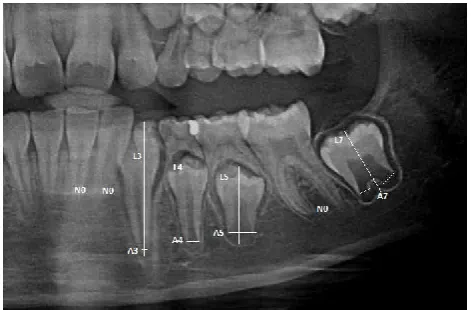
Fig. 1. An example of tooth measurement: N0, teeth with apical ends completely closed; Ai, i=1,...,5 (teeth with one root), is the distance between the inner sides of the open apex; Ai, i=6, 7 (teeth with two roots), is the sum of the distances between the inner sides of the two open apices; and Li, i=1,...,7, is the length of the seven teeth
Dental age estimation was performed according to the method described by Rai et al. (2010)(Fig 1).
1. The number of teeth with complete root development, i.e., apical ends of the roots completely closed (N0), were counted.
2. Teeth with incomplete root development, i.e., with open apices, were examined and the distance (Ai, i = 1, . . ., 7) between the inner side of the open apex was measured.
3. In order to take into account the effect of possible differences among radiographs in magnification and angulations, measurements were normalized by dividing by the tooth length (Li, i = 1, . . ., 7).
[image:2.595.316.552.340.495.2]Age= 9.402-0.879 C+0.663 N0-0.711s-0.106s×N0
Where “c” is a variable, 1 for south Indian population and 0 for central and north Indian population.
Statistical analysis
Data was entered into Microsoft® Excel & was analyzed using Predictive analysis Software version 18.0 (PASW Statistics). Data were summarized as Mean & Standard Deviation (SD). Paired t test was used to test the difference between
Chronological age & Estimated dental age among different age groups. Pearson's correlation was used to measure the strength and direction of association between Chronological & Estimated dental age among different age groups. P value less than 0.05 was considered significant for all the statistical tests.
RESULTS
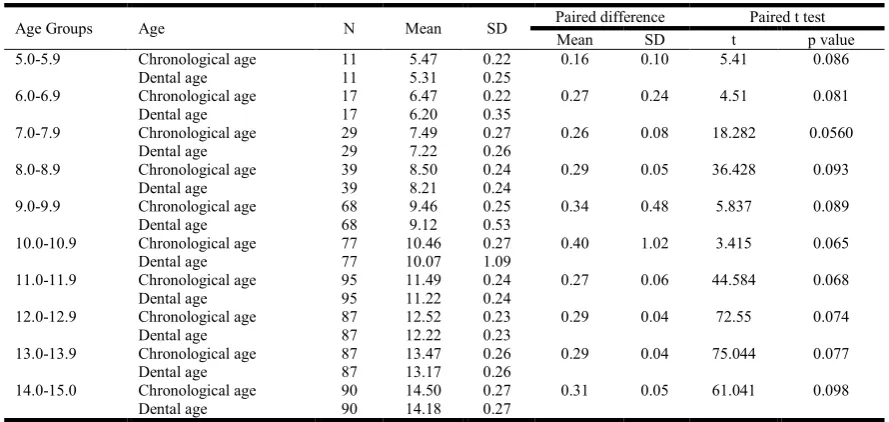
[image:3.595.101.500.208.249.2]The difference between chronological age and dental age among different age and gender subgroups were tested using Paired t test. Table 1 illustrate the mean and standard deviation
Table 1. Comparison of mean chronological age & dental age
Age N Mean SD Paired difference Paired t test
Mean SD t p value
Chronological age 600 11.37 2.34 0.31 0.41 18.504 0.08
Dental age 600 11.07 2.37
[image:3.595.76.521.289.500.2]P ≤ 0.05, N – Number of subjects, SD – Standard deviation
Table 2. Comparison of mean chronological age & dental age in different age groups
Age Groups Age N Mean SD Paired difference Paired t test
Mean SD t p value
5.0-5.9 Chronological age 11 5.47 0.22 0.16 0.10 5.41 0.086
Dental age 11 5.31 0.25
6.0-6.9 Chronological age 17 6.47 0.22 0.27 0.24 4.51 0.081
Dental age 17 6.20 0.35
7.0-7.9 Chronological age 29 7.49 0.27 0.26 0.08 18.282 0.0560
Dental age 29 7.22 0.26
8.0-8.9 Chronological age 39 8.50 0.24 0.29 0.05 36.428 0.093
Dental age 39 8.21 0.24
9.0-9.9 Chronological age 68 9.46 0.25 0.34 0.48 5.837 0.089
Dental age 68 9.12 0.53
10.0-10.9 Chronological age 77 10.46 0.27 0.40 1.02 3.415 0.065
Dental age 77 10.07 1.09
11.0-11.9 Chronological age 95 11.49 0.24 0.27 0.06 44.584 0.068
Dental age 95 11.22 0.24
12.0-12.9 Chronological age 87 12.52 0.23 0.29 0.04 72.55 0.074
Dental age 87 12.22 0.23
13.0-13.9 Chronological age 87 13.47 0.26 0.29 0.04 75.044 0.077
Dental age 87 13.17 0.26
14.0-15.0 Chronological age 90 14.50 0.27 0.31 0.05 61.041 0.098
Dental age 90 14.18 0.27
P ≤ 0.05, N – Number of subjects, SD – Standard deviation
Table 3. Mean difference between chronological age & dental age in different age groups
Age Groups Mean difference
5.0-5.9 0.16
6.0-6.9 0.27
7.0-7.9 0.26
8.0-8.9 0.29
9.0-9.9 0.34
10.0-10.9 0.40
11.0-11.9 0.27
12.0-12.9 0.29
13.0-13.9 0.29
14.0-15.0 0.31
Total 0.31
Table 4. Correlation between chronological and dental age in different age groups
Age group N Correlation Coefficient (R) R2 P value
5.0-5.9 Years 11 0.917 0.841 <0.001
6.0-6.9 Years 17 0.739 0.546 0.001
7.0-7.9 Years 29 0.956 0.914 <0.001
8.0-8.9 Years 39 0.979 0.958 <0.001
9.0-9.9 Years 68 0.407 0.166 0.001
10.0-10.9 Years 77 0.376 0.141 0.001
11.0-11.9 Years 95 0.971 0.943 <0.001
12.0-12.9 Years 87 0.987 0.974 <0.001
13.0-13.9 Years 87 0.99 0.980 <0.001
14.1-15 Years 90 0.984 0.968 <0.001
Total 600 0.985 0.970 <0.002
[image:3.595.177.423.541.658.2] [image:3.595.85.514.686.802.2]of chronological and dental age of the total sample. On applying paired t test, a p value of 0.08 was obtained which indicate that there is no statistically significant difference between chronological and dental age. Table 2 illustrate the comparison of mean chronological age & dental age in different age groups. Mean and standard deviation was calculated for each group and on applying paired t test, p value > 0.05 was obtained for all the groups indicating that the estimated dental age does not vary statistically significantly from the chronological age. Table 3 represent the mean difference between chronological age & dental age in different age groups and a mean difference of 0.31 was observed. Pearson's correlation was used to measure the strength and direction of association between chronological and dental age among different age and gender subgroups. A positive value of correlation coefficient (R= 0.985) and coefficient of variance (R2= 0.970), which are close to 1, indicates a positive correlation between chronologic age and dental age in different age groups which is depicted in Tables 4.
DISCUSSION
Age determination of individuals using the available scientific methods is a common part of forensic practice. Tooth formation has been more widely used than tooth eruption for assessing dental maturation because it is a continuous and progressive process that can be followed radiographically and clinically at each examination (Shrestha et al., 2014). Studies have shown that morphological measurements can be reliably made in panoramic radiography, provided some corrections are made to take into account the individual variability of tooth size and the differences in magnification of radiographs and angulations between x-ray beam and film (Cameriere et al., 2006). Dental x- ray methods have proved to be most accurate in childhood until the teeth have erupted and root development is completed (with the exception of wisdom teeth). However, in adolescence the validity of skeletal methods improves considerably (Shrestha et al., 2014). So the use of dental x-ray as method of choice in the present study validates its reliability. Panoramic radiographs are ideal screening tools as they are inexpensive, readily available, provide an unobstructed view of the entire dental arch and have less radiation exposure. The panoramic radiograph is considered the best tool for age estimation in children because intraoral radiography is difficult to obtain in children without image distortion (Jatti et al., 2013). Wood et al (2006) argued that the panoramic radiograph being a tomograph could result in overlapping of teeth, especially those tilted in a buccolingual direction, falling out of the focal trough, resulting in misestimation of age. To overcome this disadvantage, all cases were screened for severe malocclusion and tilting of teeth. The age range from 5-15 years remains most critical with regard to estimating a child’s dental age and this age group is commonly accepted for dental age estimation in children as teeth development passes through various stages during this age group (Bagh et al., 2014). The present study aimed to assess the accuracy and applicability of modified Cameriere’s European formula given by Rai B et al
(Rai et al., 2010) for dental age estimation in south Indian children by evaluating the open apices and number of teeth with complete root formation on orthopantomograms. A study was done by Cameriere et al. (2006)on Italian population of children aged between 5-15 years. Study was based on seven mandibular left healthy permanent teeth for assessing dental age by measurement of open apices in teeth. Pearson’s correlation coefficients between age and the variables (gender,
open apices, number of teeth with closed apices) showed that the correlations between age and the open apices in teeth were significant and negative. Gender and the number of teeth with the apical end of the root canals completely closed (N0) showed a significant correlation with chronological age. With the aid of a stepwise multiple regression model, a linear relationship between open apices, N0, and age was shown and a formula was given. The same author Cameriere et al. (2007) have done a study in a large sample of children from various European states, providing a common formula. The results showed that the median of the absolute value of residual errors were 0.035 years. A similar study was conducted by Shrestha et al. (Bagh et al., 2014) using Cameriere s formula for age estimation in south Indian population. The results showed that the formula resulted in under estimation of age by 0.18 years which was statistically insignificant, suggesting the applicability of this formula in Indian population.
But contradictory results were obtained in the study conducted by Rai et al.(2010) who aimed to evaluate an Indian sample by using Cameriere’s European formula; and if this formula turns out to be unsuitable, to study a specific formula for Indian children. Subjects were recruited from north, central and southern part of India to check if there is any influence of region. According to the authors, the European formula was not suitable for age estimation in Indian children and they derived a new linear regression formula for Indian population. When region was considered, a significant difference was noted between north and south regions. So this was included as a variable in the formula. According to the authors various factors like ethnicity, nutrition and regional variability might have played a key role for the difference in age estimation in Indian population using the European formula. In our study of evaluating 600 orthopantomograms and calculating the dental age, a mean difference of 0.31 was noted between the chorological and dental age and the difference was not statistical significant (p value 0.08). When each age group was analyzed separately, there was no statistically significant difference between the chronologic age and estimated dental age (p value > 0.05 was noted). These findings suggest that the dental age calculated using modified Cameriere’s formula given by Rai et al was reliable and formula is accurate for south Indian population. Pearson's correlation was used to measure the strength and direction of association between chronological and dental age. The value of correlation coefficient (R) obtained was 0.985 indicating a positive correlation between chronologic age and dental age in different age groups. The value of coefficient of variance; R2 = 0.970 which is close to the value obtained in the study by Rai et al. where the R2 = 0.897. The mean difference between chronological age and dental age in our study was 0.31 which suggest that there is an underestimation of age by 0.31 years, but the difference is statistically insignificant.
Conclusion
studies are warranted including larger samples from more number of states of India to truly call it an Indian formula for age estimation.
Acknowledgement
The authors would like to thank Dr. Mahesh P. (Statistician) for helping with the statistical management of data and all the participants of the study.
Source(s) of support: There are no sources of funding.
Conflicting Interest: The authors report no conflict of interest.
Ethical committee approval: Approval taken
REFERENCES
Bagh T, Chatra L, Shenai P, Veena KM, Rao PK, Prabhu RV
et al. 2014. Age estimation using Cameriere’s seven teeth method with Indian specific formula in south Indian children. International Journal of Advanced Health Sciences, 1(2):2-10.
Cameriere R, De Angelis D, Ferrante L, Scarpino F, Cingolani M. 2007. Age estimation in children by measurement of open apices in teeth: a European formula. Int J Legal Med.,
121:449–453.
Cameriere R, Ferrante L, Cingolani M. 2006. Age estimation in children by measurement of open apices in teeth. Int J Legal Med., 120:49–52.
Demirjian A, Goldstein H, Tanner JM. 1973. A new system of dental age assessment. Human Biology, 45(2):211-227. Jatti D, Kantaraj Y, Nagaraju Y, Janardhan S, Nataraj S. 2013.
Age estimation by measuring open apices of lower erupted teeth in 12-16 years olds by radiographic evaluation.
Journal of Forensic and Legal Medicine, 20:430-434. Panchbhai AS. 2011. Dental radiographic indicators, a key to
age estimation. Dentomaxillofacial Radiology, 40:199–212. Priyadarshini C, Puranik MP, Uma SR. 2015. Dental Age Estimation Methods: A Review. International Journal of Advanced Health Sciences, 1(12):19-25.
Rai B, Kaur J, Cingolani M, Ferrante L, Cameriere R. 2010. Age estimation in children by measurement of open apices in teeth: an Indian formula. Int J Legal Med., 124:237–241. Shrestha A, Yadav RP, Shrestha S, Maharajan IK, Camelio S. 2014. Measurement of open apices in teeth for estimation of age in children. Health Renaissance, 12(1):33-37. Wood RE. 2006. Forensic aspects of maxillofacial radiology.
Forensic Sci Int., 159:47-55.