[ 5 6 9 ]
THE BEHAVIOUR OF BARNACLE CYPRIDS IN RELATION
TO WATER MOVEMENT OVER A SURFACE
BY D. J. CRISP
Marine Biology Station, University College of North Wales, Bangor
{Received 1 January 1955)
CONTENTS
PAGE I n t r o d u c t i o n . . . 5 6 9 D e s c r i p t i o n o f w a t e r flow . . . 5 7 0 M e t h o d s o f i n v e s t i g a t i o n 5 7 2 V e l o c i t y o f s w i m m i n g o f c y p r i s l a r v a e . . . - 5 7 4 A t t a c h m e n t o f c y p r i s l a r v a e e x p o s e d t o d i f f e r e n t v e l o c i t y g r a d i e n t s . . 5 7 5 A t t a c h m e n t i n l i g h t a n d d a r k 5 7 9 M e c h a n i s m o f a t t a c h m e n t 5 8 0 I s t h e v e l o c i t y g r a d i e n t a n a d e q u a t e d e s c r i p t i o n o f c o n d i t i o n s o f a t t a c h m e n t ? 5 8 1 O r i e n t a t i o n o f c y p r i d s m e t a m o r p h o s i n g i n w a t e r c u r r e n t s . . . . 5 8 5 I n f l u e n c e o f w a t e r m o v e m e n t o n d i s t r i b u t i o n a n d s u r v i v a l . . . . 5 8 6 S u m m a r y . . . 5 8 8 R e f e r e n c e s 5 9 0
INTRODUCTION
There is a close similarity of behaviour among the settling stages of different groups of sessile marine invertebrates (Crisp, 1953 a; Knight-Jones & Crisp, 1953). Generally the process of settlement can be divided into three distinct phases, which will be called, respectively, attachment, exploration and fixation.
On attachment the larva comes into contact with a solid surface and begins crawling over it, but the process is usually reversible, since the larva retains its swimming powers. Exploration consists of one or more crawling excursions over various surfaces following temporary attachment, the intervals between these migra-tions being occupied by periods of renewed swimming. Fixation, however, is irrever-sible and determines the ultimate site of the adult; it usually involves an orientation reaction and a cementing process.
Although most marine larvae possess some ability to swim, their own movements would carry them through distances which are very small in relation to the wide expanse of sea over which suitable habitats are scattered. They therefore depend largely upon mass water movements for dispersal, and for bringing them into contact with objects on which to settle. It follows that they must be able to attach themselves to these objects under conditions of water movement similar to those which had carried them into the vicinity.
570 D. J. C R I S P
McDougall (1943), may reveal differences in behaviour between species but suffers from the defect that no precise relation between current and settlement can be deduced. The most informative work on this subject is that of Walton Smith (1946) who used rotating disks and water pumped through graded glass tubes to obtain conditions of steady flow. He showed that the settlement of cyprids was inhibited by water currents of greater than a certain velocity. The critical velocity was found to vary to some extent with the species of barnacle studied. His hydrodynamical approach, however, was not beyond criticism, as explained below.
DESCRIPTION OF WATER FLOW
Since at a liquid-solid interface there is no relative movement (or slip) between the phases, the fluid velocity very near the boundary of a stationary object will approach zero, however great the water current may be some distance away.
At the moment of attachment the cyprid cannot be more than a millimetre from the surface, and since it is small and of similar density to water it will take up a velocity close to that of the fluid stream in this region. It is therefore the velocity of the water past the substratum about 0-5 mm. from the surface which will determine the possibility of attachment. We shall refer to this velocity as Av, and the distance approached by the cypris at attachment as Ay.
Since the velocity gradient normal to the surface, dvjdy is usually constant within a short distance of a stationary object, Av will be given approximately by the relation
A D ?
'(%).»•
(dvldy)0 being the velocity gradient at the boundary of the object. Hence it is the
velocity gradient or rate of shear at the boundary of an object that is likely to be the determining factor in settlement, rather than the velocity of the water current an unspecified distance away from it. The experiments described in this paper have therefore been designed, as far as possible, to enable (dvldy)0 to be measured. The
importance of choosing the appropriate hydrodynamic quantity has been overlooked by previous investigators, who have suggested that settlement is prevented if the current itself exceeds a certain speed. Although the velocity gradient varies in the same sense as the current, the relation between the two is entirely dependent upon the topography of the object in relation to the stream.
When the object is relatively small, such as a post in a wide stream, the water flow diminishes sharply in its vicinity. This region, in which the flow of fluid is influenced by the object, is called the boundary layer, for outside it the general flow remains sensibly undisturbed. Clearly, the larger the stationary object the greater the thick-ness of its boundary layer; in other words, the greater the disturbance of the stream flowing past it.
parallel to the current. The thickness, h, of the boundary layer at a distance, x, from the leading edge is given very approximately by the relation
where U= stream velocity of fluid, 77 its viscosity, and p its density.
According to Lamb (1932), the velocity distribution given by the equation
leads to values of the drag consistent with the results obtained independently of this assumption by Blasius (1908). Lamb's assumed velocity distribution may therefore be taken as an approximate description of flow in the boundary layer.
Differentiating Eqn. (3), substituting h from Eqn. (2), and putting y = o, we obtain for the velocity gradient at the surface of the lamina
(dv\
Eqn. (4) shows that the velocity gradient over a small plate lying in the current increases towards the leading edge of the plate (as x decreases). Settlement would therefore become progressively easier at greater distances from the leading edge; moreover, the larger the plate exposed the greater the chance of settlement occurring on it. It should be noted that the velocity gradient increases with the value of the current raised to the power 1 • 5. If the flow rate or the size of the system is sufficiently large, so that the function Upx/r) exceeds the critical Reynolds number for the system, a turbulent regime becomes established. The rate of shear then increases with the velocity raised to a power approaching 2, and does not vary greatly with the length of the object. Several empirical equations have been advanced for the drag under turbulent conditions, differing from one another mainly in their application to surfaces of different roughness (see Baker, 1948). Froude's equation, based on experiments with long planks (Froude, 1872), is in common use and gives the resistance Rf as
R
t=fSU», (5)
where/is a constant dependent on the length of the plank, S is the wetted area and n is approximately 1-85.
Assuming a thin layer of laminar flow very close to the surface we obtain for the mean velocity gradient
/AJA fTln
(6) fdv\ fUn
572 D. J. C R I S P
the entry length is passed there is no change in velocity along the length of the tube, and each section has a similar velocity pattern. The simplest system from the experi-mental point of view is a long tube of circular section, to which the Poiseuille (1846) equation may be applied. The velocity gradient at the surface of the tube (dt>/dr)0 where r = radius is given by
(
where q is the quantity flowing through the tube in unit time. The velocity v at any point at a distance r' measured from the centre will be
Since dvjdr is not linear, Eqn. (8) may be used to obtain a more accurate value for Aw/Ar than that given by Eqns. (1) and (7) above.
Eqn. (8) also shows that the velocity at the centre of the tube, ve, is twice the
mean velocity, vm:
vc = 2vn = ^-i. (9)
METHODS OF INVESTIGATION
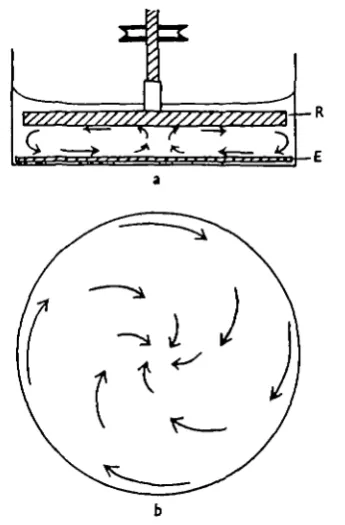
A rotating apparatus was first employed, consisting of a shallow circular glass trough, about 15 cm. in diameter, with a circular plate of black ebonite lying at the bottom, and just fitting it. A circular glass plate, with good clearance from the sides of the trough, was mounted on a vertical shaft and rotated by means of a pulley and motor through a variable speed gear box (Fig. id). In such an apparatus the flow is, unfortunately, not entirely tangential to the moving plate because of centrifugal effects, which cause water to veer outwards across its surface. The flow over the surface of the lower plate has a compensating inward component, increasing in magnitude (relative to the tangential flow) towards the centre of the disk (Fig. 1 b). Computing difficulties therefore ruled out this system for quantitative experiments. It proved to be a convenient apparatus, however, for observing the behaviour of individual cyprids when exposed to continuously variable rates of shear, as existed over different parts of the disk.
By a slight modification the whole vessel and its contents were rotated with the upper glass plate removed. Cyprids swimming against the direction of rotation appeared to remain stationary when in a part of the vessel moving with an equal and opposite velocity. Then u, the velocity of the cyprid, could be measured from the speed of rotation in revolutions per second (n), and the distance of the cyprid from the centre of the dish (b)
u=2Tmb. (10)
by measuring the volume of water issuing in unit time. Cyprids were introduced one at a time from a pipette, and their rapid movement down the tube was observed visually. This method was more successful with the larger cyprids of Balanus balanoides than with those of Elminius modestus, which being much smaller were less easy to follow.
[image:5.451.144.317.147.410.2]Fig. 1. (a) Apparatus for observing the behaviour of cyprids when exposed to current. R, rotating glass plate; E, ebonite disk. Arrows indicate the direction of water currents. (6) The direction of flow at the surface of the ebonite disk, seen from above, when the glass disk is rotated clockwise.
Fig. 2. Trough for experiments on settlement under conditions of steady laminar flow. The water is driven by three compressed air jets—Cu C,, C,—playing on the surface, and returns through the
guides, Gu Gt, over a Bakelite strip, 5, bearing barnacles which initiate settlement.
[image:5.451.78.370.450.528.2]574 D- J- C R I S P
remote from the air jets. Since the rest of the trough bore no barnacles it was not attractive to cyprids and none attempted to settle there (Knight-Jones & Crisp, 1953; Knight-Jones, 1953). This apparatus could be left with a steady circulation of sea water for periods of up to 48 hr., and the rate of shear could be controlled by altering the depth of the water or the rate of discharge of the air jets. Particles dusted on the surface could be timed over a measured length, and the rate of shear calculated on the basis of uniform laminar flow. The effect of the curved ends of the apparatus was minimized by inserting small Bakelite guides to prevent vortices persisting.
VELOCITY OF SWIMMING OF CYPRIS LARVAE
[image:6.451.49.407.279.470.2]The cyprids of B. balanoides and B. crenatus are strongly phototactic when swim-ming. This reaction was used to determine the velocity of swimming, by shining a beam of light into the sector of a rotating dish which was moving away from the source of light. The cyprids on certain radii then appeared stationary, and their speed was calculated as described above. The results are given in Table 1.
Table 1. Rate of swimming o/Balanus cyprids
B. balanoides
Mean
B. crenatus
Mean
B. crenatus in surface film
Mean
Rotational speed of dish
n (rev./sec.)
0 2 8 0-28 0 2 8 0 1 4 0 1 4 —
0 1 4 0-14
—
0 1 4 0 2 8
—
Distance from centre at which cyprids maintained
position
b (cm.)
2 - 4
3'5 3 0 4'7 5 0 — 4-5 4-5 — 6-s 3-4 — Velocity 21mb (cm./sec.) 4-z 6 0 5-3 4 1 4-4 4-8 3-9 3-9 3-9 5"7 6 0 5-85
Both species can swim at a speed in the region of 4-5 cm./sec, though it is diffi-cult to judge whether this sustained speed represents their maximum effort. They did, however, give the appearance of struggling to prevent themselves being carried away from the light source.
ATTACHMENT OF CYPRIS LARVAE EXPOSED TO DIFFERENT VELOCITY GRADIENTS
(a) Experiments using rotating plates
Observations were first made in the rotating glass disk apparatus, using cyprids of B. balanoides and B. crenatus. When the disk was rotating at its maximum speed cyprids of B. balanoides were still able to attach to the lower plate and retain their hold. Rough calculation, on the basis of tangential movement alone, gave a shear of about 100 sec"1, but in fact it would have been somewhat greater on account of the unknown centrifugal and centripetal components (see p. 572). Settlement occurred most readily in regions subjected to gradients of greater than 25-50 sec"1. The cyprids of B. cretanus did not attach as readily as those of B. balanoides; when the upper plate was rotated they tended to collect in the centre of the dish. Few of either species attached to the glass surface, and those which did so soon swam off.
When B. balanoides cyprids attached to the lower ebonite surface and crawled over it, water currents produced by the upper plate did not orientate them in the manner that might have been expected, namely by swinging the body passively about the antennules on which it was pivoted. On the contrary, they appeared to be remarkably unaffected by the water movement and walked in any direction at will. At rates of shear of about 100 sec"1 they could with slight difficulty walk with the body at right angles to the stream of water. However, with rates of shear of this order they usually swam off after walking a short distance, two or three centimetres being covered at the most.
(b) Experiments using glass tubes
576 D. J. C R I S P
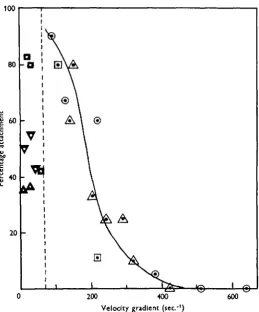
antennule and so coming to rest. Beyond ioo sec.""1 attachment was clearly more difficult, and there resulted a steady fall in the percentage of successes, attachment never being observed at rates of shear above 400 sec."1. It was not found possible to obtain a current of sufficient magnitude forcibly to pull them off the tube once they had attached firmly. Nevertheless, attachment at very high rates of the order of
[image:8.451.96.356.151.464.2]200 400 600 Velocity gradient (sec1)
Fig. 3. Percentage of cyprids of Balanus balanoides which attach when passed through a i m . length of glass tube, plotted against the velocity gradient at the surface of the tube. O, tube radius 1-13 mm.; A . tube radius i-8omm.; V , tube radius 2-65 mm.; Q , tube radius 3-2 mm. Open symbols indicate strong reaction to current and attempt to attach. Solid symbols indicate little or no reaction to current and desultory attachment. The dotted line indicates approximately the minimum gradient necessary to stimulate a strong attachment reaction.
200-400 sec."1 was often momentary, as though the antennulary sucker was not able quite to complete its hold. A moderate current tended to keep the cyprids gripping firmly once they were attached, and detachment could be obtained only by reducing the flow to a sufficiently low level.
Elminius being in better condition, but it would be in keeping with ecological differences between the species, for Elminius settles commonly in quiet inlets and estuaries where the stimulus of water movement does not always exist (Moore, 1944), while B. balanoides is often found in more exposed situations. Nevertheless, Elminius was able to settle at high shear rates even better than B. balanoides. The smaller size of the cyprid may account for this difference, for other factors being equal it will be closer to the surface at the moment of attachment and therefore, at a given velocity gradient, it will be carried at a slower speed and exposed to smaller forces. Elminius cyprids were observed to be strongly photo-positive in a strong light after settling in the tube. If either side of the tube was shaded they walked away towards the illuminated side; similarly, by appropriate shading, they could be induced to walk with or against the direction of the flow of water. Walking against
200 400 600 800 1000
[image:9.451.64.387.244.491.2]Velocity gradient (sec.-1 )
Fig. 4. Percentage attachment of cyprids of Elmniw modatus plotted against velocity gradient in a tube of radius 0-091 cm. Open and solid symbols, and dotted lines have the same meaning as in Fig. 3.
578 D. J- C R I S P
so if the light was directed from one side of the tube. The cyprids observed walking in tubes appeared to be less influenced by a given gradient than those walking on a flat surface (see p. 580).
The observation that once the cyprid has obtained a hold, it can withstand and indeed walk in the face of strong currents, may be explained on the basis of the forces acting on the cypris.
The magnitude of the drag on a cyprid of B. balanoides, which measures about 1 mm. in length and 0-5 mm. in height, may be calculated approximately by con-sidering simple models of similar size. If a short lamina 1 mm. long and 0-5 mm. high were lying in the plane of the current, the drag F on each side given by the
Light
-7 Current
Light
/ Current
Fig. 5. Cypris larvae of Elmimus crawling towards the light in a glass tube with surface velocity gradient exceeding 600 sec"1. A, light and current from same direction, cyprid able to walk; B, light and current from opposite directions, cyprid lifted at hind end and often unable to continue without becoming detached.
Blasius formula « 1-3 p^U^l^b, where p= 1,77 = 0-01, 6 = 0-05 and /=o-io. Thus for a mean current U of 50 cm./sec, at the level of the cyprid, corresponding roughly to a shear of over 1000 sec."1, the force acting on each side of the lamina will be approximately 0-7 dyne, making a total force of 1 -4 dynes. If instead we consider the drag on a sphere of diameter 1 mm., Stokes (1850) formula, F=&mirU, gives approximately 0-5 dyne. The order of magnitude of the force required to hold the cyprid stationary in a very high velocity gradient of 1000 sec."1 will therefore be about
two antennules x 25 dynes. Thus, even allowing for some inefficiency in developing suction, the forces holding the antennules to the substratum appear to be adequate to withstand directly the drag caused by very high velocity gradients on the body of the cyprid. The actual diameter of the sucker is about 40-45 p in B. balanoides and 20-25 H- m E. modestus.
ATTACHMENT IN LIGHT AND DARK
Since attachment in a water current appears to be preceded by rheotaxis the question arises as to the type of stimulus necessary for the rheotactic movements. It is known that fish maintain position in a current by responding to movements of the visual field (Lyon, 1904; Russell, 1938), though Gray (1937) has shown that bunded fish can respond to a limited extent to rotational currents. It appeared to be unlikely that cyprids use a visual mechanism, first, because the simple structure of the paired eyes would hardly allow image formation, and secondly, because the above experi-ments were performed in glass tubes placed at some distance from any object which could serve as a background. However, as the work of a number of observers has shown (Pomerat & Reiner, 1942; Weiss, 1947) light is undoubtedly an important factor affecting barnacle settlement.
Table 2. Time of stay in tube 1-13 mm. radius, with shear 142 seer1
Inert Living
Mean
Light (sec.)
1 2 4
3O 17
'4-5
2&
16 41-S
45
20-s 16 16
24-25
Dark (sec.)
12-4 1 2
5°
16-5 16-5 I3'5 4 0
55
1 2
So 35
3005
To test the effect of background on attachment, dark strips of paper were placed round the glass tube at intervals, and cyprids of E. modestus were introduced under a moderate gradient of 200 sec."1. The disposition of attached cyprids was noted. More cyprids were found nearer the entrance of the tube, as would be expected, since they sought to find a hold as soon as they were exposed to the current, but otherwise no significant pattern of attachment was obtained. The cyprids were found no more frequently in the light than in the dark sections, nor were the junctions of light and dark specially favoured.
Attachment in complete darkness was also examined. The rate of passage of an inert (dead) cyprid of B. balanoides was first determined under a velocity gradient of about 150 sec."1 by timing it between the 1 m. marks in the tube. Live cyprids of
580 D. J. C R I S P
the same species were then introduced under artificial light one at a time, and the light immediately switched off. After a passage of time of about i sec. less than that required for the passage of a dead cyprid, the light was switched on again and the end of the tube carefully watched to see if the cyprid was emerging. If it was not, the tube was rapidly examined to find the cyprid, which was then followed down the tube and its total time of stay measured. After some experience it was found that attachment occurred regularly in the dark, and the period of darkness was extended beyond the time which would have been taken for an inert cyprid to pass through the tube. The results of a number of trials are given in Table 2, and show that the time of stay in the tube is not significantly influenced by light. Cyprids were also introduced into the tube in dim red light, to which many arthropods are insensitive, and were seen to swim against the flow and to attach exactly as in the light.
MECHANISM OF ATTACHMENT
The negative rheotaxy of the cyprid is worth commenting upon. It appears to be a response either to current variation near a solid boundary, or more probably to contact with it, and appears to lead almost immediately to attempts to make fast. Although attachment by the antennule cannot be seen in detail visually, certain inferences may be drawn as to the mechanism. From the velocity gradients at which attachment occurs fairly readily, viz. up to 150 sec."1 for B. balanoides and 250 sec."1 for Elminius, the distance at which the water velocity will equal the maximum rate at which the cyprid can swim may be calculated. For B. bcdanoides this will be 4-7/150 s; 0-03 cm. and for Elminius it will be approx. 4/250 «o-o 15 cm.
The total height of the cyprids of these species when crawling flat on the sub-stratum is about 0-06 and 0-03 cm. respectively. Hence maximum attachment occurs when the current at half the height of the cyprid from the surface has a velocity just equal to the cyprid's own maximum swimming velocity. It is a reasonable assump-tion therefore that on reaching the boundary they swim upstream and attach readily only if their own movements are capable of bringing them momentarily to rest-Since some attachment occurred at gradients exceeding those stated, either they can attach on occasion in spite of being carried downstream, or they can attain momen-tary bursts of speed in excess of those given in Table 1. As soon as attachment occurs the swimming movements presumably cease and the cyprid experiences drag due to the current. The shape of the substratum may considerably modify this drag, for if the cyprid is in a narrow tube or pit, only the upper surface will ex-perience drag, whereas if attached to an edge almost the whole surface will be sur-rounded by a thin boundary layer and will experience a much greater pull. This may be the factor causing the apparently greater effect of current upon crawling on a flat surface than in a narrow tube (see p. 578) and may be one of the reasons for the cyprids' avoidance of sharp edges and their predilection for pits (Crisp & Barnes,
54)-IS THE VELOCITY GRADIENT AN ADEQUATE DESCRIPTION OF CONDITIONS OF ATTACHMENT?
It is of interest to compare these results with those reported by Walton Smith (1946), who correlated settlement (as distinct from attachment in our sense) with the water velocity measured at some distance from the settling surface. His first method of obtaining a relative movement of substratum and water, that of rotating a large disk in the sea, is not readily amenable to hydrodynamic analysis. Cochran (1934), however, gives a solution for the drag on the surface of a rotating disk of infinite size as
where a> is the angular velocity and r the radius, g' a constant« 0-616, (dv\dz\ is the gradient of tangential velocity along an axis normal to the disk; p is the density, and rj the viscosity of the fluid.
This solution applies strictly to a large smooth disk rotating in a perfect plane. Walton Smith's second method, that of using a series of glass tubes, is somewhat more suitable for analysis. Provided the tubes were long and that the turbulence developed at the junctions did not seriously upset the flow, equations (7) and (8) above (p. 572) are exact solutions. Table 3 shows the results given in his tables 1 and 2, recalculated on a basis of rate of shear instead of the radial velocity of the disk or the mean velocity in the tube. It will be seen that for the tubes a limiting velocity gradient of about 100 sec."1 fits the observations for most of the barnacles, B. amphitrite and B. eburneus being rather more sensitive and B. impro-visus less sensitive to shear. These values are slightly lower than the highest gradients which strH gave attachment of E. modestus and fi. balanoides. Possibly this difference
is because in Walton Smith's experiments only final settlements were observed, whereas in the experiments on B. balanoides and E. modestus initial attachment, however temporary, was included. If such temporary attachments took place in the narrower sections of the graded tubes they might well have been missed, since the larvae on swimming off would immediately be carried to the wider tubes where they would have a longer time in which to settle. A comparison on the basis of mean flow velocity gives no semblance of agreement between Walton Smith's observations and those described here. Thus the limiting average flow velocity in Walton Smith's tubes, which were of large diameter, was about i-o mile/hr., which is equivalent to 45 cm./sec. In a smaller tube of 6-4 mm. diameter the limiting average flow velocity for B. balanoides now proves to be about 20 cm./sec, and in a tube of 2-3 mm. dia-meter it is only 12 cm./sec. E. modestus, passed through an even narrower tube of diameter less than a millimetre, gives limiting flow velocities of only 6 cm./sec. Yet all sets of results agree well in their orders of magnitude if expressed in terms of limiting velocity gradient. Walton Smith's findings give the appearance of con-sistency on a basis of average flow velocity only because he did not use a wide range of tube diameters in his experiments.
582 D. J. C R I S P
The calculations of shear for the rotating disk method must be treated with some reserve because of assumptions implicit in Cochran's (1934) analysis, but the limiting values are so high that some explanation seems to be needed to account for the lack of agreement with the results from the tube experiments. Several possible reasons
Table 3. Recalculation of results taken from Walton Smith (1946) in terms of velocity
gradient {reciprocal seconds) at surface of tube instead of mean velocity of flow doom the tube, which is given in brackets as miles per hour*
(Only values to the right of the firm line were suitable for barnacle settlement.)
Period and place
17. xi. 43 to 27- xi- 43, Miami Beach
20. v. 44 to 12. vii. 44,
Kure Beach
12. vii. 44 to 18. ix. 44
Kure Beach
18. ix. 44 to 25- »• 44, Kure Beach Rate of flow q (ml./sec.) 217-267 35°
2 1 2
180
Surface
r = o-7 cm.
807-992 (3-O-3-7)
1300
(S-3)
7 6 0 (3-2)
6 7 0 (2-7)
velocity gradient {dvjdr)n in glass tubes oi calculated from (Su/9r)0 = 49/JTT* r = i - i cm.
208-256 (1-2-i-6) 336 (2-3) 196 (i-3) 173
( I - I )
r=i"4 cm.
102-125 (o-8-i-o)
164 (i-4)
r= 1-85 cm.
43-7-54-O (0-5-0-6) <—B. ottt 71 (o-8) •*-Balanus sp.-96 (o-8) 41 (05) •*-Balanus sp.-»-84 (o-7) 36-3 (o-4) •*-B. impTOvisut-* radius r
7 = 2-5 cm.
17-8-21-9 (0-2-0-3)
ihitrite-*-28-7 (o-4)
1 6 8 (0-2)
14-8 (0-2)
•*-B. dwrneus-y
Recalculation of results for rotating disk in terms of velocity gradient (dvjdz)0 at disk
surface instead of tangential velocity of a point on the disk ((or)
Disk
iB
4A 6A 7A
Speed of rotation (radians/sec.) (a>) 56-5 2O-I I4-O 63 Maximum attachment radius (cm.)
w
0-95 2-55 3-20 IO-2 Velocity gradient (sec."1)(dvldz)0 2460 1420 1070 1000 Tangential velocity (knots) («ur)
I - i
i-o 0 9 1-3
• The calculations of table 2 (Walton Smith, 1946) appear to be in miles per hour, and not in knots as stated in his table.
where the rate of shear was low might well have been followed by migration of the cyprids outwards. Since the rotation of the disk produces an axial stream flowing towards the centre, cyprids would be drawn into contact with the region of low gradient initially, would attach without difficulty, and might then migrate as usual by walking. On this interpretation the gradients given by this experiment are the maximum gradients across which cyprids can walk once they have successfully attached.
While no direct evidence can be presented that fixation is possible under condi-tions of flow more rigorous than those which limit attachment, the migrating larva has been observed to withstand gradients greatly in excess of those which prevent attachment, and it is reasonable to suppose that it could also metamorphose under such conditions.
It is not claimed that the velocity gradient at the boundary automatically controls the possibility of attachment, for one assumption has been made which can only partially be true. This is that the cyprid takes up the velocity of the water in which it finds itself, or alternatively that it can swim at a certain speed against the velocity of the water in this layer. In fact, however, if it swims rapidly across a velocity gradient its own inertia will tend to prevent its slowing down to the speed of the layers near the boundary. It may therefore need to swim along the boundary for a short time while it slows down. In other words, the behaviour of the cyprid at the moment of attachment is very important.
The magnitude of this inertia effect may be roughly estimated by considering instead of the cyprid a moving sphere of approximately equivalent mass and viscous drag, to which Stokes's (1850) formula is applicable. This gives the drag due to viscous forces as „_ .. „
where V is the velocity of the sphere relative to the medium, a its radius, and 77 the Newtonian viscosity of the medium.
The deceleration — dV\dt of such a body of density p moving freely will therefore be
dV _{ym\aV 977
dt ^P z
Putting 9V
2*V dXog.V^
~ dt ~A>
hence the subsequent motion is given by
where Vo is the velocity at zero time, and e is the base of natural logarithms.
Now we shall assume that the body is caused to move with a velocity Vy across
584 D. J. C R I S P
where Vx is the velocity of the body along the direction Ox, and vm that of the layer
of fluid in which it is moving. Then, ignoring viscous forces operating along the
dt
Bringing in viscous forces the equation of motion becomes
dt
v\dy)
+ V-Putting <x = Vy yjr I / A, the solution becomes
When V0=o, this equation becomes
V being a direct measure of the discrepancy between the motion of the body and that of the fluid after the body has moved across the velocity gradient for a time t.
Vm V
Fig. 6.
Since the term in brackets is negative, a movement away from the fixed boundary (Vv positive) causes a displacement of the body against the stream (V negative),
but movements towards the boundary (Vv negative) cause the body to be carried
77 = o-oi poise, the time constant Xx 50 and the half life of any displacement velocity will be less than 0-015 s e c- The animal need therefore remain at the boundary for only about 0025 sec. to acquire virtually the same velocity as the water.
ORIENTATION OF CYPRIDS METAMORPHOSING IN WATER CURRENTS
Knight-Jones (1953) has shown that cyprids of several species of barnacle do not metamorphose readily unless other previously settled individuals of the same species are present on the substratum. Glass tubes already bearing such individuals were not available, hence for experiments on metamorphosis it was necessary to use bakelite plates with previously settled individuals occupying small pits drilled in the surface. These were placed in a shallow Bakelite trough within which a continuous
2-0
10-150
-120 1
90 £0
1
J
30
1
J
Angle 0
1
•
I
-30
1
-#>
1— -90T"
-120 -1S0
1 '
[image:17.451.78.371.246.426.2]
-_
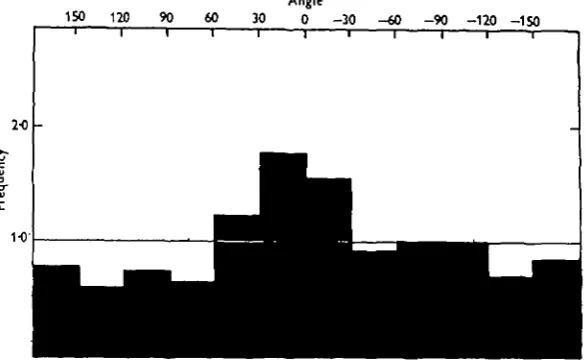
Fig. 7. Orientation histogram of 252 individuals settling in the dark on a plane surface over which a steady water current was passing. An orientation with the anterior end pointing downstream is taken as o° and with the anterior end upstream as 1800. Orientations in a clockwise (anti-clockwise) direction are shown as positive (negative) angles of appropriate magnitude. Fre-quencies are given as the ratio of number observed in each 30 degree range to the random expectation of 21 (252 -r-12). The line of unit frequency is drawn to indicate the expected value were no orientational forces at work. The x1 test indicates that the peak at zero angle is significant at Pxo-oi.
58b D. J. C R I S P
apparatus, however, were relatively small, ranging from 10 to 60 sec."1. The orienta-tion induced was so slight that it was not possible to determine whether there was any relation between the degree of orientation and the magnitude of the velocity gradient. A few experiments carried out under directional lighting showed that the' current had no appreciable effect on the strong orientation to light.
Cyprids settling in the current were observed to walk in many directions, not in any way related to that of the current, and to explore the substratum in a way similar to that shown in the absence of current. If the current was reversed while a cyprid was walking at right angles to it, the cyprid momentarily swung round to face the new direction of thrust, but then twisted back to restore itself to its original position so that it resumed its progress in the same direction as before.
Evidently the orientating influence of water currents is much less than that of light (Barnes et al. 1951) and of surface contour (Crisp & Barnes, 1954). However, it should be emphasized that the current would orientate a passive cyprid so that its posterior end pointed downstream. Hence the observed orientation (or indeed even an apparently random orientation) reveals an active opposition to the mechanical forces caused by the current. It seems likely that this weak orientation to current is occasioned by a tendency to over-compensate for the twist exerted by the current rather than to the detection of the current followed by a deliberate orientation to it. In this respect it differs from the reaction to light and surface contour which are genuine orientation reactions.
The effect of water current on settlement at high velocity gradients could not be investigated since gradients exceeding 100 sec."1 could not be readily maintained in this apparatus. It was established, however, that settlement occurs readily in B. balanoides and in B. crenatus at gradients of 40-60 sec."1.
INFLUENCE OF WATER MOVEMENT ON DISTRIBUTION AND SURVIVAL
settlements of B. balanoides occur in areas of moderate exposure than in shelter. Barnes & Powell (1953) also have emphasized the importance of water movement, and similarly accounted for the intertidal distribution of this species, attributing its absence below low-water mark to the fact that there is no periodic washing by waves. Pyefinch (1948) refers to the clinging response of B. balanoides evoked by water currents, but states that it is not shown by B. crenatus. The difference is, I believe, rather one of degree, since I have observed B. crenatus attaching and metamorphosing in weak currents. However, if the response to water movement differed from one species to another, it would provide a possible mechanism to account for the dis-tribution of barnacles in relation to wave exposure. Thus some species, notably Chthamalus steUatus, favour very exposed habitats (Hatton & Fischer-Piette, 1932; Moore & Kitching, 1939), while others such as E. modestus are found mainly in shelter (Moore, 1944).
Moreover, the stimulus to settle where there is a current of water may have a general advantage, for it is a matter of common observation that exposed headlands and narrow passages carrying strong currents, where the water is rapidly replenished, often support rich populations with individuals of large size. These are clearly the most advantageous for a sessile form to colonize. For example, Fox & Coe (1943) observed greatest growth of Mytilus calafornianus on wave-washed shores, while Bishop (1954) has found individuals of E. modestus, which normally grows to about 8 mm. diameter, to reach over twice this size on bridges spanning the narrow drowned river valleys of N. Finisterre, where the large tidal range produces exceptionally fast currents. The advantageous effect of water movement can also operate very locally, for Hentschel (1923) records the greatest barnacle growth on the most exposed parts of ships, while I have frequently observed that M. eduUs grows most rapidly at the exposed corners of pontoons, piers, etc. The most advantageous positions for bar-nacles to settle are therefore those where the water movement is as great as they can tolerate. Stagnant water is disadvantageous, not only because it limits the food supply, but also because silting up is a serious danger to young spat (Coe & Allen,
1937; Fuller, 1946).
A further advantage would accrue if the position of settlement were such that the current were usually directed into the cirral net when the barnacle was fishing (Moore, 1935; Crisp, 19536). It is therefore interesting to note that the observed tendency for the posterior end to face the current would, after metamorphosis, achieve this result.
588 D. J. C R I S P
particularly in evidence at the after end, where relatively stationary pockets of water* develop. This has been noted on slow moving ferries, and on ships moored for long periods in a tideway.
In practice, the flow past a ship is invariably turbulent, since the critical Reynolds number is exceeded even at very moderate speeds. The velocity gradient at the surface will be correspondingly large and an average figure can be calculated on the basis of Froude's equation. Expressing (3w/^y)0 and 77 in metric units, and / in dynes per cm.2 of wetted surface, we obtain for a ship of 400 ft. length with a smooth painted surface (Eqn. 6)
where U is expressed in knots. Hence at 1 knot the average shear will be 342 sec."1, and will increase with velocity, becoming 1250 at 2 knots, and 24,800 at 10 knots. Hence, if we accept a figure of 500 sec."1 as the absolute limit for barnacle attach-ment, no barnacle settlement would be possible at speeds exceeding 1-2 knots, pro-vided that the gradient were uniform over the whole ship. In fact, considerable variation will occur; not only will the after end as a whole experience lower shear, but lapped plates and rivets will cause local eddies where the velocity gradient may be reduced, so that regions of low shear may allow settlement even at velocities slightly higher than 2 knots. It is important, however, to notice from Froude's experiments that the gradient increases very sharply with velocity, but that it is not very materially influenced by the size of the object above a certain minimum. Thus for a ship of only 100 ft. the constant / increases only by 20%. Hence, while local variations in velocity gradient may allow settlement to occur at velocities slightly exceeding 1 or 2 knots, at water speeds exceeding, say, 5 knots, settlement would cease altogether. The sharp increase in shear with increase in velocity, and its relative independence of the size of the object, has undoubtedly given rise to the view that the velocity itself, rather than velocity gradient, controls settlement. For empirical purposes, moreover, it is justifiable to assume that a large flat object exposed to a relative motion of 3 knots or more parallel to its surface will not become fouled.
A factor which has not been considered in this paper, but which is certainly of great importance in practice is the influence of suspended matter on the settlement of larvae. Particles, if of size comparable with the larvae, might on account of their density and consequent inertia very materially accentuate the inhibition of settle-ment by water currents. The scouring action of certain sea areas was in the past a well known remedy for accumulated fouling. The effect, too, can be seen on rocks standing on a sandy shore. These are often well covered in barnacles, except for a bare zone some 2 or 3 ft. from the sea bed, caused by the abrasion of sand particles lifted by the waves.
SUMMARY
move-ment past the object is of importance only in so far as it influences the velocity gradient in the boundary layer.
2. Experiments in glass tubes on cypris larvae of Elmimus modestus and Balanus bcdanoides show that moderate velocity gradients exceeding 500 sec."1 sweep the cyprids past the surface before they can attach. For large objects exposed to tur-bulent flow, the critical velocity gradient corresponds very approximately to a flow of 1-2 knots.
3. Attachment under conditions of water flow is accompanied by negative rheotaxy, and can occur equally in the light and in the dark.
4. Maximum attachment occurs at or below velocity gradients just great enough for the cyprid to be able to maintain position by swimming along the surface against the current.
5. Once the cyprid has attached it cannot be pulled off the surface even by gradients greatly in excess of those which prevent attachment.
6. Cyprids can migrate in all directions when exposed to moderate gradients, but they do so only with difficulty when the velocity gradient is high, particularly if the water is flowing in the same direction as that in which the cyprids are walking. The direction in which the cyprid migrates is altered only momentarily by changes in the direction of the current, the animal actively resisting the redistribution of forces acting on it.
7. No direct evidence is given in this paper on the influence of water currents on fixation, but a critical comparison with other published work suggests that fixation can occur in places where the velocity gradients are greater than those which limit attachment, provided the cypris is able to migrate there after attachment.
8. Moderate velocity gradients have little effect on the orientation at metamor-phosis. Individuals tend to settle with the anterior end pointing downstream rather than in any other position. This orientation is the opposite from that which would be expected if the cyprid were passively orientated by the water current, but is likely to make subsequent feeding more efficient.
9. The ability to attach under conditions of water flow, and the tendency not to attach under stagnant conditions, may have an important influence on the animals' distribution and survival.
10. Solid particles in suspension may profoundly influence the behaviour, hence the results given in this paper may not be relevant to conditions where scouring takes place.
590 D. J. C R I S P
REFERENCES
BAKER, G. S. (1948). Ship design, resistance and screw propulsion. The Design of Ship Forms and
Their Resistance, Vol. I, 2nd ed. Liverpool.
BARNES, H., CRISP, D. J. & POWELL, H. T. (1951). Observations on the orientation of some species of barnacles. J. Anim. Ecol. 20, 227-41.
BARNES, H. & POWELL, H. T. (1953). The growth of Balanus balanoides (L.) and B. crenatus Brug. under varying conditions of submersion. J. Mar. Biol. Ass. U.K. 32, 107-27.
BISHOP, M. W. H. (1954). Elminius modestus in France. Nature, Lond., 173, 1145.
BLASIUS, H. (1908). Ober Grenzschichten in Flussigkeiten bei sehr Kleiner Reibung. Z. Math. Phys. 56,
i-37-COCHRAN, W. G. (1934). The flow due to a rotating disc. Proc. Camb. Phil. Soc. 30, 365-75. COE, W. R. & ALLEN, W. E. (1937). Growth of sedentary marine organisms on experimental blocks
and plates for nine successive years at the pier of the Scripps Institution of Oceanography.
Bull. Scripps Instn Oceanogr. Tech. 4, no. 4, 101—36.
CRISP, D. J. (1953a). Selection of site and position by some marine larvae. Brit.J. Anim. Behaviour, I, 80-1.
CRISP, D. J. (19536). Changes in the orientation of barnacles of certain species in relation to water currents. J. Anim. Ecol. 22, 331-43.
CRISP, D. J. & BARNES, H. (1954). The orientation and distribution of barnacles at settlement with particular reference to surface contour. J. Anim. Ecol. 23, 142—62.
Fox, D. L. & COE, W. R. (1943). Biology of the Californian sea mussel (Mytilus calafornianus). II. Nutrition, metabolism, growth and calcium deposition. J. Exp. Zool. 93, 205-49.
FROUDE, W. (1872). Experiments on the surface friction experienced by a plane moving through water. Brit. Ass. Rep. 42, 118-24.
FULLER, J. (1946). Season of attachment and growth of sedentary organisms at Lamoine Maine.
Ecology, 27, 150—8.
GRAY, J. (1937). Pseudo-rheotropism in fishes. J. Exp. Biol. 14, 95-103.
HATTON, H. & FISCHER-PIETTE, E. (1932). Observations et experiences sur le peuplement des cotes rocheuses par les Cirripedes. Bull. Inst. oceanogr. Monaco, 592, 1—15.
HENTSCHEL, E. (1923). Der Berwuchs an Seeschiffen. Int. Rev. Hydrobiol. 11, 238-64.
HENTSCHEL, E. (1934). Das Werden und Vergehen des Bewuchs an Schiffen. Mitt. zool. Mus.
Hamb. 41, 1—51.
KARMAN, T H . VON (1921). Ober laminare und turbulente Reiburg. Z. angew. Math. Mech. Band 1, Heft 4, 233-52.
KNIGHT-JONES, E. W. (1953). Laboratory experiments on gregariousness during setting in Balanus
balanoides and other barnacles. J. Exp. Biol. 30, 584-598.
KNIGHT-JONES, E. W. & CRISP, D. J. (1953). Gregariousness in barnacles in relation to the fouling of ships and to antifouling research. Nature, Lond., 171, 1109.
LAMB, H. (1932). Hydrodynamics, 6th ed. p. 687. Cambridge.
LYON, E. P. (1904). On rheotropism: I. Rheotropism in fishes. Amer.J. Physiol. 12, 149-61. MCDOUGALL, K. D. (1943). Sessile marine invertebrates at Beaufort, N.C.: a study of settlement,
growth, and seasonal fluctuations among pile-dwelling organisms. Ecol. Monogr. 13, 321—74. MOORE, H. B. (1935). The biology of Balanus balanoides. IV. Relation to environmental factors.
J. Mar. Biol. Ass. U.K. 20, 279-307.
MOORE, H. B. & KITCHING, J. A. (1939). The biology of Chthamalus stellatus (Poli). J. Mar. Biol.
Ass. U.K. 23, 521-41.
MOORE, L. B. (1944). Some intertidal sessile barnacles of New Zealand. Trans. Roy. Soc. N.Z. 73,
3I5-34-NEU, W. (1932). Untersuchungen iiber den Schiffobewuchs. Int. Rev. Hydrobiol. 27, 105-19. POISEUILLE, J. L. M. (1846). Mhn. prte. Acad. Sci., Paris, p. 433.
POMERAT, C. M. & REINER, E. R. (1942). The influence of surface angle and of light on the attach-ment of barnacles and other sedentary organisms. Biol. Bull., Woods Hole, 82, 14.
PYEFINCH, K. A. (1948). Notes on the biology of Cirripedes. J. Mar. Biol. Ass. U.K. 27, 464-503. RUSSELL, E. S. (1938). The Behaviour of Animals, 2nd ed. pp. 55-8. London.
SOUTHWARD, A. J. (1953). The ecology of some rocky shores in the south of the Isle of Man. Trans.
Lpool Biol. Soc. 59, 1-50.
STOKES, G. G. (1850). On the effect of the internal friction of fluids on the motion of pendulums. Part I, Section 4. Trans. Camb. Phil. Soc. 9, part 2, 48-57.
WALTON SMITH, F. G. (1946). Effect of water current upon the attachment and growth of barnacles.
Biol. Bull., Woods Hole, go, 51^70.