THE FUNCTION OF THE BRAIN OF OCTOPUS IN
TACTILE DISCRIMINATION
BY M. J. WELLS AND J. WELLS* Stazione Zoologica, Naples
{Received 14 November 1956)
INTRODUCTION
In a previous survey of the capabilities of the tactile nervous system of Octopus (Wells & Wells, 1956) evidence was presented suggesting that the brain correlates information from sense organs in the arms in a relatively simple manner. Animals trained to discriminate between objects differing only in their non-chemical surface characteristics could distinguish surfaces differing in degree of irregularity (e.g. by having a greater or lesser number of grooves cut into their otherwise smooth surfaces) but were unable to make discriminations dependent upon the recognition of the pattern or orientation of irregularities. It appears that octopuses do not make use of a projection of the sensory field or of any scanning mechanism in order to identify objects touched. It was suggested that these animals distinguish objects made of the same material on a basis of the proportion of mechanoreceptors stimu-lated in the sensory areas (the rims of the suckers) in contact, an object with a rough surface being recognized as distinct from one with a smooth surface because it stimulates a greater (or lesser) number of sensory endings, the arrangement of irregularities or the shape of the object being irrelevant. If this is correct, the ease with which it is possible to teach octopuses to discriminate between objects touched and the similarity of those objects in terms of the proportion of sensory endings that they excite should be closely correlated. The aim of the present series of experiments has been to test this correlation.
It was previously supposed (Wells & Wells, 1956) that the only way of obtaining a measure of the difficulty that an octopus has in distinguishing two objects was to count the number of trials that it took to learn to discriminate between them. This method is impractical because of the large number of experiments that it necessarily involves (see p. 134), and no attempt was made to compare the performances of individuals in this way. When further experiments were made, however, an alterna-tive method of measuring the difficulty of discriminations was seen to be possible. It was observed that under any given set of training conditions octopuses, after an initial rapid improvement in performance, settle down to making a more or less constant proportion of errors to trials, and continue to err at this rate irrespective of the duration of training (but see p. 138). This proportion of errors is related to the
* This work was done whilst one of us (M. J. W.) was holding an Eli Lilly Research Fellowship at the Stazione Zoologica, Naples. We should like to thank Prof. J. Z. Young, F.R.S., for his continued encouragement and helpful criticism. M.J.W. is now a Fellow of Trinity College, Cambridge. Present address: The Zoological Laboratory, University of Cambridge.
132 M. J. WELLS AND J. WELLS
similarity of the objects that they are required to distinguish, and provides a means of measuring and comparing the difficulty of different discriminations independent of the rates of learning of the experimental animals.
MATERIAL
Octopus vulgaris Lamarck of between 250 and 1000 g. caught in the Bay of Naples were used; methods of catching and keeping these octopuses have been described by Boycott (1954). The temperature of the sea water circulating through the tanks in which the experimental animals were kept varied from 160 C. (spring and late autumn) to 23 ° C. (summer), the water being heated in winter to about 180 C , because at temperatures below 130 C. Octopus ceases to feed regularly.
Animals were trained after section of the optic nerves as described in Wells & Wells (1956). The experiments quoted are from animals trained in 1954, 1955 and 1956. Animals used in 1954 are identified by a number preceded by the prefix A (e.g. A173), those in 1955 by B, and those during 1956 by C. Experiments made with the A (1954) series of animals have been reported in a previous paper.
EXPERIMENTAL METHOD
A. Training method
The method used to train blind octopuses to discriminate between objects, and the movements they make in accepting or rejecting objects touched, have been described fully elsewhere (Wells & Wells, 1956). Briefly, each experiment consisted of a number of trials at each of which one or other of a pair of objects was presented to an animal, which was rewarded with a small crab or piece of sardine for passing the 'positive' object to the mouth, and given a small (6-9 V. a.c.) electric shock if it responded in the same way to the' negative' object. There were eight trials per day, at intervals of not less than 1 hr., the objects being presented in an order that repeated itself every 8 days. As a control against initial preferences for one or other of the objects and the possibility of contamination of the positive object by food, each group of animals was divided and one-half trained to react negatively to the object positive for the other.
During these experiments animals grew very rapidly, often increasing in weight by as much as 50 % during 3 weeks of training. The results with occasional animals that ceased to feed regularly and lost weight were discarded.
B. Objects used in the tests
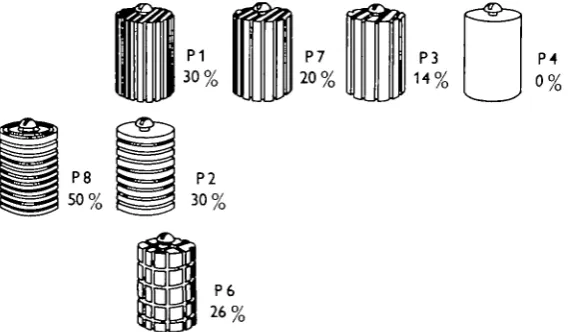
expressed as a percentage for each object so that the similarity of any two objects can be expressed in terms of the difference between two percentages. This assumes that the pattern and orientation of the grooves is irrelevant and that Octopus cannot make use of these attributes in distinguishing between the members of this series of objects. This assumption is based on experiments already reported elsewhere, showing that octopuses find it difficult or impossible to distinguish between P1 (which has grooves running along the length of the cylinder) and P2 (grooved circumferentially) or P6 (a pattern of squares). In the present analysis we shall show that the proportion of errors to trials made when octopuses are trained to distinguish these objects is consistent with the view that they cannot distinguish them other than by the proportion of grooves.
P3 14%
P4
[image:3.451.86.372.233.399.2]0%
Fig. 1. The objects used in the tests. The series is arranged so that there is a decreasing proportion of grooved to flat surface from left to right. This proportion is indicated as a percentage for each object. The top row contains objects that differ only in the frequency of vertical grooves cut into them. Pz differs from P i only in the orientation of the grooves cut into it. P6 has very nearly the same proportion of groove as P i, but the grooves are arranged to form a pattern of squares. Octopuses apparently find P i , P2 and P6 difficult or impossible to distinguish, but can be taught to discriminate between the members of the top row (and between P 8 and P 4) relatively easily.
EXPERIMENTAL RESULTS
134 M. J. WELLS AND J. W E L L S
There is considerable variation in the behaviour of individual octopuses during the first forty or fifty trials of training. Most animals react as described above, examining each object presented to them by feeling it over with the suckers for 5 or 10 sec, and react in a predominantly positive manner throughout training, making errors mainly by taking the negative object. A minority, after receipt of several electric shocks, become temporarily almost wholly negative in their reactions, snatching their arms away from objects touched without examining them. Such animals naturally take longer to learn to distinguish the objects in the test, although they eventually reach a condition in which their behaviour is in all respects like that
— — — — — •<—Random errors
— — — — •*— Random errors
c
-\—s~-=
^ar—\zz** Random errors
20 days 160 trills
Fig. 2. A summary of the errors made in the course of four series of training experiments in each of which six (or twelve in the case of P8/P4) octopuses were trained to distinguish between two Perspex cylinders. The four series are arranged in order of difficulty for Octopus, P8/P4 being the easiest discrimination for them and P1/P2 the most difficult.
of the initially more ' positive' animals. As a result of these differences in reaction to the training conditions, tending to produce a considerable scatter in the number of trials required to train animals to a given criterion, the' number of trials to criterion' cannot be used as a means of comparing the difficulty that Octopus has in distinguish-ing the test objects under these conditions unless a very large number of experiments be made.
however, and from the third day onwards the daily proportion of errors to trials remained more or less constant. In similar experiments it was found that the proportion of errors made was not further reduced by increasing the voltage of the electric shocks given as punishment, despite the fact that the majority of errors were due to the animals taking the negative objects. While decreasing the voltage eventu-ally increased the proportion of errors because the animals tended to ignore the shocks altogether, increasing them from 9 V. upwards was without effect until shocks of the order of 12-15 V. were given, at which level animals commonly became entirely negative in their reactions to the test objects, so that the proportion of total errors rose sharply, due to the animals refusing the positive objects as well as the negatives. Nor was the proportion of errors noticeably altered by variations, within wide limits, in the size or quality of the rewards given (e.g. crabs instead of fish).
It could, on the other hand, be reduced considerably by increasing the frequency of the trials. In the present series of experiments octopuses trained to distinguish P1 from P4 tended to settle down to making errors at a rate of about one per day of eight trials (Fig. zb). In experiments to be reported in a later account octopuses were trained to discriminate between the same objects at a rate of forty trials per day; under these conditions the proportion of errors to trials dropped to about half that made under the ' eight trials per day' conditions, typical animals making about one mistake in thirteen trials as against one in eight. We have chosen to compare the performance of octopuses under training at a rate of eight trials per day because it was convenient to do experiments this way and not because there is any particular virtue in this rate of training.
Fig. 2 shows the results of training octopuses to make discriminations between the members of four different pairs of Perspex objects. These discriminations range from P4/P8, which octopuses can readily be trained to distinguish, to P1/P2, which they evidently cannot distinguish at all. It can be seen that in all cases there was very little, if any, improvement in performance after the first forty or fifty trials, the proportion of errors made thereafter remaining approximately constant even though training was continued in some cases for as many as two hundred further trials.
The proportion of errors made during any period after the first forty or fifty trials can therefore be used as a measure of the difficulty of the discrimination concerned and to predict how many errors will be made if training is continued. The ratio of errors to trials in such a period thus approximates closely to the probability of error at any one trial during that period, and the term ' probability of error' will be used here to refer to the figure so obtained, although strictly no prediction of probability can be made in training experiments unless it can be demonstrated that the animals concerned have reached a steady state.
136 M. J. W E L L S AND J. W E L L S
with P1/P3 039 and with P1/P2 0-505. It must be stressed that these figures for 'probability of error' are not directly comparable with the 'indices of correct differential response' used by Boycott & Young (1957) as a measure of the relative difficulty of visual discriminations, since the latter are based upon the errors made throughout the course of experiments including the initial period of rapid improvement.
06r P1/P2
£ t>4
o .5-0-3
o
02
01 # #
\
P1/P6
— • • -*—Random errors
P1/P3
0 10 20 30 40 50 Difference in the percentage of grooved surface between the objects used
in the experiment
Fig. 3. Results of forty-eight training experiments, showing the relation between errors made and the similarity of objects to be discriminated. Each point shows the probability of error by one animal trained to make a stated discrimination (indicated P1/P2, etc.). In each case this figure is derived from the forty trials during days 8-12 of the experiment. The probabilities of error by these animals during the last forty trials of the same experiments, the length of which differed con-siderably, are listed in Table 1. For details of the objects used see Fig. 1.
Table 1 Discrimination P8/P4 P1/P4 P7/P4 P1/P3 P1/P6 P1/P2 P1/P5 P3/PS Animal
C 2 3 C 2 6 C 2 7 C 2 8 C 3 4 C96 C113 C114 C124 C127 C132 Ci35 A127 A133 A135 A159* Ai66*
A i 7 3# Ai85» Ai86* A194 Bio* B 4 2 B43 B178 B180 B181 B183 B186 B187 A159 A168 C4 C5
C 2 3 C 2 7 A iS8
A160 A166 A173 A185 A186 A194 A 203 C 2 6 C 2 8 C 2 9 C 3 0
A14S A 14s A158 A160 A166 Errors in 40 trials on days 8-12 of
exp. 5 5 0 3 5 1 3 1 3 5 2 3 1 0 6 4 13 8 4 6 5 9 0 5 6 3t I 3 t i o f i 3 t I 3 t I 2 f
IS 2 2 1 3 1 4 16 H IS 8 18 2 0 2 0 14 23 2 0 2 2 19 19 19 5 6 1 2 1 1 15 Errors in last 40 trials S 5 0 3 S 1 3 1 3 5 2 3 1 0 6 4 13 1 0 4 5 4 9 0 5 6 2 4 1 0 IS IS 1 0 17 23 18 14 16 17 2 0 8 2 1 19 19 17 18 2 0 2 1 2 0 19 19 S 8 1 1 1 1 19 Probability of error in last
40 trials 0-125 0-125 o-o 0-075 0-125 0-025 0-075 0-025 0075 0-125 0-05 0-075 0 2 5 0-15 o - i 0-325 0 2 5
o - i 0-125 o - i 0-225 o-o 0-125 O-I5 0-05 o - i 0 2 5 O-37S O-375 0-25 0-425 O-575 0-45 o-35 0-4 0-425 o-5 O-2 O-525 O-475 0-475 0-425 0-45 0 5 O'52S 0 5 O-47S 0-475 0-125 O-2 O-275 0-275 °'475 Total length of exp. in
trials at 8 per day
96 96 96 96 88 96 96 96 96 96 96 96 72 72 72 1 1 2 1 1 2
1 1 2 128 1 1 2 72 1 2 0
96 88 184 184 184 136 144 144 2 4 0 2 4 0 1 9 2 1 9 2 1 9 2 1 9 2 184 88
1 6 0 1 9 2 1 9 2 1 9 2 1 6 0
88 144 144 1 0 4 144 56 144 144 i 4 4 144 Previous exps. P1/P3 P1/P2 P1/P3 P1/P2 P1/P2 — — — — — — — — — — P1/P3 P1/P6, P3/P5 P1/P6 P1/P6 P1/P6 P1/P2 — — — — — — — — — — — — — — — P3/P5 P3/P5 P3/P5 — — — — — — — — — — P1/P5 — — —
* Animals used for plotting Fig. xb.
138 M. J. W E L L S AND J. W E L L S
that continuation of training after the first fifty trials (up to 200 trials in the case of difficult discriminations such as P1/P6 or P1/P3) rarely led to any further improve-ment in performance. In fact training under these conditions appears to increase rather than decrease the probability of error when continued for more than 100 or so trials. Of twelve animals trained to discriminate P1 from P6 or P1 from P3, seven made a higher proportion of errors in the last forty trials of training after an average of 144 trials, than in the forty trials on days 8-12 after only fifty-six trials; of the remaining five, three made exactly the same proportion of errors and only two showed a slight improvement in performance.
Why long continuation of training should lead to an increase in the proportion of errors made is obscure. It is possible that the octopuses become accustomed to receiving electric shocks; it is also possible that the rewards, remaining the same size throughout the experiment, become inadequate as the animals grow bigger and presumably hungrier, although it is unlikely that they were fed to anything approach-ing repletion at any time durapproach-ing these experiments. A similar tendency for the total errors to increase when training is long continued can be traced in visual discrimina-tion experiments (Sutherland, 1957).
The spread of results obtained when a number of octopuses are trained to make the same discrimination is due to individual variation and is not an artifact produced by defects in the experimental method. It can be seen in Table 1 that with few exceptions animals making a relatively small number of errors in one discrimination performed correspondingly well in the next, and vice versa. The wide individual differences in ability, particularly evident in the case of very difficult discriminations such as P1/P6, are presumably due to using animals from a wild population. Octopus is a solitary animal, each individual living, so far as is known, in a rather restricted territory around its home, so that, in addition to the genetical source of variation, it is likely that the behaviour of animals will differ widely due to their individual experiences in the sea before capture.
Results with another Perspex object
In the original series there was an object P5. This was like the others in size and shape, but the grooves cut into it were 2 mm. instead of 1 mm. wide. P5 had eleven such vertical grooves and therefore a proportion of grooved to flat surface similar to P1 (P 5 28 %, P1 30 %). In the case of the objects other than P 5 the percentage of grooved surface can be taken as a measure of the proportion of the surface of the applied suckers not in contact with the object. In the case of P5 this measurement was seen to be meaningless when it was observed that the rims to the suckers of most of the experimental animals were flexible enough to touch the bottom of the wide grooves on this object.
should have been almost impossible for it, made a proportion of errors comparable with that made by other animals in distinguishing P1 from P4 (five errors in forty trials against an average of 6-3 errors made by animals in P1/P4 discriminations). When the same animal and three others were trained to discriminate between P 3 and P5 the average number of errors made was eleven. Although no P3/P4 experi-ments were made, the average number of errors in P4/P7 discriminations (P7 being the object most like P3 in the present series) was io-6; one would expect the pro-portion of errors in P3/P4 experiments to be slightly higher than this because P3 is more like P4 than is P7 (its surface being 16% grooves against Py's 20%). When this is taken into account it can be seen that the figure of eleven for the P3/P5 experiments is reasonable if P5 = P 4 or nearly so.
Whilst these results confirm the view that the experimental octopuses were dis-tinguishing the objects on a basis of the proportion of the sucker surface in contact with them, they have not been included in the summary in Fig. 3 because of the impossibility of calculating the correct proportion of groove (untouchable) to smooth (touchable) surface on P5.
DISCUSSION
It is relatively easy to teach octopuses to distinguish between Perspex cylinders that differ in having a greater or lesser number of grooves cut into them, but difficult or impossible to teach them to make discriminations dependent upon the recognition of the arrangement of these grooves relative to one another or to the shape of the cylinders. The proportion of errors made in discriminating between any two such cylinders is closely related to the difference in percentage of groove on their surfaces, the probability of error and the groove percentage difference being related almost linearly over the range 0-30% (Fig. 3). This is equally true of discriminations such as P1/P3, P1/P4, in which the objects differ only in the frequency of grooves cut into them and of others (P1/P2, P1/P6) where the objects are also potentially separable using different criteria. Evidently octopuses do not make use of cues such as the orientation or pattern of irregularities in distinguishing these cylinders. The groove percentage difference can therefore be taken as a measure of the similarity of these objects to Octopus, and used to predict the proportion of errors that will be made in further discriminations of this type.
That Octopus does not make use of the arrangement of surface irregularities relative to each other or to the shape of objects can probably be attributed to the extreme mobility of its suckers. It seems probable that the brain of Octopus is not capable of integrating proprioceptive information about the relative position of its individual suckers with tactile information from the sense organs on these in suffi-cient detail to permit the recognition of patterns of irregularity on surfaces touched (Wells & Wells, 1956).
140 M. J. W E L L S AND J. W E L L S
Of these it seems likely that the fusiform endings, which are found throughout the skin and are most common in the rims of the suckers, are the mechanoreceptors concerned in distinguishing objects touched. Alexandrowicz (1927) has described such endings in detail from the cornea and orbital membrane of the eye of Sepia where they probably act as receptors recording distortions of the eyeball produced by pressure changes arising from accommodation or sudden movement (Alexan-drowicz, 1928). He also found similar endings in the skin of the arms of Sepia, and we have ourselves found a great many endings of similar appearance in the suckers of Octopus. There are several thousand such receptors in each sucker, distributed more or less irregularly but particularly in the rims of the suckers which are more
Axial ganglia
Axon running to the brain
Sense organs In the rims of the suckers
Fig. 4. Diagram of part of an arm of an octopus touching one of the test objects (P1). Only sensory nerves are shown. The existence of pathways from the sense organs passing through the axial ganglia, and of long axons from the axial ganglia to the brain is inferred from physiological data and degeneration experiments respectively (see text).
sensitive to mechanical stimulation than any other part of the arms (Ten Cate, 1928). These endings have nerves running from them that join with the sensory nerves described by Gu6rin (1908) as coming from areas in and around the rims of the suckers. Each sucker is represented by a ganglionic swelling in the axial nerve cord above it, and the sensory nerves from the receptors in the suckers run directly into that ganglion where they ramify in the central white matter of the nerve cord. Physiological evidence (von Uexkiill, 1894) suggests that some pass into the neighbouring two or three ganglia but for no greater distance along the arms.
Such a system would have the properties already described provided that the brain is capable of frequency analysis and the individual mechanoreceptors dis-charge or alter a resting rate of disdis-charge when stimulated. Whether the sense organs discharge when in contact with a surface (the grooves in the test objects representing areas in which they are not excited) or when distorted (by bulging of the rims of the suckers into the grooves) is irrelevant. In either case the number of nerve impulses arriving in the ganglion over a sucker will be a reflexion of the degree of irregularity of the surface of any object touched by that sucker.
One effect of any increase or decrease in the number of nerve impulses arriving in an axial ganglion will be to change the general level of excitation and therefore the state of the individual cell bodies within that ganglion. As has already been pointed out, a number of these cell bodies have axons running directly to the brain. The frequency of nerve impulses along these axons is presumably related to the state of excitation within the ganglia in which they arise and thus represents the information from many individual sense organs in a summarized form.
The brain of Octopus must therefore be capable of setting in motion reactions whose nature (acceptance or rejection) is dependent upon quantitative differences in the sum of nerve impulses reaching it as a result of contact with objects en-countered by the arms. There is no need to suppose that it can gain additional information about such objects by simultaneous or successive comparisons of the inputs from different nerve fibres as would be necessarily involved, for example, in the recognition of patterns of irregularity.
SUMMARY
The results of fifty-three experiments in which octopuses were trained to make tactile discriminations between the members of pairs of Perspex cylinders are reported. Grooves cut into these otherwise smooth cylinders varied in number and arrangement. The proportion of errors made in distinguishing such objects depends upon the difference between the proportions of groove on the objects concerned, and is not affected by the pattern or orientation of the grooves. It has thus been possible to measure the similarity to Octopus of the objects used and to predict the errors that will be made in any such discrimination.
When these results are considered in the light of the known nervous arrangements in the arms, it is possible to present a hypothesis about the mode of action of the peripheral tactile sensory system and the function of the brain. It is necessary to suppose that the latter distinguishes frequencies of nerve impulses in the sensory nerves from the arms; it is not necessary to postulate any projection of the sensory field or scanning mechanism involving the use of proprioceptive information.
REFERENCES
ALEXANDROWICZ, J. S. (1927). Contribution a l'etade des muscles, des nerfs et du mecanisme de 1'accommodation de 1'oeil des C^phalopodes. Arch. Zool. exp. gin. 66, 71—134.
ALEXANDROWICZ, J. S. (1928). Sur la fonction des muscles intrinseques de l'oeil des Cephalopodes.
142 M. J. W E L L S AND J. W E L L S
BOYCOTT, B. B. (1954). Learning in Octopus vulgaris and other Cephalopoda. Pubbl. Stas. zool.
Napoli, 15, 67-93.
BOYCOTT, B. B. & YOUNG, J. Z. (1957). Further effects of interference with the vertical lobes on visual discriminations in Octopus vulgaris Lamarck. (In preparation).
GUERTN, J. (1908). Contribution a P£tude des systemes cutane, musculaire et nerveux de Pappareil tentaculaire des Cephalopodes. Arch. Zool. exp. gin. 8, 1-178.
SUTHERLAND, N. S. (1957). Visual discrimination of orientation by Octopus. Brit. J. Psychol. 48, (in the Press).
TEN CATS, J. (1928). Contribution a l'innervation des ventouses chez Octopus vulgaris. Arch, nierl.
Physiol. 13, 407-22.
UEXKOLLJJ. VON (1894). PhyBiologische Untersuchungen an Eledone moschata. II. Die Reflexe des Armes. Z. Biol. 30, 179-83.
WELLS, M. J. & WELLS, J. (1956). Tactile discrimination and the behaviour of blind Octopus.