Review Article
Association of protamine1 gene c.-190C>A
polymorphism with male infertility risk: a meta-analysis
Qiying He, Lan Deng, Shi Deng, Tao Jin
Department of Urology, Institute of Urology, West China Hospital, Sichuan University, Chengdu, Sichuan Province, China
Received January 29, 2018; Accepted July 6, 2018; Epub April 15, 2019; Published April 30, 2019
Abstract: Objective: Many studies have investigated the association of PRM1 gene c.-190C>A polymorphism with male infertility risk. Previous results have been inconclusive, however. To derive a more precise estimation of the relationship, a meta-analysis was performed. Methods: A search of PubMed, Embase, Web of Science, and Chinese National Knowledge Infrastructure (CNKI) was conducted up through Nov 30, 2017. Odds ratios (ORs) with 95%
confidence intervals (CIs) were used to assess strength of association in the allele comparison model, dominant model, recessive model, and codominant model. Sensitivity analysis was used to confirm the reliability and stability
of the meta-analysis. Results: A total of 8 studies, involving 1,891 cases and 1,491 controls, were included in this meta-analysis. Pooled results indicated that PRM1 c.-190C>A polymorphism was significantly associated with in -creased risk of male infertility in the allele model (A vs. C: OR = 1.58, 95% CI = 1.17-2.13), dominant model (AA+CA vs. CC: OR = 1.66, 95% CI = 1.20-2.30), and additive model (AA vs. CC: OR = 1.90, 95% CI = 1.01-3.56). According
to subgroup analysis by nationality, c.-190C>A polymorphism was significantly associated with male infertility risk in
Caucasians in the allele model (A vs. C: OR = 1.87, 95% CI = 1.14-3.06) and dominant model (AA+CA vs. CC: OR = 2.06, 95% CI = 1.24-3.44). No association was found between PRM1 gene c.-190C>A polymorphism and male in-fertility in Asians in any of the genetic models. Conclusions: This meta-analysis suggests that PRM1 gene c.-190C>A polymorphism can cause male infertility susceptibility, especially in Caucasian populations.
Keywords: Protamine gene, single nucleotide polymorphism, male infertility, meta-analysis
Introduction
Infertility affects 10%~15% of couples that wish to have children. Half of these cases are associated with male factors [1-3]. The etiology of half of male infertility cases is still not well understood. It has been suggested that genetic factors contribute up to 15~30% of male factor infertility [4, 5]. Previous studies have reported that some genetic mutations in PRM1 and PRM2 genes, such as PRM1 gene c.-190C>A and PRM2 gene 298G>C polymorphisms, may be associated with risk of male infertility. These
findings have been supported by subsequent
meta-analysis [6-8].
Protamines, major proteins in the sperm nucle-us, are involved in the formation of a highly compact package of genomic DNA in the head of the sperm [9, 10]. Sperm nuclear is com-pletely reorganized during spermatogenesis and DNA condensation. Histones are replaced
the majority of these had small patient sample sizes, resulting in inconclusive results. A meta-analysis based on 5 case-control studies, in- cluding 1025 cases and 819 controls, was per-formed in 2015. Sample sizes of included pub-lished articles were small, however. Sub-
sequently, a series of novel studies have been
performed, thus an updated meta-analysis based on 8 studies of PRM1 gene c.-190C>A polymorphism (1,891 cases and 1,491 con-trols) was performed to derive a more precise estimation of association.
Methods
Search strategy
A comprehensive search of studies in PubMed, Embase, Web of Science, and CNKI was conducted up through November 30, 2017. Included studies evaluated the association of PRM1 gene c.-190C>A polymorphism with male infertility in humans. The search strategy pro-vided use of the following terms: “Protamine gene” or “PRM gene” and “SNP” or “polymor-phism” or “mutation” or “variant” and “male infertility”. In addition, reference lists were screened of all cited articles and relevant reviews to identify other eligible studies that may have been missed by the search. A search
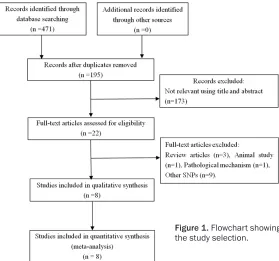
strategy flowchart is shown in Figure 1.
(CIs). Exclusion criteria included: 1) Studies not concerning association between PRM1 gene c.-190C>A polymorphism and male infertility risk; and 2) Articles that were animal studies, review articles, meta-analysis, and conference abstracts or editorial articles.
Quality assessment
Newcastle-Ottawa Scale (NOS) was used to
assess the quality of included studies [18].
NOS contains eight items for both cohort and case-control studies. This scale assesses the
quality of case-control studies based on three
areas: selection, comparability, and exposure. A star rating system was used to judge
method-ological quality. Selection had a maximum of 4
stars, comparability had a maximum of 2 stars, and exposure had a maximum of 3 stars. Total scores ranged from 0 stars (worst) to 9 stars
(best). The quality of each study was graded
as low (0±3), moderate (4±6), or high (7±9). Discrepant opinions were resolved by discus-sion and consensus.
Data extraction strategy
Two investigators independently extracted da- ta, in compliance with inclusion criteria using a standardized data-collection form. Disagre- ements were resolved by discussion and con-Figure 1. Flowchart showing
the study selection.
Inclusion and exclusion criteria
Inclusion criteria of literature were as follows: 1) Full text of the article was available; 2) Case-control studies investi-gating association between PRM1 gene c.-190C>A poly-morphism and male infertility; 3) Genotype distributions we- re available for both cases and controls; 4) There were no duplicate data. For studies that considered partially or fully duplicate data and were by the same authors, the study with the most subjects was selected; 5) Published language was English or Chi- nese; and 6) Genotypic distri-butions were available for es- timation of odds ratios (ORs)
[image:2.612.94.373.72.333.2]sensus. The following information was extract-ed: 1) First author’s name, year of publication, country, and genotyping method; 2) Number of cases and controls; 3) Genotype and allele
fre-quencies; and 4) Results of Hardy-Weinberg equilibrium tests.
Statistical analysis
Meta-analysis of association studies between PRM1 gene c.-190C>A polymorphism and male infertility were estimated by pooled ORs with 95% CI. To perform the meta-analyses, data were entered and analyzed using Reviewer Manager 5.3 and STATA 12.0. Pooled ORs we- re performed in the allele comparison model, dominant model, recessive model, and codomi-nant model. Statistical heterogeneity among studies was estimated using Q-test and I2
sta-tistics. Also, I2 statistics was used to measure
the degree of heterogeneity (I2 = 0%-20%, no
heterogeneity; I2 = 20%-50%, moderate hete-
rogeneity; I2>50%, obvious heterogeneity). A
random-effects model was used to estimate pooled ORs and 95% CIs, as heterogeneity was found with P<0.10 or I2>50. Potential
publica-analysis. Five studies were conducted in Cau- casian populations [19-23] and three involved Asian populations [24-26]. These studies were published between 2008 and 2018. Hardy-Weinberg test (HWE) was performed on all included studies. Results showed that PRM1
gene genotype frequencies of nine studies
[image:3.612.91.528.84.213.2]were in HWE in the controls. Detailed charac-teristics of all included studies are shown in Table 1. Quality of studies based on the NOS scores is presented in Table 2.
Association of PRM1 gene c.-190C>A polymor-phism with male infertility
A total of 8 studies, including 3,382 individ-
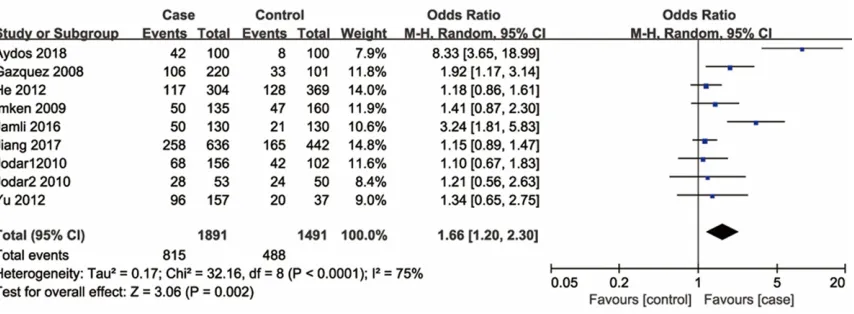
uals, evaluated the influence of PRM1 gene c.-190C>A polymorphisms on risk of male in- fertility. Figures 2-5 show meta-analysis re- sults for the allele model (A vs. C), additive model (AA vs. CC), dominant model (AA+CA vs. CC), and recessive model (AA vs. CA+CC). I2
val-ues, representing the among-study heteroge-neity, were 83%, 57%, 78%, and 57%, respec-tively. Thus, random-effects models were ap-
plied. Overall, results indicate that significant
Table 1. Characteristics of studies included in meta-analysis
Author Year Country Method Case Control Case Control HWE
CC CA AA C A CC CA AA C A
Aydos et al. 2018 Turkey PCR 100 100 58 38 4 154 46 92 8 0 192 8 0.564
Gazquez et al. 2008 Spain PCR sequence 220 101 114 90 16 318 122 68 30 3 166 36 0.887
He et al. 2012 China MassArray 304 369 187 100 17 474 134 241 112 16 594 144 0.523
Imken et al. 2009 Morocco PCR sequence 135 160 85 45 5 215 55 113 42 5 268 52 0.658
Jamli et al. 2016 Iran PCR-RFLP 130 130 80 39 11 199 61 109 20 1 238 22 0.120
Jiang et al. 2017 China MassArray 636 442 378 229 29 985 287 277 144 21 698 186 0.684
Jodar1 et al. 2010 Spain PCR sequence 156 102 88 55 13 231 81 60 38 4 158 46 0.492
Jodar2 et al. 2010 Sweden PCR sequence 53 50 25 27 1 77 29 26 17 7 69 31 0.153
[image:3.612.91.377.249.386.2]Yu et al. 2012 China MassArray 157 37 61 70 26 192 122 17 19 1 53 21 0.086
Table 2. Quality assessment for all included studies
Author Publishing year Selection Comparability Exposure Total
Aydos et al. 2018 ★★★ ★★ ★★ 7
Gazquez et al. 2008 ★★ ★ ★★ 5
He et al. 2012 ★★★ ★ ★★ 6
Imken et al. 2009 ★★ ★ ★★ 5
Jamli et al. 2016 ★★ ★★ ★★ 6
Jiang et al. 2017 ★★ ★ ★★ 5
Jodar1 et al. 2010 ★★★ ★★ ★★ 5
Jodar2 et al. 2010 ★★★ ★★ ★★ 7
Yu et al. 2012 ★★ ★ ★★ 5
tion bias was estimated using funnel plots and Egger’s re- gression test. Sensitivity anal-ysis was performed to evalu-ate the stability of results.
Results
Study characteristics
meta-association was observed between PRM1 gene c.-190C>A polymorphism and male infertility risk (A vs. C: OR = 1.58, 95% CI = 1.17-2.13; AA
[image:4.612.94.524.72.225.2] [image:4.612.100.523.278.433.2]vs. CC: OR = 1.90, 95% CI =1.01-3.56; AA+CA vs. CC: OR = 1.66, 95% CI = 1.20-2.30; AA vs. CA+CC: OR = 1.95, 95% CI = 0.71-5.34). Figure 2. Forest plot of studies assessing association between PRM1 gene c.-190C>A polymorphism and male infertility. (Allelic model: A vs. C).
Figure 3. Forest plot of studies assessing association between PRM1 gene c.-190C>A polymorphism and male infertility. (Additive model: AA vs. CC).
[image:4.612.96.523.483.640.2]Sub-group analyses were performed on data
stratified by ethnicity. Significant association
was observed between PRM1 gene c.-190C>A polymorphism and male infertility risks in
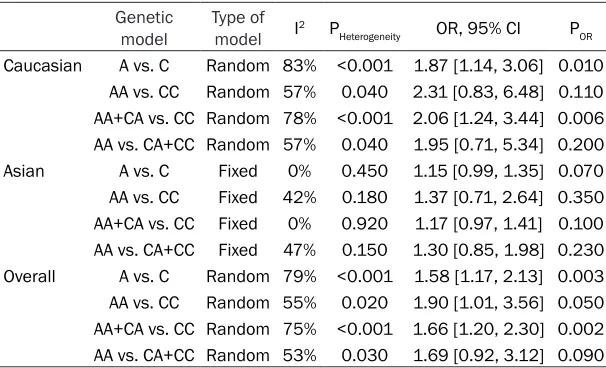
Caucasians. There were no significantly elevat -ed infertility risks associat-ed with PRM1 gene c.-190C>A polymorphism and male infertility in Asians. Results of sub-group analyses for all genetic models are listed in detail in Table 3. Sensitivity and publication bias
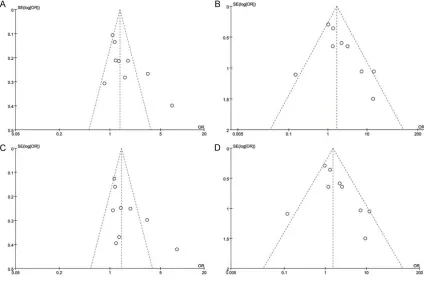
Publication bias was assessed for PRM1 gene c.-190C>A polymorphism by funnel plots, Begg’s test, and Egger’s test, under all contrast models. The shape of the funnel plot did not indicate any evidence of obvious asymmetry in any contrast model for PRM1 gene c.-190C>A
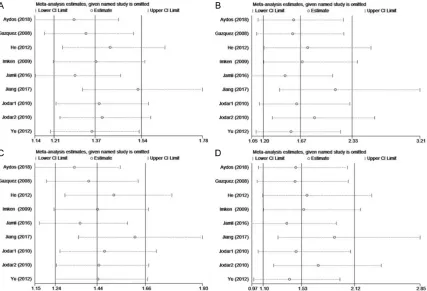
7), indicating that the results of this meta- analysis are relatively stable.
Discussion
This meta-analysis and systemic review investi-gated the association of PRM1 gene c.-190C>A polymorphism and male infertility. This novel data demonstrated that PRM1 gene c.-190C>A polymorphism was correlated with male infer- tility risk in Caucasians, but not in Asians. Patients with the A allele of c.-190C>A gene polymorphism have a higher risk for male
infer-tility. Significant heterogeneity was found
[image:5.612.94.525.73.226.2]be-tween individual studies under the four genetic models (Pheterogeneity<0.05). Subgroup analysis showed that the ethnicity could partially ex- plain the heterogeneity. In subgroup analysis Figure 5. Forest plot of studies assessing association between PRM1 gene c.-190C>A polymorphism and male infertility. (Recessive model: AA vs. CA+CC).
Table 3. Meta-analysis of association of PRM1 gene c.-190C>A poly-morphism with male infertility
Genetic
model Type of model I2 PHeterogeneity OR, 95% CI POR Caucasian A vs. C Random 83% <0.001 1.87 [1.14, 3.06] 0.010
AA vs. CC Random 57% 0.040 2.31 [0.83, 6.48] 0.110 AA+CA vs. CC Random 78% <0.001 2.06 [1.24, 3.44] 0.006 AA vs. CA+CC Random 57% 0.040 1.95 [0.71, 5.34] 0.200 Asian A vs. C Fixed 0% 0.450 1.15 [0.99, 1.35] 0.070 AA vs. CC Fixed 42% 0.180 1.37 [0.71, 2.64] 0.350 AA+CA vs. CC Fixed 0% 0.920 1.17 [0.97, 1.41] 0.100 AA vs. CA+CC Fixed 47% 0.150 1.30 [0.85, 1.98] 0.230 Overall A vs. C Random 79% <0.001 1.58 [1.17, 2.13] 0.003 AA vs. CC Random 55% 0.020 1.90 [1.01, 3.56] 0.050 AA+CA vs. CC Random 75% <0.001 1.66 [1.20, 2.30] 0.002 AA vs. CA+CC Random 53% 0.030 1.69 [0.92, 3.12] 0.090
polymorphism (Figure 6). In addition, Egger’s lin-ear regression analysis suggested no evidence of publication bias (P = 0.054 for an allelic con-trast model, P = 0.146 for an additive model, P = 0.200 for a recessive model, and P = 0.069 for a dominant model) (Table 4). Sensitivity an- alyses were conducted to calculate pooled ORs by omitting one study each time. Results sh- owed that no individu-
[image:5.612.91.394.302.486.2]stratified by ethnicity, heterogeneity still
exist-ed in the Caucasian subgroup (Pheterogeneity< 0.0001) but disappeared in the Asian sub- group (Pheterogeneity = 0.31). This heterogeneity among studies may be due to study differ- ences in genotyping method, population sub-structure, or other factors.
There is considerable experimental evidence that protamines are essential for male infertili-ty. PRM1 and PRM2 play a pivotal role in sperm chromatin condensation and spermatogenesis [27, 28]. Single nucleotide polymorphisms (SNPs) of PRM genes can impair nuclear con-densation, leading to male infertility [29, 30]. Recent studies have revealed that PRM1 gene c.-190C>A polymorphism was associated with
effects of the polymorphism on different ethnic
groups have not been fully clarified. Jamli et al.
studied PRM1 gene c.-190C>A polymorphism in 130 infertile and 130 fertile men in Iran. Results showed that the c.-190C>A transver-sion may involve in susceptibility for oligozoo-spermia. Similarly, Aydos et al. found that PRM1 c.-190C>A polymorphism was associated with sperm DNA fragmentation, possibly impacting male infertility in the Turkish population. However, He et al. found no evidence of an association of this polymorphism with male infertility risk in the Chinese population. This present study revealed that PRM1 c.-190C>A
polymorphism significantly associated with
[image:6.612.93.517.74.355.2]male infertility risk in Caucasians, but not in Asian populations. Inconsistency between the Figure 6. Funnel plots for PRM1 gene c.-190C>A polymorphism and male infertility risk. (A. Allelic model: A vs. C; B. Additive model: AA vs. CC; C. Dominant model: AA+CA vs. CC, D. Recessive model: AA vs. CA+CC).
Table 4. Publication bias test for PRM1 gene c.-190C>A polymor-phism
Comparisons Egger test Begg test
Coefficient P value 95% CI P value A vs. C 3.514 0.054 -0.723 7.101 0.076 AA vs. CC 1.532 0.146 -0.682 3.746 0.251 AA+CA vs. CC 3.073 0.069 -0.319 6.466 0.076 AA vs. CA+CC 1.347 0.200 -0.906 3.600 0.251
[image:6.612.91.374.435.514.2]studies could arise from geographic variations, racial, and ethnic differences in the distribution of polymorphisms in PRM1 genes. However, only 9 studies were included in the meta-analy-sis. Three studies reported a relationship between PRM1 c.-190C>A polymorphism and male infertility risk, but sample sizes were
small. Thus, high-quality studies with larger
sample sizes are needed to further investigate the potential relationship of PRM1 c.-190C>A polymorphism with male infertility risk.
There were some limitations to the present meta-analysis. First, only nine studies were included. Sample sizes of included published
articles were small. Thus, sufficient data was
unavailable. Second, other clinical data such as
source of control, age, semen quality, and so
forth, were not analyzed due to lack of informa-tion. Third, this meta-analysis did not estimate potential interactions among gene-gene and gene-environment due to lack of information in the original studies. Finally, only studies pub-lished in English or Chinese language were
included. Unpublished studies and those in other languages were likely missed.
Conclusion
In summary, this meta-analysis provides evi-dence that PRM1 gene c.-190C>A polymor-phism may contribute to genetic susceptibility to male infertility risk in Caucasians, but not
in Asians. To reach a more definitive conclu -sion, large-scale, well-designed, and popula-tion-based studies are necessary.
Acknowledgements
This study was supported by the Technology Support Plan of Sichuan Province (2017S- Z0149).
Disclosure of conflict of interest
None.
[image:7.612.94.521.72.363.2]Address correspondence to: Dr. Tao Jin, Depart- ment of Urology, Institute of Urology, West China
Hospital, Sichuan University, 37 Guo Xue Road, Chengdu 610041, Sichuan Province, China. E-mail: [email protected]
References
[1] Agarwal A, Mulgund A, Hamada A and Chyatte
MR. A unique view on male infertility around
the globe. Reprod Biol Endocrinol 2015; 13: 37.
[2] Gurunath S, Pandian Z, Anderson RA and
Bhat-tacharya S. Defining infertility-a systematic re -view of prevalence studies. Hum Reprod Up-date 2011; 17: 575-588.
[3] Yu XW, Wei ZT, Jiang YT and Zhang SL. Y chro-mosome azoospermia factor region microdele-tions and transmission characteristics in azo-ospermic and severe oligozoazo-ospermic patients. Int J Clin Exp Med 2015; 8: 14634-14646. [4] Neto FT, Bach PV, Najari BB, Li PS and
Gold-stein M. Genetics of male infertility. Curr Urol Rep 2016; 17: 70.
[5] Rajender S, Avery K and Agarwal A. Epigene- tics, spermatogenesis and male infertility. Mu-tat Res 2011; 727: 62-71.
[6] Grassetti D, Paoli D, Gallo M, D’Ambrosio A, Lombardo F, Lenzi A and Gandini L. Prot-amine-1 and -2 polymorphisms and gene ex-pression in male infertility: an Italian study. J Endocrinol Invest 2012; 35: 882-888.
[7] Tuttelmann F, Krenkova P, Romer S, Nestorovic AR, Ljujic M, Stambergova A, Macek M Jr, Macek M Sr, Nieschlag E, Gromoll J and Simoni M. A common haplotype of protamine 1 and 2 genes is associated with higher sperm counts. Int J Androl 2010; 33: e240-248.
[8] Jiang W, Sun H, Zhang J, Zhou Q, Wu Q, Li T, Zhang C, Li W, Zhang M and Xia X. Polymor-phisms in protamine 1 and protamine 2 pre-dict the risk of male infertility: a meta-analysis. Sci Rep 2015; 5: 15300.
[9] Oliva R and Dixon GH. Vertebrate protamine
gene evolution I. Sequence alignments and
gene structure. J Mol Evol 1990; 30: 333-346. [10] Aoki VW, Emery BR, Liu L and Carrell DT. Prot-amine levels vary between individual sperm cells of infertile human males and correlate with viability and DNA integrity. J Androl 2006; 27: 890-898.
[11] Steger K, Pauls K, Klonisch T, Franke FE and Bergmann M. Expression of protamine-1 and -2 mRNA during human spermiogenesis. Mol Hum Reprod 2000; 6: 219-225.
[12] Dadoune JP. Expression of mammalian sper-matozoal nucleoproteins. Microsc Res Tech 2003; 61: 56-75.
[13] Bao J and Bedford MT. Epigenetic regulation of the histone-to-protamine transition during
spermiogenesis. Reproduction 2016; 151: R55-70.
[14] Gou LT, Kang JY, Dai P, Wang X, Li F, Zhao S, Zhang M, Hua MM, Lu Y, Zhu Y, Li Z, Chen H, Wu LG, Li D, Fu XD, Li J, Shi HJ and Liu MF.
Ubiquitination-deficient mutations in human
piwi cause male infertility by impairing histone-to-protamine exchange during spermiogene-sis. Cell 2017; 169: 1090-1104.
[15] Carrell DT, Emery BR and Hammoud S. The ae-tiology of sperm protamine abnormalities and their potential impact on the sperm epig-enome. Int J Androl 2008; 31: 537-545. [16] Carrell DT, Emery BR and Hammoud S. Altered
protamine expression and diminished sper-matogenesis: what is the link? Hum Reprod Update 2007; 13: 313-327.
[17] Cho C, Willis WD, Goulding EH, Jung-Ha H, Choi
YC, Hecht NB and Eddy EM. Haploinsufficiency
of protamine-1 or -2 causes infertility in mice. Nat Genet 2001; 28: 82-86.
[18] Stang A. Critical evaluation of the
Newcastle-Ottawa scale for the assessment of the quality
of nonrandomized studies in meta-analyses. Eur J Epidemiol 2010; 25: 603-605.
[19] Aydos OSE, Hekmatshoar Y, Altinok B, Ozkan T, Sakiragaoglu O, Karadag A, Kaplan F, Ilgaz S, Taspinar M, Yukselen I, Sunguroglu A and Ay-dos K. Genetic polymorphisms in PRM1, PRM2, and YBX2 genes are associated with male factor infertility. Genet Test Mol Biomark-ers 2018; 22: 55-61.
[20] Jamali S, Karimian M, Nikzad H and Aftabi Y. The c.-190 C>A transversion in promoter re-gion of protamine1 gene as a genetic risk fac-tor for idiopathic oligozoospermia. Mol Biol Rep 2016; 43: 795-802.
[21] Imken L, Rouba H, El Houate B, Louanjli N,
Barakat A, Chafik A and McElreavey K. Muta -tions in the protamine locus: association with spermatogenic failure? Mol Hum Reprod 2009; 15: 733-738.
[22] Gazquez C, Oriola J, de Mateo S, Vidal-Taboada
JM, Ballesca JL and Oliva R. A common prot-amine 1 promoter polymorphism (-190 C->A) correlates with abnormal sperm morphology and increased protamine P1/P2 ratio in infer-tile patients. J Androl 2008; 29: 540-548. [23] Jodar M, Oriola J, Mestre G, Castillo J,
Giwerc-man A, Vidal-Taboada JM, Ballesca JL and Oli-va R. Polymorphisms, haplotypes and muta-tions in the protamine 1 and 2 genes. Int J Androl 2011; 34: 470-485.
[24] Yu QF, Yang XX, Li FX, Ye LW, Wu YS and Mao XM. Association of PRM1-190C- > A polymor-phism with teratozoospermia. Zhonghua Nan Ke Xue 2012; 18: 314-317.
rs35576928 (Arg>Ser) is associated with de-fective spermatogenesis in the Chinese Han population. Reprod Biomed Online 2012; 25: 627-634.
[26] Jiang W, Zhu P, Zhang J, Wu Q, Li W, Liu S, Ni M, Yu M, Cao J, Li Y, Cui Y and Xia X. Polymor-phisms of protamine genes contribute to male infertility susceptibility in the Chinese Han population. Oncotarget 2017; 8: 61637-61645.
[27] Kanippayoor RL, Alpern JH and Moehring AJ. Protamines and spermatogenesis in drosophi-la and homo sapiens: a comparative analysis. Spermatogenesis 2013; 3: e24376.
[28] Depa-Martynow M, Kempisty B, Jagodzinski PP, Pawelczyk L and Jedrzejczak P. Impact of protamine transcripts and their proteins on the
quality and fertilization ability of sperm and the
development of preimplantation embryos. Re-prod Biol 2012; 12: 57-72.
[29] Siasi E, Aleyasin A, Mowla J and Sahebkashaf H. Association study of six SNPs in PRM1, PRM2 and TNP2 genes in iranian infertile men with idiopathic azoospermia. Iran J Reprod Med 2012; 10: 329-336.