Knowledge Management Practices in Higher
Education: Attaining competitive Advantage
Neena Sohani1, Nagendra Sohani2
1
Patel Grop of Institutions, Indore
2
IET DAVV, Indore
Abstract: Knowledge management is the process of retrieving, protecting, shielding, using and managing the available knowledge. It has gained huge importance in the Industrial, Institutional and Business world . It is considered as tool for the effective decision making and attaining competitive advantage. Educational Institutes are ocean of knowledge and hold the prime responsibility of effective creation and successful dissemination of the knowledge, it is viewed that the knowledge management practices have greater application to the educational institutions. Knowledge Management (KM) comprises a range of strategies and practices used in an organization to identify, create, represent, distribute, and enable adoption of insights and experiences. Such insights and experiences comprise knowledge, either embodied in individuals or embedded in organizational processes or practice. This research bases on the key success factors of the KM and applies to the Fuzzy Comprehensive Evaluation (FCE) and Analytical Hierarchy Process (AHP) to calculate the level of Knowledge Management for Educational Institutions.
Keywords: Knowledge, Knowledge Management, FCE, AHP.
I. INTRODUCTION
Knowledge is an intangible asset and is the part of intellectual capital. It is the most valuable and influencing asset for an organization and provides a base for driving research, development and innovation. It provides an organizational growth driven by the excellence Knowledge management. Various practices are adopted by the organizations to manage this valuable asset for better decision making and ensuring the competitiveness. Knowledge Management (KM) comprises a range of strategies and practices used in an organization to identify, create, represent, distribute, share and enable adoption of insights and experiences. Such insights and experiences comprise knowledge, either embodied in individuals or embedded in organizational processes or practice. It is a management practice whose core is knowledge, and a series of process management that is collections, organization, innovation, diffusion, use and development of knowledge. It is a management philosophy and methods, through the systematic use of information content, processes and expert skills; it can improve the innovative capability of organisation . The content of knowledge management includes the contents of a system. The main content of knowledge management include four parts: knowledge acquisition, knowledge management systems, knowledge sharing, and knowledge utilization. These four sections are closely connected, interdependent and mutually reinforcing. Educational Institutions face huge competition. Due to the introduction of competition in the market, these Educational Institutions face unprecedented challenges. Therefore, KM is of extreme importance to these institutions.
II. EVALUATION OF KNOWLEDGE MANAGEMENT IN HIGHER EDUCATION
Primarily the Higher Educational Institutions have the responsibility to create and disseminate the in depth knowledge of various fields. Being the significant source of enormous information, knowledge and insights, these institutions have the great opportunities to implement the Knowledge management tools and techniques. Knowledge management underlines the learning and inheritance of human knowledge, and emphasize on creation, accumulation, use and updates of internal knowledge. Through the implementation of knowledge management, colleges can update and manage their knowledge innovation to create favorable conditions and environment, and can achieve the best combination and effective use of the knowledge of their faculty members . Application of knowledge management practices in Higher education can lead to better decision-making capabilities, curriculum development and research, improved academic and administrative services and reduced costs [1].
handling the future of the country.They provide services which lead and represent the nation at the global level. For this purpose we follow the principles of scientific, systematic, hierarchical nature, practicality and operability.
Education in India has witnessed a tremendous growth in the last two decades with the growing number of providers as well as takers of higher education. The number of students has increased with the increasing awareness and rising importance of education. Also, there has been massive increase in the number of educational institutions with the upcoming of private providers. The present situation is such that the educational institutions are facing a lot of competition from each other. The institutions are striving to improve their standards, quality and adding more and more value to the services in order to attract quality students and faculty. Here arises the need to implement the knowledge management practices in the educational institutions to accomplish their mission, be competitive, remain innovative, and ensuring the satisfaction of stakeholder’s expectations.[2]
III. ANALYTICAL HIERARCHY PROCESS
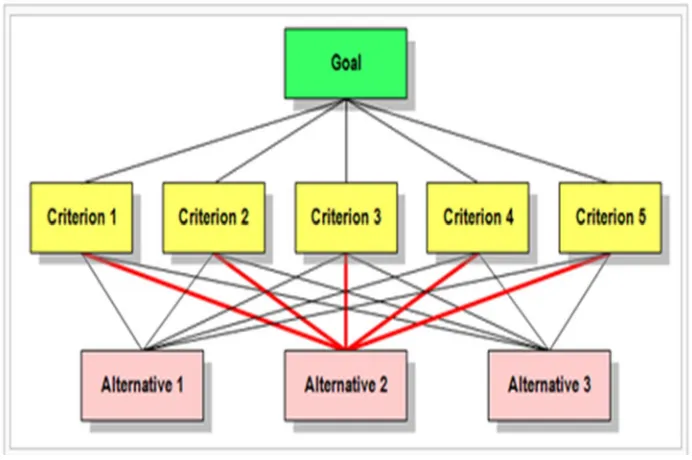
The Analytic Hierarchy Process (AHP) is a structured technique for helping people deal with complex decisions. Rather than prescribing a "correct" decision, the AHP helps people to determine one. An AHP hierarchy is a structured means of describing the problem at hand. It consists of an overall goal, a group of options or alternatives for reaching the goal, and a group of factors or criteria that relate the alternatives to the goal. In most cases the criteria are further broken down into sub criteria, sub-sub criteria, and so on, in as many levels as the problem requires (Fig. 1).The hierarchy can be visualized as a diagram like the one below, with the goal at the top, the alternatives at the bottom, and the criteria filling up the middle. In such diagrams, each box is called a node. The boxes descending from any node are called its children. The node from which a child node descends is called its parent. Applying these definitions to the diagram below, the five Criteria are children of the Goal, and the Goal is the parent of each of the five Criteria. Each Alternative is the child of each of the Criteria, and each Criterion is the parent of three Alternatives.
[image:2.612.122.468.344.574.2]
FIG. 1 – Hierarchical Structure for AHP (Thomas L. Saaty, 2008)
Table.1– Pair Wise Comparison Scale (Thomas L. Saaty, 2008)
A. Saaty [3] Developed the following steps for applying AHP 1) Define the problem and determine its goal,
2) Structure the hierarchy with the decision maker’s objective at the top with the intermediate levels capturing criteria on which subsequent levels depend and the bottom level containing the alternatives, and
3) Construct the set of n× n pair wise comparison matrices for each to the lower levels with one matrix for each element in the level immediately above. The pair wise comparisons are made suing the relative measurement scale (as discussed above). The pair wise comparisons capture a decision maker’s perception of which element dominates the other.
4) There are n(n-1)/2 judgments required to develop the set of matrices in step 3. Reciprocals are automatically assigned in each pair wise comparison.
5) The hierarchy synthesis function is used to weight the eigenvectors by the weights of the criteria and the sum is taken over all weighted eigenvector entries corresponding to those in the next lower level of the hierarchy.
6) After all the pair wise comparisons are completed, the consistency of the comparisons is assessed by using the Eigen value, λ, to calculate a consistency index, CI:
CI = (λ-n)/ (n-1).
Where n is the matrix size. Judgment consistency can be checked by taking the consistency ratio (CR) of CI with the appropriate value in table 2, given below. Saaty suggests that the CR is acceptable if it does not exceed 0.10. If the CR is greater than 0.10, the judgment matrix should be considered inconsistent. To obtain a consistent matrix, the judgments should be reviewed and repeated.
TABLE.2-AVERAGE RANDOM CONSISTENCY INDEX
Size of Matrix 1 2 3 4 5 6 7 8 9 10
Random Consistency 0.00 0.00 0.58 0.90 1.12 1.24 1.32 1.41 1.45 1.49
IV. LITRETURE REVIEW
management process models into product development process models. In the approach, a method named knowledge-based engineering process model is adopted as the method of modeling a product development process. To realize the integration between knowledge management process model sand the product development process models, a basic rule, considering the knowledge management process as a special kind of sub-process in product development processes, is followed. Maryam Alavi and Dorothy E. Leidner [8] focus on achieving the correct amount and type of accurate knowledge and garnering support for contributing to the Knowledge Management System (KMS). Yang Tong [9] classifies and concludes the risks existed in knowledge management from a view of identification. The research has been divided into following aspects of knowledge assets at risk: the risk of knowledge spillovers, knowledge conversion risk, the risk of wastage, leakage risks, contractual risks, moral hazard from Knowledge and knowledge of risk vector.
Thomas L. Saaty [3] tells that the Analytic Hierarchy Process (AHP) is a theory of measurement through pair wise comparisons and relies on the judgments of experts to derive priority scales. It is these scales that measure intangibles in relative terms. The comparisons are made using a scale of absolute judgments that represents how much more; one element dominates another with respect to a given attribute. The judgments may be inconsistent, and how to measure inconsistency and improve the judgments, when possible to obtain better consistency is a concern of the AHP. The derived priority scales are synthesized by multiplying them by the priority of their parent nodes and adding for all such nodes. He also tells that Analytic Hierarchy Process (AHP) is a theory of relative measurement with absolute scales of both tangible and intangible criteria based on the judgment of knowledgeable and expert people. How to measure intangibles is the main concern of the mathematics of the AHP. The AHP reduces a multidimensional problem into a one dimensional one. Decisions are determined by a single number for the best outcome or by a vector of priorities that gives an ordering of the different possible outcomes. We can also combine our judgments or our final choices obtained from a group when we wish to cooperate to agree on a single outcome.
Jay Liebowitz [10] discusses about the novel approach in applying the analytic hierarchy process (AHP) to generate the ratio scores for the valued graphs to be used in Social Network Analysis (SNA) in order to develop a knowledge map of the organization. According to him it quantifies subjective judgments used in decision-making, and has been applied in numerous applications throughout the world. Kamal M. Al-Subhi and Al-Harbi [11] tell that the Analytical Hierarchy Process (AHP) as a potential decision making method for use in project management. They used contractor prequalification problem as an example. For this a hierarchical structure is constructed for the prequalification criteria and the contractors wishing to prequalify for a project. They found that by applying the AHP, the prequalification criteria can be prioritized and a descending-order list of contractors can be made in order to select the best contractors to perform the project. Their paper presents group decision-making using the AHP.[12] used a supplier selection analysis model with the help of AHP method.
V. THE EVALUATING MODEL CONSTRUCTION
When enterprises evaluate a thing, which have n index factors, they are marked as c1,c2,c3……… cn. These index factors compose a finite set C.
C = { c1,c2,c3………..cn}
According to actual needs, the revies are divided into m degree v1,v2,v3………..vm. they compose a finite set of reviews V. V= {v1,v2,v3………..vm}
When enterprises need to value a thing from a several different aspects, te result is compressive. The result is a fuzzy set B from reviews set V. Because V is a finite set, B is also a finite set.
B = b1/v1+ b2/v2 + b3/v3+bm/vm. (1)
It abbreviate as m dimension fuzzy vectors: B= {b1, b2, b3………bm}
Its case is V, and bj is the membership of the corresponding elements in B and bj Є [0,1] = 1,2,3…………m.
In the actual evaluating, the importance of each element is different. This is an objective fact. The set of factors is fuzzy one. A, which is the elements set U in the case; A is also a finite set. So the factor set is also a finite fuzzy set.
A = a1/c1 + a2/c2 + a3/c3………. an/cn
Similarly, A can also be said by n- dimensional fuzzy vectors. A = (a1, a2, a3……… an)
r11 r12 ……. r1m
r 21 r22 …….. r2m
:
: : : :
r n1 r n2 …….. rnm
This is fuzzy comprehension evaluation model. B is the result of the fuzzy comprehension evaluation, and it is m- dimensional fuzzy row vectors; A is the weight set of the model, and it is n- dimensional fuzzy row vectors; R is the fuzzy relations from C to V, and it is a n×m matrix, in which the rij is the possibility of remark j for element i.[13]
VI. ORGANIZATIONAL PERFORMANCE AND EFFECTIVENESS
In this study three different higher education institutions selected for the analysis . InThe effective application of the knowledge management strategy and practices in the higher education institutions can result significant improvement in the functioning and operations of the institutions. Following factors affect performance of higher education institutions. The knowledge management practices ensure the effectiveness in the services provided by these institutions to its various stack holders ie. students, alumni, faculty, employees, industry, The institute is expected to inculcate and enhance the students knowledge, learning experience and broadening their thinking and practical abilities. The students will be benefitted with opportunity to have better placements and better packages. The effective application of knowledge management will also help the institute to redesign, refine and update the curriculum according to the industry needs considering the national and international demands. The knowledge management practices will help in faculty growth and development, enhancing their knowledge, exposure and contribution to research and development and ultimately lob satisfaction. The good knowledge management practices will increase the Industry- Academia interface and can lead to have the better solutions to the actual industrial problems and greater learning and practical knowledge to the students and faculty.
Higher education institutes required to work on following domains Domain Impact of KM Intervention Administrative
Planning and Development
Establishment and measurement of goals, objectives and targets Development of more relevant and focused policies
Focus of strategic planning efforts towards institutional goals and objectives Improved effectiveness and efficiency of the administrative services Enhanced responsiveness and accountability
Efficient decision making
Research Enhanced research and Motivation for research Facilitation for inter disciplinary research Utilization of institutional resources and facilities Teaching and Learning
Process
Effective teaching and learning process Better and modern teaching methodologies
Improved relevance of courses for industry practices Motivation towards research in selected areas Performance
Evaluation of Faculty
Enhanced support to retention and promotion Better succession planning implementation
Enhanced plans for faculty development, training programs and QIPs Motivation , Self Improvement and career development plans
Student Affairs Improved availability and accessibility of institutional resources to students Enhanced services offered to students Better placements and Enhanced
In this paper we did criteria evaluation for decision making . the major dimensions sected are 1. Student Development 2. Teaching Learnig and Evaluation. 3. Top Management Support. These Dimensions are sub divided in sub criteria the details of which are given as follows. Fig.2 shows the hierarchical structure.
Fig.2 – Hierarchical Structrue for Knowledge Management Level Evaluation
The detailed evaluation plan is given as follows:
A. Determine the reviews set, V= {Strongest, Stronger, Strong, Weak and Weaker} to determine the KM level. The factors are constructed on the basis of examination of the education system analyzed by various experts, faculty members, students and parents.
B. Comparison matrix is constructed according to hierarchical structure model for one institution.
C. Students, Faculty members and Administration gave their opinions on the basis of questionnaire .On the basis of these opinions, experts give the weights to different colleges.
TABLE.2-COMPARISON MATRIX FOR C-CK
C C1 C2 C3 W
C1 1 1/5 1/3 0.1042
C2 5 1 3 0.6372
C3 3 1/3 1 0.2583
Σ 9 1.5333 4.333 1.000
λ max = 3.0341, CI = 0.0179, RI= 0.58, CR = 0.0332 < 0.10
Calculations for λ max, CI, RI and CR:
λ max = 9(0.1042) + 1.5333(0.6372)+ 4.333(0.2583) = 3.0341 CI = (3.0358- 3)/2 = 0.0179
RI = 0.58 (From Table.1)
& CR = CI/RI = 0.0179/0.58 = 0.030 < 0.10
TABLE.3-COMPARISON MATRIX FOR CK-CIJ
C C11 C12 C13 W
C11 1 1/3 1/5 0.1061
C12 3 1 1/3 0.2604
C13 5 3 1 0. 6334
λ max = 3.0385, CI = 0.0192, RI= 0.58, CR = 0.0332 < 0.10
Knowledge Management - C
Student Developement- C1
Improved availability and accessibility of institutional resources to students-
C11
Enhanced services offered to students -
C12
Better placements-
C13
Teaching Learning and evaluationG - C2
Curriculam Develeope
ment and Quality- C21
Effective Teaching Learning Processand Methodolog y - C22
Research Motivation -
C23
Faculty Developem
ent and Growth- C24
Administrative Services - C3
Establishme nt of goals
and objectives -
C31
Effective and efficient administrati ve services -
C32
TABLE.4-COMPARISON MATRIX FOR C2-CIJ
C C21 C22 C23 C24 W
C21 1 3 1/3 1 0. 20087
C22 1/3 1 1/5 1/3 0.07885
C23 3 5 1 3 0.51941
C24 1 3 1/3 1 0.20087
λ max = 4.0428, CI = 0.01426, RI= 0.90, CR = 0.0158 < 0.10
TABLE.5-COMPARISON MATRIX FOR C3-CIJ
C C31 C32 C33 W
C31 1 1/5 1/3 0.1042
C32 5 1 3 0.6372
C33 3 1/3 1 0.2583
λ max = 3.0341, CI = 0.0179, RI= 0.58, CR = 0.0332 < 0.10
TABLE.6-WEIGHTS FOR STUDENT DEVELOPMENT Ck • Student Development- (1.042)
Cij 0.1061 0.2604 0. 6334
Strongest 0.3 0.4 0.3
Stronger 0.4 0.3 0.2
Strong 0.2 0.1 0.2
Weak 0.1 0.1 0.2
Weaker 0 0.1 0.1
TABLE.7-TEACHING LEARNING AND EVALUATION
Ck • Teaching Learning and evaluation (0.6372) Cij 0. 20087 0.07885 0.51941 0.20087
Strongest 0.3 0.4 0.3 0.3
Stronger 0.3 0.2 0.2 0.4
Strong 0.2 0.1 0.2 0.2
Weak 0.1 0.1 0.2 0.1
Weaker 0.1 0.1 0.1 0
TABLE.8-WEIGHTS FOR EXAM PATTERN
Ck • Administrative Services (0.2583)
Cij 0.1042 0.6372 0.2583
Strongest 0.4 0.2 0.4
Stronger 0.2 0.4 0.2
Strong 0.1 0.3 0.1
Weak 0.2 0.1 0.1
Weaker 0.1 0 0.2
The above digitals can be used to investigate, = (0.1061 0.2064 0.6334).
0.3 0.4 0.2 0.1 0
0.4 0.3 0.1 0.1 0.1
B1 = (0.3044 0.2310 0.1685 0.1579 0.0840) Similarly, we can get
B2 = (0.3079 0.2603 0.1921 0.1519 0.0799), and B3 = (0.2724 0.3274 0.2274 0.1104 0.0621) So, B = Uk .
OR
= (0.1042 0.6372 0.2583).
B = (0.2983 0.2745 0.1987 0.1418 0.0757) If V= (2,1,0,-1,-2), then the result will be
KML1 = (0.2983 0.2745 0.1987 0.1418 0.0757). (2,1,0,-1,-2)
KML1 = 0.5779, where KM1.= Knowledge Management level of Ist college. Proceeding in the similar manner we can get KML2 = 0.1310 and KML3 = 0.6995.
The above result shows that KM level of third educational institution is best among all the three institutions.
VII. CONCLUSIONS
Today, higher education play an important role in shaping the future of the country, so the evaluation of their knowledge management level is of great significance. In this paper, we have used the Analytical Hierarchy process combined with Fuzzy Comprehensive Evaluation Technique to evaluate the level of knowledge management for higher education Educational Institutions which seems to be worthwhile in taking such a type of decisions, as it gives the results in the form of numerical quantities which is very helpful in understanding the underlying problem. From this research work we can conclude that the average knowledge management level of the Educational Institutions is still very low and there is a strong need of taking corrective actions in this direction.
REFERENCES
[1] Ali, Q. & Yousaf, M. J., “An Analytical study of the Prospects and Challenges of Applying Knowledge Management in Educational Institutions”, International Journal of Management & Organizational Studies, Vol.2(1), pp.1-8. 2013
[2] Jafferey W. Alstet, “ Knowledge Management in Higher Education: A Critical Analysis”, Knowledge Management Research and Practices, Vol.4(3), pp.252-252, 2017
[3] Thomas L. Saaty, “Decision making with the analytic hierarchy process”, Int. J. Services Sciences, Vol. 1, No. 1, pp.13-29, 2008
[4] Robert G. and Eure, P.E, “Knowledge Management As an Integral Component of Systems Engineering .Incose”, International Council of System Engineering. 2009
[5] Rizwana Irfan, Maqbool uddin-Shaikh, “Enhanced Knowledge Management Process for Group Decision Making”, Second IEEE International Conference on Future Information Technology and Management Engineering. 2010.
[6] NIU Dongxiao, LI Jianqing, “Evaluation on the Level of generation Enterprise Knowledge Management Based on AHP and Gray Relational Analysis”, IEEE International Conference. 2010,
[7] Qian-Wang Deng, Yong-Zheng Tian, “Modeling Knowledge Management Processes from Perspectives of Knowledge Agents”. IEEE International Conference. 2008.
[8] Maryam Alavi and Dorothy E. Leidner, “Knowledge Management Systems: Issues, Challenges, and Benefits. Association for Information Systems”. 1999. [9] Yang Tong, “Summary Research of Risk Identification in the Process of Knowledge Management”, Second IEEE International Conference on Future
Information Technology and Management Engineering. 2009
[10] Jay Liebowitz Linking, “Social Network Analysis with the Analytic Hierarchy Process for Knowledge Mapping in Organizations”, Journal Of Knowledge Management, Vol. 9 No. 1, pp. 76-86, 2005
[11] Kamal M. Al-Subhi Al-Harbi, “Application of the AHP in Project Management”, International Journal of Project Management Vol. 1, pp 19-25, 2001 [12] Heung-Suk Hwang, Chiung Moon, Chun-Ling Chuang and Meng-Jong Goan3, “Supplier Selection and Planning Model Using AHP” , International Journal of
the Information Systems for Logistics and Management (IJISLM), Vol. 1, No. 1, pp. 47-53, 2005
[13] Ting Wang and Lifeng Li, “ A New Hybrid Method to Evaluate the HPR Performance Based on FCE and AHP”, Third IEEE, Computer society’s International Conference on Knowledge Discovery and Data Mining. 2010
B1
B2
B3