Enhanced DSR-An Efficient Routing Protocol for
MANET
Ms. P. A. Madnaik1, Prof. Mrs. P.P. Belagali2
1
ME, E&TC Eng., JJMCOE, Jaysingpur
2
Associate Professor of E&TC Engg, JJMCOE, Jaysingpur
Abstract: An ad-hoc network is a group of wireless mobile nodes which are self-creating, self-organizing, and self-administering. The main aim of this network is selection of routing protocol which may enhance the performance of ad-hoc networks in terms of Energy consumption, average end to end delay, average jitter and throughput, Packet delivery ratio. To fulfill this aim, an efficient algorithm viz. enhanced DSR (EDSR) is proposed in the present work. In this algorithm the flooding of RREQ (route request) packets in the network reduces which results in the reduced congestion and energy consumption. In this when a node receives a RREQ packet it checks, its own residual battery. If the defined thresholds for the node for these mentioned parameters satisfy then the RREQ packet will be forwarded in the network. If it doesn't meet the defined threshold, the RREQ packet will be discarded. Hence the proposed algorithm prohibits the unnecessary flooding of RREQ packets. This results in the improved system performance.
Keywords: Ad hoc networks, EDSR, flooding, RREQ, routing protocols.
I. INTRODUCTION
In infrastructure Network, the communication occurs only between the wireless nodes and access points (AP), but not directly between wireless nodes. In ad-hoc network, each node communicates directly with other nodes, so no access point control is needed. Ad-hoc networks are wireless networks such kind of networks is created dynamically. However, when the number of nodes in the network increases to Hundreds or even thousands, the mass control message will even block the data transmission.
Routing protocols are the software that allow routers to dynamically advertise and learn routes, determine which routes are available and which are the most efficient routes to a destination. Routing protocols between any pair of nodes within an ad hoc network can be difficult because the nodes can move randomly and can also join or leave the network. This means that an efficient route at a certain time may not work seconds later. Routing in a MANET depends on many other factors including topology, selection of routers and location of request initiator because of that it is difficult to finding the path quickly and efficiently.
In present work we have proposed an efficient and simple algorithm which reduces the number of RREQ packets flooded in order to enhance the performance of an Ad-hoc network. This algorithm modify the route discovery mechanism at intermediate nodes. The alteration process includes modification of Route discovery mechanism by defining Threshold. In this process those nodes are discarded which don't possess the defined conditions. Therefore those nodes will not further forward route request packets. Hence congestion in network will reduce.
II. NEED FOR REDUCING THE ROUTE REQUESTS IN AD-HOC NETWORK
The dynamic source routing protocol (DSR) is a reactive MANET routing protocol. When source node communicating a destination node which is not present in the route cache of the source node, it will buffer the data packets and broadcast a route request (RREQ) into the neighboring node. The neighboring DSR nodes broadcast the RREQ packet to the intended destination node. The destination node then will send a Route Reply (RREP) on the reverse route back to the source node.
If no RREP is received after a fixed number of attempts and within the time, the data packets from the buffer will be dropped. If more number of data packets are received, a new route discovery process will be initiated. Increasing number of route requests will saturate the network which makes it unable for further transmission of data packets. Proactive routing protocol is on demand because of flooding it can seriouslydegrade the performance of reactive routing protocols andaffect a node in the following ways:
During the process of route discovery the data packetsare buffered in the memory. The increased number of RREQ packets in the
network results in increase in collisions, congestion as well as delay for the data packets in the network.
III. BASIC DSR OPERATION
A. Existing DSR Algorithm:
In existing DSR algorithm when the packet arrives, first of all, node checks following conditions/possibilities:
1) If it is RREQ packet then the route discovery mechanism initiates and the step one of the algorithm (shown in fig.3.4.2) will be executed.
2) If it is RREP packet then route reply mechanism works and the step two of the algorithm (shown in fig 3.4.3) will be executed.
3) If it is data packet then data is forwarded from source to destination. This is shown in figure (3.4.1).
False False
True
True
Fig.1 Flowchart of Existing DSR Algorithm.
B. Route Discovery Mechanism
Route discovery mechanism is as follows:
1) When RREQ flooded, it reaches to the nodes which are in the transmission range of source node. When a node receive a RREQ packet, following conditions/possibilities will be checked:
a) If it is the destination node, it sends a route reply to the sender.
b) If this node receiving the route request has recently seen another route request message from this initiator bearing the same request identification and target address it discard the request.
OR
If this node's own address is already listed in the route record in the route request, this node discards the request.
c) If the above condition does not hold then the node add it's on address in the request packet and forward it.
False False
True
True
Extract the packet
Packet type is route discovery Packet type is
route discovery Packet type is
route discovery
Route discovery mechanism
Route Reply mechanism Data transmission
Receive the packet
Destination is my id
Load the packet
Route reply mechanism
Packet with same id
C. Route Reply Mechanism
Route Reply mechanism is as follows
1) If routes are bidirectional, then reverse path is set up and place that path in the header of the packet and forward it to the source.
2) Otherwise, if an entry to the source node exists in the route cache of destination node, forward the packet to the source by using that route.
3) If above condition does not happen, then destination initiates the route discovery for source node, but to avoid possible infinite recursion of route discoveries, it must piggyback this route reply on the packet containing its own route request for source.
False False False
False
True
True
Fig.3.Flowchart of route reply mechanism.
IV. PROPOSED EDSR ALGORITHM
The flow chart of proposed algorithm viz. EDSR is shown in figure. It shows the mechanism of forwarding the route request packets by the intermediate nodes.
For proposed EDSR the modifications made in route discovery process only, which is as follows:
1) When RREQ flooded, it reaches to the nodes which are in the transmission range of source node. When a node receive a RREQ packet, following conditions/possibilities will be checked:
2) If it is the destination node, it sends a route reply to the sender.
3) Else if this node receiving the route request has recently seen another route request message from this initiator bearing the same request identification and target address, or if this node’s own address is already listed in the route record in the route request, this node discard the request.
Else
If {value of the received signal strength is less than the threshold received signal strength i.e. = 10J} Discard the request.
Load the packet
Route reply
Routes are bidirection al
Reverse the path
Place the header and forward the packet to the source
An entry to the source node exist in the route cache of the destination node
Forward the route reply packet to the source by using route
Else the node adds its own address in the request packet and forwards it.
False False False
True True
[image:4.612.61.483.94.290.2]True
Fig.4. Flowchart of Proposed EDSR Algorithm.
V. IMPLEMENTATION AND RESULT
[image:4.612.157.444.361.637.2]Table no.1 shows the Parameter configuration used while performing simulation experiments. The various combinations used shows variation in results which are detailed further simulation code has been developed in NS2.
Table no.1- Parameter configuration
Simulator Used Ns-2
Protocol Under Test DSR,EDSR
Node 10,20,50,60,240
Dimension Of Simulation Area 756 X 599
Simulation Time 1000 Sec
Traffic Type CBR
Packet Size UDP 1000 Bytes
Fig no.5: Throughput Graph
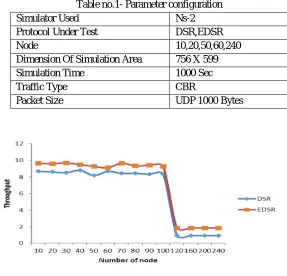
The figure 5 shows throughput of the network vs .number of nodes. The better performance of ESDSR as compare to DSR this is due to Reduction in congestion, Bandwidth consumption and Delay. Hence for EDSR number of successful bits received per second increases and throughput increases. The graph show the values of throughput on different number of nodes like after 10, 20, 30, 50 and 240 nodes
Receive the packet
Load the packet
Route reply mechanism
Discard the packet Discard the packet
Path id is my id
Forward the packet Destination
is my id
Packet with same id
Fig no.6: PDR graph
[image:5.612.154.466.324.413.2]The Packet Delivery ratio is that is packet deliver to the destination is higher in EDSR as compared to DSR. The figure 6 shows the better performance of EDSR as compare to DSR. ESDSR provides considerable improvement of PDF. This indicates that EDSR is more resistive in stressful situation than DSR because it uses transmit power control. The transmit power control reduces the collision rate of the packets. Even the stress (number of connections and traffics) is high, every data packet must be transmitted with appropriate power level.
Fig no.7: Average Energy consumption graph.
The figure 7 shows the graph of average energy consumption vs. number of nodes and the nodes in EDSR will consume less energy as compare to the nodes in DSR. The green line shows the average energy consumption of DSR and red line shows the average energy consumption of EDSR on different number of nodes. We compare the values of average energy consumption on different number of nodes.
It can be seen from graphs that average energy consumption in EDSR based network is reduced compared to DSR based network.
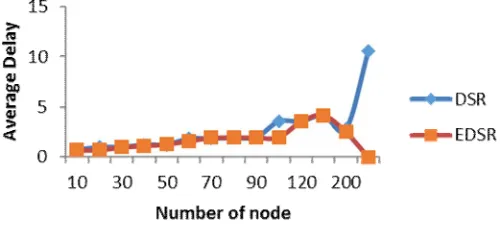
Fig no.8: End to End Delay graph.
[image:5.612.184.434.510.627.2]Fig no.9: Jitter graph
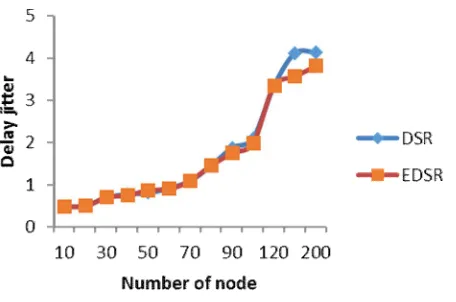
The results in figure 9 it can be observed that jitter in ESDSR is less than DSR. As end to end delay is less and also, reliable path assures maximum delivery success, number of retransmissions and fixed path scenarios assures effectively fixed and less delays. Hence jitter is less in ESDSR compared to DSR.
VI. CONCLUSION
The main important task in MANET is Need of controlling the flooding of RREQ because it consumes more power and bandwidth of the network due to that high congestion and delay in the network. In EDSR Modification in route discovery mechanism reduces congestion and energy consumption by not taking into account those nodes whose battery is lesser than the defined threshold level. If following assumptions are not considered the chances of network failure increases and saturate the network. It results in increased throughput and average Energy consumption of the node and decreased average end to end delay and jitter.
In designing the routing protocol there are lot of problem but Energy efficiency is the main problem. Modifying the DSR protocol less energy consumed. In Particular in small size networks DSR are comparable. But in medium and large size network the EDSR produce good result and the performance of EDSR in terms of throughput is good.
REFERENCES
[1] Mohamed Sharifdeen., Dhavamaniprakash .D“An Energy Efficient DSR Routing Protocol for Energy Consumption in MANET”International Journal of Innovative Research in Science, Engineering and Technology, Vol. 4, Special Issue 6, May 2015.
[2] SukantKishoroBisoy, Prasant Kumar Pattnaik, “Analysis of a Network of AQM Router Supporting TCP Flows and Comparison with XCP” Fourth International Conference of Emerging Applications of Information Technology DOI 10.1109/EAIT.2014.32 978-1-4799-4272-5/14 © IEEE 2014.
[3] SnehaV.Sangolli, JayavigneshThyagarajan,”An Efficient Congestion Control Scheme Using Cross-Layered Approach and Comparison of TCP Variants for Mobile Ad-hoc Networks (MANETs)”First International Conference on Networks & Soft Computing978-1-4799-3486-7/14/ IEEE2014.
[4] TaranpreetKaur , Amanjot Singh Toor , Krishan Kumar Saluja,“Defending MANETs against Flooding Attacks for Military Applications under Group Mobility” Proceedings of 2014 RAECS VIET Punjab University Chandigarh, 06 - 08 March, 2014.
[5] Shyam Singh Rajput,Dr. Munesh C. Trivedi, “Securing Zone Routing Protocol in MANET using Authentication Technique”2014 Sixth International Conference on Computational Intelligence and Communication Networks 978-1-4799-6929-6/14 © 2014 IEEE.
[6] TarunVarshney, AishwaryKatiyar, Pankaj Sharma, “Performance Improvement of MANET under DSR Protocol using Swarm Optimization” 978-1-4799-2900-9/14/©2014 IEEE.
[7] Shivashankar,Dr.Varaprasad G, Dr. Suresh.H.N, DevarajuG,”Implementing a Power Aware QoS Constraints Routing Protocol in MANETs” 4th ICCCNT July 4-6, 2013.
[8] Jacob, J., Seethalakshrni. V., “Performance Evaluation of Various Routing Protocols in MANET”, An International Journal of Engineering Sciences,5, pp.208-220, 2011.
[9] Cheng ,R.H, Wu,T.K, Yu,w.c. , "A highly topology adaptable ad hoc routing protocol with complementary preemptive link breaking avoidance and path shortening mechanisms", Wireless Network, DOl 10.1007/s11276-009-0203-0,pp.1218-1311,2010.