Review on Enhancement of Electric Power
Transmission using Underground Cabling
O. N. Ogbogu1, I. C. Amadi2
1, 2
Department of Electrical and Electronic Engineering, University of Port Harcourt, Rivers State, Nigeria
Abstract: Overhead transmission lines have been used for decades in the transmission high voltage power from generation point to consumer point. Several factors such as weather condition losses and virtual impacts have led to alternative transmission technology that would address those challenges. Underground power cables are a viable alternative to overhead transmission lines when proper considerations are given to many details of using those types of systems. Cables have different characteristics than overhead lines that must be factored into design, reactive compensation, operation and maintenance and repair. This work provides introduction into cable types and presents overview into consideration for using underground cables. Discussion here focusses on transmission cables, but also relevant to distribution cable application
Keywords: Cabling, underground cabling, overhead lines, transmission lines, power losses, high voltage
I. INTRODUCTION
The rate of electric energy consumption depends so much on the level of industrial growth of a nation. Hence, there is a corresponding increase in both generation and transmission facilities to meet the growing demand. Until the early 70’s, the rate of power consumption doubled in between seven and ten years. This in turn led to massive investment in power sector. Due to the fact that power is generated from different sources like hydro power plants, thermal power plants and at different locations, it was now pertinent to develop means of interconnecting these power plants and deliver power to load centres several kilometres apart. Remote power generations and systems interconnections led to a research in efficient power transmission at high power level. First transmission was constructed in November, 1893 to move hydro power from Niagara to Buffalo city in Chicago. Transmission of power to Chicago, according to the researcher, was responsible for economic prosperity in the western world. Electric power transmission lines are those lines which facilitate the movement of power from the point of generation to the point of consumption
[1]
. They can either be overhead transmission line or underground transmission lines. It is necessary for utilities companies to develop transmission system which offers greater flexibility and security of power in the best and most environmentally-friendly way. In the modern Europe, underground transmission system has been an increasing trend. New cable technology, as well as improvement in production processes and specification of international testing has given credence to increase application of underground cabling for power transmission. Range of supply input, cable loading, load mismatch, aging of cables and spacing between conductor wires and touching of the cable as major causes of losses in the system. The author attributed recent improvement in technology of cables to increasing demands of load. It was also found that lifespan of transmission cable ranges
between 30 and 50 years [2].
Adopting underground cabling could improve power quality and also reduce drastically cost of energy as the number of outages would be reduced.
The researcher further showed that in order to achieve significant benefit with underground cabling, it should be applied on medium
voltage range. Improved cabling materials and techniques is also expected to increase profitability [3]. Cables are made of two
structural elements (conductors and insulators). Conductors are arranged in segments to reduces losses while conducting current,
whereas insulators separate conductors from their support [4].
Comparative analysis done on the types of power transmission technologies revealed certain advantages and setbacks associated with each of the transmission system. Traditional overhead transmission system was described to be cost effective and robust, compared to underground type.
Overhead transmission line was said to be influenced by weather conditions which gives rise to short outages, however, restoration of these outages was also said to be simple, unlike the case with underground system which takes weeks to restore. At high voltages,
underground transmission line is restricted to short distances as compared to overhead system [5]. Underground cabling is presented
II. OVERHEAD TRANSMISSION LINES
For decades, power has been transported from the point of generation to the point of consumption through overhead transmission system. Power transmitted through overhead means is cost effective, which gives credence to its wide application. On the other hand, this mode of transfer is mostly affected by weather condition, though restoration time is not much. High virtual impact and electromagnetic emission are another disadvantages of overhead transmission techniques. Although underground cabling is several times more expensive than its counterpart, it has potential to reduce protest and enhance public support for grid expansion and also
reduce lines losses and electromagnetic emission [7]. Study by several German internationals give credence to the impression that
underground high voltage transmission system could increase public acceptance because according these studies, majority of
citizens seem to prefer underground cabling to overhead transmission line system for high voltage power transfer [8][9]. Although the
authors concluded that preference of underground cabling to overhead by the people was mostly affected by emotions, belief and knowledge of the technology, hence it does not necessarily mean that building underground system instead of overhead will achieve the desired result.
Overhead transmission lines are perceived to have significant impact to human health, which gave rise to negative attitude of
citizens toward its expansion in most developed countries [10] [11]. In spite of the perceived hazards of from overhead lines, effect of
power lines on human still remains ambiguous.
A. Challenges in Power Network
Challenges of unreliability, environmental and health issues to name a few have besieged overhead transmission system. This reality has a telling impact on the economic situation of the power sector, as well as the consumers, as businesses would be stuck when there is power outage. This has led to the search for alternative transmission network. Recently, there has been growing interest in underground transmission power system as a result of the current challenges facing overhead transmission lines. The belief is that underground transmission network has the potential to address lingering issue surrounding the power sector in terms of reliability and environment safety as well as safety of personnel.
B. Underground Cabling
Underground cabling is a revolutionary breakthrough in high voltage power is transferred through cables buried underground. Some of the issues associated with overhead transmission have been addressed by implementation of underground transmission technology.
It is considered ideal solution to issue of visual impact. Nevertheless, technically and economically, underground cabling is far more expensive than overhead, in terms of cost of materials and cost of installation. Cable system for transmission system voltages are limited in length due to the charging current. Underground is frequently installed for voltages not more than 150KV. But for higher voltages, it must be restricted for short distance.
C. Types of Underground Electric Transmission Cable
Underground transmission cable can be classified based on construction. Basically, there are two main constructional categories of underground cable: one category is constructed in a pipe with fluid or gas pumped or circulated through or around the cable in order to manage heat and insulate the cable. The other category is solid dielectric cable which requires no gas or fluid and is more recent technological advancement.
D. High Pressure Fluid-Filled Pipe Type Cable (HPFF)
These cables are made up of three conductors which could be either steel or copper materials which are enclosed in a steel pipe. Insulation is of high quality, oil impregnated and covered with metal shielding and skid wire for protection. The conductors are surrounded by dielectric oil, which acts as an insulator and does not conduct electricity.
The dielectric which is pressurized ensures that electrical discharges in the conductor’s insulation which has the potential to cause the line to fail are prevented. The outer steel pipe protects the conductor from mechanical damage, water infiltration and minimizes the potential for oil leaks.
E. High Pressure Gas-Filled Pipe-Type Cable (HPGF)
in this type of underground transmission system, instead of using dielectric oil as insulation system, pressurized nitrogen gas is used to insulate the conductors. Though nitrogen gas is less effective than dielectric in suppressing electrical discharges and cooling, conductors are made 20 percent thicker than the insulation in fluid filled oil type to compensate for that. The essence of thicker insulation is to reduce amount of current the conductor can safely and effectively carry. Fig 1 shows a cross sectional view of HPFF type of underground cable.
Fig 1: HPFF/HPGF Pipe-Type Cross Section
F. Self Contained Fluid-Filled Pipe Type (SCFF)
this particular transmission cable is often used for underwater application. The conductors are hollowed and filled with an insulating fluid that is pressurized between 25 and 50 psi. furthermore, the three cables are not placed together in the pipe, they are independent of each other. Each cable consists of a fluid filled conductor, insulated with high quality Kraft paper and protected by a lead bronze or aluminium sheath or a plastic jacket. The key function of the fluid is to reduce electrical discharge and cable failure. The sheath helps to pressurize the conductor’s fluid and the plastic jacket helps to keep the water out. The risk of total failure is prevented in this type of construction, nevertheless, the construction costs are much higher than the single pipe used to construct the HFFP or the HPGF system.
G. Solid Cable, Cross-Linked Polyethylene (XLPE) Cable
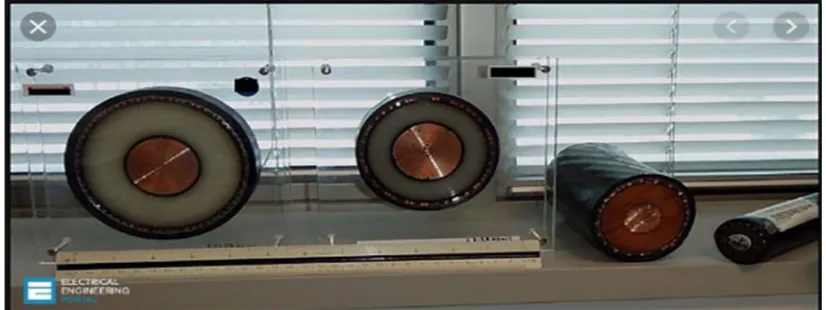
[image:3.612.157.454.158.347.2]this type of underground transmission line is often termed as solid dielectric cable. The role of pressurized fluid has been replaced by solid dielectric material solid dielectric material. XLPE is suitable for underground electric transmission line less than 200KV. Although, there is less maintenance with this type of system, monitoring impending insulation failure is always difficult. Fig 2 presents different types of XLPE cables with different ratings.
[image:3.612.99.512.551.706.2]III. FACTORS TO CONSIDER WHEN MAKING CHOICES ON CABLE TYPES
In choosing which technology to adopt, there is need to analyse advantages and disadvantages of both technologies. When compared with overhead transmission lines, the choice to build underground transmission lines instead of overhead will depend on a number of factors.
It is advisable to adopt underground cabling in highly urban area, where acquiring row that meets national electrical safety code requirement is often difficult, if not impossible. Although choosing underground system for aesthetics reason may be justified to some extent, because it is assumed that following the destruction of construction, the entire line would be out of sight, however, considerations must be made for the destruction caused by the trench construction and the ancillary facilities that would be above ground, such as transition structures, pressurizing stations and transition stations.
In general, underground transmission lines are significantly more expensive than overhead lines. There are operational limitations and maintenance issues that must be weighed against the advantages. Hence, it is recommended that a portion of the lines be
constructed underground to reduce costs.
A. Power Transfer Capability
Analysis shows that the amount of power underground is able to carry is much lower than that of overhead lines. This is also an important factor to consider when making choices on which transmission technology to adopt. In most cases, applying both technologies will help to improve power carrying capacity. Thermal constant of cables buried underground is always long, and ranges between 30-100 hours. This characteristics, therefore, permits very high emergency ratings as a percentage of normal ratings, therefore it is expected that cables may be limiting under normal conditions, but overhead lines could be limiting during emergency.
B. Operation and Maintenance
Underground cable systems have high resistance weather effects, as a result, impact of maintenance requirement is significantly reduced and reliability from unplanned are highly enhanced. It is advisable that cable terminations are checked for contaminations or mechanical damage periodically. Thermal-mechanical movement of cables in conduits should be managed appropriately, especially where changes in elevation is significant. It is also necessary for periodic evaluation of dielectric oil in order to achieve adequate assessment of paper cable condition.
C. Costs and Economics
The installation cost of underground transmission system is estimated to be 3-10 times higher than that of overhead counterpart. However, economic consideration should also be made of right of way which is typically much less than that of overhead. Costs of losses in cables are generally lower in underground system. Also, it is needful to consider reactive losses and charging current which also contribute to significant costs.
D. Increase Public Safety
When cables are buried underground, it will lead to a very high reduction in accident. There will be low potential for fatalities and injuries. Also, number of outages will be reduced. Often times, risk of accident as a result of lines downed by storms are greatly reduced with underground utilities. There is also reduction in danger caused by fire, as contacts between overhead conductors and trees or limbs can cause fire. Fire endangers both human life and personnel properties.
IV. CONCLUSION
Underground transmission system is a viable alternative to overhead lines with due consideration of factors as they relate to design specification, manufacturing and installation. It is mostly implemented where there right of way constraint, specialized obstacles and areas along planned routes. Concerns is high about weather conditions as they affect reliability of overhead lines. Underground cabling has gained attraction in spite of it higher cost of installation. To reduce cost and improve reliability, hybrid system offers such attractive potential.
REFERENCES
[1] Mohammed Safiuddin (2013). History of Electric Grid: Foundations of Smart Grid
[2] Shanmugasundaram, N., Vajunbunnisa, Begum R., Abdul, Kalam S., (2016). A Practical Approach of Reducing Dielectric Losses and Calculations of an Existing 33KV HV-UG Power Cables of a Distribution Network. IOSR Journal of Electrical and Electronics Engineering (IOSR JEEE), Vol. 11, Issue 1, pp. 07-13.
[3] Haakana, J., Lassila, J., Kaipia, T., (2009). Underground Cabling Strategies in Rural Area Electricity Distribution Network. 20th International Conference on
[4] Earle, C. Bascom & Victor, D. Antoniello (2011). Underground Power Cable Considerations: Alternative to Overhead. 47th Minnesota Power System
Conference (MIPSYCON), November, 1-3.
[5] Mutto S., Tebbs, J., Simpson, S., & Mann, R., (2000). Investigation of low reliability of Urban and Rural Feeders Phase Two of Phase Two, TXU Networks [6] Menges, R., & Bayer, G., (2013). Underground Cables Versus Overhead Lines: do Cables increase social acceptance of grid development? Results of a
Contingent Valuation Survey in Germany. International Journal of Sustainable Energy Planning and Management 3, 33-48
[7] Lienert, P., Sutterlin, B., Siegrist, M., (2018). Public Acceptance of High Voltage Power Lines: The Influence of Information Solution to Undergrounding. Energy Policy 112, 305-115
[8] Bertsch, V., Hall, M., Weinhardt, C., Fichtner, w., (2016). Public Acceptance and References Related to Renewable Energy and Grid Expansion Policy: Empirical Insight for Germany. Energy. 114, pp. 465-477.
[9] Priestley, T., Evan, G., (1996). Residents Perception of a Nearby Transmission Line. Journal of Environmental Psychology, 16, 65-73.
[10] Soini, K., Pouta, E., Salmiovirta, M., Uusitalo, M., Kivinen, T., (2011). Local Residents’ Perception on Energy Landscape: The Case of Transmission Lines. Land Use Policy 28, 294-305.
[11] Cain, N. L., Nelson, H. T., (2013). What Drives Opposition to High Voltage Transmission Lines? Land Use Policy 33, 204-213