Journal of Chemical and Pharmaceutical Research, 2012, 4(5):2512-2516
Research Article
CODEN(USA) : JCPRC5
ISSN : 0975-7384
Microwave Assisted one-pot Synthesis and Screening of some
schiff's bases of Sulfanilamide
Sofian Saleh Mohamed
1,*, Salah Al-bashier Mohamed
2, Ehassan Salem Shalfoh
1and
Omran Fhid
31
National Center for Medical Research, Medicinal Chemistry Department, Zawia, Libya
2
National Center for Medical Research, Microbiology Department, Zawia, Libya
3
Department of Medicinal Chemistry, Faculty of Pharmacy, Tripoli University, Libya
______________________________________________________________________________
ABSTRACT
A series of new Schiff’s bases of Sulfanilamide 1a-8a were synthesized by condensation of sulfanilamide with different substituted aromatic aldehydes . The structures of these products were confirmed by physical and spectral analysis. Antibacterial and antifungal activity of the synthesized derivatives 1a-8a were done in comparison with Ciprofloxacin and Ketoconazole as standard compounds. All the 3 selected strains of bacteria and fungi namely S. Aureus, E. Coli and C. Albicans. Compounds 5a, 7a showed very good activity against C .Albicans while compounds 2a, 8a showed moderate activity when compared with standard drug Ketoconazole.
Key words: Microwave assisted; Schiff’s base; Sulfanilamide; Antimicrobial activity
______________________________________________________________________________
INTRODUCTION
Schiff bases are the important compound owing to their wide range of biological activities and industrial application. they have been found to posses the pharmacological activities such as antimalarial [1], anticancer [2], antibacterial, antifungal [3], antitubercular [4], anti-inflammatory [5]. Sulfonamide derivatives have been subject to intensive studies, where a wide variety of those derivatives have been prepared and used in various biological and pharmacological fields. Schiff bases are among the most studies sulfonamide derivatives which have been used for numerous biological application [6,7]. Schiff bases are the compounds containing azomethine group (-HC=N-) formed by condensation of a primary amine with an active carbonyl compound [8,9]. These types of derivatives are very important because of their varied structures and biological activities[10-14].
EXPERIMENTAL SECTION
All chemicals and solvents, reagents used in the present study were of analytical grade purchased from Sigma, Fischer and Fluka. All the solvents were used after distillation. The melting points were determined by open capillary method and were uncorrected. The purity of compounds was confirmed by thin layer chromatography using Silica coated aluminum sheets(silica gel 60. F254). The IR spectra of samples were recorded by Varian FT-IR
spectrophotometer 660, Australia. 1H, 13C-NMR spectra (400MHz) recorded in DMSO-d6 by employing TMS as an
GENERAL PROCEDURE FOR SYNTHESIS OF SCHIFF'S BASE 1a-8a :
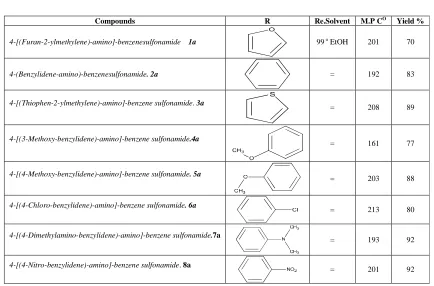
The Schiff base was prepared by reaction of equimolar (0.01 M) of sulfanilamide and substituted aromatic aldehydes were transferred to a clean and dry Teflon vessel, and triturated to form uniform mixture, then addition a drops of ethanol. This mixture was subjected to MW irradiation for 0.5-1 min at 400 watt power. After cooling , The formed crystals were filtered off, washed with several time of EtOH and recrystallized from 99 oEtOH (Table 1, Scheme 1) .
[image:2.595.81.515.320.606.2]Scheme1. Synthesis of Schiff's bases 1a-8a. Table 1. Physicochemical data of compounds 1a-8a
Antimicrobial screening method:
The antimicrobial activity of all the synthesized compounds (1a-8a) were examined against different Microorganisms, were identified and obtained from the American type of cell culture collection (ATCC), including Staphylococcus aureus (ATCC 29213), Escherichia coli (ATCC 25922) and Candida albicans (ATCC 10231) at the concentration level of 5µM by using Agar diffusion method [15]. Ciprofloxacin and ketoconazole were used as reference compounds for antibacterial and antifungal activities respectively. The results have been recorded in the form of inhibition zones (diameter, mm) Table 2.
Compounds R Re.Solvent M.P CO Yield %
4-[(Furan-2-ylmethylene)-amino]-benzenesulfonamide 1a 99 o EtOH 201 70
4-(Benzylidene-amino)-benzenesulfonamide. 2a = 192 83
4-[(Thiophen-2-ylmethylene)-amino]-benzene sulfonamide. 3a
= 208 89
4-[(3-Methoxy-benzylidene)-amino]-benzene sulfonamide.4a
= 161 77
4-[(4-Methoxy-benzylidene)-amino]-benzene sulfonamide. 5a = 203 88
4-[(4-Chloro-benzylidene)-amino]-benzene sulfonamide. 6a
= 213 80
4-[(4-Dimethylamino-benzylidene)-amino]-benzene sulfonamide.7a
= 193 92
4-[(4-Nitro-benzylidene)-amino]-benzene sulfonamide. 8a
RESULTS AND DISCUSSION
Chemical section:
The Schiff’s bases 1a-8a were prepared by condensation of sulfanilamide with aromatic aldehydes at ratio (1:1) via MW irradiation method. The purity of the new synthesized compounds were checked by TLC and The structures of the synthesized compounds were determined on the basis of their FT-IR, 1H and 13C-NMR data.
The IR spectra of the synthesized compounds showed the presence of C=N stretching bands at 1500-1690 cm-1 and absence of C=O at 1700 cm-1 and the bands due to asymmetric and symmetric SO2 group are shifted to lower
frequencies, while NH is disappeared or hidden under the broad bands at 3450-3300 cm-1 in Schiff’s base. The 1H,
13C-NMR spectra of the synthesized compounds were recorded in DMSO-d
6. The chemical shifts (δ), expressed in
part per milion (ppm) downfield form tetramethylsilane. The signals for the methane protons of the azomethine group, -N=CH- were observed between 8 and 9 ppm.
4-[(Furan-2-ylmethylene)-amino]-benzenesulfonamide. 1a
FT-IR (cm-1): 2978(C-H aromatic), 3284(N-H str), 1623(HC=N), 1578(C=C aromatic), 1147(S=O asmy), 1325(S=O sym).1H-NMR (400MHz, DMSO-d6): δ [ppm] 8.46(s, 1H, HC=N), 8.1-6.75(m, 7H, Ar-H). 13C-NMR
(400MHz, DMSO-d6): δ [ppm] 154(HC=N), 151.55, 150.15, 147.08, 141.10, 126.93, 121.24, 118.42, 112.74.
4-(Benzylidene-amino)-benzenesulfonamide. 2a
FT-IR (cm-1): 3292(N-H str), 1619(HC=N), 3002(C-H aromatic), 1574(C=C aromatic), 1150(S=O asym), 1331(S=O sym). 1H-NMR (400MHz, DMSO-d6): δ [ppm] 8.65(s, 1H, HC=N), 8-7.40(m, 9H, Ar-H). 13C-NMR (400MHz,
DMSO-d6): δ [ppm] 162.77(HC=N), 154.35, 141.14, 153.56, 132, 128.96, 128.90, 126.92, 121.24.
4-[(Thiophen-2-ylmethylene)-amino]-benzenesulfonamide. 3a
FT-IR (cm-1): 1605(HC=N), 3285(N-H str), 1149(S=O asym), 1321(S=O sym). 1H-NMR (400MHz, DMSO-d6): δ
[ppm] 8.82(d, 1H, HC=N), 7.9-6.6(m, 7H, Ar-H). 13C-NMR (400MHz, DMSO-d6): δ [ppm] 155.79(HC=N), 153.54,
141.85, 141.03, 134.62, 132.04, 128.35, 127.30, 126.85, 121.27, 112.29.
4-[(3-Methoxy-benzylidene)-amino]-benzenesulfonamide.4a
FT-IR (cm-1): 3329(N-H str), 3175(C-H aromatic), 1618(HC=N), 1579(C=C aromatic), 1296(C-O phenolic), 1150(S=O asym), 1329(S=O sym). 1H-NMR (400MHz, DMSO-d6): δ [ppm] 8.62(s, 1H, HC=N), 7.85-7.15(m, 8H,
Ar-H), 3.84(s,3H,OCH3). 13C-NMR (400MHz, DMSO-d6): δ [ppm] 162.67(HC=N), 159.53, 154.25, 141.18, 137,
130.02, 126.91, 121.96, 121.24, 118.30, 112.67, 55.23(OCH3).
4-[(4-Methoxy-benzylidene)-amino]-benzenesulfonamide. 5a
FT-IR (cm-1): 3272(N-H str), 2913(C-H aromatic), 1606(HC=N), 1569(C=C aromatic), 1147(S=O asym), 1315(S=O sym), 1265(C-O phenolic). 1H-NMR (400MHz, DMSO-d6): δ [ppm] 8.6(s, 1H, HC=N), 7.9-7(m, 8H, Ar-H), 3.8(s,
3H, OCH3). 13C-NMR (400MHz, DMSO-d6): δ [ppm] 162.28(HC=N), 161.85, 154.67, 140.72, 130.85, 128.49,
126.89, 121.18, 114.33, 55.44 (OCH3).
4-[(4-Chloro-benzylidene)-amino]-benzenesulfonamide. 6a
FT-IR (cm-1): 3289(N-H str), 3001(C-H aromatic), 1620(HC=N), 1581 (C=C aromatic), 1150(S=O asym), 1331(S=O sym). 1H-NMR (400MHz, DMSO-d6): δ [ppm] 8.67(s, 1H, HC=N), 8-7.40(m, 8H, Ar-H). 13C-NMR
(400MHz, DMSO-d6): δ [ppm] 161.62(HC=N), 154, 141.33, 136.57, 134.42, 130.57, 129.06, 126.92, 121.30.
4-[(4-Dimethylamino-benzylidene)-amino]-benzenesulfonamide.7a
FT-IR (cm-1): 3278(N-H str), 1569(HC=N), 1518(C=C aromatic), 1143(S=O asym), 1329(S=O sym). 1 H-NMR(400MHz,DMSO-d6): δ [ppm] 9.67(s,1H, NH), 8.43 (s,1H,N=CH), 8.83-6.60(m,8H,Ar-H), 6.1(s,6H,
N(CH3)2). 13C-NMR (400MHz, DMSO-d6): δ [ppm] 162.7(HC=N), 158.2, 146.8, 137, 129.8, 127.8, 123, 120.7,
4-[(4-Nitro-benzylidene)-amino]-benzenesulfonamide. 8a
FT-IR (cm-1): 3265(N-H str), 3105(C-H aromatic), 1591(C=C aromatic), 1628(HC=N), 1598(NO2), 1145(S=O
asym), 1341(S=O sym), 1277(OH). 1H-NMR (400MHz, DMSO-d6): δ [ppm] 12.7(s, 2H, NH2), 8.39(s, 1H, HC=N),
7.5-8.22(m, 8H, Ar-H). 13C-NMR (400MHz, DMSO-d6): δ [ppm] 162.7(HC=N), 156.4, 150.7, 137.8, 137.3, 129.9,
126.8, 123.7, 122.3 (NO2).
All the synthesized compounds were screened for antimicrobial activity at concentration 5µM against one Gram (+) bacterial strain (Staphylococcus aureus), one Gram (-) bacterial strain (Escherichia coli) and fungi strain Candida albican) by agar diffusion methods.
The results of preliminary bioassay indicated that [(Methoxy-benzylidene)-amino]-benzene sulfonamide. 5a, 4-[(4-Dimethylamino-benzylidene)-amino]-benzenesulfonamide.7a exhibited very good activity against C. Albicans and 4-(Benzylidene-amino)-benzenesulfonamide. 2a , 4-[(4-Nitro-benzylidene)-amino]-benzenesulfonamide. 8a, showed moderate activity against C. Albicans comparable with standard drug Ketoconazole. Compounds 3a, 4a,
8a showed closed similar activities as the reference compound Ciprofloxacine.
Table2: Zone of inhibition (mm) data of synthesized compounds
Compound
Antibacterial activity Antifungal activity
S. aureus E. coli C. albicans
1a - - 20
2a 20 - 25
3a 25 - 8
4a 23 -
-5a 12 - 30
6a 10 - 15
7a 18 - 30
8a 25 17 25
Ciprofloxacin 27 33
-Ketoconazole - - 23
(- ) No effect
Acknowledgment:
The authors are thankful to Dr. Omran fhid, Salah ben saber, department of medicinal chemistry, Tripoli University, Tripoli, Libya, for interpretation of spectral analysis.
REFERENCES
[1]. Li Y, Yang ZS, Zhang H, Cao BJ and Wang FD, Bio org and Med Chem. 2003;11:4363-4368.
[2]. Villar R,Encio I, Migliaccio M, Gil MG, Martinez-Merino V. Bioorga and Med Chem.2004;12:963-968. [3]. Bhat MA, Imran M, Khan SA and Siddiqui N. J Pharm Sci.2005; 67:151-159.
[4]. Wang L, Feng Y, Xue J and Li Y. J Serb Chem Soc. 2008; 73:1-6.
[5]. S.J. Wadher, M. P. Puranik, N. A. Karande and P. G. Yeole. International Journal of PharmTech Research
2009; 1: 22-33.
[6]. J. S. Hadi, B. K. Alsalami, and A. H. Essa. Journal of Scientific Research. 2009; 3: 563-568.
[7]. Georgia Melagraki, Antreas Afantitis, Haralambos Sarimveies,Olga Lgglessi-Markopoulou and Claudiu T. Supuran. Bioorganic & Medicinal Chemistry.2006; 14:1108-1114.
[8]. Sheikh Aadil Abbas, Muhammad Munir, Annum Fatima, Sumera Naheed and Zeeshan Ilyas. E-Journal of Life Sciences. 2010; 1(2): 37-40.
[9] E.H. EL-mossalamy, S.A. AL-thabati, F.M.AL-nowalser and Q.A. AL-sulami. commun.fac.sci.univ.ank.series B.2005: 51(2).21-30.
[10] Santosh Kumar, Niranjan M S, Chaluvaraju K C, Jamakhandi C M and Dayanand Kadadevar. Journal of Current Pharmaceutical Research. 2010; 01: 39-42.
[14].Shalin Kumar, Durga Nath Dhar and P N saxena. Journal of Scientific & Industrial Research. 2009; 68: 181-187.