603
Effective Attention Modeling for Neural Relation Extraction
Tapas Nayak and Hwee Tou Ng Department of Computer Science
National University of Singapore [email protected], [email protected]
Abstract
Relation extraction is the task of determin-ing the relation between two entities in a sen-tence. Distantly-supervised models are popu-lar for this task. However, sentences can be long and two entities can be located far from each other in a sentence. The pieces of ev-idence supporting the presence of a relation between two entities may not be very direct, since the entities may be connected via some indirect links such as a third entity or via co-reference. Relation extraction in such scenar-ios becomes more challenging as we need to capture the long-distance interactions among the entities and other words in the sentence. Also, the words in a sentence do not contribute equally in identifying the relation between the two entities. To address this issue, we propose a novel and effective attention model which incorporates syntactic information of the sen-tence and a multi-factor attention mechanism. Experiments on the New York Times corpus show that our proposed model outperforms prior state-of-the-art models.
1 Introduction
Relation extraction from unstructured text is an important task to build knowledge bases (KB) au-tomatically. Banko et al. (2007) used open in-formation extraction (Open IE) to extract relation triples from sentences where verbs were consid-ered as the relation, whereas supervised informa-tion extracinforma-tion systems extract a set of pre-defined relations from text. Mintz et al. (2009), Riedel et al.(2010), andHoffmann et al.(2011) proposed distant supervision to generate the training data for sentence-level relation extraction, where rela-tion tuples (two entities and the relarela-tion between them) from a knowledge base such as Freebase (Bollacker et al., 2008) were mapped to free text (Wikipedia articles or New York Times articles).
The idea is that if a sentence contains both enti-ties of a tuple, it is chosen as a training sentence of that tuple. Although this process can generate some noisy training instances, it can give a signif-icant amount of training data which can be used to build supervised models for this task.
Mintz et al. (2009), Riedel et al. (2010), and Hoffmann et al. (2011) proposed feature-based learning models and used entity tokens and their nearby tokens, their part-of-speech tags, and other linguistic features to train their models. Recently, many neural network-based models have been proposed to avoid feature engineering. Zeng et al. (2014, 2015) used convolutional neural networks (CNN) with max-pooling to find the relation be-tween two given entities. Though these models have been shown to perform reasonably well on distantly supervised data, they sometimes fail to find the relation when sentences are long and enti-ties are located far from each other. CNN mod-els with max-pooling have limitations in under-standing the semantic similarity of words with the given entities and they also fail to capture the long-distance dependencies among the words and enti-ties such as co-reference. In addition, all the words in a sentence may not be equally important in find-ing the relation and this issue is more prominent in long sentences. Prior CNN-based models have limitations in identifying the multiple important factors to focus on in sentence-level relation ex-traction.
To address this issue, we propose anovel multi-factor attention model1 focusing on the syntac-tic structure of a sentence for relation extraction. We use a dependency parser to obtain the syn-tactic structure of a sentence. We use a linear form of attention to measure the semantic similar-ity of words with the given entities and combine
1The code and data of this paper can be found at
it with the dependency distance of words from the given entities to measure their influence in iden-tifying the relation. Also, single attention may not be able to capture all pieces of evidence for identifying the relation due to normalization of at-tention scores. Thus we use multi-factor atten-tion in the proposed model. Experiments on the New York Times (NYT) corpus show that the pro-posed model outperforms prior work in terms of F1 scores on sentence-level relation extraction.
2 Task Description
Sentence-level relation extraction is defined as follows: Given a sentence S and two entities {E1, E2}marked in the sentence, find the relation
r(E1, E2)between these two entities inSfrom a
pre-defined set of relations R ∪ {None}. None
indicates that none of the relations inRholds be-tween the two marked entities in the sentence. The relation between the entities is argument order-specific, i.e.,r(E1, E2)andr(E2, E1)are not the
same. Input to the system is a sentence S and two entitiesE1 andE2, and output is the relation
r(E1, E2)∈R∪ {None}.
3 Model Description
We use four types of embedding vectors in our model: (1) word embedding vectorw ∈ Rdw (2) entity token indicator embedding vectorz∈ Rdz, which indicates if a word belongs to entity1, en-tity2, or does not belong to any entity (3) a posi-tional embedding vectoru1 ∈ Rdu which repre-sents the linear distance of a word from the start token of entity1(4) another positional embedding vectoru2 ∈ Rdu which represents the linear dis-tance of a word from the start token of entity2.
We use a bi-directional long short-term memory (Bi-LSTM) (Hochreiter and Schmidhuber, 1997) layer to capture the interaction among words in a sentence S = {w1, w2, ..., wn}, where n is
the sentence length. The input to this layer is the concatenated vectorx∈ Rdw+dz of word embed-ding vector w and entity token indicator embed-ding vectorz.
xt=wt||zt
− →
ht=
−−−−→
LSTM(xt,ht−1)
←−
ht=←−−−−LSTM(xt,ht+1)
ht=
− →
ht||
←−
ht
− →
ht ∈ Rdw+dz and ←−
ht ∈ Rdw+dz are the output at the tth step of the forward LSTM and backward LSTM respectively. We concatenate them to ob-tain thetth Bi-LSTM outputht∈R2(dw+dz).
3.1 Global Feature Extraction
We use a convolutional neural network (CNN) to extract the sentence-level global features for rela-tion extracrela-tion. We concatenate the posirela-tional em-beddingsu1 andu2of words with the hidden rep-resentation of the Bi-LSTM layer and use the con-volution operation with max-pooling on concate-nated vectors to extract the global feature vector.
qt=htku1tku2t
ci =fT(qikqi+1k....kqi+k−1)
cmax = max(c1, c2, ...., cn)
vg = [c1max, c2max, ...., cfmax]g
qt ∈R2(dw+dz+du) is the concatenated vector for thetth word andf is a convolutional filter vector of dimension 2k(dw +dz +du) where k is the filter width. The index imoves from1 ton and produces a set of scalar values {c1, c2, ..., cn}.
The max-pooling operation chooses the maximum
cmax from these values as a feature. With fg
number of filters, we get a global feature vector
vg ∈Rfg.
3.2 Attention Modeling
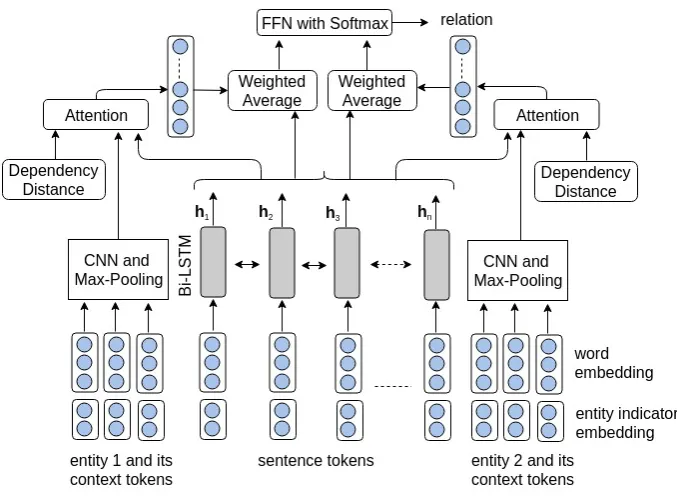
Figure 1 shows the architecture of our attention model. We use a linear form of attention to find the semantically meaningful words in a sentence with respect to the entities which provide the pieces of evidence for the relation between them. Our at-tention mechanism uses the entities as atat-tention queries and their vector representation is very im-portant for our model. Named entities mostly con-sist of multiple tokens and many of them may not be present in the training data or their frequency may be low. The nearby words of an entity can give significant information about the entity. Thus we use the tokens of an entity and its nearby to-kens to obtain its vector representation. We use the convolution operation with max-pooling in the context of an entity to get its vector representation.
ci =fT(xikxi+1k....kxi+k−1)
cmax = max(cb, cb+1, ...., ce)
Figure 1: Architecture of our attention model withm = 1. We have not shown the CNN-based global feature extraction here. FFN=feed-forward network.
fis a convolutional filter vector of sizek(dw+dz)
where k is the filter width and x is the concate-nated vector of word embedding vector (w) and entity token indicator embedding vector (z). b
andeare the start and end index of the sequence of words comprising an entity and its neighbor-ing context in the sentence, where 1 ≤ b ≤
e ≤ n. The index i moves from b to e and produces a set of scalar values{cb, cb+1, ..., ce}.
The max-pooling operation chooses the maximum
cmaxfrom these values as a feature. Withfe num-ber of filters, we get the entity vector ve ∈ Rfe. We do this for both entities and getv1e ∈Rfe and
v2e ∈Rfe as their vector representation. We adopt a simple linear function as follows to measure the semantic similarity of words with the given enti-ties:
fscore1 (hi,v1e) =hTi W1av1e
fscore2 (hi,v2e) =hTi W2av2e
hi is the Bi-LSTM hidden representation of the
ith word. W1a,Wa2 ∈R2(dw+dz)×fe are trainable weight matrices. f1
score(hi,ve1) andfscore2 (hi,v2e)
represent the semantic similarity score of the ith word and the two given entities.
Not all words in a sentence are equally impor-tant in finding the relation between the two enti-ties. The words which are closer to the entities
are generally more important. To address this is-sue, we propose to incorporate the syntactic struc-ture of a sentence in our attention mechanism. The syntactic structure is obtained from the depen-dency parse tree of the sentence. Words which are closer to the entities in the dependency parse tree are more relevant to finding the relation. In our model, we define the dependency distance to every word from the head token (last token) of an entity as the number of edges along the dependency path (See Figure2for an example). We use a distance window sizewsand words whose dependency dis-tance is within this window receive attention and the other words are ignored. The details of our at-tention mechanism follow.
d1i = ( 1
2l1i−1exp(f
1
score(hi,v1e)) ifl1i ∈[1, ws]
1
2wsexp(fscore1 (hi,v1e)) otherwise
d2i = ( 1
2l2i−1exp(f
2
score(hi,v2e)) ifl2i ∈[1, ws]
1
2wsexp(fscore2 (hi,v2e)) otherwise
p1i = d
1
i P
jd1j
, p2i = d
2
i P
jd2j
d1i andd2i are un-normalized attention scores and
p1
i andp2i are the normalized attention scores for
Figure 2: An example dependency tree. The two num-bers indicate the distance of the word from the head token of the two entities respectively along the depen-dency tree path.
of the ith word from the two entities. We mask those words whose average dependency distance from the two entities is larger than ws. We use the semantic meaning of the words and their de-pendency distance from the two entities together in our attention mechanism. The attention feature vectorsv1aandv1awith respect to the two entities are determined as follows:
v1a= n X
i=1
p1ihi, v2a= n X
i=1
p2ihi
3.3 Multi-Factor Attention
Two entities in a sentence, when located far from each other, can be linked via more than one co-reference chain or more than one important word. Due to the normalization of the attention scores as described above, single attention cannot cap-ture all relevant information needed to find the re-lation between two entities. Thus we use a multi-factor attention mechanism, where the number of factors is a hyper-parameter, to gather all relevant information for identifying the relation. We re-place the attention matrix Wa with an attention
tensor W1:m
a ∈ Rm×2(dw+dz)×2fe where m is
the factor count. This gives us m attention vec-tors with respect to each entity. We concatenate all the feature vectors obtained using these atten-tion vectors to get the multi-attentive feature vec-torvma∈R4m(dw+dz).
3.4 Relation Extraction
We concatenatevg,vma,v1e, andv2e, and this con-catenated feature vector is given to a feed-forward layer with softmax activation to predict the nor-malized probabilities for the relation labels.
r= softmax(Wr(vg||vma||ve1||v2e) +br)
Wr ∈R(fg+2fe+4m(dw+dz))×(|R|+1)is the weight matrix,br ∈R|R|+1is the bias vector of the
feed-forward layer for relation extraction, andris the
vector of normalized probabilities of relation la-bels.
3.5 Loss Function
We calculate the loss over each mini-batch of size
B. We use the following negative log-likelihood as our objective function for relation extraction:
L=−1
B B X
i=1
log(p(ri|si, e1i, e2i, θ))
where p(ri|si, e1i, e2i, θ) is the conditional proba-bility of the true relationriwhen the sentencesi,
two entitiese1i ande2i, and the model parametersθ
are given.
4 Experiments
4.1 Datasets
We use the New York Times (NYT) corpus (Riedel et al., 2010) in our experiments. There are two versions of this corpus: (1) The original NYT cor-pus created by Riedel et al.(2010) which has 52
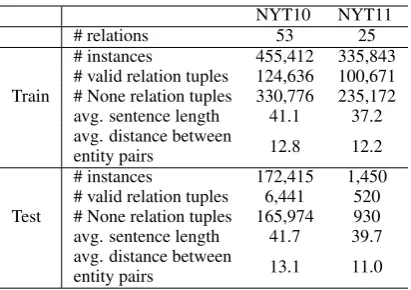
valid relations and aNonerelation. We name this dataset NYT10. The training dataset has455,412
instances and330,776of the instances belong to theNonerelation and the remaining 124,636 in-stances have valid relations. The test dataset has
172,415 instances and 165,974 of the instances belong to the None relation and the remaining
6,441 instances have valid relations. Both the training and test datasets have been created by aligning Freebase (Bollacker et al., 2008) tuples to New York Times articles. (2) Another version created byHoffmann et al. (2011) which has 24
valid relations and aNonerelation. We name this dataset NYT11. The corresponding statistics for NYT11 are given in Table1. The training dataset is created by aligning Freebase tuples to NYT ar-ticles, but the test dataset is manually annotated.
4.2 Evaluation Metrics
NYT10 NYT11 # relations 53 25
Train
# instances 455,412 335,843 # valid relation tuples 124,636 100,671 # None relation tuples 330,776 235,172 avg. sentence length 41.1 37.2 avg. distance between
entity pairs 12.8 12.2
Test
# instances 172,415 1,450 # valid relation tuples 6,441 520 # None relation tuples 165,974 930 avg. sentence length 41.7 39.7 avg. distance between
[image:5.595.79.285.60.205.2]entity pairs 13.1 11.0
Table 1: Statistics of the NYT10 and NYT11 dataset.
This confidence threshold is the one that achieves the highest F1 score on the validation dataset. We also include the precision-recall curves for all the models.
4.3 Parameter Settings
We run word2vec (Mikolov et al., 2013) on the NYT corpus to obtain the initial word embeddings with dimensiondw = 50and update the embed-dings during training. We set the dimension of entity token indicator embedding vectordz = 10
and positional embedding vector du = 5. The hidden layer dimension of the forward and back-ward LSTM is60, which is the same as the dimen-sion of input word representation vector x. The dimension of Bi-LSTM output is 120. We use
fg = fe = 230 filters of width k = 3 for fea-ture extraction whenever we apply the convolution operation. We use dropout in our network with a dropout rate of 0.5, and in convolutional layers, we use the tanh activation function. We use the sequence of tokens starting from 5 words before the entity to 5 words after the entity as its con-text. We train our models with mini-batch size of
50and optimize the network parameters using the Adagrad optimizer (Duchi et al., 2011). We use the dependency parser from spaCy2 to obtain the dependency distance of the words from the enti-ties and usews= 5as the window size for depen-dency distance-based attention.
4.4 Comparison to Prior Work
We compare our proposed model with the follow-ing state-of-the-art models.
(1) CNN (Zeng et al., 2014): Words are rep-resented using word embeddings and two posi-tional embeddings. A convoluposi-tional neural
net-2https://spacy.io/
work (CNN) with max-pooling is applied to ex-tract the sentence-level feature vector. This fea-ture vector is passed to a feed-forward layer with softmax to classify the relation.
(2) PCNN (Zeng et al.,2015): Words are repre-sented using word embeddings and two positional embeddings. A convolutional neural network (CNN) is applied to the word representations. Rather than applying a global max-pooling oper-ation on the entire sentence, three max-pooling operations are applied on three segments of the sentence based on the location of the two entities (hence the name Piecewise Convolutional Neural Network (PCNN)). The first max-pooling opera-tion is applied from the beginning of the sentence to the end of the entity appearing first in the sen-tence. The second max-pooling operation is ap-plied from the beginning of the entity appearing first in the sentence to the end of the entity appear-ing second in the sentence. The third max-poolappear-ing operation is applied from the beginning of the en-tity appearing second in the sentence to the end of the sentence. Max-pooled features are concate-nated and passed to a feed-forward layer with soft-max to determine the relation.
(3) Entity Attention (EA) (Shen and Huang, 2016): This is the combination of a CNN model and an attention model. Words are represented using word embeddings and two positional em-beddings. A CNN with max-pooling is used to extract global features. Attention is applied with respect to the two entities separately. The vec-tor representation of every word is concatenated with the word embedding of the last token of the entity. This concatenated representation is passed to a feed-forward layer with tanh activation and then another feed-forward layer to get a scalar at-tention score for every word. The original word representations are averaged based on the attention scores to get the attentive feature vectors. A CNN-extracted feature vector and two attentive feature vectors with respect to the two entities are con-catenated and passed to a feed-forward layer with softmax to determine the relation.
NYT10 NYT11
Model Prec. Rec. F1 Prec. Rec. F1
CNN (Zeng et al.,2014) 0.413 0.591 0.486 0.444 0.625 0.519 PCNN (Zeng et al.,2015) 0.380 0.642 0.477 0.446 0.679 0.538† EA (Shen and Huang,2016) 0.443 0.638 0.523† 0.419 0.677 0.517 BGWA (Jat et al.,2017) 0.364 0.632 0.462 0.417 0.692 0.521
BiLSTM-CNN 0.490 0.507 0.498 0.473 0.606 0.531
[image:6.595.116.482.62.176.2]Our model 0.541 0.595 0.566* 0.507 0.652 0.571*
[image:6.595.332.501.246.432.2]Table 2: Performance comparison of different models on the two datasets. * denotes a statistically significant improvement over the previous best state-of-the-art model withp < 0.01 under the bootstrap paired t-test. † denotes the previous best state-of-the-art model.
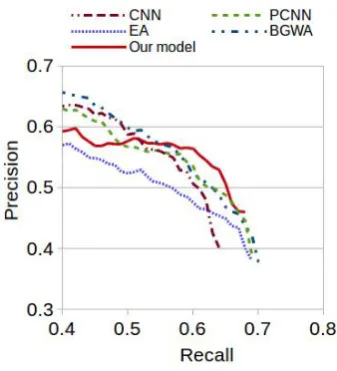
Figure 3: Precision-Recall curve for the NYT10 dataset.
to compute a scalar attention score for each word. Hidden vectors of the BiGRU layer are multiplied by their corresponding attention scores. A piece-wise CNN is applied on the weighted hidden tors to obtain the feature vector. This feature vec-tor is passed to a feed-forward layer with softmax to determine the relation.
(5) BiLSTM-CNN: This is our own baseline. Words are represented using word embeddings and entity indicator embeddings. They are passed to a bidirectional LSTM. Hidden representations of the LSTMs are concatenated with two posi-tional embeddings. We use CNN and max-pooling on the concatenated representations to extract the feature vector. Also, we use CNN and max-pooling on the word embeddings and entity indica-tor embeddings of the context words of entities to obtain entity-specific features. These features are concatenated and passed to a feed-forward layer to determine the relation.
Figure 4: Precision-Recall curve for the NYT11 dataset.
4.5 Experimental Results
We present the results of our final model on the relation extraction task on the two datasets in Ta-ble2. Our model outperforms the previous state-of-the-art models on both datasets in terms of F1 score. On the NYT10 dataset, it achieves 4.3%
higher F1 score compared to the previous best state-of-the-art model EA. Similarly, it achieves
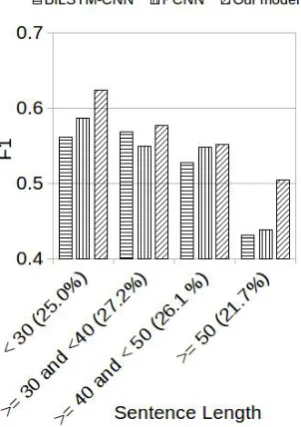
[image:6.595.99.264.246.432.2]Figure 5: Performance comparison across different sentence lengths on the NYT10 dataset.
the KB will be poor. From Figure 3, we observe that when the recall score is above0.4, our model achieves higher precision than all the competing models on the NYT10 dataset. On the NYT11 dataset (Figure4), when recall score is above0.6, our model achieves higher precision than the com-peting models. Achieving higher precision with high recall score helps to build a cleaner KB with good coverage.
5 Analysis and Discussion
5.1 Varying the number of factors (m)
We investigate the effects of the multi-factor count
(m)in our final model on the test datasets in Ta-ble 3. We observe that for the NYT10 dataset,
m ={1,2,3}gives good performance withm = 1achieving the highest F1 score. On the NYT11 dataset,m= 4gives the best performance. These experiments show that the number of factors giv-ing the best performance may vary dependgiv-ing on the underlying data distribution.
5.2 Effectiveness of Model Components
We include the ablation results on the NYT11 dataset in Table4. When we add multi-factor at-tention to the baseline BiLSTM-CNN model with-out the dependency distance-based weight factor in the attention mechanism, we get0.8%F1 score improvement (A2−A1). Adding the dependency weight factor with a window size of 5 improves
Figure 6: Performance comparison across different sentence lengths on the NYT11 dataset.
NYT10 NYT11
m Prec. Rec. F1 Prec. Rec. F1
1 0.541 0.595 0.566 0.495 0.621 0.551
2 0.521 0.597 0.556 0.482 0.656 0.555
3 0.490 0.617 0.547 0.509 0.633 0.564
4 0.449 0.623 0.522 0.507 0.652 0.571 5 0.467 0.609 0.529 0.488 0.677 0.567
Table 3: Performance comparison of our model with different values ofmon the two datasets.
the F1 score by 3.2% (A3−A2). Increasing the window size to10reduces the F1 score marginally (A3−A4). Replacing the attention normalizing function with softmax operation also reduces the F1 score marginally (A3−A5). In our model, we concatenate the features extracted by each atten-tion layer. Rather than concatenating them, we can apply max-pooling operation across the mul-tiple attention scores to compute the final atten-tion scores. These max-pooled attenatten-tion scores are used to obtain the weighted average vector of Bi-LSTM hidden vectors. This affects the model performance negatively and F1 score of the model decreases by3.0%(A3−A6).
5.3 Performance with Varying Sentence Length and Varying Entity Pair Distance
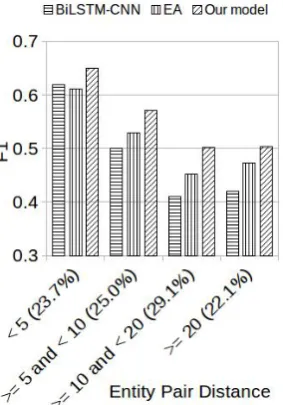
[image:7.595.103.254.77.292.2] [image:7.595.339.490.79.293.2]be-Figure 7: Performance comparison across different dis-tances between entities on the NYT10 dataset.
Prec. Rec. F1 (A1) BiLSTM-CNN 0.473 0.606 0.531 (A2) Standard attention 0.466 0.638 0.539 (A3) Window size(ws) = 5 0.507 0.652 0.571
(A4) Window size(ws) = 10 0.510 0.640 0.568 (A5) Softmax 0.490 0.658 0.562 (A6) Max-pool 0.492 0.600 0.541
Table 4: Effectiveness of model components (m = 4) on the NYT11 dataset.
tween the two entities in the two datasets in Fig-ures7and8. We observe that with increasing sen-tence length and increasing distance between the two entities, the performance of all models drops. This shows that finding the relation between en-tities located far from each other is a more diffi-cult task. Our multi-factor attention model with dependency-distance weight factor increases the F1 score in all configurations when compared to previous state-of-the-art models on both datasets.
6 Related Work
[image:8.595.342.485.68.282.2]Relation extraction from a distantly supervised dataset is an important task and many researchers (Mintz et al., 2009; Riedel et al., 2010; Hoff-mann et al., 2011) tried to solve this task us-ing feature-based classification models. Recently, Zeng et al. (2014, 2015) used CNN models for this task which can extract features automatically. Shen and Huang(2016) andJat et al.(2017) used attention mechanism in their model to improve performance. Surdeanu et al. (2012), Lin et al.
Figure 8: Performance comparison across different dis-tances between entities on the NYT11 dataset.
(2016),Vashishth et al.(2018),Wu et al. (2019), andYe and Ling(2019) used multiple sentences in a multi-instance relation extraction setting to cap-ture the feacap-tures located in multiple sentences for a pair of entities. In their evaluation setting, they evaluated model performance by considering mul-tiple sentences having the same pair of entities as a single test instance. On the other hand, our model and the previous models that we compare to in this paper (Zeng et al.,2014,2015;Shen and Huang, 2016;Jat et al.,2017) work on each sentence inde-pendently and are evaluated at the sentence level. Since there may not be multiple sentences that contain a pair of entities, it is important to improve the task performance at the sentence level. Future work can explore the integration of our sentence-level attention model in a multi-instance relation extraction framework.
[image:8.595.109.251.73.276.2]used graph convolution networks with pruned de-pendency tree structures for this task. In this work, we have incorporated the dependency dis-tance of the words in a sentence from the two en-tities in a multi-factor attention mechanism to im-prove sentence-level relation extraction.
Attention-based neural networks are quite suc-cessful for many other NLP tasks. Bahdanau et al. (2015) and Luong et al.(2015) used atten-tion models for neural machine translaatten-tion, Seo et al.(2017) used attention mechanism for answer span extraction. Vaswani et al.(2017) andKundu and Ng(2018) used multi-head or multi-factor at-tention models for machine translation and an-swer span extraction respectively.He et al.(2018) used dependency distance-focused word attention model for aspect-based sentiment analysis.
7 Conclusion
In this paper, we have proposed a multi-factor at-tention model utilizing syntactic structure for rela-tion extracrela-tion. The syntactic structure component of our model helps to identify important words in a sentence and the multi-factor component helps to gather different pieces of evidence present in a sentence. Together, these two components im-prove the performance of our model on this task, and our model outperforms previous state-of-the-art models when evaluated on the New York Times (NYT) corpus, achieving significantly higher F1 scores.
Acknowledgments
We would like to thank the anonymous reviewers for their valuable and constructive comments on this work.
References
Dzmitry Bahdanau, Kyunghyun Cho, and Yoshua Ben-gio. 2015. Neural machine translation by jointly learning to align and translate. In Proceedings of the International Conference on Learning Represen-tations.
Michele Banko, Michael J Cafarella, Stephen Soder-land, Matthew Broadhead, and Oren Etzioni. 2007. Open information extraction from the web. In Pro-ceedings of the International Joint Conference on Artificial Intelligence.
Kurt Bollacker, Colin Evans, Praveen Paritosh, Tim Sturge, and Jamie Taylor. 2008. Freebase: A col-laboratively created graph database for structuring
human knowledge. InProceedings of the ACM SIG-MOD International Conference on Management of Data.
Kyunghyun Cho, Bart Van Merri¨enboer, Dzmitry Bah-danau, and Yoshua Bengio. 2014. On the proper-ties of neural machine translation: Encoder-decoder approaches. InProceedings of Eighth Workshop on Syntax, Semantics and Structure in Statistical Trans-lation.
John Duchi, Elad Hazan, and Yoram Singer. 2011. Adaptive subgradient methods for online learning and stochastic optimization. Journal of Machine Learning Research.
Zhijiang Guo, Yan Zhang, and Wei Lu. 2019. Attention guided graph convolutional networks for relation ex-traction. InProceedings of the 57nd Annual Meeting of the Association for Computational Linguistics.
Ruidan He, Wee Sun Lee, Hwee Tou Ng, and Daniel Dahlmeier. 2018. Effective attention modeling for aspect-level sentiment classification. In Proceed-ings of the 27th International Conference on Com-putational Linguistics.
Sepp Hochreiter and J¨urgen Schmidhuber. 1997. Long short-term memory.Neural Computation.
Raphael Hoffmann, Congle Zhang, Xiao Ling, Luke Zettlemoyer, and Daniel S Weld. 2011. Knowledge-based weak supervision for information extraction of overlapping relations. InProceedings of the 49th Annual Meeting of the Association for Computa-tional Linguistics.
Lifu Huang, Avirup Sil, Heng Ji, and Radu Florian. 2017. Improving slot filling performance with atten-tive neural networks on dependency structures. In
Proceedings of the 2017 Conference on Empirical Methods in Natural Language Processing.
Sharmistha Jat, Siddhesh Khandelwal, and Partha Talukdar. 2017. Improving distantly supervised re-lation extraction using word and entity based atten-tion. InProceedings of the 6th Workshop on Auto-mated Knowledge Base Construction.
Souvik Kundu and Hwee Tou Ng. 2018. A question-focused multi-factor attention network for question answering. InProceedings of the Association for the Advancement of Artificial Intelligence.
Yankai Lin, Shiqi Shen, Zhiyuan Liu, Huanbo Luan, and Maosong Sun. 2016. Neural relation extraction with selective attention over instances. In Proceed-ings of the 54th Annual Meeting of the Association for Computational Linguistics.
Minh-Thang Luong, Hieu Pham, and Christopher D Manning. 2015. Effective approaches to attention-based neural machine translation. InProceedings of the 2015 Conference on Empirical Methods in Nat-ural Language Processing.
Tomas Mikolov, Kai Chen, Greg Corrado, and Jeffrey Dean. 2013. Efficient estimation of word represen-tations in vector space. InProceedings of the Inter-national Conference on Learning Representations.
Mike Mintz, Steven Bills, Rion Snow, and Dan Juraf-sky. 2009. Distant supervision for relation extrac-tion without labeled data. In Proceedings of the 47th Annual Meeting of the Association for Compu-tational Linguistics and the 4th International Joint Conference on Natural Language Processing.
Makoto Miwa and Mohit Bansal. 2016. End-to-end relation extraction using LSTMs on sequences and tree structures. InProceedings of the 54th Annual Meeting of the Association for Computational Lin-guistics.
Sebastian Riedel, Limin Yao, and Andrew McCallum. 2010. Modeling relations and their mentions with-out labeled text. In Proceedings of the European Conference on Machine Learning and Knowledge Discovery in Databases.
Minjoon Seo, Aniruddha Kembhavi, Ali Farhadi, and Hannaneh Hajishirzi. 2017. Bidirectional attention flow for machine comprehension. InProceedings of the International Conference on Learning Represen-tations.
Yatian Shen and Xuanjing Huang. 2016. Attention-based convolutional neural network for semantic re-lation extraction. InProceedings of the 26th Inter-national Conference on Computational Linguistics.
Mihai Surdeanu, Julie Tibshirani, Ramesh Nallapati, and Christopher D. Manning. 2012. Multi-instance multi-label learning for relation extraction. In Pro-ceedings of the 2012 Joint Conference on Empirical Methods in Natural Language Processing and Com-putational Natural Language Learning.
Shikhar Vashishth, Rishabh Joshi, Sai Suman Prayaga, Chiranjib Bhattacharyya, and Partha Talukdar. 2018. Reside: Improving distantly-supervised neural rela-tion extracrela-tion using side informarela-tion. In Proceed-ings of the 2018 Conference on Empirical Methods in Natural Language Processing.
Ashish Vaswani, Noam Shazeer, Niki Parmar, Jakob Uszkoreit, Llion Jones, Aidan N Gomez, Łukasz Kaiser, and Illia Polosukhin. 2017. Attention is all you need. InProceedings of Advances in Neural In-formation Processing Systems.
Shanchan Wu, Kai Fan, and Qiong Zhang. 2019. Im-proving distantly supervised relation extraction with neural noise converter and conditional optimal se-lector. InProceedings of the Association for the Ad-vancement of Artificial Intelligence.
Yuning Xu, Lili Mou, Ge Li, Yunchuan Chen, Hao Peng, and Zhi Jin. 2015. Classifying relations via long short term memory networks along shortest de-pendency paths. InProceedings of the 2015 Con-ference on Empirical Methods in Natural Language Processing.
Zhi-Xiu Ye and Zhen-Hua Ling. 2019. Distant supervi-sion relation extraction with intra-bag and inter-bag attentions. InProceedings of the 2019 Conference of the North American Chapter of the Association for Computational Linguistics.
Daojian Zeng, Kang Liu, Yubo Chen, and Jun Zhao. 2015. Distant supervision for relation extraction via piecewise convolutional neural networks. In Pro-ceedings of the 2015 Conference on Empirical Meth-ods in Natural Language Processing.
Daojian Zeng, Kang Liu, Siwei Lai, Guangyou Zhou, and Jun Zhao. 2014. Relation classification via con-volutional deep neural network. In Proceedings of the 25th International Conference on Computational Linguistics.