Perceptron and Beam Search
Yue Zhang
∗University of Cambridge
Stephen Clark
∗∗ University of CambridgeWe study a range of syntactic processing tasks using a general statistical framework that consists of a global linear model, trained by the generalized perceptron together with a generic beam-search decoder. We apply the framework to word segmentation, joint segmentation and POS-tagging, dependency parsing, and phrase-structure parsing. Both components of the framework are conceptually and computationally very simple. The beam-search decoder only requires the syntactic processing task to be broken into a sequence of decisions, such that, at each stage in the process, the decoder is able to consider the top-n candidates and generate all possibilities for the next stage. Once the decoder has been defined, it is applied to the training data, using trivial updates according to the generalized perceptron to induce a model. This simple framework performs surprisingly well, giving accuracy results competitive with the state-of-the-art on all the tasks we consider.
The computational simplicity of the decoder and training algorithm leads to significantly higher test speeds and lower training times than their main alternatives, including log-linear and large-margin training algorithms and dynamic-programming for decoding. Moreover, the framework offers the freedom to define arbitrary features which can make alternative training and decoding algorithms prohibitively slow. We discuss how the general framework is applied to each of the problems studied in this article, making comparisons with alternative learning and decoding algorithms. We also show how the comparability of candidates considered by the beam is an important factor in the performance. We argue that the conceptual and computational sim-plicity of the framework, together with its language-independent nature, make it a competitive choice for a range of syntactic processing tasks and one that should be considered for comparison by developers of alternative approaches.
1. Introduction
In this article we study a range of syntactic processing tasks using a general framework for structural prediction that consists of the generalized perceptron (Collins 2002) and
∗ University of Cambridge Computer Laboratory, William Gates Building, 15 JJ Thomson Avenue, Cambridge, UK. E-mail:[email protected].
∗∗ University of Cambridge Computer Laboratory, William Gates Building, 15 JJ Thomson Avenue, Cambridge, UK. E-mail:[email protected].
beam-search. We show that the framework, which is conceptually and computationally simple, is practically effective for structural prediction problems that can be turned into an incremental process, allowing accuracies competitive with the state-of-the-art to be achieved for all the problems we consider.
The framework is extremely flexible and easily adapted to each task. One advan-tage of beam-search is that it does not impose any requirements on the structure of the problem, for example, the optimal sub-problem property required for dynamic-programming, and can easily accommodate non-local features. The generalized per-ceptron is equally flexible, relying only on a decoder for each problem and using a trivial online update procedure for each training example. An advantage of the linear perceptron models we use is that they are global models, assigning a score to a complete hypothesis for each problem rather than assigning scores to parts which are then com-bined under statistical independence assumptions. Here we are following a recent line of work applying global discriminative models to tagging and wide-coverage parsing problems (Lafferty, McCallum, and Pereira 2001; Collins 2002; Collins and Roark 2004; McDonald, Crammer, and Pereira 2005; Clark and Curran 2007; Carreras, Collins, and Koo 2008; Finkel, Kleeman, and Manning 2008).
The flexibility of our framework leads to competitive accuracies for each of the tasks we consider. For word segmentation, we show how the framework can accommodate a word-based approach, rather than the standard and more restrictive character-based tagging approaches. ForPOS-tagging, we consider joint segmentation andPOS-tagging, showing that a single beam-search decoder can be used to achieve a significant accuracy boost over the pipeline baseline. For Chinese and English dependency parsing, we show how both graph-based and transition-based algorithms can be implemented as beam-search, and then combine the two approaches into a single model which out-performs both in isolation. Finally, for Chinese phrase-structure parsing, we describe a global model for a shift-reduce parsing algorithm, in contrast to current deterministic approaches which use only local models at each step of the parsing process. For all these tasks we present results competitive with the best results in the literature.
In Section 2 we describe our general framework of the generic beam-search algo-rithm and the generalized perceptron. Then in the subsequent sections we describe each task in turn, based on conference papers including Zhang and Clark (2007, 2008a, 2008b, 2009, 2010), presented in our single coherent framework. We give an updated set of results, plus a number of additional experiments which probe further into the advantages and disadvantages of our framework. For the segmentation task, we also compare our beam-search framework with alternative decoding algorithms including an exact dynamic-programming method, showing that the beam-search method is sig-nificantly faster with comparable accuracy. For the joint segmentation andPOS-tagging task, we present a novel solution using the framework in this article, and show that it gives comparable accuracies to our previous work (Zhang and Clark 2008a), while being more than an order of magnitude faster.
In Section 7 we provide further discussion of the framework based on the studies of the individual tasks. We present the main advantages of the framework, and give an analysis of the main reasons for the high speeds and accuracies achieved. We also dis-cuss how this framework can be applied to a potential new task, and show that the com-parability of candidates in the incremental process is an important factor to consider.
make it a competitive choice that should be considered for comparison by developers of alternative approaches.
2. The Decoding and Training Framework
The framework we study in this article addresses the general structural prediction problem of mapping an input structurex∈Xonto an output structurey∈Y, where Xis the set of possible inputs, and Yis the set of possible outputs. For example, for the problem of Chinese word segmentation,Xis the set of raw Chinese sentences and Yis the set of all possible segmented Chinese sentences. For the problem of English dependency parsing,Xis the set of all English sentences andYis the set of all possible English dependency trees.
Given an input sentencex, the outputF(x) is defined as the highest scored among the possible output structures forx:
F(x)= arg max y∈GEN(x)
Score(y) (1)
where GEN(x) denotes the set of possible outputs for an input sentencex, and Score(y) is some real-valued function onY.
To compute Score(y), the output structureyis mapped into a global feature vector Φ(y)∈Nd. Here a feature is a count of the occurrences of a certain pattern in an output structure, extracted according to a set of feature templates, anddis the total number of features. The termglobal feature vectoris used by Collins (2002) to distinguish between feature counts for whole sequences and the local feature vectors in maximum entropy tagging models, which are boolean-valued vectors containing the indicator features for one element in the sequence (Ratnaparkhi 1998). Having defined the feature vector, Score(y) is computed using a linear model:
Score(y)= Φ(y)·w~ (2)
wherew~ ∈Rd is the parameter vector of the model, the value of which is defined by supervised learning using the generalized perceptron.
For the general framework we study in this article, the output yis required to be built through an incremental process. Suppose thatK incremental steps are taken in total to buildy. The incremental change at theith step (0<i≤K) can be written as
δ(y,i). For word segmentation,δ(y,i) can be an additional character added to the output; for shift-reduce parsing,δ(y,i) can be an additional shift-reduce action. Denoting the change to the global feature vector at the incremental step asΦ(δ(y,i)), the global feature vectorΦ(y) can be written asΦ(y)=PKi=1Φ(δ(y,i)). Hence, Score(y) can be computed incrementally by
Score(y)= K
X
i=1
Φ(δ(y,i))·w~ (3)
2.1 Beam-Search Decoding
Given an inputx, the output structurey is built incrementally. At each step, an incre-mental sub-structure is added to the partially built output. Due to structural ambiguity, different sub-structures can be built. Taking POS-tagging for example, the incremental sub-structure for each processing step can be aPOS-tag assigned to the next input word. Due to structural ambiguity, different POS-tags can be assigned to a word, and the decoding algorithm searches for the particular path of incremental steps which builds the highest scored output.
We present a generic beam-search algorithm for our decoding framework, which uses an agenda to keep theB-best partial outputs at each incremental step. The partially built structures, together with useful additional information, are represented as a set of state items. Additional information in a state item is used by the decoder to organize the current structures or keep a record of the incremental process. For POS-tagging it includes the remaining input words yet to be assigned POS-tags; for a shift-reduce parser, it includes the stack structure for the shift-reduce process and the incoming queue of unanalyzed words.
The agenda is initialized as empty, and the state item that corresponds to the initial structure is put onto it before decoding starts. At each step during decoding, each state item from the agenda is extended with one incremental step. When there are multiple choices to extend one state item, multiple new state items are generated. The new state items generated at a particular step are ranked by their scores, and theB-best are put back onto the agenda. The process iterates until a stopping criterion is met, and the current best item from the agenda is taken as the output.
Pseudo code for the generic beam-search algorithm is given in Figure 1, where the variableproblemrepresents a particular task, such as word segmentation or dependency parsing, and the variablecandidaterepresents a state item, which has a different defini-tion for each task. For example, for the segmentadefini-tion task, acandidateis a pair, consisting of the partially segmented sentence and the remaining character sequence yet to be segmented. Theagendais an ordered list, used to keep all the state items generated at each stage, ordered by score. The variablecandidatesis the set of state items that can be used to generate new state items, that is, theB-best state items from the previous stage. Bis the number of state items retained at each stage.
functionBEAM-SEARCH(problem, agenda, candidates, B) candidates←{STARTITEM(problem)}
agenda←CLEAR(agenda) loop do
for eachcandidateincandidates
agenda←INSERT(EXPAND(candidate, problem),agenda) best←TOP(agenda)
ifGOALTEST(problem, best) then returnbest
candidates←TOP-B(agenda, B) agenda←CLEAR(agenda) Figure 1
STARTITEM initializes the start state item according to the problem; for example, for the segmentation task, the start state item is a pair consisting of an empty seg-mented sentence and the complete sequence of characters waiting to be segseg-mented. CLEAR removes all items from the agenda. INSERT puts one or more state items onto the agenda. EXPAND represents an incremental processing step, which takes a state item and generates new state items from it in all possible ways; for example, for the segmentation task, EXPAND takes the partially segmented sentence in a state item, and extends it in all possible ways using the first character in the remaining character sequence in the state item. TOP returns the highest scoring state item on the agenda. GOALTESTchecks whether the incremental decoding process is completed; for example, for the segmentation task, the process is completed if the state item consists of a fully segmented sentence and an empty remaining character sequence. TOP-B returns theB -highest scoring state items on the agenda, which are used for the next incremental step. State items in the agenda are ranked by their scores. Suppose that Kincremental steps are taken in total to build an outputy. At theith step (0<i≤K), a state item in the agenda can be written ascandidatei, and we have
Score(candidatei)= i
X
n=1
Φ(δ(candidatei,n))·w~
Features for a state item can be based on both the partially built structure and the additional information we mentioned earlier.
The score of a state item can be computed incrementally as the item is built. The score of the start item is 0. At theith step (0<i≤K), a state itemcandidateiis generated by extending an existing state itemcandidatei−1 on the agenda withδ(candidatei,i). In this case, we have
Score(candidatei)=Score(candidatei−1)+ Φ(δ(candidatei,i))·w~
Therefore, when a state item is extended, its score can be updated by adding the incremental score of the stepΦ(δ(candidatei,i))·w~. The nature of the scoring function means that, given appropriately defined features, it can be computed efficiently for both the incremental decoding and training processes.
Because the correct item can fall out of the agenda during the decoding process, the general beam-search framework is an approximate decoding algorithm. Nevertheless, empirically this algorithm gives competitive results on all the problems in this article.
2.2 The Generalized Perceptron
Inputs: training examples (xi,yi) Initialization: setw~=0
Algorithm:
forr=1..P,i=1..N calculatezi= decode(xi) ifzi6=yi
~
w=w~+ Φ(yi)−Φ(zi) Outputs:w~
Figure 2
The generalized perceptron algorithm, adapted from Collins (2002).
development test accuracy as the final number in testing. Figure 2 gives the algorithm, whereNis the number of training sentences andPis the number of passes over the data. The averaged perceptron algorithm (Collins 2002) is a standard way of reducing overfitting on the training data. It was motivated by the voted-perceptron algorithm (Freund and Schapire 1999) and has been shown to give improved accuracy over the non-averaged perceptron on a number of tasks. LetNbe the number of training sen-tences,Pthe number of training iterations, andw~i,r the parameter vector immediately after the ith sentence in the rth iteration. The averaged parameter vector ~γ∈Rd is defined as
~
γ= 1
PN
X
i=1..N,r=1..P ~ wi,r
and it is used instead ofw~as the model parameters. We use the averaged perceptron for all the tasks we consider.
We also use the early-update strategy of Collins and Roark (2004), which is a modified version of the perceptron algorithm specifically for incremental decoding using beam search. At any step during the decoding process to calculatezi, if all partial candidates in the agenda are incorrect, decoding is stopped and the parameter vector is updated according to the current best candidate in the agenda and the corresponding gold-standard partial output. To perform early-update, the decoder needs to keep a version of the correct partial output for each incremental step, so that the parameter values are adjusted as soon as the beam loses track of the correct state item. The intuition is to force the beam to keep the correct state item at every incremental step, rather than learning only the correct overall structure. This strategy has been shown to improve the accuracy over the original perceptron for beam-search decoding.
In summary, our general framework consists of a global linear model, which is trained by the averaged perceptron, and a beam-search decoder. When applied to a particular task, the structure of a state item as well as some of the functions in the decoder need to be instantiated. In the following sections, we show how the general framework can be applied to Chinese word segmentation, joint segmentation and POS-tagging, Chinese and English dependency parsing, and Chinese constituent parsing.
3. Word Segmentation
Word segmentation is a problem of ambiguity resolution, often requiring knowl-edge from a variety of sources. Out-of-vocabulary (OOV) words are a major source of ambiguity. For example, a difficult case occurs when anOOVword consists of characters which have themselves been seen as words; here an automatic segmentor may split the OOVword into individual single-character words. Typical examples of unseen words include Chinese names, translated foreign names, and idioms.
The segmentation of known words can also be ambiguous. For example, should be (here) (flour) in the sentence (flour and rice are ex-pensive here) or (here) (inside) in the sentence (it’s cold inside here). The ambiguity can be resolved with information about the neighboring words. In comparison, for the sentence , possible segmentations include (the discussion) (will) (very) (be successful) and (the discussion meeting) (very) (be successful). The ambiguity can only be resolved with contextual infor-mation outside the sentence. Human readers often use semantics, contextual informa-tion about the document, and world knowledge to resolve segmentainforma-tion ambiguities.
There is no fixed standard for Chinese word segmentation. Experiments have shown that there is only about 75% agreement among native speakers regarding the correct word segmentation (Sproat et al. 1996). Also, specific NLP tasks may require different segmentation criteria. For example, could be treated as a single word (Bank of Beijing) for machine translation, although it is more naturally segmented into (Beijing) (bank) for tasks such as text-to-speech synthesis. Therefore, supervised learning with specifically defined training data has become the dominant approach.
Following Xue (2003), the standard approach for building a statistical CWSmodel is to treatCWS as a sequence labeling task. A tag is assigned to each character in the input sentence, indicating whether the character is a single-character word or the start, middle, or end of a multi-character word. The context for disambiguation is normally a five-character window with the current character in the middle. We call these methods character-basedword segmentation. The advantage of character-based segmentation is that well-known tagging approaches can be applied directly to theCWSproblem.
There are various character-based models in the literature. They differ mainly in the learning algorithm and the features used. Several discriminative learning algorithms have been applied to the character-based systems. Examples include Xue (2003), Peng, Feng, and McCallum (2004), and Wang et al. (2006), which use maximum entropy and conditional random field models, and Jiang et al. (2008), which uses the perceptron model. The standard feature set is that defined by Ng and Low (2004), though other feature sets are reported to improve the accuracy (Zhao, Huang, and Li 2006). Zhao, Huang, and Li (2006) also showed that the best accuracy for conditional random field (CRF) models is given by using a set of six character segmentation tags, rather than the standard set {beginning, middle, end, single} shown previously. Standard search algorithms for sequence tagging have been applied to the decoding process, such as the dynamic-programming algorithm and beam-search.
In Zhang and Clark (2007) we proposed a word-based approach to segmentation, which provides a direct solution to the problem. In comparison with the character-based approach, our segmentor does not map the CWS problem into sequence labeling. By using a global linear model, it addresses the segmentation problem directly, extracting word-based features from the output segmented structure. Hence we call our word segmentation model theword-based approach. In fact, word-based segmentors can be seen as a generalization of character-based segmentors, because any character-based features can be defined in a word-based model.
In the following sections, we describe a word-based segmentor using the general framework of this article, which is slightly different from the original system we pro-posed in Zhang and Clark (2007). We compare the accuracies of this segmentor and the 2007 segmentor, and report a set of improved results for our 2007 segmentor using a better method to optimize the number of training iterations. We then study alterna-tive decoders to the general framework, including a Viterbi inference algorithm and a multiple-beam search algorithm, and provide discussion on the general framework and word-based segmentation.
3.1 Instantiating the General Framework
In this section we formulate our word-based segmentor as an instance of the general framework of this article. Our segmentor builds a candidate segmentation incremen-tally, one character at a time. When each character is processed, it is either combined with the last word of the partial candidate that has been built so far, or added to the candidate as the start of a new word. The same process repeats for each input character, and therefore runs in linear time.
For ambiguity resolution, we use a beam-search decoding algorithm to explore the search space. Initially containing only an empty sentence, an agenda is used to keep a set of candidate items for each processing step. When an input character is processed, it is combined with each candidate in the agenda in the two aforementioned ways, and two new candidates are generated. At the end of each step, theB-best newly generated candidates are kept in the agenda for the next processing step. When the input sentence is exhausted, the top candidate from the agenda is taken as the output.
This decoding process can be expressed as an instance of the generic algorithm in Figure 1. For the word segmentation problem, a state item in the algorithm is a pair hS,Qi, whereS contains part of the input that has been segmented, andQ contains the rest of the input sentence as a queue of incoming characters. The initial state item STARTITEM(word segmentation) contains an empty sentence, and an incoming queue of the whole input sentence. EXPAND(candidate, word segmentation) pops the first character from the incoming queue, and adds it to the partial segmented sentence incandidatein two different ways to generate two new state items: It either appends the character to the last word in the sentence or joins it as the start of a new word in the sentence. Finally, GOALTEST(word segmentation, best) returns true ifbestcontains a fully segmented input sentence, and therefore an empty incoming queue, and false otherwise.
Table 1
Feature templates for the word segmentor.
Feature template Whenc0is
1 w−1 separated
2 w−1w−2 separated
3 w−1, wherelen(w−1)=1 separated
4 start(w−1)len(w−1) separated
5 end(w−1)len(w−1) separated
6 end(w−1)c0 separated
7 c−1c0 appended
8 begin(w−1)end(w−1) separated
9 w−1c0 separated
10 end(w−2)w−1 separated
11 start(w−1)c0 separated
12 end(w−2)end(w−1) separated
13 w−2len(w−1) separated
14 len(w−2)w−1 separated
w = word; c = character. The index of the current character is 0.
3.2 Comparisons with Zhang and Clark (2007)
Both the segmentor of this article and our segmentor of Zhang and Clark (2007) use a global linear model trained discriminatively using the perceptron. However, when comparing state items in the agenda, our 2007 segmentor treated full words in the same way as partial words, scoring them using the same feature templates. This scoring mechanism can potentially have a negative effect on the accuracy. In this article, we take a different strategy and apply full-word feature templates only when the next input character is separated from the word. In fact, most of the feature templates in Table 1 are related to full word information, and are applied when separating the next character. This method thus gives a clear separation of partial word and full word information. We also applied early-update in this article, so that the training process is closely coupled with beam-search decoding. In Zhang and Clark (2007) we performed the standard global discriminative learning.
3.3 Combining Word-Based and Character-Based Segmentation
As stated earlier, a character-based segmentor maps the segmentation problem into a sequence labeling problem, where labels are assigned to each input character to represent its segmentation. Our word-based approach does not map the segmentation problem into a labeling task but solves it directly. In this article, we further show that the flexibility of the word-based approach, enabled by our general framework, allows the combination of a character-based sub-system into our word-based system. The intuition is simple: Both perceptron learning and beam-search decoding allow arbitrary features, and therefore features from a typical character-based system can be incorporated into our segmentor to provide further information. Though character-based segmentors can also leverage word-level features indirectly, the labeling nature prevents them from direct use of word information.
beginning, end, and middle of a multiple-character word, respectively, and the tag S represents the character being a single-character word.
The character-based features that we incorporate into our segmentor are shown in Table 2, which consist of unigram, bigram, and trigram information in the three-character window surrounding the current three-character, paired with the segmentation tag of the current character. To distinguish this system from our system without combina-tion of character-based informacombina-tion, we call our segmentor in Seccombina-tion 3.1 thepure word-based segmentorand the segmentor that uses character-based features thecombined segmentorin our experimental sections.
3.4 Experiments
We performed two sets of experiments. In the first set of experiments, we used the Chinese Treebank (CTB) data to study the speed/accuracy tradeoff by varying the size of the beam. In the second set of experiments, we used training and testing sets from the first and second international Chinese word segmentation bakeoffs (Sproat and Emerson 2003; Emerson 2005) to compare the accuracies to other models in the literature, including our segmentor of Zhang and Clark (2007).
F-score is used as the accuracy measure: 2pr/(p+r), where precisionpis the per-centage of words in the decoder output that are segmented correctly, and recallris the percentage of gold-standard output words that are correctly segmented by the decoder. CWSsystems are evaluated by two types of tests. Theclosed tests require that the system is trained only with a designated training corpus. Any extra knowledge is not allowed, including common surnames, Chinese and Arabic numbers, European letters, lexicons, parts-of-speech, semantics, and so on. The open tests do not impose such restrictions. Open tests measure a model’s capability to utilize extra information and domain knowledge, which can lead to improved performance, but because this extra information is not standardized, direct comparison between open test results is less informative. In this article, we focus only on the closed test.
3.4.1 Speed/Accuracy Tradeoff. We split CTB5 into training, development test, and test sets as shown in Table 3, where the development test data are used to determine the number of training iterations, which are used to obtain the final accuracies on the test data. We measure the accuracies on the test data with various beam-sizes, and plot the speed/accuracy tradeoff graph in Figure 3. Each point in the figure, from right to left, corresponds to beam sizeB=1, 2, 4, 8, 16, 32, and 64, respectively. Speed is mea-sured in the number of thousand characters per second, and accuracy is calculated using F-score.
[image:10.486.48.436.593.645.2]As the size of the beam increases, the speed of the segmentor decreases. Because a larger part of the search is explored with an increased beam size, the accuracy of
Table 2
Feature templates of a typical character-based word segmentor.
Feature template Whenc0is
1 cis0,i∈ {−1, 0, 1} separated, appended
2 ci−1cis0,i∈0, 1 separated, appended
3 c−1c0c1s0 separated, appended
Table 3
Training, development, and test data for word segmentation onCTB5.
Sections Sentences Words
Training 1–270, 400–931, 1001–1151 18,085 493,892
Dev 301–325 350 6,821
Test 271–300 348 8,008
the decoder has the potential to increase. This explains the increased accuracies when Bincreases from 1 to 16. However, the amount of increase drops when the beam size increases.
3.4.2 Closed Test on theSIGHANBakeoffs.Four training and testing corpora were used in the first bakeoff (Sproat and Emerson 2003), including the Academia Sinica Corpus (AS), the Penn Chinese Treebank Corpus (CTB), the Hong Kong City University Corpus (CU), and the Peking University Corpus (PU). However, because the testing data from the Penn Chinese Treebank Corpus is currently unavailable to us, we excluded this corpus from our experiments. The corpora are encoded in GB (PU, CTB) and BIG5 (AS, CU). In order to test them consistently in our system, they are all converted to UTF8 without loss of information.
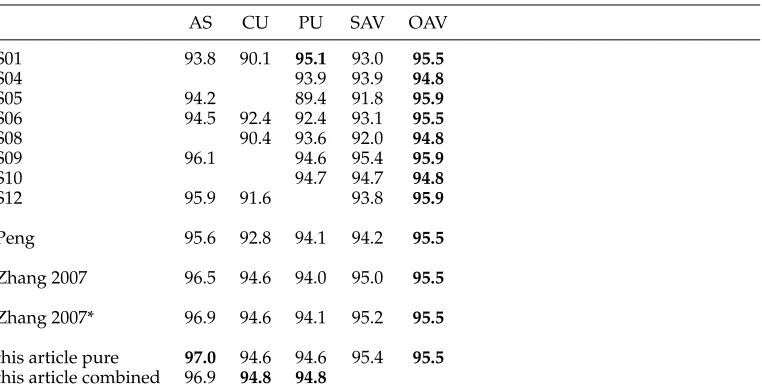
The results are shown in Table 4. We follow the format from Peng, Feng, and McCallum (2004), where each row represents a CWS model. The first three columns represent tests with the AS, CU, and PU corpora, respectively. The best score in each column is shown in bold. The last two columns represent the average accuracy of each model over the tests it participated in (SAV), and our average over the same tests (OAV), respectively. The first eight rows represent models from Sproat and Emerson (2003) that participated in at least one closed test from the table, row “Peng” represents theCRF model from Peng, Feng, and McCallum (2004), row “Zhang 2007” represents our model as reported in Zhang and Clark (2007), and the last two rows represent our model in this article, using only word-based features in Table 1 and combined features in Tables 1 plus 2, respectively.
[image:11.486.51.234.493.642.2]In Zhang and Clark (2007) we fixed the number of training iterations to six for all experiments, according to a separate set of development data. An alternative way to decide the number of training iterations is to set apart 10% from the training data
Figure 3
Table 4
The accuracies of various word segmentors over the firstSIGHANbakeoff data.
AS CU PU SAV OAV
S01 93.8 90.1 95.1 93.0 95.5
S04 93.9 93.9 94.8
S05 94.2 89.4 91.8 95.9
S06 94.5 92.4 92.4 93.1 95.5
S08 90.4 93.6 92.0 94.8
S09 96.1 94.6 95.4 95.9
S10 94.7 94.7 94.8
S12 95.9 91.6 93.8 95.9
Peng 95.6 92.8 94.1 94.2 95.5
Zhang 2007 96.5 94.6 94.0 95.0 95.5
Zhang 2007* 96.9 94.6 94.1 95.2 95.5
this article pure 97.0 94.6 94.6 95.4 95.5 this article combined 96.9 94.8 94.8
The best score in each column and the best average in each row is inboldface.
*Zhang 2007 with the (Carreras, Surdeanu, and Marquez 2006) method applied (see text for details).
as development test data, and use the rest for development training. For testing, all training data are used for training, with the number of training iterations set to be the number which gave the highest accuracy during the development experiments. This method was used by Carreras, Surdeanu, and Marquez (2006) in their parsing model. We apply it to our segmentor model in this article. Moreover, we also use this method to decide the number of training iterations for our system of Zhang and Clark (2007), and show the accuracies in row “Zhang 2007*”.
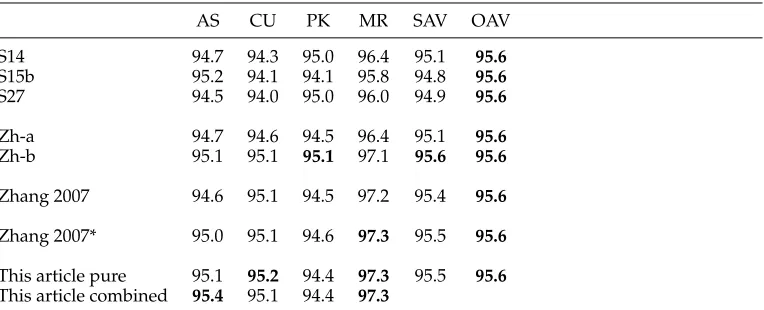
For each row the best average is shown in bold. We achieved the best accuracy in all three corpora, and better overall accuracy than all the other models using the method of this article. Our new method to decide the number of training iterations also gave improved accuracies compared to our 2007 model. The combination of character-based features and our original word-based features gave slight improvement in the overall accuracy.
Four training and testing corpora were used in the second bakeoff (Emerson 2005), including the Academia Sinica corpus (AS), the Hong Kong City University Corpus (CU), the Peking University Corpus (PK), and the Microsoft Research Corpus (MR). Different encodings were provided, and the UTF8 data for all four corpora were used in our experiments.
Table 5
The accuracies of various word segmentors over the secondSIGHANbakeoff data.
AS CU PK MR SAV OAV
S14 94.7 94.3 95.0 96.4 95.1 95.6
S15b 95.2 94.1 94.1 95.8 94.8 95.6
S27 94.5 94.0 95.0 96.0 94.9 95.6
Zh-a 94.7 94.6 94.5 96.4 95.1 95.6
Zh-b 95.1 95.1 95.1 97.1 95.6 95.6
Zhang 2007 94.6 95.1 94.5 97.2 95.4 95.6
Zhang 2007* 95.0 95.1 94.6 97.3 95.5 95.6
This article pure 95.1 95.2 94.4 97.3 95.5 95.6 This article combined 95.4 95.1 94.4 97.3
The best score in each column and the best average in each row is inboldface.
*Zhang 2007 with the (Carreras, Surdeanu, and Marquez 2006) method applied (see text for details).
3.5 Alternative Decoding Algorithms
Besides the general framework of this article, there are various alternative learning and decoding algorithms for a discriminative linear model applied to the word segmenta-tion problem, using the same feature templates we defined. In this secsegmenta-tion, we study two alternative decoding algorithms to the beam-search decoder, including a multiple-beam search algorithm, which can be viewed as an alternative decoder specifically designed for the word segmentation and joint segmentation and tagging problems, and a dynamic-programming algorithm. Both algorithms explore a larger part of the search space than the single beam-search algorithm, and we compare the accuracy and speed of these algorithms within the generalized perceptron learning framework.
3.5.1 A Multiple-Beam Search Decoder. In Zhang and Clark (2008a) we proposed a multiple-beam decoder for the problem of joint word segmentation andPOS-tagging, in which state items only contain complete words. This algorithm can be naturally adapted for word segmentation. Compared with the single-beam decoder, it explores a larger fraction of the search space. Moreover, the multiple-beam decoder does not have the problem of comparing partial words with full words in a single agenda, which our segmentor of Zhang and Clark (2007) has. We implement this decoder for segmentation and compare its accuracies with our single-beam decoder.
multiple-beam search decoder explores a larger number of candidate outputs compared to the single-beam search. To improve the running speed, a maximum word length record is kept to limit the length of candidate words.
Because the multiple-beam decoder can also be applied to the joint segmentation and POS-tagging problem in Section 4, we describe this algorithm by extending the generic beam-search algorithm in Figure 1. Three modifications are made to the original algorithm, shown in Figure 4. First, theB-bestcandidatesgenerated in each processing step are kept inprev topBs. Hereprev topBscan be seen as a list of thecandidatesin the original search algorithm, withprev topBs[k] containing the current items with sizek, andprev topBs[0] containing only the start item. An extra loop is used to enumerate all state items inprev topBsfor the generation of new state items. Second, variablekis used to represent the size of the state items to be generated, and EXPANDgenerates only state items with sizek, takingkas an extra parameter. Third, theB-best newly generated state items are appended to the back ofprev topBs, without removing previous state items in prev topBs. The algorithm thereby keeps track ofkBstate items instead ofBat thekth processing stage, and explores a larger subset of the exponential search space.
The rest of the algorithm is the same as the original algorithm in Figure 1. To in-stantiate this generic algorithm for word segmentation, STARTITEM(word segmentation) consists of an empty sentence S and a queue Q containing the full input sentence; EXPAND(candidate,k,word segmentation) generates a single new state item by popping characters on the incoming queue from the front until thekth character (kis the index in the input sentence rather than the queue itself), and appending them as a new word to candidate; and GOALTEST(word segmentation, best) returns true if bestconsists of a complete segmented sentence and an empty incoming queue.
As before, the linear model from Section 2 is applied directly to score state items, and the model parameters are trained with the averaged perceptron algorithm. The features for a state item are extracted according to the feature templates in Table 1.
3.5.2 A Dynamic-Programming Decoder. Given the feature templates that we define, a dynamic-programming algorithm can be used to explore the whole search space in cubic time. The idea is to reduce the search task into overlapping sub-problems.
functionMULTIPLE-BEAM-SEARCH(problem, agenda, prev topBs, B) prev topBs←{{STARTITEM(problem)}}
agenda←CLEAR(agenda) k←0
loop do
k←k+1
for eachcandidatesinprev topBs
for eachcandidateincandidates
agenda←INSERT(EXPAND(candidate, k, problem),agenda) ifGOALTEST(problem, agenda)
then returnTOP(agenda) candidates←TOP-B(agenda, B)
prev topBs←APPEND(prev topBs, candidates) agenda←CLEAR(agenda)
Figure 4
Suppose that the input hasncharacters; one way to find the highest-scored segmenta-tion is to first find the highest-scored segmentasegmenta-tions with the last word being characters b..n−1, whereb∈0..n−1, respectively, and then choose the highest-scored one from these segmentations. In order to find the highest-scored segmentation with the last word being charactersb,..n−1, the last word needs to be combined with all different segmentations of characters 0..b−1 so that the highest scored can be selected. However, because the largest-range feature templates span only over two words (see Table 1), the highest scored among the segmentations of characters 0..b−1 with the last word being charactersb0..b−1 will also give the highest score when combined with the word
b..n−1. As a result, the highest-scored segmentation with the last word being charac-tersb..n−1 can be found as long as the highest-scored segmentations of 0..b−1 with the last word beingb0..b−1 are found, whereb0∈0..b−1. With the same reasoning, the highest-scored segmentation of characters 0..b−1 with the last word beingb0..b−1 can be found by choosing the highest-scored one among the highest-scored segmentations of 0..b0−1 with the last word being b00..b0−1, where b00 ∈0..b0−1. In this way, the search task is reduced recursively into smaller problems, where in the simplest case the highest-scored segmentation of characters 0..ewith the last word being characters 0..e(e∈0..n−1) are known. And the final highest-scored segmentation can be found by incrementally finding the highest-scored segmentations of characters 0..e(e∈0..n−1) with the last word beingb..e(b∈0..e).
The pseudo code for this algorithm is shown in Figure 5. It works by building ann byntable chart, where nis the number of characters in the input sentencesent. chart[b,e] records the highest scored segmentation from the beginning to character e, with the last word starting from characterband ending at charactere.chart[0,e] can be computed directly fore=0..n−1, whereaschart[b,e] needs to be built by combing the best segmentation onsent[0,b−1] andsent[b,e], forb>0. The final output is the best amongchart[b,n−1], withb=0..n−1. The reason for recording partial segmentations with different final words separately (leading to cubic running time) is the word bigram feature template. Note that with a larger feature range, exact inference with dynamic-programming can become prohibitively slow.
Inputs: raw sentencesent(lengthn)
Variables: annbyntablechart, wherechart[b,e] stores the best scored (partial)
segmentation of the characters from the begining of the sentence to character e, with the last word spanning over the characters frombuntile;
character indexbfor the start of word; character indexefor the end of word;
character indexpfor the start of the previous word. Initialization:
fore=0..n−1:
chart[0,e]←a single wordsent[0..e] Algorithm:
fore=0..n−1: forb=1..e:
chart[b,e]←the highest scored segmentation among those derived by combining chart[p,b−1] withsent[b,e], forp=0..b−1
Outputs: the highest scored segmentation amongchart[b,n−1], forb=0..n−1 Figure 5
Table 6
Comparison between three different decoders for word segmentation.
Bakeoff 1 Bakeoff 2
AS CU PU AS CU PU MS Average
SB F-measure 96.9 94.6 94.1 95.0 95.1 94.6 97.3 95.4
SB sent/sec 212 145 202 358 115 177 105 188
SB char/sec 3,054 6,846 4,808 5,263 5,333 5,870 4,963 5,162 SB # features 4.0M 0.5M 1.5M 3.9M 1.8M 1.5M 2.7M 2.3M
MB F-measure 97.0 94.5 94.1 95.0 95.0 94.4 97.3 95.3
MB sent/sec 147 7 13 167 7 11 5 51
MB char/sec 2,118 331 187 2,455 325 365 236 859 MB # features 4.0M 0.6M 1.5M 3.9M 1.8M 1.5M 2.7M 2.3M
DP F-measure 97.1 94.6 94.3 95.0 95.0 94.5 97.2 95.4
DP sent/sec 131 3 6 142 4 4 2 42
DP char/sec 1,887 142 86 2,087 185 133 95 659
DP # features 4.0M 0.5M 1.5M 3.9M 1.7M 1.4M 2.7M 2.3M
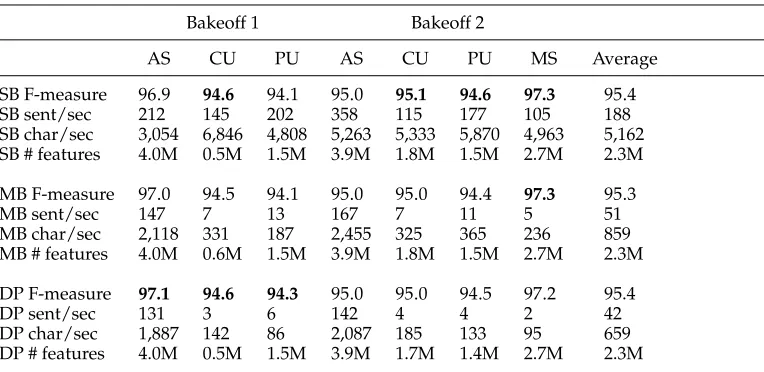
3.5.3 Experiments.Table 6 shows the comparison between the single-beam (SB), multiple-beam (MB), and dynamic-programming (DP) decoders by F-score and speed.1Speed is
measured by the number of sentences (sent) and characters (char) per second (excluding model loading time). We also include the size of the models in each case. The slight difference in model size between different methods is due to different numbers of negative features generated during training. The single-beam search algorithm achieved significantly higher speed than both the multiple-beam and the dynamic-programming algorithms, whereas the multiple-beam search algorithm ran slightly faster than the dynamic-programming algorithm. Though addressing the comparability issue and exploring a larger number of candidate output segmentations, neither multiple-beam search nor dynamic programming gave higher accuracy than the single-beam search algorithm overall. One of the possible reasons is that the perceptron algorithm adjusts its parameters according to the mistakes the decoder makes: Although the single-beam might make more mistakes than the multiple-beam given the same model, it does not necessarily perform worse with a specifically tailored model.
4. Joint Segmentation and Part-of-Speech Tagging
Joint word segmentation and POS-tagging is the problem of solving word segmen-tation andPOS-tagging simultaneously. Traditionally, Chinese word segmentation and POS-tagging are performed in a pipeline. The output from the word segmentor is taken as the input for the POS-tagger. A disadvantage of pipelined segmentation and POS-tagging is that POS-tag information, which is potentially useful for segmentation, is not used during the segmentation step. In addition, word segmentation errors are propagated to the POS-tagger, leading to lower quality of the overall segmented and
POS-tagged output. Joint word segmentation and POS-tagging is a method that ad-dresses these problems. In Zhang and Clark (2008a) we proposed a joint word segmen-tor andPOS-tagger using a multiple-beam decoder, and showed that it outperformed a pipelined baseline. We recently showed that comparable accuracies can be achieved by a single-beam decoder, which runs an order of magnitude faster (Zhang and Clark 2010). In this section, we describe our single-beam system using our general framework, and provide a detailed comparison with our multiple-beam and baseline systems of Zhang and Clark (2008a).
4.1 Instantiating the General Framework
Given an input sentence, our joint segmentor andPOS-tagger builds an output incre-mentally, one character at a time. When a character is processed, it is either concatenated with the last word in the partially built output, or taken as a new word. In the latter case, aPOS-tag is assigned to the new word. When more characters are concatenated to a word, thePOS-tag of the word remains unchanged.
For the decoding problem, an agenda is used to keep B different candidates at each incremental step. Before decoding starts, the agenda is initialized with an empty sentence. When a character is processed, existing candidates are removed from the agenda and extended with the current character in all possible ways, and theB-best newly generated candidates are put back onto the agenda. After all the input characters have been processed, the highest-scored candidate from the agenda is taken as output.
Expressed as an instance of the generic algorithm in Figure 1, a state item is a pair hS,Qi, withSbeing a segmented and tagged sentence andQbeing a queue of the next in-coming characters. STARTITEM(joint tagging) contains an empty sentence and the whole input sentence as incoming characters; EXPAND(candidate,joint tagging) pops the first character from the incoming queue, adds it to candidate, and assigns POS-tags in the aforementioned way to generate a set of new state items; and GOALTEST(joint tagging, best) returns true ifbestcontains a complete segmented andPOS-tagged output and an empty queue.
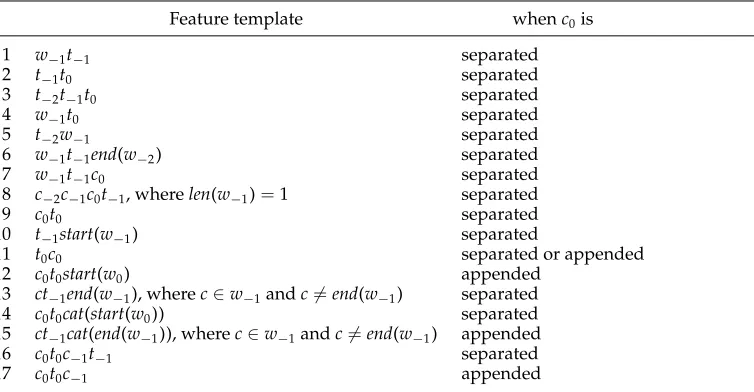
The linear model from Section 2 is applied to score state items, differentiating partial words from full words in the aforementioned ways, and the model parameters are trained with the averaged perceptron. The features for a state item are extracted incrementally according to Equation (3), where for theith character,Φ(δ(y,i)) is com-puted according to the feature templates in both Table 1, which are related to word segmentation, and Table 7, which are related toPOS-tagging. During training, the early-update method of Collins and Roark (2004), as described in Section 2, is used. It ensures that state items on the beam are highly probable at each incremental step, and is crucial to the high accuracy given by a single-beam.
4.2 Pruning
Table 7
POSfeature templates for the joint segmentor andPOS-tagger.
Feature template whenc0is
1 w−1t−1 separated
2 t−1t0 separated
3 t−2t−1t0 separated
4 w−1t0 separated
5 t−2w−1 separated
6 w−1t−1end(w−2) separated
7 w−1t−1c0 separated
8 c−2c−1c0t−1, wherelen(w−1)=1 separated
9 c0t0 separated
10 t−1start(w−1) separated
11 t0c0 separated or appended
12 c0t0start(w0) appended
13 ct−1end(w−1), wherec∈w−1andc6=end(w−1) separated
14 c0t0cat(start(w0)) separated
15 ct−1cat(end(w−1)), wherec∈w−1andc6=end(w−1) appended
16 c0t0c−1t−1 separated
17 c0t0c−1 appended
w = word; c = character; t =POS-tag. The index of the current character is 0.
Second, a tag dictionary is used to record POS-tags associated with each word. During decoding, frequent words and words with “closed set” tags2are only assigned
POS-tags according to the tag dictionary, while other words are assigned every POS-tag to make candidate outputs. Whether a word is a frequent word is decided by the number of times it has been seen in the training process. Denoting the number of times the most frequent word has been seen byM, a word is a frequent word if it has been seen more thanM/5, 000+5 times. The threshold value is taken from Zhang and Clark (2008a), and we did not adjust it during development. Word frequencies are initialized as zeros and updated according to each training example before it is processed; the tag dictionary is initialized as empty and updated according to each training example before it is processed.
Third, we make an additional record of the initial characters for words with “closed set” tags. During decoding, when the current character is added as the start of a new word, “closed set” tags are only assigned to the word if it is consistent with the record. This type of pruning is used in addition to the tag dictionary to prune invalid partial words, while the tag dictionary is used to prune complete words. The record for initial character and POSis initially empty, and updated according to each training example before it is processed.
Finally, at any decoding step, we group partial candidates that are generated by separating the current character as the start of a new word by the signaturep0p−1w−1,
and keep only the best among those having the samep0p−1w−1. The signaturep0p−1w−1
is decided by the feature templates we use: it can be shown that if two candidatescand1 andcand2generated at the same step have the same signature, and the score ofcand1 is higher than the score ofcand2, then at any future step, the highest scored candidate
generated fromcand1will always have a higher score than the highest scored candidate generated fromcand2.
From these four pruning methods, only the third was not used by our multiple-beam system (Zhang and Clark 2008a). This was designed to help keep likely partial words in the agenda and improve the accuracy, and does not give our system a speed advantage over our multiple-beam system.
4.3 Comparison with Multiple-Beam Search (Zhang and Clark 2008a)
Our system of Zhang and Clark (2008a) was based on the perceptron and a multiple-beam decoder. That decoder can be seen as a slower alternative of our decoder in this ar-ticle, but one which explores a larger part of the search space. The comparison between our joint segmentation and tagging systems of Zhang and Clark (2008a) and this article is similar to the comparison between our segmentors in sections 3.5.1 and 3.1. In Zhang and Clark (2008a), we argued that the straightforward implementation of the single-beam decoder cannot give competitive accuracies to the multiple-single-beam decoder, and the main difficulties for a single-beam decoder are in the representing of partial words, and the handling of an exponentially large combined search space using one beam. In this section, we give a description of our system of Zhang and Clark (2008a), and discuss the reason we can achieve competitive accuracies using a single beam in this article.
4.3.1 The Multiple-Beam System of Zhang and Clark (2008a).The decoder of our multiple-beam system can be formulated as an instance of the multiple-multiple-beam decoder described in Section 3.5.1.
Similar to the multiple-beam search decoder for word segmentation, the decoder compares candidates only with complete tagged words, and enables the size of the search space to scale with the input size. A set of state items is kept for each character to record possible segmented and POS-tagged sentences ending with the character. Just as with the single-beam decoder, the input sentence is processed incrementally. However, when a character is processed, the number of previously built state items is increased fromBtokB, whereBis the beam-size andkis the number of characters that have been processed. Moreover, partial candidates ending with any previous character are available. The decoder thus generates all possible tagged words ending with the cur-rent character, concatenating each with existing partial sentences ending immediately before the word, and putting the resulting sentence onto the agenda. After the character is processed, theB-best items in the agenda are kept as the corresponding state items for the character, and the agenda is cleared for the next character. All input characters are processed in the same way, and the final output is the best state item for the last character.
To instantiate the generic multiple-beam algorithm in Figure 4 for joint segmenta-tion and POS-tagging, STARTITEM(joint tagging) consists of an empty sentenceS and a queueQcontaining the full input sentence; EXPAND(candidate,k,joint tagging) pops characters on the incoming queue from the front until thekth character (kis the index in the input sentence rather than the queue itself), appending them as a new word tocandidate, and assigning to the new word all possible POS-tags to generate a set of new items; and GOALTEST(joint tagging,best) returns true ifbestconsists of a complete segmented andPOS-tagged sentence and an empty incoming queue.
for a state item are extracted according to the union of the feature templates for the baseline segmentor and the baselinePOS-tagger.
4.3.2 Discussion.An important problem that we solve for a single-beam decoder for the global model is the handling of partial words. As we pointed out in Zhang and Clark (2008a), it is very difficult to score partial words properly when they are compared with full words, although such comparison is necessary for incremental decoding with a single-beam. To allow comparisons with full words, partial words can either be treated as full words, or handled differently.
We showed in Zhang and Clark (2008a) that a naive single-beam decoder which treats partial words in the same way as full words failed to give a competitive ac-curacy. An important reason for the low accuracy is over-segmentation during beam-search. Consider the three characters (tap water). The first two characters do not make sense when put together as a single word. Rather, when treated as two single-character words, they can make sense in a sentence such as (please) (self) (come) (take). Therefore, when using single-beam search to process (tap water), the two-character word candidate is likely to have been thrown off the agenda before the third character is considered, leading to an unrecoverable segmentation error.
This problem is even more severe for a joint segmentor and POS-tagger than for a pure word segmentor, because the POS-tags and POS-tag bigram of and fur-ther supports them being separated when is considered. The multiple-beam search decoder we proposed in Zhang and Clark (2008a) can be seen as a means to ensure that the three characters always have a chance to be considered as a single word. It explores candidate segmentations from the beginning of the sentence until each character, and avoids the problem of processing partial words by considering only full words. However, because it explores a larger part of the search space than a single-beam decoder, its time complexity is correspondingly higher.
In our single-beam system, we treat partial words differently from full words, so that in the previous example, the decoder can take the first two characters in (tap water) as a partial word, and keep it in the beam before the third character is processed. One challenge is the representation ofPOS-tags for partial words. ThePOSof a partial word is undefined without the corresponding full word information. Though a partial word can make sense with a particularPOS-tag when it is treated as a complete word, thisPOS-tag is not necessarily thePOSof the full word which contains the partial word. Take the three-character sequence as an example. The first character represents a single-character word ‘below’, for which thePOScan beLCorVV. The first two characters represent a two-character word ‘rain’, for which the POScan beVV. Moreover, all three characters when put together make the word ‘rainy day’, for which thePOSisNN. As discussed earlier, assigningPOStags to partial words as if they were full words leads to low accuracy.
An obvious solution to this problem is not to assign aPOSto a partial word until it becomes a full word. However, lack ofPOSinformation for partial words makes them less competitive compared to full words in the beam, because the scores of full words are further supported byPOSandPOSn-gram information. Therefore, not assigningPOS to partial words potentially leads to over segmentation. In our experiments, this method did not give comparable accuracies to our multiple-beam system.
predictions are made with the first character of the word, and the likely ones will be kept in the beam for the next processing steps. For example, with the three characters , we try to keep two partial words (besides full words) in the beam when the first word is processed, with thePOS beingVV andNN, respectively. The first POS predicts the two-character word , and the second the three-character word . Now when the second character is processed, we still need to maintain the possiblePOS
NNin the agenda, which predicts the three-character word .
We show that the mechanism of predicting the POS at the first character gives competitive accuracy. This mechanism can be justified theoretically. Unlike alphabetical languages, each Chinese character represents some specific meanings. Given a character, it is natural for a human speaker to know immediately what types of words it can start. This allows the knowledge of possiblePOS-tags of words that a character can start, using information about the character from the training data. Moreover, thePOSof the previ-ous words to the current word are also useful in deciding possiblePOSfor the word.3
The mechanism of first-character decision ofPOSalso boosts the efficiency, because the enumeration ofPOSis unnecessary when a character is appended to the end of an existing word. As a result, the complexity of each processing step is reduced by half compared to a method withoutPOSprediction.
Finally, an intuitive way to represent the status of a partial word is using a flag explicitly, which means an early decision of the segmentation of the next incoming character. We take a simpler alternative approach, and treat every word as a partial word until the next incoming character is separated from the last character of this word. Before a word is confirmed as a full word, we only apply to it features that represent its current partial status, such as character bigrams, its starting character, its part-of-speech, and so forth. Full word features, including the first and last characters of a word, are applied immediately after a word is confirmed as complete.
An important component for our proposed system is the training process, which needs to ensure that the model scores a partial word with predictedPOS properly. We apply the general framework and use the averaged perceptron for training, together with the “early update” mechanism.
4.4 Experiments
We performed two sets of experiments, using the Chinese Treebank 4 and 5, respectively. In the first set of experiments,CTB4 was separated into two parts:CTB3 (420K characters in 150K words/10, 364 sentences) was used for the final 10-fold cross validation, and the rest (240K characters in 150K words/4, 798 sentences) was used as training and test data for development. The second set of experiments was performed to compare with relevant systems onCTB5 data.
The standard F-scores are used to measure both the word segmentation accuracy and the overall segmentation and tagging accuracy, where the overall accuracy is
JF=2pr/(p+r)
with the precision p being the percentage of correctly segmented and tagged words in the decoder output, and the recallrbeing the percentage of gold-standard tagged
words that are correctly identified by the decoder. For direct comparison with Ng and Low (2004), thePOS-tagging accuracy is also calculated by the percentage of correct tags on each character.
4.4.1 Development Experiments.Our development data consists of 150K words in 4, 798 sentences. Eighty percent (80%) of the data were randomly chosen as the development training data, and the rest were used as the development test data. Our development tests were mainly used to decide the size of the beam, the number of training iterations, and to observe the effect of early update.
Figure 6 shows the accuracy curves for joint segmentation andPOS-tagging by the number of training iterations, using different beam sizes. With the size of the beam increasing from 1 to 32, the accuracies generally increase, although the amount of increase becomes small when the size of the beam becomes 16. After the tenth iteration, a beam size of 32 does not always give better accuracies than a beam size of 16. We therefore chose 16 as the size of the beam for our system.
The testing times for each beam size between 1 and 32 are 7.16 sec, 11.90 sec, 18.42 sec, 27.82 sec, 46.77 sec, and 89.21 sec, respectively. The corresponding speeds in the number of sentences per second are 111.45, 67.06, 43.32, 28.68, 17.06 and 8.95, respectively.
Figure 6 also shows that the accuracy increases with an increased number of train-ing iterations, but the amount of increase becomes small after the 25th iteration. We chose 29 as the number of iterations to train our system.
[image:22.486.49.374.388.628.2]The effect of early update:We compare the accuracies by early update and normal perceptron training. In the normal perceptron training case, the system reached the best performance at the 22nd iteration, with a segmentation F-score of 90.58% and joint
Figure 6
The influence of beam-sizes, and the convergence of the perceptron for the joint segmentor and
Table 8
The accuracies of joint segmentation andPOS-tagging by 10-fold cross validation.
Baseline (pipeline) Joint single-beam Joint multiple-beam
# SF JF JA SF JF JA SF JF JA
Av. 95.2 90.3 92.2 95.8 91.4 93.0 95.9 91.3 93.0
SF= segmentation F-score; JF= overall segmentation and POS-tagging F-score; JA = tagging accuracy by character.
F-score of 83.38%. When using early update, the algorithm reached the best accuracy at the 30th training iteration, obtaining a segmentation F-score of 91.14% and a joint F-score of 84.06%.
4.4.2 Cross-Validation Results.Ten-fold cross validation is performed to test the accuracy of the joint word segmentor andPOS-tagger, and to make comparisons with existing models in the literature. Following Ng and Low (2004), we partition the sentences in CTB3, ordered by sentence ID, into 10 groups evenly. In thenth test, the nth group is used as the testing data.
Table 8 shows the cross-validation accuracies of the pipeline baseline system and the joint system using single and multiple beam decoders. SF, JF and JA represent segmentation F-score, tagging F-score, and tagging accuracy, respectively. The joint segmentor and tagger systems outperformed the baseline consistently, while the single beam-search decoder in this article gave comparable accuracies to our multiple-beam algorithm of Zhang and Clark (2008a).
Speed comparisons of the three systems using the same 10-fold cross-validation are shown in Table 9. TE, ML, and SP represents the testing time (seconds), model loading time (seconds), and speed (number of sentences per second), respectively. Speed is cal-culated as number of test sentences divided by the test time (excluding model loading). For the baseline system, test time and model loading time for both the segmentor and thePOS-tagger are recorded. The joint system using a single beam decoder was over 10 times faster than the multiple-beam system, and the baseline system was more than three times as fast as the single-beam joint system. These tests were performed on a Mac OSX platform with a 2.13GHz CPU and a gcc 4.0.1 compiler.
[image:23.486.52.434.574.625.2]Table 10 shows the overall accuracies of the baseline and joint systems, and com-pares them to two relevant models in the literature. The accuracy of each model is
Table 9
The speeds of joint word segmentation andPOS-tagging by 10-fold cross validation.
Baseline (pipeline) Joint single-beam Joint multiple-beam
# TE (s+p=total) ML (s+p=total) SP TE ML SP TE ML SP
Av. 8.8+10.4=19.2 2.9+3.7=6.6 82.2 58.6 12.1 22.4 575.0 9.5 1.9
Table 10
The comparison of overall accuracies of various joint segmentor andPOS-taggers by 10-fold
cross validation usingCTB.
Model SF JF JA
Baseline+ (Ng) 95.1 – 91.7
Joint+ (Ng) 95.2 – 91.9
Baseline+* (Shi) 95.85 91.67 –
Joint+* (Shi) 96.05 91.86 –
Baseline (ours) 95.20 90.33 92.17 Joint (our multiple-beam) 95.90 91.34 93.02 Joint (our single-beam) 95.84 91.37 93.01
SF = segmentation F-score; JF = joint segmentation andPOS-tagging F-score; JA = tagging accuracy by character.
+ Knowledge about special characters. * Knowledge from semantic net outsideCTB.
shown in a row, where Ng represents the models from Ng and Low (2004), which applies a character tagging approach to perform word segmentation andPOS-tagging simultaneously, and Shi represents the models from Shi and Wang (2007), which is a reranking system for segmentation andPOS-tagging. These two models are described in more detail in the related work section. Each accuracy measure is shown in a col-umn, including the segmentation F-score (SF), the overall tagging F-score (JF), and the tagging accuracy by character (JA). As can be seen from the table, our joint models achieved the largest improvement over the baseline, reducing the segmentation error by more than 14% and the overall tagging error by over 12%.
The overall tagging accuracy of our joint model was comparable to but less than the joint model of Shi and Wang (2007). Despite the higher accuracy improvement from the baseline, the joint system did not give higher overall accuracy. One possi-ble reason is that Shi and Wang (2007) included knowledge about special characters and semantic knowledge from Web corpora (which may explain the higher baseline accuracy), whereas our system is completely data-driven. However, the comparison is indirect because our partitions of theCTBcorpus are different. Shi and Wang (2007) also chunked the sentences before doing 10-fold cross validation, but used an uneven split. We chose to follow Ng and Low (2004) and split the sentences evenly to facilitate further comparison.
Compared with Ng and Low (2004), our baseline model gave slightly better accu-racy, consistent with our previous observations about the word segmentors in Section 3. Due to the large accuracy gain from the baseline, our joint model performed much better.
In summary, when compared with existing joint word segmentation and POS-tagging systems using cross-validation tests, our proposed model achieved the best accuracy boost from the pipelined baseline, and competitive overall accuracy. Our sys-tem based on the general framework of this article gave comparable accuracies to our multiple-beam system in Zhang and Clark (2008a), and a speed that is over an order of magnitude higher than the multiple-beam algorithm.
Table 11
Training, development, and test data fromCTB5 for joint word segmentation andPOS-tagging.
Sections Sentences Words
Training 1–270, 400–931, 1001–1151 18,085 493,892
Dev 301–325 350 6,821
Test 271–300 348 8,008
to compare the accuracies of our joint system with models in the literature, and to draw the speed/accuracy tradeoff graph.
Kruengkrai et al. (2009) made use of character type knowledge for spaces, numerals, symbols, alphabets, and Chinese and other characters. In the previous experiments, our system did not use any knowledge beyond the training data. To make the comparison fairer, we included knowledge of English letters and Arabic numbers in this experiment. During both training and decoding, English letters and Arabic numbers are segmented using rules, treating consecutive English letters or Arabic numbers as a single word.
The results are shown in Table 12, where row N07 refers to the model of Nakagawa and Uchimoto (2007), rows J08a and J08b refer to the models of Jiang et al. (2008) and Jiang, Mi, and Liu (2008), and row K09 refers to the models of Kruengkrai et al. (2009). Columns SF and JF refer to segmentation and joint segmentation and tagging accuracies, respectively. Our system gave comparable accuracies to these recent works, obtaining the best (same as the error-driven version of K09) joint F-score.
The accuracy/speed tradeoff graphs for the joint segmentor and POS-taggers, to-gether with the baseline pipeline system, are shown in Figure 7. For each point in each curve, the development test data were used to decide the number of training iterations, and then the speed and accuracy were measured using test data. No character knowl-edge is used in any system. The baseline curve was drawn withB=16 for the baseline segmentor, because the baseline segmentation accuracy did not improve beyondB=16 in our experiments. Each point in this curve corresponds to a different beam size of the baselinePOS-tagger, which are 2, 4, 8, 16, 32, 64, 128, and 256, respectively, from right to left.
[image:25.486.52.446.550.644.2]When the speed is over 2.5 thousand characters per second, the baseline system performed better than the joint single-beam and multiple-beam systems, due to the higher segmentation accuracy brought by the fixed beam segmentor. However, as the
Table 12
Accuracy comparisons between various joint segmentors andPOS-taggers onCTB5.
SF JF
K09 (error-driven) 97.87 93.67 our system 97.78 93.67 Zhang 2008 97.82 93.62 K09 (baseline) 97.79 93.60
J08a 97.85 93.41
J08b 97.74 93.37
N07 97.83 93.32