General estimation and evaluation
of compositional distributional semantic models
Georgiana Dinu and Nghia The Pham and Marco Baroni Center for Mind/Brain Sciences (University of Trento, Italy)
(georgiana.dinu|thenghia.pham|marco.baroni)@unitn.it
Abstract
In recent years, there has been widespread interest in compositional distributional semantic models (cDSMs), that derive meaning representations for phrases from their parts. We present an evaluation of al-ternative cDSMs under truly comparable conditions. In particular, we extend the idea of Baroni and Zamparelli (2010) and Guevara (2010) to use corpus-extracted examples of the target phrases for param-eter estimation to the other models pro-posed in the literature, so that all models can be tested under the same training con-ditions. The linguistically motivated func-tional model of Baroni and Zamparelli (2010) and Coecke et al. (2010) emerges as the winner in all our tests.
1 Introduction
The need to assess similarity in meaning is cen-tral to many language technology applications, and distributional methods are the most robust ap-proach to the task. These methods measure word similarity based on patterns of occurrence in large corpora, following the intuition that similar words occur in similar contexts. More precisely, vector space models, the most widely used distributional models, represent words as high-dimensional vec-tors, where the dimensions represent (functions of) context features, such as co-occurring context words. The relatedness of two words is assessed by comparing their vector representations.
The question of assessing meaning similarity above the word level within the distributional paradigm has received a lot of attention in re-cent years. A number of compositional frame-works have been proposed in the literature, each of these defining operations to combine word vec-tors into representations for phrases or even
en-tire sentences. These range from simple but ro-bust methods such as vector addition to more ad-vanced methods, such as learning function words as tensors and composing constituents through in-ner product operations. Empirical evaluations in which alternative methods are tested in compara-ble settings are thus called for. This is compli-cated by the fact that the proposed compositional frameworks package together a number of choices that are conceptually distinct, but difficult to disen-tangle. Broadly, these concern (i) the input repre-sentations fed to composition; (ii) the composition operation proper; (iii) the method to estimate the parameters of the composition operation.
For example, Mitchell and Lapata in their clas-sic 2010 study propose a set of composition op-erations (multiplicative, additive, etc.), but they also experiment with two different kinds of input representations (vectors recording co-occurrence with words vs. distributions over latent topics) and use supervised training via a grid search over pa-rameter settings to estimate their models. Gue-vara (2010), to give just one further example, is not only proposing a different composition method with respect to Mitchell and Lapata, but he is also adopting different input vectors (word co-occurrences compressed via SVD) and an unsu-pervised estimation method based on minimizing the distance of composed vectors to their equiva-lents directly extracted from the source corpus.
Blacoe and Lapata (2012) have recently high-lighted the importance of teasing apart the differ-ent aspects of a composition framework, presdiffer-ent- present-ing an evaluation in which different input vector representations are crossed with different compo-sition methods. However, two out of three com-position methods they evaluate are parameter-free, so that they can side-step the issue of fixing the pa-rameter estimation method.
In this work, we evaluateallcomposition meth-ods we know of, excluding a few that lag
hind the state of the art or are special cases of those we consider, while keeping the estimation method constant. This evaluation is made pos-sible by our extension to all target composition models of the corpus-extracted phrase approxima-tion method originally proposed inad-hocsettings by Baroni and Zamparelli (2010) and Guevara (2010). For the models for which it is feasible, we compare the phrase approximation approach to supervised estimation with crossvalidation, and show that phrase approximation is competitive, thus confirming that we are not comparing mod-els under poor training conditions. Our tests are conducted over three tasks that involve different syntactic constructions and evaluation setups. Fi-nally, we consider a range of parameter settings for the input vector representations, to insure that our results are not too brittle or parameter-dependent.1
2 Composition frameworks
Distributional semantic models (DSMs) approxi-mate word meanings with vectors recording their patterns of co-occurrence with corpus contexts (e.g., other words). There is an extensive literature on how to develop such models and on their eval-uation (see, e.g., Clark (2012), Erk (2012), Tur-ney and Pantel (2010)). We focus here on compo-sitional DSMs (cDSMs). After discussing some options pertaining to the input vectors, we review all the composition operations we are aware of (excluding only the tensor-product-based models shown by Mitchell and Lapata (2010) to be much worse than simpler models),2and then methods to estimate their parameters.
Input vectors Different studies have assumed different distributional inputs to composition. These include bag-of-words co-occurrence vec-tors, possibly mapped to lower dimensionality with SVD or other techniques (Mitchell and La-pata (2010) and many others), vectors whose
di-1
We made the software we used to construct seman-tic models and estimate and test composition methods available online at http://clic.cimec.unitn.it/ composes/toolkit/
2
Erk and Pad´o (2008) and Thater et al. (2010) use in-put vectors that have been adapted to their phrasal contexts, but then apply straightforward composition operations such as addition and multiplication to these contextualized vec-tors. Their approaches are thus not alternative cDSMs, but special ways to construct the input vectors. Grefenstette and Sadrzadeh (2011a; 2011b) and Kartsaklis et al. (2012) pro-pose estimation techniques for the tensors in the functional model of Coecke et al. (2010). Turney (2012) does not com-pose representations but similarity scores.
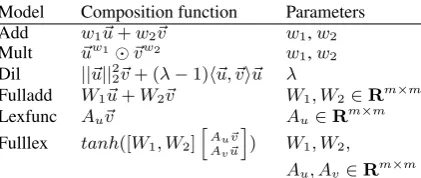
Model Composition function Parameters Add w1~u+w2~v w1,w2 Mult ~uw1~vw2 w
1,w2 Dil ||~u||2
2~v+ (λ−1)h~u, ~vi~u λ
Fulladd W1~u+W2~v W1, W2∈Rm×m
Lexfunc Au~v Au∈Rm×m
Fulllex tanh([W1, W2]
h
Au~v Av~u i
[image:2.595.310.521.61.150.2]) W1, W2, Au, Av∈Rm×m
Table 1: Composition functions of inputs(u, v).
mensions record the syntactic link between targets and collocates (Erk and Pad´o, 2008; Thater et al., 2010), and most recently vectors based on neural language models (Socher et al., 2011; Socher et al., 2012). Blacoe and Lapata (2012) compared the three representations on phrase similarity and paraphrase detection, concluding that “simple is best”, that is, the bag-of-words approach performs at least as good or better than either syntax-based or neural representations across the board. Here, we take their message home and we focus on bag-of-words representations, exploring the impact of various parameters within this approach.
Most frameworks assume that word vectors constitute rigid inputs fixed before composition, often using a separate word-similarity task inde-pendent of composition. The only exception is Socher et al. (2012), where the values in the in-put vectors are re-estimated during composition parameter optimization. Our re-implementation of their method assumes rigid input vectors instead.
Composition operations Mitchell and Lapata (2008; 2010) present a set of simple but effec-tive models in which each component of the output vector is a function of the corresponding compo-nents of the inputs. Given input vectors~u and~v, the weighted additive model (Add) returns their weighted sum: p~ = w1~u+w2~v. In the dilation
model (Dil), the output vector is obtained by de-composing one of the input vectors, say~v, into a vector parallel to ~u and an orthogonal vector, and then dilating only the parallel vector by a fac-tor λ before re-combining (formula in Table 1). Mitchell and Lapata also propose a simple mul-tiplicative model in which the output components are obtained by component-wise multiplication of the corresponding input components. We intro-duce here its natural weighted extension (Mult), that takes w1 and w2 powers of the components
before multiplying, such that each phrase compo-nentpi is given by:pi=uwi1v
w2
Guevara (2010) and Zanzotto et al. (2010) ex-plore a full form of the additive model (Fulladd), where the two vectors entering a composition pro-cess are pre-multiplied by weight matrices before being added, so that each output component is a weighted sum of all input components: ~p =
W1~u+W2~v.
Baroni and Zamparelli (2010) and Coecke et al. (2010), taking inspiration from formal seman-tics, characterize composition asfunction applica-tion. For example, Baroni and Zamparelli model adjective-noun phrases by treating the adjective as a function from nouns onto (modified) nouns. Given that linear functions can be expressed by matrices and their application by matrix-by-vector multiplication, a functor (such as the adjective) is represented by a matrix Au to be composed with
the argument vector ~v (e.g., the noun) by multi-plication, returning thelexical function(Lexfunc) representation of the phrase:~p=Au~v.
The method proposed by Socher et al. (2012) (see Socher et al. (2011) for an earlier proposal from the same team) can be seen as a combination and non-linear extension of Fulladd and Lexfunc (that we thus call Fulllex) in which both phrase elements act as functors (matrices)andarguments (vectors). Given input terms uandv represented by (~u, Au) and (~v, Av), respectively, their
com-position vector is obtained by applying first a lin-ear transformation and then the hyperbolic tangent function to the concatenation of the productsAu~v
and Av~u (see Table 1 for the equation). Socher
and colleagues also present a way to construct ma-trix representations for specific phrases, needed to scale this composition method to larger con-stituents. We ignore it here since we focus on the two-word case.
Estimating composition parameters If we have manually labeled example data for a target task, we can use supervised machine learning to optimize parameters. Mitchell and Lapata (2008; 2010), since their models have just a few param-eters to optimize, use a direct grid search for the parameter setting that performs best on the train-ing data. Socher et al. (2012) train their models using multinomial softmax classifiers.
If our goal is to develop a cDSM optimized for a specific task, supervised methods are undoubt-edly the most promising approach. However, ev-ery time we face a new task, parameters must be re-estimated from scratch, which goes against the
idea of distributional semantics as a general sim-ilarity resource (Baroni and Lenci, 2010). More-over, supervised methods are highly composition-model-dependent, and for models such as Fulladd and Lexfunc we are not aware of proposals about how to estimate them in a supervised manner.
Socher et al. (2011) propose an autoencoding strategy. Given a decomposition function that re-constructs the constituent vectors from a phrase vector (e.g., it re-generatesgreenandjacket vec-tors from the composed green jacketvector), the composition parameters minimize the distance be-tween the original and reconstructed input vectors. This method does not require hand-labeled train-ing data, but it is restricted to cDSMs for which an appropriate decomposition function can be de-fined, and even in this case the learning problem might lack a closed-form solution.
Guevara (2010) and Baroni and Zamparelli (2010) optimize parameters using examples of how the output vectors should look like that are directly extracted from the corpus. To learn, say, a Lexfunc matrix representing the adjective green, we extract from the corpus example vectors of hN, green Ni pairs that occur with sufficient fre-quency (hcar, green cari, hjacket, green jacketi, hpolitician, green politiciani, . . . ). We then use least-squares methods to find weights for thegreen matrix that minimize the distance between the green Nvectors generated by the model given the input N and the corresponding corpus-observed phrase vectors. This is a very general approach, it does not require hand-labeled data, and it has the nice property that corpus-harvested phrase vec-tors provide direct evidence of the polysemous be-haviour of functors (thegreen jacketvs.politician contexts, for example, will be very different). In the next section, we extend thecorpus-extracted phrase approximationmethod to all cDSMs de-scribed above, with closed-form solutions for all but the Fulllex model, for which we propose a rapidly converging iterative estimation method.
3 Least-squares model estimation using corpus-extracted phrase vectors3
Notation Given two matricesX, Y ∈Rm×nwe
denote their inner product byhX, Yi, (hX, Yi = Pm
i=1 Pn
j=1xijyij). Similarly we denote by
hu, vithe dot product of two vectorsu, v∈Rm×1
and by ||u|| the Euclidean norm of a vector:
||u|| = hu, ui1/2. We use the following Frobe-nius norm notation:||X||F =hX, Xi1/2. Vectors
are assumed to be column vectors and we usexi
to stand for thei-th(m×1)-dimensional column of matrixX. We use[X, Y] ∈Rm×2nto denote
the horizontal concatenation of two matrices while
h
X Y
i
∈R2m×nis their vertical concatenation.
General problem statement We assume vocab-ularies of constituentsU, V and that of resulting phrases P. The training data consist of a set of tuples(u, v, p)wherepstands for the phrase asso-ciated to the constituentsuandv:
T ={(ui, vi, pi)|(ui, vi, pi)∈ U ×V×P,1≤i≤k}
We build the matricesU, V, P ∈Rm×kby con-catenating the vectors associated to the training data elements as columns.4
Given the training data matrices, the general problem can be stated as:
θ∗= arg min
θ
||P−f compθ(U, V)||F
where f compθ is a composition function and θ stands for a list of parameters that this composition function is associated to. The composition func-tions are defined: f compθ : Rm×1×Rm×1 →
Rm×1 andf comp
θ(U, V)stands for their natural extension when applied on the individual columns of theU andV matrices.
Add The weighted additive model returns the sum of the composing vectors which have been re-weighted by some scalars w1 and w2: ~p = w1~u+w2~v. The problem becomes:
w1∗, w∗2 = arg min w1,w2∈R
||P −w1U −w2V||F
The optimalw1 andw2are given by:
w1∗= ||V|| 2
FhU, Pi − hU, VihV, Pi
||U||2
F||V||2F − hU, Vi2
(1)
w∗2 = ||U|| 2
FhV, Pi − hU, VihU, Pi
||U||2
F||V||2F − hU, Vi2
(2)
4In reality, not all composition models requireu,vandp
to have the same dimensionality.
Dil Given two vectors ~u and ~v, the dilation model computes the phrase vector~p = ||~u||2~v+ (λ−1)h~u, ~vi~u where the parameterλis a scalar. The problem becomes:
λ∗ = arg min
λ∈R
||P−V D||ui||2−U D(λ−1)hui,vii||F
where by D||ui||2 and D(λ−1)hui,vii we denote diagonal matrices with diagonal elements (i, i)
given by ||ui||2 and(λ−1)hui, vii respectively.
The solution is:
λ∗ = 1−
Pk
i=1hui,(||ui||2vi−pi)ihui, vii
Pk
i=1hui, vii2||ui||2
Mult Given two vectors~u and~v, the weighted multiplicative model computes the phrase vector
~
p = ~uw1 ~vw2 where stands for
component-wise multiplication. We assume for this model that
U, V, P ∈ Rm++×n, i.e. that the entries are strictly larger than 0: in practice we add a small smooth-ing constant to all elements to achieve this (Mult performs badly on negative entries, such as those produced by SVD). We use thew1andw2weights
obtained when solving the much simpler related problem:5
w∗1, w2∗= arg min w1,w2∈R
||log(P)−log(U.∧w1V.∧w2)||F
where.∧stands for the component-wise power op-eration. The solution is the same as that for Add, given in equations (1) and (2), withU →log(U),
V →log(V)andP →log(P).
Fulladd The full additive model assumes the composition of two vectors to be~p=W1~u+W2~v
whereW1, W2 ∈Rm×m. The problem is:
[W1, W2]∗ = arg min [W1,W2]∈Rm×2m
||P−[W1W2]
U V
||
This is a multivariate linear regression prob-lem (Hastie et al., 2009) for which the least squares estimate is given by: [W1, W2] = ((XTX)−1XTY)T where we useX= [UT, VT]
andY =PT.
Lexfunc The lexical function composition method learns a matrix representation for each functor (given byU here) and defines composition as matrix-vector multiplication. More precisely:
5In practice training Mult this way achieves similar or
~
p=Au~vwhereAuis a matrix associated to each
functor u ∈ U. We denote by Tu the training
data subset associated to an element u, which contains only tuples which haveuas first element. Learning the matrix representations amounts to solving the set of problems:
Au = arg min
Au∈Rm×m
||Pu−AuVu||
for each u ∈ U where Pu, Vu ∈ Rm×|Tu|
are the matrices corresponding to the Tu
train-ing subset. The solutions are given by: Au = ((VuVuT)−1VuPuT)T. This composition function
does not use the functor vectors.
Fulllex This model can be seen as a generaliza-tion of Lexfunc which makes no assumpgeneraliza-tion on which of the constituents is a functor, so that both words get a matrix and a vector representation. The composition function is:
~
p=tanh([W1, W2]
Au~v
Av~u
)
where Au and Av are the matrices associated to
constituents u and v and [W1, W2] ∈ Rm×2m.
The estimation problem is given in Figure 1. This is the only composition model which does not have a closed-form solution. We use a block coordinate descent method, in which we fix each of the matrix variables but one and solve the corre-sponding least-squares linear regression problem, for which we can use the closed-form solution. Fixing everything but[W1, W2]:
[W1∗, W2∗] = ((XTX)−1XTY)T
X=
[Au1v~1, ..., Aukv~k]
[Av1u~1, ..., Avku~k]
T
Y =atanh(PT)
Fixing everything but Au for some elementu,
the objective function becomes:
||atanh(Pu)−W1AuVu−W2[Av1~u, ..., Avk0~u]||F
where v1...vk0 ∈ V are the elements occurring withuin the training data andVuthe matrix
result-ing from their concatenation. The update formula for theAumatrices becomes:
A∗u =W1−1((XTX)−1XTY)T
X=VuT
Y = (atanh(Pu)−W2[Av1~u, ..., Avk0~u])
T
In all our experiments, Fulllex estimation con-verges after very few passes though the matrices. Despite the very large number of parameters of this model, when evaluating on the test data we ob-serve that using a higher dimensional space (such as 200 dimensions) still performs better than a lower dimensional one (e.g., 50 dimensions).
4 Evaluation setup and implementation
4.1 Datasets
We evaluate the composition methods on three phrase-based benchmarks that test the models on a variety of composition processes and similarity-based tasks.
Intransitive sentences The first dataset, intro-duced by Mitchell and Lapata (2008), focuses on simple sentences consisting of intransitive verbs and their noun subjects. It contains a total of 120 sentence pairs together with human similar-ity judgments on a 7-point scale. For exam-ple,conflict erupts/conflict burstsis scored 7,skin glows/skin burns is scored 1. On average, each pair is rated by 30 participants. Rather than eval-uating against mean scores, we use each rating as a separate data point, as done by Mitchell and La-pata. We report Spearman correlations between human-assigned scores and model cosine scores.
Adjective-noun phrases Turney (2012) intro-duced a dataset including both noun-noun com-pounds and adjective-noun phrases (ANs). We focus on the latter, and we frame the task dif-ferently from Turney’s original definition due to data sparsity issues.6 In our version, the dataset contains 620 ANs, each paired with a single-noun paraphrase. Examples include: archaeolog-ical site/dig, spousal relationship/marriage and dangerous undertaking/adventure. We evaluate a model by computing the cosine of all 20K nouns in our semantic space with the target AN, and look-ing at the rank of the correct paraphrase in this list. The lower the rank, the better the model. We re-port median rank across the test items.
Determiner phrases The last dataset, intro-duced in Bernardi et al. (2013), focuses on a class of grammatical terms (rather than content
6Turney used a corpus of about 50 billion words, almost
W1∗, W2∗, A∗u1, ..., A∗v1, ...= arg min Rm×m
||atanh(PT)−[W1, W2]
[Au1v~1, ..., Aukv~k]
[Av1u~1, ..., Avku~k]
||F
= arg min Rm×m
||atanh(PT)−W1[Au1v~1, ..., Aukv~k]−W2[Av1u~1, ..., Avku~k]||F
Figure 1: Fulllex estimation problem.
words), namely determiners. It is a multiple-choice test where target nouns (e.g., amnesia) must be matched with the most closely related determiner(-noun) phrases (DPs) (e.g., no mem-ory). The task differs from the previous one also because here the targets are single words, and the related items are composite. There are 173 tar-get nouns in total, each paired with one correct DP response, as well as 5 foils, namely the de-terminer (no) and noun (memory) from the correct response and three more DPs, two of which con-tain the same noun as the correct phrase (less mem-ory, all memory), the third the same determiner (no repertoire). Other examples of targets/related-phrases are polysemy/several senses and tril-ogy/three books. The models compute cosines be-tween target noun and responses and are scored based on their accuracy at ranking the correct phrase first.
4.2 Input vectors
We extracted distributional semantic vectors us-ing as source corpus the concatenation of ukWaC, Wikipedia (2009 dump) and BNC, 2.8 billion to-kens in total.7 We use a bag-of-words approach and we count co-occurrences within sentences and with a limit of maximally 50 words surrounding the target word. By tuning on the MEN lexical relatedness dataset,8 we decided to use the top 10K most frequent content lemmas as context fea-tures (vs. top 10K inflected forms), and we experi-mented with positive Pointwise and Local Mutual Information (Evert, 2005) as association measures (vs. raw counts, log transform and a probability ratio measure) and dimensionality reduction by Non-negative Matrix Factorization (NMF, Lee and Seung (2000)) and Singular Value Decomposition (SVD, Golub and Van Loan (1996)) (both outper-forming full dimensionality vectors on MEN). For
7
http://wacky.sslmit.unibo.it; http://www.natcorp.ox.ac.uk
8http://clic.cimec.unitn.it/∼elia.
bruni/MEN
both reduction techniques, we varied the number of dimensions to be preserved from 50 to 300 in 50-unit intervals. As Local Mutual Information performed very poorly across composition exper-iments and other parameter choices, we dropped it. We will thus report, for each experiment and composition method, the distribution of the rele-vant performance measure across 12 input settings (NMF vs. SVD times 6 dimensionalities). How-ever, since the Mult model, as expected, worked very poorly when the input vectors contained neg-ative values, as is the case with SVD, for this model we report result distributions across the 6 NMF variations only.
4.3 Composition model estimation
Training by approximating the corpus-extracted phrase vectors requires corpus-based examples of input (constituent word) and output (phrase) vec-tors for the composition processes to be learned. In all cases, training examples are simply selected based on corpus frequency. For the first experi-ment, we have 42 distinct target verbs and a total of≈20K training instances, that is,hhnoun,verbi, noun-verbituples (505 per verb on average). For the second experiment, we have 479 adjectives and ≈1 million hhadjective, nouni, adjective-nouni training tuples (2K per adjective on average). In the third, 50 determiners and 50K hhdeterminer, nouni, determiner-nouni tuples (1K per deter-miner). For all models except Lexfunc and Ful-llex, training examples are pooled across target el-ements to learn a single set of parameters. The Lexfunc model takes only argument word vectors as inputs (the functors in the three datasets are verbs, adjectives and determiners, respectively). A separate weight matrix is learned for each func-tor, using the corresponding training data.9 The Fulllex method jointly learns distinct matrix rep-resentations for both left- and right-hand side
con-9For the Lexfunc model we have experimented with least
stituents. For this reason, we must train this model on balanced datasets. More precisely, for the in-transitive verb experiments, we use training data containing noun-verb phrases in which the verbs and the nouns are present in the lists of 1,500 most frequent verbs/nouns respectively, adding to these the verbs and nouns present in our dataset. We obtain 400K training tuples. We create the training data similarity for the other datasets ob-taining 440K adjective-noun and 50K determiner phrase training tuples, respectively (we also exper-imented with Fulllex trained on the same tuples used for the other models, obtaining considerably worse results than those reported). Finally, for Dil we treat direction of stretching as a further param-eter to be optimized, and find that for intransitives it is better to stretch verbs, in the other datasets nouns.
For the simple composition models for which parameters consist of one or two scalars, namely Add, Mult and Dil, we also tune the parame-ters through 5-fold crossvalidation on the datasets, directly optimizing the parameters on the target tasks. For Add and Mult, we search w1, w2
through the crossproduct of the interval[0 : 5] in
0.2-sized steps. For Dil we useλ∈[0 : 20], again in0.2-sized steps.
5 Evaluation results
We begin with some remarks pertaining to the overall quality of and motivation for corpus-phrase-based estimation. In seven out of nine comparisons of this unsupervised technique with fully supervised crossvalidation (3 “simple” mod-els –Add, Dil and Mult– times 3 test sets), there was no significant difference between the two esti-mation methods.10 Supervised estimation outper-formed the corpus-phrase-based method only for Dil on the intransitive sentence and AN bench-marks, but crossvalidated Dil was outperformed by at least one phrase-estimated simple model on both benchmarks.
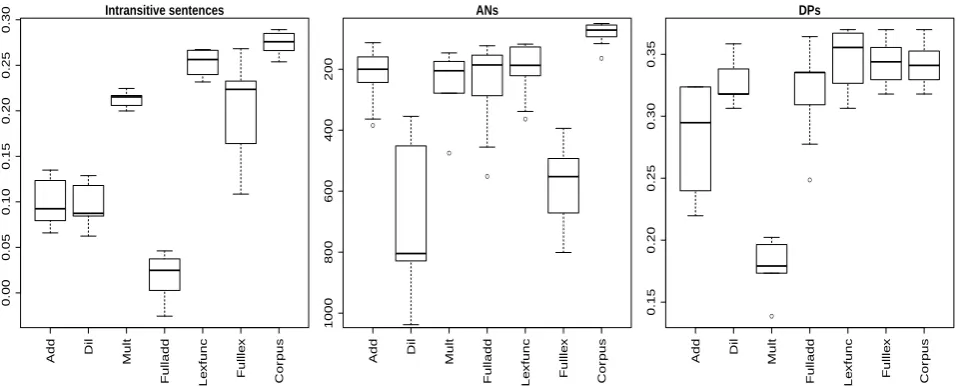
The rightmost boxes in the panels of Fig-ure 2 depict the performance distribution for us-ing phrase vectors directly extracted from the corpus to tackle the various tasks. This non-compositional approach outperforms all composi-tional methods in two tasks over three, and it is one of the best approaches in the third, although
10Significance assessed through Tukey Honestly
Signifi-cant Difference tests (Abdi and Williams, 2010),α= 0.05.
in all cases even its top scores are far from the theoretical ceiling. Still, performance is impres-sive, especially in light of the fact that the non-compositional approach suffers of serious data-sparseness problems. Performance on the intran-sitive task is above state-of-the-art despite the fact that for almost half of the cases one test phrase is not in the corpus, resulting in 0 vectors and consequently 0 similarity pairs. The other bench-marks have better corpus-phrase coverage (nearly perfect AN coverage; for DPs, about 90% correct phrase responses are in the corpus), but many tar-get phrases occur only rarely, leading to unreliable distributional vectors. We interpret these results as a good motivation for corpus-phrase-based estima-tion. On the one hand they show how good these vectors are, and thus that they are sensible targets of learning. On the other hand, they do not suffice, since natural language is infinitely productive and thus no corpus can provide full phrase coverage, justifying the whole compositional enterprise.
The other boxes in Figure 2 report the perfor-mance of the composition methods trained by cor-pus phrase approximation. Nearly all models are significantly above chance in all tasks, except for Fulladd on intransitive sentences. To put AN me-dian ranks into perspective, consider that a meme-dian rank as high as 8,300 has near-0 probability to oc-cur by chance. For DP acoc-curacy, random guessing gets 0.17% accuracy.
Lexfunc emerges consistently as the best model. On intransitive constructions, it significantly out-performs all other models except Mult, but the dif-ference approaches significance even with respect to the latter (p = 0.071). On this task, Lexfunc’s median correlation (0.26) is nearly equivalent to thebestcorrelation across a wide range of parame-ters reported by Erk and Pad´o (2008) (0.27). In the AN task, Lexfunc significantly outperforms Ful-llex and Dil and, visually, its distribution is slightly more skewed towards lower (better) ranks than any other model. In the DP task, Lexfunc significantly outperforms Add and Mult and, visually, most of its distribution lies above that of the other mod-els. Most importantly, Lexfunc is the only model that is consistent across the three tasks, with all other models displaying instead a brittle perfor-mance pattern.11
Still, the top-performance range of all models
11No systematic trend emerged pertaining to the input
Add Dil Mult
Fulladd Le xfunc Fullle
x
Cor
pus
0.00
0.05
0.10
0.15
0.20
0.25
0.30
Intransitive sentences
●
●
● ●
●
Add Dil Mult
Fulladd Le xfunc Fullle
x
Cor
pus
1000
800
600
400
200
ANs
● ●
Add Dil Mult
Fulladd Le xfunc Fullle
x
Cor
pus
0.15
0.20
0.25
0.30
0.35
[image:8.595.59.538.62.255.2]DPs
Figure 2: Boxplots displaying composition model performance distribution on three benchmarks, across input vector settings (6 datapoints for Mult, 12 for all other models). For intransitive sentences, figure of merit is Spearman correlation, for ANs median rank of correct paraphrase, and for DPs correct response accuracy. The boxplots display the distribution median as a thick horizontal line within a box extending from first to third quartile. Whiskers cover 1.5 of interquartile range in each direction from the box, and extreme outliers outside this extended range are plotted as circles.
on the three tasks is underwhelming, and none of them succeeds in exploiting compositionality to do significantly better than using whatever phrase vectors can be extracted from the corpus directly. Clearly, much work is still needed to develop truly successful cDSMs.
The AN results might look particularly worry-ing, considering that even the top (lowest) median ranks are above 100. A qualitative analysis, how-ever, suggests that the actual performance is not as bad as the numerical scores suggest, since of-ten the nearest neighbours of the ANs to be para-phrased are nouns that are as strongly related to the ANs as the gold standard response (although not necessarily proper paraphrases). For example, the gold response tocolorimetric analysis is col-orimetry, whereas the Lexfunc (NMF, 300 dimen-sions) nearest neighbour is chromatography; the gold response toheavy particleisbaryon, whereas Lexfunc proposes muon; for melodic phrase the gold istuneand Lexfunc hasappoggiatura; for in-door garden, the gold ishothousebut Lexfunc pro-posesglasshouse(followed by the more sophisti-catedorangery!), and so on and so forth.
6 Conclusion
We extended the unsupervised corpus-extracted phrase approximation method of Guevara (2010) and Baroni and Zamparelli (2010) to estimate
all known state-of-the-art cDSMs, using closed-form solutions or simple iterative procedures in all cases. Equipped with a general estimation ap-proach, we thoroughly evaluated the cDSMs in a comparable setting. The linguistically moti-vated Lexfunc model of Baroni and Zamparelli (2010) and Coecke et al. (2010) was the win-ner across three composition tasks, also outper-forming the more complex Fulllex model, our re-implementation of Socher et al.’s (2012) compo-sition method (of course, the compocompo-sition method is only one aspect of Socher et al.’s architecture). All other composition methods behaved inconsis-tently.
In the near future, we want to focus on improv-ing estimation itself. In particular, we want to explore ways to automatically select good phrase examples for training, beyond simple frequency thresholds. We tested composition methods on two-word phrase benchmarks. Another natural next step is to apply the composition rules recur-sively, to obtain representations of larger chunks, up to full sentences, coming, in this way, nearer to the ultimate goal of compositional distributional semantics.
Acknowledgments
References
Herv´e Abdi and Lynne Williams. 2010. Newman-Keuls and Tukey test. In Neil Salkind, Bruce Frey, and Dondald Dougherty, editors, Encyclopedia of Research Design, pages 897–904. Sage, Thousand Oaks, CA.
Marco Baroni and Alessandro Lenci. 2010. Dis-tributional Memory: A general framework for corpus-based semantics. Computational Linguis-tics, 36(4):673–721.
Marco Baroni and Roberto Zamparelli. 2010. Nouns are vectors, adjectives are matrices: Representing adjective-noun constructions in semantic space. In
Proceedings of EMNLP, pages 1183–1193, Boston, MA.
Raffaella Bernardi, Georgiana Dinu, Marco Marelli, and Marco Baroni. 2013. A relatedness benchmark to test the role of determiners in compositional dis-tributional semantics. InProceedings of ACL (Short Papers), Sofia, Bulgaria. In press.
William Blacoe and Mirella Lapata. 2012. A com-parison of vector-based representations for seman-tic composition. InProceedings of EMNLP, pages 546–556, Jeju Island, Korea.
Stephen Clark. 2012. Vector space models of lexical meaning. In Shalom Lappin and Chris Fox, editors,
Handbook of Contemporary Semantics, 2nd edition. Blackwell, Malden, MA. In press.
Bob Coecke, Mehrnoosh Sadrzadeh, and Stephen Clark. 2010. Mathematical foundations for a com-positional distributional model of meaning. Linguis-tic Analysis, 36:345–384.
Katrin Erk and Sebastian Pad´o. 2008. A structured vector space model for word meaning in context. In
Proceedings of EMNLP, pages 897–906, Honolulu, HI.
Katrin Erk. 2012. Vector space models of word mean-ing and phrase meanmean-ing: A survey. Language and Linguistics Compass, 6(10):635–653.
Stefan Evert. 2005. The Statistics of Word Cooccur-rences. Dissertation, Stuttgart University.
Gene Golub and Charles Van Loan. 1996. Matrix Computations (3rd ed.). JHU Press, Baltimore, MD.
Edward Grefenstette and Mehrnoosh Sadrzadeh. 2011a. Experimental support for a categorical com-positional distributional model of meaning. In Pro-ceedings of EMNLP, pages 1394–1404, Edinburgh, UK.
Edward Grefenstette and Mehrnoosh Sadrzadeh. 2011b. Experimenting with transitive verbs in a Dis-CoCat. InProceedings of GEMS, pages 62–66, Ed-inburgh, UK.
Emiliano Guevara. 2010. A regression model of adjective-noun compositionality in distributional se-mantics. In Proceedings of GEMS, pages 33–37, Uppsala, Sweden.
Trevor Hastie, Robert Tibshirani, and Jerome Fried-man. 2009. The Elements of Statistical Learning, 2nd ed. Springer, New York.
Dimitri Kartsaklis, Mehrnoosh Sadrzadeh, and Stephen Pulman. 2012. A unified sentence space for categorical distributional-compositional semantics: Theory and experiments. In Proceedings of COL-ING: Posters, pages 549–558, Mumbai, India.
Daniel Lee and Sebastian Seung. 2000. Algorithms for Non-negative Matrix Factorization. InProceedings of NIPS, pages 556–562.
Jeff Mitchell and Mirella Lapata. 2008. Vector-based models of semantic composition. InProceedings of ACL, pages 236–244, Columbus, OH.
Jeff Mitchell and Mirella Lapata. 2010. Composition in distributional models of semantics. Cognitive Sci-ence, 34(8):1388–1429.
Richard Socher, Eric Huang, Jeffrey Pennin, Andrew Ng, and Christopher Manning. 2011. Dynamic pooling and unfolding recursive autoencoders for paraphrase detection. InProceedings of NIPS, pages 801–809, Granada, Spain.
Richard Socher, Brody Huval, Christopher Manning, and Andrew Ng. 2012. Semantic compositionality through recursive matrix-vector spaces. In Proceed-ings of EMNLP, pages 1201–1211, Jeju Island, Ko-rea.
Stefan Thater, Hagen F¨urstenau, and Manfred Pinkal. 2010. Contextualizing semantic representations us-ing syntactically enriched vector models. In Pro-ceedings of ACL, pages 948–957, Uppsala, Sweden.
Peter Turney and Patrick Pantel. 2010. From fre-quency to meaning: Vector space models of se-mantics. Journal of Artificial Intelligence Research, 37:141–188.
Peter Turney. 2012. Domain and function: A dual-space model of semantic relations and compositions.
Journal of Artificial Intelligence Research, 44:533– 585.