Features
Héctor Martínez Alonso, Bolette Sandford Pedersen University of Copenhagen
Copenhagen, Denmark [email protected]
Núria Bel
Universitat Pompeu Fabra Barcelona, Spain [email protected]
Abstract
The following work describes a method to au-tomatically classify the sense selection of the complex type Location/Organization –which depends on regular polysemy– using shallow features, as well as a way to increase the vo-lume of sense-selection gold standards by us-ing monosemous data as filler. The classifier results show that grammatical features are the most relevant cues for the identification of sense selection in this instance of regular poly-semy.
1 Introduction
In this paper we report on our experiments to automatically assess the distributional evi-dence that allow the recognition of sense selec-tion for regular polysemy, focusing on the Loca-tion/Organization alternation or dot type (Puste-jovsky, 1995). Broadly speaking, regular poly-semy involves the predictable alternation be-tween senses in a systematic way for a signifi-cant number of words, i.e. a semantic class or type (cf. section 2). The definition of dot type is further elaborated in 2.1.
The analysis of this data has been imple-mented by applying a decision tree classifier to the shallow features obtained from a set of occur-rences of dot-type words in order to obtain their selected sense. In this aspect, our work is akin to Word Sense Disambiguation (WSD) but it in-cludes an attempt to identify underspecified senses. The machine-learning strategy is also different from state-of-the-art WSD, as seen in sections 3 and 4.
We also propose a method to increase the volume of gold-standard training data by using monosemous words as an aid to provide
distribu-tional information of one of the possible senses in a sense alternation.
The results are expected to give pointers on how to face a general approach for the computa-tional treatment of cases of regular polysemy described as the sense selection of dot types, along with the recognition and tagging of dot predication. The technical application of this re-search can be used to improve results on infor-mation retrieval, semantic role annotation, etc.
2 Regular polysemy
Regular polysemy is known by several names throughout the literature: logical, com-plementary or systematicpolysemy or even logi-calmetonymy.
The wordings are naturally different and may be slightly nuanced, as can be seen by comparing Apresjan’s definition (1974, p. 18): "For any word that has a meaning of type 'A', is true that it can be used in a meaning of type 'B' as well [...] Regular polysemy is triggered by metonymy, whereas irregular polysemy is triggered by other metaphorical processes."
...with Pustejovsky's definition (1995, p. 28): "I will define logical polysemy as a complemen-tary ambiguity where there is no change of lexi-cal category, and the multiple senses of the word have overlapping, dependent or shared mean-ings."
From these definitions we understand regular polysemy as a phenomenon whereby a word that belongs to a semantic type can act as a member of another semantic type without incurring in metaphor, as this change of type is the result of metonymy. Some well known examples are:
a) Container for content: He drank a whole glass.
b) Property for subject of property: The au-thorities arrived quickly.
c) Producer for product: I drive a Honda. d) Location for organization: France elects
a new president.
This differentiates regular polysemy from what is traditionally referred as polysemy ( irre-gular polysemy according to Apresjan), which is more often metaphorical in nature and is some-times pooled together with homonymy as in the cases of “olive pit” vs. “tar pit” or “sand bank” vs. “federal bank”.
2.1 Dot type
The Generative Lexicon or GL (Pustejovsky, 1995) is a theoretical framework of lexical se-mantics that tackles the description of the gene-rativity of word meaning. The GL introduces a series of theoretical objects like qualiastructure, typecoercion and dottype.
The dot type is, according to the GL a type of noun that is simultaneously a member of more than one semantic class. According to Rum-shisky (2007), the senses –i.e. classes or types– that a dot object presents are metonymically re-lated to one another. This means that the relation between the semantic classes of a dot type is one of regular polysemy. Some examples of dot types are:
e) book : Artifact/Information f) construction : Process/Result g) chicken: Animal/Food
h) country: Location/Organization
A dot type selects one or more of its possible senses when placed in a context, as shown by the following examples from the American National Corpus or ANC (Ide and Macleod, 2001):
i) Manuel died in exile in 1932 in England. j) England was being kept busy with other
concerns
k) England was, after all, an important wine market
In case i), England selects the Location sense, whereas in case j) it selects the Organization sense. In k) however, the sense of England is both “the English organizations” and “the Eng-lish territory”. We use the name dot predication for the instances of a dot type that do not have one of the possible senses as most salient, as in k), which can be seen a kind of underspecifica-tion.
In spite of the GL's computational perspec-tive, Natural Language Processing (NLP) im-plementations that examine the actual computa-tional feasibility of the GL are few. Moreover,
there is no overt attempt to identify the possible three behaviors of a dot type, as the dot predica-tion has not been computapredica-tionally tackled, which is related to the lack of strategies to capture meaning underspecification.
3 State of the art
The computational study of systematic polysemy has been geared to the collapsing of senses (Vossen et al., 1999; Buitelaar, 1998; Tomuro, 2001) prior to Word Sense Disambigua-tion (WSD). The best performance in WSD is obtained by supervised methods that require a very large amount of annotated learning data. The other main approach is to use a lexical knowledge base such as WordNet and a Page-Rank algorithm to compute the most likely sense in the sense enumeration of the lexical know-ledge base (Agirre and Soroa, 2009). WordNet does not include the Location/Organization al-ternation in geopolitical locations, so the task at hands falls outside the traditional scope of WSD. The field of Named Entity Recognition (NER) shows two different approaches to regu-lar-polysemy based sense alternations. In their account, Johannessen et al. (2005) differentiate what they call the Form over Function and the Function over Form strategy. Some NER sys-tems assign a constant value to a word type, en-forcing what Finkel et al. (2005) call label con-sistency, namely Form over Function. The Func-tion over Form strategy, however, assigns a se-mantic type to the analyzed word depending on how it behaves in each context and is analogous to the work exposed in this article.
A class of nominals that shows regular polysemy and is well studied is the deverbal noun (destruction, examination), which has dis-tinct grammatical features that can help pinpoint its reading as either process or result, as covered in theory by Grimshaw (1990) and computation-ally acknowledged by Peris et al. (2009).
There is also recent work in the identifica-tion of metonymy (Markert and Nissim, 2009) as well as other Generative-Lexicon based sense-disambiguation works, such as Rumshisky et al. (2007) or Pustejovsky et al. (2010). Disambigua-tion systems, however, are still coping with the need of a representation and recognition of un-derspecification (Pustejovsky, 2009).
a qualia structure. SIMPLE list the Geopolitical Location class as a class associated to a complex type <Location,Human_Group>, which ex-presses the dot-type ambiguity of words of this class. Words that are considered geopolitical lo-cations can be proper (Africa, Boston, China) or common (city, nation, state, etc) nouns.
4 Experiment
We propose a classification experiment that identifies the senses of Location/Organization words by firstly characterizing the grammatical and lexical features of each and using the ex-tracted features as input for a decision tree clas-sifier. Our experiment can be regarded as a case of WSD in which all disambiguated words can have a Location sense, an Organization sense, or a mixed or underspecified sense which corres-ponds to the dot predication.
Let t be the analyzed token of a sentence – the headword in WSD jargon–, which belongs to the dot type Location/Organization. The goal of the task is to determine whether each t has the Location or Organization sense, or rather, if it exhibits a mixed or underspecified behavior, i.e. a dot predication.
The goal of the experiment is to assess the distribution of the complex type Loca-tion/Organization and its sense selection in a se-ries of occurrences of proper names for geopolit-ical locations. A supervised method has been chosen, as this specific phenomenon was ex-pected to require a smaller volume of training data than the general case of supervised WSD.
Markert and Nissim (2009) assume in their metonymy resolution account that the se-mantic class of the analyzed nouns was already known; claiming that standard NER can be fol-lowed by metonymy resolution. We have taken the same assumption and also chosen named ent-ities to build our datasets following their claim that “Named entities [...] are also very often used figuratively but not listed in dictionaries”.
After evaluating the SensEval-2007 re-sults, Markert and Nissim (2009) acknowledge the difficulty of identifying specific cases of me-tonymy for Location and Organization words, and we have considered derivated metonymies from a given class as symptoms of the class it-self. For instance, if an Organization type ap-pears very often as a subject, it is very likely to be experiencing the org-for-members metonymy, which we do not separate from the Organization-type behavior, but instead count the presence of
the word as subject as a potential indicator of its ORG sense.
A total of 2132 instances of Loca-tion/Organization words were obtained from the ANC from the occurrences of high-frequency (>500) nouns: Each of the instances was manual-ly identified to obtain their selected sense: Loca-tion, Organization or Dot, henceforth LOC, ORG and DOT.
Only one annotator has tagged the data, but Market and Nissim offer a rationale for using one annotator for such coarse-grained distinc-tions, because they identify an inter-encoder agreement of 0.88. Noise examples (homony-mies like China being a part of a larger named entity like AOL China) were discarded.
For any given instance of a proper noun X, it was seen if it could be acceptably (albeit pos-sibly in an awkward manner) paraphrased as “the territory of X” (LOC) or “the institutions of X” (ORG). If both applied, it was considered a dot predication (DOT).
4.1 Boosting dataset
The initial distribution of senses is skewed on the side of LOC. In order to balance the Loca-tion/Organization distribution of senses, 200 oc-currences of CIA, Microsoft, NATO and Penta-gon (also high-frequency words in the ANC) were added because they are purely Organization words that only have Location sense if they ex-perience the organization-for-headquarters me-tonymy, which has not been accounted for. This provides the final distribution of senses in the gold-standard data. It is expected that the Organ-ization sense of the dot types has a similar distri-butional behavior to the purely Organization-typed word, which allows us to compensate the asymmetry of the data. This has created two dif-ferent datasets, Total-dots, which only has occur-rences of words belonging to dot types, and To-tal-boost, which also includes the 800 rows of Organization-type words.
4.2 Distribution of senses
LOC ORG DOT Total
Afghanistan 213 12 60 285
Africa 110 11 18 139
America 69 70 65 204
Boston 121 2 25 148
California 88 16 61 165
Canada 91 43 69 203
China 60 80 27 167
England 86 21 41 148
Europe 151 32 59 242
Germany 123 62 62 247
London 102 6 76 184
Total-dots 1214355 563 2132
CIA 0 200 0 200
Microsoft 0 200 0 200
NATO 0 200 0 200
Pentagon 0 200 0 200
[image:4.612.130.260.63.365.2]Total-boost 12141155 563 2932
Table 1: distribution of senses for the two datasets
As it can be seen, some lexical elements are much more often Location, which is their fundamental type, but the Organization reading is more common, for instance, for country names. It can also be seen that each lexical item has a different distribution of senses.
5 Feature space
The features have been extracted from the POS-tagged, XML version of the ANC with noun chunks, the only source of external infor-mation for feature extraction system is the WordSketch (Kilgarrif et al, 2004), which has only been used to establish the nominal word space. No other external resources like Frame-Net or WordFrame-Net have been used, following Mar-kert and Nissim’s (2009) claim that grammatical features tend to be the most discriminating fea-tures. For similar remarks, cf. Peris (2009), Rumshisky (2007).
The hypotheses that regular polysemy alterna-tions are often determined at subphrasal level can contradict traditional WSD algorithms like Page Rank, which have a larger scope of analysis. Se-lection of metonymical senses falls outside of the One-sense-per-discourse approach (Gale et al., 1992), since such approach has been phrased
re-ferring to irregular polysemy like “olive pit” vs. “tar pit”.
5.1 Lexical and grammatical features
Extracted features are meant to describe the dot type Location/Organization, be it by its grammatical behavior or the lexical environmen-tal that words of this type appear in.
So-called grammatical features describe as-pects of the structure of the headword’s NP, its position within the sentence, the relative pres-ence of verbs and punctuations, and most impor-tantly, the presence of prepositions before the headword t. Prepositions are regarded as function words and therefore considered part of the grammar.
Lexical features list the words that appear around the instances of the dot type. In order to increase the recall of the system, a set of verbs and nouns from the word sketch of the words city, country and continent –hypernyms for the dot types in the training data– was obtained.
[image:4.612.330.517.559.681.2]A word sketch is a corpus-based automatic summary of a word’s grammatical and colloca-tional behavior obtained using the Sketch Engine tool (Kilgarrif et al, 2004). Each binary feature informs of the presence of one of the mentioned lemmas in the whole sentence. The verbs were taken from the object_of and subject_of relations, whereas the nouns were taken from the n_modifier, modifies, posession, pp_obj_of-p and pp_of-p. Only common nouns have been used. To avoid overfitting the experiment to the sam-ple by using the lexical environment of the ana-lyzed word themselves, the BNC (British Na-tional Corpus, distributed by Oxford University Computing Services on behalf of the BNC Con-sortium) was used. The usage of a lexical envi-ronment to assist the disambiguation of a dot type follows Rumshisky (2007).
5.2 List of features
Following Joanis et al. (2006), the occur-rences have been characterized in order to assess the amount of semantic information that their distributional data can provide. The total size of the feature space is of 317 binary features, di-vided as follows:
1. NP-traits (6 features): which describe the internal structure of the NP where t appears. The features indicate the presence of an adjective in the NP, of a common noun before or after t, of a genitive mark after t, of a coordinate “X and Y” and the presence of an ar-ticle at the beginning of the NP. 2. Position of t (2 features): t being the
first or last token of the sentence. 3. Prepositions before t (57 features):
each binary feature indicates whether the NP where t is included is intro-duced by a preposition. The list of checked prepositions it the one used by the Preposition Project (Litkowski and Hargraves, 2005).
4. Previous and next token after t's NP (4 features): each binary feature de-scribes whether the previous or next token is either a comma or a parenthe-sis.
5. Verb after of before t (2 features): in-forms whether there is a verb imme-diately before t, or whether there is a modal or non-modal verb thereafter. 6. Lexical space (243 features): The
nouns and verbs obtained from the hypernyms’ word sketch.
5.3 Classifier runs
In order to establish a classifier, C.45 pruned decision trees from the Weka (Witten and Frank, 2005) implementation were used, as in Resnik and Bel (2009). Decision trees provide an analy-sis of the importance of the features for a given class, and are more adequate for sparse enviro-ments than other families of algorithms (Quinlan, 1993). Due to the relatively small amount of da-ta, performance was evaluated by means of 10-fold cross-validation instead of keeping separate training and test sets.
The six classifier runs can be paired in three groups:
1. Allthree: 3-way identification of LOC, ORG and DOT senses from the Total-dots and the Total-boost datasets.
2. Loc/Org: Binary identification of LOC and ORG senses from the Total-dots and the Total-boost datasets, dis-carding occurrences tagged as DOT. 3. Dot/NoDot: Binary identification of
DOT classes from the Total-dots and the Total-boost datasets, treating both cases of LOC and ORG selection as a NODOT sense.
6 Evaluation
The following section details the importance of the lexical features for the construction of the decision tree, as well as the performance meas-ures of the classifier.
6.1 Impact of lexical features
This section details the relevance of the lex-ical features for the decision tree classifier, that is, how relevant the lexical environment is when choosing a possible sense. A very high preva-lence of lexical features versus grammatical fea-tures would contradict the statement that gram-matical features are often key to establish the sense selection of a dot type.
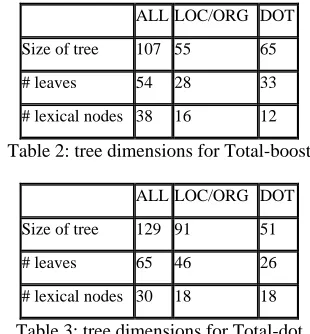
The following tables describe the dimen-sions of the resulting decision trees for the expe-riments. Size of tree indicates the number of nodes, number of leaves is the amount of nodes that assign a sense when reached during the deci-sion process, and lexical nodes are those that cor-respond to one of the 243 lexical features in the feature space. Each binary feature generates two nodes when incorporated into the tree, so 15 lex-ical items will generate 30 lexlex-ical nodes in the decision tree.
ALL LOC/ORG DOT
Size of tree 107 55 65
# leaves 54 28 33
[image:5.612.337.492.513.680.2]# lexical nodes 38 16 12
Table 2: tree dimensions for Total-boost
ALL LOC/ORG DOT
Size of tree 129 91 51
# leaves 65 46 26
# lexical nodes 30 18 18
Table 3: tree dimensions for Total-dot
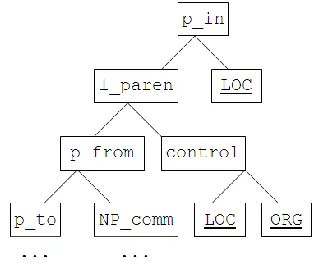
trees that have a very similar amount of lexical nodes. Lexical nodes are about a third of the total of nodes for a given tree, which always use all the grammatical features such as prepositions and the position of token t before anything else. Lexical nodes do not appear before the third lev-el in the decision tree, as the first levlev-els are oc-cupied by grammatical features, with the excep-tion of frequents word like control, road or south, which can appear at that level in the dif-ferent decision trees. Figure 2 shows the first four levels of the LOC/ORG decision trees. The left branch of a given node indicates feature=0 while right branch means feature=1. The nodes p_in and p_from and p_to represent the features that inform of the presence of the corresponding preposition before the headword. L_paren in-forms of the presence of a left parenthesis, NP_comm indicates if there is another common noun in the headword’s NP and control is the lexical feature that indicates the presence of the word control in the sentence. Underlined nodes are the leaves or output of classifier.
Figure 2: top levels for the LOC/ORG decision tree.
Some prepositions are very safe indicators for LOC, like in, from, across, over, while ORG is very often indicated by the relative position of a verb after t (and therefore a higher likelihood of being a subject) and by prepositions such as with, against, or by, as well as t being followed by a genitive mark. The contexts that select DOT are much more varied and scarce and the same time, but the prepositions of and for tend to select for dot predication.
This confirms the position that grammat-ical elements have more predictive power throughout the datasets than lexical elements for this sort of classification task. The DOT sense is difficult to identify but some prepositions and syntactic contexts favor its unspecified reading. Pure Location/Organization distinction is easy
due to the abundance of fixed syntactic patterns like word order and prepositional cues
6.2 Performance
On the account of sparseness, 42 of the lexical features are all-zero, but only 15 rows are all-zero and the rest have at least a feature with a value of 1. Most of the empty lexical features are common collocates for country or city but not for the named-entities which are their hyponyms, like “country bumpkin” or “city dweller”.
The following tables show the perfor-mance of the classifiers in the six runs, the last column lists the Most Frequent Sense (MFS) baseline that the performance is compared against.
Precision Recall F-measure Accuracy MFS
Allthree 0,713 0,72 0,72 72% 41%
LOC 0,77 0,8 0,79
ORG 0,73 0,79 0,76
DOT 0,55 0,41 0,47
Loc/Org 0,85 0,85 0,85 85% 51%
LOC 0,86 0,86 0,86
ORG 0,85 0,85 0,85
Dot/NoDot 0,57 0,8 0,83 83% 81%
DOT 0,6 0,3 0,4
[image:6.612.121.281.343.477.2]NODOT 0,85 0,95 0,9
Table 4: classifier performance for Total-boost
Precision Recall F-measure Accuracy MFS
Allthree 0,69 0,7 0,69 70% 57%
LOC 0,78 0,85 0,81
ORG 0,57 0,46 0,51
DOT 0,56 0,53 0,55
Loc/Org 0,86 0,86 0,86 86% 77%
LOC 0,89 0,94 0,91
ORG 0,73 0,61 0,67
Dot/NoDot 0,44 0,76 0,77 77% 74%
DOT 0,6 0,44 0,5
NODOT 0,82 0,89 0,85
Table 5: classifier performance for Total-dot
[image:6.612.323.510.474.669.2]DOT class is fuzzier than the other two, and overlaps largely with the ORG class, as it can be seen in the cases of Allthree selection. The in-crease in accuracy in the Dot-NoDoT experiment for the Total-boost dataset with regards to Total-dots is not conclusive, since accuracy is only higher because there are 800 more instances of the most frequent sense, while f-measure remains largely constant for the DOT class in both data-sets. The same also holds for the Allthree expe-riment.
In the LOC/ORG case, however, we can see how the Total-boost performs substantially better for the ORG class than the Total-dots, which is to be expected because it has almost as many examples of each class, while the performance for the LOC class does not become significantly hindered. This supports the usage of boosted da-tasets as exposed in section 4.1. Accuracy de-feats both the expected MFS baseline and the usual baseline for WSD of ~60%.
7 Conclusions
It has been seen that the identification of LOC and ORG selection is feasible with good performance measures using only a set of easy-to-obtain linguistic cues and a very naive use of one external resource (WordSketch) which could anyway be replaced by other means of colloca-tion extraccolloca-tion. The experiments confirm the hy-pothesis that grammatical features are more rele-vant for the identification of senses in this partic-ular instance of regpartic-ular polysemy, as lexical items are less represented in the decision trees and seldom appear before the third level of the decision tree. Sparseness means some patterns are underrepresented.
As shown by the performance of the Total-boost dataset over Total-dots, it is a good idea to increase the volume of sense-selection gold stan-dards by using monosemous data as filler, as this allows training the system on more balanced da-ta. This method can be used to compensate for the skewness of senses in related experiments, as well as to help create faster gold-standard data with a reduced impact on the precision of the system.
The exposed combination of feature space and classifier is suitable for the identification of Location/Organization type selection, but re-mains insufficient to identify dot predications, although some of them, which are introduced by certain prepositions (of, for) can be recognized
beforehand and separated from the data in a pre- or postprocessing step.
The poor performance on the identification of dot predication requires a deeper analysis and measure of the inter-encoder agreement for this phenomenon, which is very likely to be lower than the expected value of 0.88 mentioned in section 4.
8 Further work
The research has to be expanded to comprise the whole Location/Organization dot type and not only proper nouns, that is, by including common nouns.
After fully studying the Location/Organization dot type, the other listed types (Arti-fact/Information, etc.) need to be studied in order to grasp the general picture of the soundness of dot type as a theoretical object that can be incor-porated into NLP.
More complex, non-shallow features might be necessary for the identification of dot predica-tions. Dependency parsing could indicate some types of dot predications, such as copredications and multiple selections. For other dot types or subtle dot predications, the usage of lexical se-mantic resources like WordNet might become necessary. The dot type Artifact/Information, for instance, could have a lower inter-encoder agreement than Location/Organization and pos-sibly also a higher relevance of lexical features for the selection of senses, which would imply a smaller role for the grammatical features in the selectional behavior.
An increase in the need to deal with lexical in-formation would also raise the number of fea-tures for the sense selection classifiers. Using the ontological types of the words in the lexical fea-ture space instead of the words themselves would reduce the size of the lexical feature space and improve its coverage, as words like secretary, chairman and president would fall under the same ontological type. Ontological types could be obtained from resources like WordNet or the SIMPLE lexicon.
Acknowledgments
References
Agirre, E. and Soroa, A. 2009, Personalizing page-rank for word sense disambiguation, Proceedings of the 12th Conference of the European Chapter of the Association for Computational Linguistics, As-sociation for Computational Linguistics, pp. 33.
Apresjan, J.D. 1974, Regular Polysemy, Linguistics.
Buitelaar, P. 1998, Phd Thesis, CoreLex: systematic polysemy and underspecification.
Finkel, J.R., Grenager, T. & Manning, C. 2005, "In-corporating non-local information into information extraction systems by gibbs sampling", Proceed-ings of the 43rd Annual Meeting on Association for Computational LinguisticsAssociation for Compu-tational Linguistics, , pp. 363.
Gale, W.A., Church, K.W. and Yarowsky, D. 1992, One sense per discourse, Proceedings of the work-shop on Speech and Natural Language,Association for Computational Linguistics, pp. 237.
Grimshaw, J.B. 1991, Argument structure, MIT press Cambridge, MA.
Ide, N. and Macleod, C. 2001, The american national corpus: A standardized resource of american eng-lish, Proceedings of Corpus Linguistics 2001, pp. 274.
Joanis, E., Stevenson, S. and James, D. 2006, A gen-eral feature space for automatic verb classifica-tion, Natural Language Engineering, vol. 14, no. 03, pp. 337-367.
Johannessen, J.B., Hagen, K., Haaland, Å., Jónsdottir, A.B., Nøklestad, A., Kokkinakis, D., Meurer, P., Bick, E. & Haltrup, D. 2005, "Named entity recog-nition for the mainland Scandinavian languages",
Literary and Linguistic Computing, vol. 20, no. 1, pp. 91.
Kilgarriff, A., Rychly, P., Smrz, P. and Tugwell, D. 2004, The sketch engine, Proceedings of the Ele-venth EURALEX International Congress, pp. 105– 116.
Lapata, M. and Lascarides, A. 2003, A probabilistic account of logical metonymy, Computational Lin-guistics, vol. 29, no. 2, pp. 261-315.
Lenci, A., Bel, N., Busa, F., Calzolari, N., Gola, E., Monachini, M., Ogonowski, A., Peters, I., Peters, W. and Ruimy, N. 2000, SIMPLE: A general framework for the development of multilingual lex-icons, International Journal of Lexicography, vol. 13, no. 4, pp. 249.
Litkowski, K.C. and Hargraves, O. 2005, The preposi-tion project, Proceedings of the Second ACL-SIGSEM Workshop on the Linguistic Dimensions of Prepositions and their Use in Computational
Linguistics Formalisms and Applications, pp. 171– 179.
Markert, K. and Nissim, M. 2009, Data and models for metonymy resolution, Language Resources and Evaluation, vol. 43, no. 2, pp. 123-138.
Peris, A., Taulp, M. and Rodríguez, H. 2009, Hacia un sistema de clasificación automática de sustanti-vos deverbales, Procesamiento del Lenguaje Natu-ral, vol. 43, pp. 23-31.
Pustejovsky, J. 1995, The generative lexicon: a theory of computational lexical semantics, MIT press.
Pustejovsky, J., Rumshisky, A., Plotnick, A., Jezek, E., Batiukova, O. and Quochi, V. 2010, SemEval-2010 task 7: argument selection and coercion, Pro-ceedings of the 5th International Workshop on Se-mantic Evaluation,Association for Computational Linguistics, pp. 27.
Quinlan, J.R. 1993, C4.5: Programs for Machine Learning, Morgan Kaufmann.
Resnik, G. and Bel, N. 2009, Automatic Detection of Non-deverbal Event Nouns in Spanish, Proceedings of the 5th International Conference on Generative Approaches to the Lexicon, .
Rumshisky, A., Grinberg, V. and Pustejovsky, J. 2007, Detecting selectional behavior of complex types in text, Fourth International Workshop on Generative Approaches to the Lexicon, Paris, France.
Tomuro, N. 2001, Tree-cut and a lexicon based on systematic polysemy, Proceedings of the second meeting of the North American Chapter of the As-sociation for Computational Linguistics on Lan-guage technologies, Association for Computational Linguistics.
Vossen, P., Peters, W. & Gonzalo, J. 1999, Towardsa universal index of meaning, Proceedings of SIG-LEX99: Standardizing Lexical Resources.