Unsupervised Russian POS Tagging with Appropriate Context
Li Yang, Erik Peterson, John Chen, Yana Petrova, and Rohini Srihari Janya Inc.
1408 Sweet Home Road, Suite 1 Amherst, NY 14228, USA
lyang,epeterson,jchen,ypetrova,[email protected]
Abstract
While adopting the contextualized hid-den Markov model (CHMM) framework for unsupervised Russian POS tagging, we investigate the possibility of utiliz-ing the left, right, and unambiguous con-text in the CHMM framework. We pro-pose a backoff smoothing method that in-corporates all three types of context into the transition probability estimation dur-ing the expectation-maximization process. The resulting model with this new method achieves overall and disambiguation ac-curacies comparable to a CHMM using the classic backoff smoothing method for HMM-based POS tagging from (Thede and Harper, 1999).
1 Introduction
A careful review of the work on unsupervised POS tagging in the past two decades reveals that the hidden Markov model (HMM) has been the stan-dard approach since the seminal work of (Kupiec, 1992) and (Merialdo, 1994) and that researchers sought to improve HMM-based unsupervised POS tagging from a variety of perspectives, includ-ing explorinclud-ing dictionary usage, context utilization, sparsity control and modeling, and parameter and model updates tuned to linguistic features. For ex-ample, (Banko and Moore, 2004) and (Goldberg et al., 2008) utilized contextualized HMM (CHMM) to capture rich context. To account for spar-sity, (Goldwater and Griffiths, 2007) and (John-son, 2007) utilized the Dirichlet hyperparameters of the Bayesian HMM. (Berg-Kirkpatrick et al., 2010) integrated the discriminative logistic regres-sion model into the M-step of the standard gener-ative model to allow rich linguistically-motivated features.
Unsupervised systems went beyond the main-stream HMM framework by employing methods
such as prototype-driven clustering (Haghighi and Klein, 2006; Abend et al., 2010), Bayesian LDA (Toutanova and Johnson, 2007), integer program-ming (Ravi and Knight, 2009), and K-means clus-tering (Lamar et al., 2010).
Despite this large body of work, little effort has been devoted to unsupervised Russian POS tag-ging. Supervised Russian POS systems emerged in recent years. For example, eleven supervised systems entered the POS track of the 2010 Russian Morphological Parsers Evaluation 1. Although
the top two systems from the 2010 Evaluation achieved near perfect accuracy over the Russian National Corpus, little has been done on unsu-pervised Russian POS tagging. In this paper, we present our solution to unsupervised Russian POS tagging by adopting the CHMM. Our choice is based on the accuracy and efficiency of CHMM, an identical rationale to that behind (Goldberg et al., 2008).
We aim to achieve two goals. First, we intend to resolve the potential issue of missing useful con-textual features by the backoff smoothing scheme in (Thede and Harper, 1999) and (Goldberg et al., 2008) for transition probabilities. Second, we ex-plore the possibility of incorporating unambigu-ous context into transition probability estimation in an HMM framework. We propose a novel plan to achieve both goals in a unified approach.
In the following, we adopt the CHMM for un-supervised Russian POS tagging in section 2. Sec-tion 3 highlights the potential issue of missing use-ful left context in the backoff scheme by (Thede and Harper, 1999). Section 4 illustrates an up-dated backoff scheme to resolve this potential is-sue. This scheme also unifies the left, right, and unambiguous context. The experiments and dis-cussion are presented in section 5. We present con-clusions in section 6.
1Seehttp://ru-eval.ru/tables index.html
2 CHMM for Russian POS Tagging
Our system is built upon the architecture of a con-textualized HMM. Like other existing unsuper-vised HMM-based POS systems, the task of un-supervised POS tagging for us is to construct an HMM to predict the most likely POS tag sequence in the new data, given only a dictionary listing all possible parts-of-speech of a set of words and a large amount of unlabeled text for training.
Traditionally, the transition probability in a second-orderHMMis given byp(ti|ti−2ti−1), and
the emission probability byp(wi|ti) ((Kriouile, 1990; Banko and Moore, 2004)). The CHMM, such as such as (Banko and Moore, 2004), (Adler, 2007), and (Goldberg et al., 2008),, incorporates more context into the transition and emission probabilities. Here, we adopt the transition proba-bility p(ti—ti1ti+1) of (Adler, 2007) and (Gold-berg et al., 2008) and the emission probability p(wi—titi+1) of (Adler, 2007).
Our training corpus consists of all 406,342 words of the plain text for training from the Appen Russian Named Entity Corpus 2, containing
tex-tual documents from a variety of sources. We cre-ated a POS dictionary for all 61,020 unique tokens in this corpus, using the output from the Russian lemmatizer 3. The lemmatizer returns the stems
of words and a list of POS tags for each word, re-lying on the morphology dictionary of the AOT Team 4. Our tag set consists of 17 tags,
compa-rable to those5 used in Russian National Corpus
(RNC), with the only addition of the Punct tag for punctuation marks. We relied on the Appen data because we did not have access to the RNC when our project was being developed. But we hope to be able to train and test out system with the RNC in the future.
3 Parameter Estimation and a Potential Issue
Given the model and resources for training de-scribed in section 2, we estimate the model pa-rameters for our CHMM by following the stan-dard EM procedures. During pre-processing, the dictionary is consulted, and a list of potential POS tags is provided for each word/token in the train-ing sequence. In case of unknown words, the
mor-2Licensed fromhttp://www.appen.com.au/ 3Available athttp://lemmatizer.org/en/ 4Seehttp://aot.ru/
5Listed athttp://www.ruscorpora.ru
phology analyzer built in the Russian lemmatizer suggests a list of tags. If the morphology analyzer does not make any suggestion, a list of open POS tags are assigned to the unknown words.
The potential POS tags in the training data pro-vide counts to roughly esitimate the initial transi-tion and emission probabilities. (Adler, 2007) ini-tialized transition probabilities using a small por-tion of the training data. In our work, we initialize the emission probabilities using20%of the train-ing data withp(wi|titi+1) = #(#(wtii,t,tii,t+1i+1)). During
the EM process, we use additive smoothing when estimatingp(wi|titi+1)(Chen, 1996).
We initialize the transition probabilities p(ti|ti−1ti+1) with a uniform distribution. When
re-estimating p(ti|ti−1ti+1), we use the method
from (Thede and Harper, 1999) for backoff smoothing in equation (1).
ˆ
p(ti|ti−1ti+1) =λ3 N3 C2
+ (1−λ3)λ2· N2 C1
+ (1−λ3)(1−λ2)· N1 C0 (1)
The λ coefficients are calculated the same way as in (Thede and Harper, 1999), that is λ2 =
log(N2+1)+1
log(N2+2) andλ3 =
log(N3+1)+1
log(N3+2) . The counts, Ni and Cj are modified for our unsupervised CHMM, as shown in Table 1. Note thatN2
cap-tures the counts of the bi-gram titi+1, consisting
of the current statetiand its right contextti+1.
(Thede and Harper, 1999) and (Goldberg et al., 2008) show that equation (1) is quite effective in both supervised and unsupervised scenarios. However, in our case where Russian is concerned, there are situations where equation (1) may not give good estimates.
Through RNC’s online search tool, we discov-ered that the word from a specific set of pronouns following the comma is always analyzed as a con-junction, which itself can be followed by a number of possible POS tags. This set includes ambiguous words such aschtoandchem. Although the Appen corpus does not come with POS tags, our Russian linguist observed similar linguistic regularties in the corpus. Some examples regarding chto from
N1=N1e estimated counts ofti+1
N2=N2e estimated counts oftiti+1
N3=N3e estimated counts ofti−1titi+1
C0=C0e estimated total#of tags
C1=C1e estimated counts ofti C2=C2e estimated counts ofti−1ti+1
Appen are listed below.
Example 1 ,(Punct) chto(CONJ) na(PREP)
Gloss comma and/or/that on
Example 2 ,(Punct) chto(CONJ) gotovy(ADJ)
Gloss comma and/or/that ready
In the preceding examples, the comma to the left of chto provides for a useful clue. However, a potential issue arises when we estimate p(ti-1titi+1) using equation (1). That is, when the tri-gram ti−1titi+1 is rare and the first term of the
equation is very small, the second term will affect ˆ
p(ti−1titi+1)more. The count,N2, in the second
term is for the bi-gram (chto-CONJ, right word-POS), right word-POS) but not for (left word-comma, chto-CONJ). Therefore, the useful clue in the latter bi-gram is missed. To resolve this, one cannot simply switch to the left context inN2
be-cause there are cases where the right context pro-vides more of a clue. For example, observed from the Russian National Corpus, adjectival pronouns are only followed by a noun or an adjective and a noun, where the right context of adjectival pro-nouns are more important for disambiguating the adjectival pronouns. Several more examples from the Appen data where the left or right context con-tributing to disambiguation are listed in the Ap-pendix.
4 Incorporating All Three Types of Context
Several systems made use of the information pro-vided in unambiguous POS tag sequence. (Brill, 1995) learned rules from the context of unambigu-ous words. (Mihalcea, 2003) created equivalence classes from unambiguous words for training. We expected the assumption that unambiguous con-text helps with disambiguation to hold for Russian as well.
N1=N1u,#of unambiguous counts ofti+1 NL
2 =N2uL,#of unamb. bi-gramti−1tiwleft contextti−1 NR
2 =N
uR
2 ,#of unamb. bi-gramtiti+1wright contextti+1 N3=N3u,#of unamb. tri-gramti−1titi+1
C0=Cu0, total#of unamb. tags C1=Cu1,#of unamb.ti
[image:3.595.308.523.61.158.2]C2=Cu2,#of unamb. bi-gram ofti−1ti+1
Table 2: Counts of unambiguous tri-grams, bi-grams, and unigrams. The superscriptustands for unambiguous counts.
N1u←N1e estimated counts ofti+1
N2uL←N2eL estimated counts ofti−1ti NuR
2 ←N2eR estimated counts oftiti+1
N3u←N3e estimated counts ofti−1titi+1
C0u←C0e estimated total#of tags Cu
1 ←C1e estimated counts ofti C2u←C2e estimated counts ofti−1ti+1
Table 3: Replacement plan for unambiguous counts
In the Appen training corpus, 84% of the words/tokens have a unique POS tag, based on our dictionary and the Russian lemmatizer. We can easily spot examples in the corpus where unambiguous context helps with disambigua-tion. Again, in our earlier example, ,(Punct) chto(CONJ) na(PREP), the unambiguous left con-text ‘,’ reveals that chto is a CONJ instead of a PRON. To take advantage of the unambiguous context, we collect the counts for all unambigu-ous tri-gram and bi-gram sequences in the Ap-pen training corpus and integrate these counts into equation (2) through the equivalence in Table 2.
ˆ
p(ti|ti−1ti+1) = λ3
N3
C2
+(1−λ3)λ2·
NL
2
CL
1 ×N
R
2
CR
1
+(1−λ3)(1−λ2)·
N1
C0 (2)
where λ2 = log(N
L
2+1)+1
log(NL
2+2) ×
log(NR
2+1)+1
log(NR
2+2) , and λ3 = log(log(NN3+1)+13+2) . λ2 incorporates both the left
and right context. The unambiguous counts are defined in Table 2.
Now that the new backoff smoothing plan com-bines both the left and right unambiguous bi-gram counts, we extend this plan to cover the cases where the unambiguous tri/bi/uni-grams are not available, by replacing them with the estimated counts from Table 1. Table 3 displays the scheme for replacing an unambiguous count with an esti-mated count from the EM process.
5 Experiments and Results
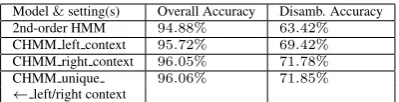
[image:3.595.311.529.413.568.2]Model&setting(s) Overall Accuracy Disamb. Accuracy 2nd-order HMM 94.88% 63.42%
CHMM left context 95.72% 69.42%
CHMM right context 96.05% 71.78%
CHMM unique 96.06% 71.85%
[image:4.595.82.282.61.112.2]←left/right context
Table 4: Experiments, overall and disambiguation accuracies over test data
evaluation set. We passed both sets through the Russian lemmatizer to obtain POS tags for the data and had the tags manually corrected by a Rus-sian linguist. Thus, we have created both develop-ment and evaluation data.14%of words/tokens in both development and evaluation data have multi-ple POS tags. Table 4 summarizes our experimen-tal settings and results over the evaluation data.
The second-order HMM was trained with the traditional transition probability p(ti|ti−2ti−1)
and emission probability p(wi|ti). It gained an overall accuracy of94.88%, and was able to cor-rectly disambiguate 63.42% of the ambiguous words/tokens.
All three CHMM models were trained with the emission probabilityp(wi|titi+1) initialized with
20% of the unlabeled training corpus. Model
CHMM left contextconsidered the left context bi-gramti−1ti when calculating the second term in equation (1). ModelCHMM right context consid-ered the right context bi-gramtiti+1 when
calcu-lating the same term. ModelCHMM unique ←
left/right unified both unambiguous context counts and estimated counts for left and right con-text from the EM process, using equation (2).
All CHMM models achieved accuracies 1% higher than the HMM, while the disambiguation accuracies from the former three are7−9%higher than the latter. This shows that the CHMM mod-els capture more useful context information for Russian POS tagging than the traditional HMM. At the same time, the overall and disambigua-tion accuracies betweenCHMM right contextand CHMM unique ← left/rightare comparable.
Er-ror analyses indicate that a backoff scheme for emission probabilities is also needed to incorpo-rate the left context.
6 Conclusion and Future Work
We adopted the CHMM to unsupervised Russian POS tagging. The CHMM models using either the left or right context were able to outperform the traditional second-order HMM. To resolve the
potential issue of missing out the left context with the classic smoothing scheme in (Thede and Harper, 1999), we experimented with an approach to unifying the information provided in the left, right, and unambiguous contexts. The results from the latter were comparable to a CHMM with the classic backoff smoothing method in (Thede and Harper, 1999), although we expected a more sig-nificant improvement. We plan to investigate a backoff scheme for emission probabilities where we will incorporate the left context as well, while currently we only rely on additive smoothing for emission probabilities.
Acknowledgments
We would like to thank the anonymous review-ers for their valuable comments and sugges-tions. Our work was partially funded by the Air Force Research Laboratory/RIEH in Rome, New York through contracts FA8750-09-C-0038 and FA8750-10-C-0124.
References
Omri Abend, Roi Reichart, and Ari Rappoport. 2010. Improved unsupervised pos induction through pro-totype discovery. InProceedings of the 48th ACL.
Meni Adler. 2007. Hebrew Morphological Disam-biguation. Ph.D. thesis, University of the Negev.
Michele Banko and Robert C. Moore. 2004. Part of speech tagging in context. In Proceedings of the 20th international conference on Computational Linguistics.
Taylor Berg-Kirkpatrick, Alexandre Bouchard-Ct, John DeNero, and Dan Klein. 2010. Painless un-supervised learning with features. InProceedings of NAACL 2010.
Eric Brill, 1995. Very Large, chapter Unsuper-vised Learning of Disambiguation Rules for Part of Speech Tagging, pages 1–13. Kluwer Academic Press.
Stanley F. Chen. 1996. Building Probabilistic Models for Natural Language. Ph.D. thesis, Harvard Uni-versity.
Yoav Goldberg, Meni Adler, and Michael Elhadad. 2008. Em can find pretty good pos taggers (when given a good start). In Proceedings of ACL-08: HLT.
Aria Haghighi and Dan Klein. 2006. Prototype-driven learning for sequence models. InProceedings of the main conference on HLT-NAACL.
Mark Johnson. 2007. Why doesnt em find good hmm pos-taggers. Inn EMNLP.
Abdelaziz Kriouile. 1990. Some improvements in speech recognition algorithms based on hmm. In
Acoustics, Speech, and Signal Processing.
Julian Kupiec. 1992. Robust part-of-speech tagging using a hidden markov model. Computer Speech & Language, 6:225–242.
Michael Lamar, Yariv Maron, and Elie Bienenstock. 2010. Latent descriptor clustering for unsupervised pos induction. InEMNLP 2010.
Bernard Merialdo. 1994. Tagging english text with a probabilistic model. Computational Linguistics, 20:155–171.
Rada Mihalcea. 2003. The role of non-ambiguous words in natural language disambiguation. In Pro-ceedings of the Conference on RANLP.
Sujith Ravi and Kevin Knight. 2009. Minimized mod-els for unsupervised part-of-speech tagging. In Pro-ceedings of ACL-IJCNLP 2009,, pages 504–512.
Scott M. Thede and Mary P. Harper. 1999. A second-order hidden markov model for part-of-speech tag-ging. InProceedings of the 37th Annual Meeting of the ACL.
Kristina Toutanova and Mark Johnson. 2007. A bayesian lda-based model for semi-supervised part-of-speech tagging. InProceedings of NIPS.
Appendix: Linguistic Patterns Observed in Appen
In Section 3, we illustrated how the left context helped to disambiguatechto. In the following we present several more examples from the Appen corpus illustrating the helpful left or right con-text. While the patterns our Russian linguist ob-served are common in both the RNC and Appen, the counts and statistics regarding each pattern are unavailable for reporting because the RNC was then inaccessible to us and Appen was not tagged with POS tags.
Examples 3 through 7 show that the left context ofchem,poka, andkakhelps to disambiguate them as conjuctions.
Example 3 ,(Punct) chem(CONJ) v(PREP)
stolitse(NOUN)
Gloss comma and/than in capital
Example 4 ,(Punct) poka(CONJ)
eta(PRONOUN)
Gloss comma yet this
Example 5 ,(Punct) poka(CONJ) Sovet(NOUN)
Gloss comma yet council
Example 6 ,(Punct) kak(CONJ) dva(NUMERAL)
neudachnika(NOUN)
Gloss comma as two losers
Example 7 ,(Punct) kak(CONJ) on(PRONOUN)
Gloss comma as he
The next examples show that the right context determines the adjectival tag, PRONOUN P, of the pronouns.
Example 8 obekty(NOUN) svoey(PRONOUN P)
sistemy(NOUN)
Gloss units their/they system
Example 9 esli(CONJ) mnogie(PRONOUN P)
mnogie(NOUN)