The CUED HiFST System for the WMT10 Translation Shared Task
Juan Pino Gonzalo Iglesias‡1
Adri`a de Gispert Graeme Blackwood Jamie Brunning William Byrne
Department of Engineering, University of Cambridge, Cambridge, CB2 1PZ, U.K. {jmp84,gi212,ad465,gwb24,jjjb2,wjb31}@eng.cam.ac.uk
‡Department of Signal Processing and Communications, University of Vigo, Vigo, Spain
Abstract
This paper describes the Cambridge Uni-versity Engineering Department submis-sion to the Fifth Workshop on Statistical Machine Translation. We report results for the French-English and Spanish-English shared translation tasks in both directions. The CUED system is based on HiFST, a hierarchical phrase-based decoder imple-mented using weighted finite-state trans-ducers. In the French-English task, we investigate the use of context-dependent alignment models. We also show that lattice minimum Bayes-risk decoding is an effective framework for multi-source translation, leading to large gains in BLEU score.
1 Introduction
This paper describes the Cambridge University Engineering Department (CUED) system submis-sion to the ACL 2010 Fifth Workshop on Statis-tical Machine Translation (WMT10). Our trans-lation system is HiFST (Iglesias et al., 2009a), a hierarchical phrase-based decoder that generates translation lattices directly. Decoding is guided by a CYK parser based on a synchronous context-free grammar induced from automatic word align-ments (Chiang, 2007). The decoder is imple-mented with Weighted Finite State Transducers (WFSTs) using standard operations available in the OpenFst libraries (Allauzen et al., 2007). The use of WFSTs allows fast and efficient exploration of a vast translation search space, avoiding search errors in decoding. It also allows better integration with other steps in our translation pipeline such as 5-gram language model (LM) rescoring and lattice minimum Bayes-risk (LMBR) decoding.
1Now a member of the Department of Engineering,
Uni-versity of Cambridge, Cambridge, CB2 1PZ, U.K.
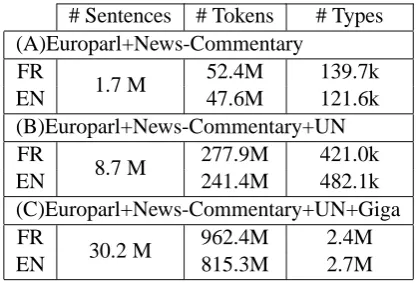
# Sentences # Tokens # Types (A)Europarl+News-Commentary
FR
1.7 M 52.4M 139.7k
EN 47.6M 121.6k
(B)Europarl+News-Commentary+UN FR
8.7 M 277.9M 421.0k
EN 241.4M 482.1k
(C)Europarl+News-Commentary+UN+Giga FR
30.2 M 962.4M 2.4M
[image:1.595.312.521.205.346.2]EN 815.3M 2.7M
Table 1: Parallel data sets used for French-to-English experiments.
We participated in the French-English and Spanish-English translation shared tasks in each translation direction. This paper describes the de-velopment of these systems. Additionally, we re-port multi-source translation experiments that lead to very large gains in BLEU score.
The paper is organised as follows. Section 2 describes each step in the development of our sys-tem for submission, from pre-processing to post-processing. Section 3 presents and discusses re-sults and Section 4 describes an additional experi-ment on multi-source translation.
2 System Development
We built three French-English and two Spanish-English systems, trained on different portions of the parallel data sets available for this shared task. Statistics for the different parallel sets are sum-marised in Tables 1 and 2. No additional parallel data was used. As will be shown, the largest paral-lel corpus gave the best results in French, but this was not the case in Spanish.
2.1 Pre-processing
The data was minimally cleaned by replacing HTML-related metatags by their corresponding
# Sentences # Tokens # Types (A) Europarl + News-Commentary
SP
1.7M 49.4M 167.2k
EN 47.0M 122.7k
(B) Europarl + News-Commentary + UN SP
6.5M 205.6M 420.8k
[image:2.595.85.278.61.158.2]EN 192.0M 402.8k
Table 2: Parallel data sets used for Spanish-to-English experiments.
UTF8 token (e.g., replacing “&” by “&”) as this interacts with tokenization. Data was then to-kenized and lowercased, so mixed case is added as post-processing.
2.2 Alignments
[image:2.595.316.516.62.213.2]Parallel data was aligned using the MTTK toolkit (Deng and Byrne, 2005). In the English-to-French and English-to-Spanish directions, we trained a word-to-phrase HMM model with maximum phrase length of 2. In the French to English and Spanish to English directions, we trained a word-to-phrase HMM Model with a bigram translation table and maximum phrase length of 4.
We also trained context-dependent alignment models (Brunning et al., 2009) for the French-English medium-size (B) dataset. The context of a word is based on its of-speech and the part-of-speech tags of the surrounding words. These tags were obtained by applying the TnT Tagger (Brants, 2000) for English and the TreeTagger (Schmid, 1994) for French. Decision tree clus-tering based on optimisation of the EM auxiliary function was used to group contexts that trans-late similarly. Unfortunately, time constraints pre-vented us from training context-dependent models for the larger (C) dataset.
2.3 Language Model
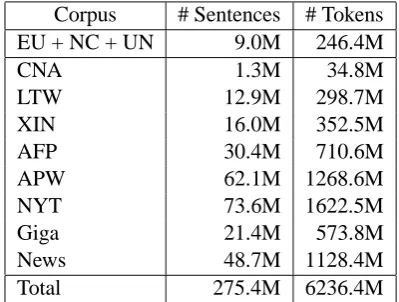
For each target language, we used the SRILM Toolkit (Stolcke, 2002) to estimate separate 4-gram LMs with Kneser-Ney smoothing (Kneser and Ney, 1995), for each of the corpora listed in Tables 3, 4 and 5. The LM vocabulary was ad-justed to the parallel data set used. The compo-nent models of each language pair were then in-terpolated to form a single LM for use in first-pass translation decoding. For French-to-English trans-lation, the interpolation weights were optimised for perplexity on a development set.
Corpus # Sentences # Tokens EU + NC + UN 9.0M 246.4M
CNA 1.3M 34.8M
LTW 12.9M 298.7M
XIN 16.0M 352.5M
AFP 30.4M 710.6M
APW 62.1M 1268.6M
NYT 73.6M 1622.5M
Giga 21.4M 573.8M
News 48.7M 1128.4M
Total 275.4M 6236.4M
Table 3: English monolingual training corpora.
Corpus # Sentences # Tokens EU + NC + UN 9.0M 282.8
AFP 25.2M 696.0M
APW 12.7M 300.6M
News 15.2M 373.5M
Giga 21.4M 684.4M
Total 83.5 M 2337.3M
Table 4: French monolingual training corpora.
Corpus # Sentences # Tokens
NC + News 4.0M 110.8M
EU + Gigaword (5g) 249.4M 1351.5M
Total 253.4 M 1462.3M
Table 5: Spanish monolingual training corpora.
The Spanish-English first pass LM was trained directly on the NC+News portion of monolingual data, as we did not find improvements by using Europarl. The second pass rescoring LM used all available data.
2.4 Grammar Extraction and Decoding
After unioning the Viterbi alignments, phrase-based rules of up to five source words in length were extracted, hierarchical rules with up to two non-contiguous non-terminals in the source side were then extracted applying the restrictions de-scribed in (Chiang, 2007). For Spanish-English and French-English tasks, we used a shallow-1 grammar where hierarchical rules are allowed to be applied only once on top of phrase-based rules. This has been shown to perform as well as a fully hierarchical grammar for a Europarl Spanish-English task (Iglesias et al., 2009b).
[image:2.595.318.515.252.351.2]de-coder (Iglesias et al., 2009a). HiFST is a hierarchi-cal decoder that builds target word lattices guided by a probabilistic synchronous context-free gram-mar. Assuming Nto be the set of non-terminals
and Tthe set of terminals or words, then we can
define the grammar as a set R = {Rr} of rules Rr : N → hγr,αri / pr, where N ∈ N; and γ, α∈ {N∪T}+.
HiFST translates in three steps. The first step is a variant of the CYK algorithm (Chappelier and Rajman, 1998), in which we apply hypothesis re-combination without pruning. Only the source language sentence is parsed using the correspond-ing source-side context-free grammar with rules
N → γ. Each cell in the CYK grid is specified by a non-terminal symbol and position: (N, x, y), spanningsx+yx −1on the source sentences1...sJ.
For the second step, we use a recursive algo-rithm to construct word lattices with all possi-ble translations produced by the hierarchical rules. Construction proceeds by traversing the CYK grid along the back-pointers established in parsing. In each cell (N, x, y) of the CYK grid, we build a target language word latticeL(N, x, y)containing every translation ofsxx+y−1from every derivation headed by N. For efficiency, this lattice can use pointers to lattices on other cells of the grid.
In the third step, we apply the word-based LM via standard WFST composition with failure tran-sitions, and perform likelihood-based pruning (Al-lauzen et al., 2007) based on the combined trans-lation and LM scores.
As explained before, we are using shallow-1 hi-erarchical grammars (de Gispert et al., 2010) in our experiments for WMT2010. One very inter-esting aspect is that HiFST is able to build ex-act search spaces with this model, i.e. there is no pruning in search that may lead to spurious under-generation errors.
2.5 Parameter Optimisation
Minimum error rate training (MERT) (Och, 2003) under the BLEU score (Papineni et al., 2001) opti-mises the weights of the following decoder fea-tures with respect to the newstest2008 develop-ment set: target LM, number of usages of the glue rule, word and rule insertion penalties, word deletion scale factor, source-to-target and target-to-source translation models, source-to-target and target-to-source lexical models, and three binary rule count features inspired by Bender et al. (2007)
indicating whether a rule occurs once, twice, or more than twice in the parallel training data.
2.6 Lattice Rescoring
One of the advantages of HiFST is direct gener-ation of large translgener-ation lattices encoding many alternative translation hypotheses. These first-pass lattices are rescored with second-pass higher-order LMs prior to LMBR.
2.6.1 5-gram LM Lattice Rescoring
We build sentence-specific, zero-cutoff stupid-backoff (Brants et al., 2007) 5-gram LMs esti-mated over approximately 6.2 billion words for English, 2.3 billion words for French, and 1.4 bil-lion words for Spanish. For the English-French task, the second-pass LM training data is the same monolingual data used for the first-pass LMs (as summarised in Tables 3, 4). The Spanish second-pass 5-gram LM includes an additional 1.4 billion words of monolingual data from the Spanish Giga-Word Second Edition (Mendonca et al., 2009) and Europarl, which were not included in the first-pass LM (see Table 5).
2.6.2 LMBR Decoding
Minimum Bayes-risk (MBR) decoding (Kumar and Byrne, 2004) over the full evidence space of the 5-gram rescored lattices was applied to select the translation hypothesis that maximises the conditional expected gain under the linearised sentence-level BLEU score (Tromble et al., 2008; Blackwood and Byrne, 2010). The unigram preci-sion p and average recall ratio r were set as de-scribed in Tromble et al. (2008) using the
new-stest2008 development set.
2.7 Hypothesis Combination
Linearised lattice minimum Bayes-risk decoding (Tromble et al., 2008) can also be used as an ef-fective framework for multiple lattice combination (de Gispert et al., 2010). For the French-English language pair, we used LMBR to combine transla-tion lattices produced by systems trained on alter-native data sets.
2.8 Post-processing
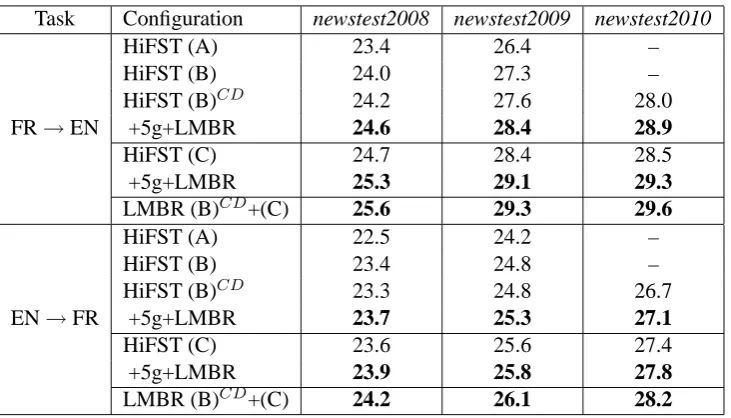
Task Configuration newstest2008 newstest2009 newstest2010
FR→EN
HiFST (A) 23.4 26.4 –
HiFST (B) 24.0 27.3 –
HiFST (B)CD 24.2 27.6 28.0
+5g+LMBR 24.6 28.4 28.9
HiFST (C) 24.7 28.4 28.5
+5g+LMBR 25.3 29.1 29.3
LMBR (B)CD+(C) 25.6 29.3 29.6
EN→FR
HiFST (A) 22.5 24.2 –
HiFST (B) 23.4 24.8 –
HiFST (B)CD 23.3 24.8 26.7
+5g+LMBR 23.7 25.3 27.1
HiFST (C) 23.6 25.6 27.4
+5g+LMBR 23.9 25.8 27.8
[image:4.595.118.484.60.269.2]LMBR (B)CD+(C) 24.2 26.1 28.2
Table 6: Translation Results for the French-English (FR-EN) language pair, shown in single-reference lowercase IBM BLEU. Bold results correspond to submitted systems.
For the French-English system, the English model was trained using the monolingual News corpus and the target side of the News-Commentary cor-pus, whereas the French model was trained using all available constrained French data.
English, Spanish and French outputs were also detokenized before submission. In French, words separated by apostrophes were joined.
3 Results and Discussion
French–English Language Pair
Results are reported in Table 6. We can see that using more parallel data consistently improves performance. In the French-to-English direction, the system HiFST (B) improves over HiFST (A) by +0.9 BLEU and HiFST (C) improves over HiFST (B) by +1.1 BLEU on the newstest2009 development set prior to any rescoring. The same trend can be observed in the English-to-French direction (+0.6 BLEU and +0.8 BLEU im-provement). The use of context dependent align-ment models gives a small improvealign-ment in the French-to-English direction: system (B)CD im-proves by +0.3 BLEU over system (B) on
new-stest2009. In the English-to-French direction, there is no improvement nor degradation in per-formance. 5-gram and LMBR rescoring also give consistent improvement throughout the datasets. Finally, combination between the medium-size system (B)CD and the full-size system (C) gives further small gains in BLEU over LMBR on each individual system.
Spanish–English Language Pair
Results are reported in Table 7. We report experi-mental results on two systems. The HiFST(A) sys-tem is built on the Europarl + News-Commentary training set. Systems HiFST (B),(B2) and (B3) use UN data in different ways. System (B) simply uses all the data for the standard rule extraction procedure. System HiFST (B2) includes UN data to build alignment models and therefore reinforce alignments obtained from smaller dataset (A), but extracts rules only from dataset (A). HiFST (B3) combines hierarchical phrases extracted for sys-tem (A) with phrases extracted from syssys-tem (B). Unfortunately, these three larger data strategies lead to degradation over using only the smaller dataset (A). For this reason, our best systems only use the Euparl + News-Commentary parallel data. This is surprising given that additional data was helpful for the French-English task. Solving this issue is left for future work.
4 Multi-Source Translation Experiments
Task Configuration newstest2008 newstest2009 newstest2010
SP→EN
HiFST (A) 24.6 26.0 29.1
+5g+LMBR 25.4 27.0 30.5
HiFST (B) 23.7 25.4 –
HiFST (B2) 24.3 25.7 –
HiFST (B3) 24.2 25.6 –
EN→SP HiFST (A) 23.9 24.5 28.0
[image:5.595.130.471.61.173.2]+5g+LMBR 24.7 25.5 29.1
Table 7: Translation Results for the Spanish-English (SP-EN) language pair, shown in lowercase IBM BLEU. Bold results correspond to submitted systems.
Configuration newstest2008 newstest2009 newstest2010
FR→EN HiFST+5g 24.8 28.5 28.8
+LMBR 25.3 29.0 29.2
ES→EN HiFST+5g 25.2 26.8 30.1
+LMBR 25.4 26.9 30.3
FR→EN + ES→EN LMBR 27.2 30.4 32.0
Table 8: Lowercase IBM BLEU for single-system LMBR and multiple LMBR multi-source translation of French (FR) and Spanish (ES) into English (EN).
Separate second-pass 5-gram rescored lattices EFR and EES are generated for each test set sen-tence using the French-to-English and Spanish-to-English HiFST translation systems. The MBR hy-pothesis space is formed as the union of these lat-tices. In a similar manner to MBR decoding over multiple k-best lists in de Gispert et al. (2009), the path posterior probability of eachn-gramu re-quired for linearised LMBR is computed as a lin-ear interpolation of the posterior probabilities ac-cording to each individual lattice so thatp(u|E) =
λFRp(u|EFR) +λES p(u|EES), where p(u|E) is the sum of the posterior probabilities of all paths con-taining the n-gram u. The interpolation weights
λFR+λES = 1are optimised for BLEU score on the development set newstest2008.
The results of single-system and multi-source LMBR decoding are shown in Table 8. The opti-mised interpolation weights wereλFR = 0.55and
λES = 0.45. Single-system LMBR gives relatively small gains on these test sets. Much larger gains are obtained through multi-source MBR combina-tion. Compared to the best of the single-system 5-gram rescored lattices, the BLEU score improves by +2.0 for newstest2008, +1.9 for newstest2009, and +1.9 for newstest2010. For scoring with re-spect to a single reference, these are very large gains indeed.
5 Summary
We have described the CUED submission to WMT10 using HiFST, a hierarchical phrase-based translation system. Results are very competitive in terms of automatic metric for both English-French and English-Spanish tasks in both directions. In the French-English task, we have seen that the UN and Giga additional parallel data are helpful. It is surprising that UN data did not help for the Spanish-English language pair.
Future work includes investigating this issue, developing detokenization tailored to each output language and applying context dependent align-ment models to larger parallel datasets.
Acknowledgments
References
Cyril Allauzen, Michael Riley, Johan Schalkwyk, Wo-jciech Skut, and Mehryar Mohri. 2007. OpenFst: A general and efficient weighted finite-state transducer library. In Proceedings of CIAA, pages 11–23.
Oliver Bender, Evgeny Matusov, Stefan Hahn, Sasa Hasan, Shahram Khadivi, and Hermann Ney. 2007. The RWTH Arabic-to-English spoken language translation system. In Proceedings of ASRU, pages 396–401.
Graeme Blackwood and William Byrne. 2010. Ef-ficient Path Counting Transducers for Minimum Bayes-Risk Decoding of Statistical Machine Trans-lation Lattices (to appear). In Proceedings of the
ACL.
Thorsten Brants, Ashok C. Popat, Peng Xu, Franz J. Och, and Jeffrey Dean. 2007. Large language models in machine translation. In Proceedings of
EMNLP-ACL, pages 858–867.
Thorsten Brants. 2000. Tnt – a statistical part-of-speech tagger. In Proceedings of ANLP, pages 224– 231, April.
Jamie Brunning, Adri`a de Gispert, and William Byrne. 2009. Context-dependent alignment models for statistical machine translation. In Proceedings of
HLT/NAACL, pages 110–118.
Jean-C´edric Chappelier and Martin Rajman. 1998. A generalized CYK algorithm for parsing stochastic CFG. In Proceedings of TAPD, pages 133–137.
David Chiang. 2007. Hierarchical phrase-based trans-lation. Computational Linguistics, 33(2):201–228.
Adri`a de Gispert, Sami Virpioja, Mikko Kurimo, and William Byrne. 2009. Minimum Bayes Risk Com-bination of Translation Hypotheses from Alterna-tive Morphological Decompositions. In
Proceed-ings of HLT/NAACL, Companion Volume: Short Pa-pers, pages 73–76.
Adri`a de Gispert, Gonzalo Iglesias, Graeme Black-wood, Eduardo R. Banga, and William Byrne. 2010. Hierarchical phrase-based translation with weighted finite state transducers and shallow-n grammars (to appear). In Computational Linguistics.
Yonggang Deng and William Byrne. 2005. HMM
Word and Phrase Alignment for Statistical Machine Translation. In Proceedings of HLT/EMNLP, pages 169–176.
Gonzalo Iglesias, Adri`a de Gispert, Eduardo R. Banga, and William Byrne. 2009a. Hierarchical phrase-based translation with weighted finite state transduc-ers. In Proceedings of NAACL, pages 433–441.
Gonzalo Iglesias, Adri`a de Gispert, Eduardo R. Banga, and William Byrne. 2009b. The HiFST System for the EuroParl Spanish-to-English Task. In
Proceed-ings of SEPLN, pages 207–214.
Reinhard Kneser and Hermann Ney. 1995. Improved backing-off for m-gram language modeling. In
Pro-ceedings of ICASSP, volume 1, pages 181–184.
Shankar Kumar and William Byrne. 2004. Minimum Bayes-risk decoding for statistical machine transla-tion. In Proceedings of HLT-NAACL, pages 169– 176.
Angelo Mendonca, David Graff, and Denise DiPersio. 2009. Spanish Gigaword Second Edition, Linguistic Data Consortium.
Franz Josef Och and Hermann Ney. 2001. Statisti-cal multi-source translation. In Machine Translation
Summit 2001, pages 253–258.
Franz J. Och. 2003. Minimum Error Rate Training in Statistical Machine Translation. In Proceedings of
ACL, pages 160–167.
Kishore Papineni, Salim Roukos, Todd Ward, and Wei-Jing Zhu. 2001. BLEU: a method for automatic evaluation of machine translation. In Proceedings
of ACL, pages 311–318.
Helmut Schmid. 1994. Probabilistic part-of-speech tagging using decision trees. In Proceedings of
International Conference on New Methods in Lan-guage Processing, volume 12. Manchester, UK.
Josh Schroeder, Trevor Cohn, and Philipp Koehn. 2009. Word Lattices for Multi-Source Translation. In Proceedings of EACL, pages 719–727.
Andreas Stolcke. 2002. SRILM–An Extensible Lan-guage Modeling Toolkit. In Proceedings of ICSLP, volume 3, pages 901–904.
Roy W. Tromble, Shankar Kumar, Franz Och, and
Wolfgang Macherey. 2008. Lattice Minimum