Assessing the Challenge of
Fine-Grained
Named Entity Recognition
and
Classification
Asif Ekbal, Eva Sourjikova, Anette Frank and Simone Paolo Ponzetto Department of Computational Linguistics
Heidelberg University, Germany
{ekbal,sourjikova,frank,ponzetto}@cl.uni-heidelberg.de
Abstract
Named Entity Recognition and Classi-fication (NERC) is a well-studied NLP task typically focused on coarse-grained named entity (NE) classes. NERC for more fine-grained semantic NE classes has not been systematically studied. This pa-per quantifies the difficulty of fine-grained NERC (FG-NERC) when performed at large scale on the people domain. We apply unsupervised acquisition methods to construct a gold standard dataset for FG-NERC. This dataset is used to bench-mark methods for classifying NEs at var-ious levels of fine-grainedness using clas-sical NERC techniques and global contex-tual information inspired from Word Sense Disambiguation approaches. Our results indicate high difficulty of the task and pro-vide a ‘strong’ baseline for future research.
1 Introduction
Named Entity Recognition and Classification (cf. Nadeau and Sekine (2007)) is a well-established NLP task relevant for nearly all semantic process-ing and information access applications. NERC has been investigated using supervised (McCallum and Li, 2003), unsupervised (Etzioni et al., 2005) and semi-supervised (Pas¸ca et al., 2006b) learning methods. It has been investigated in multilingual settings (Tjong Kim Sang, 2002; Tjong Kim Sang and De Meulder, 2003) and special domains, e.g. biomedicine (Ananiadou et al., 2004).
The classical NERC task is confined to coarse-grained named entity (NE) classes established in the MUC (MUC-7, 1998) or CoNLL (Tjong Kim Sang, 2002) competitions, typically PERS, LOC, ORG, MISC. While most recent work con-centrates on feature engineering and robust statis-tical models for various domains, few researchers
addressed the problem of recognizing and catego-rizingfine-grained NE classes (such asbiologist, composer, orathlete) in an open-domain setting.
Fine-grained NERC is expected to be benefi-cial for a wide spectrum of applications, includ-ing Information Retrieval (Mandl and Womser-Hacker, 2005), Information Extraction (Pas¸ca et al., 2006a) or Question-Answering (Pizzato et al., 2006). However, manually compiling wide-coverage gazetteers for fine-grained NE classes is time-consuming and error-prone. Also, without an extrinsic evaluation, it is difficult to define a priori which classes are relevant for a particular domain or task. Finally, prior research in FG-NERC is dif-ficult to evaluate, due to the diversity of NE classes and datasets used.
Accordingly, in the interest of a general ap-proach, we address the challenge of capturing a
broad rangeof NE classesat various levels of con-ceptual granularity. By turning FG-NERC into a widely applicable task, applications are free to choose relevant NE categories for specific needs. Also, establishing a gold standard dataset for this task enables comparative benchmarking of meth-ods. However, the envisaged task is far from triv-ial, given that the set of possible semantic classes for a given NE comprises the full space of NE classes, whereas descriptive nouns may be am-biguous between a fixed set of meanings only.
The paper aims to establish a general frame-work for FG-NERC by addressing two goals: (i) we automatically build a gold standard dataset of NE instances classified in context with fine-grain-ed semantic class labels; (ii) we develop strong baseline methods, to assess the aptness of standard NLP approaches for this task. The two efforts are strongly interleaved: a standardized dataset is not only essential for (comparative) evaluation, but also a prerequisite for classification approaches based on supervised learning, the most successful techniques for sequential labeling problems.
93
2 Related work
An early approach to FG-NERC is Alfonseca and Manandhar (2002), who identify it as a problem related to Word Sense Disambiguation (WSD). They jointly address concept hierarchy learning and instance classification using topic signatures, yet the experiments are restricted to a small on-tology of 9 classes. Similarly, Fleischman and Hovy (2002) extend previous work from Fleis-chman (2001) on locations and address the ac-quisition of instances for 8 fine-grained person classes. For supervised training they compile a web corpus which is filtered using high-confident classifications from an initial classifier trained on seeds. Due to the limitations of their method to create a good sample of training data, the perfor-mance could not be generalized to held-out data.
Recent work takes the task of FG-NERC one step further by (i) extending the number of classes, (ii) relating them to reference concept hierar-chies and (iii) exploring methods for building training and evaluation data, or applying weakly and unsupervised learning based on high-volume data. Tanev and Magnini (2006) selected 10 NE-subclasses of person and location using Word-Net as a reference. Datasets were automatically acquired and manually filtered. They compare word and pattern-based supervised and a semi-supervised approach based on syntactic features. Giuliano & Gliozzo (2007, 2008) perform NE classification against the People Ontology, an ex-cerpt of the WordNet hierarchy, comprising 21 people classes populated with at least 40 instances. Using minimally supervised lexical substitution methods, they cast NE classification as an ontol-ogy population task – as opposed to recognition and classification in context. In a similar setting, Giuliano (2009) explores semi-supervised classifi-cation of the People Ontology classes using latent semantic kernels, comparing models built from Wikipedia and from a news corpus. In a differ-ent line of research Pas¸ca (2007) and Pas¸ca and van Durme (2008) make use of query logs to ac-quire NEs on a large scale. While Pas¸ca (2007) extracts NEs for 10 target classes, Pas¸ca and van Durme (2008) combine web query logs and web documents to acquire both NE-concept pairs and concept attributes using seeds.
But while these more recent approaches all of-fer substantially novel contributions for many NE acquisition subtasks, none of them addresses the
full task of FG-NERC, i.e., recognition and clas-sification of NE tokens in context. Compared to ontology population, focusing on types, classifica-tion in raw texts needs to consider any token and cannot rely on special contexts offering indicative clues for class membership.
Bunescu and Pas¸ca (2006) also perform dis-ambiguation and classification of NEs in context, yet in a different setup. Disambiguation is per-formed into one of the known possible classes for a NE, as determined from Wikipedia disam-biguation pages. Contexts for training and testing are acquired from Wikipedia pages, as opposed to general text. Disambiguation is performed us-ing vectors of co-occurrus-ing terms and a taxonomy-based kernel that integrates word-category corre-lations. Evaluation is performed on the task of predicting, for a given NE in a Wikipedia page context, the correct class from among its known classes, including one experiment that included 10% of out-of-Wikipedia entities. The category space was confined toPeople by occupation, with 8,202 subclasses. Classification considered 110 broad classes, 540 highly populated classes (w/o out-of-Wikipedia entities), and 2,847 classes in-cluding less populated ones. This setup is diffi-cult to compare given the sense granularities em-ployed and the special Wikipedia text genre. Even though classification is performed in context, the task does not evaluate recognition.
To summarize, the field has developed robust methods for acquisition and fine-grained classifi-cation of NEs on a large scale. But, the full task of NE recognition and classification in context still remains to be addressed for a wide-coverage, fine-grained semantic class inventory that can serve as a common benchmark for future research.
3 Fine-grained NERC on a large-scale
and concepts in a taxonomic resource, it can be further extended to other domains, e.g. locations or the biomedical domain by leveraging open-domain taxonomies such as Yago (Suchanek et al., 2008) or WikiTaxonomy (Ponzetto and Strube, 2007). The contribution of this work is two-fold:
(i) We develop an unsupervised method for ac-quiring a comprehensive dataset for FG-NERC by applying linguistically motivated patterns to a cor-pus harvested from the Web (Section 4). Large amounts of NEs are acquired together with their contexts of occurrence and with their fine-grained class labels which are mapped to synsets in Word-Net. The controlled sense inventory and the tax-onomic structure offered by WordNet enables an evaluation of FG-NERC performance at different levels of concept granularity, as given by the depth at which the concepts are found. As our extraction patterns reflect a wide-spread grammatical con-struct, the method can be applied to many lan-guages and extended to other domains.
(ii) Given this automatically acquired dataset, we assess the problem of FG-NERC in a sys-tematic series of experiments, exploring the per-formance of NERC methods on different levels of granularities. For recognition and classifica-tion we apply standard sequential labeling tech-niques – i.e. a Maximum Entropy (MaxEnt) tag-ger (Section 5.1) – which we adapt to this hier-archical classification problem (Section 5.2). To test the hypothesis of whether a sequential la-beler represents a valid choice to perform FG-NERC, we compare the latter to a MaxEnt system trained on a more semantically informed feature set, and a gloss-overlap method inspired by WSD approaches (Section 5.3).
4 Acquisition of a FG-NERC dataset
We present an unsupervised method that simul-taneously acquires NEs, their semantic class and contexts of occurrence from large textual re-sources. In order to develop a clean resource of properly disambiguated NEs, we develop acqui-sition patterns for a grammatical construction that unambiguously associates proper names with their corresponding semantic class.
Pattern-based extraction of NE-concept pairs.
NEs are often introduced by so-called apposi-tional structures as in (1), which overtly ex-press which semantic class (here,painter) the NE (Kandinsky) belongs to. Appositions involving
proper names can be captured by extraction pat-terns as given in (2).
(1) . . . writings of the abstract painter Kandinsky frequently explored similarities between . . .
(2) a. [the|The]? [JJ|NN]* [NN] [NP]
the abstract painter Kandinsky
b. [NP] [,]? [a|an|the]* [JJ|NN]* [NN]
W. Kandinsky, a Russian-born painter, ..
Contexts like (2.a) provide a less noisy se-quence for extraction, due to the class and instance labels being adjacent – in contrast to (2.b) where any number of modifiers can intervene between the two. Accordingly, we apply in our experiments only a restricted version of (2.a) – with a deter-miner – to UKWAC, an English web-based cor-pus (Baroni et al., 2009) that comes in a cleaned, PoS-tagged and lemmatized form. Due to its size (>2 billion tokens) and mixed genres, the corpus is ideally suited for acquiring large quantities of NEs pertaining to a broad variety of open-domain semantic classes.
Filtering heuristics. The apposition patterns are subject to noise, due to PoS-tagging errors, as well as special constructions, e.g. reduced rela-tive clauses. The former can be controlled by fre-quency filters, the latter can be circumvented by using chunk boundary information1. A more chal-lenging problem is to recognize whether an ex-tracted nominal is in fact a valid semantic class for NEs. Besides, class labels can be ambiguous, so there is uncertainty as to which class an extracted entity should be assigned to. We apply two fil-tering strategies: we set a frequency thresholdf t on the number of extracted NE tokens per class, to remove infrequent class label extractions; we then filter invalid semantic classes using informa-tion from WordNet: given the WordNet PERSON supersense, i.e. the lexicographer file for nouns de-noting people, we check whether the first sense of the class label candidate is found in PERSON.
Mapping to the WordNet person domain. In order to perform a hierarchical classification of people, we need a taxonomy for the domain at hand. We achieve this by mapping the extracted class labels to WordNet synsets. In our setting, we map against all synsets found underperson#n#1,
1
which are direct hypernyms of at least one in-stance in WordNet (CW N pers+Inst).2 Since our
goal is to map class labels to synsets (i.e. our fu-ture NE classes), we check each class label candi-date against all synonyms contained in the synset. At this point we have to deal with two cases: two extracted class label candidates (synonyms such asdoctor, physician) will map to a single synset, while ambiguous class labels (e.g.director) can be mapped to more than one synset. In the latter case, we heuristically choose the synset which domi-nates the highest number of instances in WordNet.
Mapping evaluation. We evaluated the cover-age of our mapping for two sets of class labels extracted for two different frequency thresholds: f t = 40 andf t = 1. Withf t = 40, we cover 31.1% of the synsets found under person#n#1 in WordNet, i.e. the set of classes CW N pers+Inst;
conversely, 45.8% of the extracted class labels can be successfully mapped to CW N pers+Inst. For
threshold f t = 1, we are able to map to 87.9% of CW N pers+Inst, with only 20.1% of extracted
classes mapped to CW N pers+Inst. For the
re-maining 79.9% of class labels (e.g. goalkeeper, chancellor, superstar) that have no instances in WordNet, we manually inspected 20 classes, in 20 contexts each, and established that 76% of them are appropriate NE person classes.
For thresholdf t= 40, we obtain 153 class labels which are mapped to 146 synsets. Ten class labels are mapped to more than one synset. Using our mapping heuristic based on the majority instance class, we successfully disambiguate all of them. However, since we only map to CW N pers+Inst,
we introduce errors for 5 classes. E.g. ‘manager’ incorrectly gets mapped to manager#n#2, since the latter is the only synset containing instances. For these cases we manually corrected the auto-matic mapping.
A taxonomy for FG-NERC. We create our gold standard taxonomy of semantic classes by start-ing with the 146 synsets obtained from the map-ping, including the 5 classes that were manually corrected. Since we concentrate on the people domain, we additionally remove 5 classes that can refer to other domains as well (e.g. carrier,
guide). Given the remaining 141 synsets, we se-lect the portion of WordNet rooted atperson#n#1
2We use WordNet version 3.0. Withw#p#iwe denote the
i-th sense of a wordwwith part of speechp. E.g.,person#n#1 is defined as{person,individual. . .}).
Level #C #C w/inst #inst #inst/C % of inst
1 1 0 0 -
-2 29 8 2,662 332 5.49
3 57 37 18,229 493 37.58
4 63 46 18,422 401 37.94
5 37 30 6,231 208 12.84
6 18 13 2,366 182 4.88
7 6 5 423 85 0.87
8 2 2 179 90 0.36
[image:4.595.308.526.70.176.2]all 213 141 48,512 344 100
Table 1: Level-wise statistics of classes and in-stances across the FG-NERC person taxonomy.
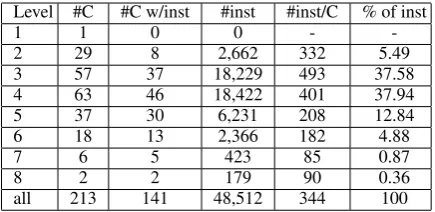
which contains them, together with any interven-ing synset found along the WordNet hierarchy. Given this WordNet excerpt, the extracted NE to-kens are then appended to the respective synsets in the hierarchy. Statistics of the resulting WordNet fragment augmented with instances are given in Table 1. The taxonomy has a maximum depth of 8, and contains 213 synsets, i.e. NE classes (see col-umn 2). 83.5% of the 31,819 extracted instances (type-level) sit in leaf nodes. The classes automat-ically refer back to the acquired appositional con-texts. Table 1 gives statistics about the number of instances (token-level) acquired for classes at dif-ferent embedding levels. In total we have at our disposal 48,512 instances (token-level) in apposi-tional contexts. The type-token ratio is 1.52.
5 Methodology for FG-NERC
We develop methods to perform FG-NERC using standard techniques developed for coarse-grained NERC and WSD. These are applied to our dataset from Section 4, in order to measure performance at different levels of semantic class granularity, i.e. corresponding to the depth of the semantic classes found in our WordNet fragment. We start in Sec-tion 5.1 to present a Maximum Entropy model to perform coarse-grained NERC and we extend it to perform multiclass classification in a hierarchi-cal taxonomy (Section 5.2). We then present in Section 5.3 an alternative proposal to perform FG-NERC using global context information, as found in state-of-the-art approaches to supervised and unsupervised WSD.
5.1 NERC using a MaxEnt tagger
Our baseline system is modeled following a Maxi-mum Entropy approach (Bender et al., 2003,inter alia). The MaxEnt model produces a probability for each class labelt(the NE tag) of a classifica-tion instance, condiclassifica-tioned on its context of occur-renceh. This probability is calculated by:
P(t|h) = 1
Z(h)exp
n X
j=1
λjfj(h, t)
(1)
where fj(h, t) is the j-th feature with associated
weightλj andZ(h)is a normalization constant to
ensure a proper probability distribution.3 Given a word wi to be classified as Beginning, Inside or
Outside (IOB) of a NE, we extract as features:
1. Context words. The words occurring within the context windowwii+2−2 =wi−2. . . wi+2.
2. Word prefix and suffix. Word prefix and suffix character sequences of length up ton.
3. Infrequent word. A feature that fires ifwi
oc-curs in the training set less frequently than a given threshold (i.e. below 10 occurrences). 4. Part-of-Speech (PoS) and chunk
informa-tion. The PoS and chunk labels ofwi.
5. Capitalization. A binary feature that checks whetherwistarts with a capital letter or not.
6. Word length. A binary feature that fires if the length of wi is smaller than a pre-defined
threshold (i.e. less than 5 characters).
3
In our implementation, we use the OpenNLP MaxEnt li-brary (http://maxent.sourceforge.net).
7. Digit and symbol features. Three features check whether wi contains digit strings,
non-characters (e.g. slashes) or number expressions. 8. Dynamic feature. The tag ti−1 of the word
wi−1precedingwi in the sequencew1n.
5.2 MaxEnt extension for FG-NERC
Extension to hierarchical classification. We apply our baseline NERC system to FG-NERC. Given a word in context, the task consists of recog-nizing it as a NE, and classifying it into the appro-priate semantic class from our person taxonomy. We approach this as a hierarchical classification task by generating a binary classifier4 with sepa-rate training and test sets for each node in the tree. To performlevel-wise classificationfrom coarse to fine-grained classes, we need to adjust the class labels and their corresponding training and test in-stances for each experiment. For classification at the deepest level, each concept contains the in-stances of the original dataset. For classification at higher levels we leverage the semantics of the WordNet hyponym relations and expand the set of target classes (i.e. synsets) of a given level to contain all instances of hyponym synsets. Given a setI of classification instances for a given tar-get class c, we add all instances labeled with the hyponyms of c to I. All other instances (not in that subtree) are labeled as being Outside (O-) a NE. This approach ensures that, for each node, the dataset contains two classes (NE and O) only, and implicitly ‘propagates’ the instances up the tree. As a result, non-leaf nodes that did not have any instance in the original dataset become populated. Also, the classification of classes at higher levels is based on larger datasets.
Extension to multiclass classification. Since we train a binary classifier for each node of the tree, we apply two methods to infer multiclass de-cisions from these binary classifiers, namely level-wiseandglobalmulticlass classification. In both paradigms, we combine the single decisions of the individual classifiers with the winner-takes-all strategy, using weighted voting. The weights are calculated based on the confidence value for the corresponding class, i.e., its conditional probabil-ity according to Equation (1). The output label is selected randomly in case of ties.
For level-wise classification, we combine only classifiers at the same level of embedding. Given n concepts at level l, we have n possible out-put labels for each word. The outout-put label for a classification instance is determined by the highest weighted vote among all binary classifiers at level l. Forglobal classificationwe combine all binary classifiers of the entire tree using weighted voting to determine the winning class label. The weights are calculated based on the product of confidence value and depth of the corresponding class in the tree.
5.3 FG-NERC using global contexts
FG-NERC is a more demanding task than ‘classi-cal’ NERC, due to the larger amount of classes, the paucity of examples for each class, and the increasingly subtle semantic differences between these classes. For such a task contextual informa-tion is expected to be very informative – e.g. if an entity co-occurs in context with’Nobel prize’, this provides evidence that it is likely to be a scien-tistorscholar. However, the context window used by our baseline MaxEnt tagger is very local, in-cluding at most the two preceding and succeeding words. Hence, the classifier is not able to capture informative contextual clues in a larger context.
Previous work has related FG-NERC to WSD approaches (Alfonseca and Manandhar, 2002). Accordingly, we investigate two context-sensitive approaches inspired from WSD proposals, which consider a more global context for classification. We first define a new feature set to induce a new MaxEnt model (MaxEnt-B) which only uses lexi-cal features from a larger context window, as used in standard supervised WSD (Lee and Ng, 2002):
1. PoS context. The part-of-speech occur-ring within the context window posii+3−3 =
posi−3. . . posi+3.
2. Local collocation. Local collocationsCnm
sur-roundingwi. We useC−2,−1andC1,2.
3. Content words in surrounding context. We consider all unigrams in contexts wii+3−3 =
wi−3. . . wi+3 ofwi (crossing sentence
bound-aries) for the entire training data. We convert to-kens to lower case, remove stopwords, numbers and punctuation symbols. We define a feature vector of length 10 using the 10 most frequent content words. Given a classification instance, the feature corresponding to tokentis set to 1 iff the contextwii−+33 ofwicontainst.
In addition, we use a Lesk-like method (Lesk, 1986) which labels instances in context with the WordNet synset whose gloss has the maximum overlap with the glosses of the senses of its words in context. Given the small context provided by the WordNet glosses, we follow Banerjee and Ped-ersen (2003) and expand these to also include the words from the glosses of the hypernym and hy-ponym synsets.
6 Experiments
6.1 Benchmarking on coarse-grained NERC
We benchmark the performance of our baseline MaxEnt classifier using the feature set from Sec-tion 5.1 (MaxEnt-A henceforth) on the CoNLL-2003 shared task dataset (Tjong Kim Sang and De Meulder, 2003), thede-factostandard for eval-uating coarse-grained NERC systems.
In MaxEnt modeling, feature selection is a cru-cial problem and key to improving classification performance. MaxEnt, however, does not provide methods for automatic feature selection. We there-fore experimented with various combinations of features standardly used for NERC (1-8 of Section 5.1). Model parameters are computed with 200 iterations without feature frequency cutoff. The best configuration is found by optimizing the F1
measure on the development data with various fea-ture representations. The chosen feafea-tures are: 1, 2 (withn = 3), 4, 5, 6, 7 and 8. Evaluation on the test set is performed blindly, using this feature set. The results are presented in Table 2.
The MaxEnt labeler achieves performance com-parable with the CoNLL-2003 task participants, ranking 12th among the 16 systems participating in the task, with a 2 point margin off the F1of the
Recall Precision Fβ=1
[image:7.595.326.504.70.143.2]PER 83.02% 81.40% 82.21% LOC 88.47% 88.19% 88.23% ORG 77.20% 68.03% 72.23% MISC 81.20% 83.92% 82.54% Overall 83.11% 80.47% 81.77%
Table 2: Results on the CoNLL-2003 test data.
Set # tokens # NEs
Training 2,431,041 38,810 Development 478,871 9,702
[image:7.595.85.278.72.159.2]Test 181,490 1,520
Table 3: Statistics for training, dev and test sets.
6.2 Evaluating FG-NERC
Experimental setting. For the task of FG-NERC, we compare the performance of MaxEnt-A with the MaxEnt-B model from Section 5.3 and the Lesk method. The data is partitioned into train-ing and development sets by randomly selecttrain-ing 80%-20% of the contexts in which the NEs occur. We use the held-out, manually validated gold stan-dard from Section 4 for blind evaluation. Statistics for the dataset are reported in Table 3.
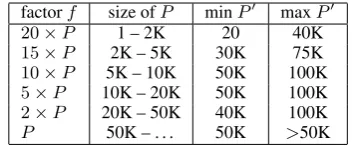
We build a MaxEnt model for each FG-NE class, using the features that performed best on the CoNLL task, except the digit and dynamic NE features (MaxEnt-A), and context features 1-3 of Section 5.1-3 (MaxEnt-B). Model parameters are computed in the same way as for coarse-grained NERC. Table 3 shows that our training set is highly unbalanced. The ratio between positive (NEs) and negative examples (i.e. O classification instances) at the topmost level is 63:1. Also, with increasing levels of fine-grainedness, the number of negative (-O) NE classes is increasing for each binary classifier. We observed on the develop-ment set that this skewed distribution heavily bi-ases the classifiers towards the negative category, and accordingly investigated sampling techniques to make the ratio of positive and negative examples more balanced. We experiment with a sampling strategy that over-samples the positive examples and under-samples the negative ones. We define various ratios of over-sampling depending upon the number of positive examples in the original training set. Table 4 lists the factors (f) of over-sampling applied to the original positive samples (P), with minimum and maximum sizes of the
ob-factorf size ofP minP0 maxP0
20×P 1 – 2K 20 40K
15×P 2K – 5K 30K 75K
10×P 5K – 10K 50K 100K
5×P 10K – 20K 50K 100K
2×P 20K – 50K 40K 100K P 50K – . . . 50K >50K
Table 4: Oversampling of positive samples.
MaxEnt-A MaxEnt-B
Level
R P F1 R P F1
1 98.7 85.0 91.4 95.1 83.0 88.6
2 96.0 65.5 77.9 48.1 46.3 47.2
3 95.3 54.3 69.3 43.3 41.1 42.2
4 86.8 52.8 65.6 41.1 37.2 39.1
5 90.4 45.9 60.9 49.2 21.5 29.9
6 91.6 36.9 52.6 51.7 13.2 21.1
7 89.5 31.8 46.9 42.2 10.2 16.4
8 100.0 19.9 66.7 87.1 8.1 14.7
[image:7.595.309.529.171.301.2]global 85.1 43.2 57.3 61.9 26.6 37.2 hierarchical 87.7 44.8 59.4 64.5 29.5 40.5
Table 6: Level-wise NE recognition & classifica-tion evaluaclassifica-tion (in %).
tained oversampled setsP0 for different ranges of original sizes ofP.5 Oversampling is done with-out replacement. The number of negative instan-ces is always downsampled on the basis ofP0 to yield a 1:5 ratio of positive and negative samples, a ratio we estimated from the CoNLL-2003 data.
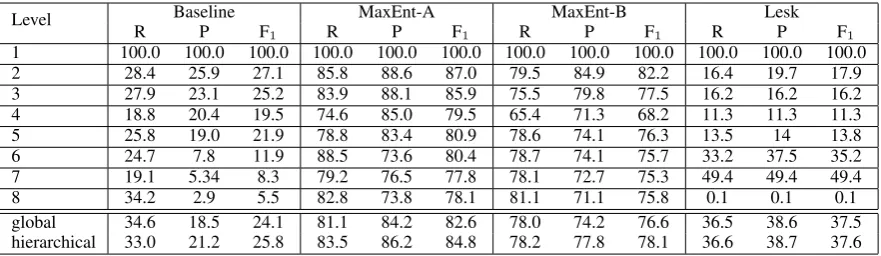
Level-wise evaluation results on the FG-NE classification-only (NEC) task for the MaxEnt classifiers and Lesk are given in Table 5. Table 6 reports results for the evaluation of the MaxEnt model performing both classification and recog-nition. As for coarse-grained NERC, we evaluate using the standard metrics of recall (R), precision (P) and balanced F-measure (F1). As baseline, we
use a majority class assignment – i.e. at each level, we label all instances with the most frequent class label. Forglobal FG-NE classification, reported in Table 5, the original fine-grained classes are con-sidered, across the entire class hierarchy. Global evaluation is performed by counting exact label predictions on the entire hierarchy (global) and us-ing the evaluation metric of Melamed and Resnik (2000, hierarchical). As baseline we assume the most frequent class label in the training set.
Discussion. All methods perform reasonably well, indicating the feasibility of the task. For the MaxEnt models, Table 5 shows a general high re-call and decreasing precision as we move down the hierarchy. Degradation in the overall F1 score is
5
[image:7.595.90.267.190.250.2]Baseline MaxEnt-A MaxEnt-B Lesk Level
R P F1 R P F1 R P F1 R P F1
1 100.0 100.0 100.0 100.0 100.0 100.0 100.0 100.0 100.0 100.0 100.0 100.0
2 28.4 25.9 27.1 85.8 88.6 87.0 79.5 84.9 82.2 16.4 19.7 17.9
3 27.9 23.1 25.2 83.9 88.1 85.9 75.5 79.8 77.5 16.2 16.2 16.2
4 18.8 20.4 19.5 74.6 85.0 79.5 65.4 71.3 68.2 11.3 11.3 11.3
5 25.8 19.0 21.9 78.8 83.4 80.9 78.6 74.1 76.3 13.5 14 13.8
6 24.7 7.8 11.9 88.5 73.6 80.4 78.7 74.1 75.7 33.2 37.5 35.2
7 19.1 5.34 8.3 79.2 76.5 77.8 78.1 72.7 75.3 49.4 49.4 49.4
8 34.2 2.9 5.5 82.8 73.8 78.1 81.1 71.1 75.8 0.1 0.1 0.1
[image:8.595.78.519.70.198.2]global 34.6 18.5 24.1 81.1 84.2 82.6 78.0 74.2 76.6 36.5 38.6 37.5 hierarchical 33.0 21.2 25.8 83.5 86.2 84.8 78.2 77.8 78.1 36.6 38.7 37.6
Table 5: Level-wise evaluation of fine-grained NE classification techniques (in %).
given by the increasingly limited amount of class instances found towards the low regions of the tree (down to an average of 85 and 90 instances per class for levels 7 and 8, respectively) (cf. Table 1). The ’classical’ feature set (MaxEnt-A) yields bet-ter performance compared to the semantic feature set (MaxEnt-B). However MaxEnt-B still achieves a respectable performance, given that it contains a few semantic features only.
The MaxEnt classifiers achieve a far better per-formance than Lesk. This is in-line with previ-ous findings in WSD, namely unsupervised fine-grained disambiguation methods rarely perform-ing above the baseline, and suggests that Lesk can be merely used as a ‘strong’ baseline. Error anal-ysis showed that it performs poorly due to the lim-ited context provided by the WordNet glosses, and the limited impact of gloss expansions deriving from the low connectivity between synsets.
Comparison of Tables 5 and 6 shows that per-formance decreases considerably for a classifier that not only assigns fine-grained classes, but also detects which tokens actually are NEs. As for the classification-only task, the performance de-creases as one moves to lower levels. This in-dicates that the complexity of the task is propor-tional to the fine-grainedness of the class inven-tory. MaxEnt-B, lacking ’classical’ NER features, shows dramatic losses, compared to MaxEnt-A.
Comparison to other work. We compared the performance of our system based on global classi-fication (one vs. rest) against the figures reported for individual categories in Giuliano (2009). The MaxEnt-A system compares favorably, although it considers (i) more classes at each level – i.e. 213 vs. 21 – and (ii) classifies NEs at finer-grained lev-els – i.e. 8 vs. 4 maximum depth in the respec-tive WordNet fragments. We achieve overall mi-cro average R, P and F1 values of 87.5%, 85.7%
and 86.6%, respectively, compared to Giuliano’s 79.6%, 80.9% and 80.2%. Due to the different se-tups and data used, these figures do not offer a ba-sis for true comparison. However, the figures sug-gest that our system achieves respectable perfor-mance on a more complex classification problem.
7 Conclusions
We presented a method to perform FG-NERC on a large scale. Our contribution lies in the def-inition of a benchmarking setup for this task in terms of gold standard datasets and strong base-line methods provided by a MaxEnt classifier. We proposed a pattern-based approach for the acqui-sition of fined-grained NE semantic classes and instances. This corpus-based method relies only on the availability of large text corpora, such as the WaCky corpora, in contrast to resources diffi-cult to obtain, such as query-logs (Pas¸ca and van Durme, 2008). It makes use of a very large Web corpus to extract instances from open-domain con-texts – in contrast to standard NERC approaches, which are tailored for newswire data and do not generalize well across domains. Our gold stan-dard training and test datasets are currently based only on appositional patterns6. Therefore, it does not include the full spectrum of constructions in which instances can be found in context. Future work will investigate semi-supervised and heuris-tics (e.g. ‘one sense per discourse’) methods to ex-pand the data with examples from follow-up men-tions, e.g. co-occurring in the same document.
Our MaxEnt models still perform very local classification decisions, relying on separate mod-els for each semantic class. We accordingly plan to explore both global models operating on the over-all hierarchy, and more informative feature sets.
6
The data are available for research purposes athttp:
References
Enrique Alfonseca and Suresh Manandhar. 2002. An unsupervised method for general named entity recognition and automated concept discovery. In
Proc. of GWC-02.
S. Ananiadou, C. Friedman, and J.I. Tsujii. 2004. Special issue on named entity recognition in biomedicine. Journal of Biomedical Informatics, 37(6).
Javier Artiles, Satoshi Sekine, and Julio Gonzalo. 2008. Web people search. InProc. of LREC ’08.
Satanjeev Banerjee and Ted Pedersen. 2003. Extended gloss overlap as a measure of semantic relatedness.
InProc. of IJCAI-03, pages 805–810.
Marco Baroni, Silvia Bernardini, Adriano Ferraresi, and Eros Zanchetta. 2009. The wacky wide web: A collection of very large linguistically processed web-crawled corpora. Journal of Language
Re-sources and Evaluation, 43(3):209–226.
Oliver Bender, Franz Josef Och, and Hermann Ney. 2003. Maximum entropy models for named entity recognition. InProc. of CoNLL-03, pages 148–151.
Razvan Bunescu and Marius Pas¸ca. 2006. Using en-cyclopedic knowledge for named entity disambigua-tion. InProc. of EACL-06, pages 9–16.
Oren Etzioni, Michael Cafarella, Doug Downey, Ana-Maria Popescu, Tal Shaked, Stephen Soderland, Daniel S. Weld, and Alexander Yates. 2005. Un-supervised named-entity extraction from the web: an experimental study. Artificial Intelligence, 165(1):91–134.
Michael Fleischman and Eduard Hovy. 2002. Fine grained classification of named entities. InProc. of
COLING-02, pages 1–7.
Michael Fleischman. 2001. Automated subcategoriza-tion of named entities. In Proc. of the ACL 2001
Student Workshop.
Radu Florian, Abe Ittycheriah, Hongyan Jing, and Tong Zhang. 2003. Named entity recognition through classifier combination. InProc. of CoNLL-03, pages 168–171.
Claudio Giuliano and Alfio Gliozzo. 2007. Instance based lexical entailment for ontology population. In
Proc. of ACL-07, pages 248–256.
Claudio Giuliano and Alfio Gliozzo. 2008. Instance-based ontology population exploiting named-entity substitution. In Proc. of COLING-ACL-08, pages 265–272.
Claudio Giuliano. 2009. Fine-grained classification of named entities exploiting latent semantic kernels. In
Proc. of CoNLL-09, pages 201–209.
Taku Kudo and Yuji Matsumoto. 2000. Use of Support Vector Machines for chunk identification. InProc.
of CoNLL-00, pages 142–144.
Yoong Keok Lee and Hwee Tou Ng. 2002. An empir-ical evaluation of knowledge sources and learning algorithms for word sense disambiguation. InProc.
of EMNLP-02, pages 41–48.
Michael Lesk. 1986. Automatic sense disambiguation using machine readable dictionaries: how to tell a pine cone from an ice cream cone. InProceedings
of the ACL-SIGDOC Conference, pages 24–26.
Thomas Mandl and Christa Womser-Hacker. 2005. The effect of named entities on effectiveness in cross-language information retrieval evaluation. In
Proc. of ACM SAC 2005, pages 1059–1064.
Andrew McCallum and Andrew Li. 2003. Early re-sults for named entity recognition with conditional random fields, features induction and web-enhanced lexicons. InProc. of CoNLL-03, pages 188–191.
Dan Melamed and Philip Resnik. 2000. Tagger evalu-ation given hierarchical tag sets. Computers and the
Humanities, pages 79–84.
MUC-7. 1998. Proceedings of the Seventh
Mes-sage Understanding Conference (MUC-7). Morgan
Kaufmann, San Francisco, Cal.
David Nadeau and Satoshi Sekine. 2007. A survey of named entity recognition and classification.Journal
of Linguisticae Investigationes, 30(1).
Marius Pas¸ca and Benjamin van Durme. 2008. Weakly-supervised acquisition of open-domain classes and class attributes from web documents and query logs. InProc. of ACL-08, pages 19–27.
M. Pas¸ca, D. Lin, J. Bigham, A. Lifchits, and A. Jain. 2006a. Names and similarities on the web: Fact ex-traction in the fast lane. InProc. of COLING-ACL-06, pages 809–816.
Marius Pas¸ca, Dekang Lin, Jeffrey Bigham, Andrei Lifchits, and Alpa Jain. 2006b. Organizing and searching the world wide web of facts – Step one: The one-million fact extraction challenge. InProc.
of AAAI-06, pages 1400–1405.
Marius Pas¸ca. 2007. Weakly-supervised discovery of named entities using web search queries. InProc. of
CIKM-2007, pages 683–690.
Luiz Augusto Pizzato, Diego Molla, and C´ecile Paris. 2006. Pseudo relevance feedback using named enti-ties for question answering. InProc. of ALTW-2006, pages 83–90.
Simone Paolo Ponzetto and Michael Strube. 2007. De-riving a large scale taxonomy from Wikipedia. In
Proc. of AAAI-07, pages 1440–1445.
Fabian M. Suchanek, Gjergji Kasneci, and Gerhard Weikum. 2008. YAGO: A Large Ontology from Wikipedia and WordNet. Elsevier Journal of Web
Semantics, 6(3):203–217.
Hristo Tanev and Bernardo Magnini. 2006. Weakly supervised approaches for ontology population. In
Proc. of EACL-06, pages 17–24.
Erik F. Tjong Kim Sang and Fien De Meulder. 2003. Introduction to the CoNLL-2003 Shared Task: Language-independent Named Entity Recog-nition. InProc. of CoNLL-03, pages 127–132.