Credibility Adjusted Term Frequency: A Supervised Term Weighting
Scheme for Sentiment Analysis and Text Classification
Yoon Kim New York University [email protected]
Owen Zhang
Abstract
We provide a simple but novel supervised weighting scheme for adjusting term fre-quency in tf-idf for sentiment analysis and text classification. We compare our method to baseline weighting schemes and find that it outperforms them on multiple benchmarks. The method is robust and works well on both snippets and longer documents.
1 Introduction
Baseline discriminative methods for text classifi-cation usually involve training a linear classifier over bag-of-words (BoW) representations of doc-uments. In BoW representations (also known as Vector Space Models), a document is represented as a vector where each entry is a count (or binary count) of tokens that occurred in the document. Given that some tokens are more informative than others, a common technique is to apply a weight-ing scheme to give more weight to discriminative tokens and less weight to non-discriminative ones. Term frequency-inverse document frequency ( tf-idf) (Salton and McGill, 1983) is an unsupervised weighting technique that is commonly employed. Intf-idf, each token iin document dis assigned the following weight,
wi,d =tfi,d·logdfN
i (1)
wheretfi,dis the number of times tokenioccurred
in documentd,N is the number of documents in the corpus, anddfi is the number of documents in
which tokenioccurred.
Many supervised and unsupervised variants of tf-idf exist (Debole and Sebastiani (2003); Mar-tineau and Finin (2009); Wang and Zhang (2013)). The purpose of this paper is not to perform an exhaustive comparison of existing weighting
schemes, and hence we do not list them here. In-terested readers are directed to Paltoglou and Thel-wall (2010) and Deng et al. (2014) for comprehen-sive reviews of the different schemes.
In the present work, we propose a simple but novel supervised method to adjust the term fre-quency portion in tf-idf by assigning a credibil-ity adjusted score to each token. We find that it outperforms the traditional unsupervised tf-idf weighting scheme on multiple benchmarks. The benchmarks include both snippets and longer doc-uments. We also compare our method against Wang and Manning (2012)’s Naive-Bayes Support Vector Machine (NBSVM), which has achieved state-of-the-art results (or close to it) on many datasets, and find that it performs competitively against NBSVM. We additionally find that the traditional tf-idf performs competitively against other, more sophisticated methods when used with the right scaling and normalization parameters. 2 The Method
Consider a binary classification task. LetCi,k be
the count of tokeniin classk, withk∈ {−1,1}. Denote Ci to be the count of token i over both
classes, and y(d) to be the class of document d. For each occurrence of tokeniin the training set, we calculate the following,
s(ij)=
(C i,1
Ci , ify (d)= 1
Ci,−1
Ci , ify(d)=−1
(2)
Here, j is the j-th occurrence of tokeni. Since there areCisuch occurrences,jindexes from 1 to
Ci. We assign a score to tokeniby,
ˆ
si = C1 i
Ci X
j=1
s(ij) (3)
Intuitively, sˆi is the average likelihood of
mak-ing the correct classification given tokeni’s occur-rence in the document, ifiwas the only token in
the document. In a binary classification case, this reduces to,
ˆ
si= C
2
i,1+Ci,2−1
C2
i (4)
Note that by construction, the support of sˆi is [0.5,1].
2.1 Credibility Adjustment
Supposesˆi = ˆsj = 0.75for two different tokens
iandj, butCi = 5andCj = 100. Intuition
sug-gests thatsˆj is a more credible score thansˆi, and
that sˆi should be shrunk towards the population
mean. Letsˆbe the (weighted) population mean. That is,
ˆ
s=X i
Ci·ˆsi
C (5)
whereC is the count of all tokens in the corpus. We definecredibility adjusted scorefor tokenito be,
si = C
2
i,1+Ci,2−1+ ˆs·γ
C2
i +γ (6)
where γ is an additive smoothing parameter. If
Ci,k’s are small, thensi ≈ˆs(otherwise,si ≈sˆi).
This is a form of Buhlmann credibility adjustment from the actuarial literature (Buhlmann and Gisler, 2005). We subsequently definetf, thecredibility adjusted term frequency, to be,
tfi,d = (0.5 + ˆsi)·tfi,d (7)
andtfis replaced withtf. That is,
wi,d=tfi,d·logdfN
i (8)
We refer to above ascred-tf-idf hereafter. 2.2 Sublinear Scaling
It is common practice to apply sublinear scaling to
tf. A word occurring (say) ten times more in a document is unlikely to be ten times as important. Paltoglou and Thelwall (2010) confirm that sub-linear scaling of term frequency results in signif-icant improvements in various text classification tasks. We employ logarithmic scaling, wheretfis replaced withlog(tf) + 1. For our method,tf is simply replaced withlog(tf) + 1. We found vir-tually no difference in performance between log scaling and other sublinear scaling methods (such as augmented scaling, where tf is replaced with
0.5 +0max.5+tftf).
2.3 Normalization
Using normalized features resulted in substan-tial improvements in performance versus using un-normalized features. We thus use ˆx(d) =
x(d)/||x(d)||
2 in the SVM, wherex(d) is the fea-ture vector obtained from cred-tf-idf weights for documentd.
2.4 Naive-Bayes SVM (NBSVM)
Wang and Manning (2012) achieve excellent (sometimes state-of-the-art) results on many benchmarks using binary Naive Bayes (NB) log-count ratios as features in an SVM. In their frame-work,
wi,d=1{tfi,d}log (dfi,1+α)/
P
i(dfi,1+α) (dfi,−1+α)/Pi(dfi,−1+α)
(9) wheredfi,k is the number of documents that
con-tain tokeniin classk,αis a smoothing parameter, and1{·} is the indicator function equal to one if
tfi,d > 0 and zero otherwise. As an additional
benchmark, we implement NBSVM withα= 1.0
and compare against our results.1
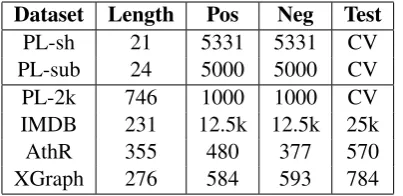
3 Datasets and Experimental Setup We test our method on both long and short text classification tasks, all of which were used to es-tablish baselines in Wang and Manning (2012). Table 1 has summary statistics of the datasets. The snippet datasets are:
• PL-sh: Short movie reviews with one sen-tence per review. Classification involves de-tecting whether a review is positive or nega-tive. (Pang and Lee, 2005).2
• PL-sub: Dataset with short subjective movie reviews and objective plot summaries. Clas-sification task is to detect whether the sen-tence is objective or subjective. (Pang and Lee, 2004).
And the longer document datasets are:
1Wang and Manning (2012) use the sameαbut they
dif-fer from our NBSVM in two ways. One, they usel2hinge
loss (as opposed to l1 loss in this paper). Two, they
in-terpolate NBSVM weights with Multivariable Naive Bayes (MNB) weights to get the final weight vector. Further, their tokenization is slightly different. Hence our NBSVM results are not directly comparable. We list their results in table 2.
2
Dataset Length Pos Neg Test PL-sh 21 5331 5331 CV PL-sub 24 5000 5000 CV PL-2k 746 1000 1000 CV IMDB 231 12.5k 12.5k 25k AthR 355 480 377 570 XGraph 276 584 593 784 Table 1: Summary statistics for the datasets. Length is the average number of unigram tokens (including punctuation) per document. Pos/Neg is the number of positive/negative documents in the training set. Test is the number of documents in the test set (CV means that there is no separate test set for this dataset and thus a 10-fold cross-validation was used to calculate errors).
• PL-2k: 2000 full-length movie reviews that has become the de facto benchmark for sen-timent analysis (Pang and Lee, 2004).
• IMDB: 50k full-length movie reviews (25k training, 25k test), from IMDB (Maas et al., 2011).3
• AthR, XGraph: The 20-Newsgroup dataset, 2nd version with headers removed.4
Clas-sification task is to classify which topic a document belongs to. AthR: alt.atheism vs religion.misc, XGraph: comp.windows.x vs comp.graphics.
3.1 Support Vector Machine (SVM)
For each document, we construct the feature vec-tor x(d) using weights obtained from cred-tf-idf with log scaling and l2 normalization. For cred-tf-idf,γis set to 1.0. NBSVM andtf-idf (also with log scaling andl2 normalization) are used to es-tablish baselines. Prediction for a test document is given by
y(d)=sign(wTx(d)+b) (10) In all experiments, we use a Support Vector Ma-chine (SVM) with a linear kernel and penalty pa-rameter ofC = 1.0. For the SVM, w, bare ob-tained by minimizing,
wTw+C
N
X
d=1
max(0,1−y(d)(wTx(d)+b)) (11)
using the LIBLINEAR library (Fan et al., 2008).
3http://ai.stanford.edu/ amaas/data/sentiment/index.html 4http://people.csail.mit.edu/jrennie/20Newsgroups
3.2 Tokenization
We lower-case all words but do not perform any stemming or lemmatization. We restrict the vo-cabulary to all tokens that occurred at least twice in the training set.
4 Results and Discussion
For PL datasets, there are no separate test sets and hence we use 10-fold cross validation (as do other published results) to estimate errors. The standard train-test splits are used on IMDB and Newsgroup datasets.
[image:3.595.82.284.62.160.2]4.1 cred-tf-idf outperformstf-idf
Table 2 has the comparison of results for the dif-ferent datasets. Our method outperforms the tra-ditional tf-idf on all benchmarks for both uni-grams and biuni-grams. While some of the differ-ences in performance are significant at the 0.05 level (e.g. IMDB), some are not (e.g. PL-2k). The Wilcoxon signed ranks test is a non-parametric test that is often used in cases where two classi-fiers are compared over multiple datasets (Dem-sar, 2006). The Wilcoxon signed ranks test indi-cates that the overall outperformance is significant at the<0.01 level.
4.2 NBSVM outperformscred-tf-idf
cred-tf-idf did not outperform Wang and Manning (2012)’s NBSVM (Wilcoxon signed ranks testp -value = 0.1). But it did outperform our own im-plementation of NBSVM, implying that the ex-tra modifications by Wang and Manning (2012) (i.e. using squared hinge loss in the SVM and in-terpolating between NBSVM and MNB weights) are important contributions of their methodology. This was especially true in the case of shorter doc-uments, where our uninterpolated NBSVM per-formed significantly worse than their interpolated NBSVM.
4.3 tf-idfstill performs well
Method PL-sh PL-sub PL-2k IMDB AthR XGraph tf-idf-uni 77.1 91.5 88.1 88.6 85.8 88.4 tf-idf-bi 78.0 92.3 89.2 90.9 86.5 88.0 Our cred-tfidf-uni 77.5 91.8 88.7 88.8 86.5 89.8 results cred-tfidf-bi 78.6 92.8 89.7 91.3 87.4 88.9 NBSVM-uni 75.5 89.9 87.0 85.9 86.7 88.5 NBSVM-bi 76.0 90.5 89.5 90.5 86.7 88.1 MNB-uni 77.9 92.6 83.5 83.6 85.0 90.0 Wang & MNB-bi 79.0 93.6 85.9 86.6 85.1 91.2 Manning NBSVM-uni 78.1 92.4 87.8 88.3 87.9 91.2 NBSVM-bi 79.4 93.2 89.5 91.2 87.7 90.7
Appr. Tax.* - - 90.2 - -
-Str. SVM* - - 92.4 - -
-aug-tf-mi - - 87.8 88.0 -
-Other Disc. Conn. - - - 91.4 -
-results Word Vec.* - 88.6 88.9 88.9 -
-LLR - - 90.4 - -
-RAE 77.7 - - - -
-MV-RNN 79.0 - - - -
-Table 2: Results of our method (cred-tf-idf) against baselines (tf-idf, NBSVM), using unigrams and bigrams. cred-tf-idf andtf-idf both use log scaling and l2 normalization. Best results (that do not use external sources) are underlined, while top three are in bold. Rows 7-11 are MNB and NBSVM results from Wang and Manning (2012). Our NBSVM results are not directly comparable to theirs (see footnote 1). Methods with * use external data or software.Appr. Tax: Uses appraisal taxonomies fromWordNet (Whitelaw et al., 2005). Str. SVM: UsesOpinionFinderto find objective versus subjective parts of the review (Yessenalina et al., 2010). aug-tf-mi: Uses augmented term-frequency with mutual information gain (Deng et al., 2014).Disc. Conn.: Uses discourse connectors to generate additional features (Trivedi and Eisenstein, 2013). Word Vec.: Learns sentiment-specific word vectors to use as features combined with BoW features (Maas et al., 2011). LLR: Uses log-likelihood ratio on features to select features (Aue and Gamon, 2005).RAE: Recursive autoencoders (Socher et al., 2011).MV-RNN: Matrix-Vector Recursive Neural Networks (Socher et al., 2012).
5 Conclusions and Future Work
In this paper we presented a novel supervised weighting scheme, which we call credibility ad-justed term frequency, to perform sentiment anal-ysis and text classification. Our method outper-forms the traditional tf-idf weighting scheme on multiple benchmarks, which include both snippets and longer documents. We also showed thattf-idf is competitive against other state-of-the-art meth-ods with the right scaling and normalization pa-rameters.
From a performance standpoint, it would be in-teresting to see if our method is able to achieve even better results on the above tasks with proper tuning of theγ parameter. Relatedly, our method could potentially be combined with other super-vised variants of tf-idf, either directly or through ensembling, to improve performance further.
References
A. Aue, M. Gamon. 2005. Customizing sentiment classifiers to new domains: A case study. Proceed-ings of the International Conference on Recent Ad-vances in NLP, 2011.
H. Buhlmann, A. Gisler. 2005. A Course in Credi-bility Theory and its Applications Springer-Verlag, Berlin.
F. Debole, F. Sebastiani. 2003. Supervised Term Weighting for Automated Text Categorization Pro-ceedings of the 2003 ACM symposium on Applied Computing. 784–788.
J. Demsar. 2006. Statistical Comparison of classifiers over multiple data sets. Journal of Machine Learn-ing Research, 7:1-30. 2006.
[image:4.595.109.491.60.322.2]Ex-pert Systems with Applications. Volume 41, Issue 7, 3506–3513.
R. Fan, K. Chang, J. Hsieh, X. Wang, C. Lin. 2008. LI-BLINEAR: A library for large linear classification.
Journal of Machine Learning Research, 9:1871– 1874, June.
A. Maas, R. Daly, P. Pham, D. Huang, A. Ng, C. Potts. 2011. Learning Word Vectors for Sentiment Analy-sis.In Proceedings of ACL 2011.
J. Martineau, T. Finin. 2009. Delta TFIDF: An Im-proved Feature Space for Sentiment Analysis. Third AAAI International Conference on Weblogs and So-cial Media
G. Paltoglou, M. Thelwall. 2010. A study of Infor-mation Retrieval weighting schemes for sentiment analysis. In Proceedings of ACL 2010.
B. Pang, L. Lee. 2004. A sentimental education: Sentiment analysis using subjectivity summarization based on minimum cuts. In Proceedings of ACL 2004.
B. Pang, L. Lee. 2005. Seeing stars: Exploiting class relationships for sentiment categorization with re-spect to rating scales. In Proceedings of ACL 2005.
R. Socher, J. Pennington, E. Huang, A. Ng, C. Man-ning. 2011. Semi-Supervised Recursive
Autoen-coders for Predicting Sentiment Distributions. In Proceedings of EMNLP 2011.
R. Socher, B. Huval, C. Manning, A. Ng. 2012. Se-mantic Compositionality through Recursive Matrix-Vector Spaces. In Proceedings of EMNLP 2012.
R. Trivedi, J. Eisenstein. 2013. Discourse Connec-tors for Latent Subjectivity in Sentiment Analysis.
In Proceedings of NAACL 2011.
G. Salton, M. McGill. 1983. Introduction to Modern Information Retrieval. McGraw-Hill.
S. Wang, C. Manning. 2012. Baselines and Bigrams: Simple, Good Sentiment and Topic Classification.
In proceedings of ACL 2012.
D. Wang, H. Zhang. 2013. Inverse-Category-Frequency Based Supervised Term Weighting Schemes for Text Categorization. Journal of Infor-mation Science and Engineering 29, 209–225. C. Whitelaw, N. Garg, S. Argamon. 2005. Using
ap-praisal taxonomies for sentiment analysis. In Pro-ceedings of CIKM 2005.