Linear Mixture Models for Robust Machine Translation
Marine Carpuat, Cyril Goutte and George Foster
Multilingual Text Processing National Research Council Ottawa, ON K1A0R6, Canada
Abstract
As larger and more diverse parallel texts become available, how can we lever-age heterogeneous data to train robust machine translation systems that achieve good translation quality on various test domains? This challenge has been ad-dressed so far by repurposing techniques developed for domain adaptation, such as linear mixture models which combine estimates learned on homogeneous sub-domains. However, learning from large heterogeneous corpora is quite different from standard adaptation tasks with clear domain distinctions. In this paper, we show that linear mixture models can re-liably improve translation quality in very heterogeneous training conditions, even if the mixtures do not use any domain knowledge and attempt to learn generic models rather than adapt them to the tar-get domain. This surprising finding opens new perspectives for using mixture mod-els in machine translation beyond clear cut domain adaptation tasks.
1 Introduction
While machine translation tasks used to be de-fined by drawing training and test data from a sin-gle well-defined domain, current systems have to deal with increasingly heterogeneous data, both at training and at test time. As larger and more di-verse parallel texts become available, how can we leverage heterogeneous data to train statistical ma-chine translation (SMT) systems that achieve good translation quality on various test domains?
So far, this challenge has been addressed by re-purposing techniques developed for more clear-cut
domain adaptation scenarios, such as linear mix-ture models (Koehn and Schroeder, 2007; Foster and Kuhn, 2007; Sennrich, 2012b). Instead of es-timating models on the whole training corpus at once, linear mixture models are built as follows: (1) partition the training corpus into homogeneous domain-based component, (2) train one model per component, (3) linearly mix models using weights learned to adapt to the test domain, (4) replace re-sulting model in translation system.
In this paper, we aim to gain a better under-standing of the benefits of linear mixture models in heterogeneous data conditions, by examining key untested assumptions:
• Should mixture component capture domain information? Previous work assumes that training data should be organized into do-mains. When manual domain distinctions are not available, previous work uses clustering approaches to approximate manual domain distinctions (Sennrich, 2012a). However, it is unclear whether it is necessary to use or mimic domain distinctions in order to define mixture components.
• Mixture models are usually assumed to im-prove translation quality by giving more weight to parts of the training corpus that are more relevant to the test domain. Is this intu-ition still valid in our more complex hetero-geneous training conditions? If not, how do mixture models affect translation probability estimates?
In order to answer these questions, we propose to study several variants of linear mixture mod-els that reflect different modeling assumptions and different levels of domain knowledge. We first
consider two methods for setting mixture weights: adaptation to the test domain via maximum like-lihood, and uniform mixtures that make no as-sumption about the domain of interest (Section 2). Then, we will describe a wide range of tech-niques that can be used to define mixture com-ponents (Section 3). Again, these techniques re-flect opposite modeling assumptions: manually defined domains and automatic clusters attempt to organize heterogeneous training sets into homo-geneous groups that represent distinct domains, while random samples capture no domain infor-mation and simply provide different views of the training set.
We present an empirical investigation of all the variations outlined above using a strong system trained on large and diverse training corpora, for two language pairs and two distinct test domains. Our results show that linear mixtures reliably and robustly improve the quality of machine transla-tion (Sectransla-tion 5). While they were originally de-veloped for domain adaptation tasks, linear mix-tures that have no domain knowledge can perform as well as traditional mixtures meant to perform domain adaptation. This suggests that improve-ments do not stem from domain modeling per se, but from better generic estimates from the hetero-geneous training data. Further analysis shows that the linear mixture estimates are very different from estimates obtained using more explicit smoothing schemes (Section 6).
2 Linear Mixtures for Translation Models
Does domain knowledge yield better translation quality when learning linear mixture weights for the translation model of a phrase-based MT sys-tem? We leave the study of linear mixtures for language and reordering models for future work.
2.1 Maximum Likelihood Mixtures
In the standard domain adaptation scenario, the linear mixture combines translation probabilities learned on distinct sub-domains in the training corpus. The conditional translation probability of phrasetgivensis defined as:
p(t|s) =XK
k=1
λkpk(t|s) (1)
where pk(t|s) is a conditional translation proba-bility learned on subset k of the training corpus.
Note that for all phrase pairs(s, t)that are not ob-served in componentkof the training corpus, we will have pk(t|s) = 0. As a result, the resulting distributions are not normalized.
The weightsλkare learned to adapt the transla-tion model to a development set, which represents the domain of interest. First, we extract all phrase pairs from the development set, using the same technique used to extract phrases from the training set as part of standard phrase-based MT training. This yields a joint distribution p˜(s, t), which can be used to define a maximum likelihood objective:
ˆ
λ=argmaxλX s,t
˜
p(s, t) logXK k=1
λkpk(s|t). (2)
We use the Expectation Maximization algo-rithm to solve this maximization problem.
2.2 Uniform Mixtures
We will consider uniform mixtures where all com-ponents are weighted equally:
p(t|s) = 1
K
K
X
k=1
pk(t|s). (3)
In contrast with maximum likelihood mixtures, uniform mixtures are not meant to adapt the trans-lation model to a specific test domain. Instead, they combine estimates learned on various subsets of the data in the hope of obtaining a better es-timate of the translation probability distributions from the (possibly heterogeneous) training domain as a whole.
2.3 Why Not Use Loglinear Mixtures?
Previous work provides empirical evidence sup-porting this. For instance, Foster et al. (2010) found that linear mixtures outperform log linear mixtures when adapting a French-English system to the medical domain, as well as on a Chinese-English NIST translation task.
2.4 Estimating Conditional Translation Probabilities
Within each mixture component, we extract all phrase-pairs, compute relative frequencies, and use Kneser-Ney smoothing (Chen et al., 2011) to produce the final estimate of conditional transla-tion probabilities pk(t|s). Per-component proba-bilities are then combined in Eq. 1 and 3. Simi-larly, baseline translation probabilities are learned using Kneser-Ney smoothed frequencies collected on the entire training set.
3 Defining Mixture Components
We assume that the heterogeneous training corpus can be split into basic elements that will be or-ganized in various ways to define the K mixture components. Basic components could be docu-ments or sets of sentences defined along various criteria. Sennrich (2012a) show that using iso-lated sentences as basic elements might not pro-vide sufficient information, as smoothing com-ponent assignments using neighboring sentences benefits translation quality. In our experiments, basic elements are sets of parallel sentences which share the same provenance, genre and dialect, as we will see in Section 4.
We consider four very different ways of defin-ing mixture components by groupdefin-ing the basic corpus elements: (1) manual partition of the train-ing corpus into domains, (2) automatically learn-ing homogeneous domains uslearn-ing text clusterlearn-ing algorithms, (3) random partitioning, (4) sampling with replacement.
3.1 Manually Defined Domains
Heterogeneous training data is usually grouped into domains manually using provenance informa-tion. In most previous work, such domain dis-tinctions are very clear and easy to define. For instance, Haddow (2013) uses European parlia-ment proceedings to improve translation of text in the movie subtitles and News Commentary do-mains; Sennrich (2012a) aims to translate Alpine Club reports using components trained on
Euro-pean parliament proceedings and movie subtitles. Foster et al. (2010) work with a slightly differ-ent setting when defining mixture compondiffer-ents for the NIST Chinese-English translation task: while there is no single obvious “in-domain” component in the NIST training set, homogeneous domains can still be defined in a straightforward fashion based on the provenance of the data (e.g., Hong Kong Hansards vs. Hong Kong Law vs. News ar-ticles from FBIS, etc.). We take a similar approach in our experiments. However, we will see that since our training data is very heterogeneous, we take into account other dimensions beyond prove-nance, such as genre and dialect information (Sec-tion 4).
3.2 Induced Domains Using Automatic Clustering Algorithms
We propose to use automatic text clustering tech-niques to organize basic elements into homoge-neous clusters that are seen as sub-domains. In our experiments, we apply clustering algorithms to the target (English) side of the corpus only.
Each corpus element is transformed into a vector-space format by constructing a tf.idf vector representation. After indexing, we filter out stop-words as well as stop-words occuring in a single doc-ument. We then weight each word token by the log of its frequency in the document, combined with an inverse document frequency (Salton and McGill, 1983) followed by a normalization to unit length. The cosine similarity between each pair of elements is obtained by simply computing the scalar product, resulting in aN×N similarity ma-trix, whereN is the number of corpus elements.
For clustering, we used Ward’s hierarchical clustering algorithm (Ward, 1963). We start with one cluster per corpus element, i.e. N clusters. From the similarity matrix, we identify the two most similar clusters and merge them into a sin-gle one, resulting inN−1clusters. The similarity matrix is updated using Ward’s method to form a (N−1)×(N−1)similarity matrix. The process is repeated on the new set of clusters, until we reach the target number of clustersK.
3.3 Random Partitioning
com-Arabic-English Training Conditions
segs src en
train 8.5M 262M 207M Test Domain 1: Webforum
segs src en
dev (tune) 4.1k 66k 72k web1 (eval) 2.2k 35k 38k web2 (eval) 2.4k 37k 40k
Test Domain 2: News
segs src en
[image:4.595.329.505.60.229.2]dev (tune) 1664 54k 51k news (eval) 813 32k 29k
Table 1: Statistics for Arabic-English data: Num-ber of segments (segs), source tokens (src) and En-glish tokens (en) for each corpus. For EnEn-glish dev and test sets, word counts averaged across 2 refer-ences.
ponent can potentially be as heterogeneous as the full training set.
3.4 Random Sampling with Replacement
All previous techniques assume that the training corpus should be partitioned into distinct clus-ters. We now consider mixture components that break this assumption, and simply represent sev-eral, possibly overlapping, views of the training corpus. They are defined by sampling basic corpus elements uniformly with replacement. This ap-proach simply requires defining a number of sam-plesK and the sizenof each sample. We set the sample size n to the average size of the manual clusters. We do not fixK in advance: in order to provide a fair comparison with corpus partitioning techniques where components achieve coverage of the entire training set by definition, we keep gen-erating samples until all basic elements have been used, and use all resultingKcomponents.
When using uniform linear mixtures, this ap-proach is similar to bootstrap aggregating (bag-ging) for regression (Breiman, 1996), where a more stable model is learned by averagingK es-timates obtained by sampling the training set uni-formly and with replacement.
4 Experiment Settings
We evaluate our linear mixture models on two different language pairs, Arabic-English and Chinese-English, and two different test domains.
Chinese-English Training Conditions
segs src en
train 11M 234M 253M
Test Domain 1: Webforum
segs src en
dev (tune) 2.7k 61k 77k web1 (eval) 1.4k 31k 38k web2 (eval) 1.2k 29k 36k
Test Domain 2: News
segs src en
dev (tune) 1.7k 39k 24k news (eval) 0.7k 19k 19k
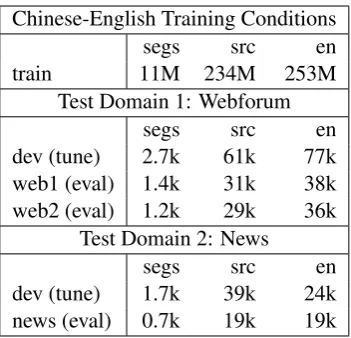
Table 2: Statistics for Chinese-English data: Num-ber of segments (segs), source tokens (src) and En-glish tokens (en) for each corpus. For EnEn-glish dev and test sets, word counts averaged across 4 refer-ences.
4.1 Training Conditions
We use the large-scale heterogeneous training con-ditions defined in the DARPA BOLT project. Data statistics for both language pairs are given in Ta-bles 1 and 2. Training corpora cover a wide variety of sources, genres, dialects, domains, topics.
For instance, for the Arabic task, the training corpus is originally bundled into 48 files repre-senting different provenance and epochs. The data spans 15 genres (defined based on data provenance, they range from lexicon to newswire, United Nations, and many variants of web data such as webforum, weblog, newsgroup, etc.) and 4 automatically tagged dialects (Egyptian, Levan-tine, Modern Standard Arabic, and untagged). The distribution along each of these dimensions is very unbalanced, and each corpus file often contains text in more than one genre, epoch or dialect.
[image:4.595.93.270.62.227.2]0 20 40 60 80
1e+01
1e+05
Arabic corpus components
corpus component
#lines / #w
ords
● ●●●●●
●● ●●●●●●●●●●●●●
●
●●●●●●●●●●●●●●●●●●●●●●●●●●● ●
●●●●●●●●●●●●●● ●
●●● ●
●● ●
● ●
● ●
● ●
● ●
● ●
●#lines #words
0 20 40 60 80 100
1e+03
1e+05
1e+07
Chinese corpus components
corpus component
#lines / #w
ords
● ●
●●●●●●●●●●●●●● ●●●●●●●●●●●●●●●●●●
● ●●●●●●●●
●●●●●● ●
●●● ●●●●
● ● ●
●●●
● ●●●●●●●●●●●●●
●●●●●●●●●●●●●●● ●●●
● ●●●
● ●
[image:5.595.76.289.63.320.2]●#lines #words
Figure 1: Sizes of the 82 Arabic-English (top) and 101 Chinese-English (bottom) corpus compo-nents.
4.2 Definition of Mixture Components
Manual partitions were created first by the system developers, based on intuitions on the nature of the test domain and manual inspection of the training data. The main goal was to group data into com-ponents that are large enough to reliably estimate translation probabilities, but small enough to be homogeneous. This resulted inKm = 10clusters for Arabic, andKm = 17for Chinese.
Automatic partitions are created as described in Section 3. Preliminary experiments with the hierarchical agglomerative clustering algorithm showed that the number of clusters used did not have a big impact on translation quality,1 so we
will only present results that use the same num-ber of clusters as in the manual partitions (10 for Arabic and 17 for Chinese).
Results for random partitions are averaged across experiments run with four random seeds.
4.3 Test Domains
We consider two test domains, as described in Ta-bles 1 and 2: webforum and news.
The webforum test domain is defined by devel-opment test sets made available through BOLT. It 1We triedK ={2,4, . . . ,18,20}for Arabic andK =
{12,14, . . . ,20}for Chinese, plus all basic components.
contains very informal text drawn from online dis-cussion of various topics. Taking these data sets as the definition of the target domain, there is no single obvious in-domain section of the training corpus. For instance, for Arabic, the dev set sen-tences are almost exclusively written in the Egyp-tian dialect. Therefore, EgypEgyp-tian webforum data is presumably the closest to the test domain, but Egyptian weblogs or mixed-dialect broadcast con-versations could potentially be useful as well.
We also test the Arabic and Chinese systems on the news domain. The goal of these experiments is to evaluate the robustness of linear mixtures across different test domains. We use publicly available test sets from the NIST evaluation. The dev set used to learn maximum likelihood mixtures and tune the translation system is the NIST section of the 2006 test set. We evaluate system performance on the newswire section of the NIST 2008 test set.
4.4 Machine Translation System
We use an in-house implementation of a Phrase-based Statistical Machine Translation system (Koehn et al., 2007) to build strong baseline sys-tems for both language pairs. Translation hypothe-ses are scored according to the following features:
• 4 phrase-table scores: Kneser-Ney smoothed phrasal translation probabilites and lexical weights, in both translation directions (Chen et al., 2011)2
• 6 hierarchical lexicalized reordering scores (Galley and Manning, 2008)
• a word penalty, and a word-displacement dis-tortion penalty
• a Good-Turing smoothed 4-gram language model trained on the Gigaword corpus, Kneser-Ney smoothed 5-gram models trained on the English side of the training corpus, and an additional 5-gram model trained on mono-lingual webforum data.
Weights for these features are learned using a batch version of the MIRA algorithm (Chiang, 2012). Phrase pairs are extracted from several word alignments of the training set: HMM, IBM2, and IBM4. Word alignments are kept constant across all experiments.
Test domain Webforum Arabic eval Forum1 Forum2 Linear mix 39.67 40.60
Loglinear mix 37.53 38.80 Chinese eval Forum1 Forum2 Linear mix 30.17 26.86
[image:6.595.314.520.60.274.2]Loglinear mix 27.65 23.78
Table 3: Impact of mixture type on translation quality as measured by BLEU.
adapted. Note that systems used to translate the web1 and web2 test sets are always tuned on the webforum tuning set, while systems used to trans-late data in the news domain are tuned on a news development set. The relevant tuning set is also used for learning maximum likelkihood mixtures when appropriate.
5 Findings: Impact on Translation Quality
5.1 Linear vs. Loglinear Mixtures
Before focusing exclusively on linear mixtures, we confirm that they outperform loglinear mix-tures. This comparison was conducted on the web-forum domain, using manually defined domains as components. For linear mixtures, we trained the weights using maximum likelihood. Loglin-ear mixture weights are trained by MIRA. Table 3 shows that linear mixtures yield consistently and significantly higher BLEU scores than loglinear mixtures, which is consistent with existing results (Foster et al., 2010, inter alia).
5.2 Impact of Mixture Components
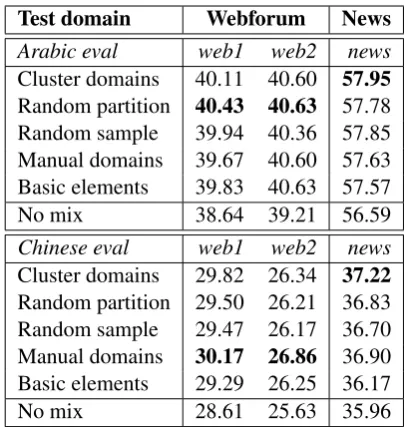
We now focus on linear mixtures and measure the impact on translation quality of the various com-ponent types described in Section 3. In all cases, mixtures weights are estimated by maximum like-lihood. Results are summarized in Table 4 for both Arabic and Chinese.
The main result is that all mixture models con-sidered significantly improve on the “no mix” baseline for both languages. Directly using the 101 basic elements for Chinese and the 82 basic elements for Arabic significantly improves on the baseline. Grouping the basic elements into coarser clusters can further improve BLEU. For Arabic, automatic partitioning (randomly or by clustering) yields better BLEU scores than manual
partition-Test domain Webforum News
Arabic eval web1 web2 news
Cluster domains 40.11 40.60 57.95
Random partition 40.43 40.63 57.78 Random sample 39.94 40.36 57.85 Manual domains 39.67 40.60 57.63 Basic elements 39.83 40.63 57.57 No mix 38.64 39.21 56.59
Chinese eval web1 web2 news
Cluster domains 29.82 26.34 37.22
Random partition 29.50 26.21 36.83 Random sample 29.47 26.17 36.70 Manual domains 30.17 26.86 36.90 Basic elements 29.29 26.25 36.17 No mix 28.61 25.63 35.96
Table 4: Impact of mixture component definition on BLEU score: there is no clear benefit to explic-itly modeling domains.
ing, while the manual and cluster-based domains yield the highest BLEU scores for Chinese.
5.3 Impact of Mixture Weights
Does domain knowledge yield better translation quality when learning linear mixture weights? We answer this question by comparing the transla-tion quality obtained with maximum likelihood vs. uniform mixtures. The maximum likelihood weights are set once per domain, using the rele-vant domain development set, while the uniform mixture is the same across all test domains.
Table 5 shows that maximum likelihood weights generally have a slight advantage over uniform weights, especially in the Webforum do-main. On ”basic elements” in Arabic, the gain is a massive 5 BLEU points, which we attribute to the fact that, as shown in Figure 1, there are many more very small components in Arabic. Those get a disproportionate influence in the uniform mix-ture, hurting the overall performance. On the other hand, the uniform mixture performs better in the News domain. This might be explained by the fact that the tune and test sets are more distant in News than in Webforum, as suggested by the fact that the tuning BLEU scores are not as good at predicing test BLEU rankings in the news domain as in the webforum domain.
[image:6.595.98.265.62.164.2]on Chinese. By comparison, the delta between the two weight setting approaches (maximum likeli-hood vs. uniform), depending on the partition-ing technique, is below 0.4 BLEU for Arabic (ex-cept for Basic elements, +3.6 BLEU) and below 0.57 BLEU for Chinese. It is therefore clear that the gain from using linear mixtures is much larger than the influence of the mixture weight setting, except in the one specific case discussed above.
Taken together, these results show that lin-ear mixtures can reliably and robustly improve the quality of machine translation. But surpris-ingly, linear mixtures that have no domain knowl-edge (random partition + uniform weights) can sometimes perform as well as traditional mixtures meant to perform domain adaptation. This sug-gests that improvements cannot be only explained by improved domain modeling.
Test domain Webforum News
Arabic eval web1 web2 news
Cluster domains 40.11 40.60 57.95 w/ uniform mix 39.63 40.15 58.21
Random partition 40.43 40.63 57.78 w/ uniform mix 40.31 40.15 58.18
Random sample 39.94 40.36 58.06 w/ uniform mix 39.88 40.56 58.65
Manual domains 39.67 40.60 57.63 w/ uniform mix 39.93 40.18 58.00
Basic elements 39.83 40.63 57.57 w/ uniform mix 34.84 35.82 58.46
No mix 38.64 39.21 56.59
Chinese eval web1 web2 news
Cluster domains 29.82 26.34 37.22 w/ uniform mix 29.44 25.94 37.47
Random partition 29.50 26.21 36.83 w/ uniform mix 29.43 25.89 36.95
Random sample 29.47 26.17 36.70
w/ uniform mix 28.47 25.54 36.61 Manual domains 30.17 26.86 36.90 w/ uniform mix 29.25 26.36 36.95
Basic elements 29.29 26.25 36.17 w/ uniform mix 29.23 25.81 36.63
No mix 28.61 25.63 35.96 Table 5: Impact of linear mixture weights on trans-lation quality as measured by BLEU: using do-main knowledge when setting weights has an un-reliable impact.
6 Findings: Impact on Translation Probability Estimates
Thus far, all our experiments have measured the impact of different types of linear mixtures on overall translation quality. But what is the im-pact of these various estimations methods on the learned phrasal translation probability distribu-tions themselves? More specifically, how do trans-lation probabilities estimated using linear mixtures differ from global “no mix” estimates? If linear mixtures do not only capture domain knowledge as suggested by Section 5, do they simply perform a form of smoothing? If so, how does this im-plicit smoothing compare to more exim-plicit smooth-ing schemes for translation probabilities?
6.1 How do linear mixtures affect translation probabilities?
Let us compare translation probabilities estimated directly on the entire corpusPnomix(t|s), with lin-ear mixtures pmix(t|s) = PkK=1λkpk(t|s). The difference between pmix(t|s) and pnomix(t|s) is hard to represent analytically in the general case, but studying a few particular cases can help us gain a better understanding.
First, we observe that linear mixtures scale down the contribution of component-specific source phrases. Assume that the phrase s oc-curs only once in the training corpus, with trans-lation t. By definition, there is a single mixture componentksuch thatpmix(t|s) = λk, which is likely to be smaller thanpnomix(t|s) = 1. In the slightly more general case where s occurs more than once, but always in the same componentk, thenpmix(t|s) =λkpnomix(t|s), which has no im-pact on the ranking of translation candidates fors, but yields a smaller feature value for the decoder.
Second, let us consider the case of very fre-quent “general language” phrases. They should have roughly the same translation distributions in all mixture components: If the pk(t|s) distribu-tions are the same in each component, theλk val-ues learned do not matter, they have no impact on
pmix(t|s) =pnomix(t|s).
In between these extremes, the impact of linear mixtures depends on the frequency and ambiguity of translation candidatestacross mixture compo-nents. For instance, let us assume that the mixture components are somehow defined such that they partition the translate candidates t of a phrase s
4 8 16 32 64 128 512 2048 8192 32768
0.00
0.02
0.04
0.06
0.08
0.10
frequency bin
JSdiv
[image:8.595.97.260.69.231.2]nomix unsmoothed vs. nomix
Figure 2: Comparing translation probability dis-tributions with and without Kneser Ney smooth-ing for Chinese phrase-tables: boxplots of Jensen-Shannon divergences binned by source phrase fre-quency. For instance, the box and whisker at x = 8 represent the distribution of the values of Jensen-Shannon divergence between the unsmoothed and smoothed translation probability distribution for all Chinese phrases seen between 5 and 8 times during phrase extraction.
is aksuch thatpk(t|s) = pnomix(t|s). The rank-ing of translation candidates t fors according to
pmix(t|s)can be very different frompnomix(t|s), as controlled by theλvalues used.
6.2 Smoothing Effects
As a basis for comparison, let us analyze the difference between unsmoothed relative frequen-cies and smoothed translation probabilities using a conventional smoothing scheme. We focus on the Kneser-Ney smoothing scheme (Chen et al., 2011), since it is used to smooth translation prob-abilities in the ‘nomix” baseline as well as in all mixture components.
For seen phrase pairs (with f(s, t) > 0), the difference between Kneser-Ney estimatespkn(t|s) and relative frequency estimates prf(t|s) can be written as:
prf(t|s)−pkn(t|s) = fD(s) −D∗nf(s()s)∗pb(t)
(4) whereDis a discount coefficient,f(s)is the raw frequency for source phrase s, n(s) is the num-ber of translation candidates for s in the phrase-table,pb(t)is a back-off distribution proportional ton(t). The first term is a discount that increases
when sis rare, while the second term adds some probability mass back, based on the frequency and degree of ambiguity of the target phraset. There-fore, Kneser-Ney smoothing has primarily a dis-count effect, applied on rare source phrases. In ad-dition, for more frequent and ambiguous phrases, the relative frequency can be adjusted up or down depending on how ambiguoussandtare.
Overall, there are some similarities between the impact of Kneser-Ney smoothing and linear mix-tures, since one can expect that the translation distributions will diverge more from global rela-tive frequencies for rare phrases than for frequent phrases. However, the discounting / down-scaling effects are controlled by very different parameters in linear mixtures than in Kneser-New smoothing. In order to better understand these differences in practice, an empirical analysis is required.
6.3 Empirical Comparison
How do linear mixtures and smoothing affect translation probabilities p(t|s) in practice? We use the Jensen-Shannon divergence (Lin, 1991) to quantify the distance between (a) various mixture model estimates and (b) the global smoothed rela-tive frequency estimates used in our baseline “no mix” experiments. In addition, we also compare the Kneser-Ney smoothed translation probabilities with unsmoothed relative frequencies, in order to highlight the difference between standard smooth-ing techniques and linear mixture models.
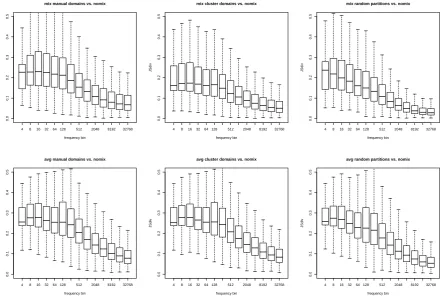
Figures 2 and 3 show the distributions of di-vergence values by source phrase frequencies for Chinese-English phrase-tables. The divergence from the global estimate is the largest for rare phrases in all cases, as expected based on previous Sections. However, the Figures also highlight the different behavior of linear mixtures compared to Kneser-Ney smoothing. The divergence values are much higher overall for the linear mixtures than for smoothing (note that the difference in range on the y axis in Figure 2 vs. Figure 3). In addi-tion, linear mixtures have a large impact on trans-lation probabilities not only on the rarest source phrases but also on relatively frequent phrases: in Figure 3, the median Jensen-Shannon divergence remains high for source phrases extracted up to 128 times from the training set3, while the median
value drops significantly as the frequency range
4 8 16 32 64 128 512 2048 8192 32768
0.0
0.1
0.2
0.3
0.4
0.5
frequency bin
JSdiv
mix manual domains vs. nomix
4 8 16 32 64 128 512 2048 8192 32768
0.0
0.1
0.2
0.3
0.4
0.5
frequency bin
JSdiv
mix cluster domains vs. nomix
4 8 16 32 64 128 512 2048 8192 32768
0.0
0.1
0.2
0.3
0.4
0.5
frequency bin
JSdiv
mix random partitions vs. nomix
4 8 16 32 64 128 512 2048 8192 32768
0.0
0.1
0.2
0.3
0.4
0.5
frequency bin
JSdiv
avg manual domains vs. nomix
4 8 16 32 64 128 512 2048 8192 32768
0.0
0.1
0.2
0.3
0.4
0.5
frequency bin
JSdiv
avg cluster domains vs. nomix
4 8 16 32 64 128 512 2048 8192 32768
0.0
0.1
0.2
0.3
0.4
0.5
frequency bin
JSdiv
[image:9.595.76.517.68.364.2]avg random partitions vs. nomix
Figure 3: Comparing translation probability distributions of mixtures vs. “nomix” on Chinese webforum data, including EM weights (top row) and uniform weights (bottom row).
creases in Figure 2. In addition, uniform mixtures have an even higher impact on frequent phrases than mixtures based on EM weights.
Furthermore, the nature of mixture components used has a visible impact on the divergence distri-butions in Figure 3: random partitions yield lower divergences for very frequent source phrases.
Overall, the linear mixtures result in very differ-ent translation probability distributions than global estimates, including smoothed estimates. This suggests that standard smoothing techniques can be improved when learning from heterogeneous training data, and that mixture components are beneficial even when they do not explicitly cap-ture domain distinctions.
7 Related work
Most previous work on domain adaptation in ma-chine translation presupposes a clear-cut distinc-tion between in-domain and out-of-domain data (Koehn and Schroeder, 2007; Foster and Kuhn, 2007; Duh et al., 2010; Bisazza et al., 2011; Had-dow and Koehn, 2012; Sennrich, 2012b; HadHad-dow and Koehn, 2012; Clark et al., 2012, among many
others). We focused instead on a different less-studied question: how can we leverage training data drawn from a wide variety of sources, genres, time periods, to translate a domain represented by a small development set?
Many approaches focus on mapping the test do-main to a single subset of the training data. In con-trast, we show that the test domain can be flex-ibly represented by a mixture of many compo-nents. Yamamoto and Sumita (2007) cluster the parallel data using bilingual representations, and assign data to a single cluster at test time. Wang et al. (2012) show how to detect a known domain at test time in order to configure a generic transla-tion system with domain-specific feature weights. Others select a subset of training data that is rele-vant to the test domain, using e.g., IR techniques (Hildebrand et al., 2005) or language model cross-entropy (Axelrod et al., 2011).
tar-get domain was Alpine Club reports, while out of domain data sets comprised European parlia-ment proceedings and movie subtitles. We address training conditions where the dimensions for or-ganizing the training data are not as clear-cut, and show that partitions that do not attempt to mimick domain distinctions can improve translation qual-ity. It would be interesting to see whether our con-clusion holds in these more artificial training set-tings, and whether sentence-level corpus organiza-tion could help translaorganiza-tion quality in our settings.
Finally, recent work shows that linear mixture weights can be optimized for BLEU, either di-rectly (Haddow, 2013), or by simulating discrim-inative training (Foster et al., 2013). In this pa-per, we limited our studies to maximum likelihood and uniform mixtures, however, the various mix-ture component definitions proposed here can also be applied when maximizing BLEU.
8 Conclusion
We have presented an extensive study of lin-ear mixtures for training translation models on very heterogeneous data on Arabic-English and Chinese-English translation tasks. In addition, we evaluated the robustness of our models across two distinct domains on the Arabic-English task.
Our results show that linear mixtures reliably and robustly improve the quality of machine trans-lation. Improvements on the mixture-free base-line system range from 0.7 to 1.6 BLEU points depending on the components and weights used. While linear mixture translation models were orig-inally proposed for domain adaptation tasks, we showed that linear mixtures that have no domain knowledge can perform as well or better than tra-ditional mixtures meant to perform domain adap-tation. This suggests that improvements with lin-ear mixture models do not only stem from giving more weight to sections of the training data that are relevant to the test domain, as is assumed in a standard domain adaptation task. Improvements also come from averaging better generic estimates from the heterogeneous training data. In other words, in heterogeneous training settings, linear mixture models improve translation quality even though they do not perform domain adaptation. Finally, we show that while linear mixtures can be viewed as a smoothing technique, linear mix-ture estimates do not diverge from global estimates in the same way as Kneser-Ney smoothed
transla-tion probabilities. In particular, while smoothing primarily has a large discounting effect for rare source phrases, linear mixtures yield differences in translation probabilities for phrases with a wider range of frequencies.
These surprising results encourage us to rethink the use of mixture models, and opens up new ways of conceptualizing learning from heterogeneous data beyond domain adaptation. In future work, we will extend this study by varying the gran-ularity of basic elements used to define mixture components, including sentences and phrases, and will explore how they compare with more general smoothing techniques.
Acknowledgments
This research was supported in part by DARPA contract HR0011-12-C-0014 under subcontract to Raytheon BBN Technologies. The authors would like to thank the reviewers and the PORTAGE group at the National Research Council.
References
Amittai Axelrod, Xiaodong He, and Jianfeng Gao. 2011. Domain adaptation via pseudo in-domain data selection. InProceedings of the Conference on
Em-pirical Methods in Natural Language Processing,
EMNLP ’11, pages 355–362.
Arianna Bisazza, Nick Ruiz, and Marcello Federico. 2011. Fill-up versus interpolation methods for phrase-based SMT adaptation. International
Work-shop on Spoken Language Translation (IWSLT).
Leo Breiman. 1996. Bagging predictors. Machine Learning, 24(2):123–140.
Boxing Chen, Roland Kuhn, George Foster, and Howard Johnson. 2011. Unpacking and transform-ing feature functions: New ways to smooth phrase tables. InProceedings of Machine Translation Sum-mit.
David Chiang. 2012. Hope and fear for discriminative training of statistical translation models. Journal
of Machine Learning Research, 13(1):1159–1187,
April.
Jonathan H. Clark, Alon Lavie, and Chris Dyer. 2012. One system, many domains: Open-domain statisti-cal machine translation via feature augmentation. In
Proceedings of the Conference of the Association for Machine Translation in the Americas.
George Foster and Roland Kuhn. 2007. Mixture-model adaptation for SMT. In Proceedings of the Second Workshop on Statistical Machine Transla-tion, pages 128–135.
George Foster, Cyril Goutte, and Roland Kuhn. 2010. Discriminative instance weighting for domain adap-tation in statistical machine translation. In Proceed-ings of the Conference on Empirical Methods in Nat-ural Language Processing.
George Foster, Boxing Chen, and Roland Kuhn. 2013. Simulating discriminative training for linear mixture adaptation in statistical machine translation. In
Pro-ceedings of the XIV Machine Translation Summit,
pages 183–190.
Michel Galley and Christopher D. Manning. 2008. A simple and effective hierarchical phrase reordering model. In Proceedings of the Conference on
Em-pirical Methods in Natural Language Processing,
EMNLP ’08, pages 848–856.
Barry Haddow and Philipp Koehn. 2012. Analysing the effect of out-of-domain data on SMT systems. In
Proceedings of the Seventh Workshop on Statistical
Machine Translation, pages 422–432.
Barry Haddow. 2013. Applying pairwise ranked opti-misation to improve the interpolation of translation models. InProceedings of the 2013 Conference of the North American Chapter of the Association for Computational Linguistics: Human Language Tech-nologies, pages 342–347.
Almut Silja Hildebrand, Matthias Eck, Stephan Vogel, and Alex Waibel. 2005. Adaptation of the transla-tion model for statistical machine translatransla-tion based on information retrieval. In European Association for Machine Translation.
Philipp Koehn and Josh Schroeder. 2007. Experiments in Domain Adaptation for Statistical Machine Trans-lation. InWorkshop on Statistical Machine Transla-tion.
Philipp Koehn, Hieu Hoang, Alexandra Birch, Chris Callison-Burch, Marcello Federico, Nicola Bertoldi, Brooke Cowan, Wade Shen, Christine Moran, Richard Zens, Chris Dyer, Ondrej Bojar, Alexandra Constantin, and Evan Herbst. 2007. Moses: Open Source Toolkit for Statistical Machine Translation.
InAnnual Meeting of the Association for
Computa-tional Linguistics (ACL), demonstration session.
Jianhua Lin. 1991. Divergence measures based on the shannon entropy. IEEE Trans. Inf. Theor., 37(1):145–151, September.
Rico Sennrich. 2012a. Mixture-modeling with un-supervised clusters for domain adaptation in statis-tical machine translation. In 16th Conference of the European Association for Machine Translation
(EAMT).
Rico Sennrich. 2012b. Perplexity minimization for translation model adaptation in statistical machine tra. InThirteenth Conference of the European Chap-ter of the Association for Computational Linguistics (EACL).
Wei Wang, Klaus Macherey, Wolfgang Macherey, Franz Och, and Peng Xu. 2012. Improved do-main adaptation for statistical machine translation.
In 10th biennial conference of the Association for
Machine Translation in the Americas (AMTA).
Hirofumi Yamamoto and Eiichiro Sumita. 2007. Bilin-gual cluster based models for statistical machine translation. In Proceedings of the 2007 Joint Con-ference on Empirical Methods in Natural Language Processing and Computational Natural Language