Autocorrection Of Arabic Common Errors For Large Text Corpus
QALB-2014 Shared Task
Taha Zerrouki
Bouira University, Bouira,
Algeria
The National Computer
Sci-ence Engineering School
(ESI), Algiers, Algeria
[email protected]
Khaled Alhawaity
Tabuk University, KSA
[email protected]
Amar Balla
The National Computer
Sci-ence Engineering School
(ESI), Algiers, Algeria
a_balla@esi
٫dz
Abstract
Automatic correction of misspelled words means offering a single proposal to correct a mistake, for example, switching two let-ters, omitting letter or a key press. In Ara-bic, there are some typical common errors based on letter errors, such as confusing in the form of Hamza ةﺰﻤھ, confusion between Daad دﺎﺿ and Za ءﺎﻇ, and the omission dots with Yeh ءﺎﯾ and Teh ءﺎﺗ .
So we propose in this paper a system de-scription of a mechanism for automatic correction of common errors in Arabic based on rules, by using two methods, a list of words and regular expressions.
Keywords: AutoCorrect, spell checking, Arabic language processing.
1
Introduction
Spell check is the most important functions of correct writing, whether manual or assisted by programs, it detects errors and suggests correc-tions.
Conventional spelling checkers detect typ-ing errors simply by compartyp-ing each token of a text against a dictionary of words that are known to be correctly spelled.
Any token that matches an element of the dictionary, possibly after some minimal mor-phological analysis, is deemed to be correctly spelled; any token that matches no element is flagged as a possible error, with near-matches displayed as suggested corrections (Hirst, 2005).
2
Auto-correction
An auto-correction mechanism watches out for certain predefined “errors” as the user types, replacing them with a “correction” and giving no indication or warning of the change.
Such mechanisms are intended for un-doubted typing errors for which only one cor-rection is plausible, such as correcting acco-modate* to accommodate (Hirst, 2005).
In Arabic, we found some common errors types, like the confusion in Hamza forms, e.g. the word Isti'maal (لﺎﻤﻌﺘﺳإ*) must be written by a simple Alef, not Alef with Hamza below. This error can be classed as a kind of errors and not a simple error in a word (Shaalan, 2003, Habash, 2011).
Spellchecking and autocorrection are widely applicable for tasks such as:
word- processing
Post-processing Optical Character Recognition.
Correction of large content site like Wikipedia.
Correction of corpora. Search queries
Mobile auto-completion and autocor-rection programs.
3
Related works
Current works on autocorrection in Arabic are limited; there are some works on improv-ing spell checkimprov-ing to select one plausible cor-rection especially for correcting large texts like corpus. In English, Deorowicz (2005) had worked on correcting spelling errors by model-ing their causes, he propose to classify
takes causes in order to improve replacement suggestion.
In Arabic, Microsoft office provides an au-tocorrect word list of common errors, which is limited and not studied.
Google search engine had improved its search algorithm for Arabic query by using some rules on letters which can be mistaken, for better words split based on letters proper-ties, for example if we type [لاﺎﻤﺠﻟاﺔﻌﺋااار]*, the engine can give results for “Rae'at alJamaal” [لاﺎﻤﺠﻟاﺔﻌﺋااار]*and [لﺎﻤﺠﻟا ﺔﻌﺋار]. , some other example: “Altarbia wa alta'lim”, “Google”, “Jaridat alahraam”, [ ، *[ﻞﻗوﻮﻗ] ،*[ماﺮھﻻاةﺪﯾﺮﺟ
] ﻢﯿﯿﻠﻌﺘﻟاوﺔﯿﺑﺮﺘﻟا]*.
Google Arabia says in its blog, that “this improvement which looked very simple, en-hance search in Arabic language by 10% which is in real an impressive change” (Ham-mad, 2010).
4
Our approach
We have launched our first project about au-tocorrection for a special objective to enhance Wikipedia article spell checking. Wikipedia is a large text database written by thousands of persons with different language skill levels and with multiple origins, which make a lot of mis-takes. The idea is to provide an automatic script which can detect common errors by us-ing regular expressions and a word replace-ment list1.
This objective can be extended to answer other needs for users in office, chat, tweets, etc.
The idea is to use a non-ambiguous regular expressions or word list, to prevent common errors, while writing or as an automated script for large texts data.
As we say above, our method is based on: - Regular expressions which can be used to identify errors and give one replacement.
- Replacement list which contains the mis-spelled word, and the exact correction for this case, this way is used for cases which can't be modeled as regular expression.
4.1 Regular Expressions
We use regular expression pattern to detect.errors in words by using word weight (Wazn) and affixes. For example we can detect that words with the
1
The script is named AkhtaBot, which is applied to arabic wikipedia, the Akhtabot is available on http://ar.wikipedia.org/wiki/مﺪﺨﺘﺴﻣ:AkhtaBot
weight INFI'AL لﺎﻌﻔﻧا must be written by Hamza Wasl, and we consider the form لﺎﻌﻔﻧإ* as wrong. Then, we represent all forms of this weight with all possible affixes.
p
prreeffiixxeess W
Weeiigghhtt S
Suuffffiixxeess
،ﺏ ،ﺏ ،لﺍ ،لﺍ ،ﻭ ،ﻭ ﻑ
ﻑ ...
لﺎﻌﻔﻨﺍ لﺎﻌﻔﻨﺍ ،ﻥﻴ ،ﻥﻴ ،ﺕﺍ ،ﺕﺍ ،ﻱ ،ﻱ ،ﻥﺍ ،ﻥﺍ ،ﻩ ،ﻩ ،ﺎﻫ ،ﺎﻫ ،ﺎﻤﻫ ،ﺎﻤﻫ ،ﻙ ،ﻙ ﺎﻤﻜ
ﺎﻤﻜ ...
Table 1 Infi'aal wheight with its affixation
# rules for لﺎﻌﻔﻧا
ur'\b(نإ(|لا)(|ب|ك)(|ف|و(\w\w)ا(\w)(ﻦﯿﺗ|ة|تا|ﻦﯾ)(|ي|)\b'
ur'\b(نإ(|ﻞﻟ)(|ف|و(\w\w)ا(\w)(ة|ﻦﯿﺗ|تا|ﻦﯾ)(|ي|)\b'
ur'\b(نإ(|ل|ب|ك)(|ف|و(\w\w)ا(\w)(
ي | )( ﺎﻤھ | ﺎﻤﻛ | ﻢھ | ﻢﻛ | ﻦھ | ﻦﻛ | ﺎﻧ | ه | ك | ﺎھ | ﺎﻤﮭﺗ | ﺎﻤﻜﺗ | ﻢﮭﺗ | ﻢﻜﺗ | ﻦﮭﺗ | ﻦﻜﺗ | ﺎﻨﺗ | ﮫﺗ | ﺎﮭﺗ | ﻚﺗ | ﮭﺗا ﺎﻣ | ﺎﻤﻜﺗا | ﻢﮭﺗا | ﻢﻜﺗا | ﻦﮭﺗا | ﻦﻜﺗا | ﺎﻨﺗا | ﮫﺗا | ﺎﮭﺗا | ﻚﺗا |)\b'
ur'\b(نإ(|لا)(|ف|و(\w\w)ا(\w)(نو|نﺎﺗ|ﻦﯿﺗ|نا|ﻦﯾ)(|ي|)\b'
[image:2.595.306.538.353.706.2]ur'\b(نإ(|ف|و(\w\w)ا(\w)(|ا اً ا|(ً(|ي|)\b'
Table 2 Rules for the Infi'al weight in all forms
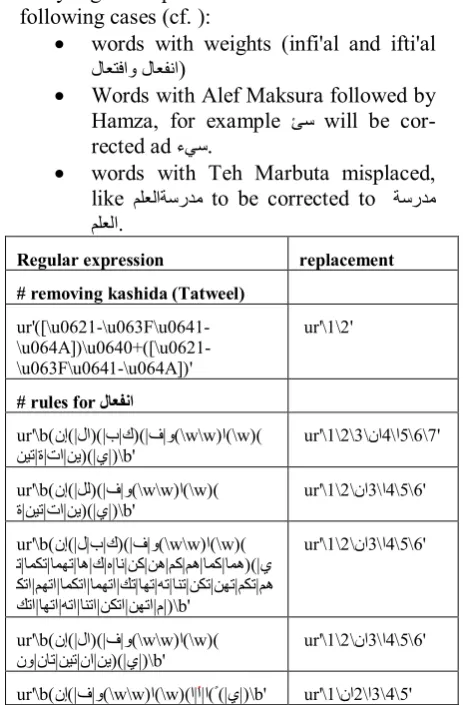
By regular expressions we have modeled the following cases (cf. ):
words with weights (infi'al and ifti'al لﺎﻌﺘﻓاو لﺎﻌﻔﻧا)
Words with Alef Maksura followed by Hamza, for example ﺊﺳ will be cor-rected ad ءﻲﺳ.
words with Teh Marbuta misplaced, like ﻢﻠﻌﻟاﺔﺳرﺪﻣ to be corrected to ﺔﺳرﺪﻣ ﻢﻠﻌﻟا.
Regular expression replacement
# removing kashida (Tatweel)
ur'([\u0621-\u063F\u0641- \u064A])\u0640+([\u0621-\u063F\u0641-\u064A])'
ur'\1\2'
# rules for لﺎﻌﻔﻧا
ur'\b(نإ(|لا)(|ب|ك)(|ف|و(\w\w)ا(\w)( ي | )( ﻦﯾ | تا | ة | ﻦﯿﺗ |)\b'
ur'\1\2\3 نا\ 4 ا\ 5\6\7'
ur'\b(نإ(|ﻞﻟ)(|ف|و(\w\w)ا(\w)( ي | )( ﻦﯾ | تا | ﻦﯿﺗ | ة |)\b'
ur'\1\2 نا\ 3 ا\ 4\5\6'
ur'\b(نإ(|ل|ب|ك)(|ف|و(\w\w)ا(\w)( ي | )( ﺎﻤھ | ﺎﻤﻛ | ﻢھ | ﻢﻛ | ﻦھ | ﻦﻛ | ﺎﻧ | ه | ك | ﺎھ | ﺎﻤﮭﺗ | ﺎﻤﻜﺗ |ﺗ ﻢھ | ﻢﻜﺗ | ﻦﮭﺗ | ﻦﻜﺗ | ﺎﻨﺗ | ﮫﺗ | ﺎﮭﺗ | ﻚﺗ | ﺎﻤﮭﺗا | ﺎﻤﻜﺗا | ﻢﮭﺗا | ﻜﺗا م | ﻦﮭﺗا | ﻦﻜﺗا | ﺎﻨﺗا | ﮫﺗا | ﺎﮭﺗا | ﻚﺗا |)\b'
ur'\1\2 نا\ 3 ا\ 4\5\6'
ur'\b(نإ(|لا)(|ف|و(\w\w)ا(\w)( ي | )( ﻦﯾ | نا | ﻦﯿﺗ | نﺎﺗ | نو |)\b'
ur'\1\2 نا\ 3 ا\ 4\5\6'
ur'\b(نإ(|ف|و(\w\w)ا(\w)(|ا اً ا|(ً(|ي|)\b' ur'\1 نا\ 2 ا\ 3\4\5' Table 3 Rules expressed by regular expressions.
4.2 Wordlist
the confusion between the Dhad and Za, and omitted dots on Teh and Yeh, such as in the ﮫﺒﺘﻜﻤﻟا * and *ﻰﻓ, So we resort to build a list of common misspelled words.
To build an autocorrect word list, we sup-pose to use statistical extraction from a corpus, but we think that's not possible in Arabic lan-guage, because the common mistakes can have certain pattern and style, for example, people who can't differentiate between Dhad and Zah, make mistakes in all words containing these letters. Mistakes on Hamzat are not limited to some words, but can be typical and occur ac-cording to letters not especially for some words.
For this reason, we propose to build a word list based on Attia (2012) spell-checking word list, by generating errors for common letters errors, then filter resulted word list to obtain an autocorrect word list without ambiguity.
How to build generated word list: 1- take a correct word list
2- select candidate words:
words start by Hamza Qat' or Wasl.
words end by Yeh or Teh marbuta.
Words contain Dhad or Zah.
3- Make errors on words by replacing can-didate letters by errors.
4- Spell check the wordlist, and eliminate correct words, because some modified words can be correct, for example, if we take the word ﻞﺿَ Dhalla ، then modify it to ﻞﻇ Zalla , the modified word exists in the dictionary, then we exclude it from autocorrect wordlist, and we keep only misspelled modified words.
words modified Spellcheck Add to
word list
ﺔﺒﺘﻜﻤﺑ ﮫﺒﺘﻜﻤﺑ True
ﺔﺒﺘﻜﻤﻟا ﮫﺒﺘﻜ ﻤﻟا False ﮫﺒﺘﻜﻤﻟا
ﺔﺒﺘﻜﻤﻟﺎﺑ ﮫﺒﺘﻜﻤﻟﺎﺑ False ﮫﺒﺘﻜﻤﻟﺎﺑ
ﺔﺒﺘﻜﻤﻟﺎﺑو ﮫﺒﺘﻜﻤﻟﺎﺑو False ﮫﺒﺘﻜﻤﻟﺎﺑو
[image:3.595.311.526.65.594.2]ﺔﺒﺘﻜﻣو ﮫﺒﺘﻜﻣو True
Table 4 Example of word errors generating
For example, if we have the word مﻼﺳإ Islam, it can be written as مﻼﺳا Islam by mistake because that have the same pronociation. We can generate errors on words by appling some rule:
Alef with Hamza above ﻊﻄﻗ ةﺰﻤھ <=> Alef ﻞﺻو ةﺰﻤھ
Alef with Hamza below ﻒﻟﻷا ﺖﺤﺗ ةﺰﻤھ <=> Alef ﻞﺻو ةﺰﻤھ
Dhah ض <=> Zah ظ The Marbuta ة <=> Heh ـھ
Yeh ي <=> Alef Maksura ى
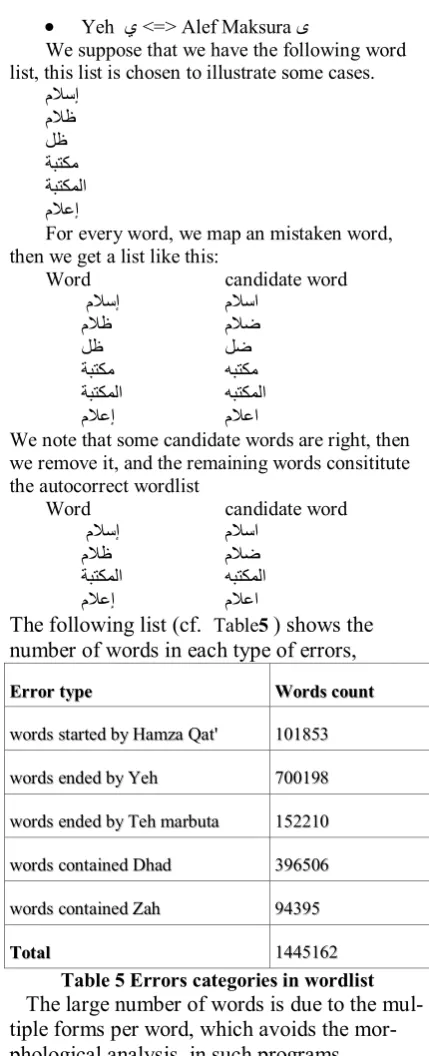
We suppose that we have the following word list, this list is chosen to illustrate some cases.
مﻼﺳإ مﻼﻇ ﻞﻇ ﺔﺒﺘﻜﻣ ﺔﺒﺘﻜﻤﻟا مﻼﻋإ
For every word, we map an mistaken word, then we get a list like this:
Word candidate word
مﻼﺳإ مﻼﺳا
مﻼﻇ مﻼﺿ
ﻞﻇ ﻞﺿ
ﺔﺒﺘﻜﻣ ﮫﺒﺘﻜﻣ
ﺔﺒﺘﻜﻤﻟا ﮫﺒﺘﻜﻤﻟا
مﻼﻋإ مﻼﻋا
We note that some candidate words are right, then we remove it, and the remaining words consititute the autocorrect wordlist
Word candidate word
مﻼﺳإ مﻼﺳا
مﻼﻇ مﻼﺿ
ﺔﺒﺘﻜﻤﻟا ﮫﺒﺘﻜﻤﻟ ا
مﻼﻋإ مﻼﻋا
The following list (cf. Table 5) shows the number of words in each type of errors,
W
Woorrddssccoouunntt E
Errrroorrttyyppee
1
10011885533 w
woorrddssssttaarrtteeddbbyyHHaammzzaaQQaatt''
7
70000119988 w
woorrddsseennddeeddbbyyYYeehh
1
15522221100 w
woorrddsseennddeeddbbyyTTeehhmmaarrbbuuttaa
3
39966550066 w
woorrddssccoonnttaaiinneeddDDhhaadd
9
944339955 w
woorrddssccoonnttaaiinneeddZZaahh
1
1444455116622 T
[image:3.595.71.292.517.637.2]Toottaall
Table 5 Errors categories in wordlist
The large number of words is due to the mul-tiple forms per word, which avoids the mor-phological analysis, in such programs.
Customized Wordlist
Large number of replacement cases in gener-ated autocorrect list encourages us to make an improvement to generate customized list for specific cases in order to reduce list length. We apply the following algorithm to generate customized list from large text data set:
1. Extract misspelled words from dataset by using Hunspell spellchecker. 2. Generate suggestions given by
3. Study suggestions to choose the best one in hypothesis that words have common errors on letters according to modified letters.
4. Exclude ambiguous cases.
The automatically generated word list is used to autocorrect the dataset instead of default word list
5
Tools and resourcesIn our program we have used the following resources:
Arabic word list for spell checking con-taining 9 million Arabic words, from Attia works (2012).
a simple Python script to generate errors. Hunspell spellchecker program with
Ayaspell dictionary (Hadjir 2009, Zer-rouki, 2013). and Attia spellchecking wordlist (2012).
our autocorrect program named Ghalatawi2 ( cf. a screenshot on Figure 1) ٫
A script to select best suggestion from Hunspell correction suggestions to gener-ate customized autocorrect list.
Example
Figure 1 Ghalatawi program, autocorrection example
6
Evaluation
In order to evaluate the performance of auto-matic correction program, we used the data set provided in the shared task test (Behrang, 2014). After that autocorrect the texts by Ga-latawi program based on regular expressions and a wordlist.
For this evaluation we have used two auto-correct word lists:
- a generic word list generated from Attia wordlist, this wordlist is used for general
2
The Ghalatawi autocorrect program is available as an open source program at
http://ghalatawi.sourceforge.net
poses. This word list is noted in evaluation as “STANDARD”.
- a customized wordlist based on dataset, by generating a special word list according to data set, in order to improve auto correction and avoid unnecessary replacement. this wordlist is noted in evaluation as “CUSTOMIZED”.
The customized autocorrect word list is built in the same way as STANDARD, by replacing the source dictionary by misspelled words from QALB corpus (Zaghouani, 2014).
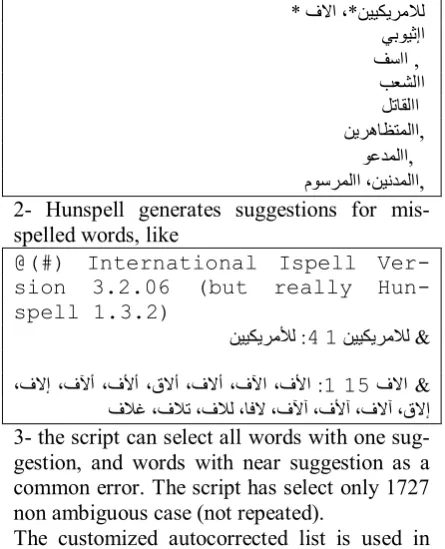
How customized list is built from dataset? 1- Hunspell detects 3463 unrepeated mis-spelled word in the dataset, like
ﻦﯿﯿﻜﯾﺮﻣﻼﻟ * ، فﻻا *
ﻲﺑﻮﯿﺛإا
, ﻒﺳاا
ﺐﻌﺸﻟاا
ﻞﺗﺎﻘﻟاا
, ﻦﯾﺮھﺎﻈﺘﻤﻟاا
, ﻮﻋﺪﻤﻟاا
, ﻦﯿﻧﺪﻤﻟاا ، مﻮﺳﺮﻤﻟاا
2- Hunspell generates suggestions for mis-spelled words, like
@(#) International Ispell Ver-sion 3.2.06 (but really Hun-spell 1.3.2)
& ﻦﯿﯿﻜﯾﺮﻣﻼﻟ 1
4 : ﻦﯿﯿﻜﯾﺮﻣﻸﻟ
& فﻻا 15 1 : فﻷا ، فﻵا ، فﻻأ ، قﻻأ ، فﻷأ ، فﻵأ ، فﻻإ ،
قﻻإ ، فﻻآ ، فﻷآ ، فﻵآ ، ﺎﻓﻻ ، فﻼﻟ ، فﻼﺗ ، ﻼﻏ ف
3- the script can select all words with one sug-gestion, and words with near suggestion as a common error. The script has select only 1727 non ambiguous case (not repeated).
The customized autocorrected list is used in test as CUSTOMIZED.
We got the following results (cf. Table 6) by using the M2 scorer (Dahlmeier et al 2012):
Training Test
STAND. CUST. STAND. CUST.
Precision 0.6785 0.7383 0.698 0.7515
Recall 0.1109 0.2280 0.1233 0.2315
[image:4.595.309.532.249.524.2]F_1.0 0.1906 0.3484 0.2096 0.35
Table 6 Training dataset evaluation
We note that the customized wordlist give us precision and recall better than the use of standard wordlist.
7
Conclusion
In Arabic there are the following common mistakes: failure to differentiate between Hamza Wasl and Qat', confusion between the Dhah and Zah, and the omission of dots on Teh and under Yeh.
We have tried in this paper to find a way to adjust these errors automatically without hu-man review, using a list of words and regular expressions to detect and correct errors.
This technique has been tried on the QALB corpus and gave mentioned results.
References
Hadjir،I٫ "Towards an open source arabic spell checker”, magister in Natural language process-ing, scientific and technique research center to arabic language development, 2009.
Zerrouki T, "Improving the spell checking dic-tionary by users feedback" A meeting of experts check the spelling and grammar and composition automation, Higher Institute of Applied Science and Technology of Damascus, the Arab Organi-zation for Education, Science and Culture, Da-mascus, April 18 to 20, 2011.
Deorowicz S٫, Marcin G. Ciura, Correcting Spell-ing Errors By ModelSpell-ing Their Causes. Int. J. Appl. Math. Comput. Sci., 2005, Vol. 15, No. 2, 275–285
Hammad M٫ and Mohamed Alhawari, recent im-provement of arabic language search, Google Arabia Blog, Google company, 2010 http://google-arabia.blogspot.com/.
K Shaalan, A Allah, Towards automatic spell checking for Arabic… - Conference on Lan-guage Engineering, 2003 - claes.sci.eg
Graeme Hirst And Alexander Budanitsky, Correct-ing real-word spellCorrect-ing errors by restorCorrect-ing lexical cohesion, Natural Language Engineering 11 (1): 87–111, 2005 Cambridge University Press
Nizar Habash, Ryan M. Roth, Using Deep Mor-phology to Improve Automatic Error Detection in Arabic Handwriting Recognition, ACL, page 875-884. The Association for Computer Linguis-tics, (2011)
Behrang Mohit, Alla Rozovskaya, Wajdi Zag-houani, Ossama Obeid, and Nizar Habash , 2014. The First shared Task on Automatic Text Correction for Arabic.
Wajdi Zaghouani, Behrang Mohit, Nizar Habash, Ossama Obeid, Nadi Tomeh, Alla Rozovskaya, Noura Farra, Sarah Alkuhlani, and Kemal Oflazer. 2014. Large Scale Arabic Error Annota-tion: Guidelines and Framework. In Proceedings of the Ninth International Conference on
Lan-guage Resources and Evaluation (LREC’14), Reykjavik, Iceland.
Golding and Roth. “A Winnow based approach to Context-Sensitive Spelling Correction”. 1999.
Dahlmeier, Daniel and Ng, Hwee Tou. 2012. Bet-ter evaluation for grammatical error correction. In Proceedings of NAACL.