Edinburgh’s Syntax-Based Systems at WMT 2014
Philip Williams1, Rico Sennrich1, Maria Nadejde1, Matthias Huck1, Eva Hasler1, Philipp Koehn1,2
1School of Informatics, University of Edinburgh
2Center for Speech and Language Processing, The Johns Hopkins University
Abstract
This paper describes the string-to-tree sys-tems built at the University of Edin-burgh for the WMT 2014 shared trans-lation task. We developed systems for English-German, Czech-English, French-English, German-French-English, Hindi-French-English, and Russian-English. This year we improved our English-German system through target-side compound splitting, morphosyntactic constraints, and refine-ments to parse tree annotation; we ad-dressed the out-of-vocabulary problem us-ing transliteration for Hindi and Rus-sian and using morphological reduction for Russian; we improved our German-English system through tree binarization; and we reduced system development time by filtering the tuning sets.
1 Introduction
For this year’s WMT shared translation task we built syntax-based systems for six language pairs:
• English-German • German-English • Czech-English • Hindi-English • French-English • Russian-English As last year (Nadejde et al., 2013), our systems are based on the string-to-tree pipeline implemented in the Moses toolkit (Koehn et al., 2007).
We paid particular attention to the production of grammatical German, trying various parsers and incorporating target-side compound splitting and morphosyntactic constraints; for Hindi and Rus-sian, we employed the new Moses transliteration model to handle out-of-vocabulary words; and for German to English, we experimented with tree bi-narization, obtaining good results from right bina-rization.
We also present our first syntax-based results for French-English, the scale of which defeated us
last year. This year we were able to train a sys-tem using all available training data, a task that was made considerably easier through principled filtering of the tuning set. Although our system was not ready in time for human evaluation, we present BLEUscores in this paper.
In addition to the five single-system submis-sions described here, we also contributed our English-German and German-English systems for use in the collaborative EU-BRIDGE system com-bination effort (Freitag et al., 2014).
This paper is organised as follows. In Sec-tion 2 we describe the core setup that is com-mon to all systems. In subsequent sections we de-scribe language-pair specific variations and exten-sions. For each language pair, we present results for both the development test set (newstest2013 in most cases) and for the filtered test set (new-stest2014) that was provided after the system sub-mission deadline. We refer to these as ‘devtest’ and ‘test’, respectively.
2 System Overview
2.1 Pre-processing
The training data was normalized using the WMT
normalize-punctuation.perlscript then tokenized and truecased. Where the target lan-guage was English, we used the Moses tokenizer’s
-pennoption, which uses a tokenization scheme that more closely matches that of the parser. For the English-German system we used the default Moses tokenization scheme, which is similar to that of the German parsers.
For the systems that translate into English, we used the Berkeley parser (Petrov et al., 2006; Petrov and Klein, 2007) to parse the target-side of the training corpus. As we will describe in Sec-tion 3, we tried a variety of parsers for German.
We did not perform any corpus filtering other than the standard Moses method, which removes
sentence pairs with dubious length ratios and sen-tence pairs where parsing fails for the target-side sentence.
2.2 Translation Model
Our translation grammar is a synchronous context-free grammar (SCFG) with phrase-structure labels on the target side and the generic non-terminal la-bel X on the source side.
The grammar was extracted from the word-aligned parallel data using the Moses implemen-tation (Williams and Koehn, 2012) of the GHKM algorithm (Galley et al., 2004; Galley et al., 2006). For word alignment we used MGIZA++ (Gao and Vogel, 2008), a multi-threaded implementation of GIZA++ (Och and Ney, 2003).
Minimal GHKM rules were composed into larger rules subject to parameterized restrictions on size defined in terms of the resulting target tree fragment. A good choice of parameter settings depends on the annotation style of the target-side parse trees. We used the settings shown in Table 1, which were chosen empirically during the devel-opment of last years’ systems:
Parameter Value Rule depth 5 Node count 20
Rule size 5
Table 1: Parameter settings for rule composition.
Further to the restrictions on rule composition, fully non-lexical unary rules were eliminated us-ing the method described in Chung et al. (2011) and rules with scope greater than 3 (Hopkins and Langmead, 2010) were pruned from the trans-lation grammar. Scope pruning makes parsing tractable without the need for grammar binariza-tion.
2.3 Language Model
We used all available monolingual data to train 5-gram language models. Language models for each monolingual corpus were trained using the SRILM toolkit (Stolcke, 2002) with modi-fied Kneser-Ney smoothing (Chen and Goodman, 1998) and then interpolated using weights tuned to minimize perplexity on the development set.
2.4 Feature Functions
Our feature functions are unchanged from the pre-vious two years. They include the n-gram
lan-guage model probability of the derivation’s target yield, its word count, and various scores for the synchronous derivation.
Each grammar rule has a number of pre-computed scores. For a grammar rulerof the form
C → hα, β,∼i
whereCis a target-side non-terminal label,αis a string of source terminals and non-terminals,βis a string of target terminals and non-terminals, and ∼is a one-to-one correspondence between source and target non-terminals, we score the rule accord-ing to the followaccord-ing functions:
• p(C, β |α,∼)andp(α|C, β,∼), the direct and indirect translation probabilities.
• plex(β |α) and plex(α|β), the direct and
indirect lexical weights (Koehn et al., 2003). • ppcfg(π), the monolingual PCFG probability
of the tree fragment π from which the rule was extracted.
• exp(−1/count(r)), a rule rareness penalty. • exp(1), a rule penalty. The main grammar
and glue grammars have distinct penalty fea-tures.
2.5 Tuning
The feature weights were tuned using the Moses implementation of MERT (Och, 2003) for all sys-tems except English-to-German, for which we usedk-best MIRA (Cherry and Foster, 2012) due to the larger number of features.
We used tuning sentences drawn from all of the previous years’ test sets (except newstest2013, which was used as the development test set). In order to speed up the tuning process, we used sub-sets of the full tuning sub-sets with sentence pairs up to length 30 (Max-30) and further applied a fil-tering technique to reduce the tuning set size to 2,000 sentence pairs for the language pairs involv-ing German, French and Czech1. We also
experi-mented with random subsets of size 2,000. For the filtering technique, we make the as-sumption that finding suitable weights for all the feature functions requires the optimizer to see a range of feature values and to see hypotheses that can partially match the reference translations in order to rank the hypotheses. For example, if a
tuning example contains many out-of-vocabulary words or is difficult to translate for other reasons, this will result in low quality translation hypothe-ses and provide the system with little evidence for which features are useful to produce good transla-tions. Therefore, we select high quality examples using a smooth version of sentence-BLEU
com-puted on the 1-best output of a single decoder run on the development set. Standard sentence-BLEU
tends to select short examples because they are more likely to have perfectn-gram matches with the reference translation. Very short sentence pairs are less informative for tuning but also tend to have more extreme source-target length ratios which can affect the weight of the word penalty. Thus, we penalize short examples by padding the de-coder output with a fixed number of non-matching tokens2 to the left and right before computing
sentence-BLEU. This has the effect of reducing
the precision of short sentences against the refer-ence translation while affecting longer sentrefer-ences proportionally less. Experiments on phrase-based systems have shown that the resulting tuning sets are of comparable diversity as randomly selected sets in terms of their feature vectors and maintain BLEUscores in comparison with tuning on the
en-tire development set.
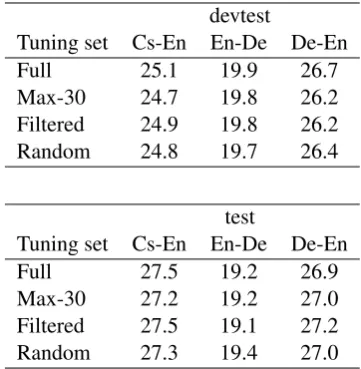
Table 2 shows the size of the full tuning sets and the size of the subsets with up to length 30, Table 3 shows the results of tuning with different sets. Reducing the tuning sets to Max-30 results in a speed-up in tuning time but affects the per-formance on some of the devtest/test sets (mostly for Czech-English). However, tuning on the full set took more than 18 days using 12 cores for German-English which is not feasible when try-ing out several model variations. Further filter-ing these subsets to a size of 2,000 sentence pairs as described above maintains the BLEU scores in
most cases and even improves the scores in some cases. This indicates that the quality of the se-lected examples is more important than the total number of tuning examples. However, the exper-iments with random subsets from Max-30 show that random selection also yields results which im-prove over the results with Max-30 in most cases, though are not always as good as with the filtered sets.3The filtered tuning sets yield reasonable per-2These can be arbitrary tokens that do not match any ref-erence token.
3For random subsets from the full tuning set the perfor-mance was similar but resulted in standard deviations of up
formance compared to the full tuning sets except for the German-English devtest set where perfor-mance drops by 0.5 BLEU4.
[image:3.595.325.506.216.401.2]Tuning set Cs-En En-De De-En Full 13,055 13,071 13,071 Max-30 10,392 9,151 10,610 Table 2: Size of full tuning sets and with sentence length up to 30.
devtest
Tuning set Cs-En En-De De-En
Full 25.1 19.9 26.7
Max-30 24.7 19.8 26.2
Filtered 24.9 19.8 26.2
Random 24.8 19.7 26.4
test
Tuning set Cs-En En-De De-En
Full 27.5 19.2 26.9
Max-30 27.2 19.2 27.0
Filtered 27.5 19.1 27.2
Random 27.3 19.4 27.0
Table 3: BLEUresults on devtest and test sets with
different tuning sets: Full, Max-30, filtered subsets of Max-30 and average of three random subsets of Max-30 (size of filtered/random subsets: 2,000).
3 English to German
We use the projective output of the dependency parser ParZu (Sennrich et al., 2013) for the syn-tactic annotation of our primary submission. Con-trastive systems were built with other parsers: Bit-Par (Schmid, 2004), the German Stanford Bit-Parser (Rafferty and Manning, 2008), and the German Berkeley Parser (Petrov and Klein, 2007; Petrov and Klein, 2008).
The set of syntactic labels provided by ParZu has been refined to reduce overgeneralization phe-nomena. Specifically, we disambiguate the labels ROOT (used for the root of a sentence, but also commas, punctuation marks, and sentence frag-ments), KON and CJ (coordinations of different constituents), and GMOD (pre- or postmodifying genitive modifier).
to 0.36 across three random sets.
NN
SEGMENT
gericht COMP
JUNC
@s@ SEGMENT
berufung COMP
JUNC
@es@ SEGMENT
[image:4.595.308.527.61.200.2]Bund
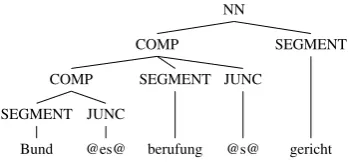
Figure 1: Syntactic representation of split com-poundBundesberufungsgericht(Engl:federal ap-peals court).
We discriminatively learn non-terminal labels for unknown words using sparse features, rather than estimating a probability distribution of non-terminal labels from singleton statistics in the training corpus.
We perform target-side compound splitting, us-ing a hybrid method described by Fritzus-inger and Fraser (2010) that combines a finite-state phology and corpus statistics. As finite-state mor-phology analyzer, we use Zmorge (Sennrich and Kunz, 2014). An original contribution of our experiments is a syntactic representation of split compounds which eliminates typical problems with target-side compound splitting, namely er-roneous reorderings and compound merging. We represent split compounds as a syntactic tree with the last segment as head, preceded by a modifier. A modifier consists of an optional modifier, a seg-ment and a (possibly empty) joining eleseg-ment. An example is shown in Figure 1. This hierarchical representation ensures that compounds can be eas-ily merged in post-processing (by removing the spaces and special characters around joining ele-ments), and that no segments are placed outside of a compound in the translation.
We use unification-based constraints to model morphological agreement within German noun phrases, and between subjects and verbs (Williams and Koehn, 2011). Additionally, we add con-straints that operate on the internal tree structure of the translation hypotheses, to enforce several syn-tactic constraints that were frequently violated in the baseline system:
• correct subcategorization of auxiliary/modal verbs in regards to the inflection of the full verb.
• passive clauses are not allowed to have ac-cusative objects.
system devtestBLEUtest
Stanford Parser 19.0 18.3
Berkeley Parser 19.3 18.6
BitPar 19.5 18.6
ParZu 19.6 19.1
+ modified label set 19.8 19.1 + discriminative UNK weights 19.9 19.2 + German compound splitting 20.0 19.8 + grammatical constraints 20.2 20.1 Table 4: English to German translation results on devtest (newstest2013) and test (newstest2014) sets.
• relative clauses must contain a relative (or in-terrogative) pronoun in their first constituent.
Table 4 shows BLEU scores with systems
trained with different parsers, and for our exten-sions of the baseline system.
4 Czech to English
For Czech to English we used the core setup de-scribed in Section 2 without modification. Table 5 shows the BLEUscores.
BLEU
system devtest test baseline 24.8 27.0
Table 5: Czech to English results on the devtest (newstest2013) and test (newstest2014) sets.
5 French to English
[image:4.595.94.269.66.147.2]For French to English, alignment of the parallel corpus was performed using fast_align (Dyer et al., 2013) instead of MGIZA++ due to the large volume of parallel data.
Table 6 shows BLEUscores for the system and
Table 7 shows the resulting grammar sizes after filtering for the evaluation sets.
BLEU
system devtest test baseline 29.4 32.3
[image:4.595.355.477.674.717.2]system devtest test baseline 86,341,766 88,657,327
Table 7: Grammar sizes of the French to En-glish system after filtering for the devtest (new-stest2013) and test (newstest2014) sets.
6 German to English
German compounds were split using the script provided with Moses.
For training the primary system, the target parse trees were restructured before rule extraction by
right binarization. Since binarization strategies increase the tree depth and number of nodes by adding virtual non-terminals, we increased the ex-traction parameters to: Rule Depth = 7, Node Count = 100, Rule Size = 7. A thorough in-vestigation of binarization methods for restructur-ing Penn Treebank style trees was carried out by Wang et al. (2007).
Table 8 shows BLEU scores for the baseline
system and two systems employing different bi-narization strategies. Table 9 shows the result-ing grammar sizes after filterresult-ing for the evaluation sets. Results on the development set showed no improvement whenleft binarizationwas used for restructuring the trees, although the grammar size increased significantly.
BLEU
system devtest test
baseline 26.2 27.2
+ right binarization (primary) 26.8 28.2
+ left binarization 26.3
-Table 8: German to English results on the devtest (newsdev2013) and test (newstest2014) sets.
system devtest test
baseline 11,462,976 13,811,304 + right binarization 24,851,982 29,133,910 + left binarization 21,387,976
-Table 9: Grammar sizes of the German to En-glish systems after filtering for the devtest (new-stest2013) and test (newstest2014) sets.
7 Hindi to English
English-Hindi has the least parallel training data of this year’s language pairs. Out-of-vocabulary
(OOV) input words are therefore a comparatively large source of translation error: in the devtest set (newsdev2014) and filtered test set (newstest2014) the average OOV rates are 1.08 and 1.16 unknown words per sentence, respectively.
Assuming a significant fraction of OOV words to be named entities and thus amenable to translit-eration, we applied the post-processing translitera-tion method described in Durrani et al. (2014) and implemented in Moses. In brief, this is an unsuper-vised method that i) uses EM to induce a corpus of transliteration examples from the parallel training data; ii) learns a monotone character-level phrase-based SMT model from the transliteration corpus; and iii) substitutes transliterations for OOVs in the system output by using the monolingual language model and other features to select between translit-eration candidates.5
Table 10 shows BLEU scores with and without
transliteration on the devtest and filtered test sets. Due to a bug in the submitted system, the language model trained on the HindEnCorp corpus was used for transliteration candidate selection rather than the full interpolated language model. This was fixed subsequent to submission.
BLEU
system devtest test
baseline 12.9 14.7
+ transliteration (submission) 13.3 15.1 + transliteration (fixed) 13.6 15.5
Table 10: Hindi to English results with and with-out transliteration on the devtest (newsdev2014) and test (newstest2014) sets.
Transliteration increased 1-gram precision from 48.1% to 49.4% for devtest and from 49.1% to 50.6% for test. Of the 2,913 OOV words in test, 938 (32.2%) of transliterations exactly match the reference. Manual inspection reveals that there are also many near matches. For instance, translitera-tion producesBernat Jackiewhere the reference is
Jacqui Barnat.
8 Russian to English
Compared to Hindi-English, the Russian-English language pair has over six times as much parallel data. Nonetheless, OOVs remain a problem: the average OOV rates are approximately half those
of Hindi-English, at 0.47 and 0.51 unknown words per sentence for the devtest (newstest2013) and fil-tered test (newstest2014) sets, respectively. We address this in part using the same transliteration method as for Hindi-English.
Data sparsity issues for this language pair are exacerbated by the rich inflectional morphology of Russian. Many Russian word forms express gram-matical distinctions that are either absent from En-glish translations (like grammatical gender) or are expressed by different means (like grammatical function being expressed through syntactic config-uration rather than case). We adopt the widely-used approach of simplifying morphologically-complex source forms to remove distinctions that we believe to be redundant. Our method is simi-lar to that of Weller et al. (2013) except that ours is much more conservative (in their experiments, Weller et al. (2013) found morphological reduc-tion to harm translareduc-tion indicating that useful in-formation was likely to have been discarded).
We used TreeTagger (Schmid, 1994) to obtain a lemma-tag pair for each Russian word. The tag specifies the word class and various morphosyn-tactic feature values. For example, the adjective республиканская(‘republican’) gets the lemma-tag pairреспубликанский + Afpfsnf, where the code A indicates the word class and the re-maining codes indicate values for the type, degree, gender, number, case, and definiteness features.
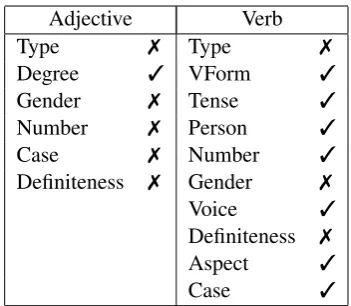
Like Weller et al. (2013), we selectively placed surface forms with their lemmas and re-duced tags, reducing tags through feature dele-tion. We restricted morphological reduction to ad-jectives and verbs, leaving all other word forms unchanged. Table 11 shows the features that were deleted. We focused on contextual inflec-tion, making the assumption that inflectional dis-tinctions required by agreement alone were the least likely to be useful for translation (since the same information was marked elsewhere in the sentence) and also the most likely to be the source of ‘spurious’ variation.
Table 12 shows the BLEU scores for
Russian-English with transliteration and morphological re-duction. The effect of transliteration was smaller than for Hindi-English, as might be expected from the lower baseline OOV rate. 1-gram precision in-creased from 57.1% to 57.6% for devtest and from 62.9% to 63.6% for test. Morphological reduction decreased the initial OOV rates by 3.5% and 4.1%
Adjective Verb
Type 7 Type 7
Degree 3 VForm 3
Gender 7 Tense 3
Number 7 Person 3
Case 7 Number 3
Definiteness 7 Gender 7
Voice 3
Definiteness 7
Aspect 3
[image:6.595.328.504.60.213.2]Case 3
Table 11: Feature values that are retained (3) or deleted (7) during morphological reduction of Russian.
BLEU
system devtest test
baseline 23.3 29.7
+ transliteration 23.7 30.3 + morphological reduction 23.8 30.3 Table 12: Russian to English results on the devtest (newstest2013) and test (newstest2014) sets.
on the devtest and filtered test sets. After both morphological and transliteration the 1-gram pre-cisions for devtest and test were 57.7% and 63.8%.
9 Conclusion
We have described Edinburgh’s syntax-based sys-tems in the WMT 2014 shared translation task. Building upon the already-strong string-to-tree systems developed for previous years’ shared translation tasks, we have achieved substantial im-provements over our baseline setup: we improved translation into German through target-side com-pound splitting, morphosyntactic constraints, and refinements to parse tree annotation; we have ad-dressed unknown words using transliteration (for Hindi and Russian) and morphological reduction (for Russian); and we have improved our German-English system through tree binarization.
Acknowledgements
The research leading to these results has received funding from the European Union Seventh Frame-work Programme (FP7/2007-2013) under grant agreement no287658 (EU-BRIDGE).
References
Stanley F. Chen and Joshua Goodman. 1998. An em-pirical study of smoothing techniques for language modeling. Technical report, Harvard University. Colin Cherry and George Foster. 2012. Batch tuning
strategies for statistical machine translation. In Pro-ceedings of the 2012 Conference of the North Amer-ican Chapter of the Association for Computational Linguistics: Human Language Technologies, pages 427–436, Montréal, Canada, June. Association for Computational Linguistics.
Tagyoung Chung, Licheng Fang, and Daniel Gildea. 2011. Issues concerning decoding with synchronous
context-free grammar. In Proceedings of the 49th
Annual Meeting of the Association for Computa-tional Linguistics: Human Language Technologies, pages 413–417, Portland, Oregon, USA, June. Nadir Durrani, Hassan Sajjad, Hieu Hoang, and Philipp
Koehn. 2014. Integrating an Unsupervised Translit-eration Model into Statistical Machine Translation. InProceedings of the 15th Conference of the Euro-pean Chapter of the ACL (EACL 2014), Gothenburg, Sweden, April. To appear.
Chris Dyer, Victor Chahuneau, and Noah A. Smith. 2013. A simple, fast, and effective
reparameteriza-tion of ibm model 2. InIn Proc. NAACL/HLT 2013,
pages 644–648.
Markus Freitag, Stephan Peitz, Joern Wuebker, Her-mann Ney, Matthias Huck, Rico Sennrich, Nadir Durrani, Maria Nadejde, Philip Williams, Philipp Koehn, Teresa Herrmann, Eunah Cho, and Alex Waibel. 2014. EU-BRIDGE MT: Combined
Ma-chine Translation. InProceedings of the ACL 2014
Ninth Workshop on Statistical Machine Translation, Baltimore, MD, USA, June.
Fabienne Fritzinger and Alexander Fraser. 2010. How to Avoid Burning Ducks: Combining Linguistic Analysis and Corpus Statistics for German Com-pound Processing. InProceedings of the Joint Fifth Workshop on Statistical Machine Translation and MetricsMATR, WMT ’10, pages 224–234, Uppsala, Sweden.
Michel Galley, Mark Hopkins, Kevin Knight, and Daniel Marcu. 2004. What’s in a Translation Rule? InHLT-NAACL ’04.
Michel Galley, Jonathan Graehl, Kevin Knight, Daniel Marcu, Steve DeNeefe, Wei Wang, and Ignacio Thayer. 2006. Scalable inference and training of
context-rich syntactic translation models. In
ACL-44: Proceedings of the 21st International Confer-ence on Computational Linguistics and the 44th an-nual meeting of the Association for Computational Linguistics, pages 961–968, Morristown, NJ, USA. Qin Gao and Stephan Vogel. 2008. Parallel
implemen-tations of word alignment tool. In Software
Engi-neering, Testing, and Quality Assurance for Natural
Language Processing, SETQA-NLP ’08, pages 49– 57, Stroudsburg, PA, USA.
Mark Hopkins and Greg Langmead. 2010. SCFG
de-coding without binarization. InProceedings of the
2010 Conference on Empirical Methods in Natural Language Processing, pages 646–655, Cambridge, MA, October.
Philipp Koehn, Franz Josef Och, and Daniel Marcu.
2003. Statistical phrase-based translation. In
NAACL ’03: Proceedings of the 2003 Conference of the North American Chapter of the Association for Computational Linguistics on Human Language Technology, pages 48–54, Morristown, NJ, USA. Philipp Koehn, Hieu Hoang, Alexandra Birch, Chris
Callison-Burch, Marcello Federico, Nicola Bertoldi, Brooke Cowan, Wade Shen, Christine Moran, Richard Zens, Chris Dyer, Ondˇrej Bojar, Alexandra Constantin, and Evan Herbst. 2007. Moses: open source toolkit for statistical machine translation. In
Proceedings of the 45th Annual Meeting of the ACL on Interactive Poster and Demonstration Sessions, ACL ’07, pages 177–180, Morristown, NJ, USA. Association for Computational Linguistics.
Maria Nadejde, Philip Williams, and Philipp Koehn. 2013. Edinburgh’s Syntax-Based Machine
Transla-tion Systems. InProceedings of the Eighth
Work-shop on Statistical Machine Translation, pages 170– 176, Sofia, Bulgaria, August.
Franz Josef Och and Hermann Ney. 2003. A sys-tematic comparison of various statistical alignment
models. Comput. Linguist., 29(1):19–51, March.
Franz Josef Och. 2003. Minimum error rate training in statistical machine translation. InProceedings of the 41st Annual Meeting on Association for Com-putational Linguistics - Volume 1, ACL ’03, pages 160–167, Morristown, NJ, USA.
Slav Petrov and Dan Klein. 2007. Improved Inference
for Unlexicalized Parsing. In Human Language
Technologies 2007: The Conference of the North American Chapter of the Association for Computa-tional Linguistics; Proceedings of the Main Confer-ence, pages 404–411, Rochester, New York, April. Slav Petrov and Dan Klein. 2008. Parsing German
with Latent Variable Grammars. InProceedings of
the Workshop on Parsing German at ACL ’08, pages 33–39, Columbus, OH, USA, June.
Slav Petrov, Leon Barrett, Romain Thibaux, and Dan Klein. 2006. Learning accurate, compact, and
interpretable tree annotation. In Proceedings of
the 21st International Conference on Computational Linguistics and the 44th annual meeting of the As-sociation for Computational Linguistics, ACL-44, pages 433–440.
Anna N. Rafferty and Christopher D. Manning. 2008. Parsing Three German Treebanks: Lexicalized and
Workshop on Parsing German at ACL ’08, pages 40– 46, Columbus, OH, USA, June.
Helmut Schmid. 1994. Probabilistic part-of-speech tagging using decision trees. InInternational Con-ference on New Methods in Language Processing, pages 44–49, Manchester, UK.
Helmut Schmid. 2004. Efficient Parsing of Highly Ambiguous Context-Free Grammars with Bit
Vec-tors. In Proc. of the Int. Conf. on Computational
Linguistics (COLING), Geneva, Switzerland, Au-gust.
Rico Sennrich and Beat Kunz. 2014. Zmorge: A Ger-man Morphological Lexicon Extracted from
Wik-tionary. In Proceedings of the 9th International
Conference on Language Resources and Evaluation (LREC 2014), Reykjavik, Iceland, May.
Rico Sennrich, Martin Volk, and Gerold Schneider. 2013. Exploiting Synergies Between Open Re-sources for German Dependency Parsing,
POS-tagging, and Morphological Analysis. In
Proceed-ings of the International Conference Recent Ad-vances in Natural Language Processing 2013, pages 601–609, Hissar, Bulgaria.
Andreas Stolcke. 2002. SRILM - an extensible
language modeling toolkit. In Intl. Conf. Spoken
Language Processing, Denver, Colorado, September 2002.
Wei Wang, Kevin Knight, Daniel Marcu, and Marina Rey. 2007. Binarizing Syntax Trees to Improve Syntax-Based Machine Translation Accuracy. In
Joint Conference on Empirical Methods in Natural Language Processing and Computational Natural Language Learning, pages 746–754.
Marion Weller, Max Kisselew, Svetlana Smekalova, Alexander Fraser, Helmut Schmid, Nadir Durrani, Hassan Sajjad, and Richárd Farkas. 2013. Munich-Edinburgh-Stuttgart submissions at WMT13: Mor-phological and syntactic processing for SMT. In
Proceedings of the Eighth Workshop on Statistical Machine Translation, pages 232–239, Sofia, Bul-garia, August.
Philip Williams and Philipp Koehn. 2011. Agreement Constraints for Statistical Machine Translation into
German. InProceedings of the Sixth Workshop on
Statistical Machine Translation, pages 217–226, Ed-inburgh, Scotland, July.
Philip Williams and Philipp Koehn. 2012. GHKM Rule Extraction and Scope-3 Parsing in Moses. In