Edinburgh’s Syntax-Based Systems at WMT 2015
Philip Williams1, Rico Sennrich1, Maria Nadejde1,
Matthias Huck1, Philipp Koehn1,2
1School of Informatics, University of Edinburgh
2Center for Speech and Language Processing, The Johns Hopkins University
Abstract
This paper describes the syntax-based sys-tems built at the University of Edinburgh for the WMT 2015 shared translation task. We developed systems for all language pairs except French-English. This year we focused on: translation out of En-glish using tree-to-string models; contin-uing to improve our English-German sys-tem; and source-side morphological seg-mentation of Finnish using Morfessor.
1 Introduction
This year’s WMT shared translation task featured five language pairs: English paired with Czech, Finnish, French, German, and Russian. We built syntax-based systems in both translation direc-tions for all language pairs except English-French. For English → German, we continued to de-velop our string-to-tree system, which has proven highly competitive in previous years. Additions this year included the use of a dependency lan-guage model, an alternative tuning metric, and soft source-syntactic constraints.
For translation from English into Czech, Finnish, and Russian, we built STSG-based tree-to-string systems. Support for this type of model is a recent addition to the Moses toolkit. In previ-ous years, our systems have all used string-to-tree models and have only translated into English and German.
For Finnish →English, we experimented with unsupervised morphological segmentation using Morfessor 2.0 (Virpioja et al., 2013).
For the remaining systems (Czech → English, German→English, and Russian→English), our systems were essentially the same as last year’s (Williams et al., 2014) except for the addition of this year’s training data.
2 System Overview
2.1 Pre-processing
The training data was pre-processed using scripts from the Moses toolkit. We first normalized the data using thenormalize-punctuation.perl script then performed tokenization, parsing, and truecasing. To parse the English data, we used the Berkeley parser (Petrov et al., 2006; Petrov and Klein, 2007). To parse the German data, we used the ParZu dependency parser (Sennrich et al., 2013).
2.2 Word Alignment
For word alignment we used either MGIZA++
(Gao and Vogel, 2008), a multi-threaded imple-mentation of GIZA++ (Och and Ney, 2003), or fast_align(Dyer et al., 2013). In preliminary experiments, we found that the tree-to-string sys-tems were particularly sensitive to the choice of word aligner, echoing a previous observation by Neubig and Duh (2014). See the individual tree-to-string system descriptions in Section 3.
2.3 Language Model
We used all available monolingual data to train one interpolated5-gram language model for each sys-tem. Using either lmplz (Heafield et al., 2013) or the SRILM toolkit (Stolcke, 2002), we first trained an individual language model for each of the supplied monolingual training corpora. These models all used modified Kneser-Ney smoothing (Chen and Goodman, 1998). We then interpolated the individual models using SRILM, providing the target-side of the system’s tuning set (Section 2.7) for perplexity-based weight optimization.
2.4 String-to-Tree Model
For English→German and the systems that trans-late into English, we used a string-to-tree model.
2.4.1 Grammar
The string-to-tree translation model is based on a synchronous context-free grammar (SCFG) with linguistically-motivated labels on the target side.
SCFG rules were extracted from the word-aligned parallel data using the Moses implemen-tation (Williams and Koehn, 2012) of the GHKM algorithm (Galley et al., 2004; Galley et al., 2006). Minimal GHKM rules were composed into larger rules subject to restrictions on the size of the resulting tree fragment. We used the settings shown in Table 1, which were chosen empirically during the development of 2013’s systems (Nade-jde et al., 2013).
Parameter Unbinarized Binarized
Rule depth 5 7
Node count 20 30
Rule size 5 7
Table 1: Parameter settings for rule composition. The parameters were relaxed for systems that used binarization to allow for the increase in tree node density.
Further to the restrictions on rule composition, fully non-lexical unary rules were eliminated us-ing the method described in Chung et al. (2011) and rules with scope greater than 3 (Hopkins and Langmead, 2010) were pruned from the trans-lation grammar. Scope pruning makes parsing tractable without the need for grammar binariza-tion.
2.4.2 Feature Functions
Our core set of string-to-tree feature functions is unchanged from previous years. It includes then -gram language model’s log probability for the tar-get string, the tartar-get word count, the rule count, and various pre-computed rule-specific scores. For a grammar rulerof the form
C → hα, β,∼i
whereCis a target-side non-terminal label,αis a string of source terminals and non-terminals,βis a string of target terminals and non-terminals, and ∼is a one-to-one correspondence between source and target non-terminals, we score the rule accord-ing to (logarithms of) the followaccord-ing functions:
• p(C, β |α,∼)andp(α|C, β,∼), the direct and indirect translation probabilities.
• plex(β |α) and plex(α|β), the direct and
indirect lexical weights (Koehn et al., 2003). • ppcfg(π), the monolingual PCFG probability
of the tree fragment π from which the rule was extracted.
• exp(−1/count(r)), a rule rareness penalty.
2.5 Tree-to-String Model
For English→Czech, English→Finnish, and En-glish→Russian, we used a tree-to-string model.
2.5.1 Grammar
In the tree-to-string model, the translation mar is a synchronous tree-substitution gram-mar (Eisner, 2003) with parse tree fragments on the source-side and strings of terminals and non-terminals on the target-side.
As with the string-to-tree models, the grammar was extracted from the word-aligned parallel data using the Moses implementation of the GHKM al-gorithm. Minimal GHKM rules were composed into larger rules subject to the same size restric-tions (Table 1). Unlike string-to-tree rule extrac-tion, fully non-lexical unary rules were included in the grammar and scope pruning was not used.
2.5.2 Feature Functions
The tree-to-string feature functions are similar to those of the string-to-tree model. For a grammar rulerof the form
hπ, β,∼i
whereπis a source-side tree fragment,βis a string of target terminals and non-terminals, and ∼ is a one-to-one correspondence between source and target non-terminals, we score the rule according to (logarithms of) the following functions:
• p(β |π,∼) and p(π |β,∼), the direct and indirect translation probabilities.
• plex(β |π) and plex(π|β), the direct and
indirect lexical weights (Koehn et al., 2003). • exp(−1/count(r)), a rule rareness penalty.
2.6 Decoding
2.7 Tuning
The feature weights were tuned using the Moses implementation of MERT (Och, 2003) for all sys-tems except English-to-German, for which we usedk-best MIRA (Cherry and Foster, 2012) due to the use of sparse features.
For the tree-to-string systems, we used all of the previous years’ test sets as tuning data (except newstest2014, which was used as the development test set). For the string-to-tree systems, we used subsets of the test data to speed up decoding. 3 Individual Systems
In this section we describe individual systems and present experimental results. In many cases, the only difference from the generic setup of the pre-vious section is that we perform right binarization of the training and test parse trees.
We also built hierarchical phrase-based systems (Chiang, 2007), which we refer to in tables as ‘Hi-ero.’ These systems were built using the Moses toolkit, with standard settings. They were not used in the submission and are included for comparison only.
For each system, we present results for both the development test set (newstest2014 in most cases) and for the test set (newstest2015) for which ref-erence translations were provided after the system submission deadline. We refer to these as ‘devtest’ and ‘test’, respectively.
3.1 English to Czech
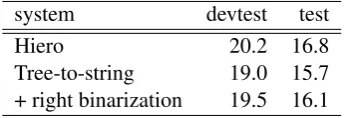
For English → Czech we built a tree-to-string system. We used fast_alignfor word align-ment due to the large training data size and on the strength of its performance for English→Finnish and English→Russian. We used all test sets from 2008 to 2013 as tuning data. Table 2 gives the mean BLEU scores, averaged over three MERT runs. Our submitted system was the right bina-rized system that, out of the three runs, scored highest on devtest.
system devtest test
Hiero 20.2 16.8
Tree-to-string 19.0 15.7 + right binarization 19.5 16.1 Table 2: English to Czech translation results (BLEU) on devtest (newstest2014) and test (news-test2015) sets.
3.2 English to Finnish
In preliminary English → Finnish experi-ments, we compared the use of MGIZA++ and
fast_align. Since there was only one test set provided, in these initial experiments we split newsdev2015 into two halves, using the first half for tuning and the second half for testing. Table 3 gives the mean BLEUscores, averaged over three MERT runs.
MGIZA++ fast_align
Hiero 11.7 11.6
[image:3.595.308.532.197.255.2]Tree-to-string 11.5 12.3 + right binarization 11.9 12.8 Table 3: Comparison of word alignment tools for English to Finnish. BLEU on subset of news-dev2015.
For our final system, we used fast_align for word alignment and we used the full news-dev2015 test set as tuning data. Table 4 gives the mean BLEUscores for this setup. Our submitted system was the right binarized system that, out of the three MERT runs, scored highest on devtest.
system dev test Hiero 11.4 11.5 Tree-to-string 11.9 11.8 + right binarization 12.2 12.3
Table 4: Final English to Finnish translation results (BLEU) on dev (newsdev2015) and test (newstest2015) sets.
3.3 English to German
We experiment with the following additions to last year’s submission system: a relational dependency language model (RDLM) (Sennrich, 2015); tuning on the syntactic metric HWCM (Liu and Gildea, 2005; Sennrich, 2015); soft source-syntactic con-straints (Huck et al., 2014); a large-scale n -gram Neural Network language model (NPLM) (Vaswani et al., 2013); treebank binarization (Sen-nrich and Haddow, 2015); particle verb restructur-ing (Sennrich and Haddow, 2015). We do not in-clude syntactic constraints in this year’s baseline. Our string-to-tree baseline uses a dependency rep-resentation of compounds, as described in (Sen-nrich and Haddow, 2015).
[image:3.595.95.270.647.706.2]system BLEU 2+ SUBJ original trees 20.1 0
+ RDLM 21.0 0
+ RDLM (bidir.) 21.2 0 right binarization 20.4 272 head binarization 20.5 152
+ RDLM 21.3 43
[image:4.595.308.524.61.202.2]+ RDLM (bidir.) 21.5 32 Table 5: English to German translation results (on newstest2013) with different binarizations and language models. 2+ SUBJ: number of finite clauses with more than one subject.
and words in the translation hypotheses based on the dependency relations and words of the ances-tor and sibling nodes in the dependency tree. Our model contains several extensions over the origi-nal paper (Sennrich, 2015). Like the origiorigi-nal pa-per, we use an ancestor context size of 2, but we increase the sibling context size from 1 to 3, and allow bidirectional context, using the 3 closest sib-lings to both the left and right of the current node. The original model predicts a virtual stop node as the last child of each tree, which models the prob-ability that a node has no more children. This is mirrored by a virtual start node in the bidirectional model.
We binarize the treebanks before rule extrac-tion. We note that treebank binarization allows the extraction of rules that overgeneralize, e.g. allow-ing structures with zero, or multiple, preterminals per node, effectively allowing verb clauses with-out verb and similar. We use head binarization
(Sennrich and Haddow, 2015), which ensures that each constituent contains exactly one head. Dur-ing decodDur-ing, the generated target trees are un-binarized to allow scoring with RDLM. Table 5 shows that both right binarization and head bi-narization overgeneralize, exemplified by the fact that they allow finite clauses to have multiple sub-jects1. The RDLM reduces this problem, and the bidirectional RDLM slightly outperforms the uni-directional variant, both in terms of BLEUand the number of overgeneralizations.
For the soft source-syntactic constraints, we an-notate the source text with the Stanford Neural Network dependency parser (Chen and Manning, 2014), along with heuristic projectivization (Nivre and Nilsson, 2005).
1Compound subjects are represented as a single node.
system devtest test
Hiero 19.2 21.0
String-to-tree baseline 19.8 21.4 + HWCM+BLEU
2 tuning 20.1 21.6
+ head binarization 20.5 22.3 + RDLM (bidirectional) 21.5 23.3 + source-syntactic constraints 21.6 23.8 +5-gram NPLM 22.0 24.1 + less pruning (submission) 22.0 24.0 + particle verb restructuring 22.0 24.4
Table 6: English to German translation results (BLEU) on devtest (newstest2013) and test (news-test2015) sets.
The NPLM is a5-gram feed-forward neural lan-guage model, and for both RDLM and NPLM we use a single hidden layer of size 750, a 150-dimensional input embedding layer with a vocab-ulary size of 500000, noise-contrastive estimation with 100 noise samples, and 2 iterations over the monolingual training set. Estimating LM proba-bilities for OOV words is a well-known problem, and we avoid this by filtering the translation model according to the vocabulary of the neural models.
The impact of all experimental components is shown in Table 6. Each system in Tables 5 and 6 was tuned separately with MIRA. For our submis-sion system, we increased the Moses parameters
cube-pruning-pop-limit from 1000 to 4000, and
rule-limitfrom 100 to 400, but this had little effect on devtest, and gave even slightly lower BLEUon test. Particle verb restructuring, which was done after the submission deadline, increases BLEUon test. In total, we observe substantial improvements over our baseline, which roughly corresponds to last year’s submission systems: 2.2 BLEUon dev-test, and 3.0 BLEUon test.
3.4 English to Russian
For English → Russian we built a tree-to-string system. During preliminary experiments we found that fast_align gave consistent gains over MGIZA++(albeit smaller than Finnish→English
[image:4.595.91.273.62.176.2]system devtest test
Hiero 29.8 23.8
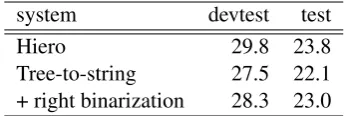
[image:5.595.94.269.62.120.2]Tree-to-string 27.5 22.1 + right binarization 28.3 23.0 Table 7: English to Russian translation results (BLEU) on devtest (newstest2014) and test (news-test2015) sets.
3.5 Czech to English
For Czech→English we built a string-to-tree sys-tem. We used all test sets from 2008 to 2013 as tuning data. Table 8 gives the mean BLEUscores, which are averaged over three MERT runs. Our submitted system was the right binarized system that, out of the three runs, scored highest on dev-test.
system devtest test
Hiero 28.5 24.9
String-to-tree 27.8 24.4 + right binarization 27.8 24.5 Table 8: Czech to English translation results (BLEU) on devtest (newstest2014) and test (news-test2015) sets.
3.6 Finnish to English
In preliminary Finnish→English experiments, we tried using Morfessor to segment Finnish words into morphemes. We used Morfessor 2.0 (with de-fault settings) to learn an unsupervised segmenta-tion model from all of the available Finnish data, which was then used to segment all words in the source-side training and test data. We compared systems with and without segmentation and using a system combination of the two — an approach that has been shown to improve translation quality for this language pair (de Gispert et al., 2009).
As with English → Finnish, we split news-dev2015 into two halves, using the first half for tuning and the second half for testing. Table 9 shows the results: the column headed ‘word’ gives BLEU scores for the unsegmented systems; the column headed ‘morph’ gives scores for systems trained on segmented data; and the column headed ‘syscomb’ gives results for a system combination using MEMT (Heafield and Lavie, 2010).
For our final system, we used morphological segmentation but not system combination. We used the full newsdev2015 test as tuning data. Ta-ble 10 gives mean BLEUscores for this setup,
av-word morph syscomb
Hiero 17.8 19.1 19.2
String-to-tree 17.6 18.5 18.7 + right binarization 17.8 18.9 18.9 Table 9: Finnish to English experiments with mor-phological segmentation.
[image:5.595.309.530.62.120.2]system dev test Hiero 18.6 17.5 String-to-tree 18.3 17.2 + right binarization 18.5 17.7
Table 10: Finnish to English translation results (BLEU) on dev (newsdev2015) and test (news-test2015) sets.
eraged over three MERT runs. Our submitted sys-tem was the right binarized syssys-tem that, out of the three, scored highest on newsdev2015.
3.7 German to English
For German → English we built a tree-to-string system with similar setup as last year’s (Williams et al., 2014). Our submitted system was right bi-narized with the following extraction parameters:
Rule Depth = 7, Node Count = 100, Rule Size = 7. At decoding time we used the following non-default parameter value: max-chart-span = 25. This limits sub derivations to a maximum span of 25 source words. For the Hiero baseline system we usedmax-chart-span = 15. For tuning we used a random subset of 2000 sentences drawn from the full tuning set.
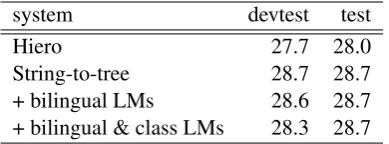
We performed some preliminary experiments with neural bilingual language models, our re-implementation of the “joint” model of (Devlin et al., 2014). The bilingual language models are trained with the NPLM toolkit (Vaswani et al., 2013). We used 250-dimensional input embedding and hidden layers, and input and output vocabu-lary sizes of 500000 and 250000 respectively. One bilingual language model was a 5-gram model with an additional context of 9 source words, the affiliated source word and a window of 4 words on either side. A second model was a 1-gram model with an additional context of 13 source words. The language models were trained on the available par-allel corpora.
[image:5.595.336.497.173.230.2]system devtest test
Hiero 27.7 28.0
[image:6.595.85.280.62.134.2]String-to-tree 28.7 28.7 + bilingual LMs 28.6 28.7 + bilingual & class LMs 28.3 28.7
Table 11: German to English translation results (BLEU) on devtest (newstest2014) and test (news-test2015) sets.
(Och, 1999). The language model was trained on all available monolingual corpora, filtering out singletons.
Table 11 shows the results. As the preliminary results were not encouraging, we did not include the bilingual LMs and class LMs in our submitted system.
3.8 Russian to English
For Russian → English we built a string-to-tree system, using the 2012 and 2013 test sets as tun-ing data. Table 12 gives the mean BLEU scores, averaged over three MERT runs. Our submitted system was the right binarized system that, out of the three runs, scored highest on devtest.
system devtest test
Hiero 31.2 27.1
String-to-tree 30.5 25.9 + right binarization 30.6 26.2 Table 12: Russian to English translation results (BLEU) on devtest (newstest2014) and test (news-test2015) sets.
4 Manual Error Analysis
Our syntax-based systems for the German– English language pairs have greatly improved over the last years and outperformed traditional phrase-based statistical machine translation sys-tems. Translating between German and English is a challenge for those systems, since extensive long distance reordering and long distance agree-ment constraints do not fit that approach. Are our syntax-based systems tackling these problems bet-ter? And what are the main remaining problems?
For both German–English and English– German, we analyzed 100 sentences, we carried out an error analysis using linguistic error cate-gories that roughly match other efforts in this area (Vilar et al., 2006; Toral et al., 2013; Herrmann et
al., 2014; Lommel et al., 2014; Aranberri, 2015). We used the following error annotation protocol:
1. A bilingual speaker corrects the machine translation output with minimal necessary ed-its to render an acceptable translation. This is done in view of the human reference transla-tion, but typically a much more literal trans-lation was obtained.
2. Each edit is noted in a list in the form "old string→new string", where either old or new string may also be empty or discontinuous. 3. In a second pass, all edits are classified with
error categories.
Such an error analysis is subjective. There are many ways to correct errors (step 1), many ways to split corrections into units (step 2), and many ways to classify the errors (step 3). Moreover, an-alyzing only 100 sentences does not lead to strong statistically significant findings. With this in mind, the following analysis is broadly indicative of the main error types in our syntax-based systems.
Occasionally, parts of a machine translation are just too muddled that a sequence of edits could be established. This happened in 8 German–English sentences, and 7 English–German sentences.
4.1 German–English
16 sentences have no error, while 18 sentences have only one error. These are of course typically the shorter ones. The longest sentence without er-ror is:
• Source: Der Oppositionspolitiker Imran Khan wirft Premier Sharif vor, bei der Par-lamentswahl im Mai vergangenen Jahres be-trogen zu haben.
• MT: The opposition politician Imran Khan accuses Premier Sharif of having cheated in the parliamentary election in May of last year.
This is not a trivial sentence, since it requires the translation of the complex subclause construction
accuses ... of having cheated, which is rendered quite differently in German aswirft ... vor ... bet-rogen zu haben.
Count Category
29 Wrong content word - noun 25 Wrong content word - verb
22 Wrong function word - preposition 21 Inflection - verb
14 Reordering: verb 13 Reordering: adjunct
12 Missing function word - preposition 10 Missing content word - verb
9 Wrong function word - other 9 Wrong content word - wrong POS 9 Added punctuation
8 Muddle
8 Missing function word - connective 8 Added function word - preposition 7 Missing punctuation
7 Wrong content word - adverb
Count Category
6 Wrong content word - phrasal verb 6 Added function word - determiner 5 Unknown word - noun
5 Missing content word - adverb 5 Missing content word - noun 5 Inflection - noun
4 Reordering: NP
3 Missing content word - adjective 3 Inflection - wrong POS
3 Casing
2 Unknown word - verb 2 Reordering: punctuation 2 Reordering: noun 2 Reordering: adverb
[image:7.595.75.488.60.296.2]2 Missing function word - determiner 2 Inflection - adverb
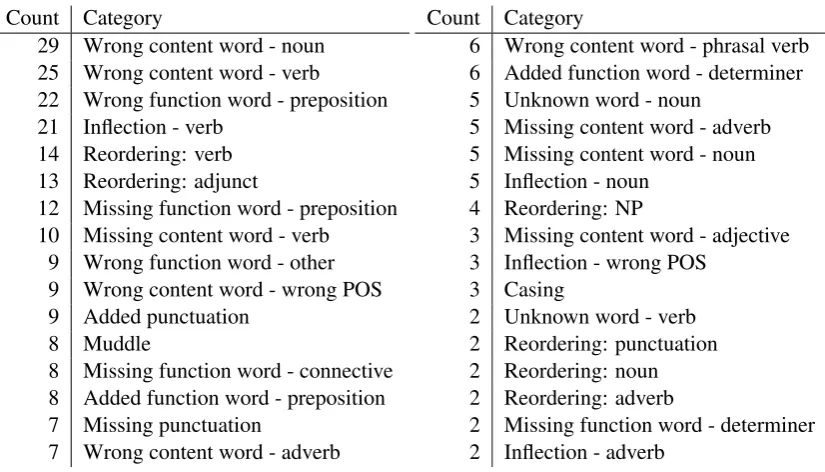
Table 13: Main error types in German–English system (count in 100 sentences).
Lexical choice The biggest group of error types concern translation of basic concepts. On average, such errors occur 0.76 times per sentence. Given the vast number of content words that need to be translated, the actual performance on the task of lexical translation is pretty high, but it is by no means solved.
Count Category
29 Wrong content word - noun 25 Wrong content word - verb
9 Wrong content word - wrong POS 7 Wrong content word - adverb 6 Wrong content word - phrasal verb
Prepositions We were surprised by the large number of errors revolving prepositions. Prepo-sitions are frequent, but not as frequent as con-tent words, so the performance on the preposi-tion translapreposi-tion task is not as good. Preposipreposi-tions mostly mark relationships of adjuncts, which in-volve quite complex considerations — the adjunct, the modified verb or noun phrase, identifying the relationship between them in the source sentence, and the fuzzy meaning of prepositions.
Count Category
22 Wrong function word - preposition 12 Missing function word - preposition
8 Added function word - preposition
Reordering We were also surprised by the low number of reordering errors. The different word order between German and English has hampered
translation quality for this language pair histori-cally. While we cannot declare complete success, our syntax-based systems constitute great progress in this area.
Count Category
14 Reordering: verb 13 Reordering: adjunct
4 Reordering: NP 2 Reordering: noun 2 Reordering: adverb
Other issues with verbs Reordering errors in-volving verbs top the list in the previous group of error types, but there are also other problems with verbs: their inflection and the unacceptable frequency of dropping verbs. The latter has its roots in faulty word alignment which are based on IBM Models which often fail to align the out-of-English-order German verb, thus enabling the translation model to drop them, which the lan-guage model often prefers. Inflection is here to be understood broadly, including the need for the right function words to form a grammatical correct verb complex (e.g.,will have been resolved).
Count Category 21 Inflection - verb
Count Category
41 Wrong content word - verb 37 Wrong content word - noun 33 Reordering - verb
30 Inflection - verb
22 Missing function word - preposition 17 Inflection - np
14 Wrong function word - preposition 12 Wrong content word - phrasal verb 12 Wrong content word - wrong POS 12 Wrong function word - clausal connective 11 Reordering - pp
11 Inflection - noun
10 Wrong function word - pronoun 10 Missing function word - pronoun 10 Missing function word - determiner
9 Reordering - noun
Count Category
9 Compound merging
8 Added function word - preposition 7 Punctuation - inserted
7 Muddle
7 Missing function word - clausal connective 7 Added function word - determiner
5 Punctuation - missing 5 Missing content word - verb 4 Reordering - adverb
4 Wrong content word - adverb 3 Missing content word - adjective 2 Reordering - pronoun
[image:8.595.74.556.59.300.2]2 Wrong content word - name 2 Missing content word - adverb 2 Wrong content word - adjective 2 Added function word - pronoun Table 14: Main error types in English–German system (count in 100 sentences).
4.2 English–German
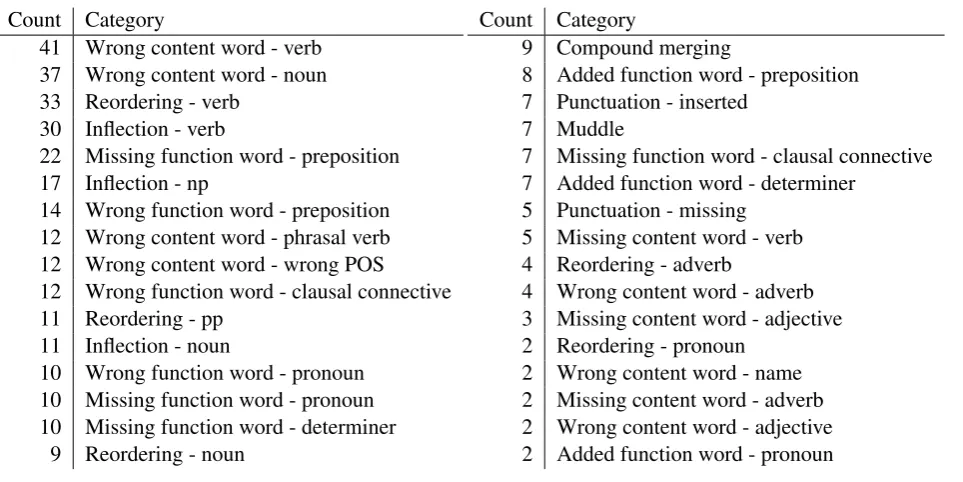
12 Sentences had no error, 13 sentences only one error. Less than German–English, which supports the general contention that translating into Ger-man is harder. On average, a total of 3.8 errors per sentence were marked, one error per sentence more than German–English. An overview of the major error categories is shown is Figure 14.
The longest sentence with no error is:
• Source:Congressmen Keith Ellison and John Lewis have proposed legislation to protect union organizing as a civil right.
• Target: Die Kongressabgeordneten Keith El-lison und John Lewis haben Gesetze zum Schutz der gewerkschaftlichen Organisation als Bürgerrecht vorgeschlagen.
In terms of word order, this is not a complicated sentence (besides the verb move-ment proposed→vorgeschlagen), but it does involve switching of part-of-speech for two content words: protect→Schutz (verb→noun),
union→gewerkschaftlichen(noun→adjective).
Lexical choice As with German–English, this is biggest group of error types, with 1.08 errors per sentence. Verb sense errors tend to be more subtle, such that a media outlet does notsagt (says) but
berichtet(reports) a news item. For nouns, there were several stark errors, such the mis-translation
ofpatient asGeduld(patience) in a medical con-text. In general, there is no reason to believe that models that more strongly draw on a wider context could not resolve many of these cases.
Count Category
41 Wrong content word - verb 37 Wrong content word - noun 12 Wrong content word - phrasal verb 12 Wrong content word - wrong POS
4 Wrong content word - adverb 2 Wrong content word - adjective
Role and order of adjuncts and arguments
While the overall sentence structure is mostly cor-rect, there are often problems with the handling of adjunct and argument phrases. Their role is iden-tified in German by a preposition or the case of a noun phrase (the main cause of inflection errors). Their position in the sentence is less strict, but mis-takes can be and are made.
Count Category
22 Missing function word - preposition 17 Inflection - np
14 Wrong function word - preposition 11 Reordering - pp
11 Inflection - noun
8 Added function word - preposition
in just the right order and placement for a correct verb complex.
33 Reordering - verb 30 Inflection - verb
5 Missing content word - verb
Pronouns Due to grammatical gender of nouns in German, translatingitandtheyis a complex un-dertaking. German verbs also require more fre-quently reflexive pronouns.
Count Category
10 Wrong function word - pronoun 10 Missing function word - pronoun
2 Added function word - pronoun
Clausal connectives A specific problem of English–German translations are clausal connec-tives. In English, the relationship of the sub clause is often not explicitly marked (e.g.,Police say the rider), while German requires a function word.
Count Category
12 Wrong function word - clausal connective 7 Missing function word - clausal connective Overall, while there are more structural prob-lems than for German–English, often the remain-ing challenge is the disambiguation of lexical choices and the correct labelling of syntactic re-lationships.
5 Conclusion
This year we submitted syntax-based systems for all language pairs except English-French. Our English → German system included significant improvements over last year’s and we intend to continue developing this system. We presented the first results using Moses’ STSG-based tree-to-string model.
Acknowledgements
This project has received funding from the European Union’s Horizon 2020 research and innovation programme under grant agreements 645452 (QT21) and 644402 (HimL), and from the Swiss National Science Foundation under grant P2ZHP1_148717.
References
Nora Aranberri. 2015. Smt error analysis and mapping to syntactic, semantic and structural fixes. In Pro-ceedings of the Ninth Workshop on Syntax, Seman-tics and Structure in Statistical Translation, pages
30–38, Denver, Colorado, USA, June. Association for Computational Linguistics.
Stanley F. Chen and Joshua Goodman. 1998. An em-pirical study of smoothing techniques for language modeling. Technical report, Harvard University. Danqi Chen and Christopher Manning. 2014. A Fast
and Accurate Dependency Parser using Neural
Net-works. InProceedings of the 2014 Conference on
Empirical Methods in Natural Language Processing (EMNLP), pages 740–750, Doha, Qatar.
Colin Cherry and George Foster. 2012. Batch Tun-ing Strategies for Statistical Machine Translation. In
Proceedings of the 2012 Conference of the North American Chapter of the Association for Computa-tional Linguistics: Human Language Technologies, pages 427–436, Montréal, Canada, June.
David Chiang. 2007. Hierarchical phrase-based trans-lation.Comput. Linguist., 33(2):201–228.
Tagyoung Chung, Licheng Fang, and Daniel Gildea. 2011. Issues concerning decoding with synchronous
context-free grammar. In Proceedings of the 49th
Annual Meeting of the Association for Computa-tional Linguistics: Human Language Technologies, pages 413–417, Portland, Oregon, USA, June. Adrià de Gispert, Sami Virpioja, Mikko Kurimo, and
William Byrne. 2009. Minimum bayes risk com-bination of translation hypotheses from alternative
morphological decompositions. In Proceedings of
Human Language Technologies: The 2009 Annual Conference of the North American Chapter of the Association for Computational Linguistics, Com-panion Volume: Short Papers, pages 73–76, Boul-der, Colorado, June.
Jacob Devlin, Rabih Zbib, Zhongqiang Huang, Thomas Lamar, Richard Schwartz, and John Makhoul. 2014. Fast and Robust Neural Network Joint Models for
Statistical Machine Translation. In Proceedings of
the 52nd Annual Meeting of the Association for Computational Linguistics (Volume 1: Long Pa-pers), pages 1370–1380, Baltimore, MD, USA, June.
Chris Dyer, Victor Chahuneau, and Noah A. Smith. 2013. A Simple, Fast, and Effective
Reparame-terization of IBM Model 2. In Proceedings of the
2013 Conference of the North American Chapter of the Association for Computational Linguistics: Hu-man Language Technologies, pages 644–648, At-lanta, GA, USA, June.
Jason Eisner. 2003. Learning non-isomorphic tree
mappings for machine translation. InThe
Compan-ion Volume to the Proceedings of 41st Annual Meet-ing of the Association for Computational LMeet-inguis- Linguis-tics, pages 205–208, Sapporo, Japan, July. Associa-tion for ComputaAssocia-tional Linguistics.
Michel Galley, Jonathan Graehl, Kevin Knight, Daniel Marcu, Steve DeNeefe, Wei Wang, and Ignacio Thayer. 2006. Scalable inference and training of
context-rich syntactic translation models. In
ACL-44: Proceedings of the 21st International Confer-ence on Computational Linguistics and the 44th an-nual meeting of the Association for Computational Linguistics, pages 961–968, Morristown, NJ, USA. Qin Gao and Stephan Vogel. 2008. Parallel
implemen-tations of word alignment tool. In Software
Engi-neering, Testing, and Quality Assurance for Natural Language Processing, SETQA-NLP ’08, pages 49– 57, Stroudsburg, PA, USA.
Kenneth Heafield and Alon Lavie. 2010. Combining Machine Translation Output with Open Source The Carnegie Mellon Multi-Engine Machine Translation
Scheme. The Prague Bulletin of Mathematical
Lin-guistics, 93:27–36.
Kenneth Heafield, Ivan Pouzyrevsky, Jonathan H. Clark, and Philipp Koehn. 2013. Scalable
modi-fied Kneser-Ney language model estimation. In
Pro-ceedings of the 51st Annual Meeting of the Associa-tion for ComputaAssocia-tional Linguistics, pages 690–696, Sofia, Bulgaria, August.
Teresa Herrmann, Jan Niehues, and Alex Waibel. 2014. Manual analysis of structurally informed re-ordering in german-english machine translation. In
Proceedings of the Ninth International Conference on Language Resources and Evaluation (LREC-2014). European Language Resources Association (ELRA).
Mark Hopkins and Greg Langmead. 2010. SCFG
de-coding without binarization. InProceedings of the
2010 Conference on Empirical Methods in Natural Language Processing, pages 646–655, Cambridge, MA, October.
Matthias Huck, Hieu Hoang, and Philipp Koehn. 2014. Preference Grammars and Soft Syntactic Constraints for GHKM Syntax-based Statistical Ma-chine Translation. InProceedings of SSST-8, Eighth Workshop on Syntax, Semantics and Structure in Statistical Translation, pages 148–156, Doha, Qatar. Philipp Koehn, Franz Josef Och, and Daniel Marcu.
2003. Statistical phrase-based translation. In
NAACL ’03: Proceedings of the 2003 Conference of the North American Chapter of the Association for Computational Linguistics on Human Language Technology, pages 48–54, Morristown, NJ, USA. Ding Liu and Daniel Gildea. 2005. Syntactic
Fea-tures for Evaluation of Machine Translation. In Pro-ceedings of the ACL Workshop on Intrinsic and Ex-trinsic Evaluation Measures for Machine Transla-tion and/or SummarizaTransla-tion, pages 25–32, Ann Ar-bor, Michigan.
Arle Lommel, Aljoscha Burchardt, Maja Popovi´c, Kim Harris, Eleftherios Avramidis, and Hans Uszkoreit.
2014. Using a new analytic measure for the anno-tation and analysis of mt errors on real data. In
Proceedings of 17th Annual conference of the Eu-ropean Association for Machine Translation, pages 165–172.
Maria Nadejde, Philip Williams, and Philipp Koehn. 2013. Edinburgh’s Syntax-Based Machine
Transla-tion Systems. InProceedings of the Eighth
Work-shop on Statistical Machine Translation, pages 170– 176, Sofia, Bulgaria, August.
Graham Neubig and Kevin Duh. 2014. On the ele-ments of an accurate tree-to-string machine
trans-lation system. In Proceedings of the 52nd Annual
Meeting of the Association for Computational Lin-guistics (Volume 2: Short Papers), pages 143–149, Baltimore, Maryland, June.
Joakim Nivre and Jens Nilsson. 2005.
Pseudo-Projective Dependency Parsing. In Proceedings
of the 43rd Annual Meeting of the Association for Computational Linguistics (ACL’05), pages 99–106, Ann Arbor, Michigan.
Franz Josef Och and Hermann Ney. 2003. A sys-tematic comparison of various statistical alignment
models. Comput. Linguist., 29(1):19–51, March.
Franz Josef Och. 1999. An Efficient Method for
Deter-mining Bilingual Word Classes. InProceedings of
the 9th Conference of the European Chapter of the Association for Computational Linguistics (EACL), pages 71–76.
Franz Josef Och. 2003. Minimum error rate training in statistical machine translation. InProceedings of the 41st Annual Meeting on Association for Com-putational Linguistics - Volume 1, ACL ’03, pages 160–167, Morristown, NJ, USA.
Slav Petrov and Dan Klein. 2007. Improved Inference
for Unlexicalized Parsing. In Human Language
Technologies 2007: The Conference of the North American Chapter of the Association for Computa-tional Linguistics; Proceedings of the Main Confer-ence, pages 404–411, Rochester, New York, April.
Slav Petrov, Leon Barrett, Romain Thibaux, and Dan Klein. 2006. Learning accurate, compact, and
interpretable tree annotation. In Proceedings of
the 21st International Conference on Computational Linguistics and the 44th annual meeting of the As-sociation for Computational Linguistics, ACL-44, pages 433–440.
Rico Sennrich, Martin Volk, and Gerold Schneider. 2013. Exploiting Synergies Between Open Re-sources for German Dependency Parsing,
POS-tagging, and Morphological Analysis. In
Proceed-ings of the International Conference Recent Ad-vances in Natural Language Processing 2013, pages 601–609, Hissar, Bulgaria.
Rico Sennrich. 2014. A cyk+ variant for scfg
decod-ing without a dot chart. InProceedings of SSST-8,
Eighth Workshop on Syntax, Semantics and Struc-ture in Statistical Translation, pages 94–102, Doha, Qatar, October.
Rico Sennrich. 2015. Modelling and Optimizing on Syntactic N-Grams for Statistical Machine
Transla-tion. Transactions of the Association for
Computa-tional Linguistics, 3:169–182.
Andreas Stolcke. 2002. SRILM – an Extensible
Lan-guage Modeling Toolkit. InProc. of the Int. Conf.
on Spoken Language Processing (ICSLP), volume 3, Denver, CO, USA, September.
Antonio Toral, Sudip Kumar Naskar, Joris Vreeke, Federico Gaspari, and Declan Groves. 2013. A web application for the diagnostic evaluation of machine translation over specific linguistic phenomena. In
Proceedings of the 2013 NAACL HLT Demonstra-tion Session, pages 20–23, Atlanta, Georgia, June. Association for Computational Linguistics.
Ashish Vaswani, Yinggong Zhao, Victoria Fossum, and David Chiang. 2013. Decoding with Large-Scale Neural Language Models Improves Translation. In
Proceedings of the 2013 Conference on Empirical Methods in Natural Language Processing, pages 1387–1392, Seattle, WA, USA.
David Vilar, Jia Xu, Luis Fernando D’Haro, and Her-mann Ney. 2006. Error analysis of statistical ma-chine translation output. InProceedings of the 5th International Conference on Language Resources and Evaluation (LREC 06), pages 697–702. Sami Virpioja, Peter Smit, Stig-Arne Grönroos, and
Mikko Kurimo. 2013. Morfessor 2.0: Python im-plementation and extensions for morfessor baseline. Technical report, Aalto University, Helsinki. Philip Williams and Philipp Koehn. 2012. GHKM
Rule Extraction and Scope-3 Parsing in Moses. In
Proceedings of the Seventh Workshop on Statisti-cal Machine Translation, pages 388–394, Montréal, Canada, June.
Philip Williams, Rico Sennrich, Maria Nadejde, Matthias Huck, Eva Hasler, and Philipp Koehn. 2014. Edinburgh’s Syntax-Based Systems at WMT
2014. InProceedings of the Ninth Workshop on
Sta-tistical Machine Translation, pages 207–214, Balti-more, Maryland, USA, June.
Hui Zhang, Min Zhang, Haizhou Li, and Chew Lim Tan. 2009. Fast translation rule matching for