Initiative Taking in Negotiation
Elnaz Nouri
University of Southern California Los Angeles, CA, USA [email protected]
David Traum
USC Institute for Creative Technologies 12015 Waterfront Dr
Playa Vista, CA 90094, USA [email protected]
Abstract
We examine the relationship between ini-tiative behavior in negotiation dialogues and the goals and outcomes of the ne-gotiation. We propose a novel annota-tion scheme for dialogue initiative, includ-ing four labels for initiative and response behavior in a dialogue turn. We anno-tate an existing human-human negotiation dataset, and use initiative-based features to try to predict both negotiation goal and outcome, comparing our results to prior work using other (non-initiative) features sets. Results show that combining initia-tive features with other features leads to improvements over either set and a major-ity class baseline.
1 Introduction
Negotiation is a complex interaction in which two or more parties confer with one another to arrive at the settlement of some matter, for example re-solving a conflict or to share common resources. The parties involved in the negotiation often have non-identical preferences and goals that they try to reach. Sometimes the parties simply try to change a situation to their favor by haggling over price. In other cases, there can be a more complex trade-off between issues. Investigating these rich and com-plex interactions in a scientific manner has been important to researchers in different fields due to the significant implications and potential applica-tions for business and profit making. Being a good negotiator is not a skill that all humans naturally have; therefore, this line of research can poten-tially be used to help humans become better ne-gotiators. Computer agents will also benefit from the ability to understand human negotiators. There has been a fair amount of previous work in un-derstanding negotiation dialogs, e.g., (Walton and
McKersie, 1991; Baker, 1994); as well as agents who can engage in negotiation, e.g. (Jameson et al., 1994; Sidner, 1994; Kraus et al., 2008; Traum et al., 2008). In this paper we investigate the role that dialogue initiative plays in negotiation.
Negotiations can be characterized by both the goals that each negotiator is trying to achieve, as well as the outcomes. Even for negotiations that attempt to partition a set of goods, the participants may have differences in their valuation of items, and the negotiations can be very different if peo-ple are trying to maximize the total gain or their individual gain, or gain a competitive advantage over the other.
Negotiations between two people are usually mixed-initiative (Walker and Whittaker, 1990), with control of conversation being transferred from one person to another. To our knowledge, no previous studies have investigated the relation-ship between verbal initiative taking patterns and the goal or the outcome of the negotiation. We suspected that both of the mentioned characteris-tics of the negotiation (goal and outcome) might be correlated with different initiative-taking patterns. We used an existing negotiation dataset in order to study the mixed initiative patterns between the two parties in the negotiation. We describe this data set in Section 2, as well as previous work that attempted to predict outcome and goal, using other features (Nouri et al., 2013).
This paper makes the following contributions: a new annotation scheme for dialogue initiative is introduced in Section 3 and used to annotate the negotiation dataset. We then study the relation-ship between initiative taking patterns and the goal and outcome of the negotiation for the participants (Section 4).
2 Data
con-tribution of initiative to problems of goal and out-come detection. We briefly describe the dataset and relevant prior work on this dataset.
The Farmers Market dataset (Carnevale, 2013) contains audio, video and transcription of 41 dyadic negotiation sessions. Participants were un-dergraduate students majoring in business. Each participant only took part in one negotiation ses-sion.
Before each negotiation session, the experi-menter told participants that they were randomly assigned to represent one of two restaurants in the task. The owners of the two restaurants had asked the participants to go to the market and get some apples, bananas, lemons, peppers and strawber-ries. The payoff matrix for each restaurant and type of item is shown in Table 1. There were mul-tiple items of each type available. Each participant was only given the pay-off matrix of his assigned restaurant and the total score of the negotiation for each participant was calculated by adding up the points for each item they received in the negotia-tion. The participants were told that they had 10 minutes to negotiate how to distribute the items on the table and reach an agreement. As an incentive, each participant could receive up to 50 dollars de-pending on the final points earned by each partici-pant for his/her restaurant.
R1 R2
Apples 1 3
Bananas 3 3
Lemons 0 0
Peppers 3 1
[image:2.595.123.240.446.529.2]Strawberries 1 1
Table 1: The Payoff Matrix for each Restaurant
2.1 Goals
The study was originally designed to investigate negotiators’ behavior when they have different goals in the negotiation. There were three types of instructions given to the participants. All the details were the same except for their goal in the negotiation.
• In “individualistic” instructions participants were told that their goal was to get at as many points as they could for themselves. An ex-cerpt from an individualistic negotiation is shown in Table 13 in the Appendix.
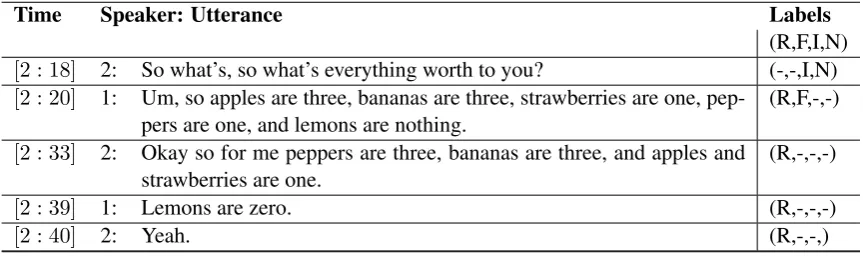
• in “cooperative” instructions they were told that they should try to maximize the joint gain with the other side of the negotiation. An ex-cerpt from a cooperative negotiation is shown in Table 11 in the Appendix.
• in “competitive” instructions they were told to try to get more points than the other party. An excerpt from a competitive negotiation is shown in Table 12 in the Appendix.
Out of the 41 interactions in the dataset 15 were competitive, 13 were individualistic and 13 were cooperative sessions.
2.2 Outcomes
The outcome of the negotiation in this case is mea-sured based on the calculation of the scores corsponding to the items that each negotiator has re-ceived by the end of the negotiation. In order to make the prediction of outcome possible based on our small dataset, we labeled the calculated score for each participant with one of the three labels: H,E or L, showing whether the participant had re-ceived more, equal or fewer points than the other person.
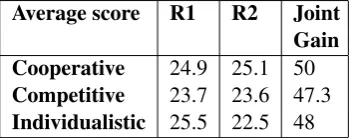
The goal of the “competitive” instructions was to get a higher score. For cooperative negotiations, the relative score did not matter. For the individu-alistic goal, higher score is somewhat correlated with the goal, but not absolutely (what matters is only an individual high score, not the relation to the other partner). 17 negotiations resulted in equal final scores for the two parties and 24 with one side scoring more than the other side. Ta-ble 2 shows the average scores for each restaurant, across the three types of goals. The scores are on average higher in the cooperative negotiations than in the other two conditions.
Average score R1 R2 Joint Gain Cooperative 24.9 25.1 50 Competitive 23.7 23.6 47.3 Individualistic 25.5 22.5 48
Table 2: Average Score by Restaurant and Goal
[image:2.595.328.505.592.661.2]average score for individuals who ended up in a tie (labeled as E) was 24.16.
2.3 Previous Work and Baseline System This data set was previously used for various pur-poses but (Nouri et al., 2013) was most similar to our current work in that it also tried to pre-dict the goal and outcome in the negotiation, us-ing a different set of features, and a slightly dif-ferent formulation of the problem. (Nouri et al., 2013) used multimodal features (such as acoustic features and sentiments of the turns) for this pur-pose. We use initiative-features to build our pre-diction models. In order to make a baseline classi-fier, we used the following automatically derivable features from (Nouri et al., 2013):
• The mean and standard deviation of acoustic features automatically extracted;
• The amount of silence and speaking time for each speaker;
• Sentiment (positive, negative) and subjectiv-ity scores calculated for words and turns
• number of words, turns, words per turn and words related to the negotiation objects
We used only features that were easily and au-tomatically derivable, excluding features from (Nouri et al., 2013) such as the number of offers and the number of rejections or acceptances.
3 Initiative Labeling
A common way of structuring dialogue is with Initiative-Response pairs, or IR units (Dahlb¨ack and J¨onsson, 1998), which are also similar to adja-cency pairs (Levinson, 1983), or simple exchange units (Sinclair and Coulthard, 1975). Several re-searchers have also proposed multiple levels of initiative. For example, (Whittaker and Stenton, 1988) had levels based on the type of utterance (commands, questions, assertions, and prompts). (Chu-Carroll and Brown, 1997) posit two levels of initiative: discourse initiative, attained by viding reasons for responses, and critiques of pro-posed plans, and task initiative, obtained by sug-gesting new tasks or plans. Linell et al. exam-ine several factors, such as initiative vs response, strength of initiative, adequacy of response, scope and focality of response (Linell et al., 1988). They end up with an ordered set of six possible strengths
of initiative. Each of these schemes is somewhat complicated by the fact that turns can consist of multiple basic elements.
Analyzing previous work, we can see that initia-tivebreaks down into two distinct concepts. First there is providing unsolicited, or optional, or ex-tra material, that is not a required response to a previous initiative. Second, there is the sense of putting a new discourse obligation (Traum and Allen, 1994) on a dialogue partner to respond. These two concepts often come together, such as for new questions or proposals that require some sort of response: they are both unsolicited and im-pose an obligation, which is why (Whittaker and Stenton, 1988) indicate that control should belong to the speaker of these utterances. However, it is also possible to have each one without the other. Statements can include new unsolicited material, without imposing an obligation to respond (other than the weak obligation to ground understand-ing of any contribution). Likewise, clarification questions impose new obligations on the other, but often do not contribute new material or are not optional, in that the responder can not reply ap-propriately without the clarification. For (Whit-taker and Stenton, 1988), the issue of whether a question or assertion was a “response” would determine whether control went to the speaker or remained with a previous speaker. On the other hand, (Narayanan et al., 2000) call a re-sponse that includes unsolicited material “mixed-initiative” rather than “system “mixed-initiative” for user responses that contain only prompted material.
Likewise, response can also be broken down into two related concepts. One concerns fulfilling obligations imposed by prior initiatives. To not do so could be considered rude and a violation of con-versational norms in some cases. This is only rel-evant, if there is an existing initiative-related obli-gation as part of the conversational state. Another concept generalizes the notion of response to any-thing that contributes to the same topic and makes an effort to relate to prior utterances by the other party, whether or not it fulfills an obligation or whether there even is a pending obligation. This is likerelevancein the sense of Sperber and Wil-son (Sperber and WilWil-son, 1986) and Lascarides and Asher (Asher and Lascarides, 2003).
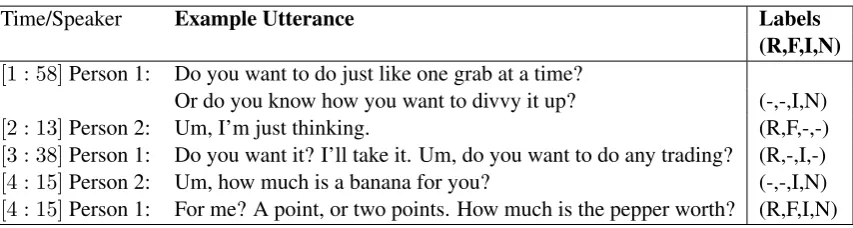
Time/Speaker Example Utterance Labels (R,F,I,N)
[1 : 58]Person 1: Do you want to do just like one grab at a time?
Or do you know how you want to divvy it up? (-,-,I,N)
[2 : 13]Person 2: Um, I’m just thinking. (R,F,-,-)
[3 : 38]Person 1: Do you want it? I’ll take it. Um, do you want to do any trading? (R,-,I,-)
[4 : 15]Person 2: Um, how much is a banana for you? (-,-,I,N)
[4 : 15]Person 1: For me? A point, or two points. How much is the pepper worth? (R,F,I,N) Table 3: Sample Annotated Utterances
Label Description
R directly relates to prior utterance F fulfills a pending discourse obligation I imposes a discourse obligation N provides new material that is optional
and not just fulfilling an obligation. Table 4: Initiative Labels
segment. The annotation is done on each turn on the conversation. In general, a turn can consist of almost any combination of these four initiative la-bels (I,R,F,N). We thus treat each of these as an independent binary dimension, and code each turn as to which set of these labels it contains. Table 3 shows an example from the corpus with initiative annotations. More examples can be found in the Appendix, Tables 11, 12, and 13.
3.1 Inter Annotator Reliability
To assess the reliability of our annotations, ap-proximately 10% of the dialogs (4 dialogs) were annotated by two annotators. The level of the agreement was then assessed using the Kappa statistic (Carletta, 1996; Siegel and Castellan, 1988). Table 5 shows the result of the assessment of the reliability of the annotations for the four an-notation labels.1 Based on this metric our results indicate that the annotators have reasonable level of agreement in labeling utterances with the I, F ,N labels, though there is less reliability for the “related” label. Further work is needed to clar-ify the degree of relation that should count and also whether relation refers just to the immediately prior turn or something further back. The remain-der of the dialogues were annotated by one anno-tator.
1Chance agreement is the probability of agreement using the frequencies of each label, but applied randomly.
R F I N
kappa 0.36 0.64 0.66 0.73
actual agreement 0.76 0.83 0.83 0.86 chance agreement 0.62 0.52 0.49 0.50
Table 5: Inter-Annotator Reliability Assessment
3.2 Initiative Taking Patterns
Table 6 shows the average frequency of each ini-tiative label for each negotiation goal. We can see that competitive dialogues have more turns that impose and fulfill obligations than the other con-ditions, while individualistic dialogues include a higher percentage of turns introducing new mate-rial.
Label R F I N
Cooperative 0.79 0.35 0.40 0.33 Competitive 0.82 0.38 0.47 0.34 Individualistic 0.82 0.34 0.39 0.40
Table 6: Comparison of the Relative Frequency of the Initiative Labels for Each Goal
Table 7 shows the relative frequency of initia-tive labels for the different outcome conditions. The higher scoring participants had a higher fre-quency of initiative-related turns (labels I and N), while their lower scoring partners had a higher fre-quency of responsive turns (R,F). Equal scoring participants tended to pattern closer to higher scor-ing participants, concernscor-ing responses, but closer to lower scoring participants, considering initia-tive.
3.3 Initiative Features
After the Initiative annotation was done, the fol-lowing features were automatically extracted:
Label R F I N H 0.80 0.35 0.47 0.38 E 0.81 0.35 0.40 0.34 L 0.84 0.38 0.43 0.36
Table 7: Comparison of the Relative Frequency of the Initiative Labels for Each Score Label
• the ratio, difference and absolute difference of the number of labels for each person against the number of labels for their nego-tiation counterpart
• the above measures normalized by the num-ber of turns in dialog
• Within-turn patternsthe number of all pos-sible combinations of labels for each utter-ance. There are 16 possible combinations for the 4 types of labels that can be shown as tu-ples (R,F,I,N). Refer to Table 5 for examtu-ples.
• Across-turn Patternsthe number of all pos-sible sequences of labels across two adjacent turns. There are also 16 possible combina-tions capturing how often each label is fol-lowed by labels. For example, the feature (I,F) applies to all two-turn sequences where the first turn contains label I and the second contains label F, such as in the last two lines of Figure 3. We count the these features for the dialogue and for each speaker.
All of the above features were automatically ex-tracted from the annotated dialogues. We exam-ined four different spans of the dialogues, to inves-tigate whether the most salient initiative informa-tion comes early in the dialogue or requires the full dialogue. We calculated features for the first quar-ter (q1), first half (q2), first three quarquar-ters (q3), and the whole negotiation (q4).
4 Prediction Models
We conducted experiments to recognize tion goal and score for each of the 82 negotia-tors. We made prediction models for recognizing the goal and outcome for each individual.For the prediction models, we compared the result of sup-port vector machine (SVM- with the polynomial kernel function) classifier, Naive Bayes and De-cision Tree. None of the classifiers outperformed the others on all cases, we are reporting the result
of SVM classifier here. Considering the size of our dataset which consists of 82 samples (41 pairs of individuals) and the distribution of the samples in different classes, we decided to use the 10-fold cross validation paradigm for our prediction tasks. In splitting the dataset into the folds we controlled so that the participants from the same negotiation were not split across training and test sets. We trained and tested at the end of the each quarter of the negotiation.
We used three sets of features to make three pre-diction models for each task:
1. Non-initiative features from (Nouri et al., 2013), described in section 2.3. We refer to these non-initiative features as IS2013’ from this point on.
2. Initiative features
3. All features combined.
We compare the performance of these models with two baseline prediction models: one that chooses one of the outcomes at random, and one that pre-dicts the majority class for all instances. In the upcoming sections, we use q1, q2, q3 and q4 to refer to the ends of the first, second, third and the forth quarters of the negotiation (e.g. q3 includes all data from the first three quarters, but not the last).
4.1 Automatic Prediction of Goal
This task predicts whether the negotiators are fol-lowing the cooperative, competitive or individual-istic instructions. It is important to note that none of the features used require understanding of the content or a semantic analysis of the conversation. However, using these basic features it’s possible to make the classification into the mentioned three classes with accuracy that is significantly higher than chance. The average accuracy of prediction at the four different points in the negotiation are shown in Table 8.
q1 q2 q3 q4
Random 0.33 0.33 0.33♣ 0.33♣
Majority 0.37 0.37 0.37♣ 0.37 IS2013 0.41 0.34 0.40♣ 0.48∗†
Initiative 0.29♣ 0.52∗†♣ 0.48∗† 0.29♣
Combined 0.41 0.40 0.57∗† 0.44∗
[image:5.595.306.526.643.729.2]We use the two-sided binomial test to measure the significance of the differences of the prediction models’ performances. Table 8 and the upcoming Tables 9 and 10 use symbols to indicate the results of these significance tests. Symbols (∗),(†) and (♣) show which models’ performances are signif-icantly different from the random baseline, major-ity baseline or the “Combined” classifier respec-tively (p <0.05).
The combined classifier is always better than both baselines, as well as the lower of classi-fiers for the IS2013 and Initiative features. In q3, where the two are close in performance, the combined classifier significantly outperforms both baselines and the IS2013 model. Note that ex-cept for q3, these numbers are lower than those reported by (Nouri et al., 2013). However the prior work did not ensure that both individuals in a ne-gotiation were in the same training/test partition, and some features are the same for both partici-pants. That work also made use of higher-level features, such as the offers, and final distributions of items.
4.2 Automatic Prediction of Outcome
In this task the goal is to predict how a partic-ipant in the negotiation is going to do in terms of the scores at the end of the negotiation. The model predicts whether the negotiator would score higher, lower or equal to the other player at the end of the different quarters of the negotiation. Results are shown in Table 9.
q1 q2 q3 q4
Random 0.33 0.33 0.33 0.33♣
[image:6.595.308.522.213.298.2]Majority 0.41 0.41 0.41 0.41 IS2013 0.43∗ 0.34 0.23∗†♣ 0.39 Initiative 0.37 0.35 0.32 0.39 Combined 0.38 0.40 0.41 0.4 6∗
Table 9: Accuracy of the Prediction of Outcome
Except for the combined model in q4, these models are not able to significantly outperform the baseline of selecting the random class (with equal likelihood). Results were also presented for out-come in (Nouri et al., 2013), however only the fi-nal quarter results are comparable, since that paper predicted interim quarter-end results rather than fi-nal results. Also, that work did not make sure that both participants in a negotiation were in the same training-test partitions, and used features related to
the final deal, that are directly related to outcome. Because the relative score was not important for cooperative negotiations, where both sides are just trying to maximize their combined points, we next examined outcome for the 28 pairs in individualis-tic and competitive conditions. Results are shown in table 10. The combined classifier outperforms all the other classifiers, starting from quarter 2. At the end of the negotiation(q4) the performance of this classifier is significantly better than all other models.
q1 q2 q3 q4
Random 0.33 0.33♣ 0.33♣ 0.33♣
Majority 0.38 0.38 0.38 0.38♣
IS2013 0.39 0.36♣ 0.36♣ 0.34♣
Initiative 0.27 0.41 0.36♣ 0.38♣
Combined 0.35 0.50∗ 0.50∗ 0.55∗†
Table 10: Accuracy of the Prediction of Outcome for Negotiations that are not Cooperative
5 Conclusion
We demonstrated how discourse initiatives in ne-gotiation dialog can be used for automatically making predictions about other aspects of the ne-gotiation such as the goals of the negotiators. Pre-vious work has mostly focused on using non-verbal cues for accomplishing similar tasks but they have not used discourse features like initia-tives. We also show that initiative features can give clues about the final outcome for the negotia-tors. Making such predictions are generally chal-lenging tasks even for humans and require under-standing of the content of the negotiations. From a dialog system’s perspective our results show how more information can be derived about the users intentions and performance by analyzing their dis-course behavior.
6 Future Work
[image:6.595.71.291.496.582.2]mod-els. We are interested in further analysis of the re-lationship between initiatives and other aspects of negotiation such as intentions and the use of lan-guage. We also want to measure the suitability of our annotation scheme for initiatives for other di-alogue genres.
Acknowledgments
We like to thank Kristina Striegnitz, Christopher Wienberg, Angela Nazarian and David DeVault for their help with this work. The effort described here has been sponsored by the US Army. Any opinions, content or information presented does not necessarily reflect the position or the policy of the United States Government, and no official endorsement should be inferred.
References
Nicholas Asher and Alex Lascarides. 2003. Logics of
Conversation. Cambridge University Press.
Michael Baker. 1994. A model for negotiation in teaching-learning dialogues.Journal of artificial in-telligence in education.
Jean Carletta. 1996. Assessing agreement on classi-fication tasks: the kappa statistic. Computational linguistics, 22(2):249–254.
Peter J Carnevale. 2013. Audio/video recordings of bi-lateral negotiations over synthetic objects on a table that vary in monetary value. Unpublished raw data. Jennifer Chu-Carroll and Michael K. Brown. 1997. Tracking initiative in collaborative dialogue inter-actions. InProceedings of the Thirty-Fifth Meet-ing of the Association for Computational LMeet-inguis- Linguis-tics, pages 262–270. Association for Computational Linguistics.
Nils Dahlb¨ack and Arne J¨onsson. 1998. A coding manual for the link¨oping dialogue model. unpub-lished manuscript.
Anthony Jameson, Bernhard Kipper, Alassane Ndi-aye, Ralph Sch¨afer, Joep Simons, Thomas Weis, and Detlev Zimmermann. 1994.Cooperating to be
non-cooperative: The dialog system PRACMA. Springer.
Sarit Kraus, Penina Hoz-Weiss, Jonathan Wilkenfeld, David R Andersen, and Amy Pate. 2008. Resolv-ing crises through automated bilateral negotiations.
Artificial Intelligence, 172(1):1–18.
Stephen C. Levinson. 1983. Pragmatics. Cambridge University Press.
Per Linell, Lennart Gustavsson, and P¨aivi Juvonen. 1988. Interactional dominance in dyadic communi-cation: a presentation of initiative-response analysis.
Linguistics, 26(3):415–442.
Shrikanth Narayanan, Giuseppe Di Fabbrizio, Can-dace A. Kamm, James Hubbell, Bruce Buntschuh, P. Ruscitti, and Jerry H. Wright. 2000. Effects of dialog initiative and multi-modal presentation strate-gies on large directory information access. In
IN-TERSPEECH, pages 636–639. ISCA.
Elnaz Nouri, Sunghyun Park, Stefan Scherer, Jonathan Gratch, Peter Carnevale, Louie Philippe Morency, and David Traum. 2013. Prediction of strategy and outcome as negotiation unfolds by using basic ver-bal and behavioral features. Inproceedings of the Interspeech conference.
Candace L. Sidner. 1994. An artificial discourse lan-guage for collaborative negotiation. InProceedings of the Fourteenth National Conference of the Amer-ican Association for Artificial Intelligence (AAAI-94), pages 814–819.
S. Siegel and N. J. Castellan. 1988. Nonparamet-ric statistics for the Behavioral Sciences. McGraw-Hill, 2nd edition.
J. M. Sinclair and R. M. Coulthard. 1975. Towards an analysis of Discourse: The English used by teachers and pupils.Oxford University Press.
Dan Sperber and Deirdre Wilson. 1986. Relevence:
Communication and Cognition. Harvard University
Press.
David R. Traum and James F. Allen. 1994. Discourse obligations in dialogue processing. InProceedings
of the 32nd Annual Meeting of the Association for
Computational Linguistics, pages 1–8.
David Traum, Stacy C Marsella, Jonathan Gratch, Jina Lee, and Arno Hartholt. 2008. Multi-party, multi-issue, multi-strategy negotiation for multi-modal virtual agents. InIntelligent Virtual Agents, pages 117–130. Springer.
Marilyn Walker and Steve Whittaker. 1990. Mixed ini-tiative in dialogue: An investigation into discourse segmentation. InProceedings of the 28th annual meeting on Association for Computational Linguis-tics, pages 70–78. Association for Computational Linguistics.
Richard E Walton and Robert B McKersie. 1991. A behavioral theory of labor negotiations: An analysis of a social interaction system. Cornell University Press.
Steve Whittaker and Phil Stenton. 1988. Cues and control in expert-client dialogues. In Proceedings
ACL-88, pages 123–130.
Appendix: Sample Annotated Negotiations
Time Speaker: Utterance Labels (R,F,I,N)
[2 : 18] 2: So what’s, so what’s everything worth to you? (-,-,I,N)
[2 : 20] 1: Um, so apples are three, bananas are three, strawberries are one,
pep-pers are one, and lemons are nothing. (R,F,-,-)
[2 : 33] 2: Okay so for me peppers are three, bananas are three, and apples and
strawberries are one. (R,-,-,-)
[2 : 39] 1: Lemons are zero. (R,-,-,-)
[2 : 40] 2: Yeah. (R,-,-,)
Table 11: Sample Annotated Cooperative Negotiation
Time Speaker: Utterance Labels
[1 : 40] 2: So, I think I need peppers and bananas for my restaurant. (-,-,-,N)
[1 : 46] 1: Okay. Um, well I really need. I want five apples and um, five bananas.
Five apples and five bananas. (R,-,I,N)
[2 : 05] 2: Um, how about this: You take five apples, and I take five peppers and
we can share the bananas. (R,F,I,N)
[2 : 13] 1: Okay. If I give you, if I give you five or if I give you, if we were to
share the bananas, if I take three bananas, I’ll give you three lemons. (R,F,I,N)
[2 : 23] 2: But we don’t need lemons in our restaurant. We only use lemons for
our store. (R,F,-,N)
[2 : 27] 1: Okay. So, um, I need bananas, like that’s gonna be my top. (R,-,-,N) Table 12: Sample Annotated Competitive Negotiation
Time Speaker: Utterance Labels
[3 : 22] 2: How about we do this. You take two of these, I take one, and since we
have five here, I take three, you take two. (-,F,I,N)
[3 : 37] 1: I’m not interested in lemons at all. But I can give you... (R,F,-,N)
[3 : 52] 2: At my restaurant, one of our dessert dishes is with strawberries, so
strawberries are very important to me. (-,-,-,N)
[4 : 00] 1: Okay. I’m willing to give you all the strawberries if you give me a
banana and two apples. I’m also willing to give you these two. (R,-,-,N)
[4 : 23] 2: So you’re going to give me those two? (R,-,I,-)
[4 : 24] 1: You can have everything on this side, I just want two apples and a
banana. (R,F,-,-)
[4 : 30] 2: Two apples and a banana? Yeah, let’s go. (R,-,-,-)
[4 : 39] 1: We have a deal. (R,F,-,N)