University of Southampton Research Repository
ePrints Soton
Copyright © and Moral Rights for this thesis are retained by the author and/or other
copyright owners. A copy can be downloaded for personal non-commercial
research or study, without prior permission or charge. This thesis cannot be
reproduced or quoted extensively from without first obtaining permission in writing
from the copyright holder/s. The content must not be changed in any way or sold
commercially in any format or medium without the formal permission of the
copyright holders.
When referring to this work, full bibliographic details including the author, title,
awarding institution and date of the thesis must be given e.g.
AUTHOR (year of submission) "Full thesis title", University of Southampton, name
of the University School or Department, PhD Thesis, pagination
A TAXOMOMIO STUDY OF COMP05ITAE W I T E S M K O A I ,
R B F Q B a M B T O i O D n O I O
b y
DaTicL G e o f f r o y D r u r y
Subnlttad. for the Degree of
Dootor of Philosophy
U n i v e r s i t y of Southampton
Departmont of Botany
(i) 00T3TBI7T5
PagG
SBCTIOn I. . . . . 1
Ssnecio the olasBification of Oonpositae . 2
The present inv5 5tiga,tio]i . . . 5
SECTION I I . M A T E R I A L S ABO KETEODS . . . 7
Pli,nt material . . * . » 8
M e t h o d s . . . . * * 8
Stem seotions , . « . . 9
F l o r a l parte md. loaves . , » 9 P o l l o n preparations . . . . 10
SEOTIOM III. o%aaM%a'iam3 . . . . 12
Stomata . . . . * « 13
F o l i a r triohomeo . . , . . 13
Pith . . • • • • 14
Seoondcry aylem . . . . . 14
V e s o e l flistrilrAtion . . . . 14
T e B s e l size . . . . * 3^
Ray width . . . . « 19
Interfasoioular cambium . . . .
Phloem . . . . ' ' 20
Cortex . . . . . « 21
Resin camals in Gtems . . . . 21
(il)
. . . , * " 24
Oryetal forma . . , « « 24
Distribution of types , . . . 2?
.Achanial hairs . , , . *
Oarbonaoeous layor . , . « 29
Pa^^uG , « , . * » 30
tailc . « « « * 33
Filamont oollar . . . « . 36
F i b r o u s layer . , , , * 37
P o l l e n . . . . * ' 3^
Bby florets . . . . « 39
OrosM mor^iology . . , . . 41
Sununary of rocor<ied. ob'^ervations . . 4 4 P E O C K K H M G T E B I W T A . . . 47 Hierarchical interpretation of the data . 48
Computational methods . . . . 49
The ]3ro,g;ramne 'Multist* . . . . 50
The 'Multist^ hierarchy of Oonposit.ie . . 54 8BOTIOF V . I J T T m P B E T i m T E E i n B R A R O B T IF T E E POBM OP A
CMSSIPICATIOIT . . . . . 56
Extracting a olaBsification . , , 57
Detecting errors . . . . . 59
(ill)
Evidenoe in support of the nev olassifioation ,
G r o u p s and SubgroupB . . * 77
G e o g r ^ ^ ^ . . ' ' * 77
Cytology . . . ' ' 79
Habit . . " ' '
Eglandular h a i r type . . . 62
M y c o l o g y . . . » « ^5
Palynology . . . « « 86
jBmbryology , , . . » 88
Genera . , , . « »
Senecio . . . * « 91
Oa,oalia . . , » « 97
Olearia , . , . « 9 8
OBteospermum , « . « 99
Conclusion . , . , , .
A C B K M i a M H & m M T S . . . . . 102
. . . . . ' 103
APPEM)IX I . C O M N U U T m B O B S E M N M ^ O m S A S E & X % m E D
. . . . . Ill
jUMMBIKCX I I . S O M E F B A m i a B S CEARAOTBRISTIO OF GBOUPS
SECTION I
8ENECI0 A N D THE CLASSIFICATION OF COMPOSITAB
Senecio is the largest angiosperm genus, taking in about of all Compositae and exhibiting nearly the whole range of vegetative diversity encompassed by the family. There is
satisfactory definition of th^ genus, and the oft-quoted 'diagnostic' features are commonly lacking, especially among extra-european species. In fact, in the Genera PIantarum of Bentham and Hooker, the diagnosis of Senecio is essentially the same as that of the tribe Senecionideae. It is a commentary on taxonomic progress that the only comprehensive account is that of De Candolle (1837), although since his time the number of named Senecio species has increased fourfold. Clearly a reappraisal of the taxonomy of Senecio and of its relationships with other Compositae is long overdue.
Regarding the classification of Compositae, one finds that despite nama changes the tribes have altered very little since their delimitation and establishment by Cassini (1816-34-).
This is remarkable because the largest angiosperm family, taking in about ^/lO of the flowering plants, would seem to provide plenty of scope for discordant taxonomic opinion. Nevertheless Table 1 shows that of tha 13 tribes recognised by Bentham (I873A), seven (i.e. 2, 3, 6, 7, 9, 10 and I3) are identical w i t h or
2 of Cassini's tribes ( i . e . l Z a n d S K ) had suffered significant
changes.
TABLE 1 : Tribes of Bentham compared with those of Cassini. The fractions in parenthesis are the number of genera in which the schemes correspond / the number of genera (known to both authors) in Cassini's tribe.
Coincidence of Bentham's subtribes with Cassini's tribes is indicated by asterisks.
Tribes (Benth&m 1873)
Tribes
(Cassini 1826-34)
1.
Vernoniaceae (28/50)2 .
Eupatoriaceae 1 9 (18/19)3.
Asteroideae (59/61)4 .
Inuloideae 12 (85/96), . 20 (10/50)5.
Helianthoideae 9 (116/134) , 10 (4/4)*6.
Helenioideae 8 (14/14)7.
Anthemideae 1 1 (41/47)8 .
Senecionideae 1 1 (34/34)*, .17 (3/3)*, 1 8 (5/6)*9 .
Calendulaceae1
(8/9)10. Arctotideae
6
(18/19)11,
Cynaroideae2
(21/36)*, 1 (41/41), 4 (31/31), i (1/1)The classification in current usage is that of H o f f m a n n
(1894); but apart from relatively trivial (usually deleterious) changes it differs from Bentham's scheme only in nomenclature, and the original has proved better for purposes of reference.
Cassini's evolutionary speculation (he designated one section of each trice the 'prototype or archetype' aad produced a map of intertribal relationships not far removed from recent
'phylogenetic' schemesi) reveals tha^ he w a s well ahead of his time; but his approach to plant classification is primitive and bizarre when viewed from the twentieth century. In any case he accepted the dictum that floral characters are the only reliable indicators of taxonomic affinity, and classified not Compositae, but florets.
His successors appear to ha^^ accepted the main outlines of his classification without bringing m u c h original thinking to bear on them. Thus, Bentham's scheme (i.e. the current one) took in more genera but few additional characters. Since the nineteenth century taxonomists have considered Compositae mainly from the floristic standpoint, allowing geographical and political considerations, coupled with the accepted taxonomic system, to govern their choice of material. ]%ie test of time, which Cassini's taxonomy has withstood, has been very stringent.
are available across accepted groupings (e.g. palynology, Stix I96O; cytology, Ornduff et al 1963; anatomy, Dormer 1962B and Carlquist 1957-64), they are generally inconsistent with them; but the authors concerned have rarely investigated fully the taxonomic implications of their work and few (with the exception of Dormer; see also Drury aad Watson I966) have drawn this conclusion.
THE PRESENT INVESTIGATION
In investigating the taxonomy of Senecio in the context of Compositae as a whole, the need is for comparative observations recorded for a large cosmopolitan sample. My sample is
inevitably small relative to the siz# of the problem; but it cuts across the artificial boundaries referable to political geography and 'established' taxonomic groups.
Taxonomic'characters' are difficult if not impossible to define satisfactorily. The fundamental problem is that we have no means of judging to what extent the occurrence of a single
observed feature is likely to provide a measure of overall
record comparative observations on various parts of plants, look
for correlations to define groups and test these in the light of additional information. In view of the crudity of the method, it seems desirable to use the largest possible number of
'characters' in the hope of masking errors. It is reasoiiaole
to seek features which are: (i) conveniently delimited, so that independent observers using the saae definitions should recognise the same pattern of variation in the same range of plants, and (ii) easily observable without elaborate preparation of the material. In practice I hew^ recorded comprehensively only those 'characters' where preliminary observations suggested that they might prove profitable.
SECTION II
PLANT MATERIAL
111 examining a world sample of any group as largo as
Compositao, it is necessary to uno herbarium material, However dried speciBens, despite their limitations, can provide an adequate source of taxonomic information; for it is not tk^ discovery of variations which is the major problem, but tnu task of recording them for a sufficiently wide range of material. It is not possible to ootain maberial for
anatomical studies from most of the major herbaria, and for this reason Compositae from th^ southern hemisphere (especially South A m e r i c a ) are loss well represented in my lists thu,n I would have liked. Nevertheless the sample is a eosinopolitu.n
one, and I stress my indebtedness to the Keepers of the H e r b a r i a at Cambridge, Manchester and Oxford who loaned me specimens.
M E T H O D S
Pew anatomists make comparative observations o n a
sufficiently large scale to impress taxonomists; and for some reason most taxonomists make no attempt to record anatomicu.1 observations. Thus numerous readily observable variations have escaped taxonomic u s e . The fact is that w i t h the aid of
dissecting instruments, a ra*or and a good microscope, it is often 'Easier to elucidate the structure of, say, the pith thu.n to discover the ovary-locule number. By employing the simple techniques outlined below, I have b e e n able to make large numbers
stem emotions
Samples including nodes woro removed from mature aerial parts of specimens, surgery being carried out in such a way as to cause minimal damage to specimens. The samples wore
resuscitated by boiling in water with 'Tecpol' for 20 minutes. i&DiM use was inade of temporary preparations using phloroglucinol and HCl, and occasionally it was necessary to resort to the sledge microtome; but sections were mostly cut by hand in water aad permanently double stained in the following way:
1. Transfer sections to 5 0 % alcohol.
2. Stain in 1% safranin in alcohol (5-10 minutes depending on material).
Rinse in 5 C # alcohol to remove excess safranin. 4 . Transfer to 1% picro-aniline blue, 'drown* and
return to 5 0 % alcohol (picro-aniline blue hc^ the advantage of rapidly removing any remaining excess of safranin).
5. Dehydrate in absolute alcohol. 6. Clear in clovo oil.
Return to absolute alcohol and mount in *Euparal'. Floral parts and loaves
10
Rocuscitated florets, opened by splitting down ons side, were mounted in lactic acid. After warming to accclGrate clo^rinb^ the preparations wore covorad with glass slips. Achenos (complete with pappus) were also mounted in lactic acid and crushcd by putting prcssuro on the covorslip. Florets and achonos demanding more drastic trcatnont were first bloachad with chloral hydrate or nascent chlorinc before mounting in the lactic acid.
av2.G
Thaso wore bont troatod with lactic acid without prior resuscitation, sincu that proccos led to difficulties in interpreting stomatal structure. Where leaf hairs formed a dunse mat, it w a s found more convenient to examine them in a dctachod state; but where a leaf was norely pubescent or sjominK^y glabrous, an epidermal preparation was examined for
. ions nail
Polloi
Semi-pormc.nent pollen slides wore prepared in the following way:
1. Place 2-^ young florets, with achanes and pappus removed, on a slide together with 1 drop of 5 ^ KOH. 2. Warm gently over a spirit lamp and macerate the
_ 11 _
3. Remove the l&rgjr fragments cmd oxCGSS KOH, 4 . Add 1-2 drops of molted glycerine jolly to the
pollen remaining on the slide.
5. To stain, stir the suspension with c needle freshly dipped in aquaous safranin.
«" 12 —
SECTION III
13 -STOMATA
Regarding the arrangement of subsidiary cells associated with stomata on the abaxial leaf surface, only two of the angiosperm variants described by Metcalfe an^ Chalk (1950), anomocytic amd anisocytic, occur in my sample of Compositae, The anomocytic state is the mmet widespread; but it seems likely that this condition could be further subdivided, for the precise number of cells and associated wall patterns vary greatly. Anisocytic stomata (not previously recorded for the family) seem to be restricted to A f r i c a n succulents (e.g. Kleinia, Othonna and certain Senecio species).
FOLIAR TRICHOMES
It was probably the apparent uniformity of the floral parts which led early workers (e.g. Archer 1860 and Hayek 1915) to employ variation in foliar trichomes to help them classify Compositae. However such studies were limited to a very few genera (e.g. Olearia and Senecio section Tephroseris).
Although a number of catalogues of hair types for Compositae have appeared (Solereder 1899, Metcalfe and C h a l k 1950 and Ramayya 1962), I know of only one attempt (Stebbins 1953) to assimilate information of this kind into wider aspects of the taxonomy of the family.
14"
comparative information for a range of species in the time available was to confine my attentions to one part, I chose, arbitrarily, the mld-lamlnar region of the abaxial surface. Leaves were recorded as glabrous only when hairs could not be found after an intensive microscopic examination. By
comparing drawings of hairs, 3 glandular and 1$ eglandular types were characterised. Some plants (e.g. Aster tataricus) bear leaves with more than one hair type in the abaxial m i d -laminar region and here all forms present were recorded. The 18 hair types are conveniently described and distinguished by presenting illustrations (fig. lA-R) and a dichotomous key.
PITH
Pith structure is markedly variable in the family. Som.e species have lignified pith parenchyma while others do not; and occasionally one encounters sclereids scattered in an unlignified m e d u l l a . A feature of man# north temperate herbaceous Senecionideae is a tendency for the pith to break down, so that the aerial stem may be completely fistulose.
SECONDARY XYLBM
There is a striking diversity in the distribution and size of xylom vessel elements and thore is further variation in the structure of rays as seen in transverse stem sections. V e s s e l distribution
15
FIGURE 1. Leaf hairs
lA-0 are the 1$ eglandular hair types, A B E - 0 (X 50), CD (X 55). IP-R are the 3 glandular hair types, P (X 150),
— l 6 —
DICHOTOMOUS KEY TO HAIR TYPES
The
1.
2.
3.
4 .
letters correspond with the illustrations A — R in figure
Terminal cells filled with oily contents, hair often
capitate ' ' ' '
Terminal cells vacuous, hair never capitate Hair uniseriate
Hair biseriate.
5.
S.
7.8.
9.10.
11.
12.
13. 14. 15. l6 • 17.Hair with (1) —2—3(""^) snail basal cells surmounted by a uni- or multicellular appendage, . . . . Hair without distinct basal cells, often tapering into
uni- or multicellular flagellura. . . . . Glandular head sub-sessile, with a membranous
envelope containing oil. . . . • _ • Glandular head borne on a column of cells, without a
m e m b r a n o u s envelope containing oil. Appendage unicellular. . • -Appendage multicellular
Cells increasing in length and tapering towards the
apex to form a flagellura •
Cells all approximately the same length (occasionally with an abortive terminal cell), i.e. hairs non-fl age 11 ate
Appendage attached to basal cells obliquely. . • Appendage attached to basal cells horizontally. Cells of appendage joined to one another obliquely. Cells of appendage joined to one another horizontally. Distal 2 or 3 cells attached to each other obliquely. Distal 2 or 3 cells attached to each other horizontally Hair tapering towards the apex, usually relatively
thick-walled.
Hair not tapering towards the apex, usually
thin-walled. . . . . . .
Appendage unbranched. . . . . Appendage branched
Hair tapering gradually towards the apex, tipped by a thread representing an abortive cell.
Hair tapering gradually towards the apex, tipped by l-2(-3) greatly elongated cells.
Terminal cell abortive and thread-like. Terminal cell complete and prominent. Hair T-shaped.
Hair stellate.
Terminal only cell markedly elongate. . Distal 2-3 cells markedly elongate. Apical cell rounded
Apical cell sharply pointed.
Basal cells thin-walled; arms of appendage thick-walled and at right-angles to basal cells. Basal cells thick-walled; arms of appendage
thin-walled and not at right angles to basal cells.
1.
2 3 Q 4 5 P R 78
10
A 11 L H J . 1 217
-trial and error into the following 10 recognisable classes. A given species usually falls unambiguously into on^ or other of these classes; but species exhibiting intermediate
conditions were scored for both,
1. Many of the v e s s e l s arranged radially in groups of 2 and 3, rarely solitary (fig. 2A).
2. Vessels usually solitary, scattered 1 evenly
throughout the wood; occasionally in radial pairs
(fig. 2B).
3. V e s s e l s commonly in long radial rows of 5 or more elements (fig. 2C).
4 . V e s s e l s in dense concentric bands (i.e. rir^ porous,
fig. 2D).
5. Vessels in radial rows of 3 or more cells long, interspersed with diagonal pairs and clusters of 3-5 elements (fig. 2B).
6. V e s s e l s in narrow radial blocks of 2-3 cells wide, the rows within the blocks interrupted and the blocks themselves separated by wide bands of fibres (fig, 2F). This condition is distinguished from 9 by the absence of segmentation of the xylem cylinder.
[image:23.541.109.504.163.694.2]18
FIGURE 2: V e s s e l distribution patterns in transverse stem sections (not to scale)
Figures 2A - H represent vessel patterns 1 - 8 rospoctively.
Figure 21 represents vessel pattern 9 aad shows one segment of xylem cylinder containing vessel elements.
d
0 ^
6
C
o
%
eg
%
o
8
9
%
56
S
— 13 "™
8 . V e s s e l s in scattered, tangential bands, 4—8 cells wide and 1-3 cells deep (fig. 2H).
9. Xylem cylinder segmented, with alternate segments containing fibres only. Within the vessel segments, vessels arranged as in 6 but the radial rows closer
(fig. 21).
10. V e s s e l s indistinguishable from th^ fibres in transverse section.
Vessel size
Since some of the species are r i n ^ porous, it would have been misleading to employ the means of diameters of vessels for taxonomic purposes. It seemed more reasonable to allow variation in the maximum vessel diameter to represent this aspect of the diversity among the species. The widest element was selected, for each species, from a random low power view (X 100) of a transverse stem section. Micrometer values were ordered and recorded under six arbitrary groups; for comparative purposes there was no need to convert them to an absolute scale.
Ray width
- 2 0
-r e c o -r d e d . In general, narrow r a y s are characteristic of
Bentham's Microchaete, Euryops ai^ some ericoid Senecio species, while wide rays are a feature of suffrutescent succulents and many herbaceous Senecio species with auricled sessile leaves.
INTERFASCICULAR CAMBIUM
Habit details such as overall size, presence or absence of rhizomes etc., w h i c h constitute some of the most conspicuous features of growing plants, are rarely given on herbarium sheets and canaot be safely deduced from the specimens. However, it is practicable to determine whether or not the aerial parts possess an interfascicular cambium. It is worth pointing out that a distinction based on this feature is not equivalent to the usual arbitrary separation into annuals, biennials and perennials. For example, it results in placing Senecio vulgaris (an annual with an interfascicular cambium) alongside shrubby plants; but this is not unreasonable in view of the fundamental significance of interfascicular cambium in determining the gross morphological potential of the plant.
PHLOEM
— 2 1 ~
horaogenGous r e g i o n s
with the fibres
c o n f i n e d
to the
p e r i p h e r y
of the vascular cylinder.
Certain frutescent Compositae have the fibre blocks linked one with another by slender uniseriate bridges of sclereids. These are readily distinguished from phloem fibres by their elongated-rectang^ilar transverse section as well as their simple pitting and brighter red coloration when stained in safranin. Such 'joining sclereids' may occur associated with either of the two fibre patterns.
CORTEX
The stem cortex of Compositae is notable for its
consistency. Besides the presence or absence of resin canals (see b e l o w ) the only attribute I found to record w a s the
presence or absence of isolated or grouped sclereids. These can be distinguished from joining sclereids by their more or
less isodiametric aspect in transverse section, and in ths^ they are never contiguous with th^ phloem fibres.
RESIN CANALS IN STEMS
Col (1894-1904) demonstrated tho^ resin canals in Compositae originate schizogenously and tabulated data on resin canal position in a raage of genera. He recognised three patterns of distribution, defined on the positions relative to the vascular bundles ("adpoj^se", "latero-dorsal"
— 2 2 "
to distinguish three additional types.
1. Cortical canals, spaced regularly in a ring in the mid-cortical region. Their position bears no obvious relation to that of the vascular bundles (uncommon).
2. Endodermal canals adjacent to the blocks of phloem fibres ("adpoyse" of Col, widespread).
2. Bndodermal canals between the blocks of phloem fibres (i.e. confined to species with homogeneous blocks of phloem fibres; including both "latero-dorsal" and "interpose" of Col, w h i c h seem indistinguishable; infrequent).
4 . Canals within the phloem (only in Senecio hartwegii). 5. Pith canals, appearing in one or two concentric
rings (uncommon). The canals of the inner ring or the single ring always develop opposite the
protoxylem points. The m e m b e r s of the outer ring, if present, usually alternate with the canals of the inner ring.
Col's statement that resin canals are absent from the aerial parts of the Vernoniaceae is incorrect; actually they do occur in some of these plants (e.g. Chresta spp.), in the cortex and associated v;ith the phloem fibres. This fact seriously
23
-NODAL CONFIGURATION
Despite the paucity of records, the complete range of nodal configurations recognised by Sinnott (1914) has already been demonstrated in Compositae (multilacunar, Dormer 1950; trilacunar and unilacunar, Solbrig I96I); but taxonomists have failed to take account of this diversity. I hsnre recorded nodal types under four headings as follows:
1. Unilacunar, characterised by one foliar trace and one gap in the stele. Confined in Compositae to certain shrubby species (e.g. Olearia ramulosa Senecio cassinioides) having small leaves with recurved margins.
2. Trilacunar, where three leaf traces leznre three (a widespread condition in Compositae).
3. Multilacunar, in which many traces leave a
corresponding number of gaps; often associated with the scapigerous habit of herbaceous Compositae in the northern hemisphere.
— 24- —
CRYSTALS
There is little information available on the structure, chemical composition and development of crystalline cellular inclusions. In fact Dormer's recent (I96I) critical account of calcium oxalate crystals in certain Compositae is a landmark, although Dormer himself made it clear tha± his investigation w a s merely preliminary. Anatomists, following Sachs
(1875),
De Bary(1884)
and Haberlandt(1914),
generally recognise five crystal categories for calcium oxalate: (i) crystal saad, (ii) druses, (iii) raphides, (iv) individual angular crystals, (v) sphaerocrystals. Dormer's detailed work concerns only two of these categories, namely druses and individual angular crystals; but he found it necessary to subdivide the latter into (a) isodiametric crystals, (b) hexagonal crystals, (c) curvilinear crystals, (d) plate crystals.Crystal forms
Seven crystal types are distinguishable in the Compositae of the present sample. Of those listed below, types 5 6 are traditional categories, type 4 has already been described by Dormer (I96I) and type 7 is new. Types 1, 2 and 3
— 25
1. Elongate hexagonal crystals with a length/breadth ratio of 6 or moro, and. flat in side view (fig. 3)* 2. Isodiametric crystals, with a longth/breadth ratio
of between 1-1.$, and flat in side view; not to be confused with the 4-sided isodiametric type described for Onopordon and Arctium by Dormer (fig. 6).
3. Intermediate hexagonal crystals with a length/breadth ratio between types 1 2 (fig. 4). In certain
species (e.g. Geneclo vulgaris) it is not uncommon to find them with truncate or rounded ends (fig. 5)« 4. Curvilinear crystals in face view exhibit smoothly
curved sides meeting to produce similar apices (fig. 9A and 9C). Forms narrower in face view and with dissimilar apices are described for Centaurea by Dormer (1962A). In side view they vary from
square to rectangular (fig. 9B and 9C).
5. Druses, conglomerate or cluster crystals, are ^ spherical aggregations of small angular crystals (fig, 10), structurally comparable with those of Carthamus (Dormer 1^61).
6. Raphides, (fig. 8),
7. Crystal mixture: the achene wall of certain Vernoniaceae contain a characteristic mixture of
26
FIGURES 3 - 10. Crystal forms
Figure ]. Inula helenium, elongate hexagonal crystal from achene wall, X 2525'
Figure 4 . Senecio gregoril, intermediate hexagonal crystal with pointed ends from ovary wall, X 600.
Figure 5. genecio vulgaris, intermediate hexagonal crystals with truncate ends from the ovary wall, X 700. Figure 6. genecio cernuus, isodiametric ovarian crystals
X 2300.
Figure 7. Albertinia eleagnus, crystal mixture. 7a aind /b. Individual crystals, both X 2800, 7c As seen in achene wall, X 1250.
Figure 8. Solidago sempervirens, raphides in pith cell,
X 1300.
Figure 9. Ligularia stenocephala, curvilinear crystals. 9a. In face view, X 1200.
9b. In side view, X 1200.
9c. As seen in ovary wall, X 65O,
27
-short in face view and. broadLly reotangular in aide
v i e w (fig. 7A, TB an& 70). Distribution of the ty^es
Crystals abound, in the ovary and. achone walls and. also appear occasionally in stamen filaments, styles, epid.8rmal cells of ray and. d.i80 corolla, in the pith and in the stem cortex. One u s u a l l y find.8 that in a given species, crystals
one
v a r y in form fromj^morphological region to another. It was practical to record, only those found, in ovary, achene and. pith.
I n the ovary, crystal types 1, 2, 3, 4 5 oan occur singly, although types 4 m-nd. 5 are frequently associated.. However it is u n c o m m o n to find, types 1, 2 and. 3 miaad. with types 4 and. 5. A c h e n i a l crystals when present seem to show less v a r i a t i o n and. are limited, to types 1, 4, 5 6. Types 1 and. 6 always occur singly, vhile 4 5 can he present
together. Types 2, 4, 5 ^.nd. 6 have all been found, in the pith parenchyma, but always singly.
ACEENIAI, E A I R 5
- 2 8
-FIGURES 11 - 16
Figures 11, 12, 15 smd 16. ^ Illustrations of achenial hairs Figure 11. Arnica montaaa, thick-walled type with apices of
duplex cells diverging and pointed, X 400. Figure 12. Senecio vulgaris, thin-walled type with apices
of duplex cells appressed and rounded, X 900. Figure 1$. Senecio gregorii, tip of hair showing the
spiral nature of contents in duplex cells, X 1800.
Figure 16. Senecio vulgaris, tip of hair showing exuded spiral, apparently contained in a sheath (only one duplex cell in focus), X 950.
Figures 13 aad 14. Illustrations of 'carbonaceous' layer Figure 13. Arnica montana, transverse section of mature
achene showing the sub-epidermal origin of the carbonaceous layer, X 450.
— 29 "
1. Hairs with duplex cells thick—walled frequently pitted, their apices sharply pointed and diverging (common in the 4steroideae aad Vernoniaceae, fig. 11)-2. Hairs with duplex cells thin-walled, without marked
pitting a#d with rounded appressed apices (common in the Senecionideae, fig. 12 and 15).
To these distinguishing features I tentatively add another, Maclowskie showed that in seme cases th^ contents of the duplex
cells ultimately assume the form of spirals (fig. 15) which are extruded under wet conditions (fig. 16). There has been scm# speculation regarding the functional significance of this curious phenomenon (Green 1964). It seems in fact to be confined to those achenial hairs of my type 2; for I have observed it in about 7 W ' of the species under t h i s heading, but never in species with the thick-walled hairs of type 1.
'CARBONACEOUS LAYER'
During the maturation of the achenes of certain species, brown substances appear sub-epidermally (fig. 15) as small amorphous particles distributed irregularly just below the insertion of the pappus. At a later stage the entire achenial surface between the ribs assumes a black-brown mottled
30
-suggests that it probably consists of the polyphenol, melanin. This so called 'carbonaceous' layer is manifest throughout tne tribes Helianthoideae, Helenioideae and in nKxst of the
Eupatoriaceae seen by me as well as in occasional genera of Vernoniaceae and Senecionideae. Here I ha^re simply recorded
its presence or absence for every species examined.
PAPPUS
Taxonomic descriptions of pappus are invariably crude and empirical. Terms like setose, pilose, paleaceous,
coroniform and aristate, stabilized by Cassini (1816-^0), are still in use. species considered here sure mostly setose, but nevertheless there is manifest variation a#^ng them in pappus construction (Drury and Watson 1965). For the purposes
31
FIGURES 17 - 19. P a p p u s structure
Figures 17a-c
17a
17b 17c Figure 17d
Figures I8a-c
18a
18b
18c
Figures 19a-c 19a
13b
19c Figure 19d
Senecio bidwillii, clubbed pappus bristle,
X 30,
Apical region showing swollen cells crowded together.
Portion of middle region. Portion of basal region.
Microchaete glabrata, apical region of clubbed pappus bristle, the swollen cells not crowded together, X jKL
Senecio rigidus, ordinary pappus bristle, X 4 0 .
Apical r e g i o n .
Portion of middle region. Portion of basal region.
Senecio rigidus, fluked pappus hair, X Apical region.
Portion of filamentous middle region. Portion of basal region.
32
TABLE 2: Comparison of pappus types.
CLUBBED ORDINARY FLUKED
Hairs consisting entirely of thlck-walled cells, their lumlna relatively w i d e .
2. Hairs not taper-ing from the middle region to the apex.
3. Cells in tha middle apical
regions having their upper ends produced to form external elong-ations or spines. 4 . Cells of the
distal region swollen and crowded together to form a head.
Hairs consisting entirely of thick walled cells, their lumina relatively w i d e .
Hairs gradually tapering from the middle region to the apex.
Cells in the middle and apical regions having their upper ends produced to form external elong-ations or spines. Cells of the distal region not swollen and
crowded together.
Hairs with cells of the middle region thin-walled and filamentous, their lumina relatively narrow.
H a i r s ; n o b
tapering from the middle region to the apex.
Cells in tl^ middle apical regions having their lower ends produced to form external elongations or spines.
Cells of tlm distal region swollen and crowded together to form a head.
5 . Hairs r i g i d . 6. Hairs detaching
easily when achene mature.
Hairs rigid. Hairs detaching easily when achene mature.
33
-Pappus bristles in most of th^ setose species seen by me are of the ordinary type. However, in some members of the genus Senecio (e.g. Senecio vulRaris), the bristles of individual achenes fall into two morphological categories. Here, the majority are of the ordinary kind, but restricted to one region on the outer of the two irregular pappus whorls are 5 - 1 0 fluked hairs. Clubbed hairs are not normally found mixed with the other forms, but genecio quinquelobus is
exceptional in having a mixture of both cluboed and fluked hairs. In the present sample of Compositae clubbed bristles are confined to certain representatives of the Asteroideae (e.g. Olearia rani) and Senecionideae (e.g. Senecio bidwillii).
ANTHER TAILS
Certain appendages associated with the base of the pollen-sac, the so-called 'tails' (caudae) and the 'auricles', have been considered important characters in classifying Compositae ever since their presence and distribution were brought into prominence by Cassini (1826 et seq.). Lessing (I832) often employed them for diagnostic purposes and De Candolle (I836) used the presence of tails to help characterise the
3 4
-distinctions using herbarium material and chosen to ignore them. It is astonishing that during the long history
of its usage, there has been no endeavour to define the
meaning of the expression "anthers tailed"; and th^ morphological relationship between tails and auricles has been persistently overlooked. It has been necessary,
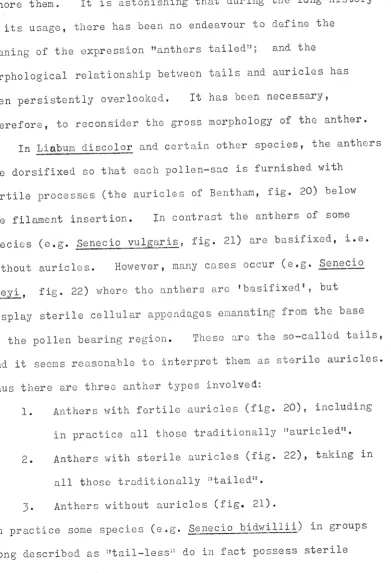
therefore, to reconsider the gross morphology of the anther. In Liabum discolor and certain other species, the anthers are dorsifixed so that each pollen-sac is furnished with
fertile processes (the auricles of Bentham, fig. 20) below the filament insertion. In contrast the anthers of scrn^ species (e.g. Senecio vulgaris, fig. 21) zure basifixed, i.e. without auricles. However, many cases occur (e.g. Senecio g r e y i , fig. 22) where the anthers are 'basifixed', but display sterile cellular appendages emanating from the ba^^ of the pollen bearing region. These are the so-called tails, and it seems reasonable to interpret them as sterile auricles. Thus there are three anther types involved:
1. Anthers with fertile auricles (fig. 20), including
in practice all those traditionally "'auricled .
2. Anthers with sterile auricles (fig. 22), taking in all those traditionally "tailed".
3. Anthers without auricles (fig. 21).
[image:44.541.98.490.111.684.2]FIGURES 20 - 28
FIGURES 20-22. Illustrations of stamens, showing variation in form of filament collar and bases of pollen-sacs below the filament insertion.
Figure 20 Liabum discolor with fertile auricles, X 200.
Figure 21 Senecio vulgaris with baluster-form filament collar and no auricles, X 300.
Figure 22 Senecio greyi with a cylindrical filament collar and with sterile auricles, X 200.
FIGURES 23-25. Fibrous layer of anther wall in surface view;
Figure 23 Figure 24 Figure 25
FIGURES 26-28.
longitudinal axis of the anther vertical. Senecio greyi, polarised tissue, X 680. Senecio vernalis, radial tissue, X 530. Chresta spkaerocephala, transitional tissue X 700.
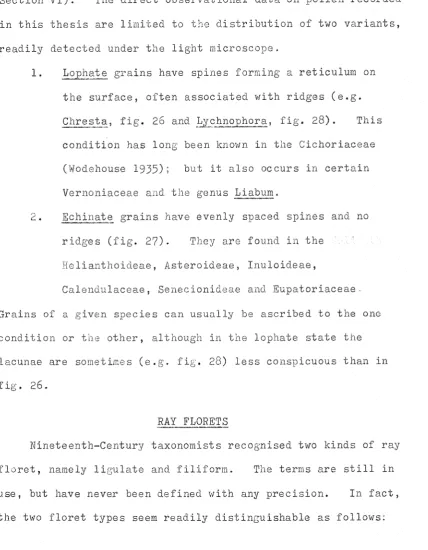
Illustrations of pollen types.
Figure 26 Chresta exsucca, lophate grain with regular lacunae, X 850.
Figure 27 Ligularia stenocephala, echinate grain X 740.
^ ^ a - * •
36
-auricles. This discrepancy may have arisen because previous workers were using different definitions, which they never recorded. Alternatively, it is possible that soDK! recorded
'observations ' represent extrapolations of the kir^ to which taxonomists have been especially prone.
FILAMENT COLLAR
The stamens of Compositae are probably unique in possessing a downward extension of connective tissue which forms an incomplete monostromatic collar of thick-walled cells, the incomplete portion lying on the adaxial side of the
filament. The functional significance of this region remains unexplored, but th^ combination of thick and thin-walled
cells suggests that it might be concerned with anther
movements. It w a s first noted by Cassini (1826) who it
as "1*article antherifere", and I refer to it here as the 'filament collar'. In the present sample of Compositae, filament collars are generally referable to one of
previously undescribed forms:
1. Baluster-form. Here the collar is basally
distended, reflecting the presence of enlarged cells in its lower part (restricted to certain genera of the tribe Senecionideae,fig. 21).
37
-the Inuloideae, Helianthoidea.e, Calendulaceae, Astoroideae and Vernoniaceae, fig. 22).
Intermediates between the two forms (i.e. where the collar shows indistinct swelling) are remarkably rare, having been found in only 3/369 species.
FIBROUS LAYER
Recently Dormer (1962B) has reported on the taxonomic significance of variations in endothecium (fibrous layer) histology involving the abaxial surface of the anther in Compositae. The three tissue types outlines by him are readily recognised, and definitions are not required for t h e present purpose. Their characteristics can be
summarised as follows:
1. Polarised tissue consists of endothecial cells
(when viewed in optical section) with wall thickenings in the form of ribs strongly concentrated upon their upper aa^ lower ends (fig. 23).
2. Radial tissue has endothecial cells which, when viewed in situ, are seen to be ribbed all round (fig. 24).
28
-cross connections (fig. 25).
Dormer mentioned the distribution of fibrous types for a very small sample from 10 of the li) tribes of Compositae. My more extensive survey, w h i l e confirming the usefulness of his tissue types, necessitates some modifications of his taxonomic
conclusions. Thus the Cichoriaceae are not unique in having transitional tissue on the abaxial flap of the anther, for Vernoniaceae (which he neglected to exemiine) also show this condition. Moreover, although Dormer demonstrated the
heterogeq%ty of the Senecionideae by revealing the distinction between Potasites, Tussilago and Doronicum (genera with
polarised thickenings) and Senecio (with radial thickenings), the inconsistency in this tribe is, in fact, more serious than ho suspected; for there is marked variation in this respect within the genus Senecio itself.
POLLEN
Stix (1960), with the aid of electron-micrographs,
39
-her species do not coincide with mine, I have been able to make only indirect taxonomic use of h^^ conclusions (see
Section VI). The direct observational data on pollen recorded in this thesis are limited to the distribution of two variants, readily detected under the light microscope.
1. Lophate grains have spines forming a reticulum on the surface, often associated with ridges (e.g. Chresta, fig. 26 and Lychnophora, fig. 28). This condition has long been known in the Cichoriaceae (Wodehouse 1935); tmt it also occurs in certain Vernoniaceae and the genus Liabum.
2. Echinate grains have evenly spaced spines and no ridges (fig. 27). They are found in the ' Helianthoideae, Asteroideae, Inuloideae,
Calendulaceae, Senecionideae and Eupatoriaceae-Grains of a given species can usually be ascribed to the on^ condition or the other, although in the lophate state the lacunae are sometimes (e.g. fig. 28) less conspicuous than in fig. 26.
RAY FLORETS
[image:50.541.78.507.127.677.2]— 4-0 —
1. Florets with long, conspicuously vascularised ligules, (ligulate florets).
2. Florets without ligules, or with short ones bearing no v a s c u l ^ traces (filiform florets).
However, since earlier workers neglected to publish definitions for the floret types, it is possible tha^ distributions of the
ouS
typesyrecorded by me in the present sample of Compositae will not coincide exactly with their descriptions of these saae plants.
Investigation of ligulate rays reveals variation in venation pattern, which ca# conveniently be reduced to three classes:
1. A 4 nerved condition, which is the most common and is usually exhibited by medium sized rays. Here, 4 traces emanate from the tube and approach the tip of the ligule. Usually the inner two bifurcate near the ligule tip, their outer anas joining with the incurving laterals to produce two vascular arches; and the inner arms fuse to form a third (fig. 29). A few species (e.g. Senecio sylvaticus) have florets which are best placed under this
heading, but which are exceptional in having 4 free traces falling short of the ligule tip.
«» "^1
be pictured as a modification of the 4 nerved type, with supernumerary traces which never contribute to the vascular arches (fig. 30).
3. A 4 - nerved condition, which is uncommon, and characterises species with small ligules. The vascular traces number 1-3 and are never joined to form arches.
The recognition of these three venation categories successfully eliminates^specific variation, which rules out a system based on absolute vein number; species are usually constant for the venation patterns. In a very few instances, where a plant shows two of the three pattern types, there is never amy
difficulty in deciding on the typical condition; emd in such cases the most frequent expression has been recorded as
representative.
De Candolle remarked on the presence of staminodes in certain genera (e.g. in Arnica and Ligularia), and I am able to extend the list considerably. Observations are here confined to a record of the presence or absence for ea^^ species of infertile stamen-like structures in the throats of ray florets.
GROSS MORPHOLOGY
4 2
FIGURES 29 smd 1#. Llgule venation patterns.
43
-or impracticable to arrive at reliable comparative data f-or such features as habit, capitulum size, floret colour,
6/
e / subterranean parts, number an^ proportion of floret types and stylar form using herbarium material. Furthermore, several features commonly mentioned loosely in taxonomic work are still in need of satisfactory definition: e.g. number of rows of involucral bracts, 'inflorescence' stylar construction. However, certain features of gross morphology, although commonly overlooked, readily lend themselves to unambiguous recording:
1. Phyllotaxy: leaves opposite or 'alternate'. 2. Leaves with without petioles, or having the
lamina decurrent on the petiole (i.e. three variants). 3. Regarding leaf venation, the sample includes:
(a) Radiate or Palmate (as in Tussilago farfara), where the veins diverge from the base of the lamina.
(b) Pinnate (as in Senecio fuchsii), where the laterals diverge from points along a midrib. (c) Arched or parallel (as in Senecio segmentates, *
4 4
S U M M A R Y OF RECORDED OBSERVATIONS
Each of the 45 characters listed below has been
consistently recorded for a sample of species, taken from 7 of tribes recognised by Bentham (18?]^: Helianthoideae
- 6 spp., Inuloideae - 3 spp., Calendulaceae - 7 spp.,
Vernoniaceae 10 spp., Eupatoriaceae 2 spp., Asteroideae -28 spp., and Senecionideae - 313 spp. The comparative data are fully recorded in A p p e n d i x I. Slides have been deposited with the Curator of the Manchester M u s e u m .
Stomata
Foliar trichomes
Pith
Cambium
Secondary xylem
1. anisocytic/anomocytic 2. eglandular, present/absent 3. eglandular type, (15 forms) 4 . glandular, present/absent 5. glandular type, (3 f o r m s ) 6. collapsed pith, present/absent 7. if not collapsed, then
lignification present/absent 8. sclereids, present/absent 9. interfascicular cambium,
present/absent
10. vessel distribution (10 types) 11. size of widest vessel (6
categories)
12. xylem rays, present/absent
45
Phloem
Cortex
Resin canals
Node
Crystals
A.chenial hairs
Carbonaceous layer Pappus
14. phloem fibres, present/absent 15. lignified phloea, present/absent 16. joining sclereids,present/absent 17. sclereids, present/absent
18. resin canals, present/absent 19. position of r e s i n canals (5
categories)
20. nodal configuration, (4 categories)
21. pith crystals, present/absent 22. pith crystal type, (4 forms) 23. achenial crystals, present/
absent
24. achenial crystal type, (4 forms) 25. ovarian crystals, present/absent 26. ovarian crystal type, (5 forms) 27. disc floret achenes with duplex
hairs present/absent
28. if duplex hairs present, th^m thick-walled type present/absent 29. carbonaceous layer, present/absent 30. pappus on disc florets,
present/absent
— 46
A n t h ^ tails
Filament collar Fibrous layer Pollen
Ray florets
Gross morphology
32. if pappus present and setose, fluked hairs present/absent ^5. if pappus present and setose,
clubbed hairs present/absent 34. stamen auricles present/absent 35. if present, fertile/sterile 36. cylindrical/baluster-form 37. fibrous layer type (3 forms) 38. lophate/echinate
39. ray florets, present/absent 40. if ray florets present, then
filiform, present/absent 41. if ray florets present, then
staminodes, present/absent 4 2 . if ray florets present and not
filiform, venation type, (3 c a t e g o r i e s )
43. leaves opposite/alternate 44. leaves with/without petioles/
decurrent lamina
47
SECTION IV
HIERARCHICAL INTERPRETATION OF THE DATA
The most useful system of classification for biological material is one based on overall resemblances; for besides providing a convenient repository for known facts, it offers the hope of successful prediction where information is not yet available. The appended data sheets contain the observational records involving over 100 entries for of 369 species of Compositae. In order to arrive at a scheme reflecting overall similarities among these plaats, it is necessary first to
An
of the analysis.
COMPUTATIONAL M E T H O D S
Fundamentally there are two methods of classifying individuals using multivariate data: 'hierarchical'
'non-hierarchicikl'. Of these only the hierarchical method need concern us here; for it alone enables individuals to be compared with each other at any desired level of similarity -a distinct -adv-ant-age in t-axonomic work where one wishes to relate each organism ultimately with every other.
Hierarchical classifications may be achieved by either 'subdivisive' or 'agglomerative' processes. The former commences the analysis with all tha information for the whole population, which is subjected to successive dichotomous divisions. At present, th^ only operational programme
observations, would lead on^ to believe.
Agglomerative ('polythetic', 'similarity') methods do not suffer from this weakness since they involve progressively fusing most like individuals, until the entire population forms one composite individual. The classificatory process here depends entirely on overall similarities between individuals being compared, and there is no question of 'key characters'. Thus it is possible to employ different kinds of sorting procedure together with a variety of similarity coefficients, and the possible combinations are seemingly unlimited; but there is a growing body of evidence that useful taxonomic groups tend to emerge regardless of the variation in the numerical approach (e.g. Watson, Williams and Lance I966).
THE PROGRAM^IE 'MULTIST'
51
-information has to be ordered, and each data class awarded the status of a unit character. In practice this increases the number of characters representing quantitative variation, so that numerical data come to be heavily weighted over other kinds of information.
Secondly and more seriously, difficulties arise with qualitative programmes in connection with 'multistate' and
'inapplicable' characters. These, and tb^ problems they pose, are exemplified in my data by the records concerning eglandular hairs. In comparing any two individuals, the question has to be answered: hairs present or absent? Then, if hairs present, of what type (1$ having been described)? If they are absent, the latter question is without meaning, aad is logically
inapplicable. Using a qualitative similarity method however, the individual must be scored with a negative or a positive for every one oi the known types if variation in hair form is to be accounted for at all, regardless of whether the question of hair type is meaningful or not. Coi^equent^^y, tv/o glabrous species will be awarded 15 'similarities^^ ^ e m d two species w i t h different hair types will be regarded as having ^ points of difference, not one. In other words, hair characters will be given disproportionate weight, and spurious differences and similarities will be created. The results of this kind of thing can only be taxonomic distortion.