Automatic Gap-fill Question Generation from Text Books
Manish Agarwal and Prashanth Mannem Language Technologies Research Center International Institute of Information Technology
Hyderabad, AP, India - 500032
{manish.agarwal,prashanth}@research.iiit.ac.in
Abstract
In this paper, we present an automatic question generation system that can generate gap-fill questions for content in a document. Gap-fill questions are fill-in-the-blank questions with multiple choices (one correct answer and three distractors) provided. The system finds the in-formative sentences from the document and generates gap-fill questions from them by first blanking keys from the sentences and then de-termining the distractors for these keys. Syn-tactic and lexical features are used in this pro-cess without relying on any external resource apart from the information in the document. We evaluated our system on two chapters of a standard biology textbook and presented the results.
1 Introduction
Gap-fill questions are fill-in-the-blank questions, where one or more words are removed from a sentence/paragraph and potential answers are listed. These questions, being multiple choice ones, are easy to evaluate. Preparing these questions manu-ally will take a lot of time and effort. This is where automatic gap-fill question generation (GFQG) from a given text is useful.
1. A bond is the sharing of a pair of va-lence electrons by two atoms.
(a) Hydrogen (b) Covalent (c) Ionic (d) Double (correct answer: Covalent)
In a gap-fill question (GFQ) such as the one above, we refer to the sentence with the gap as the
question sentence (QS) and the sentence in the text
that is used to generate the QS as the gap-fill sen-tence (GFS). The word(s) which is removed from a GFS to form the QS is referred to as the key while the three alternatives in the question are called as
distractors, as they are used to distract the students
from the correct answer.
Previous works in GFQG (Sumita et al., 2005; John Lee and Stephanie Seneff, 2007; Lin et al., 2007; Pino et al., 2009; Smith et al., 2010) have mostly worked in the domain of English language learning. Gap-fill questions have been generated to test student’s knowledge of English in using the cor-rect verbs (Sumita et al., 2005), prepositions (John Lee and Stephanie Seneff, 2007) and adjectives (Lin et al., 2007) in sentences. Pino et al. (2009) and Smith et al. (2010) have generated GFQs to teach and evaluate student’s vocabulary.
In this paper, we move away from the domain of English language learning and work on generat-ing gap-fill questions from the chapters of a biol-ogy textbook used for Advanced Placement (AP) ex-ams. The aim is to go through the textbook, identify
informative sentences1 and generate gap-fill ques-tions from them to aid students’ learning. The
sys-tem scans through the text in the chapter and iden-tifies the informative sentences in it using features inspired by summarization techniques. Questions from these sentences (GFSs) are generated by first choosing a key in each of these and then finding ap-propriate distractors for them from the chapter.
Our GFQG system takes a document with its title as an input and produces a list of gap-fill questions as
1A sentence is deemed informative if it has the relevant course knowledge which can be questioned.
output. Unlike previous works (Brown et al., 2005; Smith et al., 2010) it doesn’t use any external re-source for distractor selection, making it adaptable to text from any domain. Its simplicity makes it use-ful not only as an aid for teachers to prepare gap-fill questions but also for students who need an auto-matic question generator to aid their learning from a textbook.
2 Data Used
A Biology text book Campbell Biology, 6th
Edi-tion has been used for work in this paper. We have
reported results of our system on 2 chapters (the
structure and function of macromolecules and an introduction to metabolism ) of unit 1. Each chapter
contains sections and subsections with their respec-tive topic headings. Number of subsections, sen-tences, words per sentence in each chapter are (25, 416, 18.3) and (32, 423, 19.5) respectively. Each subsection is taken as a document. The chapters are divided into documents and each document is used for GFQG independently.
3 Approach
Given a document, the gap-fill questions are gen-erated from it in three stages: sentence selection, key selection and distractor selection. Sentence
se-lection involves identifying informative sentences in
the document which can be used to generate a gap-fill question. These sentences are then processed in the key selection stage to identify the key on which to ask the question. In the final stage, the
distrac-tors for the selected key are identified from the given
chapter by searching for words with the same con-text as that of the key.
In each stage, the system identifies a set of candi-dates (i.e. all sentences in the document in stage I, words in the previously selected sentence in stage II and words in the chapter in stage III) and extracts a set of features relevant to the task. Weighted sum of
extracted features (see equation 1) is used to score
these candidates, with the weights for the features in each of the three steps assigned heuristically. A small development data has been used to tune the feature weights.
score=
n
X
i=0
wi×fi (1)
In equation 1,fidenotes the feature andwidenotes
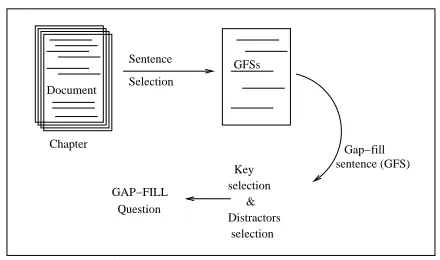
the weight of the featurefi. The overall architecture
of the system is shown in Figure 1.
Sentence
Selection
sentence (GFS) Gap−fill
selection & Distractors selection GAP−FILL
Question
GFSs
Document
Chapter
[image:2.612.316.536.109.239.2]Key
Figure 1: System architecture
In earlier approaches to generating gap-fill ques-tions (for English language learning), the keys in a text were gathered first (or given as input in some cases) and all the sentences containing the key were used to generate the question. In domains where language learning is not the aim, a gap-fill question needs an informative sentence and not just any sen-tence with the desired key present in it. For this rea-son, in our work, sentence selection is performed be-fore key selection.
3.1 Sentence Selection
A good GFS should be (1) informative and (2)
gap-fill question-generatable. An informative sen-tence in a document is one which has relevant
knowledge that is useful in the context of the docu-ment. A sentence is gap-fill question-generatable if there is sufficient context within the sentence to pre-dict the key when it is blanked out. An informative
sentence might not have enough context to generate
a question from and vice versa.
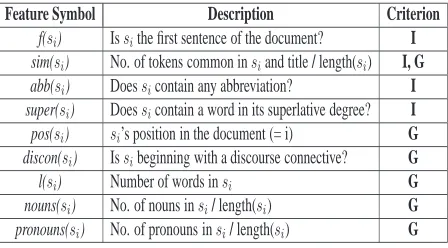
The sentence selection module goes through all the sentences in the documents and extracts a set of features from each of them. These features are de-fined in such a way that the two criterion dede-fined above are accounted for. Table 1 gives a summary of the features used.
First sentence: f(si)is a binary feature to check
whether the sentence si is the first sentence of the
document or not. Upon analysing the documents in the textbook, it was observed that the first sentence in the document usually provides a summary of the
document. Hence,f(si)has been used to make use
Feature Symbol Description Criterion f(si) Issithe first sentence of the document? I
sim(si) No. of tokens common insiand title / length(si) I, G
abb(si) Doessicontain any abbreviation? I
super(si) Doessicontain a word in its superlative degree? I
pos(si) si’s position in the document (= i) G
discon(si) Issibeginning with a discourse connective? G
l(si) Number of words insi G
nouns(si) No. of nouns insi/ length(si) G
[image:3.612.75.299.57.181.2]pronouns(si) No. of pronouns insi/ length(si) G
Table 1: Feature set for Sentence Selection (si: ith
tence of the document; I: to capture informative sen-tences; G: to capture the potential candidate for gener-ating a GFQs)
Common tokens: sim(si) is the count of words
(nouns and adjectives) that the sentence and the title of the document have in common. A sentence with words from the title in it is important and is a good candidate to ask a question using the common words as the key.
2. The different states of potential energy that
electrons have in an atom are called energy levels, or electron shells. (Title: The Energy
Levels of Electrons)
For example sentence 2, value of the feature is 3/19 (common words:3, sentence length:19) and generating gap-fill question using energy, levels or
electrons as the key will be useful.
Abbreviations and Superlatives: abb(si),
super(si) features capture those sentences which
contain abbreviations and words in superlative de-gree respectively. The binary features determine the degree of the importance of a sentence in terms of the presence of abbreviations and superlatives.
3. In living organisms, most of the strongest
chemical bonds are covalent ones.
For example, in sentence 3, presence of strongest makes sentence more informative and useful for generating a gap-fill question.
Sentence position: pos(si) is position of the
sentence si, in the document (= i). Since topic of
the document is elaborated in the middle of the document, the sentences occurring in the middle of the document are less important for the GFSs than those which occur either at the start or the end of the
document. In order to use the above observation, the module uses this feature.
Discourse connective at the beginning:
discon(si)’s value is 1 if first word of si is a
discourse connective2 and 0 otherwise. Discourse connective at the beginning of a sentence indicates that the sentence might not have enough context for a QS to be understood by the students.
4. Because of this, it is both an amine and a
car-boxylic acid.
In example 4, after selecting amine and
car-boxylic as a key, QS will be left with insufficient
context to answer. Thus binary feature,discon(si),
is used.
Length: l(si) is the number of words in the
sentence. It is important to note that a very short sentence might generate an unanswerable question because of short context and a very long sentence might have enough context to make the question generated from it trivial.
Number of nouns and pronouns: Features
nouns(si)and pronouns(si)represent the amount
of context present in a sentence. More number of pronouns in a sentence reduces the contextual infor-mation, instead more number of nouns increases the number of potential keys to ask a gap-fill question on.
Four sample GFSs are shown in Table 3 with their document’s titles.
3.2 Key Selection
For each sentence selected in the previous stage, the key selection stage identifies the most appropri-ate key from the sentence to ask the question on.
Previous works in this area, Smith et al. (2010) take keys as an input and, Karamanis et al. (2006) and Mitkov et al. (2006) select keys on the basis of term frequency and regular expressions on nouns. Then they search for sentences which contain that particular key in it. Since their approaches generate gap-fill questions only with one blank, they could end up with a trivial GFQ, especially in case of con-junctions.
(A)
DT JJS NNS IN NN NNS VBP JJ NNS CC JJ NNS
potential keys selection
[The strongest kind] of [chemical bonds] are [covalent bond and ionic bond].
[image:4.612.75.521.63.146.2][The strongest kind] of [ chemical bonds] are [ covalent bond and ionic bond] . (B)
Figure 2:Generating potential key’s list, (key-list) of strongest, chemical and covalent + ionic.
5. Somewhere in the transition from molecules to
cells, we will cross the blurry boundary be-tween nonlife and life.
For instance in example sentence 5, selecting only one of non-life and life makes the question trivial. This is an other reason for performing sentence se-lection before key sese-lection. Our system can gen-erate GFQs with multiple blanks unlike previous works described above.
Our approach of key selection from a GFS is two step process. In the first step the module generates a list of potential keys from the GFS (key-list) and in the second step it selects the best key from this
key-list.
3.2.1 Key-list formation
A list of potential keys is created in this step using the part of speech (POS) tags of words and chunks of the sentence in the following manner:
1. Each sequence of words in all the noun chunks is pushed into key-list. In figure 2(A), the three noun chunks the strongest kind, chemical bond and covalent bond and ionic bond are pushed into the key-list.
2. For each sequence in the key-list, the most im-portant word(s) is selected as the potential key and the other words are removed. The most im-portant word in a noun chunk in the context of GFQG in biology domain is a cardinal, adjec-tive and noun in that order. In case where there are multiple nouns, the first noun is chosen as the potential key. If the noun chunk is a NP coordination, both the conjuncts are selected as a single potential key making it a case of mul-tiple gaps in QS. In Figure 2(B) potential keys
strongest, chemical and covalent + ionic are
se-lected from the noun chunks by taking the order of importance into account.
An automatic POS tagger and a noun chunker has been used to process the sentences selected in the
first stage. It was observed that if words of a key are spread across a chunk then there might not be enough context left in QS to answer the question. The noun chunk boundaries ensure that the sequence of words in the potential keys are not disconnected.
6. Hydrogen has 1 valence electron in the first
shell, but the shell’s capacity is 2 electrons.
Any element of the key-list which occurs more than once in the GFS is discarded as a potential key as it more often than not generates a trivial question. For example, in sentence 6 selecting any one of the two electron as a key generates an easy gap-fill ques-tion.
7. In contrast , trypsin , a digestive enzyme
resid-ing in the alkaline environment of the intestine , has an optimal pH of .
(a) 6 (b) 7 (c) 8 (d) 9 (correct answer: 8)
If cardinals are present in a GFS, the first one is cho-sen as its key directly and a gap-fill question has been generated (see example 7).
3.2.2 Best Key selection
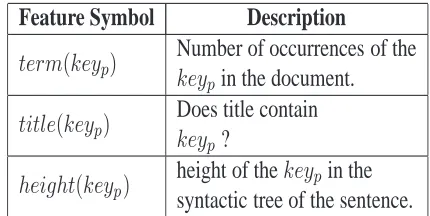
In this step three features, term(keyp),
title(keyp) and height(keyp), described in
Ta-ble 2, are used to select the best key from the key-list.
Feature Symbol
Description
term
(
key
p)Number of occurrences of the
key
pin the document.
title
(
key
p)Does title contain
key
p?
height
(
key
p)height of the
key
pin the
syntactic tree of the sentence.
Table 2: Feature set for key selection (potential key,
keypis an element of key-list)
Term frequency: term(keyp) is number of
[image:4.612.319.534.547.655.2]is considered as a feature to give preference to the potential keys with high frequency.
In title: title(keyp)is a binary feature to check
whetherkeyp is present in the title of the document
or not. A common word of GFS and the title of the document serves as a better key for gap-fill question than the ones that are not present in both.
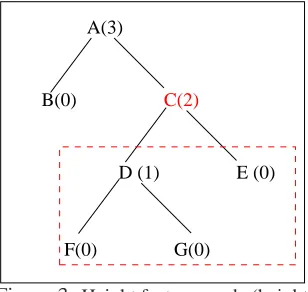
Height:height(keyp)denotes the height3of the
keyp in the syntactic tree of the sentence. Height
gives an indirect indication of the importance of the word. It also denotes the amount of text in the sen-tence that modifies the word under consideration.
F(0) G(0) D (1) E (0) A(3)
[image:5.612.314.539.54.224.2]C(2) B(0)
Figure 3: Height feature: node (height)
An answerable question should have enough con-text left after the key blanked out. A word with greater height in dependency tree gets more score since there is enough context from its dependent words in the syntactic tree to predict the word. For example in Figure 3, node C’s height is two and the words in the dashed box in its subtree provide the context to answer a question on C.
The score of each potential key is normalized by the number of words present in it and the best key is chosen based on the scores of potential keys in
key-list. Table 3 shows the selected keys (red colored)
for sample GFSs.
3.3 Distractor Selection
Karamanis et al. (2006) defines a distractor as,
an appropriate distractor is a concept semantically close to the key which, however, cannot serve as the right answer itself.
For distractor selection, Brown et al. (2005) and Smith et al. (2010) used WordNet, Kunichika et
3The height of a tree is the length of the path from the deep-est node in the tree to the root.
No. Selected keys (red colored)
1
An electron having a certain discrete amount ofenergyis something like a ball on a staircase.
(The Energy Levels of Electrons)
2
Lipids are the class of large biological molecules that does not includepolymer.
(Lipids–Diverse Hydrophobic Molecules)
3
ADNAmolecule is very long and usually consists of hundreds or thousands of genes.
(Nucleic acids store and transmit hereditary information)
4
The fatty acid will have akinkin its tail wherever a double bond occurs.
(Fats store large amounts of energy)
Table 3: Selected keys for each sample GFS
al. (2002) used their in-house thesauri to retrieve similar or related words (synonyms, hypernyms, hy-ponyms, antonyms, etc.). However, their approaches can’t be used for those domains which don’t have ontologies. Moreover, Smith et al. (2010) do not se-lect distractors based on the context of the keys. For example, in the sentences 8 and 9, the key book oc-curs in two different senses but same set of
distrac-tors will be generated by them.
8. Book the flight.
9. I read a book.
Feature Symbol Description
context(distractorp, measure of contextual similarity
keys) ofdistractorpand thekeys
in which they are present
sim(distractorp, Dice coefficient score between
keys) GFS and the sentence
containing thedistractorp
diff(distractorp, difference in term frequencies
keys) ofdistractorpandkeys
in the chapter
Table 4: Feature set for distractor selection (keysis the
selected key for a GFS,distractorp is the potential
dis-tractor for thekeys)
So a distractor should come from the same con-text and domain, and should be relevant. It is also clear from the above discussion that only term
fre-quency formula alone will not work for selection
[image:5.612.108.262.252.398.2]Contextual similarity: context(distractorp,
keys) gets the contextual similarity score of a
potential distractor and the keys on the basis
of context in which they occur in their respective
sentences. Value of the feature depends on how
similar are the key and the potential distractor
contextually. The previous two and next two words along with their POS tags are compared to calculate the score.
Sentence Similarity: sim(distractorp, keys)
feature value represents similarity of the sentences
in which the keys and the distractorp occur in.
Dice Coefficient (Dice, 1945) (equation 2) has been
used to assign weights to those potential distractors which come from sentences similar to GFS because a distractor coming from a similar sentence will be more relevant.
dice coef f icient(s1, s2) =
2×commontokens l(s1) +l(s2)
(2)
Difference in term frequencies: Feature,
diff (distractorp, keys) is used to find distractors
with comparable importance to the key. Term fre-quency of a word represents its importance in the text and words with comparable importance might be close in their semantic meanings. So, a smaller difference in the term frequencies is preferable.
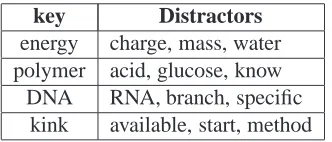
key Distractors
energy charge, mass, water
polymer acid, glucose, know
DNA RNA, branch, specific
kink available, start, method
Table 5:Selected distractors for selected keys, shown in Table 3
10. Electrons have a negative charge, the unequal
sharing of electrons in water causes the
oxy-gen atom to have a partial negative charge and
each hydrogen atom a partial positive charge.
A word that is present in the GFS would not be selected as a distractor. For example in sentence 10, if system selects oxygen as a key then hydrogen will
not be considered as a distractor. Table 5 shows
selected three distractors for each selected keys.
4 Evaluation and Results
Two chapters of the biology book are selected for testing and top 15% candidates are selected by three modules (sentence selection, key selection and
dis-tractor selection). The modules were manually
eval-uated independently by two biology students with good English proficiency. Since in current system any kind of post editing or manual work is avoided, comparison of efficiency in manual and automatic generation is not needed unlike Mitkov and Ha et al. (2003).
4.1 Sentence Selection
The output of the sentence selection module is a list of sentences. The evaluators check if each of these sentences are good GFSs (informative and
gap-fill question-generatable) or not and binary
scoring is done. Evaluators are asked to evaluate selected sentences independently, whether they are useful for learning and answerable, or not.The cov-erage of the selected sentences w.r.t the document has not been evaluated.
Chapter-5 Chapter-6 Total
No. of
390 423 813
Sentences No. of
55 65 120
Selected Sentences No. of Good
51 59 110
GFSs (Eval-1) No. of Good
44 51 95
[image:6.612.104.270.463.534.2]GFSs (Eval-2)
Table 6:Evaluation of Sentence Selection
Evaluator-1 and 2 rated 91.66% and 79.16% of sentences as good potential candidates for gap-fill question respectively with 0.7 inter evaluator agree-ment (Cohen’s kappa coefficient). Table 6 shows the results of sentence selection for individual chapters. Upon analysing the bad GFSs, we found two different sources of errors. The first source is the feature first sentence and the second is lack of used in sentence selection module.
First sentence: Few documents in the data had
either a general statement or a summary of the pre-vious section as the first sentence and the first
sen-tence feature contributed to their selection as GFS
even though they aren’t good GFSs.
11. An understanding of energy is as important
for students of biology as it is for students of physics, chemistry and engineering.
question on example 11 which isn’t a good GFS at all even though it occurs as the first sentence in the document.
Less no. of features: Features like common
to-kens, superlative and abbreviation, discourse con-nective at the beginning and number of pronouns
was useful in selecting informative sentences from the documents. However, in absence of these fea-tures in the document, module has selected the GFSs on the basis of only two features, length and position
of the sentence. In those cases Evaluators rated few
GFSs as bad.
12. Here is another example of how emergent
prop-erties result from a specific arrangement of building components.
For example, sentence 12 rated as a bad GFS by the evaluators. So more features are need to be to used to avoid this kind of errors.
13. A molecule has a characteristic size and shape.
Apart from these we also found few cases where the context present in the GFS wasn’t sufficient to answer the question although those sentences were
informative. In the above example 13, size and
shape were selected as the key that makes gap-fill
question unanswerable because of short context.
4.2 Key Selection
Our evaluation characterizes a key into two cat-egories namely good (G) and bad (B). Evaluator-1 and 2 found that 94.16% and 84.16% of the keys are good respectively with inter evaluator agreement 0.75. Table 7 shows the results of keys selection for individual chapters.
Chap-5 Chap-6 Total
G B G B G B
Eval-1 50 5 63 2 113 7
Eval-2 50 5 51 14 101 19
Table 7: Evaluation of Key(s) Selection: Chap:
Chap-ter, Eval: Evaluator, G and B are for good and bad key respectively
14. Carbon has a total of 6 electrons , with 2 in the
first electron shell and 4 in the second shell.
We observed that selection of first cardinal as key is not always correct. For example, in sentence 14 selection of 6 as the key generated trivial GFQ.
4.3 Distractors Selection
Our system generates four alternatives for each gap-fill question, out of which three are
distrac-tors. To evaluate the distractors’ quality, evaluators
are asked to substitute the distractor in the gap and check the readability and semantic meaning of the QS to classify the distractor as good or bad. Eval-uators rate 0, 1, 2 or 3 depending on the number of
good distractors in the GFQ (for example, questions
that are rated 2 have two good distractors and one
bad distractor).
15. An electron having a certain discrete amount of
is something like a ball on a staircase. (a)charge(b)energy(c)mass(d)water (Class: 3)
16. Lipids are the class of large biological
molecules that does not include . (a)acid(b)polymer(c)glucose(d) know
(Class: 2)
17. A molecule is very long and usually
consists of hundreds or thousands of genes. (a)DNA(b)RNA(c) specific (d) branch
(Class: 1)
18. The fatty acid will have a in its tail
wherever a double bond occurs .
(a) available (b) method (c)kink(d) start
(Class: 0)
Examples of gap-fill questions generated by our system are shown above (red colored alternatives are
good distractors, blue colored ones are the correct
answers for the questions and the black ones are bad
distractors).
Chap-5 Chap-6 Total
Class 0 1 2 3 0 1 2 3 0 1 2 3
[image:7.612.90.286.541.599.2]Eval-1 21 19 12 3 8 31 21 5 29 50 33 8 Eval-2 20 19 13 3 9 25 28 3 29 44 41 6
Table 8: Evaluation of Distractor Selection (Before any
corrections)
Table 8 shows the human evaluated results for
individual chapter. According to both
We observed that when a key has more than one word, distractors’ quality reduces because every to-ken in a distractor must be comparably relevant. Small chapter size also effects the number of good
distractors because distractors are selected from the
chapter text.
In our work, as we only considered syntactic and lexical features for distractor selection, the selected
distractors could be semantically conflicting with
themselves or with the key. For example, due to the lack of semantic features in our method a hyper-nym of the key could find way into the distractors list thereby providing a confusing list of distractors to the students. In the example question 1 in section 1, chemical which is the hypernym of covalent and
ionic could prove confusing if its one of the choices
for the answer. Semantic similarity measures need to be used to solve this problem.
5 Related work
Given the distinct domains in which our system and other systems were deployed, a direct com-parison of evaluation scores could be misleading. Hence, in this section we compare our approach with previous approaches in this area.
Smith et al. (2010) and Pino et al. (2009) used gap-fill questions for vocabulary learning. Smith et al. (2010) present a system, TEDDCLOG, which au-tomatically generates draft test items from a corpus. TEDDCLOG takes the key as input. It finds
dis-tractors from a distributional thesaurus. They got
53.33% (40 out of 75) accuracy after post editing (editing either in carrier sentence (GFS) or in
dis-tractors) in the generated gap-fill questions.
Pino et al. (2009) describe a baseline technique to generate cloze questions (gap-fill questions) which uses sample sentences from WordNet. They then re-fine this technique with linguistically motivated fea-tures to generate better questions. They used the Cambridge Advanced Learners Dictionary (CALD) which has several sample sentences for each sense of a word for stem selection (GFS). The new strat-egy produced high quality cloze questions 66% of the time.
Karamanis et al. (2006) report the results of a pi-lot study on generating Multiple-Choice Test Items (MCTI) from medical text which builds on the work of Mitkov et al. (2006). Initially key set is enlarged with NPs featuring potential key terms as their heads
and satisfying certain regular expressions. Then sen-tences having at least one key are selected and the terms with the same semantic type in UMLS are se-lected as distractors. In their manual evaluation, the domain experts regarded a MCTI as unusable if it could not be used in a test or required too much revi-sion to do so. The remaining items were considered to be usable and could be post edited by the experts to improve their content and readability or replace inappropriate distractors. They have reported 19% usable items generated from their system and after post editing stems accuracy jumps to 54%.
However, our system takes a document and pro-duces a list of GFQs by selecting informative
sen-tences from the document. It doesn’t use any
exter-nal resources for distractors selection and finds them in the chapter only that makes it adaptable for those domains which do not have ontologies.
6 Conclusions and Future Work
Our GFQG system, selects most informative
sen-tences of the chapters and generates gap-fill
ques-tions on them. Syntactic features helped in quality of gap-fill questions. We look forward to experiment-ing on larger data by combinexperiment-ing the chapters. Eval-uation of course coverage by our system and use of semantic features will be part of our future work.
Acknowledgements
We would like to thank Avinesh Polisetty and Sudheer Kolachina from LTRC, IIIT-Hyderabad for their helpful discussions and pointers during the course of this work. Thanks also to the anonymous reviewers for useful feedback.
References
Eiichiro Sumita, Fumiaki Sugaya, and Seiichi Yamamoto 2005. Measuring Non-native Speakers Proficiency of English by Using a Test with Automatically-Generated Fill-in-the-Blank Questions, 2nd Wkshop on Building Educational Applications using NLP, Ann Arbor.
John Lee and Stephanie Seneff. 2007. Automatic Gen-eration of Cloze Items for Prepositions, CiteSeerX - Scientific Literature Digital Library and Search Engine [http://citeseerx.ist.psu.edu/oai2] (United States).
Automatic Multiple-Choice Question Generation Scheme for English Adjective Understanding, CCE 2007 Workshop Proc. of Modeling, Management and Generation of Problems / Questions in eLearning, pp. 137-142.
Juan Pino, Michael Heilman and Maxine Eskenazi. 2009. A Selection Strategy to Improve Cloze Question Quality, Wkshop on Intelligent Tutoring Systems for Ill-Defined Domains. 9th Int. Conf. on ITS.
Simon Smith, P.V.S Avinesh and Adam Kilgarriff. 2010. Gap-fill Tests for Language Learners: Corpus-Driven Item Generation .
Jonathan C. Brown, Gwen A. Frishkoff, Maxine Es-kenazi. 2005. Automatic Question Generation for Vocabulary Assessment, Proc. of HLT/EMNLP ’05, pp. 819-826.
Nikiforos Karamanis, Le An Ha and Ruslan Mitkov. 2006 Generating Multiple-Choice Test Iterms from Medical Text: A Pilot Study, In Proceedings of INLG 2006, Sydney, Australia.
Ruslan Mitkov, Le An Ha and Nikiforos Karamanis. 2006 A computer-aided environment for generating multiple-choice test items, Natural Language Engi-neering 12(2): 177-194
Hidenobu Kunichika, Minoru Urushima,Tsukasa Hi-rashima and Akira Takeuchi. 2002. A Computational Method of Complexity of Questions on Contents of English Sentences and its Evaluation, In: Proc. of ICCE 2002, Auckland, NZ, pp. 97101 (2002).
Lee Raymond Dice. 1945. Measures of the Amount of Ecologic Association Between Species