The RWTH Aachen Machine Translation System for WMT 2012
Matthias Huck, Stephan Peitz, Markus Freitag, Malte Nuhn and Hermann Ney
Human Language Technology and Pattern Recognition Group Computer Science Department
RWTH Aachen University D-52056 Aachen, Germany <surname>@cs.rwth-aachen.de
Abstract
This paper describes the statistical ma-chine translation (SMT) systems developed at RWTH Aachen University for the translation task of theNAACL 2012 Seventh Workshop on Statistical Machine Translation(WMT 2012). We participated in the evaluation campaign for the French-English and German-English language pairs in both translation directions. Both hierarchical and phrase-based SMT sys-tems are applied. A number of different tech-niques are evaluated, including an insertion model, different lexical smoothing methods, a discriminative reordering extension for the hierarchical system, reverse translation, and system combination. By application of these methods we achieve considerable improve-ments over the respective baseline systems.
1 Introduction
For the WMT 2012 shared translation task1RWTH utilized state-of-the-art phrase-based and hierarchi-cal translation systems as well as an in-house sys-tem combination framework. We give a survey of these systems and the basic methods they implement in Section 2. For both the French-English (Sec-tion 3) and the German-English (Sec(Sec-tion 4) language pair, we investigate several different advanced tech-niques. We concentrate on specific research direc-tions for each of the translation tasks and present the respective techniques along with the empirical re-sults they yield: For the French→English task (Sec-tion 3.1), we apply a standard phrase-based system.
1
http://www.statmt.org/wmt12/ translation-task.html
For the English→French task (Section 3.2), we aug-ment a hierarchical phrase-based setup with a num-ber of enhancements like an insertion model, dif-ferent lexical smoothing methods, and a discrimina-tive reordering extension. For the German→English (Section 4.3) and English→German (Section 4.4) tasks, we utilize morpho-syntactic analysis to pre-process the data (Section 4.1) and employ sys-tem combination to produce a consensus hypothesis from normal and reverse translations (Section 4.2) of phrase-based and hierarchical phrase-based setups.
2 Translation Systems
2.1 Phrase-Based System
The phrase-based translation (PBT) system used in this work is an in-house implementation of the state-of-the-art decoder described in (Zens and Ney, 2008). We use the standard set of models with phrase translation probabilities and lexical smooth-ing in both directions, word and phrase penalty, distance-based distortion model, an n-gram target language model and three binary count features. The parameter weights are optimized with minimum er-ror rate training (MERT) (Och, 2003).
2.2 Hierarchical Phrase-Based System
For our hierarchical phrase-based translation (HPBT) setups, we employ the open source trans-lation toolkit Jane (Vilar et al., 2010; Stein et al., 2011; Vilar et al., 2012), which has been developed at RWTH and is freely available for non-commercial use. In hierarchical phrase-based translation (Chiang, 2007), a weighted synchronous context-free grammar is induced from parallel text.
In addition to contiguous lexical phrases, hierar-chical phrases with up to two gaps are extracted. The search is carried out with a parsing-based procedure. The standard models integrated into our Jane systems are: phrase translation probabilities and lexical smoothing probabilities in both trans-lation directions, word and phrase penalty, binary features marking hierarchical phrases, glue rule, and rules with non-terminals at the boundaries, four binary count features, and ann-gram language model. Optional additional models comprise IBM model 1 (Brown et al., 1993), discriminative word lexicon (DWL) models and triplet lexicon models (Mauser et al., 2009), discriminative reordering ex-tensions (Huck et al., 2011a), insertion and deletion models (Huck and Ney, 2012), and several syntactic enhancements like preference grammars (Stein et al., 2010) and string-to-dependency features (Peter et al., 2011). We utilize the cube pruning algorithm (Huang and Chiang, 2007) for decoding and optimize the model weights with MERT.
2.3 System Combination
System combination is used to produce consen-sus translations from multiple hypotheses generated with different translation engines. The basic concept of RWTH’s approach to machine translation system combination is described in (Matusov et al., 2006; Matusov et al., 2008). This approach includes an enhanced alignment and reordering framework. A lattice is built from the input hypotheses. The trans-lation with the best score within the lattice according to a couple of statistical models is selected as con-sensus translation.
2.4 Other Tools and Techniques
We employ GIZA++(Och and Ney, 2003) to train word alignments. The two trained alignments are heuristically merged to obtain a symmetrized word alignment for phrase extraction. All language mod-els (LMs) are created with the SRILM toolkit (Stol-cke, 2002) and are standard 4-gram LMs with in-terpolated modified Kneser-Ney smoothing (Kneser and Ney, 1995; Chen and Goodman, 1998). We evaluate in truecase, using the BLEU(Papineni et al., 2002) and TER(Snover et al., 2006) measures.
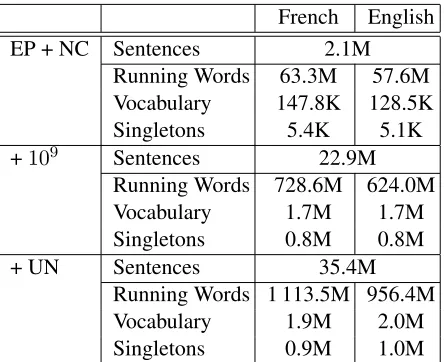
French English EP + NC Sentences 2.1M
Running Words 63.3M 57.6M Vocabulary 147.8K 128.5K Singletons 5.4K 5.1K
+109 Sentences 22.9M
Running Words 728.6M 624.0M Vocabulary 1.7M 1.7M Singletons 0.8M 0.8M
+ UN Sentences 35.4M
[image:2.612.317.539.53.234.2]Running Words 1 113.5M 956.4M Vocabulary 1.9M 2.0M Singletons 0.9M 1.0M
Table 1: Corpus statistics of the preprocessed French-English parallel training data. EPdenotes Europarl,NC
denotes News Commentary. In the data, numerical quan-tities have been replaced by a single category symbol.
3 French-English Setups
We trained phrase-based translation systems for French→English and hierarchical phrase-based translation systems for English→French. Corpus statistics for the French-English parallel data are given in Table 1. The LMs are 4-grams trained on the provided resources for the respective language (Europarl, News Commentary, UN,109, and mono-lingual News Crawl language model training data).2 For French→English we also investigate a smaller English LM on Europarl and News Commentary data only. For English→French we experiment with additional target-side data from the LDC French Gi-gaword Second Edition (LDC2009T28), which is an archive of newswire text data that has been acquired over several years by the LDC.3 The LDC French Gigaword v2 is permitted for constrained submis-sions in the WMT shared translation task. As a de-velopment set for MERT, we use newstest2009 in all setups.
3.1 Experimental Results French→English
For the French→English task, the phrase-based SMT system (PBT) is set up using the standard mod-els listed in Section 2.1. We vary the training data we use to train the system and compare the results.
2
The parallel109 corpus is often also referred to asWMT Giga French-English release 2.
newstest2008 newstest2009 newstest2010 newstest2011 French→English BLEU TER BLEU TER BLEU TER BLEU TER
PBT baseline 20.3 63.8 23.0 60.0 23.2 59.1 24.7 57.3 + LM: +109+UN 22.5 61.4 26.2 57.3 26.6 56.1 27.7 54.5 + TM: +109 23.3 60.8 27.6 56.2 27.6 55.4 29.1 53.4
Table 2: Results for the French→English task (truecase). newstest2009 is used as development set. BLEUand TER
are given in percentage.
newstest2008 newstest2009 newstest2010 newstest2011 English→French BLEU TER BLEU TER BLEU TER BLEU TER
HPBT 20.9 66.0 23.6 62.5 25.1 60.2 27.4 57.6
+109 and UN 22.5 63.2 25.4 59.8 27.0 57.1 29.9 53.9 + LDC Gigaword v2 23.0 63.0 25.9 59.4 27.3 56.9 29.6 54.1 + insertion model 23.0 62.9 26.1 59.2 27.2 56.8 30.0 53.7 + noisy-or lexical scores 23.2 62.5 26.1 59.0 27.6 56.4 30.2 53.4
+ DWL 23.3 62.5 26.2 58.9 27.9 55.9 30.4 53.2
[image:3.612.108.500.54.127.2]+ IBM-1 23.4 62.3 26.2 58.8 28.0 55.7 30.4 53.1 + discrim. RO 23.5 62.2 26.7 58.5 28.1 55.9 30.8 52.8
Table 3: Results for the English→French task (truecase). newstest2009 is used as development set. BLEUand TER
are given in percentage.
It should be noted that these setups do not use any English LDC Gigaword data for LM training at all.
Our baseline system uses the Europarl and News Commentary data for training LM and phrase table. Corpus statistics are shown in the ”EP+NC” section of Table 1. This results in a performance of 24.7 points BLEUon newstest2011. Then we add the109 as well as UN data and more monolingual English data from the News Crawl corpus to the data used for training the language model. This system ob-tains a score of27.7points BLEUon newstest2011. Our final system uses Europarl, News Commentary, 109and UN data and News Crawl monolingual data for LM training and the Europarl, News Commen-tary and109data (Table 1) for phrase table training. Using these data sets the system reaches29.1points BLEU.
The experimental results are summarized in Ta-ble 2.
3.2 Experimental Results English→French
For the English→French task, the baseline system is a hierarchical phrase-based setup including the stan-dard models as listed in Section 2.2, apart from the binary count features. We limit the recursion depth
for hierarchical rules with a shallow-1grammar (de Gispert et al., 2010).
In a shallow-1grammar, the generic non-terminal Xof the standard hierarchical approach is replaced by two distinct non-terminals XH and XP. By changing the left-hand sides of the rules, lexical phrases are allowed to be derived fromXP only, hi-erarchical phrases fromXH only. On all right-hand sides of hierarchical rules, theXis replaced byXP. Gaps within hierarchical phrases can thus solely be filled with purely lexicalized phrases, but not a sec-ond time with hierarchical phrases. The initial rule is substituted with
S→hXP∼0,XP∼0i
S→hXH∼0,XH∼0i, (1)
and the glue rule is substituted with
S→hS∼0XP∼1, S∼0XP∼1i
S→hS∼0XH∼1, S∼0XH∼1i. (2)
The experimental results for English→French are given in Table 3. Starting from the shallow hi-erarchical baseline setup on Europarl and News Commentary parallel data only (but Europarl, News Commentary,109, UN, and News Crawl data for LM training), we are able to improve translation qual-ity considerably by first adopting more parallel (109 and UN) and monolingual (French LDC Gigaword v2) training resources and then employing several different models that are not included in the baseline already. We proceed with individual descriptions of the methods we use and report their respective effect in BLEUon the test sets.
109and UN (up to +2.5 points BLEU) While the amount of provided parallel data from Europarl and News Commentary sources is rather lim-ited (around 2M sentence pairs in total), the UN and the109corpus each provide a substan-tial collection of further training material. By appending both corpora, we end up at roughly 35M parallel sentences (cf. Table 1). We utilize this full amount of data in our system, but ex-tract a phrase table with only lexical (i.e. non-hierarchical) phrases from the full parallel data. We add it as a second phrase table to the base-line system, with a binary feature that enables the system to reward or penalize the application of phrases from this table.
LDC Gigaword v2 (up to +0.5 points BLEU) The LDC French Gigaword Second Edition (LDC2009T28) provides some more monolin-gual French resources. We include a total of 28.2M sentences from both the AFP and APW collections in our LM training data.
insertion model (up to +0.4 points BLEU) We add an insertion model to the log-linear model com-bination. This model is designed as a means to avoid the omission of content words in the hy-potheses. It is implemented as a phrase-level feature function which counts the number of in-serted words. We apply the model in source-to-target and source-to-to-source direction. A source-to- target-side word is contarget-sidered inserted based on lexi-cal probabilities with the words on the foreign language side of the phrase, and vice versa for a source-side word. As thresholds, we compute
individual arithmetic averages for each word from the vocabulary (Huck and Ney, 2012).
noisy-or lexical scores (up to +0.4 points BLEU) In our baseline system, thetNorm(·) lexical
scor-ing variant as described in (Huck et al., 2011a) is employed with a relative frequency (RF) lex-icon model for phrase table smoothing. The single-word based translation probabilities of the RF lexicon model are extracted from word-aligned parallel training data, in the fashion of (Koehn et al., 2003). We exchange the base-line lexical scoring with a noisy-or (Zens and Ney, 2004) lexical scoring varianttNoisyOr(·).
DWL (up to +0.3 points BLEU) We augment our system with phrase-level lexical scores from discriminative word lexicon (DWL) mod-els (Mauser et al., 2009; Huck et al., 2011a) in both source-to-target and target-to-source di-rection. The DWLs are trained on News Com-mentary data only.
IBM-1 (up to +0.1 points BLEU) On News Com-mentary and Europarl data, we train IBM model-1 (Brown et al., 1993) lexicons in both translation directions and also use them to com-pute phrase-level scores.
discrim. RO (up to +0.4 points BLEU) The modi-fication of the grammar to a shallow-1version restricts the search space of the decoder and is convenient to prevent overgeneration. In order not to be too restrictive, we reintroduce more flexibility into the search process by extending the grammar with specific reordering rules
XP →hXP∼0XP∼1,XP∼1XP∼0i
XP →hXP∼0XP∼1,XP∼0XP∼1i. (3)
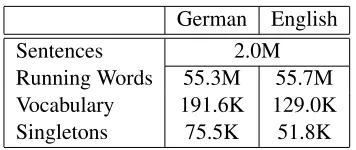
German English
Sentences 2.0M
[image:5.612.97.275.52.127.2]Running Words 55.3M 55.7M Vocabulary 191.6K 129.0K Singletons 75.5K 51.8K
Table 4: Corpus statistics of the preprocessed German-English parallel training data (Europarl and News Com-mentary). In the data, numerical quantities have been re-placed by a single category symbol.
these rules, a discriminatively trained lexical-ized reordering model is applied (Huck et al., 2012).
4 German-English Setups
We trained phrase-based and hierarchical transla-tion systems for both translatransla-tion directransla-tions of the German-English language pair. Corpus statistics for German-English can be found in Table 4. The lan-guage models are 4-grams trained on the respective target side of the bilingual data as well as on the pro-vided News Crawl corpus. For the English language model the109 French-English, UN and LDC Giga-word Fourth Edition corpora are used additionally. For the109French-English, UN and LDC Gigaword corpora we apply the data selection technique de-scribed in (Moore and Lewis, 2010). We examine two different language models, one with LDC data and one without. All German→English systems are optimized on newstest2010. For English→German, we use newstest2009 as development set. The news-test2011 set is used as test set and the scores for new-stest2008 are included for completeness.
4.1 Morpho-Syntactic Analysis
In order to reduce the source vocabulary size for the German→English translation, the German text is preprocessed by splitting German compound words with the frequency-based method described in (Koehn and Knight, 2003). To further reduce trans-lation complexity of PBT, we employ the long-range part-of-speech based reordering rules proposed by Popovi´c and Ney (2006).
4.2 Reverse Translation
For reverse translations we need to change the word order of the bilingual corpus. For example, if we
re-verse both source and target language, the original training example “der Hund mag die Katze . →the dog likes the cat .” is converted into a new training example “. Katze die mag Hund der→. cat the likes dog the”. We call this type of modification of source or target language reversion. A system trained of this data is calledreverse. This modification changes the corpora and hence the language model and align-ment training produce different results.
4.3 Experimental Results German→English
Our results for the German→English task are shown in Table 5. For this task, we apply the idea of reverse translation for both the phrase-based and the hierar-chical approach. It seems that the reversed systems perform slightly worse. However, when we em-ploy system combination using both reverse trans-lation setups (PBT reverseand HPBT reverse) and both baseline setups (PBT baselineandHPBT base-line), the translation quality is improved by up to 0.4 points in BLEUand 1.0 points TERcompared to the best single system.
The addition of LDC Gigaword corpora (+GW) to the language model training data of the baseline setups shows improvements in both BLEUand TER. Furthermore, with the system combination including these setups, we are able to report an improvement of up to 0.7 points BLEUand 1.0 points TERover the best single setup. Compared to the system combina-tion based on systems which are not using the LDC Gigaword corpora, we gain 0.3 points in BLEUand 0.4 points in TER.
4.4 Experimental Results English→German
newstest2008 newstest2009 newstest2010 newstest2011 German→English BLEU TER BLEU TER BLEU TER BLEU TER
PBT baseline 21.1 62.3 20.8 61.4 23.7 59.3 21.3 61.3
PBT reverse 20.8 62.4 20.6 61.5 23.6 59.2 21.2 61.2
HPBT baseline 21.3 62.5 20.9 61.7 23.9 59.4 21.3 61.6 HPBT reverse 21.2 63.5 20.9 62.0 23.6 59.2 21.4 61.9 system combination (secondary) 21.5 61.6 21.2 60.6 24.3 58.3 21.7 60.3 PBT baseline +GW 21.5 61.9 21.2 61.1 24.0 59.0 21.3 61.4
PBT reverse 20.8 62.4 20.6 61.5 23.6 59.2 21.2 61.2
[image:6.612.83.529.53.224.2]HPBT baseline +GW 21.6 62.3 21.3 61.3 24.0 59.4 21.6 61.5 HPBT reverse 21.2 63.5 20.9 62.0 23.6 59.2 21.4 61.9 system combination (primary) 21.9 61.2 21.4 60.5 24.7 58.0 21.9 60.2
Table 5: Results for the German→English task (truecase). +GW denotes the usage of LDC Gigaword data for the language model, newstest2010 serves as development set. BLEUand TERare given in percentage.
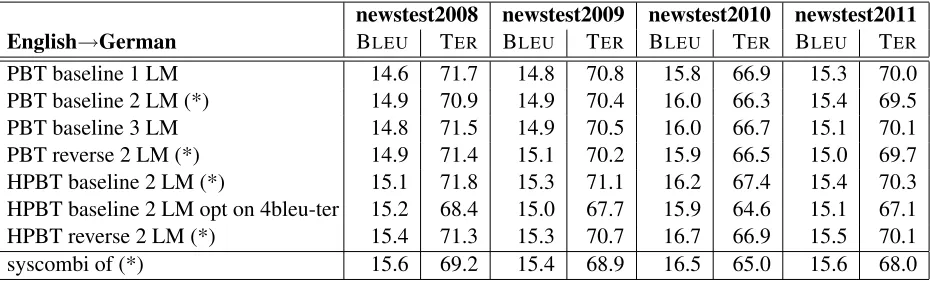
newstest2008 newstest2009 newstest2010 newstest2011 English→German BLEU TER BLEU TER BLEU TER BLEU TER
PBT baseline 1 LM 14.6 71.7 14.8 70.8 15.8 66.9 15.3 70.0 PBT baseline 2 LM (*) 14.9 70.9 14.9 70.4 16.0 66.3 15.4 69.5 PBT baseline 3 LM 14.8 71.5 14.9 70.5 16.0 66.7 15.1 70.1 PBT reverse 2 LM (*) 14.9 71.4 15.1 70.2 15.9 66.5 15.0 69.7 HPBT baseline 2 LM (*) 15.1 71.8 15.3 71.1 16.2 67.4 15.4 70.3 HPBT baseline 2 LM opt on 4bleu-ter 15.2 68.4 15.0 67.7 15.9 64.6 15.1 67.1 HPBT reverse 2 LM (*) 15.4 71.3 15.3 70.7 16.7 66.9 15.5 70.1 syscombi of (*) 15.6 69.2 15.4 68.9 16.5 65.0 15.6 68.0
Table 6: Results for the English→German task (truecase). newstest2009 is used as development set. BLEUand TER
are given in percentage.
translation for both the phrase-based and the hier-archical approach. ThePBT reverse 2 LMsystems perform slightly worse compared toPBT baseline 2 LM. TheHPBT reverse 2 LM performs better com-pared to HPBT baseline 2 LM. When we employ system combination using both reverse translation setups (PBT reverse 2 LMandHPBT reverse 2 LM) and both baseline setups (PBT baseline 2 LM and
HPBT baseline 2 LM), the translation quality is im-proved by up to 0.2 points in BLEUand 2.1 points in TERcompared to the best single system.
5 Conclusion
For the participation in the WMT 2012 shared trans-lation task, RWTH experimented with both phrase-based and hierarchical translation systems. Several different techniques were evaluated and yielded con-siderable improvements over the respective
base-line systems as well as over our last year’s setups (Huck et al., 2011b). Among these techniques are an insertion model, the noisy-or lexical scoring vari-ant, additional phrase-level lexical scores from IBM model 1 and discriminative word lexicon models, a discriminative reordering extension for hierarchical translation, reverse translation, and system combi-nation.
Acknowledgments
This work was achieved as part of the Quaero Pro-gramme, funded by OSEO, French State agency for innovation.
References
[image:6.612.75.540.267.409.2]Mathemat-ics of Statistical Machine Translation: Parameter Es-timation. Computational Linguistics, 19(2):263–311, June.
Stanley F. Chen and Joshua Goodman. 1998. An Em-pirical Study of Smoothing Techniques for Language Modeling. Technical Report TR-10-98, Computer Science Group, Harvard University, Cambridge, Mas-sachusetts, USA, August.
David Chiang. 2007. Hierarchical Phrase-Based Trans-lation. Computational Linguistics, 33(2):201–228. Adri`a de Gispert, Gonzalo Iglesias, Graeme Blackwood,
Eduardo R. Banga, and William Byrne. 2010. Hierar-chical Phrase-Based Translation with Weighted Finite-State Transducers and Shallow-n Grammars. Compu-tational Linguistics, 36(3):505–533.
Liang Huang and David Chiang. 2007. Forest Rescoring: Faster Decoding with Integrated Language Models. In
Proceedings of the 45th Annual Meeting of the Associ-ation for ComputAssoci-ational Linguistics, pages 144–151, Prague, Czech Republic, June.
Matthias Huck and Hermann Ney. 2012. Insertion and Deletion Models for Statistical Machine Trans-lation. InProceedings of the North American Chapter of the Association for Computational Linguistics -Human Language Technologies conference, Montreal, Canada, June.
Matthias Huck, Saab Mansour, Simon Wiesler, and Her-mann Ney. 2011a. Lexicon Models for Hierarchical Phrase-Based Machine Translation. In International Workshop on Spoken Language Translation, pages 191–198, San Francisco, California, USA, December. Matthias Huck, Joern Wuebker, Christoph Schmidt,
Markus Freitag, Stephan Peitz, Daniel Stein, Arnaud Dagnelies, Saab Mansour, Gregor Leusch, and Her-mann Ney. 2011b. The RWTH Aachen Machine Translation System for WMT 2011. InEMNLP 2011 Sixth Workshop on Statistical Machine Translation, pages 405–412, Edinburgh, UK, July.
Matthias Huck, Stephan Peitz, Markus Freitag, and Her-mann Ney. 2012. Discriminative Reordering Exten-sions for Hierarchical Phrase-Based Machine Transla-tion. In16th Annual Conference of the European As-sociation for Machine Translation, Trento, Italy, May. Reinhard Kneser and Hermann Ney. 1995. Improved Backing-Off for M-gram Language Modeling. In Pro-ceedings of the International Conference on Acoustics, Speech, and Signal Processing, volume 1, pages 181– 184, May.
Philipp Koehn and Kevin Knight. 2003. Empirical Meth-ods for Compound Splitting. InProceedings of Euro-pean Chapter of the ACL (EACL 2009), pages 187– 194.
Philipp Koehn, Franz Joseph Och, and Daniel Marcu. 2003. Statistical Phrase-Based Translation. In
Proc. of the Human Language Technology Conf. (HLT-NAACL), pages 127–133, Edmonton, Canada, May/June.
Evgeny Matusov, Nicola Ueffing, and Hermann Ney. 2006. Computing Consensus Translation from Multi-ple Machine Translation Systems Using Enhanced Hy-potheses Alignment. InConference of the European Chapter of the Association for Computational Linguis-tics (EACL), pages 33–40, Trento, Italy, April. E. Matusov, G. Leusch, R.E. Banchs, N. Bertoldi,
D. Dechelotte, M. Federico, M. Kolss, Y.-S. Lee, J.B. Marino, M. Paulik, S. Roukos, H. Schwenk, and H. Ney. 2008. System Combination for Machine Translation of Spoken and Written Language. IEEE Transactions on Audio, Speech and Language Pro-cessing, 16(7):1222–1237.
Arne Mauser, Saˇsa Hasan, and Hermann Ney. 2009. Ex-tending Statistical Machine Translation with Discrimi-native and Trigger-Based Lexicon Models. InProc. of the Conf. on Empirical Methods for Natural Language Processing (EMNLP), pages 210–218, Singapore, Au-gust.
Robert C. Moore and William Lewis. 2010. Intelli-gent Selection of Language Model Training Data. In
ACL (Short Papers), pages 220–224, Uppsala, Swe-den, July.
Franz Josef Och and Hermann Ney. 2003. A Systematic Comparison of Various Statistical Alignment Models.
Computational Linguistics, 29(1):19–51, March. Franz Josef Och. 2003. Minimum Error Rate
Train-ing in Statistical Machine Translation. InProc. of the 41th Annual Meeting of the Association for Compu-tational Linguistics (ACL), pages 160–167, Sapporo, Japan, July.
Kishore Papineni, Salim Roukos, Todd Ward, and Wei-Jing Zhu. 2002. Bleu: a Method for Automatic Eval-uation of Machine Translation. InProceedings of the 41st Annual Meeting of the Association for Computa-tional Linguistics, pages 311–318, Philadelphia, Penn-sylvania, USA, July.
Jan-Thorsten Peter, Matthias Huck, Hermann Ney, and Daniel Stein. 2011. Soft String-to-Dependency Hier-archical Machine Translation. InInternational Work-shop on Spoken Language Translation, pages 246– 253, San Francisco, California, USA, December. Maja Popovi´c and Hermann Ney. 2006. POS-based
Association for Machine Translation in the Americas, pages 223–231, Cambridge, Massachusetts, USA, Au-gust.
Daniel Stein, Stephan Peitz, David Vilar, and Hermann Ney. 2010. A Cocktail of Deep Syntactic Features for Hierarchical Machine Translation. InConf. of the Association for Machine Translation in the Americas (AMTA), Denver, Colorado, USA, October/November. Daniel Stein, David Vilar, Stephan Peitz, Markus Fre-itag, Matthias Huck, and Hermann Ney. 2011. A Guide to Jane, an Open Source Hierarchical Trans-lation Toolkit. The Prague Bulletin of Mathematical Linguistics, (95):5–18, April.
Andreas Stolcke. 2002. SRILM – An Extensible Lan-guage Modeling Toolkit. InProc. of the Int. Conf. on Speech and Language Processing (ICSLP), volume 2, pages 901–904, Denver, Colorado, USA, September. David Vilar, Daniel Stein, Matthias Huck, and Hermann
Ney. 2010. Jane: Open source hierarchical transla-tion, extended with reordering and lexicon models. In
ACL 2010 Joint Fifth Workshop on Statistical Machine Translation and Metrics MATR, pages 262–270, Upp-sala, Sweden, July.
David Vilar, Daniel Stein, Matthias Huck, and Hermann Ney. 2012. Jane: an advanced freely available hier-archical machine translation toolkit. Machine Trans-lation, pages 1–20. http://dx.doi.org/10.1007/s10590-011-9120-y.
Richard Zens and Hermann Ney. 2004. Improve-ments in Phrase-Based Statistical Machine Transla-tion. In Proc. Human Language Technology Conf. / North American Chapter of the Association for Com-putational Linguistics Annual Meeting (HLT-NAACL), pages 257–264, Boston, Massachusetts, USA, May. Richard Zens and Hermann Ney. 2008. Improvements