Classifying Arab Names Geographically
Hamdy Mubarak, Kareem Darwish
Qatar Computing Research Institute
Hamad Bin Khalifa University
Doha, Qatar
{
hmubarak, kdarwish
}
@qf.org.qa
Abstract
Different names may be popular in different coun-tries. Hence, person names may give a clue to a per-son’s country of origin. Along with other features, mapping names to countries can be helpful in a va-riety of applications such as country tagging twitter users. This paper describes the collection of bic Twitter user names that are either written in Ara-bic or transliterated into Latin characters along with their stated geographical locations. To classify pre-viously unseen names, we trained naive Bayes and Support Vector Machine (SVM) multi-class classi-fiers using primarily bag-of-words features. We are able to map Arabic user names to specific Arab countries with 79% accuracy and to specific regions (Gulf, Egypt, Levant, Maghreb, and others) with 94% accuracy. As for transliterated Arabic names, the accuracy per country and per region was 67% and 83% respectively. The approach is generic and language independent, and can be used to collect and classify names to other countries or regions, and considering language-dependent name features (like the compound names, and person titles) yields to better results.
1 Introduction
Geo-locating tweets and tweeps (Twitter users) has captured significant attention in recent years. Ge-ographical information is important for many ap-plications such as transliteration, social studies, di-rected advertisement, dialect identification, and Au-tomatic Speech Recognition (ASR) among others. In social studies, researchers may be interested in studying the views and opinions of tweeps for spe-cific geographical locations. Similarly, tweets can
offer a tool for linguists to study different linguistic phenomena. For ASR, training language models us-ing dialectal Arabic tweets that are associated with different regions of the Arab world was shown to reduce recognition error rate for dialectal Egyptian Arabic by 25% (Ali, et. al, 2014).
Previous work has looked at a variety of fea-tures that may geo-locate tweets and tweeps such as the dialect of tweet(s), words appearing in tweets, a tweep’s social network, etc. In this work we examine the predictive power of tweep names in predicting a tweep’s location or region of origin. We define geographic units at two different levels, namely: country level and region level. The coun-try level geographic units are defined based on po-litical boundaries regardless of the size and proxim-ity of different geographic entities. Thus, Qatar and Bahrain as well as Lebanon and Syria are consid-ered as different units. At the region level, we con-flate nearby countries into regions. Conflation was guided by previous work on dialects, where dialects were categorized into five regional language groups, namely: Egyptian (EGY), Maghrebi (MGR), Gulf (Arabian Peninsula) (GLF), Iraqi (IRQ), and Levan-tine (LEV) (Zbib et al., 2012; Cotterell et al., 2014). Sometimes, the Iraqi dialect is considered to be one of the Gulf dialects (Cotterell et al., 2014). In this paper we consider Iraq as a part of the Gulf region.
locations need to be mapped to countries. We built multiple classifiers using either a naive Bayes or a Support Vector Machine (SVM) classifier using bag-of-words features, namely word unigrams. We also considered improvements that entailed using char-acter n-gram features and word position weighting. For our work, we tried to collect tweets for all 22 Arab countries, but we did not find Arabic tweets from Mauritania, Somalia, Djibouti and Comoros. The contributions of this paper are:
1. We show that we can use Twitter as a source for collecting person names for different Arab countries by mapping user location to one of the Arab countries.
2. We show that we can build a classifier of Arabic names at the county level or region level with reasonable accuracy.
3. we show the characteristics of Arabic names and how they differ among different countries or regions.
The paper is organized as follows: Section 2 sur-veys previous work on person name classification; Section 3 describes some features of Arabic names including dialectal variation in transliteration; sec-tion 4 describes how names are collected from Twit-ter, cleaned and classified; section 5 shows results of name classification experiments; and Section 6 contains conclusion and future work.
2 Previous Work
The problem of classifying names at country level is not well explored. As far as we know, there are no studies for Arabic person name classifica-tion. Some work has been done on clustering and classifying person names by origin like (Fei et al., 2005), where they used the LDC bilingual person name lists to build a name clustering and classifica-tion framework. They considered that several ori-gins may share the same pattern of transliteration and applied their technique to a name transliteration task by building letter n-gram language models for source and target languages. They clustered names into typical origin clusters (English, Chinese, Ger-man, Arabic., etc.).
Balakrishnan (Balakrishnan, 2006) extracted a list of person names from the employee database
of a multinational organization covering 9 countries: US, UK, France, Germany, Canada, Japan, Italy, In-dia, and China. Equal number of names is chosen from each country (1,000 names for each). He used pattern search for first and second names and used k-nearest neighbor and Levenshtein edit distance to measure the distance between two names. He re-ported a classification accuracy = 0.67 for super-vised training set and 0.63 for unsupersuper-vised training set.
Fu et al. (Fu et al., 2010) mentioned that hu-mans often identify correctly the origins of person names, and there seem to be distinctive patterns in names to distinguish origins. They constructed an ontology containing all linguistic knowledge that can directly contribute to language origin identifica-tion, and this was employed for the analysis of name structure. They reported an average performance of 87.54% using ME-based language identifier for 8 languages (Arabic, Chinese, English, French, Ger-man, Japanese, Russian, and Spanish-Portuguese).
Rao et al. (Rao et al., 2010) classified the la-tent user attributes including gender, age, regional origin, etc., using features like n-grams models and number of followers/followees (in a social graph in-formation) among others.
Mahmud et al. (Mahmud et al., 2012) collected tweets using the geo-tag filter option on Twitter un-til they received tweets from 100 unique users from the top 100 cities in US. They used this corpus for inferring home locations of users at the level of their cities. They reported a recall of 0.7 for 100 cities.
Huang et al. (Huang et al., 2014) discussed the challenges of detecting the nationality of Twitter users using profile features and they studied the ef-fectiveness of different features for inferring nation-alities. They reported an accuracy of 83.8% for these nationality groups: Qatari, Arabs, Western, South-east Asia, Indian, and Others. They mentioned that due to the unbalanced data distribution, the perfor-mance of less populated groups is not very high. We observe similar results in this paper.
3 Person Names in Arabic
3.1 Compound Names
of 2 or 3 words. We refer here to single names with more than one word as ‘compound names’. There are some words such as
é<Ë@
(Allh1– meaning“God”) and
áKYË@
(Aldyn – meaning “religion”) that trail other words as iné<Ë@ YJ.«
(Ebd Allh – mean-ing “slave of Allah”) constructmean-ing the name “Abdul-lah” and as ináKYË@ hC
(SlAH Aldyn – mean-ing “perfection of religion”) constructmean-ing the name “Salahudin” (Saladin). In some countries, father and family names are often preceded by words meaning “son of” such asáK.
(bn),áK.@
(Abn) orYËð
(wld) or the wordÈ@
(|l – meaning family of). An exam-ple that combines the aforementioned variations of compound names is the name of the former king of Saudi ArabiaXñª È@ QK QªË@ YJ.« áK. é<Ë@ YJ.«
(Ebd Allh bn Ebd AlEzyz |l sEwd – “Abdullah ibn Ab-delaziz Aal Saud”). A list of common words used in compound names are listed in table 1. When processing the names in our collection, we heuris-tically split the full names into single Arabic names, whether compound or not. As in the previous exam-ple,Xñª È@ QK QªË@ YJ.« áK. é<Ë@ YJ.«
(Ebd Allh bn Ebd AlEzyz|l sEwd), it was split into:é<Ë@ YJ.«
(Ebd Allh),QK QªË@ YJ.« áK.
(bn Ebd AlEzyz), andXñª È@
(|l sEwd). The heuristic involved always attaching the words marked in Table 1 aspre to the trailing words and ones that are marked as post to preceding words.Type Word Example
Pre ÈñQË@ ,ÐCB@ , áKYË@ ,é<Ë@ Allh,
Aldyn, Al<slAm, Alrswl syf AlÐCB@ J<slAm
Post ,YJ.« , áK. , áK.@ , I K. ,Ð@,ñK.@,AK.@,úG.@,ñK.
YËðEbd, bn, Abn, bnt,>m,>bw,
>bA,>by, bw, wld
QåA K I K. YÒm× YËð bnt nASr, wld mHmd
Table 1: Words that are parts of a name.
3.2 Dialectal Variations of Names
Names in Arabic are normally written without dia-critics, and when they are transliterated, these hid-den diacritics are shown in addition to dialectal dif-ferences in pronunciation among countries as shown
1Buckwalter transliteration is used exclusively in the paper
in table 2. Since we are classifying names that are written in both Arabic and Latin scripts, spelling variations can perhaps be helpful in ascertaining the country/region of origin.
3.3 Religion and Gender
Names can also be indicative of other attributes such as religion and gender. For example, the names
èXñ J
($nwdp – “Shnouda”),ámÌ'@ YJ.«
(Ebd AlH-syn – “Abdul Hussein”), andQÔ«
(Emr – “Omar”) are typically Coptic, Shia, and Sunni respectively. And for gender, feminine names frequently end with@ ,ø ,Z@ , è
(p, A’, Y, A), such aséÒ£A ¯
(FaTmp – “Fatima”) andZA Jë
(hnA’ – “Hannah”). Second names, either father or family names, are mostly masculine. Though guessing a tweep’s religion and gender are interesting, such is beyond the scope of this paper.Name Variations Phonetic
Mapping
Yg.AÓ
(mAjd) g/jMaged (EGY), Majed (GLF)
àAÒJ«
(EvmAn) s/thOsman (EGY), Othman (GLF)
¬Qå @
(A$rf) sh/chAsharf (EGY), Achraf (MGR)
Yê ¯
(fhd) diacriticsFahd (EGY), Fahad (GLF)
ÉJ»ñË@
(Alwkyl) Determiner [image:3.595.74.290.519.608.2]ElWakil (EGY),AlWakil (GLF)
Table 2: Dialectal effects on Transliteration.
4 Data Collection
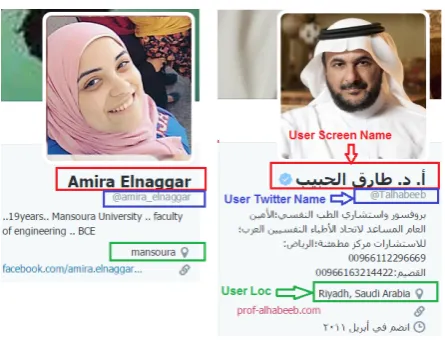
Twitter user profiles contain user-declared informa-tion like: Twitter account name, screen name(user name), user location, description, etc. User names are normally written in Arabic or Latin characters, and user locations are written in full or abbreviated, formal or informal, etc. as shown in Figure 1.
We used the Twitter4J2 interface to the Twitter
API to collect Arabic tweets during the whole of
Figure 1: User Profile Information
March 2014. We searched using the query “lang:ar”, which indicates any Arabic tweet. In all we col-lected 175 million tweets that were authored by 5.5 million unique tweeps. We used the users self-declared locations to map them to countries. We mapped the locations using the GeoNames3
geo-graphical database, which contains 8M place names and a database of of the most commonly used 10,000 user locations on Twitter (Mubarak et al., 2014). If the location referred to two or more different coun-tries, as in “UK and Kuwait”, it was removed. User location was successfully mapped to one of the Arab countries for 1M unique user names. After name cleaning (described later in this section), we have 170 thousand Namesarband 182K Namestrans that
are considered as valid names and mapped to only one country.
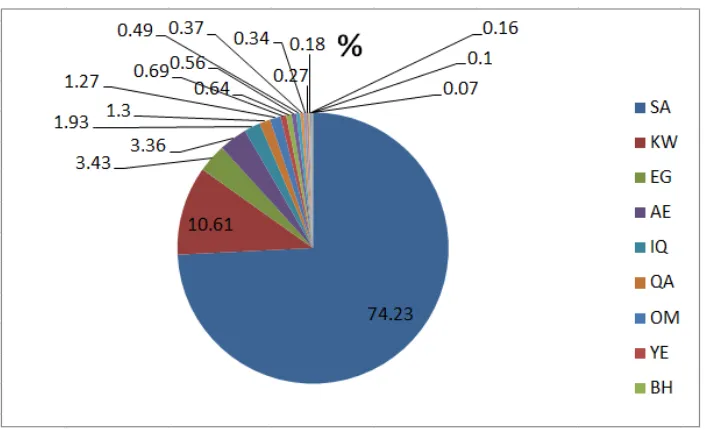
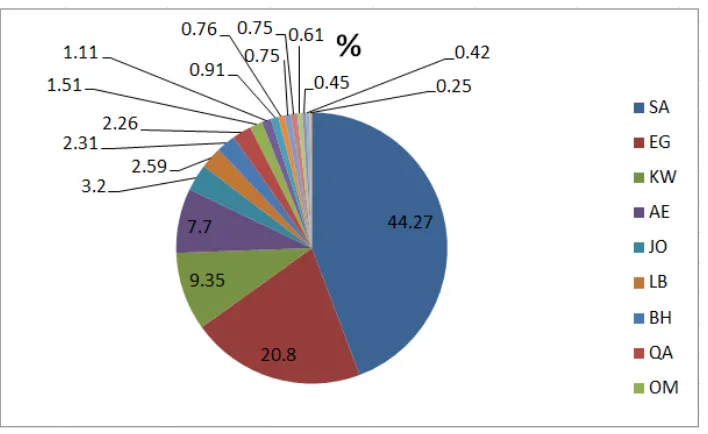
Per-country distributions are shown in Figure 2 and Figure 3. One of the interesting observations from these figures is that people from Saudi Arabia (SA4) are the majority in both cases, and they tend
to write their names in Arabic, while people from Egypt (EG) tend to write their names as transliter-ated. We opted not to limit our collection to tweeps who have geo-tagged tweets (tweets with latitude and longitude), because geo-tagged tweets represent less than 1% of the total number of tweets5. We
found that 0.3% of the collected tweets are
geo-3http://www.geonames.org
4We use ”ISO 3166-1 alpha-2” for country codes 5 http://thenextweb.com/2010/01/15/twitter-geofail-023-tweets-geotagged/
[image:4.595.70.293.103.274.2]tagged.
Table 3 shows some examples of the collected names. We took samples of 200 random names from each set and found that 70% of the names are real and the rest are unreal person names (fake). We plan to identify fake names from real names in future.
Name cleaning included ignoring words that are composed of single letters, special characters out-side the Arabic or the Latin alphabets, entries that are single words only, and entries having stopwords. Names were normalized in the manner described by Darwish et al. (2012), which involved removing dia-critics, kashidas, normalizing different forms of alef, ya and alef maqsoura, and ha and ta marbouta, and mapping letters from other languages such as Farsi that use the Arabic script to Arabic letters. Further, titles, such as Dr., and numbers were removed. We also identified compound names as described earlier. For example, the user name ”Dr. Abdullah Bin Fa-had AL MUTAIRI1973” will be normalized to ”ab-dullah bin fahad al mutairi”.
User name Real/Unreal
ú GA¢j®Ë@ ÈC£ (TlAl AlqHTany), Bassam Jawad
Real names
ù ®»ð é®J K@(Anyqa wKfY), Sweet Boy Unreal names
Table 3: Examples of user names
5 Name Classification Experiments
Given the 170K Namesarb and 182K Namestrans
that we collected, we randomly split the set into 80/20 training and testing splits. We used word uni-grams as features. We also examined giving first and last names different weights and character trigrams as a back-off for unseen words. Further, we trained two classifiers namely a Naive Bayes classifier and an SVM classifier. When using a Naive Bayes clas-sifier and a name was not observed during training in general or for a class, we used KenLM language modeling toolkit to compute the smoothing proba-bility of it (Heafield, 2011).
re-Figure 2: Country Distribution for Namesarb
sults in term of accuracy. Precision for the majority class would be identical to the overall accuracy and recall would be one. Precision and recall would be zero for all the other classes.
Name type Accuracy
NamesarbCountry 74.2%
NamesarbRegion 91.4%
NamestransCountry 44.3%
[image:5.595.122.476.103.320.2]NamestransRegion 67.4%
Table 4: Baseline Results
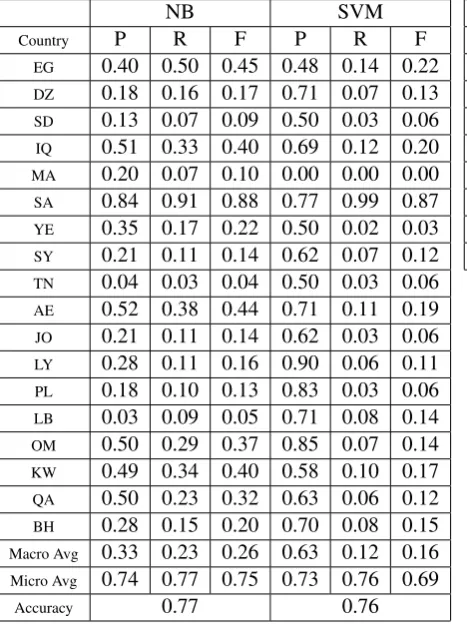
Table 5 and Table 6 show the results for Namesarb
per country and per region respectively using word unigrams only. Similarly, Table 7 and Table 8 show the results for Namestrans per country and per
re-gion respectively using word unigrams only. Micro and Macro averages refer to computing metrics per test example or taking the average of per country re-sults respectively. As can be seen, the naive Bayes classifier performed better than SVM classifier for the vast majority of countries and in overall accu-racy and F-measure. Mostly the SVM classifier had higher precision with less recall.
In further experiments, we exclusively used the naive Bayes classifier. We tried two modifications of the classifier. The first involved giving different weights to different single names in the full name,
such that a person’s last name would get a higher weight than his/her first name. The intuition is that different countries may have different common fam-ily names that may indicate their place of origin, family, or tribe. The weight of the word based on its position is determined using the following formula:
weighti= no of single names1 −i+1
Where i ranged between 1 and number of single names in the full name. Thus the last single name would get a weight of 1 and all previous single names would get a weight of 1/2, 1/3, etc. (from end to beginning).
The second entailed using a character trigram model as a back-off for out of vocabulary words, which were not seen during training. We used KenLM to train a trigram character model using all the names in the training set (Heafield, 2011).
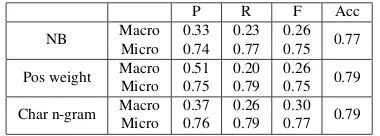
Table 9 and Table 10 compare the plain Bayesian classifier with using the classifier with single name weighting and character trigram back-off for Namesarb at country and region level respectively.
Table 11 and Table 12 compare the same for Namestrans. As the results show, both methods
[image:5.595.105.258.422.495.2]Figure 3: Country Distribution for Namestrans
6 Conclusion and Future Work
In this paper, we presented our work on classify-ing person names based on their country or region. To construct training data, we collected Twitter user names that authored Arabic tweets with their asso-ciated self-declared locations, which we mapped to Arab countries and regions. We experimented with Bayesian and SVM classifiers and the Bayesian clas-sifier outperformed the SVM clasclas-sifier most of the time. Adding position information and back-off to a character trigram model for names not observed dur-ing traindur-ing generally improved results. Classifydur-ing user names at region level generally yielded better results than at country level.
Because majority of user names written in Arabic are from the Gulf region (93%), the classification improvement above the majority baseline was not that big, but when we applied the same approach for classifying transliterated user names, we achieved an increase of the accuracy by 52% and 20% at the country level and group level in order, and an in-crease in the F-measure by 135% and 46% at the country level and region level in order.
In future, we want to incorporate the user name feature in conjunction with other features in the con-text of geo-locating Twitter users. We need to test our engine for classifying names collected for each country from outside Twitter, think in other ways to
collect user names from regions like the Maghreb, and detect more information from user profile like the gender and religion.
References
Ahmed Ali, Hamdy Mubarak, Stephan Vogel. 2014. Ad-vances in Dialectal Arabic Speech Recognition: A Study Using Twitter to Improve Egyptian ASR. Inter-national Workshop on Spoken Language Translation (IWSLT 2014).
Balakrishnan, Raju. 2006. Country wise classification of human names. Proceedings of the 5th WSEAS Int. Conf. on Artificiall Intelligence, Knowledge Engineer-ing and Data Bases, Madrid, 2006.
Ryan Cotterell and Chris Callison-Burch. 2014. A Multi-Dialect, Multi-Genre Corpus of Informal Written Ara-bic. LREC-2014, pages 241–245.
Kareem Darwish, Walid Magdy, and Ahmed Mourad. 2012. Language processing for arabic microblog re-trieval. Proceedings of the 21st ACM international conference on Information and knowledge manage-ment. ACM, 2012.
Huang, Fei, Stephan Vogel, and Alex Waibel. 2005. Clus-tering and classifying person names by origin. Pro-ceedings of the National Conference on Artificial In-telligence. Vol. 20. No. 3. Menlo Park, CA; Cam-bridge, MA; London; AAAI Press; MIT Press; 1999, 2005.
Determin-NB SVM
Country P R F P R F
EG 0.40 0.50 0.45 0.48 0.14 0.22
DZ 0.18 0.16 0.17 0.71 0.07 0.13
SD 0.13 0.07 0.09 0.50 0.03 0.06
IQ 0.51 0.33 0.40 0.69 0.12 0.20
MA 0.20 0.07 0.10 0.00 0.00 0.00
SA 0.84 0.91 0.88 0.77 0.99 0.87
YE 0.35 0.17 0.22 0.50 0.02 0.03
SY 0.21 0.11 0.14 0.62 0.07 0.12
TN 0.04 0.03 0.04 0.50 0.03 0.06
AE 0.52 0.38 0.44 0.71 0.11 0.19
JO 0.21 0.11 0.14 0.62 0.03 0.06
LY 0.28 0.11 0.16 0.90 0.06 0.11
PL 0.18 0.10 0.13 0.83 0.03 0.06
LB 0.03 0.09 0.05 0.71 0.08 0.14
OM 0.50 0.29 0.37 0.85 0.07 0.14
KW 0.49 0.34 0.40 0.58 0.10 0.17
QA 0.50 0.23 0.32 0.63 0.06 0.12
BH 0.28 0.15 0.20 0.70 0.08 0.15
Macro Avg 0.33 0.23 0.26 0.63 0.12 0.16 Micro Avg 0.74 0.77 0.75 0.73 0.76 0.69
Accuracy 0.77 0.76
Table 5: NamesarbResults per country
ing the Origin and Structure of Person Names. LREC. 2010.
Heafield, Kenneth. 2011. KenLM: Faster and Smaller Language Model Queries. Proceedings of the EMNLP 2011 Sixth Workshop on Statistical Machine Transla-tion. pp 187–197
Huang, Wenyi, Ingmar Weber, and Sarah Vieweg. 2014. Inferring nationalities of Twitter users and studying inter-national linking. Proceedings of the 25th ACM conference on Hypertext and social media. ACM, 2014.
Mahmud, Jalal, Jeffrey Nichols, and Clemens Drews. 2012. Where Is This Tweet From? Inferring Home Lo-cations of Twitter Users. ICWSM. 2012.
Hamdy Mubarak, Kareem Darwish. 2014. Using Twit-ter to collect a multi-dialectal corpus of Arabic. ANLP 2014.
Rao, Delip, David Yarowsky, Abhishek Shreevats, Man-aswi Gupta. 2010. Classifying latent user attributes in twitter. Proceedings of the 2nd international workshop on Search and mining user-generated contents. ACM, 2010.
Rabih Zbib, Erika Malchiodi, Jacob Devlin, David
NB SVM
Country P R F P R F
EGY 0.40 0.50 0.45 0.48 0.14 0.22
GLF 0.96 0.96 0.96 0.94 0.99 0.97
LEV 0.19 0.14 0.16 0.70 0.05 0.09
MGR 0.24 0.13 0.17 0.65 0.05 0.09
OTHER 0.29 0.14 0.19 0.50 0.02 0.04 Macro Avg 0.42 0.38 0.39 0.66 0.25 0.28 Micro Avg 0.92 0.92 0.92 0.92 0.94 0.91
[image:7.595.72.306.108.425.2]Accuracy 0.92 0.94
Table 6: NamesarbResults per region
NB SVM
EG 0.68 0.78 0.73 0.68 0.43 0.53
DZ 0.18 0.19 0.18 0.33 0.08 0.14
SD 0.22 0.14 0.17 0.26 0.05 0.08
IQ 0.15 0.12 0.14 0.25 0.04 0.08
MA 0.38 0.27 0.32 0.50 0.23 0.32
SA 0.71 0.80 0.75 0.54 0.94 0.68
YE 0.00 0.00 0.00 0.50 0.01 0.02
SY 0.22 0.10 0.14 0.18 0.02 0.03
TN 0.29 0.32 0.30 0.46 0.16 0.24
AE 0.43 0.33 0.37 0.50 0.16 0.24
JO 0.38 0.24 0.29 0.39 0.07 0.13
LY 0.03 0.10 0.05 0.33 0.01 0.03
PL 0.13 0.08 0.10 0.22 0.01 0.02
LB 0.48 0.42 0.45 0.54 0.31 0.39
OM 0.61 0.40 0.48 0.69 0.13 0.22
KW 0.54 0.40 0.46 0.52 0.18 0.27
QA 0.44 0.23 0.31 0.75 0.06 0.11
BH 0.45 0.28 0.34 0.46 0.09 0.15
Macro Avg 0.35 0.29 0.31 0.45 0.17 0.20 Micro Avg 0.60 0.62 0.61 0.55 0.55 0.49
[image:8.595.72.294.109.413.2]Accuracy 0.62 0.55
Table 7: NamestransResults per country
NB SVM
EGY 0.68 0.78 0.73 0.68 0.43 0.53
GLF 0.88 0.86 0.87 0.77 0.94 0.85
LEV 0.51 0.35 0.42 0.59 0.17 0.27
MGR 0.25 0.38 0.30 0.57 0.22 0.31
OTHER 0.22 0.10 0.14 0.15 0.04 0.06 Macro Avg 0.51 0.50 0.49 0.55 0.36 0.40 Micro Avg 0.79 0.79 0.79 0.73 0.75 0.72
Accuracy 0.79 0.75
Table 8: NamesarbResults per region
P R F Acc NB MacroMicro 0.330.74 0.230.77 0.260.75 0.77
Pos weight MacroMicro 0.510.75 0.200.79 0.260.75 0.79
[image:8.595.323.509.156.225.2]Char n-gram MacroMicro 0.370.76 0.260.79 0.300.77 0.79
Table 9: Namesarb Results by country for plain Naive
Bayes, position weighting, and char n-gram back-off
P R F Acc NB MacroMicro 0.420.92 0.380.92 0.390.92 0.92
Pos weight MacroMicro 0.590.93 0.340.94 0.390.93 0.94
[image:8.595.319.510.371.436.2]Char n-gram MacroMicro 0.470.93 0.380.93 0.410.93 0.93
Table 10: Namesarb Results by country for plain Naive
Bayes, position weighting, and char n-gram back-off
P R F Acc NB MacroMicro 0.350.60 0.290.62 0.310.61 0.62
Pos weight MacroMicro 0.480.62 0.270.65 0.320.61 0.65
[image:8.595.71.299.457.585.2]Char n-gram MacroMicro 0.450.63 0.300.66 0.350.63 0.66
Table 11: NamestransResults by country for plain Naive
Bayes, position weighting, and char n-gram back-off
P R F Acc NB MacroMicro 0.510.79 0.500.79 0.490.79 0.79
Pos weight MacroMicro 0.640.80 0.460.81 0.500.80 0.81
Char n-gram MacroMicro 0.610.81 0.500.82 0.530.81 0.82
Table 12: NamestransResults by country for plain Naive
[image:8.595.320.509.581.649.2] [image:8.595.86.276.625.693.2]