http://www.scirp.org/journal/ajcm ISSN Online: 2161-1211 ISSN Print: 2161-1203
DOI: 10.4236/ajcm.2017.73023 Aug. 28, 2017 291 American Journal of Computational Mathematics
Topological Design via a Rule Based Genetic
Optimization Algorithm
David Webb1, Qian Liu2, Wissam Alobaidi2*, Eric Sandgren2#
1Axalta Coating Systems, Front Royal, USA
2Systems Engineering Department, Donaghey College of Engineering & Information Technology, University of Arkansas at Little Rock, Little Rock, USA
Abstract
A topological structural design approach is presented which is based upon the implementation of a two phase evolutionary optimization algorithm in con-junction with a finite element analysis code. The first phase utilizes a conven-tional genetic approach which performs a global search for the optimal design topology. Dual level material properties are specified within the genetic encod-ing and are applied to each individual element in the design mesh to represent either design material or a void. The second phase introduces a rule based re-finement which allows for user design intent to accelerate the solution process and eliminate obvious design discrepancies resulting from the phase one search. A series of plate design problems are presented where the objective is to minim-ize the overall volume of the structure under predefined loading and constraint conditions. The constraints include both stress and deflection considerations where stress is calculated through the use of a commercial finite element pack-age. The initial plate example incorporates a coarse mesh, but a gradual decrease in element size was employed for the remaining cases examined. Replacement of the phase one search with a set of randomly generated designs is demon-strated in order to form a greatly reduced design space which drastically in-creases the efficiency of the solution process. Comparison results are drawn between the conventional genetic algorithm and the two phase procedure.
Keywords
Topological Design, Structural Optimization, Genetic Optimization, Variable Material Design
1. Introduction
Structural optimization has evolved considerably over the years to the point
How to cite this paper: Webb, D., Liu, Q., Alobaidi, W. and Sandgren, E. (2017) To-pological Design via a Rule Based Genetic Optimization Algorithm. American Journal of Computational Mathematics, 7, 291-320.
https://doi.org/10.4236/ajcm.2017.73023 Received: July 22, 2017
Accepted: August 23, 2017 Published: August 28, 2017
Copyright © 2017 by authors and Scientific Research Publishing Inc. This work is licensed under the Creative Commons Attribution International License (CC BY 4.0).
http://creativecommons.org/licenses/by/4.0/
DOI: 10.4236/ajcm.2017.73023 292 American Journal of Computational Mathematics where it now represents an important design tool. During this evolution, progress has been made on the analysis side, the optimization side and the coor-dination between analysis and optimization. From the very beginning, structural optimization was viewed as a computationally intensive task and much of the effort was placed on efficiency. The implementation of sensitivity analysis for generating gradient information for size and shape optimization is one aspect of this early work. A review of the history as well as progress in structural optimi-zation up to the turn of the century is available from a number of sources [1] [2] [3] [4] and [5]. The push to extend structural optimization into the topological realm resulted in several interesting new approaches. Most notably, the work of Bendsoe [2] introduced the concept of homogenization and material density variation. This work was important as the logical design approach is to consider an initial mass of material and to shape it in the optimal form for the design cri-teria imposed. Several alternative approaches were also introduced, building upon this concept, and taken as a whole; they define a design strategy based on the implementation of a genetic or evolutionary algorithm.
DOI: 10.4236/ajcm.2017.73023 293 American Journal of Computational Mathematics The discretized nature of computational structural analysis provides a direct link to the encoding used in a genetic optimization algorithm. If each element is represented by an individual position in the chromosome, topological modifica-tion can be carried out by removing or adding individual elements. The removal of elements may easily be handled through the assignment of a weak material property which effectively eliminates the element, but does not require any re-meshing. Using this approach, a region, or allowable design space, can be identified and meshed into elements. The genetic algorithm will then select the elements required for the design topology which best satisfies the design criteria and constraints. Often, however, the result of an evolutionary structural optimi-zation contains obvious flaws that an experienced designer would not allow. This is a result of the fact that a mathematical abstraction of the “real” design problem is being operated on by the optimization algorithm. In order to elimi-nate these design flaws, some knowledge of the structural design process must be embedded within the optimization process. Overall, the encoding or chromo-some string of a traditional genetic algorithm is proportional to the complexity of the problem, however knowledge based encoding approach is independent of problem size and does not proportionally grow in complexity. A smaller know-ledge based encoding scheme eliminates traditional genetic algorithm solution flaws, increases solution convergence time, and provides feedback to the end us-er regarding which key features of information wus-ere the most essential when de-riving the final solution.
The fields of expert systems and neural networks may be utilized in order to capture elements of the manual design process. This may, however, limit the de-sign to known techniques and procedures which removes the possibility of creating a novel or revolutionary design. The best of both worlds would be a process which exploits the benefits of a global optimization process, but is guided or influenced by domain specific knowledge. This is possible within the framework of a genetic algorithm. This process may well maintain the global nature of the search as well as to allow for an adaptive framework over time as rules are modified to improve performance. A simple framework is presented, but this framework provides a rich development platform for more sophisticated structural design optimization approaches.
DOI: 10.4236/ajcm.2017.73023 294 American Journal of Computational Mathematics two phase genetic algorithm for robust topological design is developed herein. A series of design problems utilizing plate elements is presented and the results of the two phase algorithm are contrasted to those generated by a traditional ge-netic algorithm. Only loading conditions, restraints and geometric boundaries are specified for each problem.
2. Background
The plate optimization procedure considered here operates through the assign-ment of different material properties throughout a predefined meshed design re-gion. In order to simplify the concept, only two different material property val-ues are introduced. For a plate design, the logical material property to consider is the modulus of elasticity. The first material property value represents the in-tended design material such as that for steel or aluminum. The second material property value corresponds to an extremely weak material which adds little to the structural integrity of the design. The utilization of a weak material allows for extreme topological change to occur without requiring a re-mesh for the elements and eliminates the problem of generating a singular stiffness matrix. The stiffness matrix for the finite element analysis of the design is assembled with material property information provided by the genetic encoding on an ele-ment by eleele-ment basis. The final topology of the design may be identified by simply removing the elements formed of the weak material. This is not intended to provide a final, highly detailed design, but rather a topology which may be re-fined in order to generate such a design.
The plate design process investigated incorporates a genetic algorithm pro-grammed in Microsoft Visual Basic [14], and CAEFEM [15], a finite element solver which performs a linear static analysis for each design topology considered. The plate design mesh is constructed using Femap [16], a three dimensional CAD package, which generates a neutral file that the finite element solver can read and evaluate. This neutral file [17] documents the geometry as well as all of the material properties and other parameters of each plate design investigated. The genetic algorithm generates designs through the alteration of the material property of each plate element within the selected neutral file. The alteration of material properties can generate a realm of diverse topological designs, where each design is processed by altering the neutral file and passing it on to the finite element solver. The element stresses and the nodal deflections are computed by the finite element solver and subsequently, this information is utilized to eva-luate the objective function and constraints which are defined by the optimiza-tion formulaoptimiza-tion. The specific form of objective funcoptimiza-tion in this applicaoptimiza-tion was chosen to be the minimization of the total volume of a plate based design subject to predefined loading and constraint conditions. Stress and displacement limits served as structural constraint bounds.
DOI: 10.4236/ajcm.2017.73023 295 American Journal of Computational Mathematics As the number of elements increases, the complexity as well as the time required for solution by the optimization algorithm increases significantly. On the other hand, the number of elements required to define the fundamental design topol-ogy will generally be considerably below that required for a detailed design anal-ysis. Another approach is to limit the optimization to a specific region of a de-sign, where the topology of other regions is already fully defined. Meshing at several levels of detail is considered in the examples which follow. This is some-what equivalent to the refinement provided by a variable length encoding [13] which could be implemented in order to automate the overall process. The fun-damental question which must be addressed is whether a rule based genetic al-gorithm is capable of solving a realistic structural design problem with a rea-sonable amount of computational effort. The process is inherently parallel in nature which could lead to significant reduction in computational time but not in computational effort. Extensions to problems involving three dimensional solid objects are straightforward, using the same design optimization strategy with an expanded genetic encoding.
3. Problem Formulation and Phase One
Two separate genetic optimization formulations are introduced. The first represents a traditional encoding, where each element in the defined structural region has its own binary variable in the encoding string. This formulation is developed in this section. The development of the rule based extension follows in the next section. The plate design examples investigated were all subjected to identical stress and displacement constraint conditions. Each plate design was also restricted to the same spatial design volume, although the discretization lev-el or lev-element size was varied. The dimensions of the spatial design volume con-sisted of eighteen cm in the x direction, thirteen cm in the y direction, and a thickness of 0.5 cm in the z direction. Directional forces consisting of 67 new-tons in the x, y and z directions were applied at coordinate locations (15, 3.25, 0.5) and (12, 9.75, 0.5) where the units are in cm and the origin is at the lower left corner of the bottom surface of the specified plate design volume. The use of multidirectional forces allow for an optimal yet robust topological design to be acquired. The concept of robust design optimization has been effectively dem-onstrated by Sandgren and Cameron [18] for truss structures as well as an au-tomotive inner body panel. Mesh sizes ranged from twenty four to two hundred thirty four elements. The maximum allowable stress constraint was set at 140 MPa and a maximum allowable displacement constraint was defined to be 0.635 cm. The objective function used to evaluate each design is based upon the amount of volume removed from the original mesh. This objective function val-ue is equal to the total element volume of weak material present in each design as specified by the genetic algorithm encoding.
DOI: 10.4236/ajcm.2017.73023 296 American Journal of Computational Mathematics
(
) (
)
Maximize volume=
∑
Volumei * Encoding valuei (1)1, ,
i= ⋅⋅⋅ number of elements
subject to
( )
lim max(
)
lim
Constra int Constra int Calculated 0 Constra int
it i
it
g x = − ≥
(2)
where i= ⋅⋅⋅1, , number of constraints
( )
1
g x correlates to stress and g2
( )
x displacementThe encoding value for each element has a value of zero if the element is as-signed to the design material and one if it is asas-signed to the weak design materi-al. This way, the summation of volume to be maximized in Equation (1) consists of the total volume of weak material elements, or alternatively, the volume of material removed. In the constraint equations, Slimit and Dlimit are the maximum
allowable stress and displacement values while Smax(calculated) and Dmax
(calcu-lated) are the maximum computed values for the design being analyzed over all of the elements considered. The formulation of Equation (2) generates ratios, which allow for normalization of constraint violation in the disparate magni-tudes of the displacement and stress values as well as to allow for a consistent graphical representation over the diverse set of designs within each genetic pop-ulation. Both constraint equations produce positive values for any design which does not exceed the design limits.
Material properties of each plate element were designated to be either the in-tended design material, AISI 4340 steel, or a substantially weaker material with a modulus of elasticity of 2 MPa. Additionally, Poisson’s Ratio was assigned a val-ue of 0.32 for all elements in each plate design investigated. The modulus for the weak material may be defined as any reasonably small value as long as it is sig-nificantly less than that of the selected design material. The main function of this material property is to prevent the formulation of a singular stiffness matrix within the finite element algorithm and to avoid the necessity of re-meshing the design region. The assumption is made that low stress magnitudes in plate ele-ments assigned the weak material property are deemed to be practically non-existent. Steel material properties were represented the by the encoding value of 0, while weak material properties are assigned the encoding value of 1. These as-signed numeric values correspond to defined material properties generated within Femap which are encoded within the genetic algorithm for material property manipulation of each element. A sample string is shown below for a ten element plate.
Sample string {0, 1, 1, 0, 0, 0, 1, 0, 0, 1}
DOI: 10.4236/ajcm.2017.73023 297 American Journal of Computational Mathematics the search.
Based upon the structure of the sample string, an initial set of designs are generated randomly and the genetic algorithm methodology begins. Both cros-sover and mutation operations are applied by the genetic algorithm, and ulti-mately new generations of offspring or designs are formed. The method of cros-sover involves the selection of two parent designs where material properties or chromosomes within each chosen design string are interchanged at a random position, forming two new offspring designs. Parent designs are selected ran-domly, based on their overall fitness value, which considers the value of the ob-jective function as well as any constraint violation. A single numeric value for each design is formed through the use of an exterior penalty function. Using the penalty function allows parent design strings which meet or exceed predefined constraint values to be assigned an overall fitness value solely based upon the objective function value. Parent designs which fail to meet the constraint crite-ria, are reduced in value by a penalty function. A typical penalty function is represented by the equation
( )
( )
{
( )
}
2–
i i
P x = f x R
∑
g x (3)for i = 1,⋅⋅⋅, number of constraints where
( )
{
}
( )
( )
{
}
( )
( )
0; 0; 0
i i
i i i
g x for g x
g x g x for g x
= ≥
= <
In this equation, f(x) represents the objective function value at the design point x, which specifies how much material was removed from the spatial design region. The penalty factor, R is a numeric value which continually increases from an initial value by a user specified amount as the optimization proceeds. This allows an early exploration phase where some constraint violation is al-lowed, but builds a penalty over time so that later designs are pulled toward the feasible design region. Lastly, the array gi(x) represents the constraint value for
each of the defined constraints. Additional background on penalty function theory and operation is provided by Gen and Cheng [19]. The penalty function or specific fitness value for each population member determines which members of the population are best suited for producing new design offspring, resulting in the term parent designs. An in depth discussion of parent selection as well as the genetic optimization process is given by Goldberg [20] and Davis [21].
DOI: 10.4236/ajcm.2017.73023 298 American Journal of Computational Mathematics random search rather than an ordered search. Toward the end of the search process, most progress is made through mutation as most of the design content in the original population of designs has been exploited or lost. In a computa-tionally expensive problem environment, such as structural design, it is impor-tant to have a reasonable mutation rate as the population size must be limited.
Once the crossover of traits between parent designs has been completed, stresses and displacements for each of the offspring designs are calculated and evaluated in the stress and displacement constraint functions. Element stresses and nodal displacements are immediately available once the finite element anal-ysis algorithm, CAEFEM, has completed the analanal-ysis. Now the evolutionary process has commenced. This evolutionary process begins with the selection of new parent designs from the current generation. Once all parent designs have bred new offspring, one generation has been completed. The total number of generations of offspring produced is a user specified variable, which is application specific. The effectiveness of a specified set of input parameter values may be observed through feedback from the graphical user interface.
4. Phase Two
The second phase of the optimization process is designed to refine the best de-sign or dede-signs from the phase one search through the implementation of do-main specific knowledge provided by the user in the form of rules. These rules are created by the user and encoded into a design string similar to the element selection string within the phase one search. Upon the conclusion of phase one, a global search has been performed which should result in a reasonably good de-sign, which is at or close to a feasible design topology. Since by nature, the ge-netic optimization process tends to make good progress early in the optimiza-tion, the location of a set of reasonable design points does not require many generations to be executed in the phase one search. Alternatively, the phase one search can be done away with entirely and replaced by a set of randomly gener-ated designs. While this process may lead to a local minimum, depending upon the diversity of the randomly selected designs generated, it allows for large problems to be solved using the greatly reduced encoding length of the rule based search. The alternatives supported by the two phase design optimization methodology lead to a rich set of alternatives which can be implemented to bal-ance computational effort with the scope of the global search.
DOI: 10.4236/ajcm.2017.73023 299 American Journal of Computational Mathematics Figure 1. Phase two operation layout.
This specific encoding example consists of ten columns, where each column or block position contains information that is necessary in order to execute one or more of the rules. This particular encoding method allows for up to three rules to be executed simultaneously. The first position in the encoding string termines how many rules are to be executed in order to modify the current de-sign. This leaves three groups of three block positions to provide the information necessary to execute specific rules. The first of the three block position values determines which rule to execute. The second and third block position values provide any additional information necessary to execute the selected rule (i.e. specific element to manipulate). This encoding method is repeated throughout the remaining two block sets which compose the remainder of the encoded row. This encoding methodology provides the foundation for the development of sign strings which are injected into the genetic algorithm to refine the best de-sign(s) from phase one. Phase two has the ultimate goal of determining the best rule sequence, from a global perspective, which refines a previously located de-sign point from the phase one search or the current dede-sign(s) in the phase two search.
Five rules were developed for demonstrating the operation of the phase two search process. Each rule works independently or in a synchronized manner with multiple rules in order to achieve an improvement in the objective function which is to reduce the overall volume of the current plate design. Listed below are the five rules developed.
1) Rule one indicates that for a randomly selected element, the material prop-erty is switched from its current material propprop-erty to its opposite (i.e. weak ma-terial property to the design mama-terial property or vice versa).
2) Rule two switches the material properties of two randomly selected plate elements with one another.
3) Rule three locates the element of maximum stress. Upon the location of the element of maximum stress, if applicable, the optimizer alters the weak material property of the element to the design material property.
4) Rule four locates the element of maximum displacement, and alters the material property of the element to the design material property if the current material property was designated a weak material.
5) Rule five locates the element of minimum stress and switches the material property to the weak material property if the design material property was in-itially present.
DOI: 10.4236/ajcm.2017.73023 300 American Journal of Computational Mathematics provides the information required to process the rules for a given topological plate design. In all cases, the first of the three block positions represents the rule number, which is an integer from one to five. The second block position is an integer representing the element number selected for modification (when re-quired) and the third block position is only applicable for rule number two where it is an integer identifying the second element number selected for rule execution.
In order to clarify the interpretation of the rule encoding, consider the fol-lowing string.
{
}
Sample string= 3, 2,12, 56, 5, 21,13,1, 33, 44
As the first position has a value of three, all three rules represented by the string will be executed on the current plate design. The next three blocks in the encoding designate that rule two is to be executed which will exchange the ma-terial properties of elements twelve and fifty-six. The next block of three values indicates that rule five will be executed which relies on stress information from the finite element analysis (element of maximum stress) and therefore does not require the values in the following two fields (21 and 13). The material property of the element which has the maximum stress value will be altered to the design material if it is not already designated as such. The final three fields will execute rule 1 which will alter the material property of the thirty third elements to the value opposite the current setting. The last position, 44, is not required in order to execute this rule. The three modifications are made to the design and then it is evaluated for objective function and constraint values. If the design is improved, it is saved for future consideration by the genetic algorithm.
Other rules than those specified may be more effective in the phase two process, but the algorithm will adapt through the genetic process to locate the best rules and combination of rules. The rules are controlled by the genetic algo-rithm which in turn is utilized to modify a previously specified plate design. It should be noted that the rules are not required to be good design rules. For ex-ample, rule number four may be seen to be of limited value since the reduction of displacement at a nodal position will be influenced by all elements along the load path and particularly, those elements close to a ground position. The beauty of the rule based process is that good rules will be executed and bad rules will be avoided as the search progresses. At the end of the search, the user can see which rules or combination of rules lead to design improvements during the search. This can lead to rule refinement or even the discovery of a new design strategy. This links the process closely with learning and memory which are fundamental to any successful design process.
5. Results
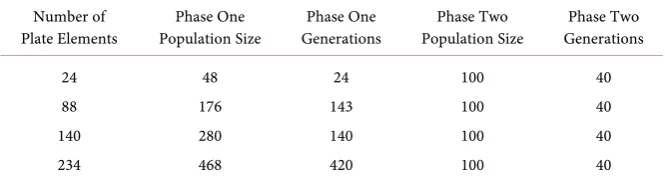
DOI: 10.4236/ajcm.2017.73023 301 American Journal of Computational Mathematics Table 1. Overview of population and generation sizes assigned to each plate considered.
Number of Plate Elements Phase One Population Size Phase One Generations Phase Two Population Size Phase Two Generations 24 88 140 234 48 176 280 468 24 143 140 420 100 100 100 100 40 40 40 40
offspring utilized for both the phase one and phase two search processes are do-cumented in Table 1. From this table, it is noted that both the population size as well as the number of generations required increased as the number of elements increased in the phase one search. These parameters for the phase two search remained constant, regardless of the number of plate elements contained in the design space mesh. This is a direct correlation to the length of the encoding string which increases for phase one as the number of elements increases, but remains fixed for the phase two search component. This once again shows the promise of the design process using a rule based approach. Regardless of the size of the problem, the phase two search remains the same, reduced size. The results for each of the four mesh densities will be reviewed in detail. The phase one search is equivalent to a traditional genetic optimization, while the two phase search procedure represents the rule based, global search process.
6. Example One
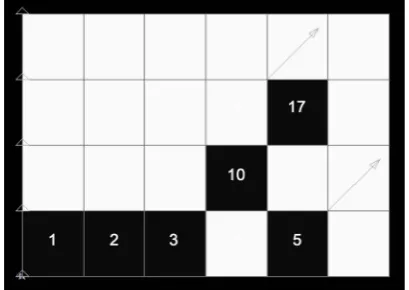
The first example utilized a twenty four element mesh to fill the designated de-sign space with the predefined loading and constraint conditions established for all of the examples. The 0.5 cm. thick plate is fixed in all directions along the left edge, and two nodal forces were applied which consisted of sixty seven Newtons in the x, y, and z directions. A maximum stress constraint of 140 MPa and a maximum displacement constraint of 0.635 cm. were imposed as well. The phase one population size and number of generations produced were 48 and 24 respec-tively. The resulting plate design from the phase one search is illustrated in Fig-ure 2. The dark shaded regions within Figure 2 represent the elements which were assigned the design material. The light regions indicate elements which were assigned the weak material and are treated as voids. The element number-ing proceeds from left to right by rows, startnumber-ing at the bottom row. The final ob-jective function value for the design shown in Figure 2 was 67.25 cm3. This
represents the volume removed from the original design region.
DOI: 10.4236/ajcm.2017.73023 302 American Journal of Computational Mathematics Figure 2. Phase one solution.
Figure 3. Phase two solution.
constraints or by other means [19][20][21] and [22]. This issue is not dealt with on the examples presented as only the design topology is desired and refinement of this topology is considered as a separate task. While the result pictured in Figure 2 from the phase one search contains elements that are beyond the point of force application, the phase two result does not contain such elements. The total volume removed for this design is improved to a total of 87.75 cm3. The
results remain rather crude due to the selected course mesh size and this leads to the question of whether the design would improve with a decreased mesh size.
Graphical representations for both displacement and stress versus element number are provided below in Figure 4 and Figure 5 upon the conclusion of phase two operation. The cyclical nature of the plots is a direct result of the ele-ment numbering scheme. The eleele-ments of highest stress and displaceele-ment are identified as element one and element five respectively. The maximum stress and displacement values fall slightly below the values allowed for the design. The large mesh size does not allow for the removal of any more material as eliminat-ing one additional element would have lead to a design which violated the con-straints. This once again is an indication that further improvement might be possible with a finer mesh.
DOI: 10.4236/ajcm.2017.73023 303 American Journal of Computational Mathematics Figure 4. Displacement versus plate element.
Figure 5. Stress versus plate element.
[image:13.595.206.536.501.702.2]DOI: 10.4236/ajcm.2017.73023 304 American Journal of Computational Mathematics Figure 7. Constraint versus generation.
Figure 8. Objective function versus generation.
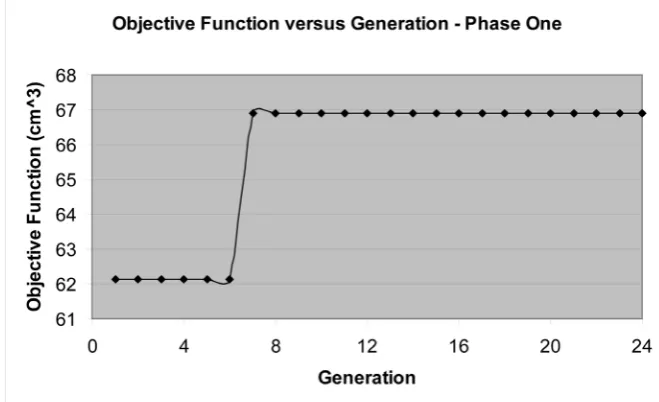
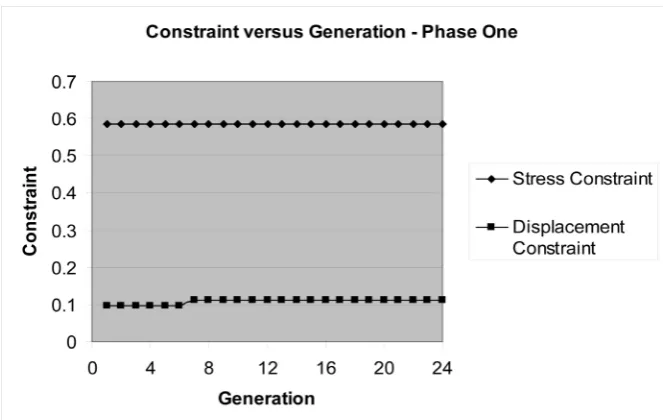
rithm behavior for the phase one search process. These graphical representations correspond to the final solution illustrated in Figure 2. Figure 6 indicates that the solution was located by the eighth generation and Figure 7 indicates that both the displacement and stress constraints were satisfied. The displacement constraint can be seen to be near its prescribed bound, while the stress constraint is far from being active.
Figure 8 and Figure 9 provide the solution history for the phase two search process. Figure 8 contains a plot of the objective function for each generation of designs produced and from this plot it can be seen that little improvement in the phase one design is produced after the tenth generation. The resulting objective function from the phase two search was enhanced from 68.25 cm3 to 87.75 cm3
DOI: 10.4236/ajcm.2017.73023 305 American Journal of Computational Mathematics Figure 9. Constraint versus Generation.
limit compared to the phase one solution.
7. Example 2
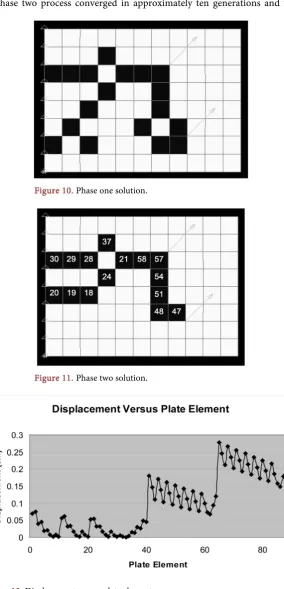
The first decrease in the mesh size for the prescribed design region resulted in an increase in the number of plate elements from twenty-four to eighty-eight. All other design parameters remained at identical levels as in the previous design example. Solutions for both the phase one and phase two search are provided below in Figure 10 and Figure 11.
An examination of Figure 10 compared to the phase one solution for the course mesh from Figure 2 shows a significant change in the design topology. The objective function value was improved from the previous phase one solution of 68.25 cm3 to a value of 93.07 cm3. A more refined design was located upon the
conclusion of the phase two search which is illustrated in Figure 11. The phase two search solution improved the objective function value to 97.06 cm3 and
re-moved extraneous elements from the phase one solution. The element identifi-cation numbers are provided for the elements formed from the actual design material in Figure 11, which correlate to the graphical representations for the element stress and displacement values.
The displacement and stress values for each plate element upon the conclu-sion of the phase two search process are presented graphically in Figure 12 and Figure 13. The nodal numbering scheme which is determined by the mesh ge-nerator makes it more difficult to identify specific element values, but it is clear from these graphs that both stress and displacement values are below the speci-fied design limits. This once again points toward the possibility of a reduced mesh size allowing for even more material removal.
DOI: 10.4236/ajcm.2017.73023 306 American Journal of Computational Mathematics been produced and the displacement constraint was active at the phase one de-sign solution.
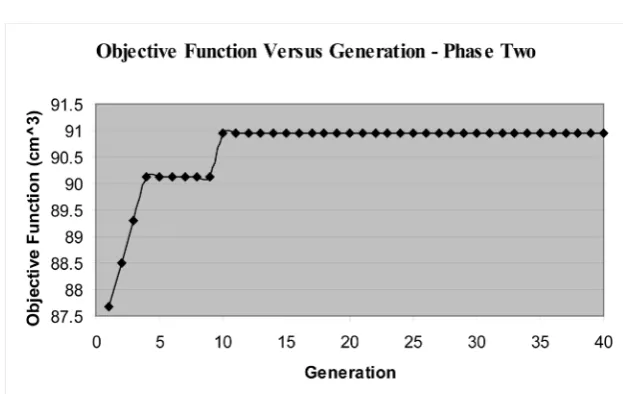
[image:16.595.232.517.122.713.2]The phase two optimization progress is plotted in Figure 16 and Figure 17. The phase two process converged in approximately ten generations and while
[image:16.595.265.481.142.303.2]Figure 10. Phase one solution.
Figure 11. Phase two solution.
[image:16.595.214.528.516.700.2]DOI: 10.4236/ajcm.2017.73023 307 American Journal of Computational Mathematics Figure 13. Stress versus plate element.
Figure 14. Objective function versus generation.
DOI: 10.4236/ajcm.2017.73023 308 American Journal of Computational Mathematics Figure 16. Objective function versus generation.
Figure 17. Constraint versus generation.
neither the stress nor displacement constraints were fully active, the design stress is approaching the specified limiting value. In this design exercise, the phase two search resulted in a more modest reduction of additional material, but the re-sulting design can be seen to be more refined in nature. The other interesting point of note is that the phase two result reduced the amount of material quired for the design while increasing the safety margin of the design with re-spect to both displacement and stress criteria.
8. Example 3
DOI: 10.4236/ajcm.2017.73023 309 American Journal of Computational Mathematics Figure 18. Phase one solution.
Figure 19. Phase two solution.
examination of Figure 18 reveals that the phase one global search solution had several disassociated elements in the final design as well as elements beyond the load application points which are both indicators of the level of difficulty this size problem presents for a traditional genetic algorithm in locating a refined solution. Once again, the phase two solution remedies the design discrepancies and produces a fairly refined design.
Graphical representations of displacement and stress values for each plate element in the final design after the phase two operation are provided in Figure 20 and Figure 21. From these plots it can be seen that both constraints are satis-fied, although both are approaching the design limits imposed on the optimiza-tion formulaoptimiza-tion.
The behavior of the genetic algorithm is presented graphically for the phase one solution in Figure 22 and Figure 23. An objective function value of 88.59 cm3 was located after approximately one hundred twenty generations of phase
DOI: 10.4236/ajcm.2017.73023 310 American Journal of Computational Mathematics Figure 20. Displacement versus plate element.
Figure 21. Stress versus plate element.
[image:20.595.216.530.494.702.2]DOI: 10.4236/ajcm.2017.73023 311 American Journal of Computational Mathematics Figure 23. Constraint versus generation.
Figure 24. Objective function versus generation.
needs to be increased, but this would have a dramatic impact upon the solution time required. The constraint value versus generation graph displayed in Figure 23 reveals that the final phase one design satisfied both the stress and displace-ment constraint criterion.
Graphical representations of the phase two search process are illustrated within Figure 24 and Figure 25. Only ten generations were required to reach the final design solution. The objective function value was increased from 88.59 cm3 to 92.76 cm3 while maintaining acceptable stress and displacement design
criterion. Once again, the volume of material removed is slightly worse than for the previous example. Both displacement and stress constraints are shown to be satisfied throughout the phase two process in Figure 25.
9. Example 4
[image:21.595.215.527.265.462.2]DOI: 10.4236/ajcm.2017.73023 312 American Journal of Computational Mathematics Figure 25. Constraint versus generation.
Figure 26. Phase one solution.
Figure 27. Phase two solution.
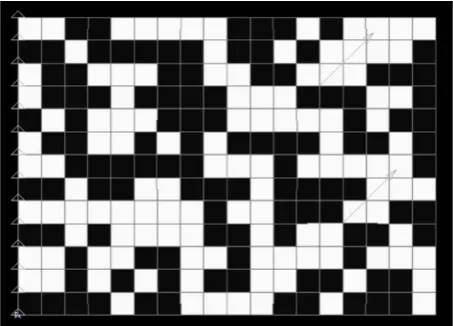
[image:22.595.260.485.481.648.2]solu-DOI: 10.4236/ajcm.2017.73023 313 American Journal of Computational Mathematics tions. The phase one result is difficult to interpret as the final topology is not as well defined as for the previous plate examples considered. This fact is attributed to the substantial increase in the number of plate elements in this example which magnifies the difficulty in generating a solution through the use of a traditional genetic algorithm. Conversely, the phase two design shown in Figure 27 represents reasonable design solution, where elements are reconfigured and connected with surrounding elements and are no longer located beyond the de-fined nodal loading conditions. This is perhaps the best indicator of the power of the phase two approach as significant redesign was necessary in order to refine the phase one solution.
Displacement and stress values versus plate element number are presented graphically in Figure 28 and Figure 29. Both the displacement constraint and the stress constraint are seen to be active.
[image:23.595.216.523.310.486.2]Objective function and constraint values versus generation graphs are pro-vided below which plot the progress of the phase one genetic optimization
Figure 28. Displacement versus plate element.
[image:23.595.214.532.513.711.2]DOI: 10.4236/ajcm.2017.73023 314 American Journal of Computational Mathematics Figure 30. Objective function versus generation.
Figure 31. Constraint versus generation.
search. A steady increase in the objective function value for the phase one search is noted in Figure 30; however converged constraint values are not as evident within Figure 31, even after 400 generations. Additional generations might con-tinue to slowly improve the objective function. The final objective function value attained upon the conclusion of the phase one search was 60.00 cm3. This is
sig-nificantly below the values reported previously for the larger mesh sizes and once again demonstrates the traditional phase one genetic search process is not adequate to solve a problem with this number of elements with a limited popula-tion size. From Figure 31 it is noted that both stress and displacement con-straints are active at the conclusion of the phase one search.
Figure 32 and Figure 33 below display the phase two genetic behavior for both objective function value and constraint values versus generation. The ob-jective function was increased to a value of 94.00 cm3 in less than ten generations
DOI: 10.4236/ajcm.2017.73023 315 American Journal of Computational Mathematics Figure 32. Objective function versus generation.
Figure 33. Constraint versus generation.
made during the phase one search process. Additionally, the constraint versus generation graph illustrated in Figure 33, is clearly indicates that both design constraints are active at the solution.
10. Extensions and Further Insight
[image:25.595.217.531.283.462.2]DOI: 10.4236/ajcm.2017.73023 316 American Journal of Computational Mathematics problem formulation. This brings up the issue of how much, if any, of a phase one search is required in the topological optimization. The other issue which deserves some additional consideration is the post evaluation of the rule usage during the phase two search process. Both of these issues will be addressed briefly.
In order to test the algorithm with a limited phase one search component, the 88 element plate problem was revisited. A phase one search was conducted with an extremely limited population size, 25, and for only 25 generations. The best final population member was then passed directly to the phase two search process which utilized a population size of 100 rule strings for a total of 40 gen-erations. The final topology from the phase two search is presented in Figure 34. The final amount of material removed was 98.38 cm3. This is actually slightly
higher than the final two phase solution presented in Example 2, although the final topology is very similar to that presented in Figure 11. The objective func-tion value and the constraint values versus generafunc-tions conducted in the phase two search process are documented in Figure 35 and Figure 36. Thus by reduc-ing the total phase one function and constraint evaluations by over a factor of 40, did not damage the value of the final result. The limit of the reduction of the phase one search would be to stop the phase one search after the first generation which would produce a set of randomly generated designs. Utilizing this ap-proach, the design space, or encoding length in the genetic algorithm, for a mesh containing tens of thousands of elements would be on the order of ten or twenty elements. Solving this size problem repeatedly, is demonstrated to be and ex-pected to be far more efficient with respect to the number of function and con-straint evaluations.
[image:26.595.264.483.548.706.2]The issue of which rules are implemented and which of those rules were suc-cessfully utilized in the solution process provides an important look at how the general topological optimization process can be improved over time. The distri-bution of rule utilization for the solution of the 88 element problem with the re-duced phase one search is shown in Figure 37. It was mentioned in the early discussion in the selection of the rules that rule number four was not constructed
DOI: 10.4236/ajcm.2017.73023 317 American Journal of Computational Mathematics Figure 35. Objective function versus generation.
Figure 36. Constraint versus generation.
Figure 37. Rule Distribution for Successful Design Moves.
[image:27.595.232.513.484.641.2]DOI: 10.4236/ajcm.2017.73023 318 American Journal of Computational Mathematics rule. The distribution of the remaining four rules shows a dominance of rule number five, and lesser dependence on rules one, two and three. This means that for this particular case, the search was improved most often through the removal of material in regions of low stress. This is not an unexpected result, but the usefulness of building some randomness into the rule base is documented by the high rate of use of rules one and two. The interesting part of the rule develop-ment process over time, is that a better understanding of the optimization and design process is developed. This is a rare feature among any topological opti-mization procedure.
These insights to the rule development process and the ability to reduce or eliminate the phase one search process highlight the promise of the rule based approach. The implementation tested is one of a wide variety of similar algo-rithms which could have been constructed. Further understanding of the rule development process is needed as well as additional testing on larger topological design problems. The post process review of the successful rule distribution could be expanded to include rule interactions which would also provide useful design information. Based on the results achieved to date, however, the method promises to provide an effective design tool for structural design which provides insights into the solution process that are unavailable by most other approaches. The process represents a unique combination of an evolutionary search which is guided by domain specific knowledge.
11. Summary and Conclusions
The inclusion of domain specific knowledge in the form of design rules was im-plemented within the framework of a genetic algorithm and tested on a series of structural design problems involving plates. Each problem was subjected to identical boundary and loading conditions as well as the same original prede-fined design volume. The problems involved four different mesh sizes for the prescribed design region. The topology was defined by the assignment of ma-terial property values to each of the elements through the genetic encoding of the optimization algorithm. Two material values were assigned, a normal value for the intended design material and a value which represents a significantly weaker material which represents a void.
The results clearly demonstrate the lack of effectiveness of the traditional ge-netic algorithm implemented for the phase one search for this class of problems. The final designs generated by the phase one search are “dirty designs” as they contain obvious design flaws. The convergence of the phase one search was found to be slow which made it difficult to assign the population size required for a true global search to be performed. As the mesh was refined to form small-er elements, the problem size increased to the point whsmall-ere a reliable solution could not be located through the phase one search alone.
DOI: 10.4236/ajcm.2017.73023 319 American Journal of Computational Mathematics search. This process was found to require a very small number of generations, even when the number of elements assigned to the design region grew. The re-sult from the phase one search was improved by the phase two search in all de-sign cases considered. The issue of the topology generated as the number of ele-ments increased was interesting. When relatively few eleele-ments were assigned, the final design was easily defined and clearly related to the design generated by the phase one search. As the number of elements increased, the final design to-pology represented a better design (less weight), but as the number was in-creased farther, the final design actually dein-creased in the measure of quality.
The level of difficulty certainly increases with the number of elements consi-dered and this may partially explain this phenomena. Another possibility is that the topology is shifting from a global level to a microscopic level of detail. With large elements, the fundamental form of the structure is the major result. The approach clearly does not generate a final detailed design, but a clear topology is evident from which to form a final design. As the mesh is formed of smaller ele-ments, the topology shifts to a finer grain which actually allows for more of a grain type structure to be formed such as that represented by a foam or matrix material containing small patterns of voids. Additional experimentation will be required in this area.
The two phase approach can be implemented in a host of different ways and the effectiveness of the resulting algorithm may improve in the process. Certain-ly, however, the initial results are promising. Completing the phase one search before implementing the phase two process may not be as efficient as a mixture of the phase one and phase two search where the phase two process operates on the entire phase one population. The development and representation of rules is also an area which requires further experimentation. The use of the rule history for improvement of the process is also an open area for further research. In any case, the basic methodology has been demonstrated and shown to be an effective approach to topological optimization. It certainly exceeds the performance of a traditional genetic based approach.
References
[1] Vanderplaats, G.N. (1997) Structural Optimization: Where We’ve Been and Where We’re Going. In: Hernandez, S. and Brebbia, G.A., Eds., Computer Aided Optimum Design of Structures V, Computational Mechanics Publications, Berlin, 45-54. [2] Bendsoe, M.P. and Kikuchi, N. (1988) Generating Optimal Topologies in Structural
Design Using a Homogenization Method. Computer Methods in Applied Mechan-ics and Engineering, 71, 197-224. https://doi.org/10.1016/0045-7825(88)90086-2
[3] Sandgren, E. (1997) Robust Shape Optimal Design with Consideration of Variation. In: Hernandez, S. and Brebbia, G.A., Eds., Computer Aided Optimum Design of Structures V, Computational Mechanics Publications, Berlin, 287-297.
[4] Alobaidi, W., Sandgren, E. and Alkuam, E. (2017) Decision Support through Intel-ligent Agent Based Simulation and Multiple Goal Based Evolutionary Optimization.
Intelligent Information Management, 9, 97-113.
DOI: 10.4236/ajcm.2017.73023 320 American Journal of Computational Mathematics [5] Alobaidi, W.M., Webb, D.J. and Sandgren, E. (2017) A Rule Based Evolutionary
Optimization Approach for the Traveling Salesman Problem. Intelligent Informa-tion Management, 9, 115-132. https://doi.org/10.4236/iim.2017.94006
[6] Sandgren, E. and Jensen, E. (1992) Automotive Structural Design Employing a Ge-netic Optimization Algorithm. SAE Technical Paper Series, Article ID: 920772. [7] Kicinger, R., Arciszewski, T. and DeJong, K. (2005) Evolutionary Computation and
Structural Design: A Survey of the State of the Art. Computers and Structures, 83, 1943-1978. https://doi.org/10.1016/j.compstruc.2005.03.002
[8] Xie, Y.M. and Steven, G.P. (1997) Evolutionary Structural Optimization. Sprin-ger-Verlag, Berlin. https://doi.org/10.1007/978-1-4471-0985-3
[9] Eschenauer, H.A. and Olhoff, N. (2001) Topology Optimization of Continuum Structures: A Review. Applied Mechanics Reviews, 54, 331-389.
https://doi.org/10.1115/1.1388075
[10] Mackerle, J. (2003) Topology and Shape Optimization of Structures Using FEM and BEM—A Bibliography (1999-2001). Finite Elements in Analysis and Design, 39, 243-253. https://doi.org/10.1016/S0168-874X(02)00071-9
[11] Yang, X.Y., Xie, Y.M., and Steven, G.P. (2005) Evolutionary Methods for Topology Optimization of Continuous Structures with Design Dependent Loads. Computers and Structures, 83, 956-963. https://doi.org/10.1016/j.compstruc.2004.10.011
[12] Yang, X.Y. and Xie, Y.M. (1999) Bidirectional Evolutionary Method for Stiffness Optimization. AIAA Journal, 37, 1483-1488. https://doi.org/10.2514/2.626
[13] Kim, I.Y. and de Weck, O.L. (2005) Variable Length Chromosome Length Genetic Algorithm for Progressive Refinement in Topology Optimization. Structural and Multidisciplinary Optimization, 29, 445-456.
https://doi.org/10.1007/s00158-004-0498-5
[14] Microsoft Corporation (1998) Microsoft Visual Basic Version 6.0, Microsoft Cor-poration, Washington DC.
[15] Concurrent Analysis Corporation (1998) Getting Started with CAEFEM Version 4.0, Concurrent Analysis Corporation, Encino.
[16] Femap (2002) http://www.eds.com/products/plm/unigraphics/ds/femap/
[17] Enterprise Software Products Inc. (1996) Femap Neutral File Format, Enterprise Software Products Inc.
[18] Sandgren, E. and Cameron, T.M. (2002) Robust Design Optimization of Structures through the Consideration of Variation. Computers and Structures Publications, 1605-1613. https://doi.org/10.1016/S0045-7949(02)00160-8
[19] Gen, M. and Cheng, R.W. (1997) Genetic Algorithms & Engineering Design. John Wiley & Sons Inc., New York.
[20] Goldberg, D.E. (1989) Genetic Algorithms in Search, Optimization and Machine Learning. Addison-Wesley, Boston.
[21] Davis, L. (1991) Handbook of Genetic Algorithms. Van Nostrand Reinhold, New York.
Submit or recommend next manuscript to SCIRP and we will provide best service for you:
Accepting pre-submission inquiries through Email, Facebook, LinkedIn, Twitter, etc. A wide selection of journals (inclusive of 9 subjects, more than 200 journals)
Providing 24-hour high-quality service User-friendly online submission system Fair and swift peer-review system
Efficient typesetting and proofreading procedure
Display of the result of downloads and visits, as well as the number of cited articles Maximum dissemination of your research work
Submit your manuscript at: http://papersubmission.scirp.org/