Memory-Based Acquisition of Argument Structures and its Application to
Implicit Role Detection
Christian ChiarcosandNiko Schenk Applied Computational Linguistics Lab Goethe University Frankfurt am Main, Germany
{chiarcos,n.schenk}@em.uni-frankfurt.de
Abstract
We propose a generic, memory-based ap-proach for the detection of implicit se-mantic roles. While state-of-the-art meth-ods for this task combine hand-crafted rules with specialized and costly lexical resources, our models use large corpora with automated annotations forexplicit se-mantic roles only to capture the distri-bution of predicates and their associated roles. We show that memory-based learn-ing can increase the recognition rate of im-plicit roles beyond the state-of-the-art. 1 Introduction
Automated implicit semantic role labeling (iSRL) has emerged as a novel area of interest in the re-cent years. In contrast to traditional SRL, which aims to detect events (e.g., verbal or nominal predicates) together with their associated seman-tic roles (agent, theme,recipient, etc.) as overtly realized in the current sentence, iSRL extends this analysis with locallyunexpressedlinguistic items. Hence, iSRL requires to broaden the scope beyond isolated sentences to the surrounding discourse. As an illustration, consider the following example from Roth and Frank (2013):
El Salvador is now the only Latin Ameri-can country which still has troops in [Iraq]. Nicaragua, Honduras and the Dominican Repub-lic have withdrawn their troops [∅].
In the second sentence, a standard SRL parser would ideally identifywithdrawas the main ver-bal predicate. In its thematic relation to the other words within the same sentence, all countries serve as the overtly expressed (explicit) agents, and are thus labeled as arguments A0.1
Seman-tically, they are the action performers, whereas
1For details on all PropBank labels used in our study, see Palmer et al. (2005).
troopswould carry the patient role A1 as the entity which undergoes the action of being withdrawn. However, given these explicit role annotations for A0 and A1 in the second sentence, the standard system would definitely fail to infer the underly-ing, linguistically unexpressed, i.e., non-overt re-alization of animplicitargument ofwithdraw (de-noted by [∅]) about source information. Its corre-sponding realization is associated withIraqin the preceding sentence, which is outside of the scope of any standard SRL parser. The resulting implicit role has the label A2.
Many role realizations are suppressed on the surface level. The automated detection of such im-plicit roles and their fillers, which are also called
null instantiations(NIs) (Fillmore, 1986; Ruppen-hofer, 2005), is a challenging task. Yet, if un-covered, NIs provide highly beneficial ‘supple-mentary’ information which in turn can be incor-porated into practical, downstream NLU applica-tions, like automated text summarization, recog-nizing textual entailment or question answering.
Current issues in iSRL Corpus data with
man-ually annotated implicit roles is extremely sparse and hard to obtain, and annotation efforts have emerged only recently; cf. Ruppenhofer et al. (2010), Gerber and Chai (2012), and also Feiz-abadi and Pad´o (2015) for an attempt to enlarge the number of annotation instances by combina-tion of scarce resources. As a result, most state-of-the-art iSRL systems cannot be trained in a super-vised setting and thus integrate custom, rule-based components to detect NIs (we elaborate on related work in Section 2). To this end, a predicate’s overt roles are matched against a predefined predicate-specific template. Informally, all roles found in the template but not in the text are regarded as null in-stantiations. Such pattern-based methods perform satisfactorily, yet there are drawbacks:
(1) They are inflexible and absolute according to
their type, in that they assume that all candidate NIs are equally likely to be missing, which is unre-alistic given the variety of different linguistic con-texts in which predicates co-occur with their se-mantic roles.
(2) They are expensive in that they require hand-crafted, idiosyncratic rules (Ruppenhofer et al., 2011) and rich background knowledge in the form of language-specific lexical resources, such as FrameNet (Baker et al., 1998), PropBank (Palmer et al., 2005) or NomBank (Meyers et al., 2004). Dictionaries providing information about each predicate and status of the individual roles (e.g., whether they can serve as implicit elements or not) are costly, and for most other languages not avail-able to the same extent as for English.
(3) Most earlier studies heuristically restrict im-plicit arguments to core roles2 only (Tonelli and
Delmonte, 2010; Silberer and Frank, 2012), but this is problematic as it ignores the fact that im-plicit non-core roles also provide valid and valu-able information. Our approach remains agnostic regarding the role inventory, and can address both core and non-core arguments. Yet, in accordance with the limited evaluation data and in line with earlier literature, we had to restrict ourselves to evaluate NI predictions for core arguments only.
Our contribution We propose a novel, generic
approach to infer information about implicit roles which does not rely on the availability of manually annotated gold data. Our focus is exclusively on
NI role identification, i.e., per-predicate detection of the missing implicit semantic role(s) given their overtly expressed explicit role(s) (without finding filler elements) as we believe that it serves as a crucial preprocessing step and still bears great po-tential for improvement. We treat NI identification
separatelyfrom the resolution of their fillers, also because not all NIs are resolvable from the con-text. In order to facilitate a more flexible mech-anism, we propose to condition on the presence of other roles, and primarily argue that NI de-tection should be probabilistic instead of
rule-based. More specifically, we predict implicit
ar-guments using large corpora from which we build a background knowledge base of predicates, co-occurring (explicit) roles and their probabilities. With such amemory-basedapproach, we
gener-2Coreroles are obligatory arguments of a predicate. Infor-mally,non-coreroles are optional arguments often realized as adjuncts or modifiers.
alize over large quantities of explicit roles to find evidence for implicit information in a mildly su-pervised manner. Our proposed models are largely domain independent, include a sense distinction for predicates, and are not bound to a specific re-lease of a hand-maintained dictionary. Our ap-proach is portable across languages in that train-ing data can be created ustrain-ing projected SRL anno-tations. Unlike most earlier approaches, we em-ploy a generic role set which is based on Bank/NomBank rather than FrameNet: The Prop-Bank format comprises a relatively small role in-ventory which is better suited to obtain statisti-cal generalizations than the great variety of highly specific FrameNet roles. While FrameNet roles seem to be more fine-grained, their greater num-ber arises mostly from predicate-specific semantic roles, whose specific semantics can be recovered from PropBank annotations by pairing semantic roles with the predicate.
Yet another motivation of our work is related to the recent development of AMR parsing (Ba-narescu et al., 2013, Abstract Meaning Represen-tation) which aims at modeling the semantic rep-resentation of a sentence while abstracting from syntactic idiosyncrasies. This particular appraoch makes extensive use of the PropBank-style frame-sets, as well, and would greatly benefit from the integration of information on implicit roles.
The paper is structured as follows: Section 2 outlines related work in which we exclusively fo-cus on how previous research has handled the sole identification of NIs. Sect. 3 describes our approach to probabilistic NI detection; Sect. 4 presents two experiments and their evaluation; Sect. 5 concludes our work.
2 Related Work
In the context of the 2010 SemEval Shared Task on Linking Events and Their Participants in Dis-course3 on implicit argument resolution,
Ruppen-hofer et al. (2010) have released a data set of fic-tion novels with manual NI role annotafic-tions for diverse predicates. The data has been referred to by various researchers in the community for di-rect or indidi-rect evaluation of their results. The NIs in the data set are further subdivided into two categories: Definite NIs (DNIs) are locally unex-pressed arguments which can be resolved to ele-ments in the proceeding or following discourse;
Indefinite NIs (INIs) are elements for which no an-tecedent can be identified in the surrounding con-text.4 Also, the evaluation data comes in two
fla-vors: a base format which is compliant with the FrameNet paradigm and a CoNLL-based Prop-Bank format. Previous research has exclusively focused on the former.
Chen et al. (2010) present an extension of an ex-isting FrameNet-style parser (SEMAFOR) to han-dle implicit elements in text. The identification of NIs is guided by the assumption that, whenever the traditional SRL parser returns the default label in-volved in a non-saturated analysis for a sentence, an implicit role has to be found in the context in-stead. Additional FrameNet-specific heuristics are employed in which, e.g., the presence of one par-ticular role in a frame makes the identification of another implicit role redundant.5
Tonelli and Delmonte (2010, VENSES++) present a deep semantic approach to NI resolu-tion whose system-specific output is mapped to FrameNet valency patterns. For the detection of NIs, they assume that these are always core ar-guments, i.e., non-omissible roles in the interac-tion with a specific predicate. It is unclear how different predicate senses are handled by their ap-proach. Moreover, not all types of NIs can be de-tected, resulting in a low overall recall of identi-fied NIs, also having drawbacks for nouns. Again using FrameNet-specific modeling assumptions, their work has been significantly refined in Tonelli and Delmonte (2011).
Despite their good performance in the overall task, Silberer and Frank (2012, S&F) give a rather vague explanation regarding NI identification in text. Using a FrameNet API, the authors restrict their analysis only to the core roles by exclud-ing “conceptually redundant” roles without further elaboration.
Laparra and Rigau (2013) propose a determinis-tic algorithm to detect NIs on grounds of discourse coherence: It predicts an NI for a predicate if the corresponding role has been explicitly realized for the same predicate in the preceding discourse but is currently unfilled. Their approach is promising but ignorant of INIs.
Earlier, Laparra and Rigau (2012, L&R) intro-duce a statistical approach to identifying NIs sim-ilar to ours in that they rely on frequencies from
4The average F-score annotator agreement for frame as-signments is about .75 (Ruppenhofer et al., 2010).
5Cf.CoreSetandExludesrelationship in FrameNet.
overt arguments to predict implicit arguments. For each predicate template (frame), their algorithm computes all Frame Element patterns, i.e., all co-occurring overt roles and their frequencies. For NI identification a given predicate and its overtly expressed roles are matched against the most fre-quent pattern not violated by the explicit argu-ments. Roles of the pattern which are not overtly expressed in the text are predicted as missing NIs. Even though their approach outperforms all pre-vious results in terms of NI detection, Laparra and Rigau (2012) only estimate theraw frequen-cies from a very limited training corpus, raising the question whether all patterns are actually suf-ficiently robust. Also, the authors disregard all the valuable less frequent patterns and limit their anal-ysis to only a subtype of NI instances which are resolvable from the context.
Finally, Gerber and Chai (2012) describe a su-pervised model for implicit argument resolution on the NomBank corpus which—unlike the pre-vious literature—follows the PropBank annotation format. However, NI detection is still done by dic-tionary lookup, and the analysis is limited to only a small set of predicates with only one unambigu-ous sense. Again limiting NIs to only core roles, the authors empirically demonstrate that this sim-plification accounts for 8% of the overall error rate of their system.
3 Experimental Setup
3.1 Memory-Based Learning
3.2 Data & Preprocessing
We train our model on a subset of the
WaCkypedia EN6 corpus (Baroni et al., 2009).
The data set provides a 2008 Wikipedia dump from which we extracted the tokens and sentences. We have further divided the dump into pieces of growing size (cumulatively by 100 sentences) and applied MATE7 (Bj¨orkelund et al., 2009) for the
automatic detection of semantic roles to the vary-ing portions and annotated them with SRL infor-mation. For each sentence, MATE identifies the predicates and all of its associated core and non-core arguments.8 MATE has been used in
previ-ous research on implicit elements in text (Roth and Frank, 2013) and provides semantic roles with a sense disambiguation for both verbal and nominal predicates. The resulting output is based on the PropBank format.
3.3 Model Generation
We build a probablistic model from annotated predicate-role co-occurrences as follows:
1. For every sentence, record all distinct predicate instances and their associated roles.
2. For every predicate instance, sort the role labels lexicographically (not the role fillers), disre-garding their sequential order. (We thus obtain a normalized template of role co-occurrences for each frame instantiation.)
3. Compute the frequencies for all templates asso-ciated with the same predicate.
4. By relative frequency estimation, derive all conditional probabilities of the form:
P(r|R,PREDICATE)
with R being the role inventory of the SRL parser,R ⊆ Ra (sub)set of explicitly realized semantic roles, andr ∈ R \R an arbitrary se-mantic role. When we try to gather information on null instantiated roles,r is typically an un-realized role label. ThePREDICATEconsists of the lemma of the corresponding verb or noun, optionally followed by sense number (if pred-icates are sense-disambiguated) and its part of speech (V/N), e.g.,PLAY.01.N.
6http://wacky.sslmit.unibo.it/doku.php?id=corpora
7http://code.google.com/p/mate-tools/
8In order to minimize the noise in the data, we attempted to resplit unrealistically long sentences (> 90 tokens) by means of the Stanford Core NLP module (Manning et al., 2014). All resulting splits>70 tokens were rejected.
Paradigm #Roles #Overt
Overt DNI INI #DNI+#INI
[image:4.595.307.531.62.126.2]Train FrameNet 2,526 303 277 4.36 PropBank 1,027 125 101 4.52 Test FrameNet 3,141 349 361 4.42 PropBank 1,332 167 85 5.28
Table 1:Label distribution of the SemEval 2010 data set for overt and null instantiated arguments for both the FrameNet (all roles and parts of speech) and the PropBank version (only core roles for nouns and verbs).
We build models from SRL data in PropBank for-mat, both manually and automatically annotated. We experiment with models for two different styles of predicates: Sense-ignorantorSI models represent predicates by lemma and part of speech (PLAY.N),sense-disambiguatedorSD models rep-resent predicates by lemma, sense number and part of speech (PLAY.01.N,PLAY.02.N, etc.).
3.4 Annotated Data
Role Verbs Nouns
Overt NIs Overt NIs
A0 40 45 24 23
A1 83 39 29 33
A2 3 11 10 6
A3 - 7 - 1
A4 - 24 -
[image:5.595.87.274.62.146.2]-totals: 126 126 63 63
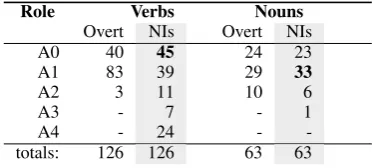
Table 2: Label distributions of all roles in both data sets from Experiment 1; majority NI classes in bold.
4 Experiments
4.1 Experiment 1
To evaluate the general usefulness of our memory-based approach to detect implicit roles, we set up a simplified framework for predicates with exactly
one overt argument and one NI annotated in the SemEval data (for all verbs and all nouns and from both the train and test files to obtain a reasonably large sample; no differentiation of DNIs and INIs). This pattern accounts for 189 instances—roughly 9% of the data samples in the SemEval set. We di-vided the instances into two subsets based on the predicate’s part of speech. The label distributions over overt and null instantiated roles for both ver-bal and nominal predicates are given in Table 2.
4.1.1 Task Description
Predict the role of the single missing NI (A0–A4) for each given predicate instance.
4.1.2 Predicting Null Instantiations
We trained one sense-disambiguated (SD) gold model for verbs (PB) and one for nouns (NB) ac-cording to Sect. 3.3 on the complete PropBank and the complete NomBank, respectively. This was compared with 30 separateSDandSImodels on varying portions of the automatically annotated
WaCkypedia ENdump: These were trained on the firstksentences each, in order to make their pre-diction quality comparable, while k ranges from 50 sentences for the smallest model to k = 10 million for the largest model (≈ 1
5 of the whole
corpus). For NI role prediction, we returnni, i.e.,
the maximally probable unrealized semantic role given the overt argumentojplus the predicate:
ni = arg max
n∈R\RP(n|oj,PREDICATE),
where R = {oj}, the predicate’s single explicit
role andR={A0..A4} ⊃R, the role inventory.
4.1.3 Results & Evaluation
The prediction accuracies for verbal and nominal predicates are illustrated in Figure 1. Although the number of instances in the data sets is small, some general trends are clearly visible. Our major find-ings are:
By increasing the number of training sentences the performance of theSDand theSI-based clas-sification models steadily increases as well. The trend is the same for both verbs and for nouns, even though training in the nominal domain re-quires more data to obtain similarly good results. More precisely, models trained on only 50k sen-tences already have an adequate performance on test data for verbs (≈76% with theSDmodel). To reach a similar performance on nouns, we need to increase the training size roughly by a factor of 5. Likewise, the performance of theSDmodels is better in general than the one of the SI models throughout all models analyzing verbal predicates, but only marginally better for nouns.
Both theSDand theSImodels outperform the majority class baseline for both parts of speech.9
Also, with 800k sentences for nouns and only 50k sentences for verbs, both SD model types reach accuracies equal to or greater than the super-visedPBandNB(gold) models which have been trained on the complete PropBank and NomBank corpus including sense distinctions, respectively.
The classification accuracies for theSDmodels reach their saturated maxima for verbs at around 91.27% (115/126) with 6 million training tences and 85.71% (54/63) with 2.85 million sen-tences for nouns. For verbs, a χ2 test confirms
a significant (p < .01) improvement of our best model over thePBgold model. On the sparse eval-uation data for nouns, the improvement over the
NBgold model is, however, not significant. Taken together, the improvements confirm that memory-based learning over mass data of auto-matically annotated (explicit) semantic roles can actually outperform gold models constructed from corpora with manual SRL annotations, even if the tools for automated mass annotation were trained on the very same corpora used to build the gold models (PropBank, NomBank). Also, the exper-iment demonstrated the feasibility of predicting implicit roles solely using information about the distribution of explicit roles. For the artificially
0.0 0.1 0.2 0.3 0.4 0.5 0.6 0.7 0.8 0.9
0.1k 1k 10k 100k 1,000k
# training sentences
accur
acy
classifier
MC PB
SD SI MC
PBSI SD
NB
accur
acy
SD SI
MC
# training sentences
0.1k 1k 10k 100k 1,000k
[image:6.595.72.553.66.253.2]0.0 0.1 0.2 0.3 0.4 0.5 0.6 0.7 0.8
Figure 1: Prediction accuracies for verbal (left figure) and nominal predicates (right figure) from Experiment 1. Majority class (MC) baselines in red, PropBank (PB) and NomBank (NB) gold models in green. The log-scaled x-axis only refers to the SDandSImodels and indicates firstksentences used for training.
simplified NI patterns in Experiment 1, already small portions of automatically annotated SRL data are sufficient to yield adequate results for both types (DNIs and INIs). Sense disambiguation of predicates generally increases the performance.10
4.2 Experiment 2
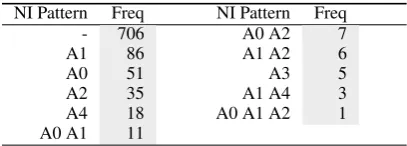
The setup from the previous experiment is by far too simplistic compared to a real linguistic sce-nario. Usually, a predicate can have an arbitrary number of overt arguments, and similarly the num-ber of missing NIs varies. To tackle this problem, we take the original train and test split (744 vs. 929 unrestricted frame instances of the form: any combination of overt roles vs. any combination of NI roles per predicate). Again, we do not draw a distinction between DNIs and INIs, but treat them generally as NIs. Table 3 shows the distribution of the different NI role patterns in the test data.
4.2.1 Task Description
Given a predicate and its overtly expressed argu-ments (ranging from any combination of A0 to A4 or none), predict the correct set of null instantia-tions (which can also be empty or contain up to five different implicit elements).
10A simple error analysis of the misclassified noun in-stances revealed that classification on the test data suffers from sparsity issues: In the portions of theWaCkypedia EN that we used for model building, three predicates were not attested (twicemurder.01and oncemurderer.01). This has a considerable impact on test results.
NI Pattern Freq NI Pattern Freq
- 706 A0 A2 7
A1 86 A1 A2 6
A0 51 A3 5
A2 35 A1 A4 3
A4 18 A0 A1 A2 1
A0 A1 11
Table 3: The 929 NI role patterns from the test set sorted by their number of occurrence. Most of the predicates are saturated and do not seek an implicit argument. Only one predicate instance has three implicit roles.
4.2.2 Predicting Null Instantiations
We distinguish two main types of classifiers: su-pervised classifiersare directly obtained from NI annotations in the SemEval training data, mildly supervised classifiersinstead use only information about (automatically obtained) explicitly realized semantic roles in a given corpus,hybrid classifiers
combine both sources of information. We esti-mated all parameters optimizing F-measure on the train section of the SemEval data set. Their perfor-mance is evaluated on its test section. We aim to demonstrate that mildly supervised classifiers are capable of predicting implicit roles, and to study whether NI annotations can be used to improve their performance.
Baseline:Given the diversity of possible patterns,
[image:6.595.314.518.315.388.2]Classifier A B1 B2 C0 C1 C2 C3 C4 C4n,v C4n,v,B1 C4n,v,B2 Precision 0.149 0.848 0.853 0.368 0.378 0.398 0.400 0.400 0.423 0.561 0.582 Recall 0.075 0.155 0.206 0.861 0.851 0.837 0.837 0.837 0.782 0.615 0.814 F1Score 0.100 0.262 0.332 0.516 0.523 0.540 0.541 0.541 0.549 0.589 0.679
Table 4: Precision, recall and F1scores for all classifiers introduced in Experiment 2. Scores are compared row-wise to the
best-performing classifier C4n,v,B2. A significant improvement over a cell entry withp < .05is indicated initalics.
no NIs with a probability of 76.0% (706/929), A1 with 38.6% (86/929), etc. The baseline scores are averaged over 100 runs of this random ‘classifier’, further referred to asA.
Supervised classifier: Supervised classifiers, as
understood here, are classifiers that use the in-formation obtained from manual NI annotations. We set uptwopredictors B1 andB2 tuned on the
SemEval training set: B1 is obtained by
count-ing for each predicate its most frequent NI role pattern. For instance, for seem.02—once anno-tated with implicit A1, but twice without implicit arguments—B1 would predict an empty set of
NIs.B2is similar toB1but conditions NI role
pat-terns not only on the predicate, but also on its ex-plicit arguments.11For prediction, these classifiers
consult the most frequent NI pattern observed for a predicate (B2: plus its overt arguments). If a test
predicate is unknown (i.e., not present in the train-ing data), we predict the majority class (empty set) for NI.
Mildly supervised classifier: Mildly supervised
classifiers do not take any NI annotation into ac-count. Instead, they rely on explicitly realized semantic roles observed in a corpus, but use ex-plicit NI annotations only to estimate prediction thresholds. We describe an extension of our pre-diction method from Exp. 1 and present eight parameter-based classification algorithms for our best-performing SD model from Exp. 1, trained on 6 million sentences.
We define prediction for classifier C0 as
fol-lows: Given a predicate PREDICATE, the role in-ventoryR = {A0..A4}, its (possibly empty) set of overt roles R ⊆ R and a fixed, predicate-independent threshold t0. We start by
optimiz-ing thresholdt0 on all predicate instances withno
given overt argument. If there isnoovert role and an unrealized roleni ∈ Rfor which it is true that 11Specifically, we extract finer-grained patterns, e.g.,
evening.01[A1]→ {}=2,{A2}=3, where a predicate is as-sociated with its overt role(s) (left side of the arrow). The corresponding implicit role patterns and their number of oc-currence is shown to the right.
P(ni|PREDICATE)> t0, then predictnias an
im-plicit role. If there is an overt roleoj ∈ Rand an
unrealized roleni ∈ R \Rfor which it is true that
P(ni|oj,PREDICATE) > t0, then predictni as an
implicit role. Note that C0requires that this
condi-tion to hold foroneoj, not all explicit arguments
of the predicate instance (logical disjunction). We refine this classifier by introducing an additional parameter that accounts for the group of overtly realized frames with exactly
one overt argument, i.e., C1 predicts ni if
P(ni|oj,PREDICATE) > t1; for all other
configu-rations the procedure is the same as in C0, i.e., the
thresholdt0is applied.
Classifiers C2, C3 and C4 extend C1
ac-cordingly and introduce additional thresholds t2,
t3, t4 for the respective number of overt
ar-guments. For example, C3 predicts ni if
P(ni|oj1, oj2, oj3,PREDICATE) > t3, for
config-urations with less arguments, it relies on C2, etc.
Our general intuition here is to see whether the creasing number of specialized parameters for in-creasingly marginal groups of frames is justified by the improvements we achieve in this way.
A final classifier C4n,v extends C4 by distin-guishing verbal and nominal predicates, yielding a total of ten parameterst0n..t4n, t0v..t0n.
Hybrid classifier: To explore to what extent
ex-plicit NI annotations improve the classification re-sults, we combine the best-performing and most elaborate mildly supervised classifier C4n,v with the supervised classifiers B1 and B2: For
pred-icates encountered in the training data, C4n,v,B1
(resp.,C4n,v,B2) usesB1 (resp.,B2) to predict the most frequent pattern observed for the predicate; for unknown predicates, apply the threshold-based procedure of C4n,v.
4.2.3 Results & Evaluation
classifiers outperform the supervised algorithms in terms of F1 score and recall. However, detecting
NIs by the supervised classifiers is very accurate in terms of high precision. Classifier B2outperforms
B1 as a result of directly incorporating additional
information about the overt arguments.
Concerning our parameter-based classifiers, the main observations are: First, the overall perfor-mance (F1 score) increases from C0 to C4 (yet
not significantly). Secondly, with more param-eters, recall decreases while precision increases. We can observe, however, that improvements from
C2 to C4 are marginal, at best, due to the
spar-sity of predicates with two or more overt argu-ments. Similar problems related to data sparsity have been reported in Chen et al. (2010). Results for C3 and C4 are identical, as no predicate with
more than three overt arguments occurred in the test data. Encoding the distinction between ver-bal and nominal predicates into the classifier again slightly increases the performance.
A combination of the high-precision supervised classifiers and the best performing mildly suvised algorithm yields a significant boost in per-formance (Tab. 4, last two columns). The optimal parameter values for all classifiers C4n,v estimated on the train section of the SemEval data set are given in Table 5.
Nounthresholds tC0n tC1n tC2n tC3n tC4n Values 0.35 0.10 0.20 0.35 0.45
Verbthresholds tC0v tC1v tC2v tC3v tC4v Values 0.05 0.25 0.25 0.30 0.20
Table 5: Optimal parameter values for the thresholds in all C4n,v classifiers estimated on the train section of the SemEval data set.
In Table 6, we report the performance of our best classifier C4n,v,B2 with detailed label scores.
Its overall NI recognition rate of 0.81 (recall) out-performs the state-of-the-art in implicit role identi-fication: cf. L&P (0.66), SEMAFOR (0.63), S&F (0.58), T&D (0.54), VENSES++ (0.08).12
Summarizing our results, Exp. 2 has shown that combining supervised and mildly supervised strategies to NI detection achieves the best re-sults on the SemEval test set. Concerning the mildly supervised, parameter-based classifiers, it
12Note that only an indirect comparison of these scores is possible due to the aforementioned difference between data formats and also because none of the other systems report precision scores for their pattern-based NI detection systems.
Roles A0 A1 A2 A3 A4
# Labels 70 107 49 5 21
Precision 0.675 0.578 0.432 0.400 0.791 Recall 0.800 0.897 0.653 0.400 0.905 F1Score 0.732 0.703 0.520 0.400 0.844
Table 6:Evaluation of C4n,v,B2for all 252 implicit roles.
has proven beneficial to incorporate a maximum of available information on overtly expressed ar-guments in order to determine implicit roles. Our best-performing classifier achieves NI recognition rate beyond state-of-the-art.
Interestingly, memory-based learning offers the capability to detect both DNIs (resolvable from context), as well as INIs (not resolvable from con-text), simply by learning patterns from local ex-plicit role realizations. Subsequent experiments should extend this approach to distinguish be-tween the two types, as well, which we have treated equivalently in our settings. First promis-ing experiments in this direction are bepromis-ing con-ducted in Chiarcos and Schenk (2015).
5 Summary and Outlook
We have presented a novel, statistical method to infer evidence for implicit roles from their explicit realizations in large amounts of automatically an-notated SRL data. We conclude that—especially when annotated training data is sparse—memory-based approaches to implicit role detection seem highly promising. With a much greater degree of flexibility, they offer an alternative solution to static rule-/template-based methods.
References
Collin F. Baker, Charles J. Fillmore, and John B. Lowe. 1998. The Berkeley FrameNet Project. In Pro-ceedings of the 36th Annual Meeting of the Associ-ation for ComputAssoci-ational Linguistics and 17th International Conference on Computational Linguistics -Volume 1, ACL ’98, pages 86–90, Stroudsburg, PA, USA. Association for Computational Linguistics.
Laura Banarescu, Claire Bonial, Shu Cai, Madalina Georgescu, Kira Griffitt, Ulf Hermjakob, Kevin Knight, Philipp Koehn, Martha Palmer, and Nathan Schneider. 2013. Abstract Meaning Representation for Sembanking. Proc. Linguistic Annotation Work-shop.
Marco Baroni, Silvia Bernardini, Adriano Ferraresi, and Eros Zanchetta. 2009. The WaCky Wide Web: A Collection of Very Large Linguistically Processed Web-Crawled Corpora. Language Resources and Evaluation, 43(3):209–226.
Anders Bj¨orkelund, Love Hafdell, and Pierre Nugues. 2009. Multilingual Semantic Role Labeling. In Pro-ceedings of the Thirteenth Conference on Computa-tional Natural Language Learning (CoNLL 2009): Shared Task, pages 43–48, Boulder, Colorado, June. Association for Computational Linguistics.
Desai Chen, Nathan Schneider, Dipanjan Das, and Noah A. Smith. 2010. SEMAFOR: Frame Argu-ment Resolution with Log-linear Models. In Pro-ceedings of the 5th International Workshop on Se-mantic Evaluation, SemEval ’10, pages 264–267, Stroudsburg, PA, USA. Association for Computa-tional Linguistics.
Christian Chiarcos and Niko Schenk. 2015. (accepted) Towards the Unsupervised Acquisition of Implicit Semantic Roles. In Recent Advances in Natu-ral Language Processing, RANLP 2015, September, 2015, Hissar, Bulgaria.
Christian Chiarcos. 2012. Towards the Unsupervised Acquisition of Discourse Relations. InProceedings of the 50th Annual Meeting of the Association for Computational Linguistics: Short Papers - Volume 2, ACL ’12, pages 213–217, Stroudsburg, PA, USA. Association for Computational Linguistics.
Walter Daelemans and Antal van den Bosch. 2009.
Memory-Based Language Processing. Cambridge University Press, New York, NY, USA, 1st edition.
Parvin Sadat Feizabadi and Sebastian Pad´o. 2015. Combining Seemingly Incompatible Corpora for Implicit Semantic Role Labeling. InProceedings of STARSEM, pages 40–50, Denver, CO.
Charles J. Fillmore. 1986. Pragmatically Controlled Zero Anaphora. InProceedings of Berkeley Linguis-tics Society, pages 95–107, Berkeley, CA.
Matthew Gerber and Joyce Chai. 2012. Semantic Role Labeling of Implicit Arguments for Nominal Pred-icates. Comput. Linguist., 38(4):755–798, Decem-ber.
Egoitz Laparra and German Rigau. 2012. Exploiting Explicit Annotations and Semantic Types for Im-plicit Argument Resolution. In Sixth IEEE Inter-national Conference on Semantic Computing, ICSC 2012., Palermo, Italy. IEEE Computer Society.
Egoitz Laparra and German Rigau. 2013. ImpAr: A Deterministic Algorithm for Implicit Semantic Role Labelling. InProceedings of the 51st Annual Meet-ing of the Association for Computational LMeet-inguistics (Volume 1: Long Papers), pages 1180–1189. Asso-ciation for Computational Linguistics.
Christopher D. Manning, Mihai Surdeanu, John Bauer, Jenny Finkel, Steven J. Bethard, and David Mc-Closky. 2014. The Stanford CoreNLP natural lan-guage processing toolkit. In Proceedings of 52nd Annual Meeting of the Association for Computa-tional Linguistics: System Demonstrations, pages 55–60.
Adam Meyers, Ruth Reeves, Catherine Macleod, Rachel Szekely, Veronika Zielinska, Brian Young, and Ralph Grishman. 2004. The NomBank Project: An Interim Report. In A. Meyers, editor, HLT-NAACL 2004 Workshop: Frontiers in Corpus Anno-tation, pages 24–31, Boston, Massachusetts, USA, May 2 - May 7. Association for Computational Lin-guistics.
Martha Palmer, Daniel Gildea, and Paul Kingsbury. 2005. The Proposition Bank: An Annotated Corpus of Semantic Roles. Comput. Linguist., 31(1):71– 106, March.
Anselmo Pe˜nas and Eduard Hovy. 2010. Semantic Enrichment of Text with Background Knowledge. InProceedings of the NAACL HLT 2010 First Inter-national Workshop on Formalisms and Methodology for Learning by Reading, FAM-LbR ’10, pages 15– 23, Stroudsburg, PA, USA. Association for Compu-tational Linguistics.
Michael Roth and Anette Frank. 2013. Automati-cally Identifying Implicit Arguments to Improve Ar-gument Linking and Coherence Modeling. In Pro-ceedings of the Second Joint Conference on Lexical and Computational Semantics (*SEM), pages 306– 316, Atlanta, Georgia, USA, June. Association for Computational Linguistics.
Josef Ruppenhofer, Philip Gorinski, and Caroline Sporleder. 2011. In Search of Missing Arguments: A Linguistic Approach. In Galia Angelova, Kalina Bontcheva, Ruslan Mitkov, and Nicolas Nicolov, ed-itors,RANLP, pages 331–338. RANLP 2011 Organ-ising Committee.
Josef Ruppenhofer. 2005. Regularities in Null Instan-tiation. Ms, University of Colorado.
Carina Silberer and Anette Frank. 2012. Casting Im-plicit Role Linking as an Anaphora Resolution Task. InProceedings of the First Joint Conference on Lex-ical and Computational Semantics - Volume 1: Pro-ceedings of the Main Conference and the Shared Task, and Volume 2: Proceedings of the Sixth In-ternational Workshop on Semantic Evaluation, Se-mEval ’12, pages 1–10, Stroudsburg, PA, USA. As-sociation for Computational Linguistics.
Sara Tonelli and Rodolfo Delmonte. 2010. VENSES++: Adapting a Deep Semantic Processing System to the Identification of Null Instantiations. InProceedings of the 5th International Workshop on Semantic Evaluation, pages 296–299. Association for Computational Linguistics.