We consider spinless fermions on a finite one-dimensional lattice, interacting via nearest-neighbor repulsion and subject to a strong electric field. In the noninteracting case, due to Wannier-Stark localization, the single-particle wave functions are exponentially localized even though the model has no quenched disorder. We show that this system remains localized in the presence of interactions and exhibits physics analogous to models of conventional many-body localization (MBL). In particular, the entanglement entropy grows logarithmically with time after a quench, albeit with a slightly different functional form from the MBL case, and the level statistics of the many-body energy spectrum are Poissonian. We moreover predict that a quench experiment starting from a charge-density wave state would show results similar to those of Schreiberet al.[Science349, 842 (2015)].
DOI:10.1103/PhysRevLett.122.040606
Introduction.—In the latter half of the twentieth century, pioneering work by Anderson [1] and collaborators [2] established that the eigenfunctions of a quantum particle moving in a disordered potential landscape in one or two dimensions are exponentially localized. In the beginning of the twenty-first century, it was shown [3–5] that this localization can persist even for finite densities of fermions with repulsive interparticle interactions, a phenomenon now termed many-body localization (MBL) [6].
Subsequent theoretical work has explored the disorder-driven transition from ergodic to MBL behavior in a variety of mostly one-dimensional models. Key results include the “l bit” picture of the MBL regime [7], the logarithmic growth of entanglement entropy following a quench into it [8–10], and the subdiffusive transport of spin and energy in the approach to the MBL transition from the ergodic side [11–14]. Significant progress has also been made in the experimental study of MBL in one- and two-dimensional systems of cold atoms[15–17].
It is natural to ask whether disorder is at all an essential ingredient for observing MBL phenomenology, or whether it is possible for thermalization to fail for reasons due to interactions alone. This can happen when the system is integrable[18,19], but such cases constitute isolated points in parameter space, with arbitrarily small generic variations in the Hamiltonian parameters restoring ergodicity. An important question is then whether there can be robust
nonergodic phases in models without quenched disorder. There have so far been several proposals for this, ranging from models inspired by classical glassy physics [20,21] to variants of the Bose-Hubbard model [4,22] and models with mixed species [23]; however, there are also
counterarguments that the localization in some of these systems is a long-lived intermediate-time phenomenon which eventually yields to thermalization at very long times[24,25].
Here, we approach the question of MBL without dis-order from a different angle, by introducing interactions into a single-particle model that exhibits Wannier-Stark localization[26]. It is instructive to compare the resulting physics, which we call Stark many-body localization, with the well-known many-body disorder localized (MBL) case. The comparison is interesting, because in both cases the single-particle eigenfunctions are exponentially localized in space, and thus one might expect at least some MBL signatures also to be present in the disorder-free Stark-MBL case.
Specifically, we study the properties of spinless fermions on a finite one-dimensional lattice. The fermions interact via nearest-neighbor repulsion, and we subject them to a strong electric field: either a strictly spatially uniform one, for which the noninteracting many-body spectrum contains many exact degeneracies, or a field with a slight spatial gradient, for which these degeneracies are lifted. The setup is depicted in Fig.1.
those seen in the MBL case. Interestingly, for a strictly uniform field[27], entropy and level statistics deviate from MBL phenomenology, which we attribute to exact degen-eracies in the noninteracting spectrum.
Model.—The Hamiltonian of our model is
ˆ
H¼J
2 XL−2
j¼0
ðc†jcjþ1þH:c:Þ þ
XL−1
j¼0
Wj
nj− 1 2
þVX
L−2
j¼0
nj− 1 2
njþ1−12
: ð1Þ
Here the operatorc†j creates a fermion on lattice sitej, and the associated number operator nj¼c†jcj. J=2 is the hopping matrix element between neighboring sites, V is the strength of the nearest-neighbor repulsion, andLis the number of sites on the lattice, the boundary conditions of which we take to be open.
Wj is the on-site potential energy due to the applied electric field. For a uniform field γ, it takes the form
Wj¼−γj. For a nonuniform field, it acquires some curvature,Wj¼−γjþαj2=L2. This means that the poten-tial has the same value and slope as the linear one atj¼0, but differs at the other end of the chain byαfrom the purely linear case (see the inset of Fig.2).
Entanglement entropy growth.—A quantity that is often used to diagnose and characterize MBL is the entanglement entropy. To calculate this, a spatial bipartition into two halves is made by cutting a particular bond. The reduced density matrix of the subsystem,ρred, is calculated, and the
entropy determined viaS¼−tr½ρredlogðρredÞ. Serbynet al.
[10]argued, on the basis of the general physical picture of
“l bits” in the MBL regime, that at long times the entropy should grow logarithmically with time, i.e., that
SðtÞ∼S0lnðVtÞ.
This argument uses the fact that the density profiles of the individuall bits are exponentially localized. We now show that the long-time entanglement growth in the Stark-MBL system behaves similarly, though with some modification reflecting the fact that the tails of Wannier-Stark-localized wave functions are not pure exponentials. The functional form of these tails may be obtained from a semiclassical argument [29] in which the wave function is approximated by a WKB-like expression ψðxÞ∼
exp½iRxkðx0Þdx0, withkðxÞ obtained from the condition of local energy conservation, JcosðkaÞ þVðxÞ ¼E, where a is the lattice spacing. Our potential is to a good approximation VðxÞ ¼−γx, and hence kðxÞ ¼
1
aarccos½ðγxþEÞ=J. Taking x to be large and positive, the exponent in the WKB wave function is thus given by −ð1=aÞRxln½ðγx0Þ=Jdx0≈−ðx=aÞln½ðγxÞ=J, where we have dropped a linear-in-x term that does not have a logarithm. Hence, the form of the tail of the wave function is
ψðxÞ∼exp
−x
aln
γx J
[image:2.612.331.548.45.205.2]
: ð2Þ
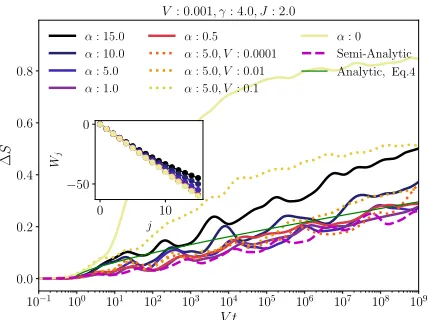
FIG. 2. DifferenceΔSbetween the bipartite entanglement in the interacting and noninteracting cases. The parameter α denotes the cumulative effect of field nonuniformity on the potential at the end site. For sufficiently smallαand suitably large fieldγ, there is good qualitative agreement with our semianalytic calculation (magenta dashed line) and full analytic calculation [green line and Eq.(4)]. For largerα, the entanglement growth becomes stronger than predicted due to the progressive delocalization of some of the single-particle orbitals as the position-dependent field gets weaker at the right-hand end of the chain (see right of inset). For the purely uniform field, there is an initial steep rise, which we attribute to additional degeneracies of the many-body spectrum. The numerical curves have been smoothed by convolution with a Gaussian,wðnÞ ¼e−ðn=σÞ2=2, withσ¼4. Inset: Potential used in
the respective main curves. FIG. 1. Schematic illustration of our model. On afinitelattice in
[image:2.612.53.296.45.196.2]Now, consider the total entanglement entropy of the subsystem. This can be thought of as an entanglement front moving through the system from the cut astincreases. At timet, this front will have moved a distancexðtÞ, which is
obtained by solving Eq. (3) for x. The entanglement entropy will thus be SðtÞ ¼Smaxf½xðtÞ=Lg, where L is
the length of the subsystem to the left of the cut. Solving Eq. (3)for xðtÞ, we obtain as entanglement entropy
SðtÞ ¼Smax L
alnðVtÞ
pðaγlnJðVtÞÞ; ð4Þ
where pðuÞis the solution of the equation pep¼u. We supplement this analytic approach by computing a “semianalytic” form for the entanglement entropy. For strong fields,γ≫J, we may assume that the single-particle eigenfunctions of the Stark-localized states are restricted to three sites. We can thus write any initial state with fixed particle number M in fixed positions as
jψðt¼0Þi ¼X
fQg
fQβ†QðjMÞβ †
QðjM−1Þ…β † Qðj2Þβ
†
Qðj1Þj0i; ð5Þ
where β†j creates a fermion in the single-particle Stark-localized state centered at positionj. HereQis an operation that, for each original site labelji, either moves it one place to the left, moves it one place to the right, or leaves it alone. The factorfQ is given approximately by
fQ≈
J
γ
λ QþρQ
; ð6Þ
whereλQcounts the number of original site labels that are shifted to the left byQ, andρQthe number that are shifted to the right.
The energyEQ of every state componentQis composed of two parts: the electric potential energy, and the repulsive interaction energy of each pair of its constituent particles:
EQ≈E0þγðρQ−λQÞ þ
V
2 X
k X
p≠k
J
γ
2jQðj
kÞ−QðjpÞj−2
;
ð7Þ
and further details on the above calculation are found in Ref.[30].
Numerical simulations.—We now compare the above results against numerical simulations of the model (1). Hopping is set toJ¼2, and we consider anL¼16chain at half-filling. The field on one end has strength γ and decreases uniformly, so that the value of the potential on the final site of the chain differs by an amountαfrom its value in the purely linear case. We use all possible initial product states that do not have a particle on the two sites directly adjacent to the cut, which we choose to be at the middle bond. ForL¼16, this amounts to 1225 states. Using exact diagonalization, we compute the time evolution for a given initial state, and obtain the entanglement entropySðtÞfor an equal bipartition of the lattice. We then average over all of the above mentioned initial states.
Our results forγ ¼4and various values ofαare shown in Fig. 2. In order to show the effect of interactions, we displayΔS¯ðtÞ≡S¯ðtÞ−S¯0ðtÞ, whereS0ðtÞis the entropy in
the noninteracting case, and the bar denotes an average over the initial conditions as discussed above. Consistent with previous findings, the entanglement growth due to many-body dephasing effects commences at times Vt∼1. The curves scale as a function of Vt, until the interactions become strong enough to alter the eigenstates significantly. For sufficiently nonuniform field, this growth continues logarithmically up to a maximum value, which is finite for a finite system size. This growth agrees qualitatively with our semianalytic calculation presented above, confirming our intuition that the physics of this system is well described by Eqs.(5)and(7). We have also compared the pure analytic calculation(4)against the numerics. HereSmaxis taken to
be the diagonal entropy Sdiag resulting from the reduced
density matrix obtained by Eq. (8). Sdiag denotes the
maximum achievable entropy for a given initial state, assuming that the interactions do not significantly change the form of the eigenstates[10,31].
The logarithmic entanglement growth given by Eq. (4) can thus fail for two different reasons: too little nonun-iformity, or too small a local field. The former allows delocalization of the two-particle states into a broad band, with a correspondingly short dephasing time, leading to steep initial growth ofΔS¯ðtÞ. On the other hand, the latter
causes the localization to weaken in parts of the chain, in turn making the accumulation of entanglement in that part stronger. The former case is shown in Fig. 2 for α¼0, while the latter can be observed in the same panel for
α¼15. However, in between them, there is a large range of curvature values for which an MBL-like entanglement growth is observed.
Many-body level statistics.—A powerful and basis-independent diagnostic to determine whether a model is localized is its spectral statistics [32,33]. Figure 3 shows our exact diagonalization results for the gap-ratio parameter in a chain of lengthL¼16with open boundary conditions, for a range of field strengths γ and gradients α in the half-filled sector. The gap-ratio parameter is defined as
rn¼minðδn=δnþ1;δnþ1=δnÞ, whereδn is the gap between the nth and (n−1)th energy eigenvalues. Plotting a histogram of the gap-ratio parameter eliminates a depend-ence on the density of states, such that we can use the whole spectrum as long as there is no mobility edge present. We have verified this, and the results are qualitatively the same for all ranges and energy densities used.
The probability distribution for Poisson statistics reads
PPðrÞ ¼2=ð1þrÞ2, which is in excellent agreement with our results over most of our parameter range. In the case of very small or zero field gradient α, however, we find results that are consistent neither with Poissonian nor with
Wigner-Dyson (WD) statistics. We attribute this to the many exact degeneracies in the noninteracting problem, creating a disproportionally large weight for smallrnin the many-body spectrum. Interestingly, we may further observe a crossover to WD level statistics for small uniform field strengthγ. Results for both of these cases can be found in the Supplemental Material[30].
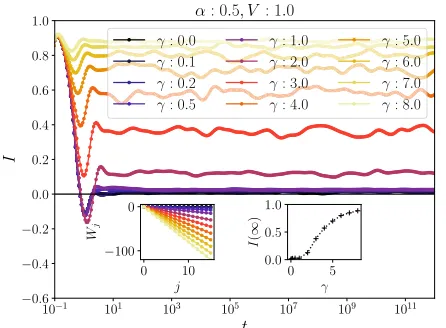
Quench from charge-density wave.—While the entan-glement and spectral statistics are experimentally difficult to extract, there are other indicators of localization. One of the simplest setups consists of monitoring the relaxation of an initial charge-density wave (CDW) order, in which all even sites are occupied[15]. An associated observable is the imbalanceI between the occupation of odd and even sites,No andNe, respectively:
I ¼Ne−No
NeþNo
: ð9Þ
In the ergodic, thermalizing case, it should quickly decay to zero, which it does in the case γ¼0 when there is no Wannier-Stark localization. For a many-body localized system, on the other hand, the value of the imbalance should remain nonzero up to infinite times.
In Fig. 4, we show exact diagonalization results of the time evolution of an initial CDW state under the unitary time evolution of Eq. (1). After initial transient behavior, the imbalance(9)remains nonzero for arbitrarily long times for sufficiently large fields.
[image:4.612.62.286.44.205.2]Discussion.—In summary, we have shown that the experimentally natural case of a finite system in an electric field, a simple Wannier-Stark-localized system, shows properties that coincide with those of the MBL FIG. 3. The many-body level statistics for the case of nonzeroα
in the half-filled sector. For all displayed values of γ and α, the probability distribution of the gap-ratio parameter, rn ¼
minðδn=δnþ1;δnþ1=δnÞ [where δn is the gap between the nth
and (n−1)th energy eigenvalues], agrees with the prediction for Poisson level statistics expected for integrable or localized models. The predicted average gap-ratio parameter in this case is hriP¼0.3863. For comparison, we have included the
pre-diction for Wigner-Dyson (WD) statistics.
FIG. 4. TheL¼16study of a hypothetical imbalance experi-ment, where an initial charge-density wave relaxes under unitary time evolution. The different curves represent different field strengthsγ with α¼0.5. Inset left: Visualization of the corre-sponding potential. Inset right: Average imbalance I at times
1013≥t=J≥1011. The numerical curves have been smoothed by
convolution with a Gaussian,wðnÞ ¼e−ðn=σÞ2=2
[image:4.612.328.551.46.210.2]implied by a uniform compound of the electric field. This precludes an asymptotic definition of exponential locali-zation, which should, however, not pose a problem in practice given the attainability of short localization lengths. While the setup of Stark-MBL is quite different from conventional disorder MBL, the similar phenomenology is quite striking. The MBL phase is described in terms of l
bits, while other disorder-free localized systems have also identified integrals of motion. Here,lbits emerge naturally and robustly as Stark locators, again without the use of any quenched disorder.
M. S. acknowledges financial support from the CM-CDT under EPSRC (UK) Grant No. EP/L015110/1. C. A. H. acknowledges financial support from the TOPNES pro-gram under EPSRC (UK) Grant No. EP/I031014/1. This research was supported in part by the National Science Foundation under Grant No. NSF PHY-1125915. Part of this work was performed at the Aspen Center for Physics, which is supported by National Science Foundation Grant No. PHY-1066293. F. P. acknowledges the support of the DFG Research Unit FOR1807 through Grants No. PO1370/2-1 and No. TRR80, the Nanosystems Initiative Munich (NIM) by the German Excellence Initiative, and the European Research Council (ERC) under the European Union’s Horizon 2020 research and innova-tion program (Grant Agreement No. 771537).
Note added.—We recently became aware of the related work by van Nieuwenburg et al.[34].
[1] P. W. Anderson,Phys. Rev.109, 1492 (1958).
[2] E. Abrahams, P. W. Anderson, D. C. Licciardello, and T. V. Ramakrishnan,Phys. Rev. Lett.42, 673 (1979).
[3] D. M. Basko, I. L. Aleiner, and B. L. Altshuler,Ann. Phys. (Amsterdam)321, 1126 (2006).
[4] I. V. Gornyi, A. D. Mirlin, and D. G. Polyakov,Phys. Rev. Lett.95, 206603 (2005).
[5] J. Z. Imbrie, J. Stat. Phys.163, 998 (2016).
[6] R. Nandkishore and D. A. Huse, Annu. Rev. Condens. Matter Phys.6, 15 (2015).
[7] D. A. Huse, R. Nandkishore, and V. Oganesyan,Phys. Rev. B90, 174202 (2014).
114, 100601 (2015).
[15] M. Schreiber, S. S. Hodgman, P. Bordia, H. P. Lüschen, M. H. Fischer, R. Vosk, E. Altman, U. Schneider, and I. Bloch, Science349, 842 (2015).
[16] P. Bordia, H. Lüschen, S. Scherg, S. Gopalakrishnan, M. Knap, U. Schneider, and I. Bloch,Phys. Rev. X7, 041047 (2017).
[17] J.-Y. Choi, S. Hild, J. Zeiher, P. Schauß, A. Rubio-Abadal, T. Yefsah, V. Khemani, D. A. Huse, I. Bloch, and C. Gross, Science352, 1547 (2016).
[18] M. Rigol, V. Dunjko, V. Yurovsky, and M. Olshanii,Phys. Rev. Lett.98, 050405 (2007).
[19] T. Kinoshita, T. Wenger, and D. S. Weiss,Nature (London)
440, 900 (2006).
[20] M. van Horssen, E. Levi, and J. P. Garrahan,Phys. Rev. B
92, 100305(R) (2015).
[21] J. M. Hickey, S. Genway, and J. P. Garrahan,J. Stat. Mech. Theory Exp.5, 054047 (2016).
[22] W. De Roeck and F. Huveneers,Commun. Math. Phys.332, 1017 (2014).
[23] A. Smith, J. Knolle, R. Moessner, and D. L. Kovrizhin, Phys. Rev. Lett.119, 176601 (2017).
[24] N. Y. Yao, C. R. Laumann, J. I. Cirac, M. D. Lukin, and J. E. Moore,Phys. Rev. Lett.117, 240601 (2016).
[25] A. Bols and W. De Roeck,J. Math. Phys. (N.Y.)59, 021901 (2018).
[26] G. Wannier,Rev. Mod. Phys.34, 645 (1962).
[27] For a treatment of a metal-insulator transition in a uniform electric field, see Ref.[28].
[28] V. Prigodin and B. Altshuler,Phys. Lett. A137, 301 (1989). [29] C. Hooley and J. Quintanilla,Phys. Rev. Lett. 93, 080404
(2004).
[30] See Supplemental Material at http://link.aps.org/ supplemental/10.1103/PhysRevLett.122.040606for details of the ‘semi-analytical’ calculation of the entanglement entropy, the behavior of the level statistics as the limit of a uniform field is approached, and the crossover from Wigner-Dyson to Poisson statistics as the field strength is increased from zero.
[31] A. Polkovnikov, Ann. Phys. (Amsterdam) 326, 486 (2011).
[32] V. Oganesyan and D. A. Huse,Phys. Rev. B 75, 155111 (2007).
[33] D. J. Luitz, N. Laflorencie, and F. Alet,Phys. Rev. B91, 081103(R) (2015).