Self-Oscillating Structural Polymer Gels
Srinivasa R. Pullela1, Qingsheng Wang2,3, Zhengdong Cheng1,4*
1Artie McFerrin Department of Chemical Engineering, Texas A&M University, College Station, USA 2Department of Fire Protection & Safety, Oklahoma State University, Stillwater, USA
3School of Chemical Engineering, Oklahoma State University, Stillwater, USA 4Materials Science and Engineering Program, Texas A&M University, College Station, USA
Email: *[email protected], [email protected]
Received November 2, 2012; revised January 22, 2013; accepted January 29, 2013
Copyright © 2013 Srinivasa R. Pullela et al. This is an open access article distributed under the Creative Commons Attribution
Li-cense, which permits unrestricted use, distribution, and reproduction in any medium, provided the original work is properly cited.
ABSTRACT
Self-oscillating polymer gel has become a distinguished class of smart soft materials. Here we fabricated and demon-strated a self-oscillating structural gel network with the incorporation of the Belousov-Zhabotinsky (BZ) reaction. The structural polymer gel oscillates at a macroscopic level with remarkably faster kinetics compared to a normal gel of similar chemical compositions. The structural polymer gel also displays larger oscillating amplitude compared to the normal gel because of the increased diffusion of fluids surrounding the gel particles. This type of structural polymer gels can be harnessed to provide novel and feasible applications in a wide variety of fields, such as drug delivery, nanopatterning, chemical and biosensing, and photonic crystals.
Keywords: Structural Gel; Belousov-Zhabotinsky Reaction; Self-Oscillation; Poly-(N-isopropylacrylamide);
Fast Response
1. Introduction
The Belousov-Zhabotinsky (BZ) reaction, which is a well-known nonlinear dynamic chemical system, has attracted much attention due to their fascinating phe-nomena [1,2]. The reaction includes a series of metal- ion-catalyzed oxidative reactions of organic substrates, such as malonic acid, by an acidified bromate solution. Recently, the BZ reaction has been used to induce me-chanical oscillations in polymeric systems to mimic bio-logical materials [3,4]. In particular, Yoshida and his co-workers have developed a self-oscillating cross-linked gel composed of stimuli-responsive poly-(N-isopropy-
lacrylamide) (PNIPAM) polymer with grafted Ru(bipy)3
moiety as the BZ catalyst [5,6]. The BZ reaction gener-ates autonomous and rhythmical redox oscillations from the oxidized Ru(III) state to the reduced Ru(II) state, which induced a periodic volume oscillation in the PNIPAM gel when the gels are immersed in an aqueous acidic solution containing the substrates for the BZ reac-tion [7]. Due to the periodic mechanical oscillareac-tions, a novel biomimetic self-walking gel was developed by Yoshida et al. [8].Directional movement of gel is
pro-duced by asymmetrical swelling-deswelling of the PNI-PAM-co-Ru(bipy)3 gels.
An approach was also developed recently for simu- lateing chemo-responsive gels that exhibit not only large variations in volume but also alterations in shape [9]. Through this approach, oscillating gels undergoing the BZ reaction were simulated, which showed that the formation of the wave pattern depends on the aspect ratios of the sample. Such self-oscillating polymer gel has become a distinguished class of soft materials whi- ch are anticipated for new concept applications such as self-beating pacemakers and drug delivery systems synchronized with human circadian rhythms [10-12]. Such advanced materials, especially those stimuli-res- ponsive polymers and gels have been actively investi-gated due to a unique nature of volume change in re-sponse to external stimuli [13]. These self-oscillating gel particles have various potential industrial applica-tions, such as drug delivery [14], chemical and bio- sensing [15], fabrication of photonic crystals [16]and absorbents [17].
In our previous studies, we have prepared the PNI-PAM gel particles of uniform size using a two step synthesis with covalently bound Ru(bipy)3 catalyst
substrate concentrations and temperature have been characterized [19]. It has shown that the automatic mechanical oscillation of the gel particles was induced by the covalently coupled BZ reaction. The chemical oscillations of the BZ reaction induce the periodic charge oscillation of the Ruthenium ions, which leads to the periodic change of the hydrophilicity of the PNIPAM polymer network, hence the volume oscilla- tion of the microgel particles. In this swell/shrink process, water is diffused either from the surface to- wards the centre of the gel, or vice versa.
However, the slow response and small amplitude of the responsive PNIPAM polymer gels prevent their further usages [20], because the swell/shrink rate is inversely pro- portional to the square of the distance that the water mole- cules have to travel [21]. Therefore, the gels with a fast response and large amplitude are desired for feasible app- lications. If we can improve the frequency and amplitude of the self-oscillation, the autonomous gel systems will have a much broader range of applications. One idea to solve this problem is to raise the temperature in the system so that the BZ reaction rate increases. However, the conventional-type self-oscillating gel usually shrinks at temperatures above its LCST (lower critical solution temperature) [4].Recently, Cho et al. fabricated a fast responsive structural gel scaf-
fold, where microgel particles assembled either through bridging or depletion interactions to yield a structure that response to the external stimulus at a macroscopic level in much shorter times as compared to a bulk polymer gel of similar characteristics [22]. In this work, we further de- velop this technique to prepare a self-oscillating structural PNIPAM gel that contains a catalyst for the BZ reaction to achieve an autonomous oscillation with both high fre- quency and large amplitude, without the temperature limi-tation.
2. Experimental Section
2.1. Synthesis of PNIPAM-co-Ru(bipy)3 Gels
Surfactant-free PNIPAM microgels have been prepared by a precipitation polymerization of N-isopropylacryla- mide (NIPAM). In a typical procedure, NIPAM (4 g), allylamine (250 μL), Ru(vmbipy)(bipy)2PF6 (0.200 g), N,
N-methylenebisacrylamide (0.180 g), 2,2’-azobisisobu- tyronitrile (AIBN) (0.166 g) and water (80 mL) were added in a 200 ml round-bottomed flask reactor equipped with a stirrer, a condenser, a nitrogen inlet, and a ther- mometer. The contents were heated to 70˚C under a ni-trogen atmosphere and at a stir rate of 300 rpm. The po-lymerization was continued for 6 hours. The microgel dispersion was then filtered through a filter (~100 μm mesh size) to remove some aggregates generated during polymerization and then, cooled down to room tempera-ture.
2.2. Synthesis of Clusters of PNIPAM-co-Ru(bipy)3Gels
Clusters of microgels were made by linking microgel particles covalently using glutaraldehyde. To the micro- gel suspension prepared above, 0.002 M negatively char- ged polyacrylic acid solution (Mol. Wt. 400,000) was added to induce ionic attractions with the positively charged Ruthenium bipyridine and allylamine. The dis-persion was heated to 60˚C leading to a phase separation of the microgel from the continuous aqueous phase. Then, approximately 1 volume % of glutaraldehyde aqueous solution (50% w/v, Aldrich) was added to chemically link amide groups on the surface of the microgel particles in contact with each other. After a 1 hour reaction at 60˚C, the resulting gel scaffolds were washed with DI water. This cluster of microgel particles with intercon-nected PNIPAM gels was named as “structural gel” and its self-oscillating behavior was compared with that of “normal gel” with no interconnected gel network. The “normal gel” was prepared following the preparation method by Maeda et al. [23]. For compared studies, both
structural gel and normal gel were cut into the same di-mensions (5 1 1 mm) and the swell/shrink response was measured at both oxidized and reduced states of Ru-thenium ion. The synthetic scheme of the structural gel using PNIPAM particles is shown in Scheme 1.
2.3. Synthesis of Suspensions of
PNIPAM-co-Ru(bipy)3 Gel Particles
The suspensions of normal gel particles and structural gel particles were prepared as below. The gel particles of PNIPAM with Ru(bipy)3 were synthesized by emulsion
polymerization as follows: purified NIPAM (3.80 g), Ru(bipy)3 (0.422 g), allylamine (0.200 g), sodium
dode-cylbenzene sulfonate (0.700 g), N, N-methylenebis-
acrylamide (0.700 g), and AIBN (0.169 g) were added in 200 mL of H2O. The suspension was stirred at 60˚C for 8
hours under the N2-flow condition. The resulting mixture
was purified through dialysis against pure water for 14 days. To the 100 mL of the above suspension, 0.002 M of polyacrylamide solution and 5 volume % of glutaral-dehyde were added at room temperature. The mixture was stirred at 250 rpm for 48 hours under N2-flow
condi-tion to form the suspension of structural gel particles.
3. Results and Discussion
For the self-oscillation study, the structural gels were dis- persed in aqueous solution containing the reactants of the BZ reaction at a fixed concentration: Malonic acid (MA) 0.30 M, sodium bromate (NaBrO3) 0.75 M, and nitric
acid (HNO3) 1.0 M. It was observed that in the oxidized
Scheme 1. Preparation of PNIPAM-co-Ru(bipy)3 structural gel particles. It only shows the frame structure, not detailed molecules.
Figure 1. Mechanical self-oscillation of PNIPAM-co-Ru(bipy)3 structural gel particles.
state in all temperature conditions. The automatic me- chanical oscillation of the PNIPAM-co-Ru(bipy)3 struc-
tural gels, induced by the BZ reaction, is shown in Fig- ure 1.
Initially, the metal catalyst Ru(II) is in the reduced state, and the structural gels remain in the shrink state. With the introduction of BZ substrates, after some time, and during the rest of the induction time, Ru(II) switches to its oxidized form, Ru(III). In this state, the structural gels become swollen. This oscillation behavior is caused by the significantly different solubility of the Ru(bipy)3
moiety in its oxidized and reduced states. The reduced Ru(bipy)3 moiety in the gel has an extreme hydrophobic
property while the oxidized Ru(bipy)3 part in the gel has
a great hydrophilic property [4].
For the suspension of PNIPAM structural gel particles, under constant temperature and stirring conditions to- gether with BZ substrates, the time course of transmis- sion was monitored by use of UV-vis spectroscopy. The transmittance of the mixed solutions in the 190 - 856 nm wavelength range was measured continuously in an epi- sodic data capture mode. The transmittance is correlated with the volume change (i.e., gel particles shrink when
transmittances decrease). The oscillations in transmit- tance at 460 nm and 685 nm reflect the chemical oscilla- tion of the Ru(bipy)3 catalyst between the Ru(II) and
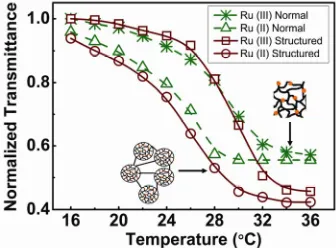
Ru(III) states, whereas the oscillations at 570 nm are attributable to the conformation change of the PNIPAM polymers [19]. Figure 2 shows the normalized transmit-
tance of the structural gel as a function of temperature
which is measured under different oxidization states of the Ruthenium. Compared to the suspension of normal gel particles, the suspension of structural gel particles displays much higher swelling and shrinkage. The inter- connected structured gel particles shrink to ~40% of their original size above their LCST (lower critical solution temperature) whereas the normal gel particles shrink to ~55%. It should be noted that the particle size of the suspension is 160 nm for the normal gel particles and about 700 nm for the structural gel particles. Since sev-eral normal gel particles are clustered together in the lat-ter, oscillations are expected to be higher in structural gel suspensions.
The response of the prepared structural gel is com- pared with that of the normal gel at room temperature and shown in Figure 3. The structural gel exhibits a re-
markable improvement in response dynamics. As men- tioned above, both structural and normal gels were cut into the dimensions of 5 1 1 mm. The shrinkage of gels in length with time was monitored by placing in a solution of 1.0 M nitric acid containing either Ce(IV) or Ce(III), which corresponds to the oxidized or reduced states of the Ruthenium. The degree of swelling in the oxidized state is higher than the swelling in the reduced state for both gels due to the increased Donnan osmotic pressure. It is observed that the structural gel responds 10 times faster than the normal gel. This remarkably faster kinetics may arise from the smaller dimensions of the gel particles than form the three dimensional gel networks.
[image:3.595.92.255.207.331.2] [image:3.595.338.506.571.695.2]Figure 3. Response time of PNIPAM-co-Ru(bipy)3 struc-tural gels in both oxidized and reduced states of the Ruthe-nium metal in comparison with the response time of normal gels.
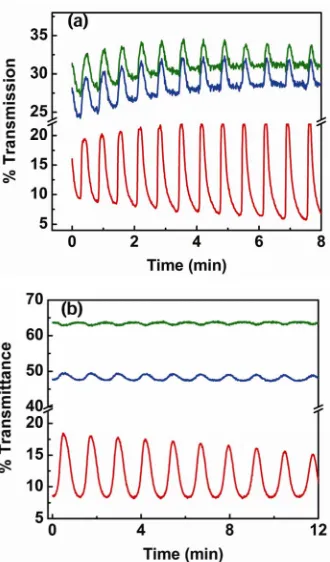
Figure 4. Comparison of the oscillation frequency and am-plitude between self-oscillating BZ active gels: (a) structural gels and (b) normal gels. Chemical oscillations were ob-served at 460 nm and 685 nm as shown in the green and blue lines, and mechanical oscillations were observed at 570 nm as shown in the red line.
The smaller size speeds up the diffusion of the fluid through the gel networks. In the case of normal gels, the cross-linked network reduces the diffusion of surround-ing fluids and hence the gel exhibits slow response.
[image:4.595.90.255.277.558.2]The oscillation frequency and amplitude changes of the PNIPAM gel particles in the structural gel and nor- mal gel suspension are compared under the same BZ reaction conditions as mentioned above and shown in
Figure 4. The Ru(bipy)3 complex has different
absorp-tion spectra in the reduced Ru(II) state and the oxidized Ru(III) state as an inherent property. The upper two os-cillations (at wavelengths of 460 nm and 685 nm) reflect the chemical oscillation of the Ru(bipy)3 catalyst
be-tween the Ru(II) and Ru(III) states, whereas the bottom oscillations (at the wavelength 570 nm) are attributable to the conformation change of the PNIPAM polymers [19]. It should be noted that the upper two oscillations in
Figures 4(a) and (b) are mostly out of phase. However,
the shape of the oscillation for structural gel particles is most pulse-like (non-sinusoidal) compared to normal gel particles. As Figure 4 shows, particles in the structural
gel oscillate at a rate twice faster than that of the gel par-ticles prepared by normal polymerization method. The oscillation amplitude of particles in the structural gel is also much larger than that of normal gel particles.
Based on these special properties obtained from the experiments (fast response kinetics with large amplitudes), more possible applications by the use of these fast res- ponsive and large amplitude polymer gels could be iden- tified, such as reduced detection time of chemical and bio sensors, micro-fluidic valves that operate with faster open/close mechanisms, mechanical switches, and ex- pansion or contraction of bio-related mechanisms such as rapid artificial muscle movements, faster heart beat in the case of artificial heart in which expansions or contra- ctions will occur quickly to drive a mechanism. How- ever, much more refined systematic work should be per-formed to explain the phenomena in this complex system in the future. First, the different mechanical oscillations may be related to the space distribution of the catalyst even at the macroscopic level and the presence of other moieties in structural polymer gels (i.e., some amine
moieties). Second, the strongly confined chemical sys-tems such as the gel network in this work may signifi-cantly affect the effective kinetics. Last but not least, the gel suspensions are similar to segregated reactive fluids where micro-mixing problems may apply, which suggest that the chemical dynamics could be affected by differ-ences in the segregated fluids [24].
4. Conclusion
way of fabricating controllable and functional selfosci- llating polymer gels with excellent responsive capabi- lities in a wide range.
5. Acknowledgements
This work was partially funded by the National Science Foundation (DMR-1006870). The authors wish to thank Texas A&M University and Oklahoma State University for the research support.
REFERENCES
[1] I. R. Epstein, “Nonlinear Oscillations in Chemical and Biological Systems,” Physica D, Vol. 51, No. 1-3, 1991,
pp. 152-160.doi:10.1016/0167-2789(91)90228-2
[2] R. J. Field, E. Koros and R. Noyes, “Oscillations in Chemical Systems. II. Thorough Analysis of Temporal Oscillation in the Bromate-Cerium-Malonic Acid Sys- tem,” Journal of the American Chemical Society, Vol. 94,
No. 25, 1972, pp. 8649-8664.doi:10.1021/ja00780a001 [3] R. Yoshida, T. Sakai, O. Tabata and T. Yamaguchi, “De-
sign of Novel Biomimetic Polymer Gels with Self-Osci- llating Function,” Science and Technology of Advanced
Materials, Vol. 3, No. 2, 2002, pp. 95-102.
doi:10.1016/S1468-6996(02)00010-4
[4] S. Nakamaru, S. Maeda, Y. Hara and S. Hashimoto, “Con- trol of Autonomous Swelling-Deswelling Behavior for a Polymer Gel,” Journal of Physical Chemistry B, Vol. 113,
No. 14, 2009, pp. 4609-4613.doi:10.1021/jp811228y [5] R. Yoshida, T. Takahashi, T. Yamaguchi and H. Ichijo,
“Self-Oscillating Gel,” Journal of the American Chemical
Society, Vol. 118, No. 21, 1996, pp. 5134-5135.
doi:10.1021/ja9602511
[6] Y. Hara and R. Yoshida, “Control of Oscillating Behavior for the Self-Oscillating Polymer with pH-Control Site,”
Langmuir, Vol. 21, No. 21, 2005, pp. 9773-9776.
doi:10.1021/la052070v
[7] Y. Hara and R. Yoshida, “Self-Oscillation of Polymer Chains Induced by the Belousov-Zhabotinsky Reaction under Acid-Free Conditions,” Journal of Physical Che-
mistry B, Vol. 109, No. 19, 2005, pp. 9451-9454.
doi:10.1021/jp0501704
[8] S. Maeda, Y. Hara, T. Sakai, R. Yoshida and S. Ha- shimoto, “Self-Walking Gel,” Advanced Materials, Vol.
19, No. 21, 2007, pp. 3480-3484.
doi:10.1002/adma.200700625
[9] V. V. Yashin and A. C. Balazs, “Pattern Formation and Shape Changes in Self-Oscillating Polymer Gels,” Scien- ce, Vol. 314, No. 5800, 2006, pp. 798-801.
doi:10.1126/science.1132412
[10] V. V. Yashin, O. Kuksenok and A. C. Balazs, “Modeling Autonomously Oscillating Chemo-Responsive Gels,” Pro-
gress in Polymer Science, Vol. 35, No. 1-2, 2010, pp.
155-173.doi:10.1016/j.progpolymsci.2009.10.003 [11] R. Yoshida, “Self-Oscillating Gels Driven by the Belou-
sov-Zhabotinsky Reaction as Novel Smart Materials,”
Advanced Materials, Vol. 22, No. 2010, pp. 3463-3483.
doi:10.1002/adma.200904075
[12] R. Yoshida, “Self-oscillating Polymer Gel as Novel Bio- mimetic Materials Exhibiting Spatiotemporal Structure,”
Colloid and Polymer Science, Vol. 289, No. 5-6, 2011, pp.
475-487.doi:10.1007/s00396-010-2371-y
[13] T. Asoh, M. Matsusaki, T. Kaneko and M. Akashi, “Fab- rication of Temperature-Responsive Bending Hydrogels with a Nanostructured Gradient,” Advanced Materials,
Vol. 20, No. 11, 2008, pp. 2080-2083.
doi:10.1002/adma.200702727
[14] C. E. Reese, A. V. Mikhonin, M. Kamenjicki, A. Tikho- nov and S. A. Asher, “Nanogel Nanosecond Photonic Crystal Optical Switching,” Journal of the American Che-
mical Society, Vol. 126, No. 5, 2004, pp. 1493-1496.
doi:10.1021/ja037118a
[15] J. Kim, S. Nayak and L. A. Lyon, “Bioresponsive Hy-drogel Microlenses,” Journal of the American Chemical
Society, Vol. 127, No. 26, 2005, pp. 9588-9592.
doi:10.1021/ja0519076
[16] Z. Hu and G. A. Huang, “A New Route to Crystalline Hydrogels, Guided by a Phase Diagram,” Angewandte
Chemie International Edition, Vol. 42, No. 39, 2003, pp.
4799-4802.doi:10.1002/anie.200351326
[17] H. Kawaguchi, K. Fujimoto and Y. Mizuhara, “Hydrogel microspheres III. Temperature-Dependent Adsorption of proteins on Poly-N-isopropylacrylamide Hydrogel Micro- spheres,” Colloid and Polymer Science, Vol. 270, No. 1,
1992, pp. 53-57.doi:10.1007/BF00656929
[18] T. Sakai, Y. Hara and R. Yoshida, “Phase Transition Be-haviors of Self-Oscillating Polymer and Nano-Gel Parti-cles,” Macromolecular Rapid Communications, Vol. 26,
No. 14, 2005, pp. 1140-1144.
doi:10.1002/marc.200500195
[19] J. Shen, S. Pullela, M. Marquez and Z. Cheng, “Ternary Phase Diagram for the Belousov-Zhabotinsky Reaction- Induced Mechanical Oscillation of Intelligent PNIPAM Colloids,” Journal of Physical Chemistry A, Vol. 111, No.
48, 2007, pp. 12081-12085.doi:10.1021/jp072574x [20] E. S. Matsuo and T. Tanaka, “Kinetics of Discon-Ti-
nuous Volume-Phase Transition of Gels,” Journal of
Chemical Physics, Vol. 89, No. 3, 1988, pp. 1695-1703.
doi:10.1063/1.455115
[21] T. Tanaka and D. J. Fillmore, “Kinetics of Swelling of Gels,” Journal of Chemical Physics, Vol. 70, No. 3, 1979,
pp. 1214-1218.doi:10.1063/1.437602
[22] E. C. Cho, J. W. Kim, A. Fernandez-Nieves and D. A. Weitz, “Highly Responsive Hydrogel Scaffolds Formed by Three-Dimensional Organization of Microgel Nano- particles,” Nano Letters, Vol. 8, No. 1, 2008, pp. 168-
172.doi:10.1021/nl072346e
[23] S. Maeda, Y. Hara, R. Yoshida and S. Hashimoto, “Pe- ristaltic Motion of Polymer Gels,” Angewandte Che- mie
International Edition, Vol. 47, No. 35, 2008, pp. 6690-
6693.doi:10.1002/anie.200801347
[24] A. K. Dutt and M. Menzinger, “Stirring and Mixing Effects on Chemical Instabilities: Bistability of the Bro- mate/Bromide/Cerium(3+) System,” Journal of Physical
Chemistry, Vol. 94, No. 12, 1990, pp. 4867-4870.