Munich Personal RePEc Archive
Modeling an Immigration Shock
Boldrin, Michele and Montes, Ana
WUStL, FEDEA and CEPR, Universidad de Murcia
20 July 2013
Online at
https://mpra.ub.uni-muenchen.de/56765/
Modeling an Immigration Shock
Michele Boldrin and Ana Montes
WUStL, FEDEA and CEPR; Universidad de Murcia
Abstract
In this paper, we model an overlapping generation economy a¤ected by an un-expected immigration shock and determine how households would insure them-selves against "immigration risks" e¢ciently. We use the model to study the impact of immigration on (i) the welfare of various generations, (ii) the distri-butions of income among factors of production, and (iii) the optimal design of the intergenerational welfare state. In particular, we construct a system of public education and public pensions that mimics e¢cient complete market allocation. We also show the impact of immigration shocks in a small open economy. In this case, our model suggests that the external capital ‡ows can act as substitutes for the missing private insurance markets. Our analysis delivers a set of predictions that we …nd useful for understanding certain aspects of the Spanish experience during 1996 and 2007.
JEL Code: H55, H53, E25, F22
Keywords: social security, human capital, overlapping generations, immigra-tion, trade de…cit, risk sharing
Boldrin acknowledges research support through the project ECO2008-06395-C05-01. Montes acknowledges …nancial support from the Spanish Ministry of Education and Science project ECO2011-28501 and from the Fundación Séneca de la Región de Murcia project 11885/PHCS/09.
1. Introduction
In most countries of the developed world, the combination of declining fertility rates and increasing life expectancies makes immigration ‡ows to developed coun-tries increasingly important. In fact, immigration is the main source of population growth in most of these countries. In addition, but perhaps no less important, in a densely populated world subject to strong climatic pressures, the risk of large population displacements is greater than ever before. All these aspects make it increasingly important that the institutions of a country are adapted to migration shocks.
Given this concern, we are interested in the following questions. What are the intergenerational economic e¤ects of a large immigration ‡ow? How do households insure themselves against an immigration shock? How does an immigration shock a¤ect the welfare of the various generations in the receiving country, both current and future generations? In particular, how does immigration impact intergener-ational arrangements such as public education and pensions, which make up the core of the contemporary welfare state? To begin answering these questions, we develop a simple theoretical framework with overlapping generations that live for three periods in which they accumulate human capital in the …rst, work in the second and retire and live o¤ the return from their investments in the third. The latter includes both physical capital and the resources they lent the young people to invest in human capital because we allow for this type of lending-borrowing relationship to be established through …nancial markets in our baseline model.
We take immigration shock to be an increase in the size of the middle-aged generation that engenders, among other things, a reduction in the average human capital of the labor force. In other words, the immigrants are new middle-aged workers who are somewhat less skilled than the average natives. The shock lasts one period after which the economy moves along its new growth path with a larger number of middle-aged workers. We assume that the children of the immigrants perfectly integrate. Hence, after one period, the children of immigrants accumu-late as much per-capita human capital as the o¤spring of the native workers with the same level of skill. In the context of our model, one period lasts approximately 25-30 years.
two …nancial assets agents buy from and sell to each other in every period. One asset pays one unit of consumption only when there is an immigration shock, and the other pays a unit of consumption only when there is no immigration shock. Through these two assets, which are accessible to all individuals living in the country, young and middle-aged people insure themselves from the impact of an immigration shock. In particular, young people, who will be middle-aged and working in the next period, would like to insure themselves against the negative impact that the arrival of immigrants may have on their wages; they do so by purchasing insurance from the currently middle age people. The latter, who are saving for retirement, can use the extra payo¤ they would receive from their capi-tal investment if the immigration shock were realized in the next period to provide such insurance. The elderly do not accumulate further assets because we assume that they must die without debt and there is no bequest motive.
The buying and selling of insurance takes place at the same time and through the same instruments that the middle aged and young use to lend/borrow to/from each other. More precisely, middle-aged individuals invest in physical capital (by purchasing assets issued by the competitive …rms that carry out production in the next period) and in human capital (by purchasing assets issued by the young agents to …nance their own education). Because the capital invested in the …rms pays o¤ more when there is immigration, it compensates for the lower payo¤ from the human capital investment accruing to the middle age. This assures that both young and middle age people implement as much consumption smoothing as it is feasible in the benchmark complete markets economy; this consumption takes place when they are middle age and elderly, respectively.
purchase insurance for the future generations is an interesting venue for future research.
The key channels through which immigration a¤ects welfare in this economy is that it increases the labor supply of unskilled workers in the face of a prede-termined stock of physical capital and skilled workers. This lowers the wages of unskilled workers and increases both the return on physical capital and the wages of skilled workers, which shifts income from one part of the population to another. In this sense, factor prices move around because we have assumed there is zero mobility of both physical capital and skilled labor in the benchmark model. If there were perfect mobility of capital and skilled labor, both factors of produc-tion would ‡ow into the country from the outside on the footsteps of unskilled immigrant labor and the capital intensity ratios would remain unchanged. In this case, factor prices would be una¤ected by immigration, which would amount to nothing more than an increase in the size of the economy. Under constant returns to scale in production, which we assume, this does not a¤ect the welfare of the native agents. The capital intensity ratios and the wage per unit of human capital remain constant. Hence, the salaries of the native do not change at all. This case is trivial, and we do not consider it.
Nevertheless, if there are frictions in the international …nancial markets and capital adjustment is not instantaneous, i.e., it takes time for the capital stock of the country to be built up to restore the initial capital intensity ratio, then immi-gration causes a redistribution between generations as outlined above. The latter observation suggests that the larger is the trade de…cit following an immigration shock, the quicker will be the adjustment toward the old capital intensity ratio and the smaller the redistribution away from native workers and toward native owners of capital. This is an interesting result because it suggests that the trade de…cit that follows an immigration shock and borrowing from aboard can be a substitute for the missing internal insurance markets.
We are not the …rst to claim a link between immigration ‡ows and interna-tional capital ‡ows. Other authors have explored this relationship in dynamic general equilibrium models designed to quantify the impact of immigration on capital in‡ows and, therefore, on trade de…cits in small open economies that have experienced a large immigration wave. Izquierdo, Jimeno and Rojas (2010) and Gavilán, de Cos, Jimeno and Rojas (2011) constructed and calibrated a large-scale overlapping generation model for Spain, which is a country that has received a massive wave of immigration in recent years1. In both papers, the results indicate
that interest rates and immigration are the main factors responsible for the in-vestment boom and the build-up of a sizable external imbalance witnessed in the Spanish economy over the period from the mid-1990s to 2008. Another example of a large immigration shock was Israel following the collapse of the Soviet Union in the 1990’s2. Cohen, Eckstein and Weiss (2012) and Cohen and Hsieh (2001) show
that the average e¤ective wages of native Israelis fell and the return to capital in-creased during the height of the in‡ux in 1990 and 1991. By 1997, however, both average wages and the return to capital had returned to pre-immigration levels due to an investment boom induced by the initial increase in the return to capi-tal. The investment boom was largely …nanced by external borrowing. The model elaborated in Wilson (2003), is calibrated to the Canadian economic environment in the years that led to the Great War in which Canada experienced a dramatic shift in migration patterns3. Again, the results suggest that up to three-quarters
of the increase in the capital formation rate and the foreign capital in‡ow rate in the Canadian economy over the period of 1899-1911 can be attributed to the dramatic in‡ow of immigrants over this period.
All these papers are quantitative macroeconomic studies4 of the impact of
im-migration on the host country based on the calibration of a general equilibrium model in which immigration is a deterministic process. Another example of this type of model for a closed economy framework is Canovas and Ravn (2000) in which the authors use an in…nitely lived agents model to demonstrate that the re-uni…cation of Germany (an event similar to a mass migration of low-skilled agents who hold no capital into a foreign country) generated a signi…cant redistribution to high-skilled workers and entrepreneurs. Although the papers listed above for-get human capital accumulation, Eberhard (2012) analyzes the e¤ect in a closed economy of an unexpected in‡ux of immigrants on the price of skill and hence on the earnings, human capital accumulation, and educational attainment of native workers. Nevertheless, Eberhard (2012) abstracts from the e¤ects of migration on
from the late nineties to 2007. The foreign population in Spain increased from 0.35 million (1% of the total population) in 1995 to 5.22 million (11% of the total population) in 2008.
2From late 1989 through 1996, 670 thousand Russian Jews immigrated to Israel, which
increased the total population of Israel by 11 percent and the labor force by 14 percent.
3Canada went from being a net supplier of migrants to a net receiver of immigrants with a net
immigration rate of 15.1% in the period of 1901-1911 (as a percentage of the 1901 population).
4There is an extensive literature of microeconometric studies of the impact of immigrants on
physical capital accumulation.
In contrast to the previous literature, our paper has mostly a normative value. We focus on the design of optimal policies that allow agents to insure against an immigration risk. In fact, we next ask whether government policies can be used to substitute for the credit and insurance markets of the baseline model when these are either absent or largely incomplete as is often the case. To do this, we build on previous results presented in Boldrin and Montes (2005, 2009), which answered the question in the a¢rmative for the case of no immigration shock, and adapt their framework to the particular circumstances at hand. Under uncertainty, we need to use the welfare state to also allocate risk e¢ciently between generations and heterogeneous agents and not only allow for intergenerational trade as in deterministic case. In the present case, we show that pension payments and social security contributions must be negatively indexed to the size of the immigration ‡ow, but educational expenditures and the issuance of public debt …nancing should be positively correlated. Intuitively, this is because social security contributions play the role that the repayment of debt plus interest—by the currently middle-aged generation to those that lend them money to invest in human capital— plays in the model with sequentially complete …nancial markets. The pension payments are nothing but these contributions as received by the elderly: they correspond to the payo¤ from the securities that were traded to …nance the human capital investment of the young generation in the previous period. Likewise, the educational investment (…nanced via the issuance of bonds) corresponds to the issuance of the same securities in this period, and hence it should increase because the size of the young generation is larger than expected.
system. Sanchez-Marcos and Sanchez (2004) con…rm the …ndings of Krueger and Kubler (2005) for the case of demographic uncertainty.
An important di¤erence between all of these papers and the economy in our paper is that the authors of these papers abstract from the accumulation of human capital and, therefore, from the negative e¤ect that missing credit markets has on education. As we show in section 4 (and in more detail in Boldrin and Montes (2005)), when credit markets for education are absent and even in the presence of government-…nanced education, there is too much investment in physical capital with respect to the complete market allocation. This is because public education allows the working generation to invest in the human capital of future generations, but it does not allow the former investors to collect the market return from their bene…ciaries. This will generally lead to an ine¢ciency: investment in physical capital is too high and there is less intergenerational consumption smoothing than under the complete market allocation. In this sense, the introduction of a PAYGO system in which social security contributions correspond to the capitalized value of education services received is a tool for "e¢ciently" crowding-out physical capital. The rest of the paper proceeds as follows. In Section 2, we describe the bench-mark model. In Section 3, we show the e¤ects of the absence of credit and insur-ance markets. In Section 4, we look at the e¢cient welfare state in the presence of immigration and in a closed economy with incomplete markets. In Section 5, we look at an open economy with incomplete …nancial markets but with pub-lic education and pensions. Section 6 concludes the paper with some practical considerations about the Spanish experience.
2. The basic model
We use an OLG model with two types of agents in each generation who live for three periods: youth, middle age, and old age. Agents di¤er in the level of productive skills they inherit: high(H) and low (L).
There is aggregate uncertainty due to an immigration ‡ow that may increase the size of the low-skill middle-aged group, which a¤ects the total supply of labor, the wage rates, the return on capital, the aggregate output and the size of future generations.
We use the superscripts,y,m and o to denote young, middle-aged and elderly people, respectively, and the superscriptsi=H; Lto denote high and low human capital. The population structure in periodt is(Nty; Ntm; Nto), withN
y t =N
yH t +
NmL
t = (1 +zt)NtyL1 and N
yi
t = (1 +n)Ntmi for i = H; L, where 1 < n, and zt
is the realization of the immigration shock in periodt. For simplicity, we assume that the shockz follows a two-state Markow process with state spaceZ =fz;0g,
z >0. The notation (zt+1jzt) denotes the probability of zt+1 2Z given zt.
In each period t = 0;1; :::; a new generation Nty = (1 +n)Ntm is born. Each
type i = H; L is born with a per-capita endowment of basic knowledge, hyit ,
which is an input to the production of future human capital, according to hmi t+1 = h(di
t; h yi
t ). We denote the physical resources invested in the education of a young
individual of type i in period t with di
t; we assume h yH t > h
yL
t . The function
h(d; hy) is a constant returns to scale neoclassical production function. During
the second period of life, individuals work and decide how much of their income to consume, how much to save, and how to allocate the latter among various …nancial instruments. When they are elderly, individuals have no decisions to make: they consume all their income and then die. We assume agents draw utility from consumption when middle age and elderly. We also assume immigrants enter the country with the same human capital as the low-skill middle-aged natives and with zero capital or …nancial assets. Consumption when young, leisure, and the welfare of descendants do not a¤ect lifetime utility.
The initial conditions are: K0, for the capital stock; (N0yi; N0mi; N0oi); for the
population; hmi
0 ; for the human capital of the middle age individuals;A
yi
1(0) and Ami
1(0); for the portfolios of middle-aged and elderly people, respectively; and Af1(0); for that of the representative …rm, which owns K0. Finally, we assume
there are no immigrants in the …rst period.
The preferences of an individual of type i, born in period t 1, are
Et 1 u(cmi(zt)) + Et u(coi(zt+1)) ;
where is the period discount factor, and E is the expectation operator. The function u : <+ ! < is assumed to be strictly increasing, strictly concave and C2.
2.1. Market structure
Normalize to one the price of output in the initial period, in which the state is z = 0; write pt(z) for the price of output in period t and state z 2 Z in
all subsequent periods. We assume sequentially complete …nancial markets, i.e.,
given the current stateztand the setZ of possible future states, for allz 2Z, there
in the units of the next period’s consumption, b[At(z); zt+1] = 1 if zt+1 =z, and
zero otherwise. We assume agents cannot die in debt, i.e., we imposeAmi
t (z) 0
for allt andz withi=H; L. Letq(z; zt)be the price, in units of consumption at
t, of assetA(z) in periodt and state zt. To save notation, the symbolAt(z)also
indicates the number of units of that asset traded in a given period.
2.2. Firms
There is a representative …rm, which uses physical capital and the two types of human capital to produce output according to Yt = F(Kt; Ht; Lt), where
Ht = hmHt NtmH , Lt = hmLt NtmL; and F (K; H; L) is a constant returns to scale
neoclassical production function. We assume a full depreciation of capital and that high-skill workers are more productive than low-skill workers, everything else equal, i.e., FH(K; X; X) > FL(K; X; X). Firms last one period and own the
physical capital, which they …nance by issuing state-contingent securities. More speci…cally, in each period t the representative …rm issues securities Aft(z) at a
price ofq(z; zt), forz 2 fz;0g, with the proceedings of which they purchaseKt+1,
which is used for production in the next period. In period t+ 1, after the realiza-tion of the shock, the …rm hires workers, carries out producrealiza-tion, pays o¤ wages, honors its …nancial liabilities and then dissolves.
Let wi(z
t) be the nominal wage in period t and state zt 2 Z for an agent of
type i = H; L. Write wi(z
t)=p(zt) = !i(zt) and '(zt) = p(zt)FK(Kt; Ht; L(zt)):
The problem of the …rm is
max
Aft(zt+1);Ht+1;Lt+1
Et
n
p(zt+1)
h
Y(zt+1) !H(zt+1)Ht+1 !L(zt+1)L(zt+1) Aft(zt+1)
io
subject to,
Y(zt+1) = F (Kt+1; Ht+1; L(zt+1))
Kt+1 =
X
z2Z
q(z; zt)Aft(z):
The …rst order conditions for H; Land for Af (z) are
!H(z
t+1) = FH(Kt+1; Ht+1; L(zt+1)) 8 zt+1 2Z (1.a) !L(z
t+1) = FL(Kt+1; Ht+1; L(zt+1)) 8 zt+1 2Z (1.b)
q(z; zt) =
(zjzt)pt+1(z)
P
z2Z (zjzt)'t+1(z)
2.3. Consumers
For a native agent of type i = H; L born in period t 1 when the state is zt 1,
the lifetime optimization problem is
max
di(z
t 1);Ayit 1(z);Amit (z)
Et 1 u(cmi(zt)) + Et u(coi(zt+1))
subject to,
di(z t 1) +
X
z2Z
q(z; zt 1)Ayit 1(z) 0 (2:a)
cmi(zt) +
X
z2Z
q(z; zt)Amit (z) = ! i
(zt)hmit +A yi
t 1(zt) 8zt 2Z (2:b)
coi(z
t+1) = Amit (zt+1) 8zt+1 2Z (2:c) hmit = h d
i
(zt 1); hyit 1 (2:d)
The …rst order conditions for the choice of Ayi(z
t 1) = fAyit 1(z), for all z 2 Zg
and di(z
t 1) reduce to
q(z; zt 1) =
(zjzt 1)u0(cmit (z))
P
z2Z (zjzt 1)u0(cmit (z))!it(z)hd di(zt 1); hyit 1
8z 2Z(3:a)
1 = X
z2Z
q(z; zt 1)!it(z)hd di(zt 1); hyit 1 : (3:b)
For each of the Ami
t (z), the …rst order condition reads
q(z; zt) =
(zjzt) u0(coit+1(z)) u0(cmi(z
t))
8z 2Z: (3:c)
For a middle-aged immigrant who arrives in the state of the world zt with human
capital hm
t =hmLt and A y
t 1(zt) = 0, the maximization problem is
max
Am t (z)
u(cm(zt)) +Et[ u(co(zt+1))]
subject to,
cm(zt) +
X
z2Z
q(z; zt)Amt (z) = ! L
(zt)hmt (4.a)
The …rst order conditions that determine Am(z
t) are analogous to those in (3.c):
q(z; zt) =
(zjzt) u0(cot+1(z)) u0(cm(z
t))
8z 2Z: (4.c)
2.4. Financial markets
It should be clear from the budget constraint that the net …nancial position of the young is non-positive (i.e., Pz2Zq(z; zt 1)A
yi
t 1(z) 0 for i = H; L) and the net
…nancial position of the middle–aged is non-negative (i.e.,Pz2Zq(z; zt)A mi t (z)
0 for i = H; L and Pz2Zq(z; zt)Amt (z) 0). When the latter is positive, it
corresponds to aggregate national savings, which is invested in the physical capital of …rms and in the education of the young agents. The …rst order conditions for the pro…t maximization of the representative …rm imply
q(z; zt) =
(zjzt)pt+1(z)
P
z2Z (zjzt)'t+1(z)
for eachz 2Z: (1.c)
Multiplying (1:c) by FK(Kt+1; Ht+1; Lt+1(z)) and aggregating over z 2 Z we
ob-tain X
z2Z
q(z; zt)FK(Kt+1; Ht+1; Lt+1(z)) = 1: (5)
2.5. Competitive equilibrium
Acompetitive equilibrium is a mapping from the current state of the world into a distribution of quantities and prices at allt. Given an initial condition(K0; H0; L0), z0, N0oi; N0mi; N
yi
0 , (A
yi
1(z0); Ami1(z0); Af1(z0)), with i=H; L;and a sequence
of exogenous basic knowledgesnhyHt (z); h yL t (z)
o1
t=0, a competitive equilibrium is
a collection of the following:
1. choices of the native, di
t(z); cmit (z); coit (z); A yi
t (z); Amit (z) 1
t=0, i = H; L,
and immigrant, cm
t (z); cot(z); Amt (z) 1
t=0, households;
2. choices of the representative …rm,nKt(z); Ht(z); Lt(z); A f t (z)
o1
t=0; and
3. prices, fpt(z); q(z; zt)g 1
such that, for all t and z 2 Z, the consumers and the …rm maximize their payo¤s and the markets clear.
In each period t and state z there are three sets of markets to clear:
i) Output market:
Ctm(z) +C o
t (z) +Dt(z) +Kt+1(z) =F (Kt; Ht; Lt(z)): (6:a)
where Cm
t (z) and Cto(z) are the aggregate consumption of the middle-aged
and old, respectively, in period t and state z; and Dt(z) is aggregate physical
resources invested in education in periodt and state z.
ii) Labor market:
Ht = hmHt N yH
t 1; (6:b)
Lt(z) = hmLt (1 +z)N yL t 1:
iii) Capital market:
X
z2Z
q(z; zt)Aft(z) = Kt+1;
Aft (z) =
X
i=H;L
Ami t (z)N
yi
t 1+Amt (z)ztNtyL1+
X
i=H;L
Ayit (z)N yi t ;
X
i=H;L
di(z
t)Ntyi =
X
i=H;L
X
z2Z
q(z; zt)Ayit (z)N yi
t : (6:c)
For each state z 2Z, the payo¤ from security Aft(z)is
b[Aft(z); zt+1 = z]Atf(z) =F (Kt+1; Ht+1; Lt+1(z)) !Ht+1(z)Ht+1 !Lt+1(z)Lt+1(z)
2.6. Numerical Evaluation
In Appendix A, we study an analytical illustration of our model in which the following speci…cation of our key functions is used5: u(c) = logc; F(K; H; L) =
AK H L1 and h(di; hyi) =B(di) (hyi)1 .
Our main purpose in this section is to consider the practical implications of an immigration shock in a world with complete markets using a numerical eval-uation of the economy in Appendix A. To do this, we assign reasonable values to each parameter and provide a numerical computation of the impact of an immigration shock. We compare two economies: an economy with no immigra-tion (z0; z1; z2; :::) = (0;0;0; :::) and another with only one immigration shock (z0; z1; z2; :::) = (0; z;0; :::). We normalize N0m = 1 with N0mH = 0:6 and assume
an annual growth rate of the population equal to 0. Recall that a period in this model is approximately 30 years. We assume z= 0:4and (zjzt) = (0jzt) = 0:5.
With respect to the production technology, is …xed to0:3; = 0:45;and the scale parameterAis …xed at1. In the human capital technology, we set = 0:13;which corresponds to an elasticity of output of0:058with respect to education for a high human capital worker and 0:0325 for a low human capital worker. The discount factor is set to match an average ratio of investment over output I=Y = 21:9%. This yields a value of = 0:904, which corresponds to an annual discount factor of0:996641. We set the scale parameterB equal to4:35to obtain an annual rate of aggregate output growth equal to 3% along the balance growth path. With these parameter values we have an annual interest rate of 4:1%. The fraction of total output spent to …nance education (D=Y) is equal to6:3%, which is on the low side for the US but not for most European countries, including Spain.
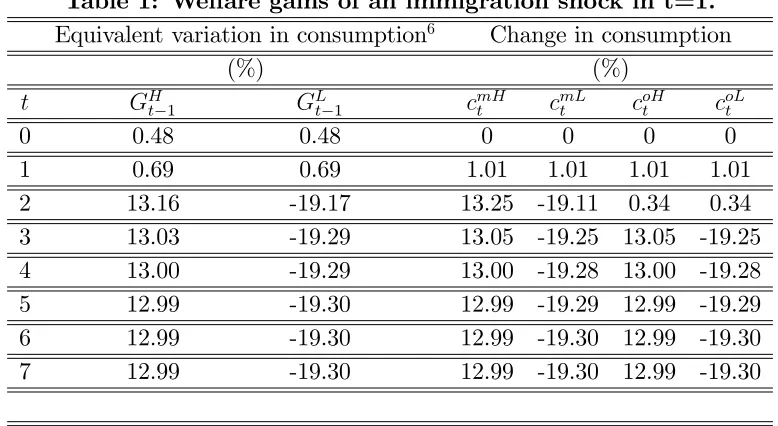
Assume the same initial conditions for both economies and assume they are on their balance growth path from the start. In Table 1, we show the welfare changes expressed as equivalent variation in consumption caused by an immigration shock in periodt= 1 (where Gi
t 1, i=H; L, denote the generation born in periodt 1
with skill i). To disaggregate the e¤ects of the shock along the life cycle of an
5We have used a particular case of a more general production function, Y = AK E1 ,
withE a CES aggregate of various types of labor of the formE=haH 1 + (1 a)L 1i 1, where >0 measures the elasticity of substitution between workers with various skills and a
(1 a) is high (low) skill-speci…c productivity level. We have assumed = 1; and therefore we getE =HaL1 a. The sign of F
HL depends on the elasticity of substitution. If < 1=
then FHL >0 and, therefore, immigration has a positive e¤ect on high human capital wages.
individual, we also shown the change in consumption of middle-aged and elderly agents induced by the immigration shock in Table 1. First, notice that the middle-aged and elderly generations that are alive when the shock hits consume more in this period than in the economy with no shock because the output is much higher during that period and the insurance mechanism redistributes this extra income to both middle-aged and elderly people. Therefore, elderly generations that are alive when immigrations arrive are better o¤.
Table 1: Welfare gains of an immigration shock in t=1.
Equivalent variation in consumption6 Change in consumption
(%) (%)
t GH
t 1 GLt 1 cmHt cmLt coHt coLt
0 0.48 0.48 0 0 0 0
1 0.69 0.69 1.01 1.01 1.01 1.01
2 13.16 -19.17 13.25 -19.11 0.34 0.34
3 13.03 -19.29 13.05 -19.25 13.05 -19.25
4 13.00 -19.29 13.00 -19.28 13.00 -19.28
5 12.99 -19.30 12.99 -19.29 12.99 -19.29
6 12.99 -19.30 12.99 -19.30 12.99 -19.30
7 12.99 -19.30 12.99 -19.30 12.99 -19.30
Nevertheless, future generations with low human capital are worse o¤ in the economy with a shock because insurance against the immigration shock cannot be purchased before being born, and they pay the price of having low human capital income competing with them. The immigration shock negatively a¤ects the low human capital workers of future generations because their wages are smaller along the transition to the new balanced growth path and positively e¤ects the high human capital workers of future generations because their wages are higher along the same path. Depending on the choice of parameter values, a second e¤ect may or may not push in the same direction: immediately after the shock hits, there is "too much"L and "too little" of both H and K relative to the balanced growth
6We compute the fraction of additional consumption along the life cycle that we must give to
ratios. As H and K accumulates toward the desired level and to the extent that this takes place at various speeds depending on the parameter values, there may be "too little"H and "too much" K for some periods during the transition. This further increases the wages of the high human capital workers, and decreases the marginal productivity of capital relative to their levels in the economy without a shock.
It is important to note that such e¤ects depend on the presence or absence of certain …nancial markets that various generations may use to purchase insurance:
i) The low human capital workers who are alive during the transition periods are worse o¤ because the immigration shock took place before they were born, and so they could not insure against it. Because there are "too many" of them during the transition, their lifetime income is lower than in the absence of the shock.
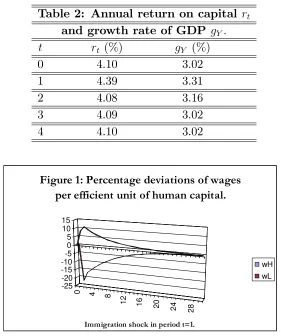
ii) The rapid increase in the stock ofK immediately after the immigration shock hits is due to the presence of the …nancial assets that allow the living middle-aged workers to pro…t from the shock. Because they share in the bounty with the owners of physical capital, their disposable income increases, and this allows them to immediately invest more in K, which immediately surges. Simple calculations show that, absent the …nancial instruments that allow middle-aged workers to share in it, the extra output that accrues to …rms in the form of an increase in the productivity of K would go to only the owners of K, i.e., the elderly retirees. They would consume it all instead of investing part in tomorrow’s stock of capital, which is instead what the middle-aged people do with their share. In an economy without this type of …nancial assets, this means that the rate of return on capital increases immediately after the shock hits and then slowly decreases toward its long run position. In our economy, instead, the rate of return on capital increases at the time of the shock and decreases a period later (when investment surges) to converge from below to its long run position because high human capital is accumulated much more slowly than is physical capital. To put it di¤erently, the hypothesis of sequentially complete …nancial markets has testable aggregate implications.
period in which the immigrants arrive and a temporarily negative (positive) e¤ect on low (high) human capital labor productivity. Capital productivity increases in the period in which the immigrants arrive and then decreases and stays tem-porarily below its value in the economy without shocks. After the adjustment is completed, the growth rate and the marginal productivities resume their original long-run levels.
Table 2: Annual return on capital rt and growth rate of GDP gY:
t rt (%) gY (%)
0 4.10 3.02
1 4.39 3.31
2 4.08 3.16
3 4.09 3.02
4 4.10 3.02
0 4
8
12 16
20 24
28
-25 -20 -15 -10 -5 0 5 10 15
Immigration shock in period t=1.
Figure 1: Percentage deviations of wages per efficient unit of human capital.
wH
wL
of output must be allocated to endow these workers and their o¤spring with physical capital and high human capital in all periods following the shock period. Hence, savings rates must temporarily increase until the factor proportions return to the balanced growth levels after which growth resumes at the same rate as in the economy without shock. Because the additional investment that is made necessary by the shock reduces (increases) the consumption of low (high) human capital agents for a few periods after which consumption grows at the same rate as in the original equilibrium path, the new path will always stay below (above) the original one for the low (high) human capital individuals. Hence, consumption levels will di¤er forever despite growing at the same rate. This explains the lower (higher) steady state utility for the representative low (high) human capital agent in the economy with the immigration shock7.
3. Equilibrium when credit and insurance markets are
miss-ing
The results obtained here are consistent with those reported in Boldrin and Montes (2005). Nevertheless, adding heterogeneity to each generation and adding un-certainty regarding the size and composition of the next cohort of middle-aged workers enriches the model and makes it possible to ask a number of new and interesting question. More precisely, one would want to distinguish the study of what happens (1) when there are not markets to insure against unexpected immigration shocks from (2) what happens when there are no markets for lend-ing/borrowing across generations and over time. This leads us to consider the following two cases separately.
1. Young people cannot trade the security Ay(z), but they can borrow to
in-vest d in human capital. Because there are no state contingent assets, they must repay their debt at a …xed interest rate regardless of whether there
7To simplify the analysis, we have considered only a one-o¤ immigration shock. It is easy
is an immigration shock in the next period. In other words, they can bor-row, but they cannot insure. In this case, even if the middle-aged people attempted to trade in state contingent Am(z) assets, this would not work
because of a lack of a counterpart. The only entity they could trade those assets with is the …rm, which cannot insure them against anything because it has no compensating sources of income in bad states. The income of el-derly people is now equal to the …xed return on d plus the random return on capital investment. Because these are linearly independent returns and there are only two states of the world, middle-aged people can still use a portfolio composed of "educational bonds" and "shares of the …rm" to fully insure their elderly consumption (for certain parameter con…gurations this may require taking a negative position in one of the two assets, which is an impossibility in this environment). However, this result is special because it follows from the simplifying assumption of only two immigration states, which makes spanning possible with just two assets. In either case, when insurance markets are absent, the young people bear all the risk because they must reimburse a …xed amount d(1 +r); when they reach middle age regardless of the state of the world. This implies that, when there is immi-gration, low human capital middle-aged natives have less income to consume and save than in the complete markets case. As in the world with complete markets, their wage bill is lower, but their debt payment is higher, which leaves less for cmL(z
t) +Pz2Zq(z; zt)A mL
t (z). Therefore, their lifetime
util-ity is lower. On the contrary, high human capital middle-aged natives have more income to consume and save than in the complete markets case (their wage bill is higher, as in the world with complete markets, but their debt payment is lower). Additionally, aggregate net labor income is lower, and therefore, total investment decreases.
2. Young people cannot borrow at all. Hence, middle-aged people can invest in only the physical capital. Obviously, this implies that there is a much lower level of human capital in the economy and that there is no growth. In this case, "workers" bear all the downside risk (i.e., they either do "normal" or do "worse"), but the owners of capital bear all the upside (i.e., they either do "normal" or do "better").
4. The Welfare State of a Closed Economy
4.1. Missing credit and insurance markets
Let us begin with case 2 of the previous section in which all credit and insurance markets other than the market for purchasing physical capital have been shut down. In this case,FK(K; H; L),FH(K; H; L)and FL(K; H; L)are all a¤ected by
the immigration shock, and no factor owner can insure against it. We want to de-rive policies capable of implementing the sequentially complete market allocation (SCMA) of Section 2. They turn out to be not very di¤erent from those derived in Boldrin and Montes (2005), apart from the fact that contributions and bene…ts are now state contingent.
In particular, in Boldrin and Montes (2005), the young "borrow" from the middle-aged via the public education system, and they pay back the debt at the market interest rate via a social security tax the proceeds of which …nance pension payments8. Under uncertainty, we need to use the welfare state to also
allocate risk e¢ciently between generations and heterogeneous agents and not just to allow for intergenerational trade as in the deterministic case. Think of what happens when there is an unexpected ‡ow of immigrants (z = z): the marginal productivity of low human capital labor decreases, and the marginal productivity of high human capital and physical capital increase. If we simply levy a social security contribution in the amount of tpit = dit 1(1 +rt) where
rt is the market interest rate (starred symbols refer to the SCMA quantities in
the remainder of the paper) and nothing else, the disposable per capita income of the low (high) human capital middle-aged individuals decreases (increases) compared to the SCMA. Furthermore, the amount by which the savings of this group decrease is not compensated by the increased saving of the high human capital workers, which implies an under-investment in physical capital compared to the SCMA.
Therefore, there are potential gains from risk sharing among various agents. We should stress here a relatively delicate point: an immigration shock causes ag-gregate uncertainty (it increases agag-gregate output), but part of that uncertainty is insurable because it a¤ects the three factors of production di¤erently. In par-ticular, the native low human capital workers face the risk of a reduced per capita income, and the native high human capital workers and capital owners face a
8As in Boldrin and Montes (2005), we assume exogenous debt constraint. See Andolfatto
larger per capita income. If there is no immigration, the opposite is true. Said it di¤erently, it is often the case that aggregate risk obtains from the composition of various individual risks and this has clear redistributional consequences. Some people gain and some loose even from "aggregate" shocks. Then, insurance must work the following way: when there is immigration, the elderly (the owners of capital) pay something to the native middle-aged people, and vice versa in the other periods. Additionally, depending on parameter values, the native high hu-man capital workers may or may not have to transfer something to the native low human capital workers: this will depend on how large their income gains are relative to the aggregate increase in output. Therefore, to implement the SCMA, the social planner needs to emulate the way in which intergenerational insurance markets would work.
Assume a period-by-period balanced budget and introduce two tax and trans-fer schemes; we call the …rst a "pension scheme" and the second an "education scheme." For eachzt 2Z, write
X
i=H;L
tpi(zt)Ntyi1+t
p
(zt)ztNtyL1 =
X
i=H;L
bi(zt)Ntyi2+b(zt)zt 1NtyL2
for the pension scheme and
X
i=H;L
tei(z t)N
yi
t 1+te(zt)ztN yL t 1 =
X
i=H;L
ei(z t)N
yi t
for the education scheme. Let us start from the last equation. Here,ei(z
t)denotes
the educational transfer received from each member iof the current young gener-ation when the aggregate shock iszt. On the other side of the budget constraint,
we …nd the contributions provided by the middle-aged natives (tei(z
t)) and by the
middle-aged immigrants (te(z
t)). In the optimal policy, we treat working native
di¤erently because they receive a di¤erent net income during middle age. The optimal policy also dictates treating young people di¤erently in light of their dif-ferent endowment of basic knoldwedge without di¤erentiating between native and immigrants.
The budget constraint for the pension scheme can be interpreted similarly, but we need treating natives and immigrants di¤erently on both sides. They make di¤erent contributions (tpi(z
t)andtp(zt), respectively) and receive di¤erent
bene-…ts when retired,bi(z
t)andb(zt). Again, this mimics what would have happened
contingent in both schemes, i.e.,they change depending on the immigration ‡ow. The latter is an aggregate variable, and hence the state contingent policy does not depend on any private information but on a state variable that should, at least in principle, be observable by the policy maker.
Under these policies, the budget constraints for a representative member of the generation born in periodt 1 become
di(zt 1) ei(zt 1)
cmi(zt) +si(zt) = !i(zt)h(di(zt 1); hyit 1) t
ei
(zt) tpi(zt) 8zt2Z
coi(z
t+1) = si(zt)R(zt+1) +bi(zt+1) 8zt+1 2Z
The symbol si(z
t) is the investment in physical capital an individual of type i =
H; L makes in period t and state zt, and R(zt+1) = (1 +r(zt+1)) is the return
factor on saving in state zt+1.
For an immigrant who arrives in period t, the budget constraints read
cm(zt) +s(zt) = !L(zt)hmt t e
(zt) tp(zt);
co(z
t+1) = s(zt)R(zt+1) +b(zt+1) 8zt+1 2Z:
If we set ei(z
t 1) =di (zt 1)(starred symbols refer to the SCMA), i.e., we
trans-fer educational resources to the young generation up to the point at which the expected return on education is equal to the expected return on physical capital,
X
z2Z
(zjzt 1)pt(z)Rt(z) =
X
z2Z
(zjzt 1)pt(z)!it(z)hd di(zt 1); hyit 1 ;
we reach the e¢cient level of human capital in period t. In Boldrin and Montes (2005), we show (in a world with no immigration shocks and with homoge-nous agents) that, in a deterministic world, this policy, tpi(z
t) = dit 1R (zt) and
bi(z
t) = teit 1R (zt) implements the e¢cient CMA overall. Pension bene…ts
Comparison of the last budget restrictions with the budget restrictions of the SCMA, (2:a)-(2:d);shows that, if the lump-sum tax-transfer amounts satisfy
tpi(z
t) = A yi
t 1(zt); tp(zt) = 0;
bi(z
t+1) = Amit (zt+1) i (zt)Kt+1R (zt+1); b(zt+1) = Amt (zt+1) (zt)Kt+1R (zt+1);
and
tei(zt) = ~Ami (zt) i (zt)Kt+1; t
e
(zt) =Ae m
(zt) (zt)Kt+1;
where i (zt) and (zt) with i i (zt)Ntyi1+ (zt)ztNtyL1 = 1 are the shares of
each type of middle-aged individual in the aggregate investment, then the SCMA is achieved. Note how public policy operates here: the pension system implements the e¢cient investment in physical and human capital by "crowding-out" private savings through social security contributions.
We can interpret the e¢cient pension system as one with two components, which are described below.
bi(zt) = tei(zt 1)R (zt)
| {z }
^
bi(z t)
+ Amit 1(zt) A~mi (zt 1)R (zt)
| {z }
~
bi(z t)
;
tpi(zt) = di (zt 1)R (zt)
| {z }
btpi(z t)
Ayit 1(zt) +di (zt 1)R (zt)
| {z }
~
tpi(z t)
:
The …rst component (^bi(z
t);btpi(zt)) is used to repay the capitalized value of
the educational debt to the lender. The second component ~bi(z
t);~tpi(zt) is an
insurance contract through which the native middle-aged and elderly generations share the immigration risk9. The signs of ~bi(z
t) and ~tpi(zt) depend on the
real-ization of the shock: when immigration is positive, ~bi(z) < 0 for i = H; L and i~tpi(z)Ntyi1 >0, which re‡ects a transfer from retirees to workers; the opposite
occurs in the other case. Additionally, depending on the technological parameters
9For an immigrant we have btp(z
t) = et p
(zt) = 0; bb(zt) = te(zt 1)R (zt) and eb(zt) =
Am
t 1(zt) Ae m
values, the native high human capital workers may or may not have to transfer something to the native low human capital workers: this will depend on how large their income gains are relative to the aggregate increase in output.
Consider now the case in which, instead of …nancing education via taxation, the government issues one-period, ear-marked debt in the amount of i=H;Ldi (zt)Ntyi
in each period. In the following period, the government pays back
i=H;Ldi (zt)R(zt+1)Ntyi+ i=H;L~bi(zt+1)Ntyi1+eb(zt+1)ztNtyL1 to the debt
hold-ers (where~bi(z
t+1) =Amit (zt+1) A~mi (zt)R (zt+1) andeb(zt+1) = Amt (zt+1)
e
Am (zt)R (zt+1)). Also in this case, the repayment is …nanced by a tax on the
middle-aged individuals who is also computed by adding two components. The …rst component is proportional to the previous use of public education …nancing. The second component again, is for intergenerational insurance. Notice that the net present value of this tax is e¤ectively a lump sum for the middle-aged worker because it depends on only actions taken when the workers are young and on the realization of an exogenous state of the world. In particular, it is not a¤ected by individual’s labor supply decisions. In this scheme, the government e¤ectively acts as a (somewhat special) …nancial institution that issues the missing securities and uses its taxing power to enforce repayment that are e¢ciently state contingent10.
4.2. Missing insurance markets
The previous analysis shows that in case 1 of section 3, i.e., when agents have ac-cess to credit markets to …nance education but insurance is not o¤ered, a PAYGO pension system that always transfers resources from workers to retirees is not e¢cient. In the absence of private insurance markets, we need a system of inter-generational tax transfers contingent on the realization of the immigration shock. Call this ~tpi(z
t);~bi(zt);eb(zt) for i = H; L. The balanced budget of this system
reads
X
i=H;L
~
tpi(zt)Ntyi1+
X
i=H;L
~bi
(zt)Ntyi2+eb(zt)zt 1NtyL2 = 0:
10It is important to note that, in general and particularly in Europe, the generosity of the
The budget constraints for a member i = L; H of the generation born in period
t 1become
di(z
t 1) ei(zt 1) cmi(z
t) +si(zt) = !i(zt)h(di(zt 1); hyit 1) di(zt 1)R(zt) + ~tpi(zt) 8zt 2Z
coi(z
t+1) = si(zt)R(zt+1) + ~bi(zt+1) 8zt+1 2Z;
where si(z
t) includes investment in both physical and human capital. For an
immigrant who arrives in period t, the budget constraints read
cm(z
t) +s(zt) =!L(zt)hmt
co(zt+1) =s(zt)R(zt+1) +eb(zt+1) 8zt+1 2Z:
Market clearing is
X
i=H;L
si(zt)Ntyi1+s(zt)ztNtyL1 =Kt+1+
X
i=H;L
di(zt)Ntyi:
To implement the SCMA, we must set
~ bi(z
t) = Amit 1(zt) A~mi (zt 1)R (zt)
eb(zt) = Am
t 1(zt) Ae m
(zt 1)R (zt) and
~
tpi(zt) = Ayit 1(zt) +di (zt 1)R (zt):
Numerical Evaluation (Continued). To provide a better understanding of how intergenerational insurance operates, we return to the log and Cobb Douglas economy of Appendix A. On the one hand, in the SCMA, the return on the savings of the middle-aged generation in period t+ 1 is Et 't+1(z) =p(zt+1) when the
shock iszt+1. In an economy without insurance markets, the return on the savings
is R(zt+1) = '(zt+1)=p(zt+1). On the other hand, in the SCMA, the net income
during middle age is equal to Et 1 pt(z)!it(z)htmi dit 1't(z) =p(zt), but in
an economy without insurance, the net income during middle age is equal to
!i(z
t)hmit dit 1R(zt). Let Ii(zt) = !i(zt)hmit di(zt 1)R(zt)be the labor income
~bi(z
t+1) = si(zt)R(zt+1)
Et't+1(z)=p(zt+1) R(zt+1)
1 and
~
tpi(zt) = Ii(zt)
Et 1fpt(z)Ii(z)g=p(zt)
Ii(z t)
1 :
The public policy that mimics the e¢cient insurance contract dictates that the welfare state compensate for the deviations from the expected net total income. In this sense, elderly individuals in periodt+ 1 must pay/receive a percentage of her capital income equal to the percent of deviation between the expected return factor on savings in real terms,Et't+1(z)=p(zt+1), and the real return factor on
savings in periodt+1,R(zt+1), when the shock iszt+1. When there is immigration,
this di¤erence is negative, and therefore, the elderly generation must pay some-thing to the working generation. Regarding the middle-aged generation in period
t, the e¢cient insurance contract says that working people must pay/receive a percentage of her net labor income in real terms equal to the percentage deviation between the expected labor income net of educational debt in real terms and the real net labor income in periodt when the shock is zt. In the economy of the
ex-ample of Appendix A,~bi
t(z)=(si(zt 1)Rt(z)) = ~tpHt (z)=ItH(z). With the parameter
values of section 2.6, these ratios are set to0:0385 when there is no immigration and to 0:0357when an immigration shock takes place. So, the e¢cient insurance contract in this economy dictates that, when there is immigration, the elderly and high-skilled workers must pay 3.57% of their total net income to the low-skilled workers. This percentage increases in the aggregate increase in output—it in-creases in the share of low human capital income in the aggregate income and in the magnitude of the immigration shock—and decreases in the probability that an immigration occurs11. When there is no immigration, these individuals must
receive 3.85% of their net income. This percentage increases in the share of low human capital income in the total output, in the magnitude of the immigration shock and in the probability that an immigration occurs. For the low human capital workers, we have~tpLt (0)=ItL(0) = 0:1356 and ~t
pL
t (z)=ItL(z) = 0:186.
11Tedious algebra shows that~bi
t(z)=(si(zt 1)Rt(z)) = ~t pH
t (z)=ItH(z) = (0jzt 1)(11+z )z, ~bi
t(0)=(si(zt 1)Rt(0)) = ~t pH
t (0)=ItH(0) = (zjzt 1)1+( + )(1 )zz, but ~tpLt (z)=ItL(z) =
(0jzt 1)( + )+ (11 (zt 1)(1+) (zzt) 1)zandt~ pL t (0)=I
L
5. The Welfare State of an Open Economy.
How should the previous analysis be altered in the case of an open economy? First, notice that, if capital mobility is instantaneous and physical capital (and high human capital) ‡ows into the country at the same speed at which low-skill immigrants do such that equality is restored between the internal rate of return on capital and the one established on the international capital markets, the immi-gration shock has no relevance whatsoever because neither the wage of the native workers nor the return on capital of the native capital owners will be a¤ected by the arrival of new workers. In this context, e¢cient and frictionless capital markets may act as insurance devices that render the state-contingent assets es-sentially redundant. This is an interesting result because it suggests that, in the light of the simulations presented earlier, the trade de…cit that follows an immi-gration shock is bene…cial to both the native and immigrant households in terms of consumption and overall utility.
This observation helps explain, at least in part, what we observed in Spain from 1996 until the arrival of the global …nancial crisis in 2007-200812: as the ‡ow
of immigration into the country continued and even increased, Spain’s external trade de…cit ballooned but productivity did not move. Along the lines of our model, these facts have the following interpretation: capital ‡ew into Spain at a very high rate if not at the same rate at which labor was entering, which prevented the capital labor ratio and the real wage of unskilled workers from falling. Analysis of the actual data is di¢cult but not impossible by means of a model as simpli…ed as this, in which there is no distinction between durable and non-durable goods and one period lasts roughly thirty years of which we have observed at most half since the immigration shock …rst hit. To put it di¤erently, if one takes our model literally, there is no sense in which it can be used to study the Spanish case because we have not yet completely observed even a single "model period" in the actual data.
Nevertheless, a simple back-of-the-envelope calculation based on our model should tell us how much the immigration shock contributed to the Spanish trade de…cit of 1996-2007. Therefore, assume that capital entered Spain at roughly the rate needed year after year to keep the internal capital labor ratio constant. We do know that, on average, the educational level of immigrants is very similar to
12As we have noted in the introduction, similar results can be obtained in other examples of
that of natives, but immigrants are more likely to be overeducated in their current jobs than are natives13. Let us assume for simplicity that the skill distribution
of the immigrant workers is similar to the skill distribution of the native workers. This assumption can provide us with a useful benchmark.
The following is the bottom line of the calculation. In Spain, the annual K/Y ratio was approximately 2.9 without housing and 4.0 with housing in 1996. Employment in 1996 was still approximately 12.8 M, and it was 20.3 M in 2007, of which 2.7 M were immigrants. The K/Y ratio increased slowly during the expansion and reached approximately 3.1 in 2007. Hence, the immigrants added almost 21% to the original work force, but they were approximately 13% of the 2007 work force. Take a number in between (i.e., 17%) to account for the fact that this process took place over roughly a decade (a little less, in fact). Because a period in our model is about three times as long as the amount of time considered in the data, everything should be scaled accordingly.
This implies that, if (i) the immigrants came without any K, (ii) the saving rate of the natives remained constant (it roughly did), which means that the national savings supplied the K needed by the natives if Spain was in a steady state before 1996, and, (iii) the …nal capital-labor ratio for immigrants is similar to those for natives, then Spain would have had to borrow the resources needed to increase its original stock of K by approximately 17% from abroad. In fact, the number is larger because, on top of the 2.7 M immigrant workers, we have approximately another 4.0 M native workers who became employed and were not o¢cially employed when the expansion period started. The quantitative problem with the native workers is more complicated because a part of them were most likely already working in the underground economy (hence, their K already ex-isted), part had accumulated savings they invested in their own K, etc. In any case, because the employment growth attributable to natives would only add to our estimated demand for capital to be imported from abroad, the reference value of 17% based only on the immigrant in‡ow is a very reasonable lower bound.
In summary, when applied to the 1996-2007 period, our simpli…ed model pre-dicts that Spain should have imported an amount of capital equal to at least 17%
13According to the Spanish Labor Force Survey, the immigrant population presents, on
of its initial capital stock if the international capital markets were functioning properly. Notice that "imported" here means "net import" because there is no export in our model: import in the model is equal to the trade de…cit in the national income accounts. This means that Spain had to import a little less than 1/5 of its original stock of capital over a period of approximately 11 years, which is approximately 1.5-1.6% of its capital stock per year every year between 1996 and 2007. Because the K/Y averaged approximately 3.0 (4.0 when housing is con-sidered) during those years, this implies that something between a lower bound of 4.5% and an upper bound of 6.4% of GNP had to be imported each year. That yields a cumulated total import of between 50% and 71% of the Spanish GNP, everything else equal. Between 1996 and 2007, the actual trade de…cit adds up to 50.7% of GNP with an annual average of 4.2%. Is this mere chance? Maybe.
6. Conclusions
We have carried out a straightforward exercise. We built the simplest dynamic model in which immigration shocks have both aggregate and distributional e¤ects, which a¤ect some parts of the population di¤erently from others. In particular, in our model, a positive immigration shock increases the labor supply of unskilled middle-aged workers, which makes the high-skill workers and the (older) owners of capital better o¤ apart from increasing GNP. Next, we asked how a system of (sequentially) complete …nancial markets would handle such shocks and charac-terized the properties of the sequentially complete market allocations (SCMA). Finally, we asked two types of questions. First, if …nancial markets were not com-plete in a practically meaningful sense, what type of welfare policies could bring back the SCMA? Second, if international capital markets were frictionless, how much capital should a country import to insure itself against the immigration shock? Our analysis provides us with four interesting lessons, which we can apply to the case of Spain (1996-2007).
Lesson number 2: the trade de…cit and borrowing from abroad can be a sub-stitute for the missing internal insurance markets. Spain received a very large number of immigrants, and this would have had a dramatic impact on produc-tivity and income distribution if the trade de…cit had not allowed the country to accumulate capital stock much faster than the national savings rate allowed. This generated a large trade de…cit but increased output, wages, consumption and overall welfare. The same could be said of other countries that have increased their trade de…cit after su¤ering heavy immigration shocks, such as in Israel in the early 1990s.
Lesson number 3: the debate over the impact of immigration on Spanish society and the economy seems to be missing some key factors. In the model presented here, we have outlined some of these factors and paid particular attention to education and pensions. In particular, we have shown that an optimal policy response to a large immigration ‡ow requires a reduction of pension payments and an increase in education investments.
Lesson number 4: even simple stylized models can facilitate the investigation of di¢cult issues in economic policy and are capable of shedding new light on issues that are often forgotten or considered too complicated to be addressed formally.
References
[1] Andolfatto David and Martin Gervais (2006). "Human Capital Investment and Debt Constraints," Review of Economic Dynamics, Elsevier for the So-ciety for Economic Dynamics, vol. 9(1), pages 52-67.
[2] Bohn, Henning (1998), "Risk Sharing in a Stochastic Overlapping Genera-tions Economy," mimeo, University of California at Santa Barbara.
[3] Bohn, Henning (1999), "Social Security and Demographic Uncertainty: The Risk Sharing Properties of Alternative Policies," NBER working paper 7030.
[5] Boldrin, Michele and Ana Montes (2009), "Assessing the e¢ciency of public education and pensions," Journal of Population Economics, Springer, vol. 22(2), pages 285-309.
[6] Canova, F., Ravn, M.O. (2000), "The macroeconomic e¤ects of german uni-…cation: real adjustments and the welfare state," Review of Economic Dy-namics, vol. 3, pages 423–460.
[7] Cohen, Sarit and Chang-Tai Hsieh (2001), "Macroeconomic and Labor Mar-ket Impact of Russian Immigration in Israel," Working Papers 2001-11, De-partment of Economics, Bar-Ilan University.
[8] Cohen, Sarit, Eckstein Zvi and Weiss Yoram, (2012), "Immigration and Labor Market Mobility in Israel, 1990 to 2009," MIT Press Books, The MIT Press, edition 1, volume 1.
[9] Cortes, P. (2008), "The E¤ect of Low-Skilled Immigration on U.S. Prices: Evidence from CPI Data," Journal of Political Economy, vol. 116, no. 3, pages 381-422.
[10] Eberhard, Juan (2012), "Immigration, Human Capital and the Welfare of Natives," MPRA Paper 37844, University Library of Munich, Germany.
[11] Gandal, Neil, Hanson, Gordon H. and Slaughter, M.J.Matthew J. (2004). "Technology, trade, and adjustment to immigration in Israel,"European Eco-nomic Review, Elsevier, vol. 48(2), pages 403-428.
[12] Gavilán, Angel, de Cos Pablo Hernández, Jimeno Juan F. and Juan A. Ro-jas (2011), "Fiscal Policy, Structural Reforms and External Imbalances: A Quantitative Evaluation for Spain," Banco de Espana Working Paper No. 1107.
[13] Hatton, Timothy J. and Massimiliano Tani (2005), "Immigration and Inter-Regional Mobility in the UK, 1982-2000,"Economic Journal, Royal Economic Society, vol. 115(507), pages 342-358.
[15] Krueger, Dirk and Felix Kubler (2006), "Pareto-Improving Social Security Reform when Financial Markets are Incomplete?,"American Economic Re-view, American Economic Association, vol. 96(3), pages 737-755.
[16] Lance J. Lochner and Alexander Monge-Naranjo (2011). "The Nature of Credit Constraints and Human Capital,"American Economic Review, Amer-ican Economic Association, vol. 101(6), pages 2487-2529.
[17] Sanchez-Marcos, Virginia and Alfonso R. Sanchez-Martin, (2006), "Can so-cial security be welfare improving when there is demographic uncertainty?,"
Journal of Economic Dynamics and Control, Elsevier, vol. 30(9-10), pages 1615-1646.
[18] Shiller, Robert J. (1999), "Social Security and Institutions for Intergener-ational, Intragenerational and International Risk Sharing," NBER working paper 6641.
Appendix A: Analytical illustration
In this analytic example, we consider an economy with logarithmic utility and Cobb Douglas production functions: u(c) = logc; F(K; H; L) = AK H L1
and h(di; hyi) =B(di) (hyi)1 .
WriteWi(z
t) =!i(zt)h(dit 1; h
yi t 1) +A
yi
t 1(zt); which is the net income of
indi-vidual i in periodt and state zt. From (3:c);we have, for a native middle-aged of
type i,
q(z; zt) =
(zjzt)
Ami t (z)
h
Wi(zt) Aemi(zt)
i
8z 2Z;
whereAemi(z
t) = Pz2Zq(z; zt)Amit (z). Multiplying this byAmit (z)and aggregating
it in z 2 Z; we arrive at the total demand for contingent securities of native middle-aged individuals of either type,
e Ami(z
t) =
1 + W
i(z t):
The demand for consumption in middle age and the demand for each component
Ami
t (z)of Ami(zt) are
cmi(z t) =
1
1 + W
i(z
t) and Amit (z) =
1 + W
i(z t)
(zjzt)
q(z; zt)
:
Write W(zt) =!L(zt)hmLt . For an immigrant in t; we obtain
e
Am(zt) =
1 + W(zt), c
m(z t) =
1
1 + W(zt) and A
m t (z) =
1 + W(zt)
(zjzt)
q(z; zt)
:
Using condition(3:b) and the …rst order conditions for the …rm, we have
dH(z
t 1)NtyH1 = Kt and dL(zt 1)NtyL1 =
(1 )
(zt 1)Kt;
where (zt 1) = Et 1fpt(z) (1 +z) g=Et 1fpt(z) (1 +z)1 g. From (3:a);
we have pt(z)cmit (z) = pt(0)cmit (0), for i =H; L. Then, using the condition for
the …rm (1:c) and the consumer budget restriction (2:c); we obtain the demand for each component Ayit 1(z) of Ayi(z):
Ayit 1(z) =
Et 1 pt(z)!it(z)h(dit 1; h
yi
t 1) dit 1't(z)
pt(z)
!i
t(z)h(dit 1; h
It is important to note that, in the SCMA, the net income during middle age in equilibrium is equal toEt 1 pt(z)!it(z)h(dit 1; h
yi
t 1) dit 1't(z) =p(zt). Now,
using(6:c)-(6:d)and taking into account thatAmi
t (z) = Aemi(zt) (zjzt)=q(z; zt)and
Am
t (z) = Ae m
(zt) (zjzt)=q(z; zt), we have the aggregate demand for each
compo-nent Ayt 1(z) of Ay(z):
X
i=H;L
Ayit 1(z)N
yi
t 1 = D(zt 1)
(zjzt 1) q(z; zt 1)
+Kt
't(z)
pt(z)
(zjzt 1) q(z; zt 1)
:
Finally, from (1); we obtain the equilibrium prices for each period t and state z
2Z :
!Ht (z) = AKtHt 1Lt(z)1
!Lt(z) = (1 )AKtHt Lt(z)
't(z) = pt(z) AKt 1Ht Lt(z)1
q(z; zt) =
(zjzt)pt+1(z)
Et
n
pt+1(z) AKt+11Ht+1 Lt+1(z)1
o:
Note also that, in equilibrium, pt(z)cmit (z) =pt(0)cmit (0). Substituting the values
of cmi
t (z) andcmit (0);we arrive topt(z) = pt(0) (1 +z) + =(1 + ( + )z), where
(1 +z) + <1 + ( + )z and we normalize pt(0) = 1.
Given initial conditions for K0; H0; L0; N0oi; N0mi; N
yi
0 ; A
yi
1(z0); Ami1(z0); Af1(z0) ,
the following system describes the dynamic of the economy for a given sequence of shocks(z0; z1; :::)and a sequence of endowments of basic knowledges
n hyHt ; h
yL t
o1
t=0 =
n
Ht=NtyH; Lt=NtyL
o1
t=0,
Kt+1 = (zt; zt 1)AKtHtL1t ; (A.1)
Ht+1 = B
(zt; zt 1)
A Kt H
+1
t L
(1 )
t ; (A.2)
L(zt+1) = (1 +zt+1)B
(1 ) (zt) (zt; zt 1)
A Kt Ht L
1
where
(zt; zt 1) =
(1 + ) (zt)
1 (1 + ( + )zt) (zt 1) (1 +zt)
(0) + (z) (1 +z) (1 + ( + )z) ;
(zt 1) = 1 + ( + (1 ) (zt 1));
and
(zt 1) =
(0jzt 1) + (zjzt 1)1+( + )1 z
(0jzt 1) + (zjzt 1)1+( + )(1+z) z :
Given a sequence of shocks (z0; z1; ::), the evolution of the factor intensity
ratiosk~=K=L and ~h=H=L are given by
~
k(zt+1) =
(A (zt; zt 1))1
(1 +zt+1)B (1 ) (zt) ~
kt(1 )~h
(1 )
t
~
h(zt+1) =
1
(1 +zt+1) (1 ) (zt)
~ h(1t ):
Set(zt; zt+1; zt+2; :::) = (0;0;0; :::). The rays
~
h =
(1 ) (0) and
~
k =
2 6
4 ( (0;0))
1
B (1 ) (0) (1 ) (0)
(1 )
3 7 5
1 1 (1 )
de…ne a balanced growth path. For all the initial conditions (H0; K0; L0) 2 <2+,
the iteration of (A:1) (A:3) leads (Ht; Kt; Lt)to the rays ~h and k~ .
Along the balanced growth path, the three stocks of capital expand (or con-tract) at the factor
1 +g = (0;0)A 2 6
4 ( (0;0))
1
B (1 ) (0)
3 7 5
1 1 (1 )
(1 ) (0)
1 (1 )