Munich Personal RePEc Archive
How Innovation Systems and
Development Theories complement each
other
Natera, Jose Miguel and Pansera, Mario
Universidad Complutense de Madrid, University of Exeter
2013
Online at
https://mpra.ub.uni-muenchen.de/53633/
1
HOW INNOVATION SYSTEMS AND
DEVELOPMENT THEORIES COMPLEMENT EACH
OTHER
José Miguel Natera* and Mario Pansera
†* GREI – ICEI Universidad Complutense de Madrid, Campus de Somosaguas, entrada 3 28223 Pozuelo de Alarcón (Madrid) Spain. E-mail:
[email protected], tel: +34 91 394 3223
† University of Exeter Business School, 0.74 Streatham court, Rennes Drive,
EX4 4PU, UK Email:[email protected] tel: +44 (0)1392 725269
ABSTRACT
The paper aims at comparing some of the most influential theories of development with the notion of Innovation Systems (IS). The objective is to understand if this comparison can be used to delve into the role of innovation within the development process. We start defining the main features that characterizes Innovation Systems. Then we contrast it with different branches of development theories: the Sen’s theory of capability building and the Institutionalism, the neo-classic approach and cumulative processes (multiple equilibrium approaches) and finally, the Structures and System Theories (LA structuralism approach, the dependency and world-system theory). We conclude that the interaction between IS and the theories considered represents a mutual benefit. IS, indeed, provide a systemic vision that considers innovation as a holistic process, giving a central role to social and economic factors. Hence, IS might be successfully applied to complement the classic development approach. Innovation Systems could also get benefits from this interaction: development theories shed light on the different ways to think of systemic relationships. Finally, rather than focusing on the discussion of IS being or not a theory for development by itself, we believe that making this relational exercise could generate new benefits and frameworks of analysis for the research community.
Keywords: innovation, innovation systems, development theory.
INTRODUCTION
2 variety of approaches and scientific disciplines, we will make an effort to present the most influential ones in the following lines. We acknowledge the high diversity that those theories present and the necessity of setting a common criterion to approach development.
When Abramovitz (1986) discusses the relationship between social and technological capabilities with economic growth, he explicitly reveals his intention of incorporating a broader perspective into the economic analysis: it is not only a matter of factors endowments; it implies the interaction of social abilities and productive use of knowledge. This kind of holistic approach to economic progress is what we consider closest to our development vision in this paper.
Not without many criticisms, GDP has often been considered as a good proxy to assess the development level of a society . Such an approach has been increasing losing its momentum due to the shortcomings of measuring wellbeing merely through chrematistic indicators (Fioramanti, 2013). The concept of a mere quantitative growth is now thought to harm the concept of development itself (Sen 1999). The typical confusion between “economic growth” and “development” might often lead to
unfortunate conclusions such as increasing inequalities and environmental degradation (Daly 1987). It becomes important, then, to highlight how the notion of development goes beyond the merely possession of economic goods. If this distinction is well established, we do not believe that there is an orthogonal relationship between development and economic growth, since many well developed societies commonly exhibit high levels of GDP per capita. We do believe that what is needed to properly link together these two concepts is a systemic vision of techno-social change dynamics (Clark 2005).
In this sense, IS could shed light on the analysis of the complex economic relationships that constitute development. The IS emerges as a tool for action rather
3 The paper is structured as follow: first, we briefly discuss the basic features of the IS notion; then, we present some of the most relevant development theories and the interactions between them and IS. In the last part, we conclude that this merge might be a valuable tool to understand and foster development by helping to disentangle the enormous level of complexity related to this process.
INNOVATION SYSTEMS: FINDING A COMMON GROUND
There are different visions when it comes to define Innovation Systems. There have been heated discussions about treating IS as a concept, a theory or a framework. Rather than discussing the implications of these differences1, we will present the main
characteristics that in our view should be listed when building and IS definition:
The agents and their interactions: IS are characterized by agents and the mesh of relationships that intertwines each other. Freeman (1995) defines IS as “the network of institutions in the public and private sectors whose activities and interactions initiate, modify and diffuse new technologies”. A
nation’s innovation performance depends on the aggregation of these interactions from the micro to the macro level (Nelson 1993). Agent identification has mostly been driven by the Sabato’s Triangle (Sábato, Botana 1968) and the closely related concept of the Triple Helix approach (Etzkowitz, Leydesdorff 2000): government, academy and firms are pointed out as the major stakeholders. However, it is important to keep an open door for many other different actors: society may use different configurations in the innovation process; not accounting for this might leave important interactions underrepresented (Lundvall 2007a).
The process: Lundvall stresses the centrality of “learning” at the IS core: it is
through learning that public and private agents relate to create new and useful objects or services (Lundvall 2007a). Different modes of learning (learning by
4
doing, learning by using and learning by interacting) take place at different
levels but always reside in people (Lundvall 1988). Describing the IS process as a set of interrelated functions has also been an alternative (Edquist 2005, Bergek, Jacobsson et al. 2008). List of functions mainly includes: knowledge search and formation, market oriented capabilities and managerial skills. This function approach is practical but it might lead to some deterministic considerations of what an IS should or is able to do.
The setting: the institutional setting (the so-called “rules of the game”) is one
of the main determinants of an IS (Nelson, Nelson 2002). The way routines are organized and its evolution will impel or burden countries economic progress (Nelson 2008). Conflict management, information supply, incentives placement and resource allocation are some of the specific roles that institutions play within the IS (Edquist 1997).
The operationalization of IS has also been a major challenge (Carlsson, Jacobsson et al. 2002). At some extend, the previously discussed “function approach”
is an attempt to make IS more rational and operative. Other approximations include the establishment of a multilevel perspective (Markard, Truffer 2008), the geographic characteristics (Cooke, Gomez Uranga et al. 1997, Tödtling, Trippl 2005) , as well as IS sectorial analysis (Breschi, Malerba et al. 1997, Malerba 2002).
Innovation Systems from the South
Since development requires people involvement, it makes absolute no sense to study the interactions between IS and development without considering the so-called developing world. IS was born in the OECD countries, finding a major success in terms of policy making for Science, Technology and Innovation (Sharif 2006, Godin 2006a). It is reasonable to think that many of their characteristics might be valid only within that context. As a consequence, it is necessary to study if IS can be applied to the South. During the last decade, recent volumes –promoted by Globelics2 network– have been devoted to study developing regions under the lens of IS: Africa (Muchie &
5 Gammeltoft, 2003) , Latin America (Cassiolato, Lastres, & Maciel, 2003), Asia (Lundvall, Intarakumnerd, 2006) are currently studying how IS could actually serve to shape their development process.
Lundvall et Al. (2009) focus their attention on the contribution of IS to development economics. Rather than a unique recipe for development, IS suggests investing in endogenous capability through a process of interactive learning. This strategy is often called competence-building, or, in other words, the processes of
learning and renewal of skills necessary to innovate (Lundvall & Borrás, 1999).
Investment in capabilities building to increase the local ability to compete is crucial for economic growth in developing countries3.
According to Ar;ocena and Sutz (2000), when one uses Innovation System in the South, it is decisive to take into account four essential aspects:
1. Unlike developed countries, for developing countries, IS is basically an
ex-ante concept. In the industrialized countries the study of innovation has been
based on empirical analysis that allowed identifying common patterns among different nations and regions. In developing countries it is very difficult to find regular patterns in the economic system at a national level;
2. “The IS concept carries a normative weight”. That means that there is no
ideal system. Some measures can be useful in a specific context and may be
less effective in other situations.
3. The IS concept is, in its nature, a relational model. The good relationships
between the actors are often the most important factor of success in the systems. In the case of Latin America, for example, it has been easy to create organizations to boost innovations, but it has been hard to make them work.
4. Finally, the IS concept is useful to formulate policies. That implies that it should be possible to act deliberately on the system to achieve real changes in the inn’ovation performances. Since in the majority of developing countries Science & Technology policy never occupied a high position in the
6 political agenda, this process of change appears to be quite difficult to achieve without a strong political commitment.
Other authors stress the importance of social aspects uncovered by the IS notion in/u less developed countries. In particular they advocate for an IS which encourages social inclusion and contrasts inequality. According to CEPAL (2009) it is possible to combine the objectives of economic growth, social inclusion and environmental sustainability. In order to achieve those goals, a multilevel decision making approach is needed. It should combine three essential elements to increase efficiency and ownership, crucial for social inclusion: the scientific and technological knowledge, the wisdom and organizational forms with high levels of self-determination and participation.
In the following section, we aim at incorporating this visions in the analysis of the interactions between IS and the mainstream body of development theories. We know the risk of creating “groups of theories” in such complex issue like development is. Nevertheless, we present three divisions among the different development theories under analysis. The objective of this exercise is to highlight their common characteristics in order to organize the most relevant ideas.
DEVELOPMENT AS FREEDOM
Nowadays, it is almost impossible to escape from Sen’s freedoms (Sen 1999)
when approaching development. The definition of development as the removal of
unfreedoms, both at the individual and social level, has constituted a major step
7 Sen defines “capabilities” as the different opportunities and the capacity to
decide what each person or society wants to do, they are the real enablers to conquer different types of freedoms that constitute development (Sen 1999). This capability approach bridges perfectly to the innovation theory. Deeply rooted in historical analysis of countries performance, Abramovitz (1986) exposed how the interactions between the technological congruence and the social capabilities explain countries’
development level. Technology and firms’ operative conditions interact with a broader set of institutions and social characteristics, generating countries ability to catch-up or to fall behind (Abramovitz, David 1996). Lall (1992) presents the concept of technological capabilities, both at the firm and national level, as the different
characterizations of skills and abilities needed to “utilize or innovate technologies”. In
these two influential proposals there is an obvious link to Sen’s vision of development: innovation means an undisputed mixture of different skills, at different levels (individual, firm and aggregated), in order to introduce new solutions. It is not a matter of just having new technologies, but making it useful for society, which implies much more complexity and calls for a systemic view. More recent empirical studies, closely linked to IS, have succeed to demonstrate how a multidimensional vision is required to explain the relationship between technology and economic growth, including social and institutional determinants in the analysis (Dang, Umemoto 2009, Fagerberg, Srholec 2008, Hall, Jones 1999). We second Lundvall when he proposes that explicitly linking this capability approach to Sen’s does enhance our understanding of development:
“Sen’s approach fits well into a system of innovation approach. It is
noteworthy however that learning and innovation capabilities generally do not seem to be explicitly included in this capability-based approach to development. Extending capabilities may be the result of changing the setting in which the agent operates, but even more important in the learning economy is whether the setting gives access to and stimulates a renewal and upgrading
of the competence of agents” (Lundvall 2007a).
Sen also refers to the “agency” factor, the power that actors have to manage and
8 perhaps the most important point in common has been already pointed out by Arocena and Sutz (2000): the assessment of IS, as a development tool, cannot escape from empowering people to deal with their own reality following their own norms.
INSTITUTIONAL ECONOMICS
Institutional economics considers that the way society behaves has a direct effect on economic development. Organizations, promoters and main actors of the economic
system, regulate their interactions by a set of formal and informal rules, the so-called
institutions (North 1990). Human beings, interacting continuously with each other and
with the environment, have to constantly face the inherent uncertainty of their actions. The main role of institutions is to reduce this uncertainty by providing a code to communicate and to decipher the actions of the subjects involved in a society. The uncertainty reduction diminishes the transaction costs that characterize any economic
exchange, since it makes easier to enforce agreements and to measure the quality of these enforcements (North 1990). Of course, institutions do not remain unchanged with the pass of time; they evolve as a consequence of new needs or actors preferences’ changes: organizations would use their knowledge, resources and capabilities to drive institutional change and achieve their goals. This change would materialize and feedback into the economy, generating a learning process.
Development is the result of making things easier for people to interact, a condition that is represented by low transaction costs (good economic performance). North relates transaction costs with the possibility of using information in order to measure the characteristics of the exchange and to enforce agreements.
Under this view, there are many connections to the IS framework. We should start by stating that there is a strong connection between transaction costs and the ability to use technology: the possibility of measuring established agreements is closely linked to the capability of using the right instruments and techniques to do so. By this, we mean that the skills developed to use knowledge are one of the drivers of uncertainty reduction, establishing a crucial bond between society and technological progress.
9 process to explain the evolution of transactions costs and, institutions as the main rules that govern agents’ interactions.
Nelson has made an important effort to emphasize the communalities between the two approaches. He presents the concept of routines: “a way of doing something, a
course of action” (Nelson, Nelson 2002). Supported by a set of understanding and
beliefs, routines are automatic by nature and admit choice within a limited range of alternatives. Routines are composed by two factors: physical technologies, the
collection of steps needed to perform an activity and, social technologies, the
coordination mode needed to organize people’s responsibilities in each of those steps (Nelson, Sampat 2001). According to this vision, institutions could be considered as social technologies that have been widely spread within organizations but also between them. In this sense, institutions could and in fact interact with different types of social technologies. They could also play a twofold role: setting the background in which social technologies take place and correspondingly emerging or changing when new social technologies require it (Nelson 2008).
The connections between Nelson’s institutional view and the IS approach have been explicitly stated by himself. He theorises that it is the coevolution between physical technologies and social technologies what drives economic development, and institutions are there to define and shape social technologies. In other words, institutions set the background conditions and establish the behavioural rules that agents must follow when interacting. Institutions change as a consequence of a knowledge process: learning.
FROM NEO-CLASSICAL THEORIES TO ENDOGENOUS GROWTH
10 firm, in an over simplified version, is assumed to have perfect and complete knowledge about the best technology available at any given time and all the capabilities needed to use it.
Schumpeter’s work reversed those assumptions. He states that the very engine of capitalism expansion is innovation that continuously revolutionising the way good and services are produced and delivered. Probably the most important consequence in the neo-classical tradition of Schumpeter work was the fact that he challenged the assumption that growth and development are based only on physical capital accumulation. Other historians, like Moses Abramovitz has also contributed to expose the role of other factor in economic growth. Based on his works on the development of the US industry, he found that something else was missing to really explain the sources of productivity (Abramovitz 1956). Moving in this direction, new scholars attempted to include technological progress in the neo-classical analysis (Fagerberg, Srholec et al. 2010). In the 1950s Solow (1957) introduced the technical change in the function of production finding that innovation accounts for the major part of productivity increase that leads to economic growth. But, once again, under this view development is considered as synonymous of economic growth. Moreover, no other characteristics but labour, physical capital and now technology were part of the equation to explain economic performance.
Later on, further research were carried out by Kenneth Arrow (1962), Paul Romer (1994) and Lucas (1988) who attempted to prove how economic growth was due to indefinite investment in human capital which had spill-over effects on economy through the continuous creation of endogenous innovation. Those model aims at explaining why in the real world the convergence process (based on the law of “diminishing return” to capital accumulation) was not taking place. The conclusion
was that technical change constantly modifies the production function. This thinking is commonly known as endogenous development theory or new growth theory. Those
11 innovation process (Godin 2006b). As a consequence, economic development occurs more quickly where innovation capability is nurtured properly. In this case, the interactions with the IS approach start to arise. The main role that human capital and knowledge has implicitly recognizes the importance of learning as a main economic process.
About the diffusion and spreading of innovation and economic growth benefits to the rest of the society, neo-classical economists are less explicit. The main argument is that sustained economic growth generates long-term increase in per capita income that is transferred to the base of social pyramid (Barro, Sala-I-Martin 1995). In a nutshell, markets are eventually able to distribute the benefit of economic growth to the entire society and to impulse innovation that spread wealth and create million of new jobs. The basic neo-liberal argument, derived by the neo-classical tradition, is that underdevelopment is simply the result of bad allocation of resources caused by an excessive government intervention and too many obstacles to free circulation of goods. The complex problem of underdevelopment is reduced to the simple recipe of “get the process right, get the property rights right, get the institutions right, get the
governance right and get the competitiveness right”(Cassiolato, Guimarães et al.
2005). Innovation and technological knowledge spill over from advanced to low income countries through international trade, FDI and licencing (Chang 2003). In a free trade world, enterprises in developing world would be able to acquire always the best technology available on the market. But: what does “right” mean in this context?
12 job creations, neglects the complexity involved in the development process: it closes the door to any other outcome of the economic process that does not produce immediate results, even when the learning processes that supports it could need additional time to reveal its economic value (Arocena, Sutz 2000).
MULTIPLE EQUILIBRIUM APPROACHES
Development as a cumulative process has been also applied to explain cross countries differences. The basic idea behind the multiple equilibrium approaches to development is that countries tend to converge to clubs or cluster that share similar macro indicators to. Different groups are defined by similar initial conditions and certain capabilities thresholds. Countries convergence to the similar equilibrium states in the long run is not always linear and does not take place equally around the world (Castellacci 2011). Determining the factors that enable countries to move to a higher development level is one of the key research questions in this approach. Even when human capital and technology have been widely accepted as two of those main factors, there are still some differences among the most influential models in this field.
Verspagen (1991) presented an interesting model in which nonlinear relationships between learning capabilities and the catching-up process vary across country groups: initial absorptive conditions are needed to close the gap and if they are not present, a gap increase could be observed. Aconsistent amount of researches seem to confirm those assumptions, including a narrower perspective in which the interaction of human capital, physical capital and technological (R&D) activities is emphasized (Fagerberg 1994).
The heterogeneous countries’ characteristics and their highly diverse starting points lead us to think that economic growth could not take place homogenously. In fact, if nonlinear systemic relationships matter, then economies characterized by different initial conditions (e.g. different levels of human capital) will tend to have diverging growth performances over time: some countries will catch-up while others will fall behind, convergence clubs would arise as a normal outcome of this process
13 Recent empirical studies extend this convergence clubs literature and argue that innovation and technology diffusion are the main factors explaining why there exist multiple growth regimes (or different stages of development). This new literature on
technology clubs (Castellacci 2008, Castellacci, Archibugi 2008, Filippetti, Peyrache
2011) thus investigates how the technology-growth relationship differs across country groups, and what are the most critical factors of catching up and growth for countries at different stages of technological development.
The Schumpeterian multiple-equilibria growth models offer a basement to these empirical results. Three groups (clubs) are distinguished according to their capacity to use, adapt and generate technology, therefore determining their correspondent development stage (Verspagen 1991, Howitt, Mayer-Foulkes 2005, Galor 2005): the most advance group (high capacity), the catching-up group (developing and increasing capacity) and, the laggard group (low capacity).
Under this view we can see many interactions with IS. First, this literature recognizes the important of the agents’ heterogeneity and interaction to produce the aggregate levels of the different thresholds of interest. Second, the initial conditions and the effect of them on the economic performance recognize the institutional setting impact on the development level. Third, since the interaction between human capital and technology are key factors defining countries’ capabilities, the learning process is also present.
14 strong interaction with this branch: it is an important complement that could help to better explain the macroeconomic performance. We also consider that this vision is compatible with the capacity building approach that “IS from the South” calls for. From a macro perspective, the multiple equilibrium models could interact with this IS approach to determine the critical competences that should be boost to move forward development levels.
LATIN AMERICAN STRUCTURALISM APPROACH
The Latin American Structuralism Approach (LASA) was first developed by Prebisch in the 1950s, when he was required to make an evaluation of the Latin American economic growth. He proposed that underdevelopment was not just a
merely previous state to (higher) development, but rather a structural pattern persistent in many countries, a different type of development (Prebisch 1949, Prebisch 1986). He argued against the deterministic approach of that pointed out that developing countries should follow a similar path that developed economies have followed before (Ríos 1964). The underlying idea is that development is not a unique state, and that each country should follow its own destiny by constructing internal capabilities. According to this view, one additional constrain to development comes from the capitalist system and the asymmetries that it creates: resources flow from a "periphery" (of low income and underdeveloped states) to a "core" (of developed and
wealthy states) (Furtado 1964, Furtado 1998).
Basically, by this two factors (low internal capabilities and dependent international relationships) are the root causes of development persistence over time. In this sense the importance of usage, production and diffusion of technology as a way to break this circle is evident (Dutrénit, Katz 2005). Many scholars have put forward the idea that combining the evolutionary perspective with the LASA is one way to study development. One of them have been Carlota Pérez, she has made a major contribution to the study of the underlying structural relationships when combining the neo-Schumpeterian approach (the rise and fall of radical innovations and their impacts) and its interactions with the entire economic system structure (Cassiolato, Pagola et al. 2009, Perez 1983, Pérez 1992, Perez 2008).
15 Sutz (2000) vision of “IS from the South”. They all make easy to identify the
similarities between these two approaches: both emphasize the role of productive system and innovation; they consider innovation as a systemic, dynamic and multidimensional phenomenon; they focus on the interaction between local and aggregate actors at the micro, meso and macro level. The systemic view is a building block of LASA and, of course, of the IS approach: the idea of generating solid capabilities as a way to cope with underdevelopment is completely reasonable in this sense. The tools that could arise from this merge include: the analysis of economic agents and processes as social and political environment embedded actors; the high context dependence of both theory and policy recommendations; and the central policy focus on constant internal and external constrains to development (Cassiolato, Guimarães et al. 2005).
DEPENDENCY THEORY AND WORLD-SYSTEM THEORY
Closely related to the Latin American Structuralism Approach, we now target the
dependency theory as our next subject. The main focus in this case is the effect of
current international structures that define those centres and peripheries previously defined by LASA4. As a consequence of historical factor accumulation (capital, knowledge and financial resources), countries at the core generates dependent relationships with countries at the periphery, while capturing the resources in which they are interested, a kind of post-colonial relationships. On this process enriches the countries belonging to the “core” at the expense of the “periphery” (Dietz, 2011).
An evolution of dependency approach was provided by world-systems theory. It
introduces a third category of countries, the “semi-periphery”, between the core and
periphery. “The semi-periphery is industrialised, but with less sophistication of technology than in the core; and it does not control finances” (Velasco, 2002). In the
periphery as well as in the core, capitalism is characterized by cyclical fluctuations of expansion and recession. According to this approach, core countries are not simply enriching at the expense of poor but it is a cross national class of rich that is more
16 benefit than low income working classes. In principle under capitalism both rich and poor can growth but they would not benefit equally.
The main contributors to world system theory are I. Wallerstein and G. Arrighi who focused on the economic and social transformation that followed the process of globalization. They criticise the positivist approach of modern development that considers economic growth an ameliorative process. In this respect Wallerstein (2004) is enlightening in providing a brilliant description of the origin of the term:
“Development, as the term came to be used after 1945, was based on a familiar explanatory mechanism, a theory of stages. Those who used this concept were assuming that the separate units - national societies - all developed in the same fundamental way but at distinct paces (thus acknowledging how different the states seemed to be at present time).”
Dependency theory and world system theory do not mention explicitly the concept of innovation. However this approach is obvious when they depict an intertwined world where high industrialised countries are able to produce innovative good and services and free to transfer the production process all around the world to minimise resource and labour costs (Arrighi, 2007).
17 about the implications for global innovation: Is innovation moving from core to periphery? Is the core moving from USA to China?
CONCLUSIONS
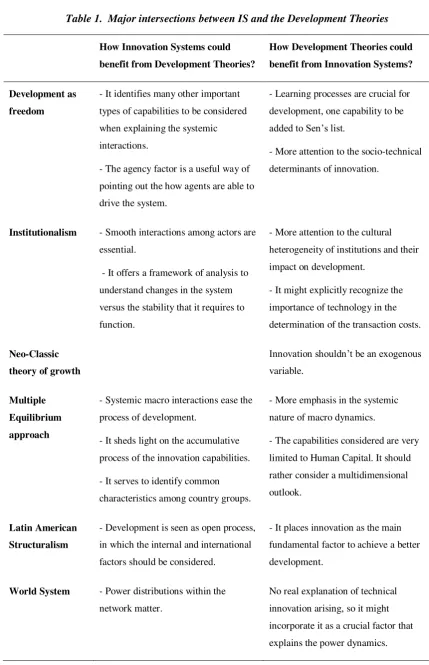
There is a wide range of theories of development. Development should not be seen as a one-dimensional process in which resources allocation is the only issue to be solved for once and for all. The systemic view is a must when it comes to analyse development. In this paper, we aim at presenting some of the most influential development theories in the literature and their interactions with the IS framework. Our objective has been to show how complementarities arise in order to investigate how this combination could be a powerful tool for development studies. Our fundamental components of Innovation Systems are the agents and their interactions, the learning process they undertake and, the institutional setting that frames the system. A summary of the intersections between the concept of IS and the theories of development considered is reported in ¡Error! No se encuentra el origen de la
referencia..
<<<< Insert Table 1 here >>>>
We started with Sen’s development as freedom. Lundvall (Lundvall 2007b) has
explicitly pointed out the relationship with Sen’s capabilities; many empirical studies also verify that the social and technological capabilities are suitable to innovation for development. Then, we analyzed institutional economics. On this regard, Nelson has
remarked a crucial interface between the institutional perspective and the IS approach, using social technologies as a linking concept (Nelson, Nelson 2002). We also highlight how technological capabilities are implicit in transactions costs, opening another door for interactions among both approaches.
18 real development theory, but rather a simplified model to deal with particular cases of economic growth.
The multiple equilibrium approaches have strong interactions with IS in order to analyse development. First, since it considers the high heterogeneity that characterizes the economic system, it opens the door for the systemic view. Merging these to streams could lead to a better understanding of the macroeconomic process of development, especially when focusing on international comparisons.
We close this paper considering development and its structural view. The Latin American Structuralism Approach (LASA) could greatly benefit from the use of the IS approach in order to unravel the underlying structures that constitute the underdevelopment phenomenon. Fortunately, at least in Latin America, scholars have realized this opportunity and have taken advantage of it.
The dependency theory and its evolution, the world-system theory, are the final thought stream considered. In this case, to our knowledge, the combination between them and IS has not been explicitly done in any other empirical or theoretical exercise. For this case, we recommend the literature on internationalization and policy implications of it on national IS. We also believe that the interaction with IS approach could expose the way and the degree of dependent relationships between the core and the periphery. Furthermore, structuralists and world system theorists stress the important role of power and its mechanisms in the process of socio-technical change. Who wins and who loses in the innovation process within the system? Such a questions is often neglected by IS advocates.
Innovation Systems are very flexible by nature. They were designed to adapt to different contexts and be always a handy tool for action. This versatility is something of much help when using a specific branch of theories, particularly in such a complex issue like development. Instead of criticizing this malleable characteristic, we would like to push forward the idea of taking advantage of it to incorporate new insights in theoretical and empirical analyses. It could be an opportunity to constantly revisit many of the theoretical milestones while contrasting them with down to earth evidence.
19 vision that considers innovation as a holistic process, giving a central role to social and economic factors. IS approach could also benefit by interacting, since this theories shed light on different ways to consider the systemic interactions and which should be the most critical relationships to evaluate. Rather than focusing on the discussion if the IS approach should or not be a theory by itself, we believe that making this relational exercise could also bring new light on both ends, generating new benefits and frameworks of analysis for the research community.
REFERENCES
ABRAMOVITZ, M., 1986. Catching up, forging ahead, and falling behind.
Journal of Economic history, 46(2), pp. 385-406.
ABRAMOVITZ, M., 1956. Resource and Output Trends in the United States Since 1870. The American Economic Review, 46(2), pp. 5-23.
ABRAMOVITZ, M. and DAVID, P.A., 1996. Convergence and deferred catch-up: productivity leadership and the waning of American exceptionalism. The mosaic of economic growth, , pp. 21-62.
AHLSTROM, D., 2010. Innovation and growth: How business contributes to society. The Academy of Management Perspectives (formerly The Academy of Management Executive)(AMP), 24(3), pp. 11-24.
ARCHIBUGI, D., HOWELLS, J. and MICHIE, J., 1999. Innovation systems in a global economy. Technology Analysis & Strategic Management, 11(4), pp. 527-539.
ARCHIBUGI, D. and IAMMARINO, S., 1999. The policy implications of the globalisation of innovation. Research Policy, 28(2-3), pp. 317-336.
ARCHIBUGI, D. and PIETROBELLI, C., 2003. The globalisation of technology and its implications for developing countries:: Windows of opportunity or further burden? Technological Forecasting and Social Change, 70(9), pp. 861-883.
AROCENA, R. and SUTZ, J., 2000. Looking at national systems of innovation from the south. Industry and Innovation, 7(1), pp. 55-75.
ARRIGHI, G. (2007). Adam Smith in Beijing. lineages of the twentyfirst century
(p. 418). Verso.ARROW, K. J. (1962). The Economic Implications of Learning by Doing. The Review of Economic Studies, 29(3), 155–173.
20 BERGEK, A., JACOBSSON, S., CARLSSON, B., LINDMARK, S. and RICKNE, A., 2008. Analyzing the functional dynamics of technological innovation systems: A scheme of analysis. Research Policy, 37(3), pp. 407-429.
BRESCHI, S., MALERBA, F. and EDQUIST, C., 1997. Sectoral innovation systems: technological regimes, Schumpeterian dynamics, and spatial boundaries.
2000) Systems of Innovation: Growth, Competitiveness and Employment, 1, pp.
261-287.
CARLSSON, B., 2006. Internationalization of innovation systems: A survey of the literature. Research policy, 35(1), pp. 56-67.
CARLSSON, B., JACOBSSON, S., HOLMÉN, M. and RICKNE, A., 2002. Innovation systems: analytical and methodological issues. Research policy, 31(2), pp.
233-245.
CASSIOLATO, J.E., GUIMARÃES, V., PEIXOTO, F. and LASTRES, H.M.M., 2005. Innovation Systems and Development: what can we learn from the Latin American experience, 3rd Globelics Conference, Pretoria, South Africa 2005.
CASSIOLATO, J. E., LASTRES, H. M. M., & MACIEL, M. L. (2003). Systems of innovation and development: evidence from Brazil. Cheltenham, UK;
Northampton, MA: Edward Elgar Publishing.CASSIOLATO, J.E., PAGOLA, C.B. and LASTRES, H.M.M., 2009. Technical change and structural inequalities: converging approaches to problems of underdevelopment. Techno-economic paradigms: essays in honor of Carlota Perez, , pp. 51.
CASTELLACCI, F., 2011. Theoretical Models of Heterogeneity, Growth and Competitiveness: Insights from the Mainstream and Evolutionary Economics Paradigms. International Handbook on the Economics of Integration, 2.
CASTELLACCI, F., 2008. Technology clubs, technology gaps and growth trajectories. Structural Change and Economic Dynamics, 19(4), pp. 301-314.
CASTELLACCI, F. and ARCHIBUGI, D., 2008. The technology clubs: The distribution of knowledge across nations. Research Policy, 37(10), pp. 1659-1673.
CEPAL. (2009). Innovar para Crecer. Desafíos y oportunidades para el desarrollo sostenible e inclusivo en Iberoamérica. Santiago de Chile.
CHANG, H.J., 2003. Rethinking development economics. Anthem Pr.
CLARK, D.A., 2005. Sen's capability approach and the many spaces of human well-being. The Journal of Development Studies, 41(8), pp. 1339-1368.
21 CORBRIDGE, S., 2002. Development as freedom: the spaces of Amartya Sen.
Progress in Development Studies, 2(3), pp. 183-217.
CUMMINGS, A. R. (2005). Against all Odds. Building Innovative Capabilities in Rural Economics Initiatives in El Salvador. Dep. Development and Planning.
Aalborg University, Aalborg, Denmark.
DALY, H.E., 1987. The economic growth debate: what some economists have learned but many have not. Journal of Environmental Economics and Management, 14(4), pp. 323-336.
DANG, D. and UMEMOTO, K., 2009. Modeling the development toward the knowledge economy: a national capability approach. Journal of Knowledge Management, 13(5), pp. 359-372.
DIETZ, J. L. (2011). Dependency Theory : A Review Article. Review Literature And Arts Of The Americas, 14(3), 751–758.
DURLAUF, S.N. and JOHNSON, P.A., 1995. Multiple regimes and cross‐country growth behaviour. Journal of Applied Econometrics, 10(4), pp.
365-384.
DUTRÉNIT, G. and KATZ, J., 2005. Innovation, growth and development in Latin-America: Stylized facts and a policy agenda. Innovation: management, policy & practice, 7(2-3), pp. 105-130.
EDQUIST, C., 2005. Systems of innovation: perspectives and challenges. The Oxford handbook of innovation, , pp. 181-208.
EDQUIST, C., 1997. Systems of innovation: technologies, institutions and organizations. London: Pinter, 107.
ETZKOWITZ, H. and LEYDESDORFF, L., 2000. The dynamics of innovation: from National Systems and. Research policy, 29(2), pp. 109-123.
FAGERBERG, J., 1994. Technology and international differences in growth rates. Journal of economic Literature, 32(3), pp. 1147-1175.
FAGERBERG, J. and SRHOLEC, M., 2008. National innovation systems, capabilities and economic development. Research policy, 37(9), pp. 1417-1435.
FAGERBERG, J., SRHOLEC, M. and VERSPAGEN, B., 2010. The Role of Innovation in Development. Review of Economics and Institutions, 1(2),.
FILIPPETTI, A. and PEYRACHE, A., 2011. The patterns of technological capabilities of countries: A dual approach using composite indicators and data envelopment analysis. World Development, .
22 FREEMAN, C., 1995. The ‘National System of Innovation’in historical perspective. Cambridge Journal of economics, 19(1), pp. 5-24.
FURTADO, C., 1998. O capitalismo global. Paz e Terra São Paulo.
FURTADO, C., 1964. Desenvolvimento e subdesenvolvimento. Univ of
California Press.
GALOR, O., 2005. From stagnation to growth: unified growth theory. Handbook of economic growth, 1, pp. 171-293.
GODIN, B., 2006a. The knowledge-based economy: conceptual framework or buzzword? The Journal of technology transfer, 31(1), pp. 17-30.
GODIN, B., 2006b. The linear model of innovation. Science, Technology & Human Values, 31(6), pp. 639-667.
HALL, R.E. and JONES, C.I., 1999. Why Do Some Countries Produce So Much More Output Per Worker Than Others? Quarterly Journal of Economics, 114(1), pp.
83-116.
HOWITT, P. and MAYER-FOULKES, D., 2005. R&D, implementation, and stagnation: A Schumpeterian theory of convergence clubs. Journal of Money, Credit and Banking, , pp. 147-177.
LALL, S., 1992. Technological capabilities and industrialization. World Development, 20(2), pp. 165-186.
LUCAS, R. E. (1988). ON THE MECHANICS OF ECONOMIC DEVELOPMENT* Robert E. LUCAS, Jr. (D. P. Jacobs, N. Lou Schwartz, E. Kalai, & M. I. Kamien, Eds.)Journal of Monetary Economics, 22(February), 3–42.
doi:10.1016/0304-3932(88)90168-7
LUNDVALL, B.A., 1988. Innovation as an interactive process: from user-producer interaction to the national system of innovation. Technical change and economic theory, 369.
LUNDVALL, B.Å., 2007a. Innovation system research: where it came from and where it might go. Globelics, Tampera, Finland, 2008a.Disponível em:<
http://www.globelicsacademy.net, .
LUNDVALL, B.Å., 2007b. National innovation systems—analytical concept and development tool. Industry and innovation, 14(1), pp. 95-119.
LUNDVALL, B., & BORRÁS, S. (1999). The globalising learning economy: Implications for innovation policy (pp. 1–30). Luxembourg.
LUNDVALL, B.-A. INTARAKUMNERD, P. (2006). Asia’s Innovation Systems in
23 LUNDVALL, B., VANG, J., & CHAMINADE, C. (2009). Innovation system research and developing countries. In B.-A. Lundvall (Ed.), Handbook of Innovation System and Developing Countries. Cheltenham, Uk: Edward Elgar.MALERBA, F.,
2002. Sectoral systems of innovation and production. Research policy, 31(2), pp.
247-264.
MARKARD, J. and TRUFFER, B., 2008. Technological innovation systems and the multi-level perspective: Towards an integrated framework. Research Policy, 37(4), pp. 596-615.
MUCHIE, M., & GAMMELTOFT, P. (2003). Putting Africa First: The Making of African Innovation Systems. Aalborg, Denmark: Aalborg University Press.
NELSON, R.R., 2008. What enables rapid economic progress: What are the needed institutions? Research Policy, 37(1), pp. 1-11.
NELSON, R.R., 1993. National innovation systems: a comparative analysis.
Oxford University Press, USA.
NELSON, R.R. and NELSON, K., 2002. Technology, institutions, and innovation systems. Research policy, 31(2), pp. 265-272.
NELSON, R.R. and SAMPAT, B.N., 2001. Making sense of institutions as a factor shaping economic performance. Journal of Economic Behavior & Organization, 44(1), pp. 31-54.
NIOSI, J. and BELLON, B., 1994. The global interdependence of national innovation systems: evidence, limits, and implications. Technology in Society, 16(2),
pp. 173-197.
NORTH, D.C., 1990. Institutions, institutional change, and economic performance. Cambridge Univ Pr.
PEIXOTO, F.J.M., 2008. O Pensamento Estruturalista Brasileiro e os Sistemas de Inovação: uma breve reflexão sobre o (sub) desenvolvimento. OIKOS (Rio de Janeiro), 5(2),.
PEREZ, C., 2008. A Vision for Latin America: a resource-based strategy for technological dynamism and social inclusion. Documento inédito preparado para la CEPAL (Comisión Económica para América Latina y el Caribe) Program on Technology Policy and Development in Latin America.Santiago, Chile, .
PEREZ, C., 1983. Structural change and assimilation of new technologies in the economic and social systems. Futures, 15(5), pp. 357-375.
24 PREBISCH, R., 1986. El desarrollo económico de la América Latina y algunos de sus principales problemas. Desarrollo económico, 26(103), pp. 479-502.
PREBISCH, R., 1949. El desarrollo económico de América Latina y algunos de sus principales problemas.
RÍOS, R.A., 1964. Raúl Prebisch, Hacia una dinámica de desarrollo latinoamericano.
ROMER, P.M., 1994. The origins of endogenous growth. The Journal of Economic Perspectives, 8(1), pp. 3-22.
SÁBATO, J. and BOTANA, N., 1968. La ciencia y la tecnología en el desarrollo futuro de América Latina. Revista de la Integración, 1(3), pp. 15-36.
SEN, A.K., 1999. Development as freedom. Oxford University Press.
SHARIF, N., 2006. Emergence and development of the National Innovation Systems concept. Research Policy, 35(5), pp. 745-766.
SMITH, M.L. and SEWARD, C., 2009. The relational ontology of Amartya Sen’s capability approach: incorporating social and individual causes. Journal of Human Development and Capabilities, 10(2), pp. 213-235.
SOLOW, R. M. (1957). Technical Change and the Aggregate Production Function.
The Review of Economics and Statistics, 39(3), 312–320.
TÖDTLING, F. and TRIPPL, M., 2005. One size fits all?: Towards a differentiated regional innovation policy approach. Research policy, 34(8), pp.
1203-1219.
VELASCO, A. (2002). Dependency Theory. Foreign Policy, (133), 44.
doi:10.2307/3183555
VERSPAGEN, B., 1991. A new empirical approach to catching up or falling behind. Structural change and economic dynamics, 2(2), pp. 359-380.
WALLERSTEIN, I. (2004). World-System analysis. An introduction (p. 109).
25
Table 1. Major intersections between IS and the Development Theories
How Innovation Systems could
benefit from Development Theories?
How Development Theories could
benefit from Innovation Systems?
Development as
freedom
- It identifies many other important types of capabilities to be considered when explaining the systemic interactions.
- The agency factor is a useful way of pointing out the how agents are able to drive the system.
- Learning processes are crucial for development, one capability to be
added to Sen’s list.
- More attention to the socio-technical determinants of innovation.
Institutionalism - Smooth interactions among actors are
essential.
- It offers a framework of analysis to understand changes in the system versus the stability that it requires to function.
- More attention to the cultural heterogeneity of institutions and their impact on development.
- It might explicitly recognize the importance of technology in the determination of the transaction costs.
Neo-Classic
theory of growth
Innovation shouldn’t be an exogenous
variable.
Multiple
Equilibrium
approach
- Systemic macro interactions ease the process of development.
- It sheds light on the accumulative process of the innovation capabilities.
- It serves to identify common
characteristics among country groups.
- More emphasis in the systemic nature of macro dynamics.
- The capabilities considered are very limited to Human Capital. It should rather consider a multidimensional outlook.
Latin American
Structuralism
- Development is seen as open process, in which the internal and international factors should be considered.
- It places innovation as the main fundamental factor to achieve a better development.
World System - Power distributions within the
network matter.