Munich Personal RePEc Archive
Rethinking Capital Structure Arbitrage
Avino, Davide and Lazar, Emese
14 November 2012
Online at
https://mpra.ub.uni-muenchen.de/42850/
Rethinking Capital Structure Arbitrage
Davide Avino and Emese Lazar*
ICMA Centre, University of Reading, Henley School of Business, PO Box 242 RG6 6BA, UK
Current version: November 2012
Abstract
It is well known that the capital structure arbitrage strategy generated negative Sharpe ratios over the period 2005-2009. In this paper we introduce four new alternative strategies that, while still based on the discrepancy between the CDS market spread and its equity-implied spread, exploit the information provided by the time-varying price discovery of the equity and CDS markets. We implement the strategies for both US and European obligors and find that these outperform traditional arbitrage trading during the financial crisis. Moreover, the new strategies show higher Sharpe ratios when CDS and equity-implied spreads are cointegrated. The correlation of the new trading rules with hedge fund index returns is low or negative even during the crisis, which suggests that the new rules can be used for portfolio diversification at times when risk reduction is hard to achieve.
JEL classification: G01; G11; G12; G14; G20; D8; D53
Keywords: credit spreads; price discovery; credit derivatives; information flow; convergence trading; financial crisis; limit of arbitrage
1. Introduction
Exploiting the mispricings between the CDS and equity markets is the main objective of the so-called
“capital structure arbitrage” strategy. At the turn of the century, capital structure arbitrage was thought of as one of the most promising and popular arbitrage strategies within the fixed income market.1 Over the last decade, the credit default swap (CDS) market has experienced an impressive growth which has reached its peak at the end of 2007 with a notional amount outstanding of about USD 62 trillion. Since then, the market hit by the “Great Recession” went through a downward trend which, however, has not compromised the massive size of a market that, as of June 2010, still boasted an outstanding value of USD 26 trillion.2 Driven by this explosion and then decline in the CDS market, fixed income arbitrage has benefited from steady growth followed by a decline: the outstanding total assets increased to almost USD 59 billion in mid-2008, reducing to about USD 23.5 billion by the end of the same year.3
Historically, fixed income arbitrage has consistently generated losses during periods of crisis in the financial markets, and these losses have caused the closure of many hedge funds and trading divisions of large investment banks.4 Since hedge funds and proprietary trading desks are known for employing market neutral strategies (able to deliver positive returns no matter how markets trend), it is natural to ask why these strategies have not generated profits during crisis periods. Ideally, trading strategies should be built so that they are profitable in both stable and distressed markets. Thus, the main question that arises is whether novel fixed income arbitrage strategies can be created which are capable of generating profits in both periods of growth and instability of the financial markets.
This paper addresses this issue by focusing on one of the commonly used fixed income strategies, capital structure arbitrage (CSA). Examining the profitability of the strategy over the period 2001-2004 in the US, Yu (2006) showed that a portfolio of individual CSA trades generates positive Sharpe ratios, in line with those of hedge fund industry benchmarks.5 Interestingly, he also found that hedging strategies used to offset CDS positions with equities can be ineffective. Alexander and Kaeck (2008) argued that a reason for these ineffective hedge ratios may be that they do not capture different market regimes. Another possible reason, according to Das and Hanouna (2009), is that equity hedges can be very expensive when markets become volatile because the hedge ratio varies very quickly and the (lack of) liquidity of the equity market becomes a determinant factor.
1
For a very general and non-technical introduction on capital structure arbitrage, see Currie and Morris (2002).
2
See ISDA Market Survey (2010).
3
See Lipper/Tass (2009)
4
The most cited example is the story of LTCM, narrated, for instance, by Lowenstein (2000). 5
Typically, when implementing the CSA strategy, a trader would look at a significant divergence between the CDS spread and its implied spread. The latter is obtained from the implementation of a structural credit risk model which extracts equity-based information. Hence, a trader would sell (buy) a CDS contract if the CDS spread is significantly higher (lower) than the implied spread and sell (buy) a given number of shares as a equity hedge to offset the CDS position. The CSA strategy (including hedging) would work well if both markets are equally efficient in the sense that none leads the other one, i.e. any discrepancy between them is random and short lived, and price discovery occurs simultaneously in both of them. Given that hedging may be ineffective for the CSA strategy (see Yu, 2006), and given that several studies document a lead-lag relationship between equity and CDS markets, it might be a better idea to trade in one market only, namely the market that is being led, as it can be more easily forecasted.
There is a vast literature analyzing the price discovery in equity markets; additionally, in the last decade, a growing number of studies have focussed on lead-lag relations and price discovery in credit spreads. For these the main references are Zhu (2004), Blanco et al. (2005), Norden and Weber (2009), Longstaff et al. (2003) and Forte and Peña (2009). These studies focused on the information flow between CDS and equity markets by implementing various methodologies. Even if their findings are mixed, all show evidence of time variation in the price discovery of credit-related information. In this paper we use both the Vector Error Correction Model (VECM) for changes in spreads, and time-varying price discovery measures to derive new strategies for trading the CDS and equity markets.
Previous studies on the CSA strategy have shown that its profitability is sensitive to the choice of the credit risk model (used to compute implied spreads) and the equity volatility estimation method. Early studies from Jones et al. (1984), Eom et al. (2004) and Huang and Huang (2003) focused on credit spreads obtained from bonds and found that, on average, credit risk models under-predict spreads. However, Ericsson et al. (2007) showed that credit risk models seem to perform better when applied to CDS spreads. Similarly, Schaefer and Strebulaev (2008) obtained evidence of good prediction of equity-to-debt hedge ratios using structural models. Bajlum and Larsen (2008) found that using option-implied (rather than historical) volatility generates higher excess returns. Also, they concluded that the choice of the credit risk model is of secondary importance and does not affect returns significantly.
the information released in market A; (3) it doesn‟t take into account the exact form of cointegration
between the two markets. If a long-term relationship between two markets exists and the market that is being led wanders away from this long-term relationship, then it is expected to move back; and (4) it ignores the existence of the error correction term, meaning that based on the long-term relationship between the two markets and the error correction term, the direction of the move in the informationally less efficient market can be anticipated. Our paper is innovative in applying price discovery measures and cointegration for the purpose of building trading strategies in the CDS and equity markets.
The implementation of the strategies is based on information coming from two time series of spreads, namely the CDS spread observed in the market and an equity-implied spread which is obtained from CreditGrades, a Merton-like structural credit risk model.6 The same model is also used by earlier studies which focussed on the analysis of capital structure arbitrage.7 Similar to previous studies, we assume that structural credit risk models can generate reasonable estimates of both implied spreads and hedge ratios.
In the first instance, the new strategies are based on an additional layer of information which can be obtained from the lead-lag relationship or the price discovery process of the CDS and equity markets. Using information on the interaction between the two markets should enhance profitability. The methodology to incorporate such information derives from the literature on common factor models, pioneered by Hasbrouck (1995) and Gonzalo and Granger (1995). These studies introduce two measures of price discovery for every market, namely the information share (IS) and the Gonzalo-Granger (GG) measures, and these are used to make inference on the price revelation process in the two markets.
One of the contributions of this paper is that the newly introduced strategies are based on forecasts of (time-varying) price discovery measures, which are built on volatility forecasts. We also add to the literature by (1) introducing strategies which are based on the cointegration of CDS and equity-implied spreads, (2) giving new empirical evidence on the controversial hedging role of equity for CDS positions and (3) dealing with the issue of asynchronous trading existing between the CDS and equity markets, which has been neglected by past studies. The rest of the paper is organised as follows: Section 2 discusses the price discovery process which underlie the trading strategies; Section 3 describes the trading strategies we implement; the data used in our analysis is presented in Section 4. Section 5 explains the construction of the return indexes for the trading strategies and analyses their monthly returns. Section 6 presents robustness checks and Section 7 concludes.
6
Structural credit risk models are based on the seminal paper of Merton (1974).
7
2. The theory underlying the trading strategies
A CDS is an insurance contract against the occurrence of credit events (such as the default on a corporate bond) related to a specific obligor (also called reference entity). Details on the pricing of a CDS contract can be found in Yu (2006). Instead, we focus our attention on the main novelty of this study, that is the introduction of trading strategies based on the information flow of the markets which are being traded. The information flow of a given market can be quantified by measures of price discovery. The two most popular measures used in the market microstructure literature are the IS and GG measures, and are defined in Hasbrouck (1995) and Gonzalo and Granger (1995), respectively. In order to compute these measures of contribution to price discovery, we first need to estimate the following VECM of changes in CDS spreads ( ) and equity-implied spreads ( ) for the series of spreads which are non-stationary:
∑ ∑ (1a)
∑ ∑ (1b)
where and are i.i.d. error terms. The cointegrating equation is defined as:
(1c)
We focus on the IS measure because, unlike the GG measure, it takes account of the volatility of the error terms of the VECM. However, only an upper and lower boundary can be defined, at every time t, so that we do not have a point estimate of price discovery.8 However, Baillie et al. (2002) show that the midpoint of these IS bounds can be considered a reasonable estimate of the price discovery of a given market at a certain point in time.9 The contributions of the CDS market to price discovery are given by the following relations:
(
)
,
( )
(2)
where and give the bounds of the IS measure of the CDS market. The GG measure would be given simply by
. , , and give the covariance matrix of and .
8
There has been a lively debate on the correct interpretation of the GG and IS measures. Generally, the IS measure seems to be the proper measure to assess the amount of information generated by each market. For more on this topic, see the special issue (issue 3, 2002) of the Journal of Financial Markets.
9
Ideally, a capital structure arbitrageur would be interested in having an estimate of the price discovery of the CDS and equity markets every day, and based on those estimates he executes his trades. We apply a bivariate GARCH model to the residuals of the VECM estimated in (1).10 In particular, we use the BEKK specification of the GARCH model as introduced by Engle and Kroner (1995):
( ) (3)
where (
)
, (
), (
), (
).
Because the IS is defined as a function of the volatility of the error terms in the VECM, a time dependent (daily) IS can be produced by replacing the unconditional error volatilities in (2) with the conditional volatilities obtained with (3). As a result, we can explore the time varying behaviour of the information flow among markets and use it for trading purposes. In order to achieve this aim, for all companies we estimate (1) and (3) by using a rolling window of 1 year of data (250 observations)11, starting from January 2004. We use the covariance matrix of the error terms (obtained with (3)) at the end of the year to compute the IS measure (the midpoint of the bounds)12, and we use the latter as an estimate of the price discovery of the CDS market for the following day. The next day, we roll over the 1-year window, we re-estimate (1)13 and (3) to get a new IS estimate for the following day. We follow this procedure till the end of our sample period, that is 31st December 2009. Hence, starting from January 2005 till the end of 2009, we have a series of estimates of price discovery for the CDS and equity markets for each reference entity. In the next section, we show how to use these estimates to trade both markets.
3. Description of the trading strategies
This section describes the main features of the 5 strategies (the first one being the standard CSA and 4 new strategies) implemented. The trading rules for each strategy are summarised in Table 1.
10
A different way to obtain daily estimates of price discovery would be based on intraday prices so that a daily VECM could be estimated using data for a given day. However, for the CDS market, high frequency trading is still in its infancy.
11
A careful observer may accuse us of “look-ahead bias” because we are using the future values of the spreads to detect the presence of cointegration. However, testing for cointegration requires many years of data, and a long run relationship between the two markets is very likely to exist (and we find it for the majority of the companies we analyse) because they are pricing the same risk, even though the Pearson correlation between changes in CDS prices and stock prices is low.
12
(1 –IScds) will give the price discovery estimate for the equity market. 13
3.1 Strategy 1: Standard CSA
Capital structure arbitrage is generally implemented on individual entities. It is originally based on two different time series of data, namely the market CDS spread and the model spread obtained from equity-based information of a given entity. When these two series of spreads deviate from each other by a threshold value (set by the trader), a trading opportunity arises. In particular, if the CDS spread is higher than the equity-implied spread by a defined trading trigger θ, a trader would short a CDS position with a notional amount of USD 114 and shares of the common stock. Instead, if the equity-implied spread is higher than the CDS spread, a trader would buy a CDS position with a notional of USD1 and, at the same time, buy shares. These positions are typically kept for a fixed holding period or for a shorter period of time if convergence occurs between the two spreads.
3.2 Strategy 2
We augment Strategy 1 by introducing a price discovery (PD) trigger. and represent, respectively, the lower and upper thresholds of IS price discovery for the CDS market selected by the trader. We are filtering Strategy 1 trades and execute them only if there is clear evidence of one market leading the other one. However, we still hedge the positions. Hence, if the CDS spread is higher than the equity-implied spread by a defined trading trigger θ and the price discovery of the CDS market is either lower than or higher than , a CDS position with a notional amount of USD 1 and shares of the common stock are shorted. On the other hand, if the equity-implied spread is higher than the CDS spread and the price discovery of the CDS market is either lower than or higher than , a CDS position with a notional amount of USD 1 and shares of the common stock are bought. Thus, trades are filtered not only on the basis of the deviation between the two spreads, but also according to the informational efficiency of the markets, captured by the IS measure of price discovery.
3.3 Strategy 3
According to Yu (2006), hedging CDS positions with equity shares can be ineffective due to the low correlation observed between changes in CDS spreads and stock prices. A trader could be better off if he trades just one market. In particular, a trader would sell a CDS contract with a notional of USD 1 if the CDS spread is higher than the equity-implied spread by a defined trading trigger θ and the price discovery of the CDS market is lower than a benchmark , meaning that the CDS market is being led. On the other hand, he would short the equity market only if the CDS spread is higher than the equity-implied spread by a defined trading trigger θ and the price discovery of the CDS market is higher than , so the equity
14
market is being led. Similarly, a CDS contract with a notional of USD 1 would be bought if the equity-implied spread is higher than the CDS spread by a defined trading trigger θ and the price discovery of the CDS market is lower than . Finally, shares are bought if the equity-implied spread is higher than the CDS spread by a defined trading trigger θ and the CDS market is leading the equity market. Hence, a trader would trade only one market, namely the least efficient one (with a low value of price discovery). We expect to improve capital allocation by not trading the efficient market, that is the market which is difficult to forecast.
3.4 Strategy 4
We use the estimated parameters in the cointegrating equation (1c) in order to define the minimum deviation between market and model spreads necessary to generate a trading opportunity. In fact, in cointegrated systems, we would expect the coefficient on the equity-implied spread to equal 1 in the cointegrating vector; and this is assumed in Strategies 1, 2 and 3. However, while from a statistical perspective is not often significantly different from 1, in practice, the actual values of the coefficient are different from 1 and could be economically significant, providing the trader with valuable information. The trading is then done similarly to Strategy 3 (except that is not assumed to be 1).
3.5 Strategy 5
Similarly to Strategy 3 and 4, this strategy does not require the equity hedge. We only use a price discovery trigger and the error correction term( ) of the VECM of changes in spreads, namely the first part of equations (1a) and (1b). A trader would sell a CDS contract with a notional of USD 1 if the product ( ) is lower than the negative of a multiplier (the trading trigger θ) times yesterday‟s CDS spread, and the price discovery of the CDS market is lower than ; whereas he would go long such a CDS contract if the product ( ) is higher than the product between the trading trigger θand yesterday‟s CDS spread, and the price discovery of the CDS market is lower than . Similarly, a trader would short equity if the product ( ) is higher than the product between the trading trigger θ and yesterday‟s CDS spread, and the price discovery of the CDS market is higher than , while he would go long equity if ( ) is lower than the negative of the trading trigger θ times yesterday‟s CDS spread, and the price discovery of the CDS market is higher than
4. Data
We use CDS quotes provided by the CMA database.15 We only use daily mid-market quotes on senior unsecured debt for non-financial companies with 5 year maturity. We include both North American and European obligors with a modified restructuring and modified-modified restructuring clause, respectively, and currencies denominated in USD and EUR, respectively. The data used for the strategies‟ execution are from 2005 to 2009. We match the CDS data with information required by the CreditGrades model to get the equity-implied spreads.
In order to implement CreditGrades, we need the following inputs for each company: daily stock prices and market capitalisations; accounting data including short- and long-term liabilities, minority interest, preferred shares; the mean global recovery rate ̅ and its standard deviation ; the recovery rate of the
firm‟s senior unsecured debt, ; the annualized equity volatility and the 5-year risk-free interest rate .
Stock prices, market capitalisations, accounting data and 5-year swap rates for both USD and EUR are downloaded from Bloomberg. For we take the value of 0.3 as reported in the CreditGrades Technical Document (2002). The recovery rate is estimated as the Moody‟s average historical recovery rate on senior unsecured debt over the period 1982-2009 (see Moody‟s, 2011) and is equal to 0.326. We follow Yu (2006) to define the value of ̅ and, for each reference entity in our sample, we use the first 10 daily CDS spreads to minimize the sum of squared pricing errors over ̅. The implied value of ̅ is then used in the credit model together with the other inputs to generate theoretical CDS spreads.
The most important input of the model is the equity volatility . We use a 250-day moving average of past equity stock returns, in order to have a volatility estimate that is responsive to changing market conditions (very important during the financial crisis, when most entities experienced a sharp increase in credit spreads). We also employ a 1,000-day moving average as suggested in CreditGrades Technical Document (2002), which would, most likely, determine a lagged response of the model spreads. From a trading perspective it would be interesting to see how the profitability of the strategies would change when we alter the length of the volatility estimation window. In fact, using a 1000-day moving average, especially during the crisis, might result in spreads which underestimate market spreads, which would alter the trade to be executed (for example, a „buy CDS‟ trade might be changed into a „sell CDS‟ trade). Thus, as a robustness test, in Section 6 we compute the returns of the strategies using equity volatilities estimated as 1000-day moving averages.
15
The following step is to make sure that we have a fairly continuous time series of CDS quotes. For each reference entity we search for the longest string of more than 100 daily quotes which are no more than 14 days apart and we check that we have all the information needed for the computation of model spreads. Applying these filters renders a final sample of 70 companies16 with 101,799 composite daily quotes starting from January 2005 till the end of 2009.17 Even though the number of companies in our sample is less than in previous studies, we analyse a longer time period which allows us to generate a total number of available quotes very close to 136,000 quotes reported in Yu (2006) and Duarte et al. (2007).
Table 3 presents summary statistics for the 70 obligors. Over 80% of the obligors are rated investment grade. We report averages over time and through firms, for the rating categories of investment grade and speculative grade. Also, as a structural credit risk model would predict, we find a positive relationship between the CDS spread and the level of leverage and volatility. The average correlation between changes in CDS spreads and equity prices is negative, consistent with structural models, but very low, which would raise concerns on the effectiveness of the equity hedge; and this is one of the reasons why we also propose new strategies which do not involve hedging.
Moreover, it is evident that we can distinguish two different regimes, the period preceding the recent financial crisis and the crisis period itself. In fact, the level of spreads, volatility and leverage increase substantially during the crisis and this is especially true for speculative grade companies. The equity market capitalisation of the obligors shrinks too due to the downtrend in the equity markets. Surprisingly, the correlation between CDS spreads and equity prices is reduced, especially for speculative grade obligors. This is in contrast with past studies which have reported more negative correlations for this category of obligors. This may be due to several factors: (1) our sample includes a very small number of B-rated and CCC-rated obligors and for these two categories the negative relationship between CDS and equity markets is stronger; (2) the divergence of views between the CDS and equity markets on the price of credit risk increased in times of financial instability; (3) Pearson‟s correlation coefficient does not capture the non-linear relationship between changes in CDS spreads and equity price, which is implied by any structural credit risk model based on Merton (1974).
16
Of these, 35 are US-based while the remaining 35 are European obligors.
17
5. Results
We implemented the 5 strategies for the 70 obligors in our final sample for the period January 2005-December 2009. The procedure we follow is similar to the one used in Yu (2006) and Duarte et al. (2007). As we have thousands of open trades every day, we construct a monthly index return for each strategy, which would facilitate the comparison of our results with returns reported by hedge fund industry benchmarks (discussed next). As the CDS position has a value of zero at initiation, we assume USD 0.5 initial capital18 for every trade we make and use the same capital to finance the equity hedge, if hedging is required by the strategy. If hedging is not required, then only one market is traded and the initial capital is invested in that single market. For instance, if the trade involves buying equity, a trader will invest USD 0.5 initial capital to buy equity, whereas if he has to sell equity, he will sell shares for USD 0.5 of capital. In the case of buying/selling CDS, USD 0.5 initial capital represents the trader‟s deposit into a margin account.
All cash flows arising from the positions in the CDS and equity such as CDS premiums and cash dividends are deducted or credited to the initial capital. We assume, for all strategies, a 10% bid-ask spread for trading CDS. Similarly to Yu (2006), we ignore transaction costs on common stocks19, which should be minimal given the fact that we use static hedging.
Using CreditGrades, we can track the daily market value of the CDS positions and hence compute the daily excess returns for every trade. After that, we compute an equally-weighted average daily return across all trades which are open, for every day of our sample. We finally compound the daily returns into monthly returns. Hence, we end up having a total of 60 monthly excess returns which are generated by holding an equally-weighted portfolio of all available trades for each of the 5 strategies we implement. For Strategy 4, in the case of speculative grade obligors for which we have a smaller sample, we do not have individual trades available for some months, in which case we assume a zero monthly excess return.
To implement the new strategies, a trader needs to choose a reasonable price discovery trigger. The role of this price discovery trigger is at least twofold: (1) it can be used to filter strong signals (the price discovery of a given market should be reasonably high); (2) it can motivate the decision not to hedge because trading in an informationally efficient market is risky, whilst it makes sense to trade in a market which is known to lag the other market.
18
For European entities, we assume EUR 0.5 initial capital.
19
Thus, for the new strategies we compared different levels of price discovery triggers. Intuitively, selecting higher triggers (stronger price discovery in one market) should generate higher profits as the second market would follow the first one more closely, so the second market could be predicted more effectively. However, too high triggers would lead to less profit due to the sharp decrease in the number of transactions and due to profitable trades being left out. We chose a value of 80% for the price discovery trigger in the CDS market (corresponding to a 20% trigger for the equity market). Hence, in the trading rules defined in Section 3, and will be equal to 20% and 80%, respectively.
Table 4 shows the number of trades executed for each strategy over the whole sample period. It is very interesting to notice how the use of an additional trigger such as the price discovery trigger substantially reduces the frequency of trading. The implementation of Strategies 2 and 3 for investment grade obligors allows a reduction in the number of trades of almost 40% if compared with the traditional capital structure arbitrage (Strategy 1). If we compare the latter with Strategy 4 and Strategy 5, a trader would reduce the number of trades by 66% and 84%, respectively, and the same is true for speculative grade obligors.
An interesting point refers to Strategy 1 and 2, both requiring hedging. For these the equity hedge becomes very expensive, especially during the crisis period. For some days, if the trade involves buying equity, we notice that a USD0.5 initial capital is not sufficient to meet the trader‟s hedging need.20 This anomaly is a limit of arbitrage, and as shown in Brunnermeier and Pedersen (2009), the potential lack of funding liquidity prevents arbitrageurs from exploiting mispricings. Our finding is supported by Das and Hanouna (2009), who explain that equity hedging costs increase when markets become more volatile, and Kapadia and Pu (2010), who show that limits to arbitrage can arise because the liquidity in markets can worsen. From the point of view of implementation, we are not able to perform a complete hedge (as predicted by the hedge ratio calculated with the CreditGrades model) on the days when such an anomaly occurs. Hence, a trader would need more capital (which becomes a scarce resource) to implement these strategies when volatility in the market is high. An alternative approach consists in trading CDS contracts on smaller amounts of notional making sure that a given percentage (such as 10%) of the CDS notional is deposited in a margin account. In these cases, we make sure that at least 10% of the notional amount of the CDS contract is left in the margin account and is not invested to buy the equity shares.21
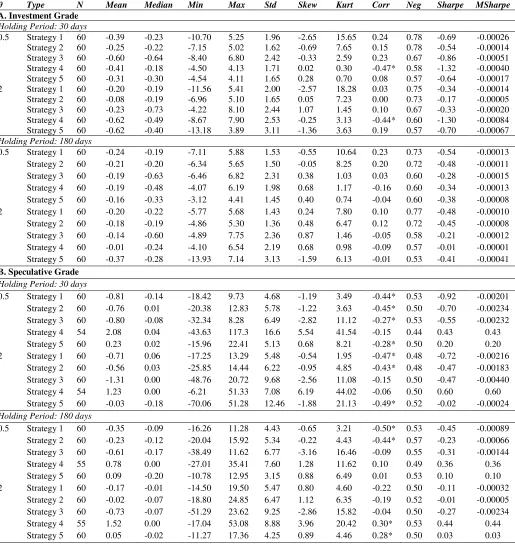
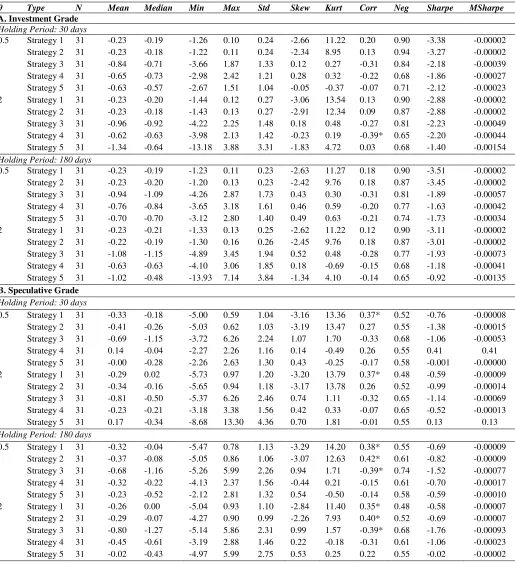
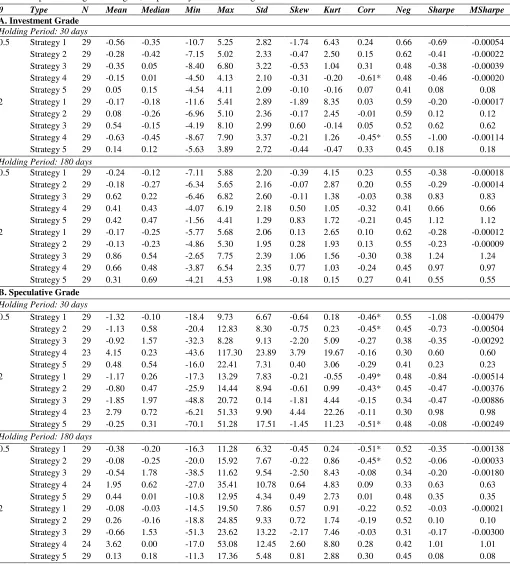
Tables 5, 6 and 7 show the summary statistics for the monthly excess returns of the 5 strategies for the whole sample period, the pre-crisis period (January 2005-July 2007) and the in-crisis period (August 2007-December 2009), respectively. We implement the strategies separately for investment and
20
As mentioned previously, the initial capital is used to finance the equity hedge.
21
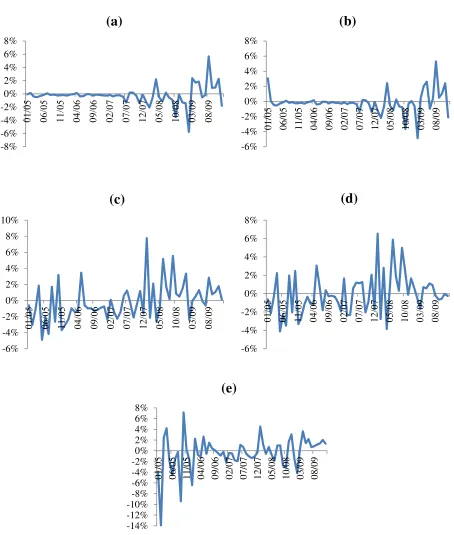
speculative grade companies by using holding periods of 30 and 180 days and θ trading triggers of 0.5 and 2, to be consistent with previous studies. As in Yu (2006) and Duarte et al. (2007), increasing the trading trigger (denoted by α in their paper) from 0.5 to 2 generates higher monthly mean returns and higher Sharpe ratios for Strategy 1, and similarly for Strategy 2. However, this relationship does not always hold for Strategies 3, 4 and 5, mostly because they do not imply hedging. Furthermore, speculative grade entities produce higher Sharpe ratios than the investment grade obligors for Strategies 4 and 5. Figure 1 presents the evolution of monthly excess returns for all strategies.
Strategy 1 (the classical CSA strategy) generates negative Sharpe ratios both before and during the crisis. All the new strategies we propose outperform Strategy 1 in the crisis period, but this is not the case for the pre-crisis period.
During the crisis period, Strategy 4 gives the best Sharpe ratios for speculative grade companies but in the case of investment grade obligors Strategies 3 and 5 do better for a trading trigger of 2 and 0.5, respectively. Interestingly, the new strategies deliver highly positive Sharpe ratios during the crisis period with Strategy 3 giving the highest Sharpe ratio of 1.24 in the case of a holding period of 180 days and a trading trigger of 2. In summary, we find that classical CSA underperforms all new strategies we propose for any holding period or trigger used. However, during the pre-crisis period, all strategies generate negative Sharpe ratios.
Ranking strategies‟ portfolios according to the Sharpe ratio when excess returns are negative can be counterintuitive. In fact, strategies which generate more negative returns and higher returns‟ volatility would be better ranked than low-volatility strategies. In order to avoid this anomaly, we also report a modified Sharpe ratio which has been proposed by Israelsen (2005). Based on this modified version of the Sharpe ratio, we can clearly notice how, during the pre-crisis period, the new strategies we propose (except for Strategy 2 in the case of investment grade obligors) show a higher volatility of returns and, for this reason, would be worse ranked compared to the CSA strategy.
Although the performance of strategies 3 to 5 is poor in the pre-crisis period, it is interesting to notice how, together with a higher volatility, they show some positive skewness and much lower excess kurtosis (if compared with strategies 1 and 2). Hence, their returns more closely resemble a normal distribution, that is they may suggest a much lower tail risk.
5) have higher VaRs than strategies 1 and 2. Strategy 2 shows the lowest VaR and seems to be the best performing strategy in the period preceding the financial crisis, as can be seen in Table 6. However, for speculative-grade obligors, the 99.5% VaR of the new strategies is lower than the traditional capital structure arbitrage strategy. Hence, the latter confirms, to a certain extent, what was stated earlier on the presence of reduced tail risk borne by the new trading strategies.
5.1 Comparison of strategies’ returns with fixed income hedge fund returns
Following Duarte et al. (2007), we compare the monthly returns indices constructed for each strategy with fixed income arbitrage hedge fund return data obtained from popular industry sources. We download monthly return data from Credit Suisse First Boston (CSFB) for the AllHedge Fixed Income Arbitrage Index over the period 2005-2009. The construction of the index is based on the TASS database, which includes data on over 8,000 hedge funds.22
The characteristics of these hedge fund returns are very similar to the capital structure index returns we constructed and described in the previous section. The annualised average return and standard deviation of the AllHedge Fixed Income Arbitrage Index are -4.84% and 12.82%, respectively. These values imply an annualised Sharpe ratio of -0.38, which is extremely similar to the Sharpe ratios reported in Table 5 for Strategy 1. The negative skewness of -3.1 and the excess kurtosis of 16.17 are also quite close to the values generated by our capital structure arbitrage returns. If we focus on the period including the financial crisis, the Sharpe ratio is even more negative at a level of -0.54. Hence, fixed income arbitrage hedge funds delivered a very bad performance during this period. Some of the strategies we propose show positive skewness and lower kurtosis over the same time period and are capable to give positive Sharpe ratios which, in some cases, are higher than 1.
Moreover, we look at the correlations between Strategy 1 and the CSFB index. They are high and positive over the whole sample period and over the subsamples of pre-crisis and in-crisis. For instance, the correlation between monthly returns of Strategy 1 (implemented with a 250-day historical volatility, holding period of 180 days and a trading trigger of 2) and the CSFB index monthly returns is 0.37. This value is much higher than those reported by Duarte et al. (2007). A reason for that may be the increased popularity of the strategy among hedge funds over the recent years and this could also explain why profits turned negative eventually.
Instead, when we look at the correlations of the new strategies with the CSFB index, we find different patterns. Except for Strategy 2 (whose correlations are of the same order as Strategy 1), Strategy 3, 4 and
22
5 present correlations of -0.15, -0.24, 0.13. Table 9 shows the correlation of the monthly returns generated by the 5 strategies and the CSFB index. It is evident that most of the new strategies show low or even negative correlation with the standard CSA. Overall, these new strategies could really help achieve the objective of portfolio risk diversification.
6. Robustness of the results
6.1 Strategies using theoretical spreads obtained from a 1000-day historical volatility
6.2 The impact of asynchronous trading between CDS and equity markets
In our study we assume that all the trades are performed at the closing time of the equity market. This point in time can be different from the recording time of the CDS quotes, so that the discrepancy can have an effect on our results if the CDS market is very active between the CDS quote recording time and the equity market closing time (whichever is first). Previous studies which analysed the profitability of the CSA strategy did not consider the effect of asynchronous trading between the CDS and equity markets on the strategies‟ profitability. However, it is worth considering the time discrepancies between the two markets and their influence on our results.
In the US, equity markets‟ closing prices for individual firms are recorded at the closing time of the New York Stock Exchange (NYSE), which is at 21:00 (London time), whereas CDS quotes from CMA are recorded at 21:30 (London time). Instead, for European firms, CDS quotes are recorded at 16:30 (London time), while their equity closing prices are recorded depending on the closing time of the corresponding European exchanges, which in any case, is either at 16:30 (for the Italian Stock Exchange, the Stockholm Stock Exchange, the Helsinki Stock Exchange and the Zurich Stock Exchange) or at later times23. In order to analyse the impact of these time discrepancies on the profitability of the trading strategies, we use data on intraday CDS quotes from GFI24 over the period from January 2006 to July 2009. The GFI period covers about three-fourth of our trading period. Specifically, we count how many CDS quote updates we find between 21:00 and 21:30 and between 16.30 and the later closing time of specific equity markets, for each of the US and European obligors which constitute our sample, respectively. We assume that, if the number of CDS quote updates over these time intervals is higher than 100, information in the CDS market may affect the price discovery estimates of the two markets and, in turn, the profitability of the trading strategies.25 We find that, for the US market, none of the companies in our sample has more than 100 updates from 21:00 (closing time for the equity market) till 21:30 (closing time of the CDS market). Instead, for the European companies in our sample, 6 firms have more than 100 updates in the CDS market after the recording time of the CDS quotes until the equity market closes.26 We then exclude these six reference entities from our original sample and re-run all the strategies. Results (available on request)
23
Equity markets‟ closing prices for the remaining European firms in our sample are recorded at 16:35 from the London Stock Exchange, the Paris Stock Exchange, the Madrid Stock Exchange and the Amsterdam Stock Exchange. Lastly, the Frankfurt Stock Exchange records closing prices at 19:00 (London time).
24
GFI is a leading CDS interdealer broker which has been ranked as a top credit broker by Risk magazine every year since 1998.
25
Our choice of 100 updates is arbitrary, and results confirm that choosing a lower or higher threshold would not affect the strategies‟ profitability. However, asynchronous trading would constitute a major issue for capital structure arbitrageurs as high frequency CDS trading develops.
26
are very similar to those reported in Tables 5, 6 and 7, and thus we conclude that asynchronous trading has no major impact on our findings.
6.3 Strategies’ profitability for US and European reference entities
Standard CDS contracts on US and European obligors are based on two different specifications for the credit event, namely the modified restructuring and modified-modified restructuring clauses, respectively. The former requires delivery of bonds with maturity shorter than 30 months, whereas the latter requires delivery of restructured obligations with maturity shorter than 60 months together with other obligations with maturity shorter than 30 months. Because of the different way the credit event is specified for US and European CDS contracts, we split our sample in two, separating the US obligors from the European obligors and run all trading strategies again for the two sub-samples of companies. This way we are able to evaluate whether differences in the specifics of the CDS contracts affect the profitability of the strategies. Moreover, we can analyse the performance of the trading strategies separately for the US and European markets. The latter point is particularly interesting as previous studies have not reported specific results on the profitability of the CSA strategy for European reference entities. Our results (available on request) are qualitatively similar to those reported in Tables 5, 6 and 7. However, we notice that Sharpe ratios are higher for the US sample. In particular, during the crisis period, for US obligors, even strategy 1 and 2 generate positive Sharpe ratios, although their performance is worse off if compared with the remaining strategies, confirming the strategies‟ ranking shown in Table 7.
6.4 Excluding companies for which the CDS and equity markets are not cointegrated
For some obligors, the CDS and equity markets were not cointegrated but we still estimated a VECM model from which the price discovery measures were derived. It can be argued that for these companies the VECM was not the most correct econometric specification to use. Thus, we discard companies which were not cointegrated from our sample.27 As expected, we obtain an improvement in the strategies‟ profitability (results available on request). Hence, the strategies we propose in this paper seem to work better for cointegrated series and ideally, a trader should trade obligors for which the equity and CDS markets are cointegrated. This could substantially reduce the risk of losses which are more likely to derive from entities whose equity and CDS markets do not exhibit a long run relationship. However, these strategies seem to work even when cointegration is not achieved.
27
7. Conclusions
Despite its popularity over the last decade, capital structure arbitrage has undergone a clear decrease in profitability over the period 2005-2009. The main reason for this fall in profits is the occurrence of the financial crisis around mid-2007. Given the need for innovative strategies which can help diversify
investors‟ portfolios particularly in periods of higher market volatility, this paper proposes new trading
strategies involving the CDS and equity markets which are based on the use of the information flow between the markets and on the supposed cointegration of CDS and equity market spreads. Specifically, triggers based on daily price discovery estimates for the two markets are introduced, which allow traders to filter the most profitable trades.
Ineffective hedging can reduce the profitability of capital structure arbitrage, as shown by Yu (2006). Our study sheds new light on the role of hedging in CDS and equity markets, although we find that this role is dependent on the state of the economy. In particular, during tranquil periods the traditional CSA strategy enhanced with the price discovery trigger (Strategy 2) performed best, having reduced volatility, less negative returns, and a better risk-adjusted performance due to hedging. However, during the crisis period, Strategy 1 (the classical CSA) and Strategy 2 (which enhances CSA with the introduction of a price discovery trigger) – both involving hedging – are worse off than the strategies which avoid hedging: Strategy 3 (which is the same as Strategy 2 but without hedging), Strategy 4 (which makes a correction based on the estimated cointegrated equation) and Strategy 5 (which also uses the error correction term). It is surprising that, unlike during the pre-crisis period, during the crisis sub-sample hedging strategies did
not help reduce the returns‟ volatility, as trading one market at a time increased returns without causing an increase in their volatility. Also, it is interesting to notice that, both before the crisis and during the crisis period, the introduction of a price discovery trigger improves the risk-return relationship of the strategies that involve hedging, that is Strategy 2 always outperforms Strategy 1.
Overall, not only do the new strategies outperform CSA, but they also require lower trading frequency. For instance, Strategy 5 would involve about 84% less trades and would still deliver better returns. At the same time, the new strategies deliver monthly returns which show low or even negative correlation with the returns of fixed income hedge fund returns, proving that they can be a risk-reducing diversification tool. We also find some evidence of lower tail risk (as quantified by VaR) for the returns generated by the new trading strategies, but only for speculative-grade obligors.
not affect our profitability analysis, partly because the trading frequency in CDS markets is low and nowhere comparable to that in the equity markets. All strategies generate a better performance for US obligors and for obligors with cointegrated CDS and equity spreads.
The trading ideas that we introduced in this paper, which are based on information flow and cointegration, can be used to diversify risk in investment fund portfolios at times when achieving diversification becomes a hard job. It would be interesting to see how the profitability of these strategies changes if option-implied volatilities are used as input, which, according to recent literature have better predicting properties than equity-implied volatilities. Further research could also focus on innovative strategies based on more advanced price discovery measures.
References
Alexander, C., Kaeck, A., 2008. Regime dependent determinants of credit default swap spreads. Journal of Banking and Finance 32, 1008-1021.
Baillie, R.T., Booth, G.G., Tse, Y., Zabotina, T., 2002. Price discovery and common factor models. Journal of Financial Markets 5, 309-321.
Bajlum, C., Larsen, P.T., 2008. Capital structure arbitrage: model choice and volatility calibration. Working Paper.
Blanco, F., Brennan, S., Marsh, I.W., 2005. An empirical analysis of the dynamic relationship between investment grade bonds and credit default swaps. Journal of Finance 60, 2255-2281.
Brunnermeier, M.K., Pedersen, L.H., 2009. Market liquidity and funding liquidity. Review of Financial Studies 22, 2201-2238.
CreditGrades Technical Document, 2002. http://www.creditgrades.com/resources/pdf/CGtechdoc.pdf Cserna, B., Imbierowicz, B., 2009, How efficient are credit default swap markets? An empirical study of capital structure arbitrage based on structural pricing models, Working Paper.
Currie, A., Morris, J., 2002. And now for capital structure arbitrage. Euromoney (December), 38-43. Das, S.R., Hanouna, P., 2009. Hedging credit: equity liquidity matters. Journal of Financial Intermediation 18, 112-123.
Duarte, J., Longstaff, F., Yu, F., 2007. Risk and return in fixed income arbitrage: nickels in front of a steamroller? Review of Financial Studies 20, 769-811.
Engle, R., Kroner, K., 1995. Multivariate simultaneous generalized ARCH. Econometric Theory 11, 122-150.
Eom, Y., Helwege, J., Huang, J., 2004. Structural models of corporate bond pricing: an empirical analysis. Review of Financial Studies 17, 499-544.
Forte, S., Peña, J.I., 2009. Credit spreads: An empirical analysis on the informational content of stocks, bonds, and CDS. Journal of Banking and Finance 33, 2013-2025.
Gonzalo, J., Granger, C.W.J., 1995. Estimation of common long-memory components in cointegrated systems. Journal of Business and Economics Statistics 13, 27-36.
Hasbrouck, J., 1995. One security, many markets: determining the contributions to price discovery. Journal of Finance 50, 1175-1199.
Huang, J.Z., Huang, M., 2003. How much of corporate-treasury yield spread is due to credit risk?: a new calibration approach. Working Paper.
International Swaps and Derivatives Association, 2010. Market Survey. Available at www.isda.org
Israelsen, C.L., 2005. A refinement to the Sharpe ratio and information ratio. Journal of Asset Management 5, 423-427.
Jones, E.P., Mason, S.P., Rosenfeld, E., 1984. Contingent claims analysis of corporate capital structures: an empirical investigation. Journal of Finance 39, 611-625.
Kapadia, N., Pu, X., 2008. Limited arbitrage between equity and credit markets. Working Paper.
Leland, H., Toft, K.B., 1996. Optimal capital structure, endogenous bankruptcy, and the term structure of credit spreads. Journal of Finance 51, 987-1019.
Lipper/Tass, 2009. Fourth quarter asset flows report, Thomson Reuters.
Longstaff, F.A., Mithal, S., Neis, E., 2003. The credit-default swap market: is credit protection priced correctly? Working Paper, UCLA.
Lowenstein, R., 2000. When genius failed: the rise and fall of Long-Term Capital Management, Random House.
Mayordomo, S., Peña, J.I., Schwartz, E.S., 2010. Are all credit default swap databases equal? Working Paper Series, CNMV.
Merton, R., 1974. On the pricing of corporate debt: the risk structure of interest rates. Journal of Finance 29, 449-470.
Moody‟s, 2011. Corporate default and recovery rates, 1920-2010.
Norden, L., Weber, M., 2009. The co-movement of credit default swap, bond and stock markets: an empirical analysis. European Financial Management 15, 529-562.
Schaefer, S.M., Strebulaev, I.A., 2008. Structural models of credit risk are useful: evidence from hedge ratios on corporate bonds. Journal of Financial Economics 90, 1-19.
Yu, F., 2006. How profitable is capital structure arbitrage? Financial Analysts Journal 62, 47-62.
Zhou, C., 2001. The term structure of credit spreads with jump risk. Journal of Banking and Finance 25, 2015-2040.
Table 1. Trading rules of the strategies.
Summary of the trading rule conditions and the corresponding trades (long or short) in CDS and equities for the 5 strategies.
Type Trading rule condition
Trade
CDS equity
Strategy 1
( ) short short
( ) long long
Strategy 2
[ ( ) ] and [( ) or ( )] short short
[ ( ) ] and [( ) or ( )] long long
Strategy 3
[ ( ) ] and [ ] short -
[ ( ) ] and [ ] - short
[ ( ) ] and [ ] long -
[ ( ) ] and [ ] - long
Strategy 4
[ ( ) ] and [ ] short -
[ ( ) ] and [ ] - short
[ ( ) ⁄ ] and [ ] long -
[ ( ) ⁄ ] and [ ] - long
Strategy 5
( ( ) ) and( ) short -
( ( ) )and( ) - short
( ( ) )and( ) long -
Table 2. Main features of the trading strategies.
The main characteristics of the 5 trading strategies based on a trading trigger θ, a price discovery trigger, hedging, cointegrating equation and error correction term.
Trading trigger Price discovery trigger
Hedging Cointegrating Equation
Error correction term
Strategy 1 √ - √ - -
Strategy 2 √ √ √ - -
Strategy 3 √ √ - - -
Strategy 4 √ √ - √ -
[image:23.612.66.548.381.503.2]Strategy 5 √ √ - - √
Table 3. Summary statistics of the 70 obligors for rating categories.
Summary statistics for each rating category (Investment and Speculative) for the whole sample period, the pre-crisis period (January 2005-July 2007) and in-crisis period (August 2007-December 2009) are reported. N represents the number of obligors. Spread is the average daily CDS spread in basis points. VOL250 and VOL1000 are the 250-day and 1000-day historical equity volatility, respectively. Lev is the ratio of total liabilities over the sum of total liabilities and equity market capitalisation. Size is the equity market capitalisation in millions of dollars. Corr is the correlation between daily changes in the CDS spread and the equity price.
Category N Spread VOL250 VOL1000 Lev Size Corr
A. Whole Sample
Investment grade 57 63 28.4% 27.8% 0.378 58,164 -0.04
Speculative grade 13 217 37.2% 35.0% 0.507 6,657 -0.10
B. Pre-crisis
Investment grade 57 26 20.2% 25.9% 0.342 62,969 -0.09
Speculative grade 13 90 24.1% 31.0% 0.449 8,025 -0.32
C. In-crisis
Investment grade 57 92 35.0% 29.4% 0.407 54,263 -0.08
Speculative grade 13 278 48.4% 38.3% 0.552 5,520 -0.04
Table 4. Total number of trades executed.
The total number of trades executed for each of the 5 strategies separately for investment grade and speculative grade obligors. Each strategy is implemented for a holding period of 180 days and a trading trigger of 2.
Category Strategy 1 Strategy 2 Strategy 3 Strategy 4 Strategy 5
Investment grade 44,376 27,151 27,151 14,984 7,016
[image:23.612.71.547.624.682.2]Table 5. Summary statistics for the 5 strategies over the whole sample period.
Summary statistics for the monthly excess returns (%) of the 5 strategies. θ is the trading trigger which defines the distance between CDS and equity-implied spread. Type defines the strategy implemented. N is the number of monthly excess returns. Corr is the first-order serial correlation of the monthly returns. Neg represents the fraction of negative returns. Sharpe and MSharpe are the annualised Sharpe ratio and modified Sharpe ratio (adjusted for autocorrelation if significant) of the strategy, respectively. Panel A and Panel B show results for investment grade and speculative grade obligors, respectively. * indicates significance at 5% level of the autocorrelation coefficient.
θ Type N Mean Median Min Max Std Skew Kurt Corr Neg Sharpe MSharpe A. Investment Grade
Holding Period: 30 days
0.5 Strategy 1 60 -0.39 -0.23 -10.70 5.25 1.96 -2.65 15.65 0.24 0.78 -0.69 -0.00026 Strategy 2 60 -0.25 -0.22 -7.15 5.02 1.62 -0.69 7.65 0.15 0.78 -0.54 -0.00014 Strategy 3 60 -0.60 -0.64 -8.40 6.80 2.42 -0.33 2.59 0.23 0.67 -0.86 -0.00051 Strategy 4 60 -0.41 -0.18 -4.50 4.13 1.71 0.02 0.30 -0.47* 0.58 -1.32 -0.00040 Strategy 5 60 -0.31 -0.30 -4.54 4.11 1.65 0.28 0.70 0.08 0.57 -0.64 -0.00017 2 Strategy 1 60 -0.20 -0.19 -11.56 5.41 2.00 -2.57 18.28 0.03 0.75 -0.34 -0.00014 Strategy 2 60 -0.08 -0.19 -6.96 5.10 1.65 0.05 7.23 0.00 0.73 -0.17 -0.00005 Strategy 3 60 -0.23 -0.73 -4.22 8.10 2.44 1.07 1.45 0.10 0.67 -0.33 -0.00020 Strategy 4 60 -0.62 -0.49 -8.67 7.90 2.53 -0.25 3.13 -0.44* 0.60 -1.30 -0.00084 Strategy 5 60 -0.62 -0.40 -13.18 3.89 3.11 -1.36 3.63 0.19 0.57 -0.70 -0.00067 Holding Period: 180 days
0.5 Strategy 1 60 -0.24 -0.19 -7.11 5.88 1.53 -0.55 10.64 0.23 0.73 -0.54 -0.00013 Strategy 2 60 -0.21 -0.20 -6.34 5.65 1.50 -0.05 8.25 0.20 0.72 -0.48 -0.00011 Strategy 3 60 -0.19 -0.63 -6.46 6.82 2.31 0.38 1.03 0.03 0.60 -0.28 -0.00015 Strategy 4 60 -0.19 -0.48 -4.07 6.19 1.98 0.68 1.17 -0.16 0.60 -0.34 -0.00013 Strategy 5 60 -0.16 -0.33 -3.12 4.41 1.45 0.40 0.74 -0.04 0.60 -0.38 -0.00008 2 Strategy 1 60 -0.20 -0.22 -5.77 5.68 1.43 0.24 7.80 0.10 0.77 -0.48 -0.00010 Strategy 2 60 -0.18 -0.19 -4.86 5.30 1.36 0.48 6.47 0.12 0.72 -0.45 -0.00008 Strategy 3 60 -0.14 -0.60 -4.89 7.75 2.36 0.87 1.46 -0.05 0.58 -0.21 -0.00012 Strategy 4 60 -0.01 -0.24 -4.10 6.54 2.19 0.68 0.98 -0.09 0.57 -0.01 -0.00001 Strategy 5 60 -0.37 -0.28 -13.93 7.14 3.13 -1.59 6.13 -0.01 0.53 -0.41 -0.00041
B. Speculative Grade Holding Period: 30 days
0.5 Strategy 1 60 -0.81 -0.14 -18.42 9.73 4.68 -1.19 3.49 -0.44* 0.53 -0.92 -0.00201 Strategy 2 60 -0.76 0.01 -20.38 12.83 5.78 -1.22 3.63 -0.45* 0.50 -0.70 -0.00234 Strategy 3 60 -0.80 -0.08 -32.34 8.28 6.49 -2.82 11.12 -0.27* 0.53 -0.55 -0.00232 Strategy 4 54 2.08 0.04 -43.63 117.3 16.6 5.54 41.54 -0.15 0.44 0.43 0.43 Strategy 5 60 0.23 0.02 -15.96 22.41 5.13 0.68 8.21 -0.28* 0.50 0.20 0.20 2 Strategy 1 60 -0.71 0.06 -17.25 13.29 5.48 -0.54 1.95 -0.47* 0.48 -0.72 -0.00216
Strategy 2 60 -0.56 0.03 -25.85 14.44 6.22 -0.95 4.85 -0.43* 0.48 -0.47 -0.00183 Strategy 3 60 -1.31 0.00 -48.76 20.72 9.68 -2.56 11.08 -0.15 0.50 -0.47 -0.00440 Strategy 4 54 1.23 0.00 -6.21 51.33 7.08 6.19 44.02 -0.06 0.50 0.60 0.60 Strategy 5 60 -0.03 -0.18 -70.06 51.28 12.46 -1.88 21.13 -0.49* 0.52 -0.02 -0.00024 Holding Period: 180 days
0.5 Strategy 1 60 -0.35 -0.09 -16.26 11.28 4.43 -0.65 3.21 -0.50* 0.53 -0.45 -0.00089 Strategy 2 60 -0.23 -0.12 -20.04 15.92 5.34 -0.22 4.43 -0.44* 0.57 -0.23 -0.00066 Strategy 3 60 -0.61 -0.17 -38.49 11.62 6.77 -3.16 16.46 -0.09 0.55 -0.31 -0.00144 Strategy 4 55 0.78 0.00 -27.01 35.41 7.60 1.28 11.62 0.10 0.49 0.36 0.36 Strategy 5 60 0.09 -0.20 -10.78 12.95 3.15 0.88 6.49 0.01 0.53 0.10 0.10 2 Strategy 1 60 -0.17 -0.01 -14.50 19.50 5.47 0.80 4.60 -0.22 0.50 -0.11 -0.00032
Table 6. Summary statistics for the 5 strategies during the pre-crisis period.
Summary statistics for the monthly excess returns (%) of the 5 strategies. θ is the trading trigger which defines the distance between CDS and equity-implied spread. Type defines the strategy implemented. N is the number of monthly excess returns. Corr is the first-order serial correlation of the monthly returns. Neg represents the fraction of negative returns. Sharpe and MSharpe are the annualised Sharpe ratio and modified Sharpe ratio (adjusted for autocorrelation if significant) of the strategy, respectively. Panel A and Panel B show results for investment grade and speculative grade obligors, respectively. * indicates significance at 5% level of the autocorrelation coefficient.
θ Type N Mean Median Min Max Std Skew Kurt Corr Neg Sharpe MSharpe A. Investment Grade
Holding Period: 30 days
0.5 Strategy 1 31 -0.23 -0.19 -1.26 0.10 0.24 -2.66 11.22 0.20 0.90 -3.38 -0.00002 Strategy 2 31 -0.23 -0.18 -1.22 0.11 0.24 -2.34 8.95 0.13 0.94 -3.27 -0.00002 Strategy 3 31 -0.84 -0.71 -3.66 1.87 1.33 0.12 0.27 -0.31 0.84 -2.18 -0.00039 Strategy 4 31 -0.65 -0.73 -2.98 2.42 1.21 0.28 0.32 -0.22 0.68 -1.86 -0.00027 Strategy 5 31 -0.63 -0.57 -2.67 1.51 1.04 -0.05 -0.37 -0.07 0.71 -2.12 -0.00023 2 Strategy 1 31 -0.23 -0.20 -1.44 0.12 0.27 -3.06 13.54 0.13 0.90 -2.88 -0.00002 Strategy 2 31 -0.23 -0.18 -1.43 0.13 0.27 -2.91 12.34 0.09 0.87 -2.88 -0.00002 Strategy 3 31 -0.96 -0.92 -4.22 2.25 1.48 0.18 0.48 -0.27 0.81 -2.23 -0.00049 Strategy 4 31 -0.62 -0.63 -3.98 2.13 1.42 -0.23 0.19 -0.39* 0.65 -2.20 -0.00044 Strategy 5 31 -1.34 -0.64 -13.18 3.88 3.31 -1.83 4.72 0.03 0.68 -1.40 -0.00154 Holding Period: 180 days
0.5 Strategy 1 31 -0.23 -0.19 -1.23 0.11 0.23 -2.63 11.27 0.18 0.90 -3.51 -0.00002 Strategy 2 31 -0.23 -0.20 -1.20 0.13 0.23 -2.42 9.76 0.18 0.87 -3.45 -0.00002 Strategy 3 31 -0.94 -1.09 -4.26 2.87 1.73 0.43 0.30 -0.31 0.81 -1.89 -0.00057 Strategy 4 31 -0.76 -0.84 -3.65 3.18 1.61 0.46 0.59 -0.20 0.77 -1.63 -0.00042 Strategy 5 31 -0.70 -0.70 -3.12 2.80 1.40 0.49 0.63 -0.21 0.74 -1.73 -0.00034 2 Strategy 1 31 -0.23 -0.21 -1.33 0.13 0.25 -2.62 11.22 0.12 0.90 -3.11 -0.00002 Strategy 2 31 -0.22 -0.19 -1.30 0.16 0.26 -2.45 9.76 0.18 0.87 -3.01 -0.00002 Strategy 3 31 -1.08 -1.15 -4.89 3.45 1.94 0.52 0.48 -0.28 0.77 -1.93 -0.00073 Strategy 4 31 -0.63 -0.63 -4.10 3.06 1.85 0.18 -0.69 -0.15 0.68 -1.18 -0.00041 Strategy 5 31 -1.02 -0.48 -13.93 7.14 3.84 -1.34 4.10 -0.14 0.65 -0.92 -0.00135
B. Speculative Grade Holding Period: 30 days
0.5 Strategy 1 31 -0.33 -0.18 -5.00 0.59 1.04 -3.16 13.36 0.37* 0.52 -0.76 -0.00008 Strategy 2 31 -0.41 -0.26 -5.03 0.62 1.03 -3.19 13.47 0.27 0.55 -1.38 -0.00015 Strategy 3 31 -0.69 -1.15 -3.72 6.26 2.24 1.07 1.70 -0.33 0.68 -1.06 -0.00053 Strategy 4 31 0.14 -0.04 -2.27 2.26 1.16 0.14 -0.49 0.26 0.55 0.41 0.41 Strategy 5 31 -0.00 -0.28 -2.26 2.63 1.30 0.43 -0.25 -0.17 0.58 -0.001 -0.00000 2 Strategy 1 31 -0.29 0.02 -5.73 0.97 1.20 -3.20 13.79 0.37* 0.48 -0.59 -0.00009 Strategy 2 31 -0.34 -0.16 -5.65 0.94 1.18 -3.17 13.78 0.26 0.52 -0.99 -0.00014 Strategy 3 31 -0.81 -0.50 -5.37 6.26 2.46 0.74 1.11 -0.32 0.65 -1.14 -0.00069 Strategy 4 31 -0.23 -0.21 -3.18 3.38 1.56 0.42 0.33 -0.07 0.65 -0.52 -0.00013 Strategy 5 31 0.17 -0.34 -8.68 13.30 4.36 0.70 1.81 -0.01 0.55 0.13 0.13 Holding Period: 180 days
Table 7. Summary statistics for the 5 strategies during the in-crisis period.
Summary statistics for the monthly excess returns (%) of the 5 strategies. θ is the trading trigger which defines the distance between CDS and equity-implied spread. Type defines the strategy implemented. N is the number of monthly excess returns. Corr is the first-order serial correlation of the monthly returns. Neg represents the fraction of negative returns. Sharpe and MSharpe are the annualised Sharpe ratio and modified Sharpe ratio (adjusted for autocorrelation if significant) of the strategy, respectively. Panel A and Panel B show results for investment grade and speculative grade obligors, respectively. * indicates significance at 5% level of the autocorrelation coefficient.
θ Type N Mean Median Min Max Std Skew Kurt Corr Neg Sharpe MSharpe A. Investment Grade
Holding Period: 30 days
0.5 Strategy 1 29 -0.56 -0.35 -10.7 5.25 2.82 -1.74 6.43 0.24 0.66 -0.69 -0.00054 Strategy 2 29 -0.28 -0.42 -7.15 5.02 2.33 -0.47 2.50 0.15 0.62 -0.41 -0.00022 Strategy 3 29 -0.35 0.05 -8.40 6.80 3.22 -0.53 1.04 0.31 0.48 -0.38 -0.00039 Strategy 4 29 -0.15 0.01 -4.50 4.13 2.10 -0.31 -0.20 -0.61* 0.48 -0.46 -0.00020 Strategy 5 29 0.05 0.15 -4.54 4.11 2.09 -0.10 -0.16 0.07 0.41 0.08 0.08 2 Strategy 1 29 -0.17 -0.18 -11.6 5.41 2.89 -1.89 8.35 0.03 0.59 -0.20 -0.00017
Strategy 2 29 0.08 -0.26 -6.96 5.10 2.36 -0.17 2.45 -0.01 0.59 0.12 0.12 Strategy 3 29 0.54 -0.15 -4.19 8.10 2.99 0.60 -0.14 0.05 0.52 0.62 0.62 Strategy 4 29 -0.63 -0.45 -8.67 7.90 3.37 -0.21 1.26 -0.45* 0.55 -1.00 -0.00114 Strategy 5 29 0.14 0.12 -5.63 3.89 2.72 -0.44 -0.47 0.33 0.45 0.18 0.18 Holding Period: 180 days
0.5 Strategy 1 29 -0.24 -0.12 -7.11 5.88 2.20 -0.39 4.15 0.23 0.55 -0.38 -0.00018 Strategy 2 29 -0.18 -0.27 -6.34 5.65 2.16 -0.07 2.87 0.20 0.55 -0.29 -0.00014 Strategy 3 29 0.62 0.22 -6.46 6.82 2.60 -0.11 1.38 -0.03 0.38 0.83 0.83 Strategy 4 29 0.41 0.43 -4.07 6.19 2.18 0.50 1.05 -0.32 0.41 0.66 0.66 Strategy 5 29 0.42 0.47 -1.56 4.41 1.29 0.83 1.72 -0.21 0.45 1.12 1.12 2 Strategy 1 29 -0.17 -0.25 -5.77 5.68 2.06 0.13 2.65 0.10 0.62 -0.28 -0.00012
Strategy 2 29 -0.13 -0.23 -4.86 5.30 1.95 0.28 1.93 0.13 0.55 -0.23 -0.00009 Strategy 3 29 0.86 0.54 -2.65 7.75 2.39 1.06 1.56 -0.30 0.38 1.24 1.24 Strategy 4 29 0.66 0.48 -3.87 6.54 2.35 0.77 1.03 -0.24 0.45 0.97 0.97 Strategy 5 29 0.31 0.69 -4.21 4.53 1.98 -0.18 0.15 0.27 0.41 0.55 0.55
B. Speculative Grade Holding Period: 30 days
0.5 Strategy 1 29 -1.32 -0.10 -18.4 9.73 6.67 -0.64 0.18 -0.46* 0.55 -1.08 -0.00479 Strategy 2 29 -1.13 0.58 -20.4 12.83 8.30 -0.75 0.23 -0.45* 0.45 -0.73 -0.00504 Strategy 3 29 -0.92 1.57 -32.3 8.28 9.13 -2.20 5.09 -0.27 0.38 -0.35 -0.00292 Strategy 4 23 4.15 0.23 -43.6 117.30 23.89 3.79 19.67 -0.16 0.30 0.60 0.60 Strategy 5 29 0.48 0.54 -16.0 22.41 7.31 0.40 3.06 -0.29 0.41 0.23 0.23 2 Strategy 1 29 -1.17 0.26 -17.3 13.29 7.83 -0.21 -0.55 -0.49* 0.48 -0.84 -0.00514
Strategy 2 29 -0.80 0.47 -25.9 14.44 8.94 -0.61 0.99 -0.43* 0.45 -0.47 -0.00376 Strategy 3 29 -1.85 1.97 -48.8 20.72 0.14 -1.81 4.44 -0.15 0.34 -0.47 -0.00886 Strategy 4 23 2.79 0.72 -6.21 51.33 9.90 4.44 22.26 -0.11 0.30 0.98 0.98 Strategy 5 29 -0.25 0.31 -70.1 51.28 17.51 -1.45 11.23 -0.51* 0.48 -0.08 -0.00249 Holding Period: 180 days
0.5 Strategy 1 29 -0.38 -0.20 -16.3 11.28 6.32 -0.45 0.24 -0.51* 0.52 -0.35 -0.00138 Strategy 2 29 -0.08 -0.25 -20.0 15.92 7.67 -0.22 0.86 -0.45* 0.52 -0.06 -0.00033 Strategy 3 29 -0.54 1.78 -38.5 11.62 9.54 -2.50 8.43 -0.08 0.34 -0.20 -0.00180 Strategy 4 24 1.95 0.62 -27.0 35.41 10.78 0.64 4.83 0.09 0.33 0.63 0.63 Strategy 5 29 0.44 0.01 -10.8 12.95 4.34 0.49 2.73 0.01 0.48 0.35 0.35 2 Strategy 1 29 -0.08 -0.03 -14.5 19.50 7.86 0.57 0.91 -0.22 0.52 -0.03 -0.00021
Table 8. Value-at-Risk (VaR) of the strategies.
The 95%, 99% and 99.5% monthly VaR of the 5 strategies are shown for investment-grade and speculative-grade obligors over the pre-crisis and in-crisis periods. The VaR values for the monthly returns of the strategies are based using the Cornish-Fisher approximation.
Pre-crisis In-crisis
95% VaR 99% VaR 99.5% VaR 95% VaR 99% VaR 99.5% VaR Investment Grade
Strategy 1 -0.748 -1.323 -1.593 -3.368 -6.026 -7.332
Strategy 2 -0.748 -1.294 -1.548 -3.102 -5.085 -6.016
Strategy 3 -3.954 -4.868 -5.178 -2.229 -2.707 -2.793
Strategy 4 -3.609 -4.375 -4.557 -2.620 -3.535 -3.838
Strategy 5 -8.340 -14.802 -17.781 -3.034 -4.596 -5.196
Speculative Grade
Strategy 1 -2.538 -4.717 -5.682 -11.555 -15.828 -17.462
Strategy 2 -2.293 -4.159 -4.998 -12.752 -18.433 -20.865
Strategy 3 -3.827 -4.470 -4.654 -27.395 -52.090 -63.219
Strategy 4 -2.763 -3.517 -3.757 -3.853 4.611 9.147
Strategy 5 -4.095 -5.203 -5.529 -7.247 -11.728 -13.898
Table 9. Correlation matrix for the monthly returns of the strategies.
The correlation matrix of the monthly returns generated by the five strategies, Strategy 1 implemented on theoretical spreads obtained by using a 1000-day historical equity volatility (denoted by Strategy 1_1000) and the CSFB index is shown for investment-grade obligors (above the main diagonal) and speculative-grade obligors (below the main diagonal). The strategies are implemented for a holding period of 180 days and a θ trading trigger of 2.
Strategy 1 Strategy 2 Strategy 3 Strategy 4 Strategy 5 Strategy 1_1000 CSFB Index
Strategy 1 1.00 0.92 0.03 -0.22 0.17 0.39 0.37
Strategy 2 0.98 1.00 0.03 -0.20 0.12 0.41 0.39
Strategy 3 0.45 0.41 1.00 0.89 0.44 -0.15 -0.15
Strategy 4 0.03 -0.10 0.31 1.00 0.32 -0.25 -0.24
Strategy 5 0.06 0.06 0.03 -0.22 1.00 0.07 0.13
Strategy 1_1000 0.15 0.17 -0.34 -0.48 0.49 1.00 0.67
[image:27.612.70.545.504.613.2]