Automatic detection of pulse morphology patterns &
cardiac risks
Rajani R. Joshi1*, Ganesh B. Nawsupe2, Smita P. Wangikar3
1Departmemt of Mathematics, Indian Institute of Technology Bombay, Mumbai, India 2Wesley Clover Communication Solutions, Pune, India
3Departmemt of Electrical Engineering, Indian Institute of Technology Bombay, Mumbai, India
Email: *[email protected]
Received February 29th, 2012; revised April 3rd, 2012; accepted April 9th, 2012
ABSTRACT
Analysis of arterial pulse waveforms is important for non-invasive diagnosis of cardiovascular functions. Large samples of IPG signal records of radial arterial pulse show presence of eight different types of shapes (morphological patterns) in the pulse waveforms. In this paper we present an efficient computational me- thod for automatic identification of these morpho- logical patterns. Our algorithm uses likelihood ratio of cumulative periodogram of pulse signals and some geometrical criteria. The algorithm is presented with necessary details on signal processing aspects. Results for a large sample of pulse records of adult Indian subjects show a high accuracy of our algorithm in de- tecting pulse-morphology patterns. Variation of pulse- morphology with respect to time is also analyzed using this algorithm. We have identified some cha- racteristic features of pulse-morphology variation in patients of certain cardiac problems, hypertension, and diabetes. These are found relevant and signifi-cant in terms of physiological interpretation of the associated shapes of pulse waveforms. Importance of these findings is highlighted along with discussion on overall scope of our study in automatic analysis of heart rate variability and in other applications for non-invasive prognosis/diagnosis.
Keywords:Pulse Signal; Spectral Analysis—Fisher’s
Ratio; Morphology Variation; Geometrical Modeling
1. INTRODUCTION
Arterial pulse signal can provide valuable diagnostic information about cardiovascular health. Implications of ancient Chinese and Indian medical sciences suggest that the different morphologies of pulse could be also corre-lated with some other pathological conditions [1-4].
Re-cent years have seen revived interest in development of instruments for pulse-signal recording and in detection and analysis of Heart Rate Variability and related non- invasive applications (e.g. [5-11]).
Modern research on pulse signals is mostly focused on analysis of Heart Rate Variability [12-15]. Relatively few studies are reported on pulse morphology or shape of the pulse waveform. Wang and Xiang [16] had ana-lyzed power spectra of four kinds of pulse signals in fre- quency-domain using Fast Fourier Transform (FFT).
Their results had correlated certain harmonics with regu-larity and smoothness properties of the pulse signal waveform. O’Ruke [7] had presented pulse waveform analysis to study arterial stiffness. De Melis [17] et al.
had carried out blood pressure waveform analysis, using wavelet transform. Important parameters for pulse wave-form analysis were analyzed in [8,18] vis-à-vis in vivo
cardiac functioning.
We have attempted a novel approach, the basic idea of which is derived from the Ayurvedic concepts and com-puter simulations of pulse waveforms [3,4,19]. Accord-ing to Ayruveda, morphology of the pulse of a person may vary within a short span of time and is specific to his/her health. We have developed a computational method for automatic detection of specific types of morphologi-cal patterns in radial arterial pulse waveform using Fisher’s Ratio [20] and some geometrical parameters. Validation on a large sample shows its high accuracy. We have also analyzed the variation (with respect to time) in pulse-morphology using this method and found characteristic results for certain diseased conditions/ disorders.
Key parameters and major steps used for automatic detection of pulse signal morphology are described in Section 2. Results are presented in Section 3. Physio-logical interpretations and implications of the results and significance and scope of this study are discussed in the last section.
2. MATERIALS AND METHODS
Dataset: The IPG signals of radial arterial pulse (often
referred as “pulse”) of adult Indians were provided by our collaborators at BARC, Mumbai and CDAC, Pune. The pulse signals were recorded using Medical Analyzer System [5,6] and its instrument “VASOMON” (product of Larsen & Toubro, Ltd.) at a constant sampling fre-quency 100 Hz. The in-built system of the instrument is tuned according to standard requirement of frequency- ranges for Fourier analysis and for collecting substantial observations for analysis of morphology variation. The pulse-signals were recorded on each person for 5 mi- nutes. Motion artifacts were nullified with the help of appropriate accessories that maintain steady position of the forearm.
In our study, random noise in the IPG signal thus re- corded was removed by using band-pass filter (0 - 20 Hz). Simple Butterworth digital band pass filtering in the range of 0.7 to 35 Hz was applied to eliminate operating frequency, low frequency interferences by other organs and other noises. Hamming windowing was done further on the filtered digital signal. Baseline wandering was
removed deploying a modified version of wavelet based cascaded adaptive filter (CAF) algorithm of [21]. Other details on signal processing aspects including filtering and removal of baseline drift are discussed in our other
paper [22]. The present study focuses on detection and analysis of the shape (morphology) of the filtered pulse records.
The final sample after filtering of baseline wandering
and other noises consisted of pulse-records of 170 Fe-males and 265 Male volunteers. The age of subjects in this sample varied between 20 and 75 years. Those within a comparable age-group, e.g. 20 - 25 or 65 - 75 years, etc, had comparable body-mass-index. Except for the hypertension cases, the blood pressures (BP) of other subjects were within normal range at the time of re-cording of the pulse. Among the diseased cases in this set, there was none who had been hospitalized within three months span, and none was under any special care treatment.
2.1. Specific Patterns in the Waveform
In their test trials on the instrument, Jindal et al. at
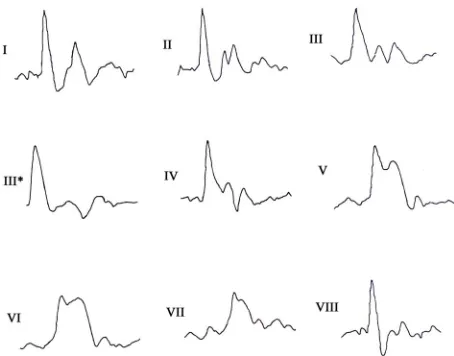
BARC had observed eight prominent patterns in mor- phologies of pulse records. These are schematically il-lustrated as patterns labeled I to VШ in Figure 1. These
patterns are also found in prominent clusters in an inde-pendent study of pulse signals [23].
During data collection, Dr. M. Dhurandhar et al. at
CDAC, Pune had noticed a pattern somewhat “in-be- tween” Ш and IV in pulse records of some Diabetic Mellitus (DM) cases. We have considered this as a
[image:2.595.310.537.522.700.2]dis-tinct pattern (Ш* in
Figure 1). Apart from patterns V, VI,
VII we found some other morphological patterns having more than one prominent peak and/or first prominent peak lower than the second. These types of patterns and the patterns V, VI, VII are referred in our study as “ ab-normal patterns”.
2.2. Significance of Fisher’s Ratio
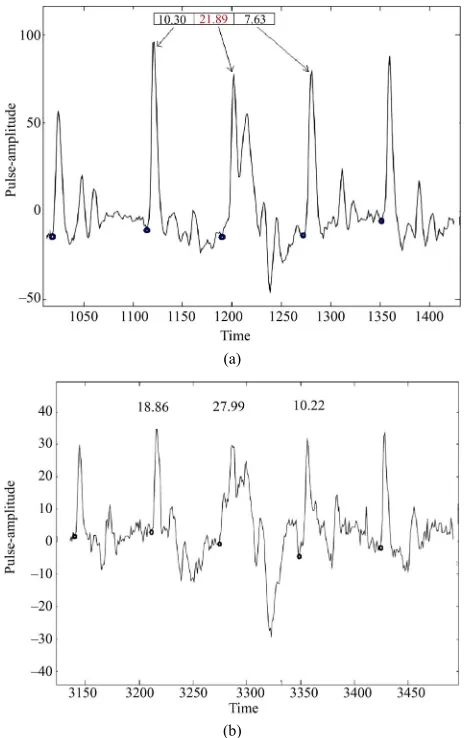
Using time-series modeling and thorough statistical ana- lysis of pulse-signals, we had found that Fisher’s Ra- tio—the likelihood ratio of cumulative periodogram [20]
—has significant relation with morphological patterns.
Figures 2(a) and (b) illustrate this for randomly selected
portions of two pulse records in our dataset. Overall in-ference based on this statistic is outlined in Section 2.2.2 below.
2.2.1. Computation of Fisher’s Ratio (FR)
This is a likelihood ratio for statistical inference of spec-trum. For a periodogram of the sample portion of a
waveform over n consecutive time-points it is computed
as
1
1
1
max j q j
q q
j i
I
q I
with q
n1 2
and I
j is the periodogramat the Fourier Frequency, j 2πj n.
2.2.2. Statistical Inference
We have computed Fisher’s Ratio (FR) for successive periods on each pulse-record on a randomly chosen
training sample of about 80 Females and 120 Males
from the above-described dataset. Statistical inference of
(a)
[image:3.595.55.289.83.452.2](b)
Figure 2. (a)Illustration of FR variation in different periods of pulse record (subject code no.: C43). Only the patterns with FR = 21.89 are abnormal here; (b) Drastic variation in FR values in three consecutive periods in a pulse record (patient code: B1). The period for which FR = 27.99 is truly rare case of ab-normal patterns. It has multiple prominent peaks but first one is lower in amplitude than the second.
this is summarized in the following rules. Here, p*
de-notes the confidence level of proportionality test of oc-currence of corresponding patterns. These “probabilistic rules” were also found valid for remaining pulse records in our dataset.
If FR [6, 8.5] then IV or VШ with p* > 0.87.
If FR (8.5, 11] then II, IV or VШ with p* > 0.88;
more likely are II or VШ.
If FR (11, 12] then II or IV with p* > 0.82; more
likely is II.
If FR (12, 13] then II with p* > 0.71 else.
If FR (13, 14] then II with p* > 0.87.
If FR (14, 15] then Ш or IV or VШ with p* > 84.6;
more likely is III.
If FR in (15, 16] then II or IV or III* with
p* > 0.82;
more likely is II.
If FR in (16, 18] then II, IV or III* with
p* > 0.95.
If FR > 18 abnormal patterns with p* > 0.9999.
These probabilistic-rules (heuristics) provide neces-sary screening and guidelines for geometrical modeling. The “more likely” option is used in case of a tie. Final detection is made using geometrical modeling. Major computational steps are outlined below.
2.3. Automated Detection of Pulse Morphology
We have developed and implemented the following al-gorithm on MatLab for online detection of pulse mor-phology by identification of the wave-patterns in succes-sive periods. The software is given to the collaborators at CDAC, Pune and BARC, Mumbai for inclusion in the decision support system of pulse-based diagnosis and integration in the Medical Analyzer System respectively.
Major Steps of the Algorithm
1) Remove Baseline Wandering by using an improved wavelet based adaptive method [21,22].
2) Detect Peak and Onset Points of Successive Periods using our algorithm, which is a modified and extended version of Pan-Tompkins algorithm [22,24] (Necessary details are given in the Appendix).
3) Compute Fisher’s Ratio [20] for successive periods (i.e. time-intervals between successive onset points) by
using the formula given in Section 2.2.1 above.
4) Normalize of each period in certain height (ampli-tude at the peak) and width using interpolation. In our computations, normalized width = 70 points and nor-malized height = 100 units.
5) Discriminate between patterns I, II, III, III*, IV and VIII, and abnormal patterns (defined in Section 2.1
above) using Fisher’s Ratio and width of the normalized waveform at amplitude 40% above the base.
6) Predict possible morphology/(ies) in each period by applying the statistical inference (probabilistic heuristics outlined above) on FR.
7) Geometrical Modeling: Compute distinct features, e.g. distance between two onset points, number of promi- nent peaks between two onset points, amplitude and dis-tance (from the left onset point) of each prominent peak, etc. Compare these with the corresponding features for template-structure/model of the possible patterns and choose the optimal match. The template-structure of a pattern is found by superposing the corresponding sche-matic design on a normalized record of the training sam-ple.
Validation results of our experiments using this algo-rithm are shown in Table 1 in the next Section.
2.4. Characterizing Morphology-Variation Strings in Healthy & Diseased States
We have characterized morphology variation with re-spect to time in pulse-records deploying sequence align-ment technique. For ready use of available multiple se-quence-alignment software of Bioinformatics applica-tions, we had coded the detected patterns as standard single letter codes of some amino acids: namely, pattern I as A, II as C, III as D, III* as E, IV as F,
abnormal pat- terns as G and pattern VIII as H.
The output of our program for automatic detection of pulse-morphology patterns for successive periods was thus transformed into a sequence (string) of letters in the alphabet {A, C, D, G, H}. Such a coded sequence is termed as “morphology-string” in this paper. Depending upon total time for which the pulse is consistently recorded, and the types of patterns occurring in it, the total number of periods and hence the length (say, k) of
its morphology-string may vary. In our dataset, k varied
between 220 and 300.
Identification of Motifs or Characteristic Patterns
The dataset was subdivided into similarity subsets with respect to gender, age, body-mass-index, blood pressure and healthy status or diagnosed disease/disorder, if any. For identification of prominent morphology patterns or their common sequential segments (motifs) we aligned
the morphology-strings within a subset using ClustalW program [25], which is an extensively used software utility for protein/DNA sequence alignment.
Pair-wise, as well as multiple sequence alignment was carried out on morphology-strings of the subjects in each
subset. Aligned portions with scores greater than 60 (on 100 point scale of ClustalW) were screened to detect the characteristic features—1) sequential motifs, i.e. common
sub-strings of consecutive patterns; and/or 2) most fre-quently occurring patterns.
3. RESULTS
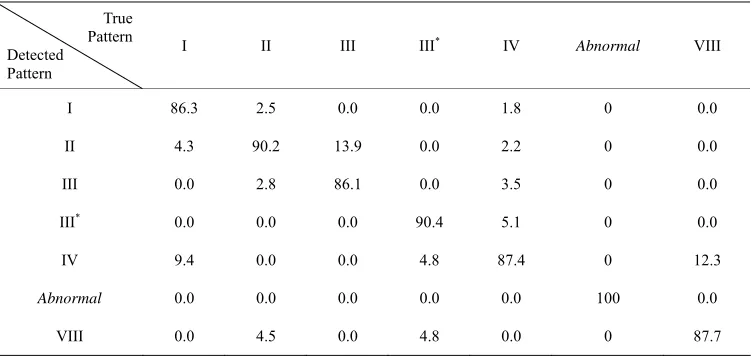
[image:4.595.111.487.559.737.2]We have evaluated the automatically detected pulse mor-phology patterns on samples of randomly selected peri-ods from the pulse records. From these the validation samples were so chosen that at least 30 representative of each pattern were present in each. Jackknife technique [26,27] was applied for cross-validation.
Table 1 below shows the average of percentage
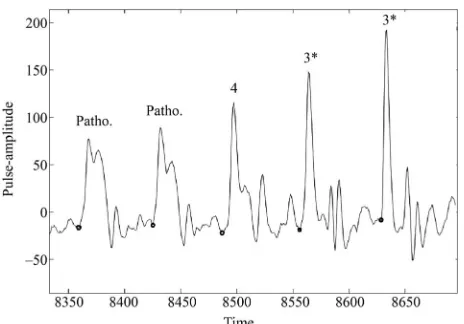
accu-racies of observed versus predicted patterns in the cross- validation trials. In this table, “True Pattern” implies manually identified pattern, which is also verified by superposition onto the template structure. The types (la-bels) of patterns are as described in Section 2.1 above. Some consecutive portions (of the morphology-strings on patient’s pulse record) are shown in Figures 3 and 4.
It can be clearly seen in these figures that predicted pat-tern-types match with the corresponding shapes in the waveform. In each figure, X-axis shows time variation (in units of 0.01 seconds) and Y-axis shows pulse-ampli- tude.
The average (with respect to all except abnormal*
patterns and with respect to all cross-validation sam- ples) sensitivity of our algorithm is about 88.03% and
average specificity is approximately 86.41%. (*As the
“abnormal” patterns are relatively easy to detect because
of two or more prominent peaks and the sample size of these in our data were less, inclusion of these increases both the average specificity and sensitivity by about
2.2% to 2.8%).
Table 1. Percentage accuracy of predicted versus actual pattern. The values in ith row jth column indicates average percentage of cases when actual pattern type is the label of jth column and the detected (by our automated predictive algorithm) pattern type is the label of ith row.
True Pattern Detected Pattern
I II III III* IV Abnormal VIII
I 86.3 2.5 0.0 0.0 1.8 0 0.0
II 4.3 90.2 13.9 0.0 2.2 0 0.0
III 0.0 2.8 86.1 0.0 3.5 0 0.0
III* 0.0 0.0 0.0 90.4 5.1 0 0.0
IV 9.4 0.0 0.0 4.8 87.4 0 12.3
Abnormal 0.0 0.0 0.0 0.0 0.0 100 0.0
Figure 3. Automatic prediction of pulse-morphology over time for pulse record (from time point 300 to 900 in units of 0.01 seconds) of subject code no. P16. Pattern type in each succes-sive period shown here is predicted as II, which is correct ac-cording to the definition of this pattern in Figure 1.
Figure 4. Automatic prediction of pulse-morphology over time for pulse record (from time point 8340 to 8710 in units of 0.01 seconds) of patient P165. (Here, Patho. Indicates an abnormal pattern; 4 indicates pattern IV and 3* denotes pattern III*).
3.1. Characteristics of Morphology Variation
The results show that motifs of morphology patterns or
their frequency distribution are distinct for most subsets. Only the results with confidence level >90% are pre-sented here. The size of corresponding groups having “healthy” cases was 45 and sizes of those having “di- seased” cases were between 11 and 24.
In the following, by percentages of occurrence of a morphology pattern we mean the percentage of periods (out of k) for which the particular letter is present in the
morphology-string. For clarity of illustration only some aligned portions (of the morphology-string) containing the motif, if any, are shown.
Characteristic Features
1) Healthy Cases in Age Group 20 - 40 years: The
morphology-strings of subjects in this group who bear no risk of cardiac or any other disease (in terms of lipid profile or family history) show significant prominence (~65% or more) of “H”. This is an important character-istic feature, distinguishing the truly healthy ones from the diseased classes, as the presence of this pattern was found insignificant in the patients’ groups: about 10% of the diseased cases show occurrence of this pattern, that too sporadic (in less than about 15% of the periods).
The other noticeable patterns found in the morphology strings of healthy people in age group 20 - 40, without any risk are—prominent continuous patches of “A” and/or “C”.
The number of healthy cases in higher age-group was very small.
2) Ischaemic Heart Disease (IHD): Morphology-
strings offemalesofage above 60 yearsandhaving IHD
were found to have significantly high frequency of “F” as compared to other patterns.
Aligned portions of morphology-strings of males of age above 60 years diagnosed for IHD with
Hyperten-sionshowed prominence of short and medium size con-tinuous patches of “D” and frequent occurrence of “E” and “A”.
3) Minor Coronary Artery Blockage: The set of
“Minor Coronary Artery Blockage” labeled separately from IHD corresponds here to those patients who had
minor coronary blockages for which no angioplasty was suggested.
Patients of Age 35 - 55 Years: Pair-wise alignment
of the following segments of morphology-strings with every string in this group showed significant score. The highlighted portions indicate the characteristic motifs
that were found in all the morphology-strings in this particular sub-group.
HCHCHCCCCHCCCCCACCCACCHCCCCCCCCCCC CCHCCCCCACCCCCCCHCCCHCCCDC
DCDACCCCCCCCCCCACCCCCCCCCCCCCCACACCCCA
The number of records in age-group 56 - 60 in this “disease” subset was very small.
Patients of Age > 60 Years: The most (pair-wise) align-
ing segments of morphology-variation found in this case were distinct from those in the group of the patients in age group 35 - 55 mainly because of high frequency of “D” and typical presence of short segments of its con-secutive occurrence. This distinct feature, along with re- latively frequent occurrence of “C” accounts for charac-teristic features of this sub-group. Typical portions of aligned segments are depicted below.
DCCCDDDCDDCEDCCDCACCACDCCCCCDCCADCACCC DCCCCCACCCCDCDCDCCFCCA
[image:5.595.56.288.315.477.2]4) Diabetes Mellitus (DM): The morphology-strings
of patients in this group showed prominent occurrence of “E” and “F”. Most of these had presence of characteris-tic segments (motifs) like:
EEEEEEEFEE and FFEFFEFF or FEEFEFEF
4. DISCUSSION
In modern medical practice different instruments and techniques are used for measurement of blood pressure, pulse rate, arterial blood flow rate, volume, cardiac out-put, electrophysiology of the heart etc. In the ancient times, especially in the Chinese and Indian traditional methods of diagnostics, deeper knowledge of the cardiac as well as other physiological functions were measured by sensing the pulse at different parts of the body in-cluding the radial arterial pulse.
Recent research on non-invasive methods of early diagnosis and deeper understanding of cardiac problems has generated new interest in pulse signal analysis. Mo- dern physiologists also regard that noninvasive radial arterial pulse waveforms contain substantial pathophy- siological information of cardiovascular system [12,19]. Major Biomedical research in this regard pertains to analysis of Heart Rate Variability and development of portable instruments for recording of pulse waveforms. Our algorithm of peak-detection (ref. paper no. [22]) also offers direct application in this regard. In the present paper we have explored a novel aspect—identification and analysis of variation in overall shape (morphology) of the waveform.
We have developed an algorithm for automatic detec-tion of different morphological patterns in pulse signals of radial artery. Fisher’s Ratio was found useful in clas-sifying distinct morphological patterns of pulse wave-form. This together with the geometrical modeling showed excellent results in accurate detection of morphological patterns. In the case of any irregular and arbitrary wave-forms (e.g. due to artifacts) this algorithm (and program) would correctly detected these as “no patterns found”. The algorithm is therefore suitable for characterization of pulse morphology variation with respect to time.
Considering the emphasis given to the nature of pulse- movement (nadi-gati) in Ayurveda (ancient Indian medi-
cal science) for pulse-based diagnosis, it appears worth investigating the characteristics of pulse morphology va- riation with respect to time. Our present study shows some characteristic features in terms of distinct morpho-logical patterns and their consecutive occurrences that distinguish healthy cases, specific cardiac problems and diabetes.
Most significant distinction we have found between the healthy groups and diseased cases is that of the
prominent presence of “H” i.e., pattern VIII in the
for-mer and its near total absence in the latter. Interestingly, the reflection index (= ratio of diastolic wave amplitude,
say, AP2 and systolic wave amplitude, say, AP1) for the
template structure of pattern VIII is within the normal standards [1,8]. So, in view of the heart physiology and some recently reported pulse waveform studies [18], this pattern does indicate healthy cardiac functions in terms of arterial blood flow and pressure variation.
We have found characteristic feature of the IHD in
higher age-groups as—prominent presence of “F” (pat-tern IV) and/or “E” (pat(pat-tern III*) or continuous patches of “D” (pattern III). Template structure of pattern IV has highest inter-wave distance index (= ratio of the inter- wave time measured at two-third of systolic peak and the total pulse time). This indicates slower and lesser arterial
blood flow. Hence prominence of this pattern implies arterial blockage or weaker heart output. The value of this index in template structure of pattern III* is
compa-rable with that of IV. This index in pattern III is lower than that of IV but is still higher than that for the re-maining patterns. So, significant presence of these pat-terns in the pulse waveform may also be regarded as indicative of similar cardiac problems, as in the case of pattern IV.
Prominent patches of “E” (pattern III*) and higher (as compared to other patterns) frequency of “F” (pattern IV) is found as common among the morphology-strings of
DM cases in our dataset. The augmentation index (=
(AP1 – AP2)/AP1) of template structure of pattern III* is highest among all patterns so its prominence indicates arterial stiffness. This together with above-mentioned implication of pattern IV with regard to weak arterial blood flow is significant in view of the fact that all the cases of DM in this dataset had high risk (because of age
> 45) of arterial blockage; some of them had had cardiac events associated with this problem.
These findings show promising scope of “morphology variation detection” as a supplementary tool for non- invasive techniques of detecting disorders in blood flow, cardio-vascular system and certain other physiological problems. Extended investigations with respect to type and duration of medication, etc. would provide deeper insight. Further studies on larger samples of different disease and age-groups would also help formulate some Gold standards for further research and validated appli-cations in prognosis/diagnosis.
5. ACKNOWLEDGEMENTS
This work was carried out at IIT Bombay. G. B. Nawsupe had contrib-uted to it as part of his M. Tech. (in Biomed. Engg.) Dissertation under the guidance of the first author. S. P. Wangikar was a research assistant in a project on Pulse Analysis undertaken by the first author. This project was part of a sponsored R. & D. project undertaken in collabo-ration with Dr. Medha Dhurandhar, Centre for Development of Ad-vanced Computing (CDAC), Pune and Dr. G.D. Jindal, Electronics Div., Bhabha Atomic Research Centre (BARC), Mumbai. The authors thank them for providing the data. The authors also thankfully acknowledge IIT Bombay for the infrastructure and administrative support and the Ministry of Information Technology, Govt. of India for the financial support granted for this project.
REFERENCES
[1] Brown, H., Kozlowski, R. and Davey, P. (1997) Physi- ology and pharmacology of the heart. Blackwell, Oxford. [2] Joshi, A.J., Chandran, S., Jayaraman, V.K. and Kulkarni,
B.D. (2007) Arterial pulse system: Modern methods for traditional Indian medicine. Proceedings of the 29th In-ternational Conference of IEEE Engineering in Medical & Biolology Society, Vancouver, 22-26 August 2007, 608- 611.
[3] Joshi, R.R. (2004) A Biostatistical approach to ayur- veda: Quantifying the tridosha. Journal of Alternate & Complementary Medicine, 10, 879-889.
[4] Joshi, R.R. (2005) Diagnostics using computational Nadi patterns. Mathematical and Computer Modeling, 41, 33- 47. doi:10.1016/j.mcm.2004.05.002
[5] Jindal, G.D., Ananthakrishnan, T.S., Mandlik, S.A., Sinha, V., Jain, R.K., Kini, A.R., Naik, M.A., Kataria, S.K., Mahajan, U.A. and Deshpande, A.K. (2003) Medical analyzer for the study of physiological variability and disease characterization. Technology Report, Bhaba Ato- mic Research Centre, Mumbai.
[6] Jindal, G.D., Ananthakrishnan, T.S., Rai, B.S., Madhyastha, M.N. and Jain, R.K. (2006) Plethysmographic techniques and applications in clinical medicine. Technology Re- port, Bhaba Atomic Research Centre, Mumbai.
[7] O’Ruke, M.F. (2004) Pulse waveform analysis and arte-rial stiffness: Realism can replace evangelism and skep-ticism. Journal of Hypertension, 22, 1633-1634.
[8] Takazawa, K., Kobayashi, H., Shindo, N., Tanaka, N. and Yamashina, A. (2007) Relationship between radial and central arterial pulse wave and evaluation of central arotic pressure using the radial arterial pulse wave. Hypertension Research, 30, 219-228.
doi:10.1291/hypres.30.219
[9] Joshi, A.J., Chandran, S., Jayaraman, V.K. and Kulkarni, B.D. (2007) Nadi Tarangini: A pulse based diagnostic system. Proceedings of the 29th International Confe- rence of IEEE Engineering in Medical & Biolology So- ciety, Lyon, 22-26 August 2007, 2207-2210.
[10] Abhinav Sareen, M., Kumar, M., Santosh, J., Salhan, A. and Anand, S. (2008) Nadi Yantra: A robust system
de-sign to capture de-signals from the radial artery for noninva-sive diagnosis. Proceedings of 2nd International Con-ference on Bioinformatics & Biomedical Engineering, Shanghai, 16-18 May 2008, 1387-1390.
[11] Abhinav Sareen, M., Kumar, M., Anand, S., Salhan, A. and Santosh, J. (2009) Nadi Yantra: A robust system de-sign to capture de-signals from the radial artery for assess-ment of the autonomic nervous system non-invasively. Journal of Biomedical Science & Engineering, 2, 471- 479.
[12] Pichot, V., Gaspoz, J.M., Molliex, S., Antoniadis, A., Busso, T., Roche, F., Costes, F., Quintin, L., Lacour, J.R. and Barthelemy, J.C. (1999) Wavelet transform to quan-tify heart rate variability and to assess its instantaneous changes. Journal of Applied Physiology, 86, 1081-1091. [13] Galinier, M., Pathak, A., Fourcade, J., Androdias, C.,
Curnier, D., Varnous, S., Boveda, S., Massabuau, P., Fauvel, M., Senard, J.M. and Bounhoure, J.P. (2000) Depressed low frequency power of heart rate variability as an independent predictor of sudden death in chronic heart failure. European Heart Journal, 21, 475-482. doi:10.1053/euhj.1999.1875
[14] Grigioni, M., Carotti, A., Del Gaudio, C., Morbiducci, U., Albanese, S.B. and D’Avenio, G. (2006) Multiresolution analysis of heart rate variability as investigational tool in experimental fetal cardiac surgery. Annals of Biomedical Engineering, 34, 799-809.
doi:10.1007/s10439-006-9084-x
[15] Huang, C.-M., Chang, H.-C., Kao, S.-T., Li, T-C., Wei, C.-C., Chen, C., Liao, Y.-T. and Chen, F.-J. (2011) Ra-dial pressure pulse and heart rate variability in heat- and cold-stressed humans. Evidence Based Complementary & Alternate Medicine, 14, 1-9.
[16] Wang, B. and Xiang, J. (1998) Detecting system and power spectral analysis of pulse signals of human body. 4th International Conference on Signal Processing Pro-ceedings, Beijing, 12-16 October 1998, 1646-1649. [17] De Melis, M., Morbiducci, U., Rietzschel, E.R., De Buy-
zere, M., Qasem, A., Van Bortel, L., Claessens, T., Mon- tevecchi, F.M., Avolio, A. and Segers, P. (2009) Blood pressure waveform analysis by means of wavelet trans- form. Medical & Biological Engineering & Computting, 47,165-173. doi:10.1007/s11517-008-0397-9
[18] Hashimoto, J., Imai, Y. and O’Rouke, M.F. (2007) In- dices of pulse wave analysis are better predictors of left ventricular mass reduction than cuff pressure. American Journal of Hypertension, 20, 378-384.
doi:10.1016/j.amjhyper.2006.09.019
[19] Joshi, R.R., Wangikar, S.W. and Nawsupe, G. (2008) Instrumentation based pulse diagnosis. DSS Technical Report, Ministry of Communication & Information Tech- nology, New Delhi.
[20] Diggle, P. and Fisher, N.I. (1991). Nonparametric com-parison of cumulative periodograms. Applied Statistics, 40, 423-434. doi:10.2307/2347522
doi:10.1016/j.compbiomed.2006.06.014
[22] Nawsupe, G. and Joshi, R.R. (2011) Modified wave-let-based technique for baseline drift removal and diag-nostic scope of spectral energy of radial pulse signal. In-ternational Journal of Biomedical Engineering and Tech- nology, 6, 1-13. doi:10.1504/IJBET.2011.040450
[23] Karamchandani, S., Merchant, S.N., Desai, U.B. and Jindal, G.D. (2010) Application of crisp and fuzzy clus-tering algorithms for identification of hidden patterns from plethysmographic observations on the radial pulse. IEEE Engineering in Medical & Biolology Society, 1, 3978-3981.
[24] Pan, J. and Tompkins, W.A. (1985) Real-time QRS de- tection algorithm. IEEE Transactions in Biomedical
En-gineering, 32, 230-237. doi:10.1109/TBME.1985.325532 [25] Thompson, J.D., Higgins, D.G. and Gibson, T.J. (1994)
CLUSTAL W: Improving the sensitivity of progressive multiple sequence alignment through sequence weighting, position specific gap penalties and weight matrix choice. Computer Applications in Biological Sciences, 10, 19-29. [26] Chou, K.C. and Shen, H.B. (2007) Review: Recent
pro-gresses in protein subcellular location prediction. Ana-lytical Biochemistry, 370, 1-16.
doi:10.1016/j.ab.2007.07.006
[27] Du, Q.S., Huang, R.B., Wang, S.Q. and Chou, K.C. (2010) Designing inhibitors of M2 proton channel against H1N1 swine influenza virus. PLoS One, 5, e9388. doi:10.1371/journal.pone.0009388
APPENDIX
Essence of Our Algorithms for Detection of Peaks and Onset Points:
Pulse signal is recorded by the instrument (VASOMON) at a constant sampling frequency 100 Hz. For peak detec-tion purpose we successively filter out this signal using linear digital band-pass filter with lower cutoff frequency 1.5 Hz and higher cutoff frequency 20 Hz. This particular range is chosen, as most of the information of pulse is contained in this range. Our peak-detection algorithm is an extension of the approach of Pan and Tompkins [24]. Their algorithm was confined to QRS detection in ECG waveforms. We have modified and extended it for detec-tion of peaks in more complicated waveforms, viz., those of pulse signals.
Considering the possibility of local maxima and varia-tion in the morphology patterns, our algorithm adaptively recognizes the peaks in a pulse waveform based on digital analysis of slope of P wave, amplitude of the peak in each beat and the distance (N-N interval) between two previous
peaks. (The first two peaks are identified by local maxima search).
Detection of Onset Points: Having identified a peak in any period, we scan n1 and n2 time-points backwards from the peak’s time point and get two local minima by using sliding window of adaptive size depending upon relative variation in amplitude in the local region. The onset point for this period is then chosen as the global minimum of all the local minima identified in this adaptive search. Here,
n1 and n2 are the number of points we find out adaptively in terms of distance between onset and peak points of the previous period [22].
The algorithm of Xu et al. [21] directly chooses the
minimum of 20 backward points; they had tested it only on simulated data and therefore did not notice the sizable error due to possible trapping in a wrong local minimum, which does occur in the case of real data. Similar limita-tion lies in their approach to identifying the peaks. Our algorithm is free of such lacunae.