Research
Web exclusive
This article has been peer reviewed. Can Fam Physician 2014;60:e223-9
Editor’s KEy Points
• Emergency department (ED) over-crowding has become an important pub-lic health issue internationally. Lack of access to primary care, and subsequent frequent ED use, is often cited as a cause of overcrowding, despite the fact that there is little evidence to support this theory. This study sought to determine if having a primary care provider was an important factor in frequency of ED use.
• Most patients attending the urban EDs did not have primary care provid-ers, a finding that was reversed in the rural setting. The proportion of patients without listed providers was 65.5% in the urban centres, compared with only 7.9% of New Brunswick residents who reported that they did not have family physicians in the 2009 Canadian Community Health Survey. So although having a primary care provider was a predictor of frequent ED use, it is possible the urban EDs in southern New Brunswick are providing a large volume of care to patients who do not have primary care providers.
• Those who used the rural ED were more likely to be frequent users and were more likely to have primary care providers. Ru-ral EDs are often staffed by local family physicians, and patients might access the ED in order to see their regular providers.
Abstract
Objective To determine if having a primary care provider is an important factor in frequency of emergency department (ED) use.
Design Analysis of a central computerized health network database.
Setting Three EDs in southern New Brunswick.
Participants All ED visits during 1 calendar year to an urban regional hospital (URH), an urban urgent care centre (UCC), and a rural community hospital (RCH) were captured.
Main outcome measures Patients with and without listed primary care providers were compared in terms of number of visits to the ED. A logistic regression analysis was used to determine factors predictive of frequent attendance.
Results In total, 48 505, 41 004, and 27 900 visits were made to the URH, UCC, and RCH, respectively, in 2009. The proportion of patients with listed primary care providers was 36.6% for the URH, 37.1% for the UCC, and 89.4% for the RCH. Among ED patients at all sites, frequent attenders (4 or more visits to an ED in 1 year) were significantly more likely (59.6% vs 45.1%, P < .001) to have listed primary care providers. Other factors that predicted frequent use included attendance at a rural ED, female sex, and older age.
Conclusion This study characterizes attendance rates for 3 EDs in southern New Brunswick. Our findings highlight interesting differences between urban and rural ED populations, and suggest that frequent use of the ED might not be related to lack of a listed primary care provider.
Emergency department use
L’utilisation des urgences
La fréquence des visites est-elle liée à
un manque de fournisseurs de soins de première ligne?
Erin Palmer
MD CCFPDenise Leblanc-Duchin
PhDJoshua Murray
MScPaul Atkinson
MB BCh MA FCEMRésumé
Objectif Vérifier si le fait d’avoir un fournisseur de soins de première ligne joue un rôle important pour déterminer la fréquence des visites à l’urgence.
Type d’étude Analyse d’une base de données d’un réseau de santé électronique central.
Contexte Trois départements d’urgence (DU) du sud du Nouveau-Brunswick.
Participants On a tenu compte de toutes les visites effectuées au cours d’une année du calendrier au DU d’un hôpital régional urbain (HRU), d’un centre urbain de soins urgents (CSU) et d’un hôpital communautaire rural (HCR).
Principaux paramètres à l’étude On a comparé les patients qui avaient accès à un fournisseur de soins de première ligne à ceux qui n’y avaient pas accès pour ce qui est du nombre de visites à des DU. Une analyse de régression multiple a servi à déterminer les facteurs prédictifs de visites nombreuses.
Résultats En 2009, il y a eu 48 505, 41 004 et 27 900 visites, respectivement au HRU, au CSU et au HCR. La proportion des patients ayant accès à un fournisseur de soins de première ligne était de 36,6 % au HRU, de 37,1 % au CSU et de 89,4 % au HCR. Parmi les patients de tous ces établissements, les plus assidus (au moins 4 visites au DU dans l’année) étaient plus susceptibles d’avoir accès à un fournisseur de soins de première ligne (59,6 % vs 45,1 %, P < ,001). Parmi les autres facteurs prédictifs de visites fréquentes, mentionnons le fait de visiter un DU rural, d’être une femme et d’être plus âgé.
Conclusion Cette étude étudiait les taux de visites à 3 urgences du sud du Nouveau-Brunswick. Les résultats révèlent d’intéressantes différences entre les populations des DU urbains et ruraux, et permettent de croire qu’il n’y a pas de relation entre l’utilisation fréquente des DU et le fait de ne pas avoir accès à un fournisseur de soins de première ligne.
Points dE rEPèrE du rédactEur
• L’encombrement des départements d’urgence (DU) est maintenant un important problème de santé publique à l’échelle inter-nationale. On mentionne souvent le manque d’accès à des soins primaires et l’utilisation fréquente des DU qui en résulte comme une cause de cet encombrement, même s’il n’y a pas de preuve pour appuyer cette théorie. La présente étude a voulu vérifier si le fait d’avoir accès à un fournisseur de soins de première ligne était une cause importante de l’encombrement des DU.
• La plupart des clients des DU urbains n’avaient pas accès à un fournisseur de soins de première ligne, alors que c’était la situation inverse en milieux rural. La pro-portion des patients qui n’avaient pas de fournisseur de soins de première ligne était de 65 % dans les centres urbains, alors qu’à l’Enquête de 2009 sur la santé dans les col-lectivités canadiennes, 7,9 % des résidents du Nouveau-Brunswick déclaraient ne pas avoir de médecin de famille. Ainsi, même si l’accès à un fournisseur de soins de première ligne est un facteur prédictif d’une utilisation plus fréquente des DU, il est possible que les DU urbains du sud du Nouveau-Brunswick dispensent une grande quantité de soins aux patients qui n’ont pas de médecins de première ligne.
• Ceux qui fréquentaient des DU ru-raux étaient plus susceptibles d’avoir un fournisseur de soins de première ligne. Comme il y a souvent des médecins de famille qui travaillent dans les DU ruraux, il se pourrait que les patients s’y présentent pour voir leur médecin habituel.
Emergency department use
|
Research
E
mergency department (ED) overcrowding has become an important public health issue interna-tionally. Studies have identified a group of individu-als who account for a disproportionately high number of ED visits in an effort to develop interventions targeted at managing this group of patients. These “frequent users” have been shown to account for 4.5% to 8% of all ED patients, but 21% to 28% of all ED visits.1Frequent ED users have previously been character-ized as individuals of low socioeconomic status with limited access to primary care, often presenting with nonurgent complaints. However, recent studies have found that this group of frequent attenders also includes many patients who have complex medical issues and adequate access to primary care services.2 In light of the
heterogeneity of this group, more research is needed to clearly define the potential subgroups of frequent users in order to develop intervention strategies.
It is unclear whether having a regular family doctor or primary care provider is related to frequent ED use, although lack of access to primary health care is often cited as a potential cause of ED overcrowding.3 Primary
care practitioner shortage has indeed been a growing problem throughout Canada. According to the Canadian Community Health Survey in 2009, 7.9% of the New Brunswick population reported not having family phy-sicians, compared with 5.6% in 2001. This problem is reflected across the country, the national average being 15.1% in 2009.4 In EDs, the proportion of patients
with-out regular doctors ranges from 20.8% to 29.5%.5 Several
studies have examined the effects of lack of access to primary care on frequent ED visits, although no studies have directly quantified this relationship.5-7
We have reviewed and analyzed characteristics of ED users in southern New Brunswick at an urban regional hospital (URH), Saint John Regional Hospital; an urban urgent care centre (UCC), St Joseph’s Hospital; and a rural community hospital (RCH), Sussex Health Centre. Our main objective was to determine if having regular access to a primary care provider (as defined by having a listed family physician or nurse practitioner) was an important factor in frequency of ED use. Other potential factors investigated included hospital site, sex, and age group.
MEthods
Study protocol
A retrospective database review of all ED visits to the URH, UCC, and RCH sites for a 12-month period was performed. Data are routinely collected for ED records for all sites and were therefore available for every patient visit from January 1, 2009, to December 31, 2009. All available demographic details were obtained from the hospital patient information systems for all visits in
this 1-year period. Anonymized data were entered into a separate database for further analysis. Ethics approval was obtained from the Horizon Health Network research ethics board.
Study setting
The URH is a 455-bed hospital in Saint John, NB, and is the premier acute care and referral centre for the prov-ince. It is the site of Dalhousie University’s distributed medical education program and hosts undergraduate and resident trainees from family medicine as well as other specialty programs.
The UCC is a 105-bed hospital located in downtown Saint John. The UCC provides 12-hour emergency services to the community. The RCH is a 25-bed hospital located in Sussex, NB. The ED provides 24-hour services to a population of approximately 30 000.
Study design and data analysis
Patients’ information included whether they had listed primary care providers or not, demographic information (age and sex), and number of visits to the ED within the 1-year period. Descriptive statistics were used to sum-marize patient demographic information and number of visits. Patients with and without listed primary care pro-viders were compared using χ2 tests for sex, a
categori-cal age variable, and urban versus rural sites. Differences between categorical variables and number of ED visits were compared using Wilcoxon rank sum tests.
Further analysis was completed for frequent users (4 or more visits in a 1-year period), in terms of access to primary care providers. The definition of frequent atten-dance was based on previous literature examining the characteristics of frequent ED users.8,9 The proportions
of frequent and nonfrequent attenders, with and with-out primary care providers, were analyzed using χ2 tests.
A logistic regression model was constructed to assess the effect of having a primary care provider on being a frequent attender while controlling for age, sex, and attending urban versus rural sites. Interactions among having a primary care provider and other variables of interest were examined. The final model was chosen to have an optimal Akaike information criterion.
rEsuLts
There were 33 862 patients (56.6%) who attended EDs only once. The maximum number of visits for any individual patient at each ED was 85 for the RCH, 53 for the UCC, and 36 for the URH. Overall and within each of the 3 EDs, the median number of visits was 1 with an interquartile range of 1 to 2 visits; the Wilcoxon rank sum test indicated higher ranks for those with pri-mary care providers (P < .001). A description of ED visits by site, as well as patient characteristics, can be found
in Table 1.
A total of 27 692 patients (46.8%) had listed primary care providers (Figure 1). This ranged from 36.6% for the URH and 37.1% for the UCC, to 89.4% for the RCH. Patient age was categorized into 4 groups: 19 years and younger (pediatric), 20 to 49 years (young adult), 50 to 74 years (older adult), and 75 years and older (geriat-ric). There was a significant association between certain age groups and having a primary care provider (χ2
3= 77.7,
P < .001). Overall, 50% of older adults and 49% of geriat-ric patients had primary care providers, while only 45% of young adults and 46% of pediatric patients had pri-mary care providers. Within all 3 sites, older adults and geriatric patients were more likely to have primary care providers. Female patients were significantly more likely to have listed primary care providers than male patients were (53.7% vs 46.2%; χ2
1= 115.3, P < .001). Similar results
were found within each of the 3 ED sites.
After removing the 9702 patients who attended both urban facilities, no difference was found in the pro-portion of patients presenting with or without primary care providers (34.9% for the URH vs 34.8% for the UCC;
χ2
1= 0.068, P = .794). To compare between the urban
set-tings and the rural setting, 1272 patients who attended both urban and rural EDs were removed. Patients pre-senting to the urban settings were significantly less likely to have primary care providers (65.5% vs 10.7%; χ2
1= 11 546.8, P < .001).
Overall, frequent attenders (4 or more visits in a year) accounted for 11.3% of all patients. This ranged from 5.3% at the URH and 5.5% at the UCC, to 13.7% in the
Figure 1.
Total number of patients with and without
registered PCPs who visited the URH, UCC, and RCH
EDs during the 2009 calendar year
ED—emergency department, PCP—primary care provider, RCH—rural community hospital, UCC—urgent care centre, URH—urban regional hospital.
SITE
With registered PCP
NO
. OF PA
TIENTS
0 5 000 10 000 15 000 20 000 25 000
URH UCC RCH
Without registered PCP
table 1.
Patient characteristics from the 3 EDs
CHARACTERISTIC URH (N = 31 395), N (%) UCC (N = 26 230), N (%) RCH (N = 13 312), N (%) ToTAL* (N = 59 803), N (%)
Total number of ED visits
• 1 22 078 (70.3) 18 143 (69.2) 7303 (54.9) 33 862 (56.6) • 2-3 7657 (24.4) 6654 (25.4) 4190 (31.5) 19 174 (32.1)
• ≥ 4 1660 (5.3) 1433 (5.5) 1819 (13.7) 6767 (11.3)
Sex
• Female 16 045 (51.1) 13 857 (52.8) 6845 (51.8) 30 705 (51.4) • Male 15 343 (48.9) 12 369 (47.2) 6370 (48.2) 28 994 (48.6) Primary care provider
• Yes 11 501 (36.6) 9727 (37.1) 11 901 (89.4) 27 692 (46.5) • No 19 894 (63.4) 16 503 (62.9) 1411 (10.6) 31 841 (53.5) Age, y
• < 20 7138 (22.7) 7308 (27.9) 3968 (29.8) 15 440 (25.8) • 20-49 12 738 (40.6) 12 017 (45.8) 5086 (38.2) 24 785 (41.4) • 50-74 8052 (25.6) 5711 (21.8) 3297 (24.8) 14 682 (24.6)
• ≥ 75 3466 (11.0) 1192 (4.5) 961 (7.2) 4894 (8.2)
ED—emergency department, RCH—rural community hospital, UCC—urgent care centre, URH—urban regional hospital.
Emergency department use
|
Research
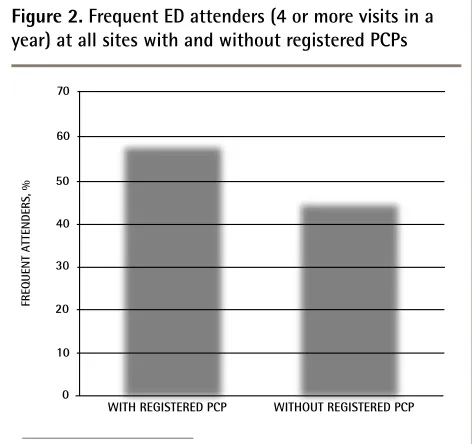
rural setting. Among ED patients at all sites (Figure 2), frequent attenders were significantly more likely to have listed primary care providers (59.6% vs 45.1%; χ2
1= 501.9,
P < .001).
Results of the logistic regression (Table 2) showed that frequent attendance was predicted by having a primary care provider, female sex, oldest age group, and attendance at the rural ED. In the final multivari-ate model, having a primary care provider increased the odds of being a frequent attender when sex, age group, and facility were controlled for. Conversely, while controlling for other factors, male patients and those who used urban facilities had lower likelihoods of being frequent attenders. The odds of being a fre-quent attender increased for those in the geriatric age group (75 and older) compared with young adults (20 to 49) but decreased for older adults (50 to 74) com-pared with young adults. There was no difference in the odds of being a frequent attender between young adults and those younger than 20 years of age. Models with interactions between having a primary care provider
and all other variables were examined; however, they decreased overall model fit.
discussion
This study looking at predictive factors of ED attendance yielded several significant findings. The study highlights some important differences between urban and rural populations in terms of ED attendance. Most patients attending urban EDs or UCCs do not have primary care providers, a finding that is reversed in the rural setting. The proportion of patients without listed providers was 65.5% in the urban centres. In similar studies of urban EDs, the proportions of patients without regular doctors range from 20.8% to 29.5%.5,10 Furthermore, in the 2009
Canadian Community Health Survey, only 7.9% of New Brunswick residents reported that they did not have family physicians.11
Compared with other studies,5,10 the difference in
the proportion of patients without regular primary care providers who visited the urban EDs at least once in 2009 raises some important questions. Does this poten-tially reflect a higher rate of patients without regu-lar providers in urban versus rural New Brunswick? Currently, data on rates of the lack of primary care physicians within specific centres in New Brunswick are unavailable. Perhaps this result indicates that the urban EDs in southern New Brunswick are providing a large volume of care to patients who do not have pri-mary care providers. Certainly, there are other services available, such as walk-in clinics; however, our find-ings might suggest that these services are not meet-ing the primary health care needs of this population. This phenomenon has been seen in other areas, such as Toronto, Ont, where one study found that patients with chronic illness were 1.2 times more likely to visit the ED if they did not have regular providers.12 Further
research might be warranted to accurately identify the number of patients without primary care providers in our urban centre, and the patterns of health care use within this population.
When all ED patients were divided into frequent attenders (defined as having visited 4 or more times in 1 year) and nonfrequent attenders it was found that the frequent attenders were more likely to have listed pri-mary care providers. Few studies have directly exam-ined the relationship between frequent attendance and lack of primary care access. Sandoval et al found that frequent ED attenders were as likely as infrequent attenders to have primary care physicians in an inner-city ED in the United States.5 In a Canadian study by
Carrière, patients who had regular doctors were just as likely to report ED use as those who did not have regular doctors.13 Our study is the first to report a significantly
table 2.
Logistic regression model predicting frequent
attenders
VARIABLE oDDS RATIo (95% CI) P VALUE
Family physician 1.56 (1.47-1.66) < .001 Urban vs rural 0.92 (0.86-0.98) .014 Male vs female 0.76 (0.72-0.80) < .001 Age, y
• < 20 vs 20-49 0.95 (1.02-1.18) .119 • 50-74 vs 20-49 0.86 (0.80-0.94) < .001 • ≥ 75 vs 20-49 1.10 (1.01-1.02) .035
Figure 2.
Frequent ED attenders (4 or more visits in a
year) at all sites with and without registered PCPs
ED—emergency department, PCP—primary care provider.
FREQUENT A
TTENDERS, %
0 10 20 30 40 50 60 70
higher likelihood of frequent attenders having listed primary care providers.
One possible explanation for this finding is that per-haps patients who attend the ED frequently are those who are more likely to access health care in general. Several studies reported that frequent and heavy ED users were more likely to be heavy users of other medi-cal services.7,13,14 The frequent-user population might
also represent patients who have several comorbidities and require ongoing care. Numerous national and inter-national studies have found that frequent and heavy users are more likely to have chronic illness or “poor health status” and to have higher hospital admission and mortality rates.1,15,16
In keeping with this theory, we found that, at all sites, the older adult group (aged 50 to 74) and the geriat-ric group (75 and older) had a greater percentage of patients with listed primary care providers. This might indicate that a younger, healthier section of the popula-tion does not have registered primary health care pro-viders and that these patients place a lower demand on the health care system in general, including infrequent use of the ED. Indeed, compared with the young adult group (aged 20 to 49), patients in the geriatric group had increased odds of being frequent attenders.
Limitations
We had to rely on the ED database to determine if patients had access to primary care providers. By using the database we assume that the information is accu-rate, although there might be changes in a patient’s status that might not be reflected in the database. This could lead to bias if there were a substantial number of patients whose primary care practitioner status was inaccurate.
In addition, the regression analysis indicated that those who used the rural facility were more likely to be frequent attenders, which again highlights some impor-tant differences between urban and rural populations of ED attenders. Rural EDs are often staffed by local fam-ily physicians, and patients might access the ED in order to see their regular providers. The results from the rural community hospital might have been confounded by this phenomenon.
It is also possible that the high proportion of patients with primary care providers in the rural set-ting might contribute to the overall finding that fre-quent attenders are more likely to have primary care providers. It is also important to note that having a listed primary care provider might be affected by many other variables that we were unable to mea-sure, such as education level and socioeconomic sta-tus. Therefore, care should be taken in interpreting the association between having a primary care pro-vider and frequent ED attendance as causal. The large
sample size included in our study is a contributing factor to the statistical significance of our results.
Further, this study does not quantify access to pri-mary care. We assume that a patient has adequate access to primary care if they report having a regular practitioner. However, there might be patients who are unable to see their own doctors for urgent complaints. Inadequate access to primary care services has been well documented in Canada. A Health Council of Canada report in 2010 found that only 45% of Canadians thought they were able to obtain same- or next-day appoint-ments with their providers when they were sick. Further, 47% of Canadians reported using the hospital ED for conditions they thought could be managed by their pri-mary providers.17 Another survey of Canadian patients
found that 59% of respondents had difficulties access-ing after-hours care without attendaccess-ing the ED.18 The
most common reasons given for poor access were a lack of available appointments and inappropriately long wait times for the next available appointment.19 Further
analysis of this potential relationship between lack of access to primary care and frequent ED use would be an important step in implementing programs to allevi-ate ED overcrowding.20 It might be useful for future
stud-ies to survey ED patients about their ability to access their primary care physicians. Other studies could target interventions for those with complex comorbid condi-tions for better management of their health and, conse-quently, a reduction in the number of ED visits.
Conclusion
This study assessed the effect of having a primary care provider on being a frequent ED attender while control-ling for age, sex, and attending urban versus rural sites for 3 EDs in southern New Brunswick. Although most patients attending urban centres (URH and UCC) were without listed care providers, having a primary care provider increased the likelihood of being a frequent ED attender. This suggests that although patients with-out primary care providers contribute to a considerable number of ED visits, and account for most of these visits in the urban settings, being without a listed primary care provider was not associated with attending EDs fre-quently. The study highlights the important differences in ED user populations between urban and rural centres and might indicate the need for more services for those without primary providers in the urban setting, as well as for frequent users of health services in general.
Dr Palmer works in the Department of Family Medicine at Dalhousie University in Saint John, NB. Dr Leblanc-Duchin and Mr Murray work in Research Services at Horizon Health Network in New Brunswick. Dr Atkinson works in the Department of Emergency Medicine at Dalhousie University.
acknowledgment
We thank Dr Keith Wilson, for his contribution to the editing of the manuscript, and Marc Arsenault, for aiding in data collection.
Contributors
Emergency department use
|
Research
the research methodology, analyzed the data, contributed to writing the manu-script, and reviewed the manuscript. Dr Atkinson reviewed the initial question, performed the literature search, designed the research methodology, analyzed the data, contributed to writing the manuscript, and reviewed the manuscript.
Dr Leblanc-Duchin reviewed the literature search, research methodology, and data analysis; contributed to writing the manuscript; and reviewed the manu-script. Mr Murray reviewed the research methodology, contributed to the data analysis, contributed to writing the manuscript, and reviewed the manuscript.
Competing interests
None declared
Correspondence
Dr Paul Atkinson, Saint John Regional Hospital, Emergency Medicine, PO Box 2100, 400 University Ave, Saint John, NB E2L 4L2; e-mail [email protected]
references
1. LaCalle E, Rabin E. Frequent users of the emergency departments: the myths, the data and the policy implications. Ann Emerg Med 2010;56(1):42-8. 2. Ruger JP, Richter CJ, Spitznagel EL, Lewis LM. Analysis of costs, length of
stay and utilization of emergency department services by frequent users: implications for health policy. Acad Emerg Med 2004;11(12):1311-7. 3. Canadian Association of Emergency Physicians. The Canadian Association of
Emergency Physicians’ submission to the Commission on the Future of Health Care in Canada: emergency department overcrowding. Ottawa, ON: Canadian Association of Emergency Physicians; 2010.
4. Statistics Canada. Canadian Community Health Survey. Population with a regular medical doctor by sex, provinces and territories. Ottawa, ON: Statistics Canada; 2009. Available from: www40.statcan.gc.ca/l01/cst01/ health76b-eng.htm. Accessed 2014 Mar 17.
5. Sandoval E, Smith S, Walter J, Schuman SA, Olson MP, Striefler R, et al. A comparison of frequent and infrequent visitors to an urban emergency department. J Emerg Med 2010;38(2):115-21.
6. Blank FS, Li H, Henneman PL, Smithline HA, Santoro JS, Provost D, et al. A descriptive study of heavy emergency department users at an academic emergency department reveals heavy ED users have better access to care than average users. J Emerg Nurs 2005;31(2):139-44.
7. Ovens HJ, Chan GT. Heavy users of emergency services: a population-based review. CMAJ 2001;165(8):1049-50.
8. Lucas RH, Sanford SM. An analysis of frequent users of emergency care at an urban university hospital. Ann Emerg Med 1998;32(5):563-8.
9. Moore L, Deehan A, Seed P, Jones R. Characteristics of frequent attenders in an emergency department: analysis of 1-year attendance data. Emerg Med J
2009;26(4):263-7.
10. Petersen LA, Burstin HR, O’Neil AC, Orav EJ, Brennan TA. Nonurgent emer-gency department visits: the effect of not having a regular doctor. Med Care
1998;36(8):1249-55.
11. Government of New Brunswick. The provincial health care plan: 2004-2008. Fredericton, NB: Government of New Brunswick; 2004. Available from: www. gnb.ca/0051/promos/healthplan/index-e.asp. Accessed 2014 Mar 17. 12. Glazier RH, Moineddin R, Agha MM, Zagorski B, Hall R, Manuel DG, et
al. The impact of not having a primary care physician among people with chronic conditions: ICES investigative report. Toronto, ON: Institute for Clinical Evaluative Sciences; 2008.
13. Carrière G. Use of hospital emergency rooms. Health Rep 2004;16(1):35-9. 14. Hansagi H, Olsson M, Sjoberg S, Tomson Y, Göransson S. Frequent use of
the hospital emergency department is indicative of high use of other health care services. Ann Emerg Med 2001;37(6):561-7.
15. Hunt KA, Weber EJ, Showstack JA, Colby DC, Callaham ML. Characteristics of frequent users of emergency departments. Ann Emerg Med 2006;48(1):1-8. 16. Sun BC, Burstin HR, Brennan TA. Predictors and outcomes of frequent
emergency department users. Acad Emerg Med 2003;10(4):320-8.
17. Health Council of Canada. How do Canadians rate the health care system?
Canadian Health Care Matters Bulletin 4. 2010 Nov.
18. Schoen C, Osborn R, Huynh PT, Doty M, Davis K, Zapert K, et al. Primary care and health system performance: adults’ experiences in five countries.
Health Aff (Millwood)2004;Suppl Web Exclusives:W4-487-503.
19. Canadian Institute for Health Information. Experiences with primary health care in Canada. Ottawa, ON: Canadian Institute for Health Information; 2009. Available from: https://secure.cihi.ca/free_products/cse_phc_aib_en.pdf. Accessed 2014 Mar 17.
20. Mian O, Pong R. Does better access to FPs decrease the likelihood of emer-gency department use? Can Fam Physician 2012;58:e658-66. Available from: