Abstract— SBU GMF Power Services is one of Business Units of PT. GMF AeroAsia and is a new diversification business. SBU GMF Power Services has some lines of business to accommodate industrial gas turbine, power generation and rotating equipment’s maintenance, repair and overhaul in Indonesia and abroad. In ruuning the business, especially in the gas turbine component repair there are still some problems. Problems that occur related to the absence of supporting documents in their business processes. The recording errors on the serial number of components to be repaired cause delays in project execution. This paper proposes a business process improvement for repairing processes in SBU GMF Power Services. The result is the redesign of business process for gas turbine component repair SBU GMF Power Services using Business Process Improvement (BPI) with Model-Based and Integrated Process Improvement. With the new business process, the company can run the business more effectively and efficiently.
Index Terms— business process improvement, business process re-design, efficiency, model-based and integrated process improvement
I. INTRODUCTION
T. Garuda Maintenance Facility (GMF) AeroAsia is a largest aircraft maintenance company in Indonesia. PT. GMF promote safety, excellence and precision as well as the application of technology to support reliable and experienced profesionals [1]. MRO company’s role as a provider of maintenance, repair, and overhaul of aircraft in the aviation industry is to ensure that the aircraft in good condition before it airs and achieve the schedule without any interruption [2]. In addition, GMF also serve MRO (maintenance, repair, and overhaul) for industries that use gas turbines and power generators. The business unit is performed by GMF Power Services.
Manuscript received December 23th, 2015; revised January 20th, 2016.
V. H. L. Saputri is with the Laboratory of Business and Logistic System, Industrial Engineering Department, Faculty of Engineering, Sebelas Maret University, Indonesia (corresponding author to provide phone: +6285747101501; e-mail: [email protected]).
Yuniaristanto is with the Laboratory of Business and Logistic System, Industrial Engineering Department, Faculty of Engineering, Sebelas Maret University, Indonesia (e-mail: [email protected]).
Muh. Hisjam is with Laboratory of Business and Logistic System, Industrial Engineering Department, Faculty of Engineering, Sebelas Maret University, Indonesia (e-mail: [email protected]).
Ria Asyrofa is with PT. Garuda Maintenance Facility AeroAsia, Indonesia (e-mail: [email protected]).
GMF Power Services (“GPS”) is a business unit which serves non aviation sector, i.e.: providing services of overhaul maintenance for industrial gas turbin engines [3]. One of executive repair at GMF Power Services is a unit of Gas Turbine Component Repair. This unit is engaged in repair of gas turbine components. Each component from the customer recorded through the Preliminary Inspection Report (PIR) based on the Serial Number (SN). PIR results are used by the Engineering division to make Planning Data Sheet (PD Sheet). PD Sheet contains corrective measures against the component to be processed by the production division. But at the time of execution, there are any mistakes when writing the serial number. The error allows the creation of documentation errors for the components that being processed.
From the observations know that error of the serial number is caused by absence of an introductory document serial number from customer. So GMF Power Service should make the process of recording the serial number manually. From the existing business process in the company, it is known that the focus of the problem occurs in the process of handling orders and production process.
Based on the company’s conditions, it can be said that there are problems in the system that has been running in the company that need to be improved so that problems can be overcome. Therefore, improvements of business processes to improve enterprise system. One of method in designing business processes is the Business Process Improvement (BPI). Business process improvement (BPI) is a challenge to organizations trying to continually improve the quality of their services and to keep up their competitiveness [4]. The purpose of business process improvement is to meet customer demands and business goals more effectively. By focusing on business processes, an organization is better able to meet or exceed its customers expectations [5].
II. METHOD
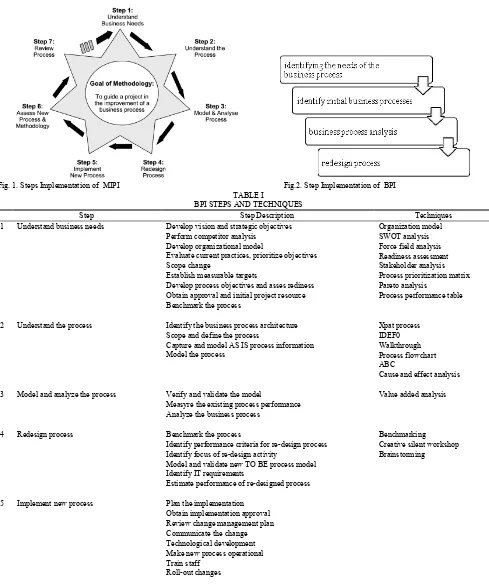
Application of Business Process Improvement (BPI) conducted using the methodology of the Model-Based and Integrated Process Improvement (MIPI). MIPI methodology consists of seven procedural steps approach as a guide for actions and decisions implementation [6]. This methodology describe “what” to do and “how” to make it happen [7]. Business Process Improvement methodology are asses readiness, outline process under review, detailed data collection, form model of current process, asses and
Business Process Improvement Using
Model-Based And Integrated Process Improvement
Methodology in SBU GMF Power Services
Virda H. L. Saputri, Yuniaristanto, Muh. Hisjam and Ria Asyrofa
redesign process, implement process, and review process. Steps implementation of MIPI is shown on Fig. 1. Steps in the implementations of BPI in this case are identify initial business processes, business process analysis, include
identifying the needs of the business process, and redesign process. It is figured in Fig.2. Then, the other step of MIPI will do in the next research. Detail of BPI steps is shown in
Table I.
[image:2.595.49.538.105.689.2]
Fig. 1. Steps Implementation of MIPI Fig.2. Step Implementation of BPI TABLE I
BPI STEPS AND TECHNIQUES
Step Step Description Techniques
1 Understand business needs Develop vision and strategic objectives Perform competitor analysis
Develop organizational model
Evaluate current practices, prioritize objectives Scope change
Establish measurable targets
Develop process objectives and asses rediness Obtain approval and initial project resource Benchmark the process
Organization model SWOT analysis Force field analysis Readiness assessment Stakeholder analysis Process prioritization matrix Pareto analysis
Process performance table
2 Understand the process Identify the business process architecture Scope and define the process
Capture and model AS IS process information Model the process
Xpat process IDEF0 Walkthrough Process flowchart ABC
Cause and effect analysis
3 Model and analyze the process Verify and validate the model
Measyre the existing process performance Analyze the business process
Value added analysis
4 Redesign process Benchmark the process
Identify performance criteria for re-design process Identify focus of re-design activity
Model and validate new TO BE process model Identify IT requirements
Estimate performance of re-designed process
Benchmarking Creative silent workshop Brainstorming
5 Implement new process Plan the implementation Obtain implementation approval Review change management plan Communicate the change Technological development Make new process operational Train staff
Roll-out changes
6 Assess new process and methodology Conduct process deployment and performance data reflections Revise organizatonal approach
Action plan
Evaluation measurement report Customer measurement survey
7 Review new process Develop strategic view of the business Set process tergets and performance Develop a plan to meet targets Implement
III. RESULT AND ANALYSIS
Results of this questionnaires is derived from interviews with workers who perform the Preliminary Inspection Report (PIR). It is known that the cause of the error in writing Serial Number (SN) is covering of the human factor, machine, material, method, and environment. After knowing these factors, the study continued with the analysis of the Analytical Hierarchy Process (AHP) to conduct a priority weighting of the factors.
A. Survey Result
Data processing using Analytical Hierarchy Process (AHP) is done by distributing questionnaires to workers who are directly doing the Preliminary Inspection Report (PIR).
From the results of the questionnaire, respondents in determining the level of interest the priority factor affecting respondents in choosing the factors that influence the Preliminary Inspection Report (PIR) obtained an answer based on a rating scale of 1, 3, 5, 7, and 9. Weighting elements expressed in percentages is shown in Table II.
From Table II, it can be seen that the assessment of several Respondents criteria indicate that the method influences the level of interest with weight 0,278 (27,80%). Thus, there is need improvement of the working method in the company. The improvement can be applied on business processes GMF Power Services. With the improvement of business processes is expected to facilitate the work of the company.
B. Identifying The Needs of The Business Process
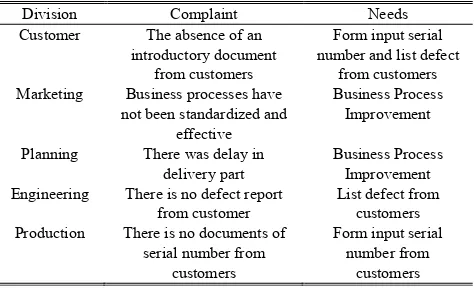
Activities performed at this stage is to collect information regarding the company’s business process flow for receiving part, document or transactions form used and the company’s internal information and the needs or complaints that required the company. The needs of the business process include the needs of the business processes in customer, marketing, planning, engineering, and production. The needs of the business process of each section is presented in the Table III.
TABLE II
THE WEIGHT OF CRITERIA FACTOR
Criteria Weight Rank
Material 0,216 21,64% 2
Man 0,150 14,97% 5
Environment 0,191 19,11% 3
Method 0,278 27,80% 1
Machine 0,165 16,48% 4
Total 1,000 100,00%
TABLE III
The Needs Of The Business Process
Division Complaint Needs
Customer The absence of an introductory document
from customers
Form input serial number and list defect
from customers Marketing Business processes have
not been standardized and effective
Business Process Improvement
Planning There was delay in delivery part
Business Process Improvement Engineering There is no defect report
from customer
List defect from customers Production There is no documents of
serial number from customers
Form input serial number from
customers
C. Identify Initial Business Processes
Business processes of GMF Power Services generally starting from order entry for repair to delivery the components that already completed repair to the customer. The generally business process of GMF Power Service is shown in Fig.3.
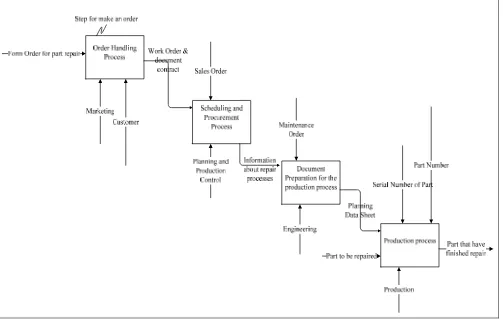
The business process of GMF Power Service also defined by IDEF0 techniques. IDEF0 was derived from a well-established graphical language known as the structured analysis and design technique (SADT) [9,10]. The IDEF0 (function modelling method) is designed to model the decision, actions, and activities of a manufacturing organization or system in a structured grapical form [11]. The modelling from business process with IDEF0 is shown by Fig. 4.
Customer
Marketing
Planning
Production
Engineering
Order Receiving
Contract Agreement
Order Reviewing
Production Schedule
MRO Process Inspection
[image:3.595.302.539.82.226.2]PD Sheet Report
Fig. 4. Business Process with IDEF0
D. Business Process Analysis
Once a process has been selected and objectives for improvement defined, it is necessary to understand the targeted process [12]. Business process analysis was performed using value added analysis. The analysis of added value is an essential tool to improve the effectiveness and efficiency of business processes, whether the goal is to effect fundamental change in the direction of the company, as solve a present operational problem [13]. Value added activity analysis involves determining the activity of each of the initial business process that adds value, not value-added but necessary and not value-added.
Activities are categorized namely value added activities required to produce the output of a process and contribute to meet costumer expectations. Activities are categorized necessary non value added activities that are required in the needs of business requirements but does not add value from the standpoint of the customer. Activities are categorized non-value added activities that do not contribute to meet costumer expectations and do not support business processes, as well as activities which when removed had no effect on the final product or service. Identification of value added analysis is done to eliminate processes that do not value added to the costumer and improve the efficiency of the processes that are not value-added but necessary in order to achieve business processes more effective and efficient.
E. Redesign Process
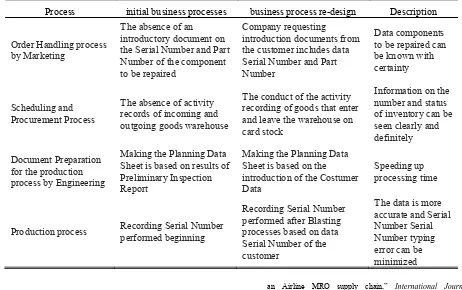
After achieving a good understanding of the process as it is, what follows is the generation and evaluation of alternatives for process repair. The design of the proposed business process done by discussion with the company. The proposed design of business processes based on the needs of the business processes and business process analysis. Table IV presents the comparison between the initial business processes with business process re-design.
IV. CONCLUSION
Business process improvement conducted using Business Process Improvement (BPI) that its application refers to the methodology of the Model-based and Integrated Process Improvement (MIPI). Business process improvement made at order handling process, so that the procedure of the company’s business processes run more effectively and efficiently.
TABLE IV
THE COMPARISON BETWEEN INITIAL BUSINESS PROCESSES WITH BUSINESS PROCESSES PROPOSALS
Process initial business processes business process re-design Description
Order Handling process by Marketing
The absence of an introductory document on the Serial Number and Part Number of the component to be repaired
Company requesting introduction documents from the customer includes data Serial Number and Part Number
Data components to be repaired can be known with certainty
Scheduling and Procurement Process
The absence of activity records of incoming and outgoing goods warehouse
The conduct of the activity recording of goods that enter and leave the warehouse on card stock
Information on the number and status of inventory can be seen clearly and definitely
Document Preparation for the production process by Engineering
Making the Planning Data Sheet is based on results of Preliminary Inspection Report
Making the Planning Data Sheet is based on the introduction of the Costumer Data
Speeding up processing time
Production process Recording Serial Number performed beginning
Recording Serial Number performed after Blasting processes based on data Serial Number of the customer
The data is more accurate and Serial Number Serial Number typing error can be minimized
ACKNOWLEDGMENT
Thanks to PT. Garuda Maintenance Facility (GMF) AeroAsia.
REFERENCES
[1] J. Malau and R. Rochman, “Failure Analysis on Intake Manifold Fuel Aircraft Boeing 737-500,” POMITS Technical Journal, Vol.2, No. 1, 2013.
[2] J. Kilpi, Sourcing of Availability Services: Case Aircraft Components Support. Finlandia: HSE Print, 2008.
[3] PT. Garuda Maintenace Facility AeroAsia, Annual Report Sustainable Growth Through Collaboration. Cengkareng: PT. Garuda Maintenance Facility AeroAsia, 2014.
[4] J. Abreu, P. V. Martins, S. Fernandes, and M. Zacarias,”Business Processes Improvement on Maintenance Management: a Case Study,” Procedia Technology 9 (2013) 320 - 330.
[5] G. D. Bhatt and R. L. Stump,”An empirically derived model of the role of IS networks in business process improvement initiatives,”
The International Journal of Management Science, 29-48, 2001. [6] E. Syafitri, Y. Priyandari, and Yuniaristanto,”Redesign of
Business Process Using Model Based and Integrated Process Improvement (MIPI) in CV. Indographia Prima Utama,” IENACO Prociding, 2014.
[7] T. Y. Zagloel, M. Dachyar, and F. N. Arfiyanto,”Quality Improvement Using Model-Based and Integrated Process Improvement (MIPI) Methodology,” Proceeding of the 11th International Conference on QIR (Quality in Research), August 2009.
[8] Adesola and Baines,”Developing and evaluating methodology for business process improvement,” Business Process Management Journal, Vol.11, No.1, pp 37-46, 2005.
[9] D. T. Ross, K. E. Schoman, “Structured analysis for requirements definition,” IEEE Transactions on software Engineering SE-3 (1)
(1977) 6-15.
[10] D. T. Ross, “Structured Analysis (SA) : A language for communication ideas,” IEEE Transactions on software Engineering SE-3 (1) (1977) 16-34.
[11] S. H. Kim and K. J. Jang, “Designing performance analysis and IDEF0 for enterprise modelling in BPR,” International Journal Production Economics 76 (2002) 121-133.
[12] J. A. P. Mendosa and K. Neailey, “A business process re-design methodology to support supply chain integration: Application in
an Airline MRO supply chain,” International Journal of Information Management 35 (2015) 620-631.