Social Learning Mechanisms
Compared in a Simple Environment
Jason Noble and Daniel W. Franks
School of Computing, University of Leeds[jasonn|dwfranks]@comp.leeds.ac.uk
Abstract
Social learning can be adaptive, but little is known about the underlying mechanisms. Many researchers have focused on imitation but this may have led to simpler mechanisms being underestimated. We demonstrate in simulation that imitative learning is not al-ways the best strategy for a group-living an-imal, and that the effectiveness of any such strategy will depend on details of the en-vironment and the animal’s lifestyle. We show that observations of behavioural conver-gence or “traditions” might suggest effective social learning, but are meaningless considered alone.
G
ETTING by in the world is all about doing the right thing at the right time: eat the fallen fruit, avoid the poi-sonous mushroom, run from the approach-ing predator. But how does an animal pro-duce the best response, or at least a satis-factory response, in each of the many pos-sible situations it may face? We can dis-tinguish two main sources of information used in this constant action-selection task. First, there is genetically inherited informa-tion, such as instinctive drives or tenden-cies. You run from the approaching preda-tor because you were born with a brain that was wired up that way. Second, there is information based on experience, i.e., the results of learning. You avoid the mush-room because you’ve learned that it will make you sick.Learning sometimes involves an individ-ual finding out through trial and error about what to do in different situations. However, in a social species, there is often valuable information to be gleaned from the behaviour of others: for example, why risk poisoning by sampling potential foodstuffs at random when you could simply eat the same things your conspecifics are eating? In this paper we are concerned with this idea of social learning, and will compare the performance of different social learning mechanisms in a simulated environment.
species in order to illustrate the likely roles that social learning may play, but can only speculate about exactlyhow the animals in question actually learn through the obser-vation of another’s behaviour.
Another curious fact about the social learning literature is the emphasis on im-itation as a potential mechanism. Imita-tion — or “imitative learning” (Tomasello, 1996, p. 324) — is a cognitively complex process that requires not only perceiving and reproducing the bodily movements of another, but understanding the changes in the environment caused by the other’s be-haviour, and finally being able to grasp the “intentional relations” between these, i.e., knowing how and why the behaviour is sup-posed to bring about the goal. This em-phasis on imitation is particularly strong in the case of work on primates (see, e.g., Whiten, 1998). A focus on imitation is not surprising: it is likely to be implicated in the explosive cultural evolution of our own species, and so we have a natural curiosity about the extent to which other animals in general, and our primate cousins in partic-ular, might share this ability. Nevertheless, looking at imitation alone may blind us to the potential of much simpler mechanisms through which the behaviour of one animal can influence the learning experience of an-other.
Although we often do not understand
how social learning occurs, there is a body of work on why it might occur, i.e., on the conditions under which it would offer a se-lective advantage. Models of cultural trans-mission (Boyd & Richerson, 1985) and re-lated phenomena such as “highly horizontal transmission” (Laland, Richerson, & Boyd, 1996) help to delineate the conditions un-der which it will be advantageous for in-dividuals to learn from others rather than finding things out for themselves. However, these models tend to result in rather
gen-eral conclusions. For example, Laland et al. (1996) summarize work on cultural trans-mission by relating it to rates of change in the environment: in static environments, genetic transmission of behaviour patterns can do the job, and in rapidly changing environments, only individual learning can keep up, whereas at intermediate rates of change, social learning will offer an advan-tage. Results like these are useful, but to get a complete picture of social learning we also need to understand the mechanisms in-volved.
Individual-based simulations, as used in artificial life research, represent an excel-lent way of instantiating a hypothesized so-cial learning mechanism and thereby test-ing its plausibility. ALife models of this type have certainly been explored in related domains such as communication, domi-nance and territorial behaviour, and flock-ing or schoolflock-ing. There are also a signif-icant number of robotics researchers who share the primatologists’ interest in imi-tation and see it as a way of improving human–robot or robot–robot communica-tion (for a review of this work see Schaal, 1999).
in Norway rats. They found that a surpris-ingly simple strategy, which involved ignor-ing signs of food poisonignor-ing in others, was favoured as long as toxins were very dan-gerous. This finding was used to explain apparently paradoxical aspects of rat be-haviour.
Noble and Todd (in press) have previ-ously argued that a focus on imitation has led to the power of simpler social learning processes being underestimated; they de-scribe a number of candidate simple mech-anisms, and encourage the use of simula-tion models as a way of demonstrating the potential of such mechanisms. The purpose of the current paper is to follow up on this work by instantiating some of the mecha-nisms discussed by Noble and Todd, in a simple environment that reflects the learn-ing challenges faced by a hypothetical ani-mal. The aim is to show that simple mecha-nisms can perform well under the right en-vironmental circumstances, and hopefully to demonstrate that imitative learning has received a disproportionate amount of at-tention. We must stress that even though our simulated agents are inspired by sev-eral different primates, our goal is not to model learning in any particular species, but to set up a specific, controlled environ-ment in which the performance of different social learning strategies can be compared.
In looking at the data that is output by our simulation, we want to adopt the perspective of an ethologist who is observ-ing behaviour in the field and tryobserv-ing to come up with conclusions about the un-derlying mechanisms. Noble and Todd (in press) make the point, following Braiten-berg (1984), that human observers of ani-mal and robot behaviour have a propensity to invoke mechanisms that are more com-plex than those strictly needed to explain that behaviour. For example, the presence of a distinctive behaviour pattern across all
members of a group could be taken as evi-dence for sophisticated social learning, but might result simply from similar individ-ual learning experiences. We hope to show that much of the data a field observer might plausibly collect about a population could easily lead them astray in theorizing about what the animals were really doing.
The simulation
The environment consists of a 10 × 10
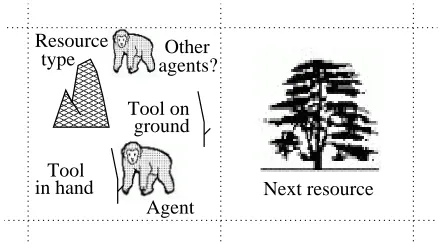
toroidal grid world, in which each square is either empty (20%) or contains a resource (80%). In addition, a grid square may con-tain a tool that agents are free to pick up and take away; agents may also drop tools. Agents occupy one square at a time, and more than one agent can occupy the same square. At each time step an agent chooses one of 12 distinct actions, and performing an action may lead to positive or nega-tive payoffs depending on the context. An agent’s choice of action is based on feed-ing its perceptual state into a reinforcement learning algorithm and choosing the action with the highest expected payoff (with a 20% chance of choosing a random action, in order to encourage exploration). Agents can perceive their local resource and the available tools — one on the ground and one in their grasp — as well as the pres-ence of other agents (see Figure 1). They can also perceive the resource type in a randomly selected square drawn from the eight-square neighbourhood around their current location. If they choose to move, they will travel to this square.
Next resource Resource
type
ground Tool on
Agent Other agents?
[image:4.595.71.294.71.195.2]in handTool
Figure 1: Aspects of the environment that can be perceived by each agent: the focal agent is in the left-hand grid square, and can perceive its local resource type — in this case a termite nest — the fact that it is grasping a stick, the presence of another stick on the ground, the presence of a sec-ond agent, and the proximity of a tree in the next grid square. If the agent chose the
travel action, it would move to the tree.
some potential rewards were easily discov-ered and that others were harder to find (al-though possibly made easier with the right kind of social learning).
Generally, different resources are associ-ated with distinct payoffs, and require the right action or sequence of actions to ob-tain them. The different resource types are listed below. Actions and tools are shown in italics, means and standard deviations for payoffs are shown as µ and σ respec-tively,P denotes the prevalence of that re-source in the environment, and n refers to the number of times the resource can be used before it is exhausted. An exhausted resource reverts to empty, and a replace-ment appears in a randomly chosen empty square elsewhere in the environment.
Tree: being in the shade of a tree is pleasant, with
a small constant reward (µ = 1, σ = 0)
re-gardless of the chosen action. P = 10%,
n=∞.
Berries: an easy resource to figure out, berries are
assumed to be automatically eaten (µ= 10,
σ = 5) regardless of action. If the agent
shakes the berry bush, twice the payoff is
ob-tained (µ= 20,σ= 5). P = 10%,n= 20.
Nettles: normally cause a nasty sting (µ=−10,
σ = 5) regardless of action but if an agent
folds the nettle leaves, they can be safely
eaten (µ= 30,σ= 5). P = 10%,n= 20.
Termite nest: the best way to get a meal of
ter-mites is to poke the nest with a peeled stick
(µ= 100, σ= 20) — the termites swarm on
the stick and the agent can lick it clean. Also
a reward for poking with a stick (µ = 50,
σ= 10) or without any tool (µ= 20,σ= 5).
Bashing the nest with a stone or abig stone
will get some termites (µ = 35, σ = 10).
P = 10%, n= 10.
Coconuts: need to be bashed to have a chance
of opening them and getting the milk (µ =
150, σ = 20). P = 10%, n = 5. Chance
of successfully opening a coconut depends on
whetherstones orbig stones are available in
hand and on the ground.
On ground
Nothing Stone Big stone
Holding
None 0.01 0.01 0.01
Stone 0.2 0.6 1.0
Big stone 0.4 0.6 0.8
Monkeys: can be caught and eaten (µ = 200,
σ= 20) if an agentchases them, but only if a
second agent is present to block their escape
route. Alternatively an agent can throw a
stonefor a 10% chance of success, orthrowa stick, a peeled stick, or a big stone for a 2%
chance of success. P = 10%,n= 2.
Thorns: are painful (µ=−20,σ= 5) regardless
of action. P = 10%,n=∞.
Beehive: there is a 20% chance that the bees
will fly out and sting the agent (µ = −200,
σ= 50) regardless of action. P= 5%,n=∞.
If the agentshakes,pokes, or bashes the hive
the chance of stinging is 100%. The hard-est trick to learn is getting honey from the
hive (µ = 500, σ = 50, n = 1): the agent
must either bash the nest with a stone or a
big stone for a 50% chance of success (and a 100% chance of getting stung) or smoke
the bees out by starting a fire, i.e., rubbing
Wasp nest: the same negative properties as the beehive but with no chance of reward.
P = 5%,n=∞.
An important action not covered above is
scratching, which leads to a modest reward (µ = 1, σ = 0; µ = 2 if the agent is car-rying either kind ofstick) regardless of the local resource. Scratching provides a kind of local optimum, in that it is easy for an agent to get locked into pursuing the mod-est rewards of this activity, perhaps under a tree, rather than moving around looking for more profitable resources.
Other actions includepeeling, which con-verts a stick in the agent’s hand into a
peeled stick;swapping, which exchanges the tool on the ground, if any, for the one in the agent’s hand, if any; and travelling, which moves the agent to the nearby re-source they have most recently seen. Note that when an agent attempts an irrelevant action, such as bashing a tree, the payoff is always zero.
Tools are distributed generously, with 40 sticks, 20 stones, and 20 large stones present in the environment. Peeled sticks only appear if an agent peels a stick. Stones do not wear out, but sticks and peeled sticks break after 1000 or 500 time steps re-spectively; a replacement stick appears at a random location.
Reinforcement learning agents
The agent population is 25, but initially agents enter the world one at a time. Every 400 timesteps a new agent is born. When 25 agents are present, the oldest agent is always killed off to make room for the youngest; an agent’s lifespan is therefore 10,000 timesteps. The middle-aged agent born 12 places ahead of a newborn is nom-inally regarded as its parent, and the new agent appears in the same square. The sim-ulation is run for 100,000 time steps, or 10
agent lifetimes. Even though the simula-tion has “generasimula-tions” of a sort, there is no genetic aspect to agent behaviour: each in-dividual comes into the world as a blank slate and must learn for itself how to max-imize payoffs.
Each agent makes its decisions on the basis of a history of reinforcement: it has learned to associate some states and ac-tions with a reward and others with punish-ment. The different social learning mech-anisms implemented all assume this un-derlying capacity for reinforcement learn-ing. The specific learning algorithm used was Q-learning (Watkins & Dayan, 1992) which allows an agent to take into account not just immediate but also delayed pay-offs. This would be important, for example, in realizing that a higher long-term payoff could be gained by picking up and peeling a stick rather than just poking the termite nest immediately. The learning rate was 0.1, the temporal discounting factor was 0.5, and the proportion of random actions was 0.2.
Q-learning in its simplest form does not include any generalization: if an agent learns that it is good to shake a berry bush when there is a stone on the ground, it will not automatically transfer that knowledge to the case where there is no stone on the ground. Given 60,000 state-action pairs1
and a lifetime of only 10,000 timesteps it is clear that an agent could not exhaustively sample its space of perceived situations. We therefore included some basic general-ization: after updating a state-action pair through Q-learning, all other state-action pairs that differed only in terms of the tools available, the presence of others, and the re-source seen in the distance (exception: the resource being left behind for the travel
ac-110 resources × 5 tool-on-ground options × 5
tool-in-hand options×2 others-present options×
tion) also had their expected returns up-dated by a small amount in the same di-rection.
Implementing social learning
To find baseline levels for payoffs in this en-vironment, we looked at the performance of agents with completely random behaviour, and at that of agents capable only of in-dividual learning. We then implemented three of the simple mechanisms described by Noble and Todd (in press): following or stimulus enhancement, contagious be-haviour, and emulation. In addition, we implemented a version of imitative learn-ing. Finally, we looked at the perfor-mance obtained when following was com-bined with each of the other mechanisms. Following: (otherwise known as stimulus
en-hancement) is implemented simply by having each agent occupy the same square as its par-ent for the first 25% of its lifetime. Beyond that, agents learn for themselves.
Contagious behaviour: if another agent is present, there is a 10% probability that the first agent will do whatever the second just did. An instinctive behavioural contagion is assumed, as when one person’s yawning stim-ulates another to yawn; actions are equally likely to be copied regardless of their payoff.
Emulation: if another agent is present and ob-tains a non-zero payoff, the first agent
ad-justs its estimated return forall state-action
pairs related to its current state. The idea is that the agent has become aware of an affor-dance in the local environment, but has no idea about what specific action is needed to exploit it.
Imitation: if another agent is present and obtains a non-zero payoff, the first agent is able to take the perspective of the second. The first agent notes the perceptual state of the other, as well as the action the other chose, and up-dates its own relevant state-action pair ac-cordingly. The advance on emulation is that the first agent not only knows which action achieved the reward, but also can perceive the other agent’s state as opposed to its own (e.g., it might be holding a stick).
Data collection
How can we collect data from this sim-ulation that parallels the data etholo-gists would collect when observing a real species? We assumed that observers watched the population for the final 1000 timesteps; i.e., they had a snapshot of the group’s behaviour rather than being able to observe the rise and fall of socially trans-mitted behaviours in the long term. We then looked at the average payoff per agent during these 1000 timesteps. We can imag-ine that the ethologists are observing dis-tinct groups in similar environments and comparing the average energy intake across groups. It is natural to assume that a popu-lation equipped with a richer social learning ability will be able to extract more energy from its environment.
We also wanted to measure behavioural convergence, i.e., the degree to which the various members of the population tend to choose the same action when faced with the same situation. This was done by compil-ing a list of 1000 states perceived by mem-bers of the population (the state of a ran-domly chosen individual was noted at each timestep). Then all 25 members of the pop-ulation were faced with each of the 1000 states in turn, and the proportion of indi-viduals who chose the modal response for each state was recorded and averaged. We can imagine that the ethologists have an outstanding ability to set up naturalistic experiments in the field, and are able to engineer things so that each member of the population can be placed into the same se-ries of states and allowed to choose an ac-tion.
observed to hunt monkeys by chasing them down, while another group tends to throw stones at them, then it seems to follow that each animal is not arriving at its own so-lution to the problem, but rather is being influenced by its fellow group members.
Finally, we looked at simple counts of the occurrence of various behaviours: the performance of more complex and hard-to-learn behaviours would probably be taken as a sign of sophisticated social learning. So, for example, if one species has mas-tered the trick of peeling sticks before pok-ing them into termite nests, and another related species has not, one might assume that the former species has a better social learning faculty.
Results and discussion
All of the learning mechanisms, both indi-vidual and social, ensured that the agents did far better than they would by choosing a random action. Figure 2 shows that the mean payoff per agent per timestep was at least 6 units; the mean payoff for random behaviour was −8.997 units. Behaviours
such as scratching, eating berries, folding nettle leaves, and poking termite nests (al-though not often with tools) were all quite common and allowed the agents to extract a good return from the environment.
Omitting for a moment the cases in which following is combined with another mechanism, we have the surprising result that the best mean payoff is for emulation, not imitative learning. Why does this oc-cur? Emulation means that an agent in-creases its estimated return for all state-action pairs associated with any state in which it witnesses another agent receiving a positive payoff. Effectively this means that emulation encourages exploration around beneficial resources, and results in more in-quisitive agents who are persistent enough
6 7 8 9 10 11 12
IL Foll. CB Emul. Imit. F/C F/E F/I
Mean payoff
[image:7.595.307.510.77.226.2]Learning mechanism
Figure 2: Mean payoff per agent per timestep across the different learning condi-tions: individual learning, following, conta-gious behaviour, emulation, imitation, fol-lowing with contagious behaviour, follow-ing with emulation, and followfollow-ing with im-itation. Each data point is averaged across 10 runs, and is shown ±1 standard error.
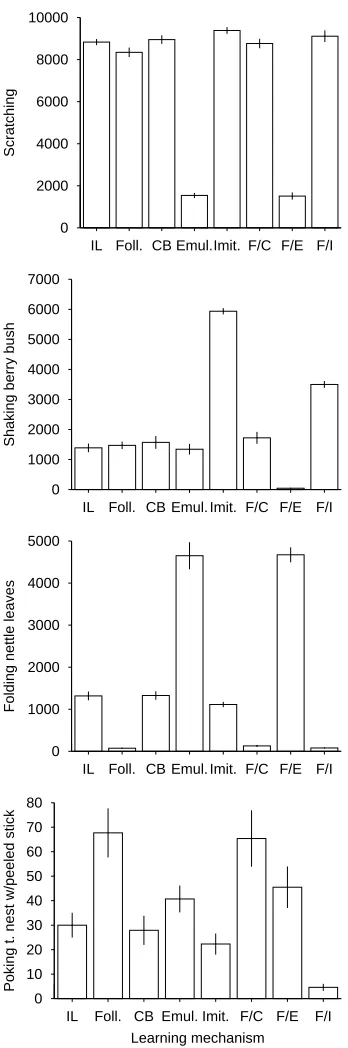
to crack a tricky resource like nettle leaves. Imitators, on the other hand, are quite con-servative. Imitative learning is sophisti-cated enough to allow an agent to pick up any clever trick it might witness, but imita-tors appear to be caught in a vicious circle in which the only role models they observe are other conservative imitators (see the be-havioural profiles in Figure 4).
Figure 2 also shows that the simple mat-ter of following your parent around for the first quarter of your life is enough to in-crease your mean payoff significantly. This is more impressive than it seems, as the im-position of following behaviour threatens to
same result in the end.
When following behaviour is combined with other mechanisms, the story becomes more complex. It is obviously not the case that following and the other three mech-anisms mesh together in a simple additive fashion: the efficiency of imitation and con-tagious behaviour is increased, but the ef-ficiency of emulation is decreased. Clearly it is important to imitate or emulate the right people: an experienced parent in one case, and a random cross-section of society in the other.
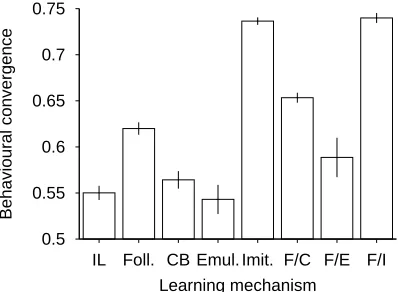
Behavioural convergence (Figure 3) was 0.55 even in the individual learning case. The convergence score for random be-haviour was inevitably much lower at 0.18, and thus we are reminded that similar be-haviour may be brought about by similar learning experiences rather than any form of social learning. Convergence was high-est in the two imitation conditions, which makes sense. However, the low conver-gence for emulation belies the fact that these agents were doing well in terms of mean payoff, and convergence rates are the same across the two imitation conditions, despite the fact that it is only in the fol-lowing / imitation condition that high pay-offs are achieved. An observation of high or low behavioural convergence, which might lead one to suspect the presence or absence of effective social learning, is meaningless considered alone.
Figure 4 shows frequency counts for sev-eral behaviours across the different con-ditions. It shows that different learn-ing mechanisms lead to quite different be-havioural profiles, e.g., emulators spend a lot of time folding nettle leaves, whereas imitators have mastered the art of shak-ing berry bushes. It is not simply the case that the more “advanced” the social learn-ing mechanism, the more behaviours are added to the repertoire.
0.5 0.55 0.6 0.65 0.7 0.75
IL Foll. CB Emul. Imit. F/C F/E F/I
Behavioural convergence
[image:8.595.310.509.78.224.2]Learning mechanism
Figure 3: Behavioural convergence across the different learning conditions. Each data point is averaged across 10 runs, and is shown ±1 standard error.
Another surprising finding is that some behaviours that would seem to suit imi-tative learning, such as learning to peel a stick and then poke it into a termite nest, are in fact more often performed by agents with simpler mechanisms (Figure 4, bot-tom). Agents who follow their parents are the ones who do this most often. Even so, it seems that this behaviour was largely too hard: note the low frequency counts over-all. Imitators could certainly have picked up this trick, but again it seems they did not have access to the right role models.
Conclusions
0 2000 4000 6000 8000 10000
IL Foll. CB Emul.Imit. F/C F/E F/I
Scratching
0 1000 2000 3000 4000 5000 6000 7000
IL Foll. CB Emul. Imit. F/C F/E F/I
Shaking berry bush
0 1000 2000 3000 4000 5000
IL Foll. CB Emul. Imit. F/C F/E F/I
Folding nettle leaves
0 10 20 30 40 50 60 70 80
IL Foll. CB Emul. Imit. F/C F/E F/I
Poking t. nest w/peeled stick
[image:9.595.91.265.72.596.2]Learning mechanism
Figure 4: Frequencies with which various behaviours were observed across the dif-ferent learning conditions: from top to bottom, scratching, shaking berry bushes, folding nettle leaves, and poking termite nests with peeled sticks. Each data point is averaged across 10 runs, and is shown ±1
standard error.
underlying reinforcement learning system. But that is exactly the point.
The argument which inspired this paper (Noble and Todd, in press) had two as-pects: first, simpler social learning mecha-nisms are inherently more likely to evolve; one reason for this is that complex mecha-nisms such as imitation will involve signif-icant costs. It follows that we should look for simple mechanisms in nature. Second, in cases of doubt about which mechanism is at work, from an epistemological point of view it is good practice to start by propos-ing simpler mechanisms. The current sim-ulation results show that an even stronger argument is possible: even if imitation was available via a cost-free, one-step mutation, it sill might not be the best learning mech-anism for a given species.
A focus on imitation as the only kind of social learning worth having is misplaced. Researchers interested in imitation as a po-tential tool for instructing robots or soft-ware agents, for example, might do well to consider giving their creations more spar-tan mechanisms, which have the additional benefit of being far easier to program. If the agent is equipped with a reinforcement learning system, it would be a good start to simply have it follow a more experienced agent (e.g., a person).
adap-tive value of social learning, such as Laland et al. (1996), are useful, but ideally we want to move beyond such theories and look at hypotheses about the utility of a particular mechanism in a particular environment.
We deliberately omitted an evolutionary dimension from the current model as we wanted to look at the effects of learning alone. However, future work could incor-porate an evolutionary aspect, in which different social learning mechanisms were selected for over generational time. The mean payoff results certainly suggest that this would not be a straightforward story of hill-climbing with imitation at the peak. Let us assume that a single-step mutation F controls following behaviour, and a two-step mutation leads from individual learn-ing to emulation (S1) and thence to
imi-tative learning (S2). This latter
assump-tion is reasonable as imitative learning can be seen as a “sharpened” version of emu-lation. For an evolving population of in-dividual learners, the final strategy will be emulation if S1 occurs first, as F and S2 will both be associated with a loss in fit-ness. On the other hand, if F occurs first, bothS1 and thenS2 will mean increases in fitness, and the population will end up as follower / imitators.
It would be useful to move away from our simplistic lookup-table implementation of Q-learning and use a neural network as a more natural way of generalizing across perceptual states. We are also interested in investigating whether infinite negative pay-offs, i.e., actions that result in the death of the agent, push an evolving popula-tion towards imitative strategies. Finally, we would like to use the same basic tech-nique described here to produce a high-fidelity model of social learning in a partic-ular species, e.g., chimpanzees, and thereby comment on which mechanisms are plau-sibly being used by that species, much as
Noble et al. (2001) do for Norway rats.
References
Box, H. O., & Gibson, K. R. (Eds.). (1999).
Mam-malian Social Learning: Comparative and Ecological Perspectives, Vol. 72 ofSymposia of the Zoological Society of London. Cam-bridge University Press, CamCam-bridge.
Boyd, R., & Richerson, P. J. (1985). Culture and
the Evolutionary Process. The University of Chicago Press, Chicago.
Braitenberg, V. (1984). Vehicles: Experiments
in Synthetic Psychology. MIT Press, Cam-bridge, MA.
Heyes, C. M., & Galef, Jr., B. G. (Eds.). (1996). Social Learning in Animals: The Roots of Culture. Academic Press, San Diego, CA.
Laland, K. N., Richerson, P. J., & Boyd, R. (1996). Developing a theory of animal social learn-ing. In Heyes & Galef (1996), pp. 129–154.
Noble, J., & Todd, P. M. (2002). Imitation or something simpler? Modelling simple mech-anisms for social information processing. In
Dautenhahn, K., & Nehaniv, C. (Eds.),
Im-itation in Animals and Artifacts, pp. 423– 439. MIT Press.
Noble, J., Todd, P. M., & Tuci, E. (2001). Ex-plaining social learning of food preferences without aversions: An evolutionary
simula-tion model of Norway rats. Proceedings of
the Royal Society of London: Biological Sci-ences,268(1463), 141–149.
Schaal, S. (1999). Is imitation learning the route
to humanoid robots?. Trends in Cognitive
Sciences,3(6), 233–242.
Tomasello, M. (1996). Do apes ape?. In Heyes & Galef (1996), pp. 319–346.
Toquenaga, Y., Kajitani, I., & Hoshino, T. (1995).
Egrets of a feather flock together. Artificial
Life,1(4), 391–411.
Watkins, C. J. C. H., & Dayan, P. (1992).
Q-learning. Machine Learning,8, 279–292.
Whiten, A. (1998). Imitation of the sequential
structure of actions by chimpanzees Pan