INTERNATIONAL
COUNCIL FOR
SCIENCE
INTERGOVERNMENTAL
OCEANOGRAPHIC
COMMISSION
WORLD
METEOROLOGICAL
ORGANIZATION
WORLD CLIMATE RESEARCH PROGRAMME
Second Session of the CLIVAR VACS Panel
Niamey, Niger, February 28 - March 2, 2002
November 2002
WCRP Informal Report No. 19/2002
CLIVAR is a component of the World Climate Research Programme (WCRP), which was
established by WMO and ICSU, and is carried out in association with IOC and SCOR. The
scientific planning and development of CLIVAR is under the guidance of the JSC Scientific
Steering Group for CLIVAR assisted by the CLIVAR International Project Office. The Joint
Scientific Committee (JSC) is the main body of WMO-ICSU-IOC formulating overall WCRP
scientific concepts.
Bibliographic Citation
TABLE OF CONTENTS
1. Introduction and VACS Panel Business 4
1.1 Introduction 4
1.2 Actions arising from 1st panel meeting 4
1.3 Other CLIVAR business 4
2. GEWEX report 5
3. Annual Cycle 7
3.1 Atlas of African Climate Variability 7
3.2 Climatology of Southern Africa 7
4. Interannual Variability 7
4.1 Case Study of the 1997-2000 Period 7
4.2 AMIP-II Sub-project 8
5. Intraseasonal Variability 9
5.1 Daily Rainfall Workshops 9
6. Decadal Variability 9
7. Field Programmes 9
7.1 AMMA 9
8. Data Issues and Datasets 13
8.1 Data Inventory 13
8.2 PIRATA 14
8.3 Indian Ocean Proposals 14
8.4 Data rescue projects 14
8.5 DEMETER and ERA40 14
9. Users and Applications 15
9.1 CLIMAG 15
9.2 The Meningitis Forecasting Project 15
10. Regional Reports 18
10.1 Report from ACMAD 18
10.2 Report from AGHRYMET 19
10.3 Report on research and prediction activity in South Africa 21
11. Any Other Business 22
11.1 Funding Issues 22
11.2 Awareness 23
11.3 VACS Web Pages 23
12. Next Meeting 23
Appendix A Attendees Names and Contact Details 24
1: Introduction and Panel Business
1.1 Introduction
The VACS meeting followed a 3-day workshop on plans for an international research project and field experiment focusing on the West African monsoon. 80 people attended this meeting including 44 representatives from 9 West African countries. The project is named AMMA (African Monsoon Multidisciplinary Analysis) and will be discussed in more detail below. The VACS panel took advantage of the fact that several experts were present in Niamey for the workshop and invited a few of them to contribute to the panel discussions. This, along with contributions from our hosts AGHRYMET and ACMAD lead to a useful and productive meeting.
At the time of preparing this report the status of some action items can be updated and will be done so where appropriate.
1.2 Actions arising from 1st panel meeting
Actions not addressed in the main sections are dealt with here:
(i) VACS Terms of Reference (TOR): The following TOR was agreed and added to the VACS TOR: “To improve our understanding of the nature and causes of African Climate Variability and its linkages with global climate”
(ii) GOOS/GCOS contact points: Contact points for GCOS are Bill Westermeyer at WMO ([email protected]) Laban Ogallo, co-chair of VACS ([email protected]). Contact points for GOOS are
Colin Summerhayes at UNESCO ([email protected]) and Geoff Brunditt at the University of Cape Town ([email protected]).
(iii) Data Inventory: Completion and publication of the data inventory is needed. It is essential that the work started by Amos Makarau be completed and made available to the community as soon as possible. See 8.1 below.
(iv) Satellite Review: A review of available remotely sensed data useful for VACS research has been kindly provided by Wassilla Thiaw and will be included in the data inventory.
(v) Awareness and Funding Issues: A list of funding opportunities is included on the VACS webpages (see 9.3 below) and should be updated with the inputs of panel members. After some discussion it was decided that an issue of Exchanges devoted to VACS-related research would be useful for promoting awareness. Some text describing the rationale for VACS and its activities should be provided for distribution in Africa including especially the climate fora.
(vi) Capacity Building: The AMS was contacted regarding journal donation. Currently the AMS donates journals to 52 institutions in Africa. A list of institutions receiving these journals should be obtained to assess whether it is appropriate or whether key institutions are missing. Following the success of the workshop on AMMA preceding this panel meeting there is a strong desire to hold another regional workshop before the next panel meeting in South Africa.
1.3 Other CLIVAR business
(i) Monsoon Modelling Workshop: In response to an action item from the SSG last year AAMP has started discussions with VACS and VAMOS to develop a cross-CLIVAR monsoon modeling workshop. Kerry Cook has agreed to be the VACS contact for this activity.
regions. To initiate interactions, and to take advantage of the efforts of the two panels, it was suggested that one member of each panel becomes an ex-officio member of the other. Furthermore, from time to time, the two panels should hold their regular meetings in the same location with interlocking agendas.
ACTIONS:
A1.1 The data inventory should be completed and made available to the community during 2002/3. C Thorncroft should ask a panel member to work with Makarau.
Action: C. Thorncroft
A1.2: Contact ICPO requesting that an Exchanges issue be devoted to VACS-related research.
Action: C. Thorncroft
A1.3: Produce text describing the role of VACS and its activities for publicity within Africa and especially the climate fora.
Action: C. Thorncroft
A1.4: Obtain the list of African institutions receiving donated AMS journals.
Action: C. Thorncroft
A1.5: A proposal for an informal workshop aimed interaction with local scientists before the next VACS meeting in South Africa should be developed and sent to VACS panel members before September 2002. The possibility of linking this with GOOS should be considered.
Action: G.Philander / C. Reason / I. Kgakatsi
2. GEWEX report (Thierry Lebel)
CEOP
The Enhanced Observing Period will cover two annual cycles from 1 October 2001 through 30 September 2003. The CEOP Research Phase will begin in a formal sense with the availability of the initial seasonal data set about the end of September 2002 and will continue for three years. The CEOP is a coordinated observation effort involving five Continental Scale Experiments (CSE): GCIP (Mississippi River Basin), BALTEX (Baltic Sea region), MAGS (Canadian Mackenzie River Basin), LBA (Amazon region) and GAME (Asian monsoon region).
The central CEOP goal is to understand and model the influence of continental hydroclimate processes on the predictability of global atmospheric circulation and changes in water resources, with a particular focus on the heat source and sink regions that drive and modify the climate system and its anomalies (see http://www.msc.ec.gc.ca/GEWEX/GHP/ceop.html for more details on the CEOP). The focus is on two major activities:
(i) Simulation and Prediction (ii) Monsoon systems.
The CEOP focus on the monsoon systems, implies a clear convergence with the objectives of the VACS panel. However there is no current CSE operating in Africa. The CATCH observing system was granted a CSA (Continental Scale Associate) status in Hamburg (1999) but cannot fully participate to the CEOP for lack of appropriate operational support from an African national or regional institution. The set up of AMMA (see section 4.4) will considerably enlarge the initial scope of Coupling of the Tropical Atmosphere Hydrological Cycle experiment in the HAPEX/Sahel region (CATCH). AMMA will much better meet the CSE criteria than CATCH did alone. These criteria are as follows:
Technical and Logistical
2. Suitable atmospheric-hydrological models, numerical experimentation, climate change studies 3. Mechanism for collecting and managing datasets
4. Participate in the international exchange of scientific information and data
5. Interactions with water resource agencies to address assessment of impacts on regional water resources
6. Evaluation of GEWEX global data products
7. Contribution to CEOP and transferability data bases Scientific
1. Close water and energy budgets
2. Determine and understand climate system variability and critical feedbacks 3. Demonstrate improvements in predictions of water-related climate parameters 4. Demonstrate the applicability of techniques and models to other regions
Despite the possibility for AMMA to meet most of the above criteria, the timing of this project is not in line with the CEOP agenda and it is thus likely that there will not BE A significant contribution from any Africa project to the CEOP. However the scientific activities carried out within the CEOP will be of interest to VACS.
Simulation and Prediction activities in the GHP
These activities are carried out in the framework of the WESP (Water and Energy-cycle Simulation and Prediction) group with the objective of using the CSE enhanced observations to document, better understand and improve the simulation of water and energy fluxes and reservoirs over land on diurnal to annual temporal scales as well as the prediction of these on temporal scales up to seasonal for water resource applications. One more specific objective during the CEOP is to conduct a comprehensive two-year synoptic climatological case study of regional CSE and global water and energy budgets as a guide to the interpretation of longer term global and regional analyses and datasets and as a precursor study to a more extensive global hydroclimatological project at the end of the decade.
An implementation approach to achieving this science objective must be able to address the following questions:
What components of the global water and energy cycles can be measured, simulated, and predicted at regional and global scales? In particular:
What are the gaps in our measurements? What are the deficiencies in our models?
What is our skill in predicting hydroclimatological water and energy budgets?
The three last questions are common to similar investigations encouraged by the VACS panel for Africa.
Monsoon System working group
The rationale of setting up such a working group in the GHP is that CEOP will provide a unique opportunity to more qualitatively and quantitatively understand the multi-scale energy and water cycle processes of the monsoon systems and their inter-comparisons and interactions from the view points of the earth climate system study and its application to water resource and management issues.
The CEOP monsoon systems studies are seen as a GEWEX-CLIVAR cooperative activity. A regional monsoon experiment is planned under CLIVAR for each of the four major monsoon regions, although not always in the CEOP observing timeframe:
Asia-Australia Monsoon North American Monsoon South American Monsoon West African Monsoon
panels need to work closely with the ad hoc CEOP monsoon working group, to develop and bring together observing system capabilities during the CEOP data collection phase.
Beside the regional initiatives global monsoon studies will focus on analysis, predictability and impacts and teleconnections. These areas of monsoon systems activity will address a number of science –relevant questions including the following:
What are the hydroclimatological characteristics of monsoons? How do monsoons differ from midlatitude summertime hydroclimatology. What controls the monsoons? Can we simulate monsoons with current models? Can we predict interannual variations in global monsoons?
What are the similar and different aspects of the major global monsoonal systems under the “same “large scale climate system?
To what extent are the monsoonal systems interconnected and what are the implications of these regional studies to the larger global climate system?
3. The Annual Cycle
3.1 Atlas of African Climate Variability
At the last VACS meeting it was agreed that VACS will promote the development of an Atlas of African climate variability which will initially focus on the continental annual cycle and its interactions with the global climate. The aim was to use this to stimulate research in this area and to represent a focus for evaluating dynamical models used for seasonal to interannual prediction.
Discussions by e-mail and one meeting which took place during the year aimed at starting this activity. The Atlas content has been outlined but more collaboration is needed in the coming year to implement it. Some work on developing a surface observational component to the atlas has also been carried out by Abou Amani. This work should be linked with future plans for the VACS page on the CLIVAR website.
3.2 Climatology of Southern Africa: (Amos Makarau)
A climatology compendium for southern Africa has been developed by several experts from NMHs and universities in the region. This work should be linked with the work on the VACS atlas.
ACTIONS:
A3.1 Continue to develop and implement the Atlas, focusing initially on the annual cycle. Incorporate other work such as the surface observational dataset of Abou Amani (see section 10. 2) and the Southern African compendium of Amos Makarau.
Action: K. Cook / W. Thiaw / R. Washington
A3.2: The list of contents of the compendium of climatology of Southern Africa should be sent to Chris Thorncroft, for possible inclusion on the VACS website and/or VACS atlas.
Action: Amos Makarau
4. Interannual Variability
4.1 Case Study of the 1997-2000 Period (N. Ward)
A report was provided by Neil Ward to the meeting and presented by C.Thorncroft. Below is a summary provided by N. Ward.
Africa were generated to focus on the indications from this suite of GCMs regarding the extent to which rainfall anomalies in these years may have been SST-forced, creating a basis for detailed studies of the mechanisms of transmission of remote SST influence into the African continent. The results strongly make the case for several clear SST-forced impacts, including East Africa in October-December for 1997, 1998 and 1999, and the Sahel for July-September 1997 and 1999. For Southern Africa in January-March 1998, there is an indication that most of the GCMs considered indicate a tendency more toward near-normal conditions in some eastern parts of southern Africa. This supports the suggestion of the possible existence of non-ENSO SST forcing in 1998 that may have been responsible for rainfall patterns in Southern Africa that were atypical of the composite ENSO signature. Preliminary analysis of the rainfall indicates however that the Southern Africa region was also characterized by considerable intraseasonal variability as well as sub-regional variability that further complicates the situation and should be taken into account.
It is suggested that these results provide sufficient evidence to justify and motivate more detailed mechanistic analyses. It is proposed to consider further the SST and non-SST forced parts of the African climate system variation through 1997-2000. Useful additional tools are expected to be coupled ocean-atmosphere-land models, and high resolution regional atmospheric models. The role of the land surface is a further additional important factor to consider. For example, it is known that the March-May period in East Africa has less strong sea-surface temperature forcing than the October-December season. However, it will be interesting to consider whether the unusually dry conditions that began during October-December 1998 (most likely being SST forced) may have impacted the land surface sufficiently strongly to be a factor in the poor March-May rains in 1999 and 2000.
4.2 AMIP-2
Chris Thorncroft reminded the panel of the AMIP-2 project and in particular the sub-project on “Model evaluation of the West African Monsoon” ( http://www.lmd.jussieu.fr/pcmdi-mirro/amip/DIAGSUBS/sp20.html).
As yet, very little progress has been made in this sub-project but it is hoped that some basic analysis of the annual cycle including rainfall onset will be made during the coming year.
RECOMMENDATIONS
4.1: In the analysis of skill measures in the case study outlined, some appropriate probabilistic skill measure should be included.
4.2: Analysis of the AMIP-2 datasets should be carried out to address various model evaluation issues as laid out in the Implementation Plan.
ACTIONS
A4.1: There are good opportunities for collaborative research projects on the case study in East and Southern Africa. Efforts should be made to encourage interactions between PIs working in this area. The proposed workshop in South Africa could be a place to develop this.
Action: N. Ward/C. Reason/I. Kgakatsi/L. Ogallo
A4.2: The basic diagnostic analysis completed so far on the case study should be prepared and included on the VACS website. This would be useful for promoting international collaborations.
5: Intraseasonal Variability
5.1 Daily rainfall workshops
Chris Thorncroft presented a short proposal for daily rainfall analysis workshops (see appendix B). It was agreed that the concept of these workshops should be developed and it was recommended that workshops could take place together with the climate for a.
One specific feature of the WAM strongly recommended for investigation, and motivated by applications, is rainfall onset including its dynamical proxies. It is important to consider the work that has already taken place on these definitions. One definition used in agriculture for example is to consider the main rains to have started if 20mm of rainfall has fallen with no gap or dry spell of more than 7 days but other definitions exist. It is also important to recognize that the timing of the onset will vary on scales of order 10km and so it is important to consider the user of the onset information. A document summarizing these issues including the various definitions should be prepared for the next meeting.
ACTIONS:
A5.1: A scientific committee should develop and implement the rainfall workshops. The DMCs in Nairobi and Harare should be involved in this activity. It was noted that there are rainfall workshops planned with Agro-Hydro-AGRYMET in collaboration with Roger Stern. Roger Stern should be contacted regarding these to avoid duplication.
Action: A. Moksitt /N.Ward/C.Thorncroft
6. Decadal Variability
The position of the VACS panel regarding decadal variability was revisited. After some discussion it was agreed that the size of the decadal signal on the African continent, particularly in West Africa and Southern Africa, warranted more emphasis than had previously been given. It was agreed that a white paper should be produced and a workshop on this subject should be considered in the near future possibly coinciding with a panel meeting.
ACTIONS:
A6.1 A white paper should be produced on decadal variability of African climate including a proposal for a workshop. This should be shared with the panel at the next meeting
Action: C. Reason / Y. Tourre / L. Ogallo
7. Field Programs
7.1 African Monsoon Multidisciplinary Analysis (AMMA): (Thierry Lebel and Chris Thorncroft)
7.1.1 Background
VACS panel members and invited experts attended the AMMA workshop that preceded the VACS meeting. Discussion concentrated on recommendations and actions as to how to proceed and develop the project in an international framework. Some brief background for AMMA is included here, but more information which will be updated as the project develops can be found at http://medias.obs-mip.fr:8000/amma/english/index_en.html.
Currently the field campaign is planned to begin in 2004 and intensive observing periods are provisionally planned for 2005.
Following this French initiative there have been meetings in Leeds, UK (June 2001), Boulder, USA (November 2001) and most recently Niamey, Niger (February 2002) to explore and develop the French proposal in an international framework.
The main goals of AMMA are:
• To improve our understanding of the WAM dynamics, water cycle, variability and associated scale interactions
• To improve our understanding of the atmospheric chemistry over West Africa and its global impactTo identify & implement an integrated observing strategy in West Africa needed to support research and prediction (medium-range, seasonal and climate scale)
• To develop & test the long term monitoring of surface & atmosphere by combining satellite and ground networks.To implement a strategy to use weather and climate observations and modeling/assimilation outputs for applications (e.g. health, food security, water resources)
• To develop training/education activities for African countries
The goals will be achieved through modeling/assimilation studies, field and satellite observations, dedicated field campaigns, database building & dissemination and close collaboration between countries and institutions.
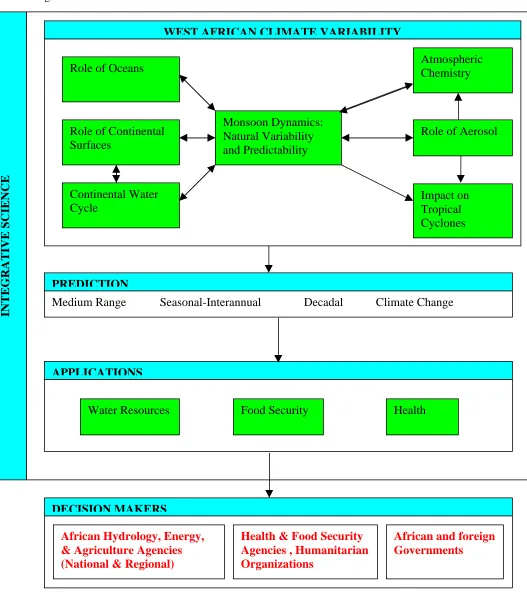
The AMMA project is organized around several interacting components shown schematically in fig. 1. Central to understanding the WAM and its variability are: (i) Monsoon Dynamics, (ii) Continental Water Cycle, (iii) Continental Surfaces and (iv) Ocean. Two interacting components that interact with the WAM and also have global impacts are (v) Atmospheric chemistry and (vi) Aerosols and an additional component is concerned with (vii) Remote impacts of the WAM such as tropical cyclones. It is important that the research in these different components feeds into the work on prediction being carried out in various weather and climate prediction centers around the world since it is the outputs from these centers that are needed for driving the applications. Indeed the final components of AMMA include applications impacted by WAM variability (viii) Water Resources, (ix) Food Security and (x) Health. The schematic includes a final component which will be dealt with explicitly within the project: (xi) Integrative Science which will be concerned with making the key linkages between the work on WAM variability and applications. Finally AMMA recognizes the importance of linking the research and prediction work on applications to decision makers.
7.1.2 Planned Observing Campaign
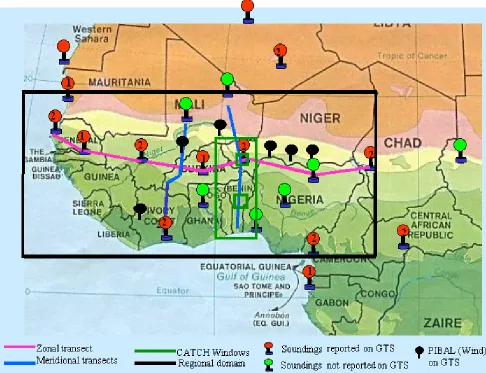
The experiment will build on CATCH and will involve enhanced observations along two north-south transects shown in fig 2. This will focus on the seasonal march of the ITCZ and associated dynamical features such as the African easterly jet. An enhanced zonal transect is also hoped for in order to observe African easterly waves.
The experiment is focused on several space and timescales. These include a long-term observing period which includes a data-rescue activity and the development of new and sustained observations from 2002. Also there will be an enhanced observing period probably in 2004-2006 enhancing observations along the transects. Finally there will be a special observing period, planned for 2005 which will include more synoptic and mesoscale observations. More details about these planned observations can be found in the documentation on the AMMA website.
7.1.3 VACS and AMMA
RECOMMENDATIONS:
7.1: A major recommendation from VACS and indeed the 3-day AMMA workshop was the need to strengthen the ocean component of AMMA, in terms of both science and observations in the field campaign. It was noted, in particular, that there is a lot of interest in the so-called Benguela “El Nino” events including oceanographers in Namibia, South Africa and Angola and IRD in France.
7.2: Within the AMMA framework there is a strong recommendation for research to be carried out to design the optimum operational observing network. It should be noted that the optimum network may vary depending on the different users.
ACTIONS:
A7.1: Although AMMA is mainly concerned with the West African monsoon region, it is recommended that the AMMA activity be communicated with regional centers outside West Africa. It is hoped that experiences gained in AMMA will be beneficial to these other regions.
Action: C. Thorncroft / T. Lebel
A7.2 There should be good communication and coordination with international projects and institutions with an African interest such as CLIMAG, UNESCO, WMO, GCOS, GTOS, GOOS as well as African institutions. Appropriate people in these organizations should be contacted in order to make them aware of AMMA.
Figure 1
Monsoon Dynamics:
Natural Variability
and Predictability
Role of Oceans
Role of Continental
Surfaces
Atmospheric
Chemistry
Role of Aerosol
Impact on
Tropical
Cyclones
Continental Water
Cycle
WEST AFRICAN CLIMATE VARIABILITY
PREDICTION
Medium Range
Seasonal-Interannual
Decadal
Climate Change
Water Resources
Food Security
Health
APPLICATIONS
DECISION MAKERS
African Hydrology, Energy,
& Agriculture Agencies
(National & Regional)
Health & Food Security
Agencies , Humanitarian
Organizations
African and foreign
Governments
13
Figure 2
8. Data Issues and Datasets
8.1 Data Inventory
As mentioned in section 1.2 above, the data inventory completion must be viewed as a very high priority for VACS. This should consider making use of resources made available through the AMMA project and datasets already catalogued at IRI and NOAA. In developing this inventory, attention should be given to land observations, ocean observations, remotely sensed observations and different users of this data. Important aims of this work are to establish the state of the current observing system and to recommend the key components that need to be improved or maintained.
14
Some data denial experiments in West Africa were presented by Aida Diongue using observations made during the JET2000 experiment in August 2000 along with standard observations (http://www.env.leeds.ac.uk/ias/dynamics/JET2000). More research along these lines is needed to help identify deficiencies in the current observing network and to make recommendations for how it can be improved.
8.2 PIRATA
The PIRATA array in the tropical Atlantic is an important component for observing the ocean surface component of African climate variability. The panel heard plans for two extensions to this array in the SE and NE Atlantic.
SE extension update: Since the VACS meeting we have heard that GEF funding has been approved for a feasibility study on monitoring in the SE Atlantic including a consideration of the SE extension and Argo floats.
VACS should consider endorsing these planned extensions with the CLIVAR Atlantic panel. Such endorsement may be helpful in gaining funds and in influencing the location of the planned buoys.
8.3 Indian Ocean Proposals
Two proposals relating to observations and capacity building in the Indian Ocean (WIOMAP and IMAP) have been considered by AAM and VACS. Peter Webster from AAM has provided some recommendations on how to proceed with these and suggested the creation of an ad-hoc committee to take them forward. This will be discussed in more detail at the CLIVAR SSG.
8.4 Data Rescue projects
It was recognized that there have been and continue to be various data rescue projects in Africa. Within AMMA, a group has been designated to document the various projects (past and present) concerned with data rescue in West Africa. It is important to do this in order to avoid duplication. Similar activities should be encouraged in other regions.
8.5 DEMETER and ERA40
Andy Morse made a presentation on the DEMETER project (http://www.ecmwf.int/research/demeter). DEMETER is an EU-funded project aimed at developing a well-validated European coupled multi-model ensemble forecast system for reliable seasonal to interannual prediction. It includes a consideration of the usefulness of such a system for applications including agriculture and health sectors. Alongside the DEMETER project is the ERA40 project which is a 40 year reanalysis to cover the period mid-1957 to 2001 (http://www.ecmwf.int/research/era). This dataset will be used to evaluate the DEMETER forecasts. It is important that this dataset be explored to address VACS-related issues. More information about the DEMETER dataset and access to it can be obtained from F. J. Doblas-Reyes at ECMWF.
RECOMMENDATIONS
8.1: It is recommended that research be carried out that aims to provide information about the ‘optimal’ observing network needed in Africa, including taking into consideration the different user needs.
8.2: Feedback to observers about how the data is used and why it is important should be encouraged.
8.3: Documentation of data rescue projects in Africa should be encouraged to avoid duplication of efforts.
15
ACTIONS:
A8.1: The reasons for non-reporting stations should be identified by contacting National Met. Services. This could initially be done through the AMMA project and its linkages.
Action: T. Lebel
A8.2: Nominate a VACS panel member to work with Makarau on data inventory issues. This person should also work with Chris Reason to include ocean observations.
Action: C. Thorncroft
A8.3: Contact WWW, GCOS and GOOS to express concerns over duplicated efforts to improve observing network, and to ensure coordination of future efforts.
Action: C. Thorncroft
A8.4: VACS should input to planned workshops at ACMAD for resource mobilization.
Action: ACMAD / T. Lebel / L. Ogallo
A8.5: Liaise with CLIVAR-Atlantic panel regarding possible endorsement of planned extensions to PIRATA array.
Action: C. Reason / C. Thorncroft
A8.6: Establish a list of data rescue activities past and present to avoid duplication.
Action: A. Amani / ACMAD / T. Lebel
9. Users and Applications
9.1 CLIMAG: (Bonaventure Some)
The Climate Prediction and Agriculture (CLIMAG) project has been developed by IGBP, IHDP and START (http://www.start.org/Projects/Climag/climag.html). The project deals with research that links climate variability with agriculture with the aim of developing prediction activities where appropriate. A sub-project has been started in Mali and was described at the meeting. Currently, one aspect of this involves using gridded data from the NCEP reanalysis for downscaling research. The possibility of using the ECMWF reanalysis dataset was discussed and recommended although procedures for accessing these data need to be sought.
9.2 Meningitis Forecasting Project (Andy Morse, Ann Molesworth, Madeleine Thomson)
A presentation was made on a meningitis forecasting project in Africa. Some background information on this is included here.
The Meningitis Forecasting Project aims to establish the potential of an environmental approach to epidemic forecasting. This is ultimately intended to increase knowledge for governments and relief organisations at the national and local levels, which may be used to improve epidemic preparedness and timely response strategies, thereby mitigating the impact of epidemic events. Specifically, its aims are to: • better define the ecological characteristics of the environments in which epidemics are likely to occur
(i.e. to explain the spatial distribution of epidemics), and
• ascertain whether environmental factors that occur in the epidemic season are associated with epidemic risk (i.e. to predict the temporal occurrence of epidemics).
16
the Sahel are most often affected, but outbreaks also occur in the East African Rift Valley and Great Lakes regions, in areas stretching from Mozambique to Angola and Namibia, and as far south as the Cape in South Africa. The identification of areas at risk of epidemics has significant implications for epidemic control, from the deployment of targeted interventions to the development of epidemic thresholds specific to eco-epidemiological zones. The spatial distribution of meningitis epidemics indicates that environmental/climate factors play a significant role (see figure) [1]. and certain environmental factors have long been associated with epidemic prone areas [2]. This suggests that it may be possible to develop early warning tools based on environmental/climate data.
Molesworth, A.M. Thomson, M.C. Connor, S.J. Cresswell, M.C. Morse, AP. Shears, P. Hart, C.A. Cuevas, L.E. (2002). Where is the Meningitis Belt? Transactions of the Royal Society of Tropical Medicine and Hygiene 96, 242-249
Molesworth, A., Cuevas, L., Morse, A.P., Herman J.R. & Thomson, M.C. (2002). Dust clouds implicated in spread of infection. The Lancet (Letter) 359 No. 9300, 81-82.
There was some discussion regarding the data needs of health applications which may also be relevant to other applications. A document discussing these needs is included in on the VACS website.
RECOMMENDATIONS:
9.1: From an agricultural and health perspective the start of the rainy season is crucial. Research is needed to help understand the processes that determine rainy season onset and alongside this efforts need to be made to provide reliable ways of monitoring it.
ACTIONS:
A9.1: Procedures for accessing ECMWF reanalysis data by African scientists need to be clarified.
17
4°N 4°N
16°N 16°N
Reported to non-specific region Reported to district
Reported to province Maximum Incidence (per 100,000)0 - 9
10 - 49 50 - 99 100 - 249 250 +
A) Epidemics documented in publications and
organisational reports1.
B) Maximum rates reported by routine WHO
surveillance data.
D) Area of 300-1100mm annual rainfall2.
C) Countries included in the epidemic belt (WHO).
The spatial distribution of meningitis in Africa between 1980 and 1999.
1
Excludes epidemics for which no location was specified within a national boundary.
2
Mean annual rainfall based on 1920-1980 climatology (Source: African Topographic and Climate
database v 1.1 1996, Centre for Resource and Environmental Studies Australian National University).
18
10. Regional Activity
10.1 West Africa
10.1.1 Report from ACMAD
Meteorological Research Incentive Fund for Africa (FIRMA): (Philippe Ladoy)
FIRMA is an incentive fund for research managed and coordinated by ACMAD. The objective of FIRMA is to encourage and promote meteorological research in Africa and encourage the use of this research for applications and operational programs. The projects are supported for two years. The next call will be in May 2002. It was suggested that there could be an opportunity for the funded projects to work with and contribute to the AMMA project and VACS. For more information see the ACMAD website at
http://www.acmad.net
Climate Change Projects: (Philippe Ladoy)
It was brought to the panel’s attention that there are four projects concerned with climate change in the West African region. The projects are concerned with how to communicate climate change information to various users including decision and policy makers. These have been funded by various sources. The four projects are:
Conservation and Sustainable use of Biodiversity of Global Significance in the Arid and Semi-arid zones (Third World Network of Scientific Organisations (TWNSO) based in Trieste): The main contact point in Africa is The International Crops Research Institute for the Semi-Arid Tropics (ICRISAT). Climate, Water and Agriculture: Impacts of Agro-Ecological Systems in Africa (World Bank and implemented by Global Environment Facility (GEF)): This is an Africa-wide project which includes a capacity building component. The countries currently targeted for involvement include: Niger, South Africa, Burkina Faso, Cameroon, Egypt, Ethiopia, Ghana, Kenya, Senegal, Zambia and Zimbabwe. Africa Climate Change Decision Support Toolbox Project (European Union): The main contact point in Africa is ACMAD and the person is Philippe Ladoy ([email protected]). This is a decision support system (Toolbox) for policy makers and practitioners. The aim is to include climate change considerations in sustainable development work in Africa. Two years will be spent developing the toolbox, followed by three years “implementation” working with users of the toolbox. This is a multi-disciplinary effort which includes experts working on climate variability.
Reinforcement of the Adaptation Capacity of the Sahel against climate change: (Canadian International Development Agency): The main contact point is AGHRYMET and the person is Abou Amani ([email protected]). The aim of this project is to perform regional impact studies on impact, vulnerability and adaptation of the Sahel (CILLS countries) associated with climate change and to communicate the implications to policy makers.
There will be a meeting at the beginning of April to discuss these four projects and to ensure good linkages where appropriate. The VACS committee was asked to consider these projects and make any recommendations before the meeting in April.
(iii) PRESA-AO: (Nassor Abdallah)
19
developing communication systems for rural communities. The PRESA-AO process consists of the following:
• The Pre-Forum Capacity building Workshop organised prior to the Consolidation Forum at ACMAD / ABN / AGRHYMET, Niamey NIGER
• The Consolidation Forum organised in one of the ECOWAS Member States
• The Post-forum Technical Evaluation of the seasonal prediction organised jointly with the meeting of the Committee of Directors of the NMHS of ECOWAS or during the Pre-forum Workshop and also socio-economic Evaluation of the prediction to see the actual impact on the application sectors. The 5th PRESA-AO activity will be carried out in 2002 in Nigeria or the Gambia. New seasonal prediction for a are planned for north Africa (PRESA-NOR), central Africa (PRESA-AC) and the south-west Indian Ocean (PRESA-OI).
10.1.2 Report from AGHRYMET
(i) Institutional Issues: (Abou Amani)
AGHRYMET is concerned with the collection and distribution of information that relate to food security and natural water management in the 9 CILSS countries in the organization (Burkina Faso, Cape Verde, Chad, Gambia, Guinea, Mali, Mauritania, Niger, Senegal). Activities include training, data collection and analysis. A monthly bulletin is produced that is distributed to various users and is also posted on the internet (http://www.aghrymet.ne).
During 2001 several institutes have formed a “CLIVAR group” in Niamey to ensure good institutional links, to ensure easy exchange of information and to avoid duplication of activities. This group includes ACMAD, AGHRYMET, DMN, EAMAC and IRD-Niamey. Abou Amani is the contact point for this group ([email protected]).
(ii) Recent Research: (Abou Amani)
Some results were shown on rainfall variability for the 1950-1999 period based on the raingauge network. Results indicate that the West Sahel has continued to be characterized by dry conditions in the last 10 years whereas the Central Sahel appears to have returned to more normal conditions. More analysis is planned on these regional differences. Some results were also shown that indicated that rainfall anomalies in August have the greatest impact on the seasonal totals. It shows clearly that work on interannual variability of rainfall must take into account the annual cycle.
In terms of applications it was noted that the relationship between rainfall variability and water resources is non-trivial. A change in rainfall of 35% can result in a change in river flow of up to 60%. This is due to changes in runoff characteristics.
Food production was discussed. Reliable gridded yield data are available for 1984-86. Based on preliminary research it appears that the start of the growing season is crucial. In particular it is important that farmers are aware of false starts.
10.2 Central and East Africa
10.2.1 Report on activities at Drought Monitoring Centre Nairobi (DMCN): (Laban Ogallo)
A report on the activities at the DMCN was provided to the meeting by Laban Ogallo. A written summary is included here.
20
prediction; early warning and applications. Calibration and the use of remotely sensed data, especially satellite derived products are also key activities at DMCN.
(i) Data Issues
There is a lot of old data in the region that are still stored in non-electronic files. Large amounts of data are also stored in old 7 and 9 track tapes that are no longer readable. DMCN and DMCH has floated a proposal for funding with the principal objective of assisting NMHSs in eastern and southern African countries through DMCN to retrieve climate data, which is stored in forms that are not compatible with modern archiving and processing facilities.
Rescued data will be transferred to electronic media which can facilitate easy access and processing. The project will also ensure that the data are quality controlled to meet the laid down standards by WMO. It will also endeavor to build capacity in Data Management at regional and National levels. It will also enable the availability of more regional data for research in all areas of climate variability and change. (ii) Climate Atlas for the Greater Horn of Africa
DMCN has just completed the development of a Climate Atlas for the Greater Horn of Africa. The atlas has detailed annual cycles of the basic climatological statistics for ten GHA countries namely Ethiopia, Sudan, Eritrea, Djibouti, Kenya, Uganda, Tanzania, Burundi Tanzania and Rwanda. The maps include annual cycles of the ENSO regional linkages, and some specific rainfall threshhold maps. In progress are also some efforts for the development of the atlas for regional climate variability, and some specific risk zone maps.
(iii) Process Studies
Extreme climate events such as droughts and floods are very common in Africa. Some of the climate extremes have been associated with ENSO. Recent studies from the region have shown that although SST and ENSO signals are discernible over parts of the African continent, both the Atlantic and Indian Oceans play significant roles in the determination of the regional climate extremes over the African continent. In addition, the large inland lakes, and the complex inland topography including the Great Rift Valley that runs across the region from north to south with attendant chains of mountains on both sides also play a significant role in modulating the regional climate anomalies. Process studies are currently one of the major focus of DMCN. Such studies involve investigation of the space time patterns of the major regional climate systems that include ITCZ, Monsoons, the roles of Atlantic and Indian oceans. This involves the used regional data bases and the newly available data sets, including reanalyses and other model output products.
An effort is being made to organize a regional workshop in conjunction with the African Meteorological Society to develop a research agenda for the region, especially the understanding of the regional monsoonal wind systems.
(iv) Decadal Variability
Various activities are planned regarding the understanding of regional decadal climate variability. These include working with partners on the production of decadal maps and analysis of GCM outputs in order to assess whether the models are able to simulate the observed regional decadal behaviour of the African climate system on these time scales. Use is being made of pre-existing model runs based on SSTs from 1950 to present.
(v) Climate modelling and Prediction
21
prediction technology and applications to socio-economic development. Modelling and the development of new prediction tools are major priorities at DMCN. Through a project funded by USAID, DMCN is working with IRI and other partners to enhance regional capacity in regional climate downscaling and prediction.
(vi) Climate change activities
DMCN has been designated by the NMHSs to develop regional climate change indicators and their use in providing annual assessments of state of the regional climate. DMCN has been mandated to help the region develop capacity in regional climate change modelling and the development of realistic regional scenarios for impacts and vulnerability studies.
(vii) Applications
DMCN has several activities to enhance the use of climate information. One of the major activities is education and creation of awareness. Several pilot application projects are also being undertaken in the region to:
• Assess and communicate examples of successful use and impediments of seasonal climate prediction products;
• Develop new methodologies for better production, dissemination, interpretation, use, and evaluation of climate information and seasonal prediction products in the mitigation of extreme climate events such as floods, droughts, frost, tropical cyclones, etc;
• Carry out research activities aimed at developing new applications tools that will enable decision-makers to take advantage of seasonal forecast information.
Many of these activities are supported by NOAA/OGP, USAID and WMO. IRI is one of the major partner in some of the application activities.
(viii) Capacity building
Capacity building is a major focus at DMCN. Such activities extend through all the above activities. 10.3 Southern Africa
10.3.1 Report on research and prediction activity in South Africa: (Chris Reason)
(i) Centres in South Africa
A seasonal forecasting project, based at the University of Cape Town and also involving the South African Weather Service, University of Pretoria, University of Zululand and the National Botanical Institute as co-investigators and sponsored by the South African Government.
(ii) Science issues
Some key science issues for South African climate variability were presented and discussed. The need to develop research in the following areas was noted.
• Diagnostic and modelling studies concerned with identifying and understanding different modes of intraseasonal, interannual and interdecadal variability over southern Africa and relationships with regional and remote SST patterns.
• Investigations on the role of local forcing (SST, soil moisture, tight vegetation and topographic gradients)
• To improve our understanding of extreme events in the region and their impacts.
22
(iii) Ocean modeling and seasonal forecasting
The existing South African Weather Bureau SST-Canonical Correlation Analysis (CCA) statistical forecasting scheme appears problematic for Indian and Atlantic Oceans, but is more successful for tropical Pacific. Some progress has been made at the University of Cape Town using neural network techniques for the tropical Indian Ocean SSTs, which appears to lead to improvements in skill over the CCA scheme . Regional ocean dynamical modeling for the South Indian and South Atlantic Oceans which uses the AGAPE model (based on GFDL code of Biastoch and Krauss (1999)) in eddy permitting in the southern African region is being used to assess the variability of Agulhas Current system and inter-ocean heat exchanges. It is also being used to investigate South Atlantic and South Indian Ocean modes of variability.
(iv) Regional atmospheric modelling
GCMs – HadAM3, COLA, CSIRO-9, University of Melbourne have been used for both perturbation type experiments with SST anomalies and for seasonal forecasting with forecast and persisted SST anomalies observed prior to rainy season.
Regional models – MM5, DARLAM and RAMS are being used for both regional climate runs and for simulations of extreme weather events. Nested within GCMs, they are also being used for improved seasonal forecasts over southern Africa
The opportunity for useful collaborations on the case-study described in 4.1 were noted. RECOMMENDATIONS:
10.1: Freshwater Integrated Resource Management with Agents (FIRMA) resources should be used for stimulating research on VACS-related climate issues.
10.2: There is a strong recommendation for close collaborations between African oceanographers and the implementation of Argo floats.
10.3: More efforts should be made to communicate VACS aims and objectives to participants of climate outlook fora such as Southern African Regional Climate Outlook Forum (SARCOF).
10.4: PIs working on the case study of section 4.1 should be encouraged to increase interactions with interested PIs in South Africa.
ACTIONS:
A10.1: The four climate change projects (discussed in 10.1.1(ii)) should be considered by VACS and any feedback should be provided to ACMAD by the end of April. Possible linkages with VACS should be sought as well as recommendations for linkages between the projects. The joint CCP/ET on CCD Panel should also be made aware of these projects.
Action: C. Thorncroft
11. Any Other Business and final comments
11.1 Funding Issues in Africa
23
challenge in Africa to convince funding agencies of the need for fundamental research needed to support work on applications.
11.2 Awareness Issues
Another repeating theme at the meeting was the visibility of VACS and what its purpose is. It is clear that more effort from panel members is required to raise the profile of VACS and to engage with more African and International scientists. AMMA is an example of how this can happen in one region, but more efforts are required in other regions. A starting point for this would be to create a short 2-3 page article on VACS and its objectives. A glossy pamphlet might also be considered. It is also important that where possible, panel members should be attending the various regional meetings in Africa and especially the climate outlook fora.
11.3 VACS Web Pages
Some simple web pages have been created by C. Thorncroft. While these contain useful information they need to be developed further. For now this can be seen at :
http://www.atmos.albany.edu/VACS.html ACTIONS
A11.1: Create a 2-3 page publicity document for VACS.
Action: C. Thorncroft
A11.2: Arrange for web pages to be developed further
Action: C. Thorncroft
12. Next Meeting
24
Appendix A: Attendees
Abou Amani
Centre Regional Agryhmet BP 11011
Niamey NIGER
[email protected] Ikalafeng Kgakatsi
Research Group for Seasonal Climate Studies SAWB P/Bag x097 Pretoria 0001 SOUTH AFRICA [email protected] Thierry Lebel IRD
Laboratoire d'etude des Transferts en Hydrologie et Environnement
B.P. 53
F-38041 Grenoble Cedex 9 FRANCE
[email protected] Amos Makarau
University of Zimbabwe Dept. of Physics
PO Box MP 167, Mount Pleasant Harare
ZIMBABWE
[email protected] Chris Thorncroft
Dept. of Earth & Atmospheric Sciences University of Albany, SUNY
Albany, NY 12222 U.S.A.
[email protected] Justin Ahanhanzo GOOS Project Office
Intergovenmental Oceanographic Commission on UNESCO
1 rue Miollis
75732 Paris Cedex 15 France
Nassor Abdallah (ACMAD)
African Centre of Meteorlogical Applications for Development
BP 13184 Niamey NIGER
Mohammed Boulahya Director of ACMAD
African Centre of Meteorlogical Applications for Development BP 13184 Niamey NIGER [email protected] Aida Diongue
School of the Environment University of Leeds Leeds LS2 9JT United Kingdome [email protected] Philippe Ladoy
ACMAD PO Box 13184 Niamey NIGER
Abdallah Mokssit
Chair of Climate Change Detection Panel Direction de la Meteorologie Nationale Face Prefecture Hay Hassani-Ain Chock Casablanca
MOROCCO
[email protected] Ann Molesworth
School of Tropical Medicine University of Liverpool Liverpool L69 3BX, UK [email protected] Andrew Morse
25
Madeleine Thomson
IRI - Lamont-Doherty Earth Observatory Monell Building Rt9w
Palisades, New York 10964 U.S.A.
Chris Reason
CLIVAR Atlantic Panel
Dept. of Environmental and Geographical Sciences
University of Cape Town Private Bag, Rondebosch 7701 Cape Town
SOUTH AFRICA
Mahaman Saloum
Service Meteorologique du Niger BP 218 Niamey
NIGER
e-mail: [email protected] Bonaventure Some(Climatologist), Centre AGHRYMET
B P 11011 Niamey NIGER
[email protected] Yves Tourre (Oceanographer) Lamond-Doherty Earth Observatory Columbia University
Palisades, NY 10964 U.S.A.
Apologies for absence:
Kerry Cook
Earth & Atmospheric Sciences Cornell
3114 Snee Hall
Cornell, Ithaca NY 14853 U.S.A.
Johan Lutjeharms University of Cape Town Dept. of Oceanography Ocean Climatology Group Rondesbosch 7700 SOUTH AFRICA Laban Ogallo
University of Nairobi Dept. of Meteorology PO Box 301, Nairobi KENYA
[email protected] also
Drought Monitoring Centre - Nairobi Dagoretti Corner, Ngong Road P.O. Box 30259
NAIROBI Kenya
Jerome Omotosho
C/0 Dept. of Meteorological Services Research Division OSHODI Lagos NIGERIA [email protected] George Philander Princeton University
Atmospheric and Ocean Sciences M47 Guyot Hall
Princeton NJ 08544-0710 U.S.A.
[email protected] Neil Ward
IRI
Lamond-Doherty Earth Observatory Columbia University
Palisades, NY 10964 U.S.A.
26
Appendix B: A Proposal for Daily Rainfall Workshops by C. Thorncroft
Motivation
There is considerable interest in the nature of intraseasonal variability in rainfall and other variables in all regions in Africa. These variations impact daily life including important applications such as agriculture, health and water resources.
From a modeling perspective it is unlikely that a GCM will be able to simulate in a realistic manner the seasonal evolution or even the seasonal total of rainfall , for example, if it cannot realistically simulate the intraseasonal variability of rainfall. We need reliable observational datasets for comparison with GCMs. We currently do not have a good knowledge or understanding of the intraseasonal variability in most regions of Africa. This requires more analysis of observations and reanalysis datasets with special emphasis on the analysis of daily observations.
An Opportunity
There is a great opportunity here for international collaboration with African scientists. African scientists can help address this lack of knowledge of intraseasonal variability by analyzing daily data available to them.
Recommendation
A way forward with this is to initiate a series of workshops which can be attached to the workshops that already take place in association with the Climate Forums in Niamey, Nairobi, Harare and North Africa. African scientists attending these workshops will be invited to bring their daily rainfall datasets (for example). The workshops will include recommendations of how to analyse the data in a way that will help to fill the gaps in our knowledge mentioned above. A similar approach was successfully taken in the recent Climate Change indices workshop held in Casablanca in 2001.
The analyses resulting from these workshops should be published and made available to the international community. They could be included in a workshop report but also in the VACS Atlas and refereed publications.
How do we Proceed?
• Seek agreement with the heads of the various institutions that will host these workshops. This should include ACMAD (n.b. FIRMA), DMCs, NMSs and NHSs.
• Evaluate financial constraints.
• Agree a timescale for these workshops to start.
• Establish an ad-hoc committee to oversee this activity. • Agree the priority variables and type of analysis to be done.
For most applications the most fundamental variable of interest is rainfall. It would therefore make sense to make this the initial variable for analysis. Fundamental analysis could consider focusing on the following areas initially:
Onset of the rainy season Dry-spells
Extreme events
27
successful, we can envisage further workshops devoted to other variables such as temperature which are also important for several applications.
28
Southampton Oceanography Centre
University of Southampton
Empress Dock, Southampton SO14 3ZH
United Kingdom