Abstract— A pressure vessel can be designed using the rules of ‘design by formula’ and ‘design by analysis’. The objective of this research work is to compare the design of a reactor pressure vessel (RPV) using the two approaches. A typical RPV of a 300MW pressurized water reactor (PWR) was selected for the analysis. A nuclear grade steel ‘SA-508 Gr.3 Cl.1’ was used as a material of the RPV for the comparison. It has been concluded that the application of the ‘design by analysis’ allows removing the unnecessary conservatism caused by applying the ‘design by formula’ approach. This study recommends that the maximum allowable pressure of the RPV may be increased up to 17.70 % by using ‘design by analysis’ approach as described in ASME code.
Index Terms—design by analysis, PWR, RPV
I. INTRODUCTION
AKISTAN is currently passing the era in which huge energy crises has increased the importance of engineering research related to nuclear power plants. In the field of the nuclear power plants, pressurized water reactor (PWR) is one of the common reactor types. The world’s first PWR was installed, in the USA, in 1956 [1, 2]. PWR is a light-water moderated and light-water cooled nuclear thermal power reactor. The reactor pressure vessel (RPV) is the most vital component of a reactor as it contains the nuclear core and various control mechanisms under high pressure and high temperature. The pressurized light-water is used as a reactor’s coolant and it enters the RPV through the set-in nozzle (see Fig. 1). The set-in nozzles are normally used as the inlet nozzles in reactor pressure vessels [2, 3]. The set-in nozzles have flange set into the vessel wall. After receiving heat from the nuclear core, the reactor coolant leaves the vessel through the outlet nozzle of the RPV (see Fig. 1) [2, 4].
Reactor pressure vessels are complex geometries and essentially have openings, nozzles, and other attachments which produce geometric discontinuities. The effect of concentration of stresses due to geometric discontinuities is one of the basic considerations in the design of a pressure vessels [5] . The elementary stress equations no longer prevail in the vicinity of the geometric discontinuities. It is due to the fact that geometric discontinuities significantly
Manuscript received Dec 05, 2014. The financial assistance of PIEAS, for this study, is highly acknowledged.
U. T. Murtaza is a Ph.D. scholar in Pakistan Institute of Engineering and Applied Sciences (PIEAS), PO 45650 Pakistan (phone: 0092-51-2207380/4x3414; fax: 0092-51-9248600; e-mail: [email protected]).
M. J. Hyder is a professor in PIEAS, PO 45650 Pakistan (e-mail: [email protected]).
alter the stress distributions in their surroundings. The geometric discontinuities are called "stress raisers" and the region in which they occur are called the areas of stress concentrations [6]. The design and manufacturing of the nuclear reactor pressure vessels are traditionally governed by the mandatory codes which certify high safety operation. The ‘design by formula’ approach described in ASME code [7] undertake a membrane stress state condition for the determination of shell thickness of the RPV and assume large factors of safety in the areas of stress concentrations and geometric discontinuities. It should be noted that large safety factors essentially increase the thickness of the component, while safety is not necessarily increased. It is due to the fact that fracture toughness normally decreases with the increase of the thickness of the component [8, 9]. In addition to this, in corrosive environments, the stress corrosion cracking is expected to be higher in thicker parts [10].
The objective of this research work is to compare the design of the RPV, using two approaches called ‘design by analysis’ (DBA) and ‘design by formula’ (DBF) [7]. ANSYS Workbench has been used for DBA here which is a finite-element-based commercial software. After 2000, finite element analysis (FEA) was included as a standard practice in most of pressure vessels design codes. The approach described in ASME code, Section III, division 1 article NB-3200 [7] has been referred to as DBA, and will be followed for this research. The ASME III, division 1 presents rules for construction of nuclear facility class 1 components.
The use of two dimensional and three dimensional shell element models is very common in the finite element stress analysis of pressure vessels [11-15]. These models are computationally efficient but contain certain inaccuracies especially in the areas of geometrical discontinuities. In the present study, a full 3D solid finite element model of the RPV, developed in our previous work [2], has been used for accurate computations of the stress state.
II. PROBLEM DESCRIPTION
Fig. 1 shows a typical double loop cylindrical RPV [2, 16] of a 300 MW pressurized water reactor. The engineering drawing of the RPV is shown in Fig. 1 (a). The RPV has been supported using the support pads under the nozzles as shown in Fig. 1 (b). The closer view of the set-in nozzle is given in Fig. 2 for showing the details of the nozzle. The set-in nozzle has conical taper of 6 degree at the nozzle-cylset-inder intersection as depicted in Fig. 2. It is a typical vertical RPV normally used in many PWR’s.
Design by Analysis versus Design by Formula
of a PWR Reactor Pressure Vessel
Usman Tariq Murtaza, Mohammad Javed Hyder
In order to protect base material of the vessel from corrosion, 4 mm thick stainless steel cladding has been recommended by the manufacturer [16] as inside lining of the RPV. In this regard, ASME III division 1 article NB-3122 [7] suggests that no structural strength shall be attributed to the cladding for the analysis of clad componenets. Furthermore, it also suggets that the presence of the cladding may be neglcted when the nominal thickness of the cladding is 10% or less than 10% of the thickness of the base component. Hence, the effect of cladding is neglected, in this study, as recommended by the ASME code.
Fig. 1 Engineering drawing of the typical RPV [2], dimensions in mm
A. Boundary Conditions
The following boundary conditions have been applied to the RPV.
The RPV has loading and geometric symmetry as depicted in Fig. 1 (b).
The internal design pressure of the vessel has been taken equal to 17.16 MPa [16]. This study has been conducted to check whether an increase in the design pressure can be recommended safely using the rules of DBA of ASME code [7].
The design temperature of the vessel has been chosen equal to 350 oC [16].
[image:2.595.355.504.280.431.2] The support pads of the vessel (see Fig. 1 (b)) have been fixed in the vertical direction while they are free to move in the radial and tangential directions of the vessel. In ANSYS Workbench, frictionless supports are applied on the lower faces of the support pads. It prevents supports from moving in the normal direction and allows it to move freely in the tangential directions.
Fig. 2 Typical set-in Nozzle of the RPV [2], dimensions in mm
B. Material Model
The nuclear grade steel ‘SA-508 Gr.3 Cl.1’ having nominal composition (3/4Ni-1/2Mo-Cr-V) was selected as the material of the RPV. It has Poisson’s Ratio equal to 0.3 and Young’s Modulus equal to 177 GPa at design temperature that is 350 oC [17]. The elastic-plastic behavior of the selected material is presented in Fig. 3 [16].
[image:2.595.304.534.563.748.2]III. DBAAPPROACH
The DBA of nuclear facility class 1 components has been performed following the two application rules described in ASME Section III, division 1 [7].
In application rule 1, the elastic-plastic analysis including strain hardening and large deformation effects is needed to be performed for determining the plastic analysis collapse load. In DBA the plastic analysis collapse load is taken as the load producing gross plastic deformation (GPD) and used to specify the allowable load. ASME III, division 1 article NB-3228 requires that “…the specified loading do not exceed two-thirds of the plastic analysis collapse load…”. Thus the allowable load is
2 3
a p
P P
(1)
where ‘Pp’ is the plastic analysis collapse load. The plastic analysis collapse load can be determined using the twice-elastic-slope (TES) criterion specified in ASME Section III, division 1 mandatory appendix II-1430. The TES criterion is based on the load-deformation response of the vessel as obtained by elastic-plastic analysis [11]. A structural response curve is plotted with load as ordinate and deformation as the abscissa. The angle that the linear part of the load-deflection curve makes with the ordinate is called ‘θ’. A second straight line, called hereinafter ‘the collapse limit line’, is drawn through the origin so that it makes an angle
tan (2 tan )1
with the ordinate. The plastic analysis collapse load (Pp) is the load corresponding to the intersection of the load-deformation curve and the collapse limit line [18, 19].In application rule 2, ASME III, division 1 article NB-3228.5 requires that the range of primary plus secondary membrane plus bending stress intensity should be 3Sm.
max min
(
) 3Sm(2)
where, ‘Sm’ is the design stress intensity value tabulated in ASME II, part D, subpart 1, Tables 2A [17]. ‘σmax’ and ‘σmin’ are the largest and smallest principal stresses, correspondingly. The left hand side of the Eq. (2) is the value of the stress intensity according to Tresca yield criterion [9].
IV. FINITE ELEMENT MODEL OF THE RPV
In our previous research work [2], a full hexahedral model of the RPV was developed in order to optimize the dimensions of the set-in nozzle. The same FE model has been used for DBA in this study. The full three dimensional finite element model of the RPV is shown in Fig. 4. The FE model contains a total of 89642 hexahedral or brick elements. The type of the element used is Solid-186. This is a 20 nodes, higher order 3-D brick element.
A preliminary elastic-plastic finite element analysis of the RPV, using the material model as presented in Fig. 3 and the developed FE model as shown in Fig. 4, was performed at the internal pressure of 17.16 MPa. The hoop stress
[image:3.595.332.523.129.417.2]distributions in the RPV are presented in Fig. 5. It is evident from the figure that the set-in nozzle-cylinder junction is the highest stress concentration point (HSCP) of the RPV. The value of hoop stress at the HSCP is around 291.6 MPa.
Fig. 4 Full 3D solid-186 finite elements model [2]
V. DBAVERSUS DBFLIMIT LOAD ANALYSIS The maximum limit load capability of the RPV was investigated using the DBA and DBF procedures in this Section.
For DBA, elastic-platic finite element analysis of the RPV was conducted applying the incremental iterative approach using the ANSYS Workbench. The internal pressure was increased in steps from the design pressure of 1MPa. The displacement of the RPV in the radial direction was noted for each incremental step and has been presented in Fig. 6. The collapse load (described in Section III) obtained from the plastic analysis is 33 MPa.
According to application rule 1, as described in Section III and Eq. (1), the maximum allowable pressure for the RPV is Pa(2 / 3) 33 22MPa.
According to application rule 2, as described in Section III, the max. stress intensity should be less than 3Sm. The design stress intensity, Sm for ‘SA-508 Gr.3 Cl.1’ material is 184 MPa [17]. Hence, max. stress intensity should be less than 552 MPa.
33
Collapse limit line according to ASME
θ
[image:4.595.337.510.108.390.2]ϕ
Fig. 6 Radial displacement of the RPV
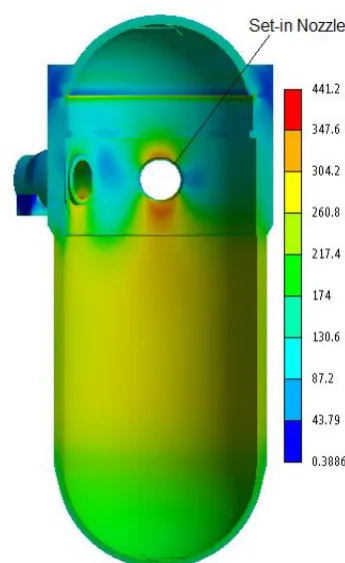
Using the max. allowable pressure Pa = 22 MPa, the distributions of stress intensity in the RPV are shown in Fig. 7. The max. stress intensity is equal to 441.2 MPa which is around the set-in nozzle of the RPV. Hence, the limiting condition of the rule 2 as described above is also satisfied under the application of max. allowable pressure.
The max. allowable pressure according to rules of DBF was calculated using the relationship given in article NB-3320 of ASME III, division 1. The cylindrical portion of the RPV is called the beltline region of the RPV. The allowable pressure calculated on the basis of the beltline region of the RPV is definitely the max. allowable pressure as because RPV cannot withsatand pressure more than this pressure in any case. The formula [7] for cylindrical vessel is given in Eq. (3):
max
0.5
m
t S P
R t
(3)
where:
t = Thickness of the shell
Sm = Design stress intensity values R = Inner radius of the shell
[image:4.595.71.273.317.484.2]The maximum allowable pressure according to DBA and DBF calculations along with percentage differences between them are given in Table I.
Fig. 7 Distributions of stress intensity (MPa) in the RPV
TABLE I
MAXIMUM ALLOWABLE PRESSURE USING DBA AND DBF DBF (MPa) DBA (MPa) % Difference
RPV 18.105 22 17.70
VI. CONCLUSION
In this paper we have compared the design of the RPV made of ‘SA-508 Gr.3 Cl.1’ material using ‘design by analysis’ and ‘design by formula’ rules. We can conclude from the comparative study as follows:
The application of the ‘design by analysis’ allows removing the unnecessary conservatism caused by applying the ‘design by formula’ approach.
An increase of 17.70 % in the maximum allowable pressure is recommended when RPV is designed using the rules of ‘design by analysis’ instead of ‘design by formula’.
REFERENCES
[1] Y. Bangash, "PWR steel pressure vessel design and practice,"
Progress in Nuclear Energy, vol. 16(1), pp. 1-40, 1985. [2] U. T. Murtaza and M. J. Hyder, "Optimization of the Size and
Shape of the Set-in Nozzle for a PWR Reactor Pressure Vessel,"
[image:4.595.298.554.452.490.2][3] ESS, "Assessment and management of ageing of major nuclear power plant components important to safety: PWR pressure vessels," International Atomic Energy Agency, IAEA-TECDOC-1120, 1999.
[4] U. T. Murtaza and M. J. Hyder, "The effects of thermal stresses on the elliptical surface cracks in PWR reactor pressure vessel,"
Theoretical and Applied Fracture Mechanics, vol. 75C, pp. 124-136, 2015.
[5] R. K. Jain, Machine Design, Third ed. Dehli: Khanna Publications, 1983.
[6] M. J. Hyder and M. Asif, "Optimization of location and size of opening in a pressure vessel cylinder using ANSYS,"
Engineering Failure Analysis, vol. 15, pp. 1-19, 2008. [7] ASME Boiler and Pressure Vessel Code, Section III, Division
1: Rules for construction of nuclear facility componenets, New York, 2010.
[8] K. Ramesh. (2007). E-Book on engineering fracture mechanics. [9] G. E. Dieter, Mechanical metallurgy, 3rd ed. USA:
McGraw-Hill, 1987.
[10] A. T. Diamantoudis and T. Kermanidis, "Design by analysis versus design by formula of high strength steel pressure vessels: a comparative study," International Journal of Pressure Vessels and Piping, vol. 82, pp. 43-50, 2005.
[11] M. Muscat, D. Mackenzie, and R. Hamilton, "A work criterion for plastic collapse," International Journal of Pressure Vessels and Piping, vol. 80, pp. 49-58, 2003.
[12] A. Petrovic, "Stress analysis in cylindrical pressure vessels with loads applied to the free end of a nozzle," International Journal of Pressure Vessels and Piping, vol. 78, pp. 485-493, 2001. [13] R. Preiss, "Design-by-analysis of a chemical reactor's head
under sustained and thermal loads," International Journal of Pressure Vessels and Piping, vol. 77, pp. 277-288, 2000. [14] J.-S. Liua, G. T. Parksb, and P. J. Clarkson, "Shape
optimisation of axisymmetric cylindrical nozzles in spherical pressure vessels subject to stress constraints," International Journal of Pressure Vessels and Piping, vol. 78, pp. 1-9, 2000. [15] Z. F. Sanga, L. P. Xuea, Y. J. Lina, and G. E. O. Widera, "Limit
and burst pressures for a cylindrical shell intersection with intermediate diameter ratio," International Journal of Pressure Vessels and Piping, vol. 79, pp. 341-349, 2002.
[16] Y. He and T. Isozaki, "Fracture mechanics analysis and evaluation for the RPV of the Chinese Qinshan 300 MW NPP under PTS," Nuclear Engineering and Design, vol. 201, pp. 121-137, 2000.
[17] ASME Boiler and Pressure Vessel Code, Section II, Part D: Properties, Materials, New York, 2010.
[18] A. G. Miller, "Review of limit loads of structures containing defects," International Journal of Pressure Vessels and Piping,
vol. 32, pp. 197-327, 1988.
![Fig. 1 Engineering drawing of the typical RPV [2], dimensions in mm](https://thumb-us.123doks.com/thumbv2/123dok_us/451826.543154/2.595.64.274.213.709/fig-engineering-drawing-typical-rpv-dimensions-mm.webp)
![Fig. 4 Full 3D solid-186 finite elements model [2]](https://thumb-us.123doks.com/thumbv2/123dok_us/451826.543154/3.595.332.523.129.417/fig-full-d-solid-finite-elements-model.webp)