Abstract— This work applies second law of thermodynamics
to analyse the effect of radiation on electrically conducting couple stress fluid through a channel. A constant magnetic field is introduced across the flow channel and the resulting Navier-Stokes and energy equations are non-dimensionalized and solved using Adomian decomposition method (ADM) and differential transform method (DTM). The obtained velocity and temperature profiles are used to calculate the entropy generation rate and irreversibility ratio. The effects of radiation, magnetic field and couple stress parameters on the velocity, temperature, entropy generation rate and Bejan number are discussed with the aid of graphs. From the study, it is observed that increase in magnetic field and couple stress parameters reduces the fluid velocity while an increase in radiation parameter reduces the temperature of the fluid. Furthermore, radiation parameter increases entropy generation as heat transfer dominates irreversibility.
Index Terms— Thermal radiation, Entropy generation,
Couple stress fluid, hydromagnetic, ADM, DTM
I. INTRODUCTION
The study energy transfer due to thermal radiation has received a boost in the past few decades due to its wide ranging applications in areas such as gas turbines, astrophysical flows, forest fire dynamics, fire spread buildings, nuclear power plants. Numerous research studies on radiative flows in porous and non-porous medium include: Mukhopadhyay [1] investigated radiation and variable fluid viscosity effects on flow and heat transfer and submitted that fluid temperature reduces with increasing value of both radiation parameter and Prandtl number. Olanrewaju et al. [2] considered the effect of radiation and viscous dissipation on the Blasius and Sakiadis flows. It was concluded that increase in Eckert number, Prandtl number and radiation parameter reduces the thermal boundary layer thickness along the plate resulting in fluid temperature reduction. Vyas et al. [3] investigated the effect of radiation on the entropy generation of an electrically conducting Couette flow inside a channel with naturally permeable base
Manuscript received February, 20, 2017; revised March 10, 2017. This work was supported by the Centre for Research and Innovation, Covenant University, Ota, Nigeria.
A.A. Opanuga and S.A. Iyase are with the Department of Mathematics, CovenantUniversity,Ota,Nigeria(email:abiodun.opanuga@covenantunivers ity.edu.ng; [email protected].)
J.A. Gbadeyan is with the Department of Mathematics, University of Ilorin,
and argued that there is an increase in entropy generation as the values of slip coefficient, magnetic field parameter, Brinkman number, radiation parameter and characteristic temperature ratio increase; while it reduces with the rising values of permeability parameter
K
. Moreover, Adesanya [4] discussed the effect of radiation on steady electrically conducting visco-elastic heat generating /absorbing slip flow through a porous medium, the results show that increase in both radiation and heat absorption parameters increases the fluid temperature and flow velocity of the non-Newtonian fluid within the channel. Other important studies on thermal radiation effects are in Refs. [5-11]Investigations have been geared towards the analysis of entropy production in designing thermal systems; this is due to the translation of available energy for work to destruction. Currently, second law of thermodynamics is being applied in the field of heat transfer and thermal design, a method introduced by Bejan [12-13]. Thereafter, several investigations were carried out to examine entropy production under various flow configurations. Adesanya et al. [14] investigated the effects of couple stresses and convective heating on the entropy generation through porous channel. The results reveal that increase in couple stress parameter lowers entropy generation while an increase in Brinkman number registers a significant increase in entropy generation rate in the middle of the channel than at the walls. Das et al. [15] analyzed the effect of Navier slip on entropy generation of an electrically conducting viscous fluid in a porous channel and reported that entropy generation is enhanced with a rise in magnetic parameter. Jery et al. [16] reported on the effect of an external oriented magnetic field on entropy generation in natural convection that, magnetic field lowers entropy generation and entropy generation due to viscous effects is the major contributor to irreversibility. Interested readers should see for more on entropy generation rate Refs. [17-20].
The Adomian decomposition and differential transform methods applied in this work have been found to be efficient, accurate and rapidly convergent. The methods have been used to obtain the solution of various linear and nonlinear boundary value problems [21-23]
To the best of our knowledge, entropy production due
Thermodynamics Analysis of Radiative
Hydromagnetic Couple Stress Fluid through a
Channel
A. A. Opanuga*,
Member, IAENG,
J. A. Gbadeyan, S. A. Iyase
stress fluid through a channel has not been reported. Therefore the main objective of this study is to analyze the effect of thermal radiation on entropy generation of MHD couple stress fluid flows through a channel.
II. MATHEMATICAL MODEL
Consider an incompressible, non-Newtonian couple stress fluid through a channel, the wall plates exchanges heat with the ambient in an axi-symmetrical manner and hot fluid is injected and sucked off at the lower and upper walls respectively with the same velocity. A uniformly transverse magnetic field,
B
0is applied in the direction of flow and the interaction of the induced magnetic field is assumed to be negligible compared to the interaction of the applied magnetic field. It is further assumed that the radiative heat flux in the energy equation follows Roseland approximation.Fig
.
1
Schematic diagram of the problem
With these assumptions and configuration (see Fig. 1) the governing equations for the flow are written as: (Adesanya et al. [14])
2 4
2
2 4
du
dp
d u
d u
B u
dy
dx
dy
dy
(1)2 2
2 2
2 2
2 2 r
dT
d T
du
d u
cpv
k
dy
dy
dy
dy
dq
B u
dy
(2) 22 3 2
0
2 *
2
2 2 2 2
2
16
3
c GT
k
dT
d T
E
T
dy
k
dy
B u
du
d u
T
dy
T
dy
T
(3)The boundary conditions are:
1
2
2 2
2 2
(0)
(
);
( )
(
)
(0)
(0)
0
( )
( )
f
dT
dT
k
T
T
k
h
dy
dy
T
T
d u
d u
u
u h
h
dy
dy
, (4) Applying the Roseland approximation for radiation [3, 24,
25] yields 4 *
4
3
c rdT
q
k
dy
(5)According to Raptis et al. [18] expressing the temperature function in equation (3) as a linear function of temperature and expanding it
T
4 in a Taylor series aboutT
0 gives
2
4 4 3 2
0 0 0 0
3 4
0 0 0
4
6
4
T
T
T
T
T
T
T
T
T T
T
T
T
(6) If the higher order terms are neglected it yields4 3 3
0 0
4
3
T
T T
T
(7) Substituting equations (5) and (7) in (2), we have2 2 2 2 2 3 2 0 *
16
3
p cdT
d T
du
c v
k
B u
dy
dy
dy
T d T
k
dy
(8)The dimensionless parameters below are introduced in equations (1, 3, 4 and 8) to yield
2
2 2
2
2 2 3
2 0 0
*
2 2
,
,
,
,
, Pr
,
,
,
(
)
(
)
4
,
,
,
f p G f f c fT
T
h
y
u
y
u
s
h
T
T
c
h
dp
G
dx
k
T h E
Br
Ns
k T
T
k T
T
T
T
B h
T
H
N
T
kk
h
a
(9) 2 4 22 2 4
2 2 2 2
1
;
(0)
(1)
(0)
(1)
du
d u
d u
s
G
H u
dy
dy
a dy
d u
d u
u
u
dy
dy
(10)2 2 2 2 2 2 2 2 2 1 2
4
1
3
;
(0)
(1)
( (0) 1),
(1)
r
d
d
N
sp
dy
dy
du
Br d u
Br
BrH u
dy
a
dy
d
d
Bi
Bi
dy
dy
(11) 2 2 2 2 2 2 2 2
4
1
3
1
d
Ns
N
dy
Br
du
d u
H u
dy
a
dy
(12)III. METHODOFSOLUTION
[image:3.595.46.291.621.784.2]Adomian decomposition and differential transform methods are applied to obtain the solution of the boundary value problems. However, owing to the magnitude of the symbolic solutions only graphical results are presented in Figures (2-10). To verify the accuracy of these computations the approximate solution obtained via ADM and DTM are validated by the exact solution. The numerical comparism is presented in Table 1.
Table I: Computation showing convergence of solution when
1,
0.1
G
H
a
s
IV. ENTROPY GENERATION
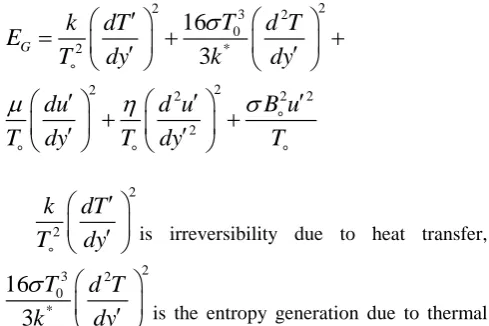
According to Bejan [11, 12] the expression for local entropy generation rate in (3) suggests five sources of entropy generation;
2
2 3 2
0
2 *
2
2 2 2 2
2
16
3
G
T
k
dT
d T
E
T
dy
k
dy
B u
du
d u
T
dy
T
dy
T
2 2k
dT
T
dy
is irreversibility due to heat transfer, 2 3 2 0 *16
3
T
d T
k
dy
is the entropy generation due to thermalradiation, 2
du
T
dy
is entropy generation as a result offluid friction,
2 2 2
d u
T
dy
is entropy generation due tocouple stresses and
2 2
B u
T
is due to the effect of MHD.
The dimensionless form is given in equation (12) as 2 2 2 2 2 2 2 2
4
1
3
1
du
dy
d
Br
Ns
R
dy
d u
H u
a
dy
Investigating entropy generation within the flow, we let 2
1
2
2 2
2 2
2 2 2
4
1
,
3
1
d
N
R
dy
Br
du
d u
N
H u
dy
a
dy
(13)The Bejan number Be = 0 is the irreversibility due to viscous dissipation, couple stress effect and magnetic effect and Be = 1 is when the irreversibility due to heat transfer dominates the flow. Be =
1
2
indicates that both contribute equally toentropy generation. Writing Bejan number as
1 2 1
1
,
1
sN
N
Be
N
N
(14)
V. RESULTSANDDISCUSSION
This study considers the effect of thermal radiation on the entropy generation rate of a hydromagnetic couple stress fluid through porous channel. The velocity and temperature profiles are solved using Adomian decomposition and differential transform methods, and the results showing the effects of some pertinent parameters on the velocity, temperature, entropy generation and Bejan number are discussed with the aid of graphs in Figs. 2-10.
EFFECTS OF PARAMETERS VARIATION ON VELOCITY AND TEMPERATURE PROFILES
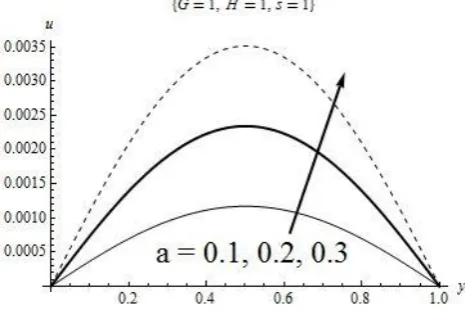
implies that couple stresses will eventually retard the flow velocity due to the size dependent effect introduced by the increased couple stresses which increases fluid viscosity. In Fig. 4, effect of variation in radiation parameter on fluid temperature is displayed. The plot indicates that temperature is lowered as thermal radiation parameter increases in value; the reduction can be attributed to the fact that increasing radiation parameter
N
has an increasing effect on the absorption parameterk
*which results to a decrease in temperature. Fig. 5 displays the implication of increasing the values magnetic field parameter on temperature; it is revealed that the temperature is enhanced across the channel as the value of Hartman’s number increases. The presence of Ohmic heating in the flow corresponds to the rise in fluid temperature. However in Fig. 6, variation in couple stress inverse parameter corresponds to a reduction in fluid temperature. This means that couple stresses enhance fluid temperature; the rise in temperature is due to increased size of fluid particles which increases flow resistance as fluid layers slide over the other resulting in temperature rise.Fig 2 Velocity profile for magnetic field parameter
[image:4.595.310.540.259.438.2]Fig 3 Velocity profile for couple stress inverse parameter
[image:4.595.49.278.338.507.2]Fig 4 Temperature profile for radiation parameter
Fig 5 Temperature profile for magnetic field
[image:4.595.307.560.462.659.2] [image:4.595.47.280.542.697.2]EFFECTS OF PARAMETERS VARIATION ON ENTROPY GENERATION RATE
[image:5.595.308.533.55.210.2]In this section, effects of parameters variation on the entropy generation are displayed in Figs. 7-8. Fig.7 represents the effect of variation in thermal radiation parameter on entropy generation rate; it is clearly revealed in that thermal radiation encourages entropy production due to increase in the emission rate within the flow channel. Fig.8 is the variation of couple stress inverse on entropy generation rate. It is obvious from the plot that entropy generation rises as couple stress inverse increases in values. The implication of this is that increase in couple stresses decreases entropy generation rate. The reason is shown in Fig.2, the plot indicates that fluid velocity reduces with increase in couple stresses due to increased fluid viscosity. The effect of this on the flow is that it lowers the randomness of fluid particles and consequently the reduction in entropy production rate.
Fig 7 Entropy generation profile for radiation parameter
Fig 8 Entropy generation profile for couple stress inverse parameter
EFFECTS OF PARAMETERS VARIATION ON BEJAN NUMBER
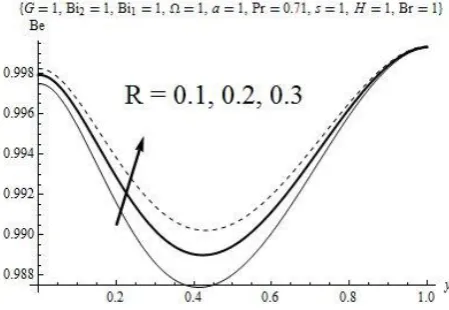
Figs.9 and 10 present the effect of variation in thermal radiation and magnetic field parameters on Bejan number. The plots show that Bejan number increases as the values of these parameters increased. This is an indication that heat
[image:5.595.46.536.261.455.2]Fig 9 Bejan number for radiation parameter
Fig 10 Bejan number for magnetic field
VI. CONCLUSION
In this study, effect of thermal radiation on the entropy generation rate of hydromagnetic couple stress fluid through porous channel is investigated. The velocity and temperature profiles obtained are solved via Adomian decomposition method and differential transform method. The results showing the effects of some pertinent parameters are discussed graphically.
• Increase in magnetic field parameter and couple stresses inhibits the fluid flow.
• Increase in thermal radiation parameter reduces the temperature while increase in magnetic field and couple stresses enhances the temperature.
• Radiation parameter encourages entropy generation while increase in couple stress parameter decreases the entropy generation rate.
• Heat transfer dominates entropy generation rate. .
ACKNOWLEDGMENT
[image:5.595.49.285.480.647.2]REFERENCES
[1] S, Mukhopadhyay, “Effects of radiation and variable fluid viscosity on flow and heat transfer along a symmetric wedge”, Journal of Applied Fluid Mechanics, vol. 2 no 2, pp. 29-34, 2009.
[2] P.O. Olanrewaju, J.A. Gbadeyan, O.O. Agboola, and S.O. Abah, “Radiation and viscous dissipation effects for the Blasius and Sakiadis flows with a convective surface boundary condition”, International Journal of Advances in Science and Technology, vol. 2 no 4 pp. 102-105, 2011.
[3] P. Vyas and A. Rai “Entropy regime for radiative MHD couette flow inside a channel with naturally permeable base”, International Journal of Energy & Technology, vol. 5, no 19, pp. 1–9, 2013. [4] S. O. Adesanya, “Steady magnetohydrodynamic visco-elastic heat
generating/absorbing slip flow through a porous medium with radiation effect”, International Journal of Heat and Technology, vol. 30, no 1, pp. 69 –74, 2012.
[5] S. Das, C. Mandal and R. N. Jana, “Radiation effects on unsteady free convection flow past a vertical plate with Newtonian Heating”, International Journal of Computer Applications, vol. 41, no 13, pp. 36-41, 2013.
[6] M. S. Dada and F. H. Adefolaju, “Dissipation, MHD and radiation on an unsteady convective heat and mass transfer in a Darcy-Forcheimer porous medium” , Journal of Mathematics Research, vol. 4, no 2, pp. 110-127, 2012.
[7] P. Vyas and N. Srivastava, “Radiative Boundary layer flow in porous medium due to exponentially shrinking permeable sheet”, ISRN Thermodynamics, article ID 214362, 9 pages, doi 10.5402/2012/214362, 2012.
[8] N. Singh, U. R. Singh and R. Jha, “Effect of thermal radiation on dusty viscous fluid through porous medium over a moving infinite vertical plate with uniform heat flux”, World Journal of Applied Sciences and Research, vol. 2, no 1 ,pp. 63-67, 2012.
[9] P. Singh, A. Jangid, N. S. Tomer and D. Sinha, “Effects of thermal radiation and magnetic field on unsteady stretching permeable sheet in presence of free stream velocity”. World Academy of Science, Engineering and Technology, vol. 4, no 3, 2010.
[10] S. Shateyi and S. S. Motsa, “Thermal radiation effects on heat and mass transfer over an unsteady stretching surface”, Mathematical Problems in Engineering, 2009, 13 pages, doi:10.1155/2009/965603 [11] A.A. Opanuga, J.A. Gbadeyan, S.A. Iyase and H.I. Okagbue, Effect
of Thermal Radiation on the Entropy Generation of Hydromagnetic Flow Through Porous Channel, The Pacific Journal of Science and Technology, vol. 17, no 2, pp. 59-68, 2016. [12] A. Bejan, “Second law analysis in heat transfer”, Energy int. J., vol.
15, pp. 721-732, 1980.
[13] A. Bejan, “Second law analysis in heat transfer and thermal design”, Adv. Heat Transfer, vol.15, pp. 1-58, 1982..
[14] S.O. Adesanya and O. D. Makinde, “Effects of couple stress on entropy generation rate in a porous channel with convective heating”, Comp. Appl. Math., vol. 34, pp. 293–307, 2015.
[15] S. Das and R. N. Jana, “Entropy generation due to MHD flow in a porous channel with Navier slip”, Ain Shams Engineering Journal, vol. 5, pp. 575-584, 2014.
[16] A. E. Jery, N. Hidouri, M. Magherbi and A. B. Brahim, “Effect of an External Oriented Magnetic Field on Entropy Generation in Natural Convection”, Entropy, vol. 12, pp. 1391-1417, 2010.
[17] S.O. Adesanya and O. D. Makinde, “Irreversibility analysis in a couple stress film flow along an inclined heated plate with adiabatic free surface”, Physica A: Statistical Mechanics and its Applications, vol. 432, no 15, pp. 222–229, 2015.
[18] A. Raptis, Perdikis, H. S. Takhar, “Effect of thermal radiation on MHD flow”, Applied Mathematics and Computation, vol. 153, pp. 645–649, 2004.
[19] A. O. Ajibade, B. K. Jha, and A. Omame, “Entropy generation under the effect of suction/injection”, Applied Mathematical Modelling, vol. 35, pp. 4630–4646, 2011.
[20] S. O. Adesanya, S. O. Kareem, J. A. Falade and S. A. Arekete, “Entropy generation analysis for a reactive couple stress fluid flow through a channel saturated with porous material”, Energy, vol. 93, 1239-1245, 2015.
[21] O. O. Agboola, A.A. Opanuga, J.A. Gbadeyan, “Solution Of Third Order Ordinary Differential Equations Using Differential Transform Method”, Global Journal of Pure and Applied Mathematics, Vol. 11, no 4, pp. 2511-2517, 2015
[22] A.A. Opanuga, O.O. Agboola and H.I. Okagbue, “Approximate solution of multipoint boundary value problems”, Journal of Engineering and Applied Sciences, vol. 10, no 4, pp. 85-89, 2015.
[23] A.A. Opanuga, O.O. Agboola , H.I. Okagbue and J.G. Oghonyon, “Solution of differential equations by three semi-analytical techniques”, International Journal of Applied Engineering Research, vol. 10, no 18, pp. 39168-39174, 2015.
[24] A.S. Idowu, A. Jimoh., F.H. Oyelami and M.S.Dada, “Numerical solution for thermal radiation effect on inclined magnetic field of MHD free convective heat transfer dissipative fluid flow past a moving vertical porous plate with variable suction”, American Journal of Fluid Dynamics, vol. 4, no 3, pp. 91-101, 2014. doi:10.5923/j.ajfd.20140403.02
[25] B.I. Olajuwon, J.I. Oahimire and M. Ferdow, “Effect of thermal radiation and Hall current on heat and mass transfer of unsteady MHD flow of a viscoelastic micropolar fluid through a porous medium”, Engineering Science and Technology, an International Journal, vol. 17, pp. 185-193, 2014. http://dx.doi.org/10.1016/j.jestch.2014.05.004
NOMENCLATURE
u
fluid velocity
dynamic viscosity
fluid density T fluid temperature0
T
initial fluid temperature fT
final fluid temperature
k
thermal conductivity of the fluid pc
specific heat at constant pressure 0
v
constant velocity of fluid suction/injection
kinematic viscosity
electrical conductivity of the fluid
fluid particle size effect due to couple stressesG
E
local volumetric entropy generation rate 1,2
heat transfer coefficients0
B
uniform transverse magnetic field r
q
radiative heat flux.u
dimensionless velocitys suction/injection parameter
dimensionless temperature a couple stress parameterPr
Prandtl numberBr
Brinkman number
parameter that measures the temperature differencebetween the two heat reservoirs
H
magnetic field parameterNs
dimensionless entropy generation rateBe
Bejan number 1,2Bi
Biot numbers respectivelyG
axial pressure gradientN
thermal radiation parameterc
Stefan-Boltzman constant *