Abstract— We proposed an application of Agrifood Supply
Chain (ASC) model for determining the priority of programs to empower the farmers as qualified supplier of modern retailer (MR). We have proposed two mathematical models that involve corporate social responsibility (CSR) activities to enhance the business skills and to improve capabilities of the farmers accessing market. By using the ASC application, MR does not need to solve the Weighted Goal Programming (WGP) to simulate its policy despite they want to change index values or parameters repeatedly. The ASC application is Decision Support System (DSS) based that incorporates database, model base, analysis tool, and Graphical User Interface (GUI). The test results of case examples provided also give good results, where the application is capable for processing data based on proposed mathematical model. The ASC application is capable to choose the priority of CSR program for quality improvement of the vegetables and for skill enhancement of the farmers. The result can be a consideration for Human Resources Department (HRD) of modern retailers to make decision in CSR programs.
Index Terms—agri-food supply chain application, corporate
social responsibility, decision support system, supplier of modern retailer.
I. INTRODUCTION
n this paper, we discuss the issue of vegetables farmers in Indonesia that deal with marketing and low selling price problems although they produce good quality of vegetables [1]-[3]. Since the farmers group and/or cooperation (FGC) could fulfill the requirements of the high-class consumers, they could sell directly to modern retailers and increase the revenues on agribusiness [4], [5]. The farmers and/or FCG should fulfill some criterion related to product specifications, delivery terms, and internal business requirements to become a qualified supplier of modern retailer [5-7].
The case described in the previous paragraph can be seen as the integration of key business processes from the integrated system in agri-food supply chain (ASC) that consists of three main entities namely farmers, the FGC, and the modern retailer (MR), and also the customers as end users [3]. Several model had been developed by
W. Sutopo, M. Hisjam, and Yuniaristanto are with the Laboratory of Logistics System and Business, Department of Industrial Engineering, Sebelas Maret University, Surakarta, 57126, INDONESIA. (Corresponding authors: phone/fax.+62-271-632110; e-mail: [email protected]; [email protected]; [email protected]).
previous researchers to improve the coordination of buyer-supplier [8], to make business contracts [9], [10], and to understand the effect ASC improvements [6], [11], [12]. We also investigated previous results related to the implementation of CSR programs in supply chains i.e. corporate enhanced its relationship with suppliers [13]-[15], reduced business risks and promoted brand [16], [17], and guided the CSR implementation in supply chain responsibility [18]-[20].
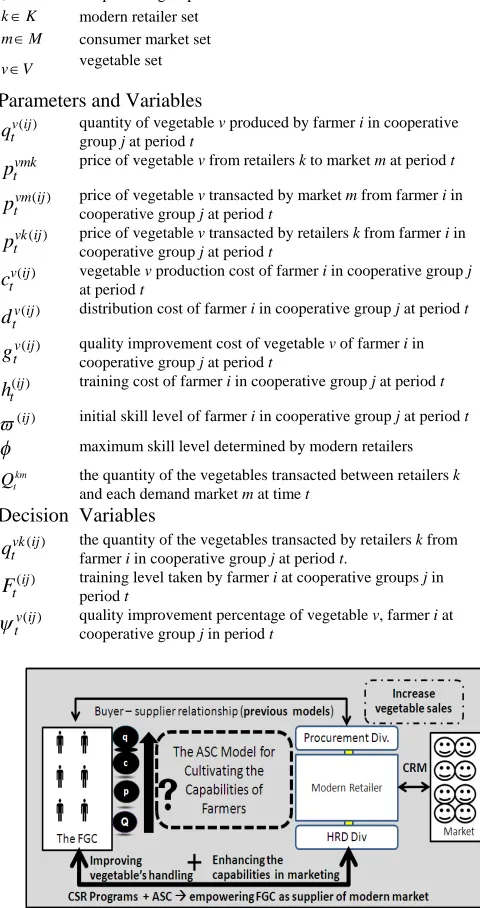
Therefore, there are no models that incorporate some factors which can be considered as particular weaknesses of the small-scale farmers and CSR programs. In previous works, we proposed an ASC model that involves the CSR activities to improve capabilities of the farmers or the FGCs and to enhance the capabilities in marketing the commodities to the modern retail [3]. Unfortunately, the ASC model involves a complicated mathematical formulation namely Weighted Goal Programming (WGP). An application is intended to simulate its policy if they want to change index values or parameters repeatedly based on the model that has been proposed by Sutopo et al. [3]. A decision support system (DSS) is a system to utilize models with internal and external databases, emphasize flexibility, effectiveness, and adaptability [21], [22]. An application based on DSS can be developed in any environments that support data storage, data analysis, solution methods, and graphical user interface.
This paper is organized as follows. In Section 1, we describe the background of our research and describe the problems in the real system. In Section 2, we construct the WGP for farmers-modern retailer relationship. In Section 3, we provide the development of an agri-food supply chain application. Discussion and analysis is provided in Section 4. In Section 5, we deliver the conclusion and future research.
II. THE WEIGHTED GOAL PROGRAMMING (WGP)FOR
FARMERS-MODERN RETAILER RELATIONSHIP
We extend our previous work in [3] by developing a user interface to ease the process of numerical input and output for simulating policy. In previous work, Multi period ASC model is formulated as WGP) to analyze the impacts of CSR programs to empower the FGCs in managing the small-scale vegetables farmers. MR proposes two CSR programs conducted by the division of HRD. The quality improvement (QI) of the vegetables and the skill
Developing an Agri-food Supply Chain
Application for Determining the Priority of CSR
Program to Empower Farmers as a Qualified
Supplier of Modern Retailer
Wahyudi Sutopo, Muh. Hisjam, and Yuniaristanto
enhancement of the farmers are designed in limited budget of CSR programs. The WGP formulation is not only to maximize the profit of farmers, but also to maximize CSR benefits for the modern retailers. The model should capable to determine the amount and timing of supply, level of farmers training skills, quality improvement target, and the CSR total cost.
Fig. 1 describes an ASC network of the relevant system. The ASC model for improving the capabilities of farmers can be formulated by the mixed integer linear programming (MILP). The following notations are used to develop the proposed model.
Index
tT period set
iI farmer set
jJ cooperative group set
kK modern retailer set
mM consumer market set
vV vegetable set
Parameters and Variables
( )
v ij t
q quantity of vegetable v produced by farmer i in cooperative
group j at period t vmk
t
p price of vegetable v from retailers k to market m at period t
( )
vm ij t
p price of vegetable cooperative group vj at period transacted by market t m from farmer i in
( )
vk ij t
p price of vegetable cooperative group vj at period transacted by retailers t k from farmer i in
( )
v ij t
c vegetable v production cost of farmer i in cooperative group j
at period t ( )
v ij t
d distribution cost of farmer i in cooperative group j at period t
( )
v ij t
g quality improvement cost of vegetable cooperative group j at period t v of farmer i in
( )ij t
h training cost of farmer i in cooperative group j at period t
( )ij
initial skill level of farmer i in cooperative group j at period t maximum skill level determined by modern retailers
km t
Q the quantity of the vegetables transacted between retailers k and each demand market m at time t
Decision Variables
( )
vk ij t
q the quantity of the vegetables transacted by retailers farmer i in cooperative group j at period t. k from
( )ij t
F training level taken by farmer i at cooperative groups j in
period t
( )
v ij t
quality improvement percentage of vegetable v, farmer i at
cooperative group j in period t
The four goals (G) will cover all aspects from for farmers-modern retailer relationship [3]. G1 denotes the profit maximization of modern retailer, G2 denotes the profit maximization of farmers, G3 denotes the total of CSR
cost, and G4 denotes the level of training that must be taken by the farmers. The multi period ASC model then can be formulated as WGP below:
Min q q q
q Q n p
(1)
subject to
( ) ( )
1 1 1
vmk km vk ij vk ij
t t t t
t T v V k K m M t T v V k K j J i I
p Q p q n p b
(2)
( ) ( ) ( ) ( ) ( )
( ) ( ) ( )
2 2 2
+
vk ij vk ij v ij ij v ij
t t t t t
t T v V k K j J i I t T v V j J i I
vm ij v ij vk ij
t t t
t T v V m M j J i I
p q c d q
p q q n p b
(3) ( ) ( ) ( ) ( )
3 3 3
v ij v ij ij ij
t t t t
t T v V j J i I t T j J i I
g F h n p b
(4)
( ) ( )
4 4 4 ij ij
t t T j J i I
F n p b
(5)
( ) 1 ( ) ij ( ), , ,
v ij v ij vk ij
t t t t
i I k K
q F q t j v
(6)
( ), , ,
vmk vk ij
t t
m M k K
Q q t j v
(7)
( )ij t t T j J i I
F
(8)
( )ij , v ij( ), vk ij( ) 0, , ,
t t t
F q i j t (9)
whereq, nq, and pqare defined as preferential weights,
negative deviational variables, and positive deviationals of from theqthgoal, b1, b2, b3, and b4denote the target level for each goal respectively. In this paper, we four goals
q. The achievement function must be minimized to ensure that the solution is closely as possible to the desired goals (1). The first goal, profit maximization of the modern retailers is expressed in (2). Equation (3) states the second goal; profit maximization of farmer is expressed.
Equation (4) and (5) define the CSR goals, which seek CSR cost minimization and training level maximization. Vvegetables quality improvement and farmers skill enhancement can increase the quantity of vegetable sold to modern retailers is expressed in (6). Equation (7) states that the vegetable flow transacted by consumer market must not exceed quantity bought by modern retailer form framers. In (8), modern retailer determines maximum skill level of each farmer required to become MR supplier. Finally, the last equation is utilized to enforce non-negativity for all decision variables.
III. DEVELOPING THE AGRI-FOOD SUPPLY CHAIN
APPLICATION
[image:2.595.48.288.254.708.2]The application was developed using Java programming language and Object Relational Mapping (ORM). Database Server was developed using web server Localhost and MySQL. The algorithm used to solve the WGP formulation
was branch and bound method. We used NetBeans IDE 7.0, JDK 1.6, XAMPP 1.7.7, Library Hibernate JPA, JCommon 1.0.15, JFreeChart 1.10.12, BettaGlasess 1.0 to develop application and to solve the WGP formulation. The ASC application for determining the priority of CSR programs was developed consists of five major components: database, model base, analysis tool, Graphical User Interface (GUI) and user.
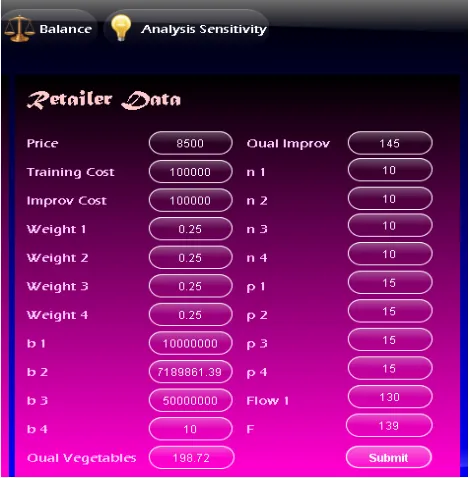
Initially, the user only interacts with the home page of the ASC application to fill in values of model parameters. The user can input data such as all the parameters and set the parameters of the farmers and modern retailer. Display data input can be seen in the Fig. 2 and Fig. 3.
The supply chain comprises 3 the FGC j, j = 1, 2, 3; 1 modern retailers k, k = 1; 1 vegetable v, v = 1; 1 consumer market m, m = 1; and 2 periods t, t = 1, 2. The numbers of farmers associated with the FCG are 3, 2, and 4 respectively, labeled by capital letter. Data input of the application is adopted from [3], in period 1 farmer produces 285 kg of vegetable, but only 69 % worthy to be sold to
modern retailers. Table 1 illustrates the farmers’ data. Table 2 demonstrates the target’s scenario.
TABLE 1. THE FARMERS DATA
Period Farmer T he Production T rans. Price to Price to FCGs Prod. Worth cost cost MR T M
(kg) (%) (Rp) (Rp) (Rp) (Rp) 1 A 1 288 69 2,437.00 1,818.00 6,819.00 6,578.00 1 B 1 337 66 2,447.00 1,254.00 6,595.00 6,541.00 1 C 1 259 65 2,251.00 1,453.00 6,659.00 6,573.00 1 D 2 128 66 2,081.00 1,580.00 6,963.00 6,526.00 1 E 2 292 68 2,470.00 1,627.00 6,946.00 6,560.00 1 F 3 434 70 2,208.00 1,846.00 6,549.00 6,588.00 1 G 3 356 69 2,326.00 1,588.00 6,940.00 6,520.00 1 H 3 328 70 2,157.00 1,385.00 6,896.00 6,551.00 1 I 3 477 70 2,018.00 1,358.00 6,967.00 6,500.00 2 A 1 398 68 2,680.70 2,090.70 6,580.00 6,518.00 2 B 1 449 68 2,691.70 1,442.10 6,972.00 6,581.00 2 C 1 488 67 2,476.10 1,670.95 6,570.00 6,575.00 2 D 2 384 70 2,289.10 1,817.00 6,771.00 6,551.00 2 E 2 327 65 2,717.00 1,871.05 7,000.00 6,530.00 2 F 3 335 67 2,428.80 2,122.90 6,735.00 6,503.00 2 G 3 487 65 2,558.60 1,826.20 6,850.00 6,511.00 2 H 3 274 69 2,372.70 1,592.75 6,928.00 6,548.00 2 I 3 298 67 2,219.80 1,561.70 6,885.00 6,536.00
Vegetable
Source: (Sutopo et al. [3])
TABLE 2. SCENARIO DATA
Scenario Goal Target Level Weight
A G1 At least 20,000,000.00 (n1) 0.25
G2 At least 30,000,000.00 (n2) 0.25
G3 At most 10% of G1 (p3) 0.25
G4 At least 15 (n4) 0.25
B G1 At least 10,000,000.00 (n1) 0.25
G2 At least 15,000,000.00 (n2) 0.25
G3 At least 10% of G1 (n3) 0.25
G4 At most 15 (p4) 0.25
C G1 At least 15,000,000.00 (n1) 0.25
G2 At least 20,000,000.00 (n2) 0.25
G3 Exactly 10% of G1 (n3p3) 0.25
G4 Exactly 15 (n4p4) 0.25
Source: (Sutopo et al. [3])
IV. DISCUSSION ANDANALYSIS
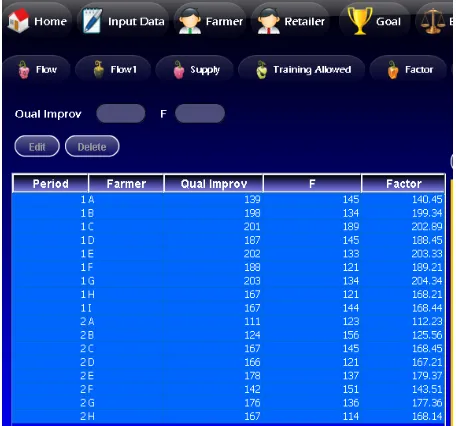
[image:3.595.56.292.226.415.2]In this section, we analyze the impact of the changes in parameters in solving the WGP to simulate its policy. Outputs of the application are recommendations for the quantity of the vegetables transacted by retailer (Fig. 4), training level taken by farmers (Fig. 5), and quality improvement percentage of vegetables (Fig 6). Fig. 7 describes the sensitivity analysis to determine how the model responds to changes.
[image:3.595.51.286.439.678.2]TABLE 3. GOAL ACHIEVEMENT RESULTS
Target Level Achieved Value Satisfied
G1 ≥ 100,0000 1,000,000 Yes
G2 ≥ 1,718,9861.39 17,201,406 Yes
G3 ≤ 247,781,7.59 2,467,579 Yes
G4 ≤ 9 8 Yes
The result of the best scenarios is shown in Table 3. The achievement function of the fourth scenario and the goals then can be stated as follows:
G1: Achieved maximum profit at least 1,000,000.00. G2: Achieved maximum profit at least 17,201,406. G3: CSR cost must not exceed 2,477,579.
G4: Training level must not exceed 8.
Recognized that effective application is intended for semi-structured problem, using a model with internal and external databases, and emphasize flexibility, effectiveness and adaptability. The test results of case examples provided also give good results, where the software is capable for processing data based on selected model. In a nutshell, ASC application succeeds to describe two CSR programs, the quality improvement of the vegetables and enhancement of the skill of the farmers.
V. CONCLUSION AND FUTURE RESEARCH
In this study, we investigated the ASC application to choose the priority of CSR program for the quality improvement of the vegetables and for the skill enhancement of the farmers. The HRD division of modern retailers can utilize the application to make decision in CSR programs. The test results of case examples also give good results, where the application is capable for processing data based on the ASC model for improving the capabilities of farmers.
[image:4.595.55.288.50.232.2]Further research is needed to extend the ASC application which considers the integration with mobile supply chain. The proposed model should be extended by considering uncertainty factors such as price, demand, and supply.
Fig. 7. The Sensitivity Analysis.
[image:4.595.315.551.50.228.2] [image:4.595.57.291.276.461.2] [image:4.595.56.284.506.719.2]ACKNOWLEDGMENT
Thanks to the Directorate General of Higher Education (DGHE), Ministry of National Education, the Republic of Indonesia for the financial support in HIBAH BERSAING
Research Program FY 2012 (DIPA UNS, contract No.
02338/UN27.16/PN/ 2012) and to the Farmers Groups and the Modern Retail Corporation which have been partners in the research project.
REFERENCES
[1] E. Y. Hastuti, “The influence of agribusiness system applied to vegetables farmers income improvement in Boyolali in regency”, M. S. thesis, Diponegoro University, 2007.
[2] W. Sutopo, M. Hisjam, and Yuniaristanto, “An Agri-Food Supply Chain Model to Enhance The Business Skills of Small-Scale Farmers Using Corporate Social Responsibility”, Makara Teknologi, vol. 16, no. 1, pp. 43-50, 2012.
[3] W. Sutopo, M. Hisjam, and Yuniaristanto, “An agri-food supply chain model for cultivating the capabilities of farmers accessing market using corporate social responsibility program, in Proc. of
World Academic of Science, Engineering, and Technology, 59, Venice, Italy, Nov 2011, pp. 2440-2444.
[4] S. K. Chowdhury, A. Gulati, and E. Gumbira-Sa’id, “The rise of supermarkets and vertical relationships in the indonesian food value chain: causes and consequences”, Asian Journal of Agriculture and Development, vol. 2, no. 1, pp. 39-48, June 2005.
[5] J. J. Cadilhon, P. Moustier, N. D. Poole, P. T. G. Tam, and A. P. Fearne, “Traditional vs. modern food systems? insights from vegetable supply chains to Ho Chi Minh city (Vietnam)”,
Development Policy Review, vol 24, no. 1, pp. 31-49, January 2006. [6] J. E. Austin, “Supporting buyer-supplier relationships,” Agency for
International Development, 2007.
[7] G. Beers, “Developing systems to maintain quality through the supply chain: getting the product right for the customer”, in Agriproduct Supply-Chain Management in Developing Countries, G.I. Johnson and P.J. Hofman, Eds. Canbera: Australian Centre for International Agricultural Research, 2004, pp. 76-87.
[8] M. Esmaeili and P. Zeephongsekul, “Seller–buyer models of SCM with an asymmetric information structure”, International Journal of Production Economics, vol. 123, no. 1, pp. 146-154, 2010.
[9] W. Sutopo and S. Nur Bahagia “An inventory model for deteriorating commodity under stock dependent selling rate”, in Proceedings: The 9th APIEMS, Bali, Indonesia, December 2008, pp. 1152-1159.
[10] A. M. Blanco, G. Masini, N. Petracci, and J. A. Bandoni, “Operations management of a packaging plant in the fruit industry”, Journal of Food Engineering, vol. 70, no. 1, pp. 299-307, 2005.
[11] C. Narrod, D. Roy, J. Okello, B. Avendaño, K. Rich, and A. Thorat, “Public–private partnerships and collective action in high value fruit and vegetable supply chains”, Food Policy, vol. 34, no. 1, pp. 8-15, 2009.
[12] F. Chaddad, F., C. Fischer, and M. Hartmann (2010) “Lessons Learned: Recommendations for Future Research on Agri-food Chain Relationships”, in Agri-Food Chain Relationships, C. Fischer and M. Hartmann, Ed., CAB International Press, 2010, pp. 267-279. [13] M. J. Maloni and M. E. Brown, “Corporate social responsibility in the
supply chain: an application in the food industry”, Journal of Business Ethics, vol. 68, pp.35–52, 2006.
[14] J. M. Cruz, “Dynamics of SC networks with CSR through integrated environmental decision-making”, European Journal of Operational Research, vol. 184, no. 1, pp. 1005–1031, 2008.
[15] J. M. Cruz and T. Wakolbinger, “Multiperiod effects of CSR on supply chain networks, transaction costs, emissions, and risk”,
International Journal of Production Economics, vol. 116, no. 1, pp. 61–74, 2008.
[16] C. Mark-Herbert and C. von Schantz, “Communicating CSR–brand management,” Electronic Journal of Business Ethics and Organization Studies, Vol. 12, No. 2, pp. 4-11, November 2007. [17] K. Amaeshi, O. Osuji, and P. Nnodim, “CSR in supply chains of
global brands: a boundary less responsibility?,” Journal of Business Ethics, vol. 81, no. 1, pp. 223-234, July 2008.
[18] P. Hohnen, “CSR an implementation guide for business,”
International Institute for Sustainable Development, 2007.
[19] P. Castka and M. Balzarova, “ISO 26000 and supply chains - on the diffusion of the social responsibility standard,” International Journal
of Production Economics, Vol. 111, No. 2, pp. 274-286, February 2008.
[20] M. Mueller, V. G. dos Santos, and S. Seuring, “The contribution of environmental and social standards towards ensuring legitimacy in supply chain governance”, Journal of Business Ethics, vol. 89, no. 4, pp. 509-52, 2009.
[21] G. M. Marakas, Decision Support Systems in the 21st Century, USA: Prentice Hall, 2003.