The perception of forests by the Czech Republic
general public
Hana Krejčí
1*, Marta Stárová
1, Ivan Hrbek
2, Miroslava Navrátilová
1,
Markéta Beranová
11University of Life Sciences Prague, Faculty of Economics and Management, Department of Trade and Accounting, Prague, Czech Republic
2University of Life Sciences Prague, Faculty of Economics and Management, Department of Languages, Prague, Czech Republic
*Corresponding author: [email protected]
Citation: KrejčíH., StárováM., HrbekI., NavrátilováM., Beranová M. (2019): The perception of forests by the Czech Republic general public.J. For. Sci., 65: 226–233.
Abstract:Forests as a part of landscape do not fulfil their economic function (timber production) only but a lot of other non-economic functions, especially ecological ones. Both economic and non-economic functions are indis-putable and equally important for society. The aim of this paper is to identify current attitudes to forest perceptions by citizens in the Czech Republic. Primary data were obtained by means of a questionnaire research survey which was carried out in 2018. Altogether 824 respondents took part in this survey (n = 824). From the results follows that approximately 70% of respondents visit forest at least three times a month. In connection with this, the relationship between respondents’ forest visit frequency and the forest density in the region where they come from was con-firmed. 60% of respondents consider the forest exploitation and forest management to be the most important cause of damage and threats to forest. In relation to forest, 46% of respondents consider forest conservation and protection to be the most important topics.
Keywords:forest functions; public opinion; recreational function of forest; damage; threat to forests, forest visitors
Supported by the the Czech University of Life Sciences Prague, Projects No. 2017/1012, 20174315. The crucial importance of forests for human life is
indisputable. Forests influenced human life in the past in the same way they influence them during present day. The relationship between people and forest has been crucial for the development of society (Ritter, Dauksta 2013). The condition of forests around the world are more and more influenced by factors con-nected with global change. At the present all forests face threats in the form of climate change, air pollu-tion and invasive pests (Trumbore et al. 2015).
The role of forest and its importance has changed in the course of the humankind. It is necessary to em-phasize that even now there exist different opinions about the perception of forest importance from the point of view of its various functions. The significance
the decisive impact on the achievement of the cur-rent standard of living in the whole civilized world. This century is bound to become the epoch in which the quality and conditions of environment, healthy forests and clean fresh air will play the decisive role in the quality of human life (Trumbore et al. 2015).
Fady et al. (2016), forest protection and sustain-able forest management in the 21st century mean
challenges for forestry and policy makers, therefore public awareness and expectations in the area of forestry are extremely valuable for both the forests’ owners and authorities (Bethmann et al. 2018). Sadecky et al. (2014) point out, that even though there were some research and studies concerning this topic carried out in the past, the perception of for-ests and forestry by general public has not been fully researched yet. One of the most important studies was a study called Shaping Forest Communication in the European Union: Public Perceptions of For-ests and Forestry study carried out by the ECORYS agency (hereafter ECORYS only) (Rametsteiner et al. 2009), in which took part 11,106 respondents of the age 16 and more from 27 EU countries.
While forest owners naturally prefer the eco-nomic function of forests, the general public con-sider ecological value to be the most important element of forest (Dobsinska, Sarvasova 2016). This was confirmed ECORYS (Rametsteiner et al. 2009) follows that for the European public the most important topic connected with forests is their preserving and protection and their impact on environment as well. Moreover, from the study follows that the preservation of biodiversity is per-ceived by the public to be much more important than their recreational function. People naturally desire to have healthy forests so that they become the source of renewable energy and building ma-terial and to provide services such as the storage of carbon, preserving of biodiversity and climate regulation (Trumbore et al. 2015). Furthermore the society requires forests to provide a wide range of ecosystem services, from timber, raw materials and renewable sources of energy to socio-cultural facilities and natural habitat for nature protection (Fady et al. 2016). Hunziger et al. (2011) add that in the general public’s view the most important function of urban forests is a wide-ranging offer of rest and relaxation opportunities.
Šišák and Sloup (2010) consider forest vis-its to be an important phenomenon of the pres-ent. Dobsinska and Sarvasova (2016) add that
the main reason why forests are visited by general public (both lay and professional) was recreational activity, which is confirmed by Sklodovski et al. (2013). According to Pejcha and Šišák (2010), the recreational function of forest has had an increas-ing importance, particularly for people who seek in forests peace and quiet, relaxation, recharging of physical and mental batteries etc.
In their research Dobsinska and Sarvasova (2016) reveal that during the last decades thee awareness about environmental issues in forestry has been increasing due to environmental educa-tion. Closely connected with it is the general public interest in information related to forest protection, the carrying out of various forest functions and the relationship between forest and climate change. This fact was confirmed by the ECORYS research as well. The aim of this paper is to identify current atti-tudes to forest perceptions by citizens in the Czech Republic by means of primary data research. A the-oretical framework is given in the Introduction sec-tion. The Materials and Methods section includes a description of the primary research and the inves-tigated sample of respondents. The Results section presents the findings while the Discussion section focuses on discussion and comparison of the find-ings with similar surveys investigating this issue.
MAteRiAl And Methods
The theoretical starting points of the paper are dealt with based on secondary sources represented by reviewed journal articles, specialized literature and scientific proceedings. Primary data were ob-tained from our own research which was carried by means of a questionnaire research survey. In prepar-ing the questionnaire the authors were inspired by the already completed ECORYS research from 2009.
The questionnaire contained 15 questions. The first 9 questions were related to forest perception, the second part of the questionnaire was aimed at socio-demographic characteristics. The questionnaire was distributed to respondents electronically. Altogether 824 respondents of the age of 15 and above took part in the survey which was carried out in 2018.
The basic socio-demographic characteristics of the observed sample were as follows:
– individual age categories were represented as follows: 15–29 years 22.1 % (182) of respondents, 30–39 years 31.7% (261) of respondents, 40–59 years 22.8% (188) of respondents, 60 years and more 23.4% (193) of respondents.
As for the size of residence where respondents have their permanent domicile, their distribution was as follows: In municipalities up to 499 inhabit-ants live 10.6% (85), 14.3% (115) respondents stated that they have their permanent residence in smaller municipalities with the number of inhabitants up to 1,999 inhabitants. Altogether 18.1% (145) re-spondents stated that they live in municipalities up to 9,999 inhabitants. The last but one group of re-spondents, who live in municipalities up to 99,999 inhabitants, was formed by 24.4% respondents (196). In municipalities with the number of inhab-itants over 100,000 inhabinhab-itants live 32.6% (262) re-spondents. To obtain a better and clearer picture in description of these figures, municipalities were aggregated into larger groups than those used for municipality size structure in the questionnaire.
In the paper were tested hypotheses connected with fulfilling the main aim. It concerned the sta-tistical testing of independence between categori-cal data obtained from the above described ques-tionnaire. Data were arranged into contingency tables. The relationship between categorical vari-ables was examined with the use of Chi-square test of independency (Agresti 2013). The test results were based on the critical value and p-value. When
p-value was lower than the level of statistical signif-icance 0.05, the null hypotheses was rejected. One part of the testing was the assessing of Chi-square test assumptions. For calculations the statistical software SPSS (IBM, USA) was used.
In connection with the hypothesis testing the density of forests was used as one of the observed factors and because of the testing needs three levels of region density in the Czech Republic were set up.
For the testing purposes three categories of forest density in the regions of the Czech Republic. The density of regions (in %) was aggregated as follows:
the least forested regions with the density below 30% (the capital Prague, Central Bohemian region, Pardubice region and South Moravian region). To medium forested regions with the forest den-sity between 30.1–40% belong South Bohemian re-gion, Plzeň rere-gion, Ústí nad Labem rere-gion, Hradec Králové region, Vysočina region, Olomouc region, Zlín region and Moravian-Silesian region. The highest forest density, above 40.1%, can be found in Carlsbad (Karlovy Vary) region and Liberec region.
For the needs of test statistics 5 null hypotheses were stated as follows:
H1: Respondents’ opinion about the forest condition is not related to the forest density of the region where they have their permanent domicile.
H2 : Respondents’ opinion about causes of damage and threats to forests is not related to the forest density of the region where they originally come from.
H3 : Respondents’ interest in learning more about well-balanced approach to the protection and utilization of forests is not related to their gender.
H4 : Respondents’ interest in the forest condition is not related to their age.
H5 : Respondents’ frequency of forest visits is not related to the forest density of the region where they have their permanent domicile.
Results
The questionnaire research showed these results following from respondents’ answers to questions concerning the topics they consider to be the most important in connection with forests, how often they visit forests (a year, in average) and what is in their opinion the most important cause of damage and the second most important threat to forests in our country (Table 1).
From the results presented in Fig. 1. it follows that in connection to forests the respondents consider as the most important topic forest conservation and protection (45.5%). As second, but with the difference of nearly 10% follows environment,
for-Table 1. The most important and the second most important threat and cause of damage to forests (in %)
Importance Forest fires Storms animalsWild Invasive species Harvesting and management
damage Unknown Other
The first 1.4 16.6 1.3 13.0 61.0 2.5 4.2
[image:3.595.65.534.687.757.2]est health and air pollution. As the least important topics are considered deforestation and recreation.
Table 1. presents respondents’ views on the most important and the second most important cause of damage and threat to forests.
Respondents consider, as can be seen from data shown in Table 1, the forest exploitation and for-est management (61.0%) to be the first important cause of damage and threats to forest. According to respondents this cause of damage is followed by
storms, though to a far lesser extent (16.6%). Never-theless, storms were considered by respondents to be the second most important cause of damage and threat to forests –31.3%. From the research it follows that in respondents’ opinion the least damage to forests is caused by forest fires and wild animals.
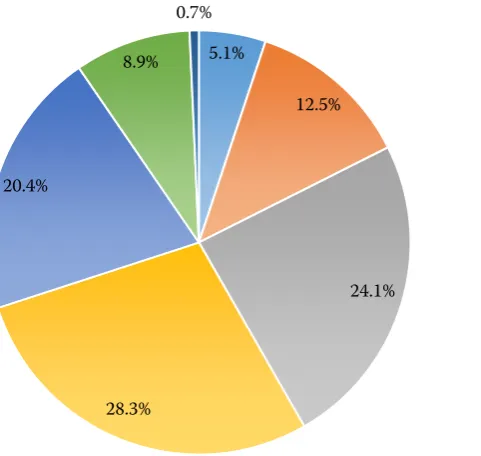
The following diagram (Fig. 2) shows often the respondents to the questionnaire visit forest.
Based on the questionnaire results we can state that 41.7% (343) of respondents visit forest once a week 45.4%
3.9% 35.5%
1.7% 4.4% 1.1%
6.6%
1.2% 0.2%
Conservation and protection
Climate change
Environ. issues, forest health, pollution
Recreation
Economic use and suitainable forest management
Deforestation
Ecosystem services
Do not know
[image:4.595.94.301.98.321.2]Others
Fig. 1. The level of importance of topics related to forest
5.1%
12.5%
24.1%
28.3% 20.4%
8.9% 0.7%
4 times or more a week Twice or 3 once times a week Once a week
Once times a month 6–11 times a year Less than 6 times a year I do not visit forests at all
[image:4.595.118.359.505.733.2]at least, 28.3% (233) of respondents visit forest once, twice or three times a month. 29.3% (242) of respon-dents visit forest less than once a month. Only 0.7% (6) of respondents replied that they never visit forest.
From the testing of prepared null hypotheses fol-low these Tables 2–6.
To meet the chi-square test assumptions, original questionnaire categories “is getting better a lot” and “Is getting better to some extent” were aggregated to “Is getting better”. In the same way original catego-ries “Is getting worse to some extent” and “Is getting worse a lot” were aggregated to “Is getting worse”.
The Pearson chi-square test statistics is 18.688 (at six degrees of freedom), p-value is 0.005. This was compared with the level of significance 0.05. Be-cause the p-value is smaller than the level of signifi-cance, the null hypothesis about “independence” was rejected. The dependence of respondents’ view on forest condition on the forest density of a region
where they have their permanent domicile, was confirmed.
Based on test results, with chi-square test hav-ing the value 3.667 and p-value was 0.722, the null hypothesis H2 is not rejected. Respondents’ view on causes of damage and threat to forest does not de-pend on the forest density of the region where they originally come from.
Based on research results (p-value is smaller than alfa 0.05) the relationship between gender and in-terest to learn more about well-balanced approach to forest protection. Females expressed higher level of interest to learn more about well-balanced ap-proach to forest protection and its use. Therefore the null hypothesis H3 is rejected.
[image:5.595.66.533.127.224.2]The hypothesis H4 that there is no relationship between the age and respondent’s interests in for-est condition was not at the level of significance 0.05 rejected. The value of the chi-square test Table 2. The relationship between respondents’ view on forest condition and the forest density of a region where they have their permanent domicile
Forest density Forest condition Total
Is improving the same stable Is deteriorating I do not knowIs staying
Least forested regions 63 63 182 19 327
Medium forested regions 63 82 256 8 409
Most forested regions 21 24 38 5 88
[image:5.595.62.533.535.641.2]Total 147 169 476 32 824
Table 3. The relationship between respondents’ view on causes of damage and threat to forest and the forest density of a region where they originally come from
Forest density
View on causes of damage and threat to forest
Total Harvesting
and improper management
Storms
and forest fires Wild animals
Invasive species, Other and I do not know
Least forested regions 195 59 7 66 327
Medium forested regions 244 77 5 83 409
Most forested regions 56 18 0 14 88
Total 495 154 12 163 824
Table 4. The relationship between respondents’ interest to learn more about well-balanced approach to forest protection and use, and gender (1 – not important at all, 2 – small importance, 3 – average, 4 – important, 5 – very important)
Gender Scale Total
1 a 2 3 4 5
Male 67 87 79 58 291
Female 68 184 168 113 533
[image:5.595.67.533.686.758.2]was 13.301 and p-value was 0.149. From these fig-ures follows that respondents’ interest in forest condition does not depend on the age.
For the last tested null hypothesis H5 individual answers concerning the frequency of forest visits were aggregated to two categories only: the cate-gory „Often“ covers original categories 1–3 (once a week at least) and the category „Rarely or never” includes original categories 4–7 (from the frequen-cy “less than once a month” to the answer “never”. To the calculated statistics chi square (24.32) cor-responds p-value smaller than 0.001. At the level of significance 0.05 the null hypothesis H5 can be rejected. The frequency of forest visits depends on the forest of the region where they have their permanent domicile. Only 33.3% of respondents from the least forested regions visit forest “Often”, in medium forested regions it is 44.6% of respon-dents and in the most forested regions it is 61.4% of respondents.
disCussion
The questionnaire research results showed that people in the Czech Republic consider in relation to forest as the most important topics forest conserva-tion and protecconserva-tion (45.5%) and the problems con-nected with environment, health forest and air pol-lution (35.5%).
According to Sklodowski et al. (2013) people perceive as the most important function of forest forests to be a habitat for plants and animals as well as a place for recreation. Therefore, they consider as the most important task of forestry the conservation of biodiversity and landscape (Pastorella et al. 2016). Even though recreation as the most important topics in relation to forest as stated only by 1.1% re-spondents in the Czech Republic, research in neigh-bouring countries confirmed the irreplaceable rec-reational role of forest for inhabitants (Sklodowski et al. 2013; Dobsinska, Sarvasova 2016).
[image:6.595.64.530.126.222.2]From the research followed relationship between the respondents’ view on forest condition and the forest density of the region where they have their permanent domicile. It is understandable that peo-ple living in the vicinity of forests can – owing to a better access to forests – manifest better aware-ness of forest condition in their surroundings and they perceive forest, forest management and forest rules more sensitively. Local people perceive forest and its functions in a different way from those who visit forests for recreational purposes. Really strong relationship between people (or more respectively local community) and forest is especially strong in mountainous areas whose inhabitants perceive the vicinity of forest as an integral part of surroundings they live in. However, they face here a rather high frequency of visitors who often use forests solely for recreational purposes (De Meo et al. 2015). Table 5. The relationship between respondents’ interest in forest condition and the age of the respondents (1 – not important at all, 2 – small importance, 3 – average, 4 – important, 5 – very important)
Age (years) 1 a 2 3 Scale 4 5 Total
15–29 35 59 48 40 182
30–39 32 63 89 77 261
40–59 31 59 51 47 188
60 and more 27 63 57 46 193
Total 125 244 245 210 824
Table 6. The relationship between respondents’ forest visit frequency and the forest density of a region where they have their permanent domicile
Forest density Frequency Total
rarely or never often
Least forested regions 218 109 327
Medium forested regions 229 180 409
Most forested regions 34 54 88
[image:6.595.63.530.670.756.2]Nevertheless, there emerge some tension among forest visitors as well: The reason is simple: they on the one hand require adequate facilities and condi-tions for their recreation, on the other hand they desire for the forests not to be visited by a lot of other people as less frequent visits would preserve in forest higher feeling of nature.
Moreover, the research showed that the forest den-sity of the region where people live depends on their forest visit frequency. Approximately 70% respon-dents from the Czech Republic stated that they visit forest rather often, e.g. at least three times a month or more frequently. In this respect, in comparison with the research carried out in 2009 (Rametstein-er et al. 2009) th(Rametstein-ere occurred a change in the Czech public’s forest visit frequency: then nearly 17% of respondents answered that they visited forest very often or rather often, e.g. once a week at least but 56.0% of respondents stated that they visited forest very rarely (e.g. once or twice a year) Riedl (2010). In the research carried out in 2018 only 10.0% of re-spondents declared that they never visited forest or if they did it was less than twice a year.
People perceive threat to forest and possible causes of damage to them as well. As the most im-portant cause of damage and threat to forest is con-sidered forest harvesting and management (60.0%), as the second, but already far less important cause the respondents declared storms (16,6%). The same main causes of damage to forest in the Czech Re-public showed research by Sadecky et al. (2014) or Riedl (2010). Even though damage caused by fire or insects can contribute to natural dynam-ics of forest health, the interaction of increasing temperatures, drought, original insect species and pathogens or deadly forest fires has led to the big-gest death of forest (Millar, Stephenson 2015). In the last few decades the awareness of the ques-tions of environment in forestry has been increas-ing as a result of changes in environmental educa-tion. (Dobsinska, Sarvasova 2016). However, riedl (2010) points out that the image of forestry and forest management is being influenced by in-formation from mass media and other sources. Neverthelesss he warns that people are not able to evaluate mediated information objectively.
The questionnaire research proved that respon-dents’ interest in forest is related to responrespon-dents’ age. Therefore it is clear that forest visitors repre-senting all age categories consider as the most im-portant forest conservation and protection (45.8%),
which in comparison with the ECORYS research is 6.0% less than in 2009 (Rametsteiner et al. 2009). On the other hand, respondents’ interest in environ-ment, forest health and air pollution rose (35.7%). This is perspicuous as this is a global topic which together with climate change has been becoming more and more important. Respondents are well aware of the fact that unless forest is healthy it will not be able to comply with its functions adequately.
ConClusions
The protection of environment has been one of the most urgent problems of the 21st century and
attitude proves that the respondents are not indif-ferent to the way in which forests are handled. Not only politicians but forest owners (among them the Czech state) as well should be aware of this fact, as they have principal responsibility for the protec-tion and management of forest and the use of its great potential. In future, more attention should be paid to communication among forest manag-ers, politicians and general public. The fact that the majority of public consider (based mainly on infor-mation from mass media) poor forest management to be the most frequent cause of threat to forests, might not reflect the reality that not all the forest owners manage their forests poorly or only exploit them but that they campaign for the protection and renewal of forest.
References:
Agresti A. (2013): Categorial Data Analysis. Hoboken, John Wiley and Sons: 78.
Bethmann S., Simminger E., Baldy J., Schraml U. (2018): For-estry in interaction. Shedding light on dynamics of public opinion with a praxeological methodology. Forest Policy and Economics, 96: 93–101.
Ciccarese L., Mattsson A., Pettenella D. (2012): Ecosystem services from forest restoration: thinking ahead. New Forests, 43: 543.
De Meo I., Paletto A., Cantiani M. G. (2015): The attractive-ness of forests: Preferences and perceptions in a mountain community in Italy. Annals of Forest Research, 58:145–156. Dobsinska Z., Sarvasova Z. (2016): Perceptions of forest own-ers and the general public on the role of forests in Slovakia. Acta silvatica et Lignaria Hungarica, 12: 23–34.
Fady B., Cottrell J., Ackzell L., Alía R., Muys B., Prada A., González-Martínez S. C. (2016): Forests and global change: what can genetics contribute to the major forest manage-ment and policy challenges of the twenty-first century? Regional Environmental Change, 16: 927–939.
Hunziker M., Freuler B., Von Lindern E. (2011): Erholung im Wald: Erwartungen und Zufriedenheit, Verhalten und Konflikte. Forum für Wissen, 2011: 43–51.
Lindner M., Kolström M. (2008): Impacts of climate change in European forests and options for adaptation. Report to the European Commission Directorate-General for agriculture and Rural Development. Available at https://ec.europa.eu/ agriculture/sites/agriculture/files/external-studies/2008/ euro-forests/full_report_en.pdf (accessed May 22, 2019). Millar C.I., Stephenson N.L. (2015): Temperate forest health in
an era of emerging megadisturbance. Science, 349: 823–826. Pastorella F., Giacovelli G., Maesano M., Paletto A., Vivona
S., Veltri A., Pellicone G., Scarascia Mugnozza G. (2016): Social perception of forest multifunctionality in southern Italy: The case of Calabria Region. Journal of Forest Science, 62: 366–379.
Pejcha J., Šišák L. (2010): Analýza příčin minimální návštěvnosti lesa ve vybraných lokalitách v České republice. Zprávy lesnic-kého výzkumu, 55: 68–75. (in Czech with English abstract) Perugini L., Vespertino D., Valentini R. (2012) Durban Climate
Conference: new perspectives on forests. Forest@ - Rivista di Selvicoltura ed Ecologia Forestale, 9: 1–7.
Rametsteiner E., Eichler L., Berg J. (2009): Schaping forest communication in the European Union: public perceptions of forests and forestry. Final Report. Rotterdam, ECORYS. Available at http://ec.europa.eu/agriculture/fore/publi/ public-perception/report_en.pdf (accessed Oct 25, 2018). Riedl M. (2010): Marketingový pohled na výsledky výzkumu vnímání lesa a lesnictví. Zprávy lesnického výzkumu, 55: 1–9. (in Czech with English abstract)
Ritter E., Dauksta D. (2013): Human-forest relationships: anfcient values in modern perspectives. Environment, Development and Sustainability, 15: 645–662.
Sadecký D., Pejcha J., Šišák L. (2014): Analýza názorů veřejnosti na les a lesní hospodářství v Chráněné krajinné oblasti Žďár-ské Vrchy. Zprávy lesnického výzkumu, 59: 11–17. (in Czech) Skłodowski J., Gołos P., Skłodowski M., Ożga W. (2013): The
preferences of visitors to selected forest areas for tourism and recreational purposes. Forest Research Papers, 74: 293–305. Šišák L., Sloup R. (2010): Škody působené návštěvníky lesa na lesních porostech, pozemcích a infrastruktuře v lesích České republiky. Zprávy lesnického výzkumu, 55: 90–97. (in Czech with English abstract)
Trumbore S., Brando P., Hartmann H. (2015): Forest health and global change. Science, 349: 814–818.