Abstract— This work presents an analysis about the impact of the human error on the risk reduction actions. This paper shows the dynamic in the human error within the maintenance process like is followed in the nuclear industry around the world. The conclusions show the importance of the background knowledge of the maintenance staff and the relevance of the sequence of the risk reductions actions included in the maintenance tasks.
Index Terms—human error, maintenance, risk reduction, nuclear power plants.
I. INTRODUCTION
Following to Rigby [1] “the human error as any member of a set of human actions that exceeds some limit of acceptability”. The tolerance may be defined clearly or not. The tolerance may be explicit or implicit in the maintenance procedures if it is possible. But in none case the human error imply a deliberated actions to damages the production, assets, personnel, public or environment [2,3].
The maintenance modelling put the focus at the beginning on the machinery [4-6]. The next stage was focused on the optimization with the modern power of calculation from the modern computer [7-10], and the last stage included the modern metaheuristics like genetic algorithm [11-12].
By on the other hand the human error raise like a necessity of show the potential of the unwanted actions on the systems. Three generations are identified on this matter. The first generation began in 1964, Swain developed THERP, Technique Human Error Rate Prediction [2] and a year after SLIM appears (Success Likelihood Index Methodology) [13]. The second generation includes in 1998 CREAM [14] (Cognitive Reliability and Error Analysis Method) introduced by Hollnagel and relevant member of this group rise in 2000 when is presented ATHEANA [15-16] (A Technique for Human Event Analysis) by the Nuclear Regulatory Commission at USA. However in 1994 the first member of the third generation is presented by Kirwan et al., NARA [17] (Nuclear Action Reliability Assessment).
Manuscript received March 23, 2013; revised April 16, 2013. This work was supported in part by the CONICET (Consejo Nacional de Investigaciones Científicas y Técnicas) and SeCTyP (Secretaría de Ciencia, Tecnolgía y Posgrado) of the Universidad Nacional de Cuyo, Argentina.
J.E. Núñez Mc Leod is with CONICET and Engineering Faculty of the Universidad Nacional de Cuyo, Mendoza, CO KFA5502, Argentina (phone: +54 261 4135000 ext. 2135; fax: +54 261 4380120; email: [email protected]).
S.S. Rivera is with Engineering Faculty of the Universidad Nacional de Cuyo, Mendoza, CO KFA5502, Argentina (phone: +54 261 4135000 ext. 2135; fax: +54 261 4380120; email: [email protected]).
These methods are only a few, but it is a demonstration of the Human Error Analysis is a discussion still open. The considerations about human error in this work pretend to add a new perspective about the context in Nuclear Power Plants (NPP) Maintenance.
II. HUMAN ERROR
The human error could be classified in Error of Omission (EOO) and Error of Commission (EOC) [3]. In the EOO one or more steps within a procedure are loss, but not intentionally by the technician. The technician does not warn the loss of the steps. The reasons include bad written procedures and stress. In the EOC the procedure is intentionally changed by the technician. The technician believes that the modified method is better than the original. He believes that the modified procedure has better performance too. [18]. But in this last case a new safety analysis for the changed procedure is not done and the modification could imply on the safety issues of the NPP.
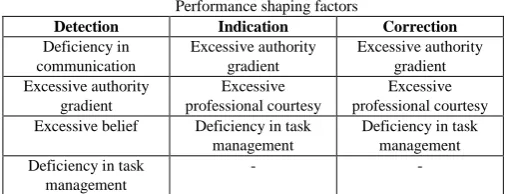
[image:1.595.298.552.529.626.2]In [18] the necessity of a supervisor is demonstrated with a model based in historical field data from US NPP. But the presence of the supervisor does not ensure that errors do not occur. K. Sasou & J. Reason in [19] showed as the error detection, error indication and the error correction is provided by a number of factors. These factors are called performance shaping factors, PSFs. The table 1 resumes some of those in [19].
TABLE I Performance shaping factors
Detection Indication Correction
Deficiency in communication
Excessive authority gradient
Excessive authority gradient Excessive authority
gradient
Excessive professional courtesy
Excessive professional courtesy Excessive belief Deficiency in task
management
Deficiency in task management Deficiency in task
management
- -
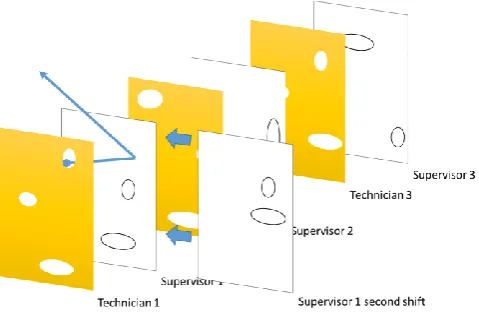
In 1990 J. Reason [20] had submitted their “Swiss cheese model” to clarify the dynamics of the progress of faults in monitored actions leading to an accident. The Fig. 1 shows this model for 3 technicians work alone. In this figure the holes represents the EOO and EOC during a procedure. The slices represent one procedure done by the technician. Three single procedures related between them are showed. When three holes are aligned the accidental sequences is developed
Human Error on the Risk Reduction Actions
during the NPP Maintenance
Fig. 1. Model for 3 technicians with EOO and EOC indicated as holes in the slices of cheese. The alignment of those holes facilitates an accidental sequence.
III. MODEL HUMAN ERROR WITH THERP
THERP [3] uses conventional reliability technology with adaptations to the uncertainties and interdependencies of human performance. THERP model the human behavior in a Boolean graphic. The right branches represent the erroneous actions and the left branches the successful action. And the actions indicated with dash lines are for the recovery actions. In general area associated to control actions by supervisors. All probabilities, except those in the first branching, are conditional probabilities. Fig. 2 shows an example of this Boolean graphics.
Fig 2. Model human error using THERP. A bold dot and the arrows were included to clarify the sequences.
In order to develop an analysis must define the system failure, list and analyze the related human operation, estimate the error probabilities for each one and finally estimate the effects of human errors on the system.
IV. CONCEPTUAL MODELING I
Our problems are three procedures that require the intervention of mechanical, electronic and, instrumentation and control maintenance task force. The three procedures are done sequentially and in a disjoint way each other. The order at first is not relevant.
[image:2.595.45.293.50.188.2]We will use the Swiss cheese model to model our problem in a conceptual way. The Fig. 3 shows the model with a right design of the controls (barriers).
Fig. 3. Model for 3 technicians and 3 supervisors. The design works right.
The design of the tasks include the probabilistic safety assessment to design a low risk tasks, well writing procedures, training for the technicians and the supervisors and adequate maintenance management at least [21-23].
One of the primary objectives of a probabilistic risk, or safety, assessment is identify and evaluate risk reduction actions (e.g. training, inspection program, check redundancy, diversity in checklists for selfcontrol, work hour limits, better coordination, quality assurance management, etc.). This actions must be included as part of a normal maintenance or operation of the NPP. So the EOO and EOC must be discovered and analyzed before that the procedures are released.
The EOO is more aligned with the poor writing procedures or checklist off. The EOC depend strongly with the management and the degree of improvisation of the technicians and supervisors within the policy of the organization. So, the Fig. 3 is dynamically changed when the supervisor 1 is replaced with the supervisor 1 for the second shift due to an illness. See Fig. 4.
Fig. 4. The graphic shows the replace of the supervisor 1.
Note that the supervisor 1 for the second shift has different EOO or EOC with him. These may be due to a different training, background, historical events in his professional life and/or experiences in the facility and so on.
[image:2.595.306.549.51.213.2] [image:2.595.47.292.399.518.2] [image:2.595.306.546.494.652.2]Fig. 5. The graphic shows the consequences of the supervisor change.
V. CONCEPTUAL MODELING II
One more time there are three procedures that require the intervention of mechanical, electronic and, instrumentation and control maintenance task force. The three procedures are done sequentially and in a disjoint way each other. The order at first is not relevant but in this case the problem now is focusing on supervises a maintenance task to avoid the EOO and/or EOC from the mechanical technician.
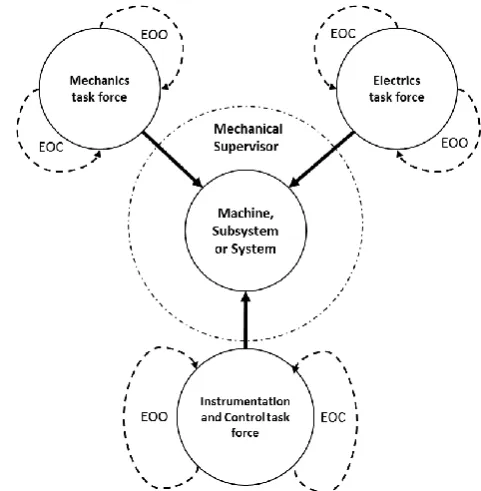
[image:3.595.299.549.55.336.2]The Fig. 6 shows a conceptual graphic where in the middle is the machine, subsystem or system, around the machine are located the different task forces (mechanical, electrical and, instrumentation and control). The precedence between them is showed by arrows in a clockwise. The mechanical task is the first task of maintenance. In Fig. 6 the maintenance is done without supervision due to this the EOO and/or EOC impact straightly to the machine.
Fig. 6. Maintenance on a machine without supervision.
The Fig. 7 shows the same intervention, but now with supervision. In this case the EOO and/or EOC are limited to the previous intervention tasks. The supervisor plays a relevant role in the containment of the propagation of the
error over the machine.
Fig. 7 Maintenance on a machine with supervision in the mechanical maintenance. The precedencies were hidden for clear the graphic.
Finally the Fig. 8 shows the intervention the supervisor when the maintenance tasks were finished.
Fig. 8 Maintenance on a machine with supervision in the mechanical maintenance when the supervisor arrives when the maintenance tasks were finished.
[image:3.595.307.548.402.648.2] [image:3.595.47.286.424.698.2]the technician). These other sources are not available for all cases (e.g. manual calibration of inner parts).
VI. MODELING
Model with THERP the first step in the procedure of a mechanical maintenance task and the final task when the machinery setup previous to run it. Fig. 9 shows the THERP model without supervision.
F1
S1 F2
erroneous setup equipment to maintenance
[image:4.595.298.549.67.262.2]fail to restore
Fig. 9. The THERP model shows the Boolean model from the technician without supervision.
The task begins with the setup the equipment to the mechanical maintenance tasks. These tasks may be at least one or more, the complexity depends on the machinery, subsystem or system. The specific procedure of mechanical maintenance is not included here for clarity. After the mechanical maintenance tasks were done the last step is the restoration the machine previous to run it.
In the model exists two possible sequences for failure and only one to successful.
Note that the model does not include any recovery actions, due to these require the presence of the supervisor or special reevaluation of the situation by the technician that in this case was not taken into account.
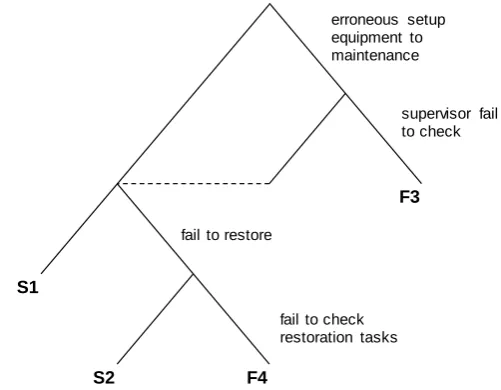
Fig. 10 shows the same procedure but now with supervision. Note that rise a recovery action due to the presence of the supervisor and additional check for the restoration tasks.
In this model, persist two sequences of failure; but the first incorporates a recovery action and the second additional control. Due to this, the model has two successful sequences. Similar sequences were calculated in [26] where the human error probabilities without supervision was equal to 5.05x10⁻¹ and the human error probabilities with
supervision was equal to 1.009x10⁻¹. Improvement in the
probability of error is a factor 5.
The EOO and EOC are hidden in the model associated with real data from the NPPs. It is not a clear way to present the analysis. But not in all cases data help to expose the EOO or EOC.
F3
S1
S2 F4
erroneous setup equipment to maintenance
supervisor fail to check
fail to restore
fail to check restoration tasks
Fig. 10 THERP model with a technician supervised.
VII. DISCUSSION
Comparing the exposed results of conceptual models with the THERP models it is clear the difficult of translate to a quantifiable model the complexity of the possible interactions in the maintenance areas.
The dynamic of the interactions between the technician and the supervisor is not simple to model in a one model. Several models are necessary for accomplish a fulfill vision of the maintenance EOO and EOC.
Risk reductions actions from probabilistic safety assessments represents a right guide to reduce the risk in the maintenance tasks. But due to the model may not include the whole picture of the maintenance staff interactions is not a simple way to accomplish the fulfill vision.
Human error reevaluated in this work is an effort to extend the knowledge around the concept of Human Error Hotspots (HEH) [27]. The HEH results in a clear and relevant concept for itself and from the Human Error in general. So, the HEH results every time as a trigger of an accidental sequence like the examples shown.
Several accidents in nuclear industry [28-32] and others in the chemical industry [33-34] includes several examples of HEHs, these historical events give to HEH their relevance.
VIII. CONCLUSIONS
On the basis of exposed models and its correlation with daily activities on the maintenance tasks it is concluded that: 1. Collecting and analyzing events and take decision in accidental situations and retrain with this knowledge to all the staff.
2. All maintenance staff should possess the same theoretical and practical knowledge of the plant.
3. An analysis must be made of decisions taken and show items theoretical and practical that endorse the decisions taken.
[image:4.595.45.288.178.343.2]those decisions, by clarifying cases in which would not be valid them.
5. Groups of technicians and supervisors must rotate its members as well as rotate the shift, in such a way of standardize the knowledge and standardize the management of each shift independently of its members
IX. FURTHER WORKS
Human Error Hotpots, require works for a systematic way to approach the HEH analysis.
REFERENCES
[1] Rigby, L.V., “The Nature of Human Error”, Annual Technical
Conference Transations of the ASQC, American Society for Quality
Control, USA, 1970.
[2] Swain, A.D., “THERP”, SC-R-64-1338, Sandia National Laboratories, Albuquerque, NM, 1964.
[3] Swain, A. and Guttman, H., Handbook on Human Reliability Analysis with Emphasis on nuclear Power Plant Applications. NUREG/CR-1278, ed. N.R. Commission. 1983, Washington, USA. [4] Pierskalla, W.P., Voelker, J.A. (1976). A survey of maintenance
models: The control and surveillance of deteriorating systems. Naval Research Logistics Quarterly, 23, pp. 353-388.
[5] Scarf, P. (1997). "On the application of mathematical models in maintenance". European Journal of Operational Research, 99(3), pp. 493506.
[6] R. Luus, “Optimization of System Reliability by a New Nonlinear Integer Programming Procedure,” IEEE Transactions on Reliability, 1975, 24(1): p. 14-16.
[7] A.K.Dhingra, “Optimal Apportionment of Reliability & Redundancy in Series Systems Under Multiple Objectives,” IEEE Transactions on Reliability, 1992, 41(4): p. 576-582.
[8] Z.Xu, W. Kuo, and H.-H. Lin, “Optimization limits in improving system reliability,” IEEE Transactions on Reliability, 1990. 39(1): p. 51-60.
[9] R.Dekker, “Applications of maintenance optimization models: a review and analysis,” Reliability Engineering and System Safety, 1996(51): p. 229-240.
[10] M. Harunuzzaman and T. Aldemir, “Optimization of standby safety system maintenance schedules in nuclear power plants,” Nuclear Technology, 1996, 113: p. 354-367.
[11] C.M.F. Lapa, C.M.N.A. Pereira, and A.C.d.A. Mol, “Maximization of a nuclear system availability through maintenance scheduling optimization using a genetic algorithm,” Nuclear Engineering and Design, 2000, 196: p. 219-231.
[12] M.Cantoni, M. Marseguerra, and E. Zio, “Genetic algorithms and Monte Carlo simulation for optimal plant design,” Reliability Engineering and System Safety, 2000(68): p. 29-38.
[13] Embrey, D., Humphreys, P., Rosa, E. Kirwan B. and Rea, K., SLIM-MAUD: An Aproach to Assessing Human Error Probabilities Using Structured Expert Judgement, NUREG/ CR-3518, NRC, USA, 1984. [14] Hollnagel, E., Cognitive Reliability and Error Analysis
Method – CREAM, Elsevier Science, Oxford, UK, 1998
[15] NRC, Technical Basis and Implementation Guidelines for A Technique for Human Event Analysis (ATHEANA), Nureg-1624, Rev. 1, USA, 2000.
[16] U. S. Nuclear Regulatory Commission – Sandia National Laboratories, Philosophy of ATHEANA, 1999.Department for Computer Science, University of Paderborn, 2005.
[17] Kirwan, B., Gibson, H., Edmunds, J., Cooksley, G., Kennedy, R., and Umbers, I. (1994). Nuclear Action Reliability Assessment (NARA): A Data-Based HRA Tool.
[18] S.S. Rivera & J.E. Núñez Mc Leod, “Human error of commission modeled with Theory of Games”, Proceedings of the World Congress
on engineering 2007, 2, pp 1117-1122.
[19] K. Sasou & J. Reason, Team errors: definition and taxonomy, Reliability Engineering & System Safety, Vol 65 (1), pp 1-9, Elsevier, 1999.
[20] J. Reason, The Contribution of Latent Human Failures to the Breakdown of Complex Systems, Philosophical Transactions of the Royal Society of London. Series B, Biological Sciences, Vol. 327, No. 1241, Human Factors in Hazardous Situations, pp. 475-484, 1990.
[21] Nuclear Regulatory Commission, PRA Procedures Guide: A guide to the performance of probabilistic risk assessments for nuclear power
plants review. NUREG/CR 2300, Washington: NRC, 1983
[22] International Atomic Energy Agency, Application of Reliability Centred Maintenance to Optimize Operation and Maintenance in Nuclear Power Plants, IAEA-TECDOC-1590, Vienna:IAEA, 2007. [23] P. Kafka, “Probabilistic safety assessment: quantitative process to
balance design, manufacturing and operation for safety of plant structures and systems,” Nuclear Engineering and Design, 1996, 165: p. 333-350.
[24] R.R. Fullwood, Probabilistic Safety Assessment in the Chemical and
Nuclear Industries, 2000, Boston, USA: Butterworth-Heinemann.
[25] Rasmussen, J., “Strategies for State Identification and Diagnosis in Supervisory Control Tasks, and Design of Computer-Based Support Systems”, Advances in Man- Machine Systems Research, Vol.1, Denmark, pp. 139-193, 1984
[26] S.S. Rivera & J.E. Núñez Mc Leod, “Human error management optimization in CAREM NPP, International” Association of Engineering; ISBN 978-988-17012-5-1, London, UK, 2009. [27] J.E. Núñez Mc Leod & S.S. Rivera, “Human Error Hotspots in
Nuclear Power Plants”, Lecture Notes in Engineering and Computer
Science, International Association of Engineering, Newswood,
London, UK, 2011.
[28] Kemeny, j. et al, Report of The President´s Commision on The
Accident at Three Mile Island, 1979, Washington DC, USA.
[29] Mochizuki, H., “Analysis of the Chernobyl accident from 1:19:00 to the first power excursion”, Nuclear Engineering and Design, 237 (2007), pp. 300-307.
[30] NEA Committee on Radiation Protection and Public Health, “Chernobyl Ten Years”, OECD Nuclear Energy Agency, 1995. [31] TECPO (March 22, 2011), url:www.tepco.co.jp/en/index-e.html, last
access March 20, 2013.
[32] METI (March 22,2011), url:www.meti.go.jp/english/index.html, March 20, 2013.
[33] Wilson, D., “Lessons from Seveso”, Chemitry in Britain,pp. 499-504, 1980
[34] Kalelkar, A., “Investigation of Large-Magnitude Incidents: Bhopal as a case study”, Chemical Engineers Conference On Preventing Major