To the Minister for Enterprise & Employment
Pursuant to the Industrial Development Act, 1993, Forfás herewith presents its report and accounts for the year ended December 31, 1998
Do Aire Fiontar & Fostaáochta
De bhun an Achta um Fhorbairt Tionscail, 1993, tá a thuarscáil agus a chuntais don bhliain dar chríoch 31 Nollaig, 1998, a dtíolacadh leis seo ag Forfás.
Tom Toner Chairman
BOARD MEMBERS
Tom Toner Chairman Forfas Peter Cassells General Secretary ICTU Sean Dorgan Chief Excecutive IDA Ireland Dan Flinter Chief Excecutive Enterprise Paul Haran Secretrary General Department of EnterpriseTrade & Employment
Prof. Michael Hillary Chair of
Manufacturing Engineering Trade & Employment
John Lynch Director General FAS
William Murphy Partner Tynan Dillon & Company
Fergal O Rourke Partner,Taxation Pricewaterhouse Coopers
William Scally Economist
Prof. Yvonne Scannel Professor of Law Trinity College
John Travers Chief Excecutive Forfas
David Lovegrove Secretary to the Board
Kieran McGowan Chairman Irish Management Institute Jim O'Mahony Excecutive Chairman Shannon Circuit Technology Oliver Tatten Chief Excecutive Voluntary Health Insurence Board
CHAIRMAN'S STATEMENT
Introduction
As one of the most open economies in the world, in the international economy and as a location for investment - both Irish-owned and foreign-owned – Ireland has to measure up against competitors from all parts of the globe. As 1999 progresses, the world economy continues to suffer uncertainties. Asian recovery is beginning but time will be needed for a full resumption of growth. There are also hopeful signs of the containment of the difficult
economic situation in many Latin American countries. The United States economy continues to grow rapidly and to provide a stimulus to the world economy as a whole though doubts remain as to whether the United States can continue for much longer as the main engine of international economic growth. In spite of the successful launch of the euro, on 1 January 1999, growth in the EU economy is modest and unemployment remains high so that the value of the euro has declined relative to sterling and the $US.
By contrast, Ireland's economy continues to out-perform the rest of the EU and, indeed, most other countries in the world. Strong export growth has been a key component of the rise in employment and real incomes.
However, recent success cannot be sustained unless full account is taken of the key competitiveness factors for the future. Investment in Ireland, whether by Irish-owned or foreign-owned firms, will continue only as long as the right policies, institutions and
infrastructure are in place to support enterprise success in a fiercely competitive world. There are signs of overheating and of infrastructural and labour-force constraints emerging in the Irish economy – in many ways a consequence of the success achieved. The relative strength of sterling, which has been of major benefit to Irish-owned enterprises in particular, will not continue indefinitely. The focus of enterprise policy, therefore, must be based on a recognition that many of the factors that have supported the successful development of Ireland’s
economy in recent years are now in a state of transition to a less favourable position.
EMU and Competitiveness
On 1 January 1999 the euro became a reality. For Ireland, this represents a profound change. We are now part of the European economic and monetary union, sharing a common currency with 10 other EU member states. The changes already underway as a consequence are significant. Government departments and public bodies (including Forfás) are ready to do business in euro with their suppliers and customers. Many of our large firms are similarly poised to take full advantage of the new currency in doing business across Europe. In this, they reflect a pattern that will expand and grow. Many large European multinationals are making the euro their internal currency from the outset. This will determine the way they do business, not only in Europe, but across the world. On world financial markets, the euro is evolving, not only as a trading instrument, but as a reference point for other currencies and as a pricing mechanism for goods and services originating in other parts of the world.
Europe can be expected as a result of EMU, as firms seek to achieve the benefits of scale in order to reduce costs and achieve increased market share.
These trends provide new opportunities for Irish firms, including the prospect of building new partnerships across Europe to exploit the potential of the single market that EMU provides.
The euro is managed by the European Central Bank, and Ireland is represented in its
decision-making and control of the currency. However, some traditional instruments of macro-economic policy at national level - the interest rate and the exchange rate - are no longer available. This means that any decline in competitiveness of Irish enterprises relative to those in other countries cannot be compensated for by a devaluation. This, in turn, means that other instruments to improve competitiveness at a national level become all the more important. We have to focus particularly on all the possible ways in which national policy can improve the productivity and innovative capability of our enterprises. The policy focus has to be on a wide competitiveness agenda. While it is individual enterprises that compete against one another, it is national policy, in the areas of education, skills development, infrastructure, R&D,
environment, regulation and competition and the quality of public administration, that
determine, to a large extent, the capacity of enterprises to compete successfully and to grow and thrive.
It is also essential, in considering competitiveness, to realise that policy cannot be set in stone. The pace of change in the world economy is accelerating. New technologies continue to emerge and product lifecycles continue to shorten. The growth of e-commerce, in
particular, is having profound effects on the way producers and consumers relate to one another, and it is playing a growing role in international trade with consequent changes in logistics. Policies and investment choices at a national level have to be monitored, reviewed, and updated continually, if competitiveness is to be sustained.
In particular, the Irish economy, if it is to continue to grow, will need to create, develop and attract firms which are research or technology-based and which can apply and trade in new technologies.
World Trade Negotiations
Ireland's external trade performance has long been the keystone of our economic success. In 1998 the growth of Irish exports over 1997 exceeded 25 per cent in value terms and the increase in the performance of locally controlled exporting companies was over 10 per cent. While this performance will be difficult to sustain in the medium to long-term, it is nonetheless remarkable in a climate where world trade is estimated to have expanded by less than four per cent.
Irish exporters have benefited greatly from the freedoms brought about by the successful conclusions of the Uruguay Round of multilateral trade negotiations in 1994 and the
subsequent work of the World Trade Organisation. These developments, combined with the consolidation of the Single European Market and the emergence of a large single currency area within EMU, have served to underpin success.
A new round of multilateral negotiations - 'The Millennium Round' – is scheduled to
commence in November 1999 in Seattle. This Round will have a significant impact on Irish business, both importers and exporters. As an open, trading economy a continued reduction in tariffs is generally in Ireland's interest but the balance of advantage will vary between sectors, both within Ireland and across EU countries. This is particularly the case in areas such as agriculture, textiles and some elements of financial services including insurance.
the issues which will affect Irish business are related to trade and the environment, trade in services, trade and investment and market access by developing countries.
Any of these issues can have a significant impact on Irish trade and investment and, consequently, on how the Irish economy grows over the next decade and beyond.
The objective of Ireland in the WTO negotiations must, therefore, be to ensure that the outcome contributes to the success of the Irish economy.
EU Issues
In addition to the lead-up to Ireland joining EMU on 1 January 1999, the year saw significant developments at EU level in the areas of taxation, state-aids, structural funds, enlargement and Research and Development programmes which will have a major impact on enterprise development in Ireland in future years. Key developments included:
• Agreement was reached with the European Commission on the phasing out of the 10 per cent corporation tax rate for manufacturing and certain related activities and the phasing in of a 12.5 per cent corporation tax rate which will apply to all trading income from 2003.
• The new regional state-aid guidelines were published by the Commission. They will lead to a welcome downward movement in state aids throughout the Community and, while they will also lower the aid ceilings for Ireland, they will still allow the use of grant aid on a scale appropriate to the development status of the individual regions within the country.
• The decisions arising from the EU Commission’s Agenda 2000 proposals were adopted at the Berlin Summit in March 1999. The decisions recognise the substantial progress made in raising living standards in Ireland in recent years and that, taking that progress into account, support for vital infrastructural and human resource development from the Structural Funds will remain in place at a substantial but reduced level for a further period.
• The immediate and long-term costs of delay in the EU enlargement schedule became clear. Delaying would be a disincentive for Eastern European governments to
continue the road of reform and legal harmonisation, and public sentiment, currently in favour of enlargement, might begin to fade.This would make political decisions in the applicant countries more difficult and complicate the negotiations for the EU. Business clearly favours a set date to fully reap the benefits of enlargement.
The effect of these changes on development policies in Ireland poses a major challenge. We must be prepared to spend more of the fruits of recent economic success in eliminating key developmental bottlenecks such as inadequate infrastructure. In addition, the development agencies will have to reduce and restructure their assistance to industry in order to focus on promoting regional development and higher value-added activities.
The 5th EU Framework Programme for Research and Technology Development (1998-2002) has a budget of 14,960 (IR£11,782) million, which will be disbursed over the next four years on a competitive basis to research teams throughout Europe. The Programme enables organisations in Ireland, in partnership with organisations in Europe and beyond, to compete for funding for specific research which the European Community considers important for competitiveness and quality of life.
National Partnership Agreement
The series of national partnership agreements between unions, employers and governments since 1987 have been a vital ingredient in the recent success of the economy. As a result of this success there is a temptation to become complacent and to forget what has been achieved and what remains to be done. The major achievement has been to staunch, and indeed reverse, the flow of our brightest young people out of the country. Today if people seek work abroad, for the most part they do so voluntarily and with the knowledge that there is the opportunity to return if they wish. We must avoid anything that would endanger this situation.
The virtuous circle, developed under social partnership, of the formulation and implementation of good public policies across the range of areas essential to a successful enterprise sector as the driving force of economic development, and anchored by wage moderation, is under some threat at present. To some extent this arises from a failure to fully recognise how transient economic success can be in a highly competitive international environment if the foundations on which it stands are undermined. It is essential that the social partners and government agree a partnership framework which enables Ireland to maintain its
competitiveness and to respond flexibly to external events. While building on the
achievements of the last decade it must also be consistent with the imperative of a more flexible, dynamic and competitive economy in which there is an equitable sharing of the benefits of growth so that improved living standards are achieved by all sectors of our community.
Acknowledgments
The work of Forfás in 1998 continued to receive significant support from the Tánaiste and Minister for Enterprise, Trade & Employment, from the Department of Enterprise, Trade & Employment and from other Government Departments. I wish to acknowledge this support and its tangible effects in a range of Government publications, policies and activities aimed at the further development of the enterprise sector in Ireland.
I also wish to acknowledge the exceptionally good results achieved by our sister organisations, Enterprise Ireland and IDA Ireland, in 1998 and those of FÁS, Shannon Development and Udárás na Gaeltachta. These results and the pro-enterprise development of public policies put in place across a range of Government Departments could not have been achieved without the sustained support of the third level sector, employer bodies and business organisations, trade unions and the media. This support is acknowledged and appreciated.
As Chairman, I record my thanks and appreciation to my fellow Board members and to the many organisations which contributed to the work of Forfás in 1998 and, in particular, to the National Competitiveness Council chaired by Brian Patterson, the Irish Council for Science, Technology and Innovation (ICSTI) chaired by Dr. Edward Walsh,the Expert Group on Future Skills Needs, which was chaired by Dr. Chris Horn up to April 1999 and the National
Accreditation Board chaired by Dr. Marie Walsh.
I wish to acknowledge the significant support provided by the EU for industrial development and the support of Science and Technology in Ireland through the Operational Programme for Industrial Development and through a range of other programmes which significantly impact on the environment for enterprise.
Finally, I want to thank sincerely the staff of Forfás for their continued dedication, hard work and professionalism throughout the year.
CHIEF EXECUTIVE'S REPORT
Introduction
The past number of years has seen unprecedented progress in employment creation. The success achieved means that the quality of jobs being created, their regional location and spatial distribution move centre stage and become a more central focus of policy.
In an increasingly volatile and competitive global investment environment, high-productivity, high value-added, knowledge-intensive jobs provide the best prospect of employment stability. This requires further development of the evaluation criteria used in assessing projects for state support. A further upgrading of the skills level of the labour-force is also required through the education and training sectors. The implications of a rapidly changing e-commerce sector for the dynamics of enterprise development must be a particular and urgent focus for policy development.
The infrastructural overload and congestion costs in the main urban centres, together with radical changes in communications technology, enhance the prospects for a more balanced regional distribution of economic activity in future years.
The achievement of such a balance in regional development, however, requires a sensible urban settlement framework which makes efficient use of the investment in physical and social capital and avoids the visual, environmental and economic costs of unplanned dispersal and sprawl.
1998 Overview
During 1998 Forfás continued to work closely with Government Departments and Agencies on the development and implementation of a wide range of policy issues supporting the development of the enterprise sector. This work supported the decisions taken by Government in a number of areas important to the development of the enterprise sector including:
• The provision of IR£75 ( 95.23) million to provide an additional 5,400 third level places to increase the supply of skills in information technology;
• The liberalisation of the market for voice telecommunications ahead of schedule in December 1998;
• The provision of IR£12 ( 15.2) million to support a public-private initiative to ensure adequate broadband connectivity;
• The sale of Cablelink to ensure the further promotion of competition in telecommunications-based services;
• The formal decision to introduce a single rate of Corporation Tax with effect from 1 January 2003.
Ireland’s increased employment and strong economic growth are strongly underpinned by the performances of manufacturing and internationally traded service companies. These
companies have continued to increase their expenditure on Irish goods and services, as well as their tax payments to the Exchequer, in recent years. In 1998 the overall corporation tax take amounted to IR£2,065 ( 2,622) million, compared to IR£1,700 ( 2,158.55) million in 1997. Some 45 per cent came from manufacturing, internationally traded and international financial services companies subject to the 10 per cent Corporation Tax and which account for a minority of companies.
Total permanent employment in companies which fall within the actual or potential client base of IDA Ireland, Forbairt/Enterprise Ireland, Shannon Development and Údarás na Gaeltachta reached a new record level of 278,000 by year end 1998 - an increase of 5.4 per cent over the year.
Employment in manufacturing in the ten-year period 1989 to 1998 grew by over 17 per cent and by 15 per cent over the most recent five-year period. These are among the highest growth rates for any country in the world and represent an excellent performance by both Irish-owned and foreign-owned business.
During 1998 also, Forfás continued to discharge its statutory role of advising the Minister for Enterprise, Trade & Employment on matters relating to the development of industry and science and technology. This was achieved through close working arrangements with the Department of Enterprise, Trade & Employment and other Government Departments and State Agencies, the preparation of a series of reports and submissions, both published and unpublished, and direct participation in policy analysis and development with Government Departments.
Reports published by Forfás in 1998 included:
• Broadband Telecommunications Investment in Ireland
• Responding to Ireland's Growing Skills Needs - First Report of the Expert Group on Future Skills Needs
• Basic Research Support in Ireland - An Evaluation of the Basic Research Grants Scheme Operated by Forbairt
• Annual Survey of Irish Economy Expenditures
• 1997 Employment Survey
• Partnership for Success : Collaboration for Innovation and Competitiveness : Report on 3rd National Forfás Innovation Conference
• State Expenditure in Science & Technology, 1998
• In conjunction with the Irish Council for Science, Technology & Innovation (ICSTI):
- Statement on the Government’s £250 Million Scientific and Technological Education (Investment) Fund
- A Partnership Approach to Research Funding – the Need for a National Science and Engineering Research Fund
- Statement on Science in Primary Schools
- Mechanisms for Prioritisation of State Expenditures on Science and Technology
- Innovation in Enterprises in Ireland
- Statement on State Expenditure Priorities in Science & Technology for 1999
• In conjunction with the National Competitiveness Council (NCC):
- Annual Competitiveness Report 1998 - The Competitiveness Challenge
- Statement on Telecommunications: A Key Factor in Electronic Commerce and Competitiveness
- Statement on Skills
In 1998, Forfás continued its role of co-ordinating the work of the development agencies - FÁS, Enterprise Ireland, IDA Ireland and Shannon Development -through a series of formal and informal working arrangements and by undertaking a number of surveys and analyses of performance essential to policy formulation and development. The National Accreditation Board (NAB), which operates as a division of Forfás, effectively discharged a wide range of executive functions involved in the accreditation of laboratories and certification bodies throughout the year.
Outlook and Key Issues
Although economic growth is expected to slow some what in 1999 and beyond, compared with the unprecedentedly high growth rates of recent years, it is likely to remain strong, both by historical and international standards, over the next two to three years at least.
This rate of growth, combined with the recent expansion in employment and reduction in unemployment and emerging tightness in the labour market, points to the need to review certain elements of public policy for the promotion of industry and services during 1999. Forfás is undertaking work to support such a review in conjunction with the review of national development strategy which NESC is undertaking at the request of the Taoiseach.
This review will provide a foundation for negotiations between the social partners on a possible national agreement to follow Partnership 2000. The focus of the Forfás work is on the adaptation of strategy for the enterprise sector to reflect the new realities of recent success, including the inroads made in dealing with the formerly endemic problem of unemployment with its consequential infrastructural and labour-force pressures. Future prospects remain positive, conditional on a reasonably favourable international economic environment and sensible domestic policies.
Technology Foresight Ireland
In the context of preparations for the National Development Plan (2000 to 2006) and the provision of advice to Government on the prioritisation of State expenditure on science and technology, the recent publication of the Technology Foresight Ireland reports by the Irish Council for Science, Technology & Innovation (ICSTI) and Forfás (March 1999) represents an important contribution to the national debate.
The fundamental basis of the rapid development of the Irish economy over the past decade and more lies in the exploitation and use of new technologies. The total value of exports of goods and services, grew from IR£18 ( 22.80) billion in 1991 to IR£48( 60.94) billion in 1998. Over 50 per cent of these exports arise from enterprises in electronics,
telecommunications, healthcare, chemicals, pharmaceuticals and other high-technology sectors.
economy has reached a stage of development where investment in the sources of technological advance through the provision of highly-skilled people and well-focussed research activities will become increasingly important in securing competitive advantage as a location for internationally mobile investment – of both domestic and foreign origin.
The objective of the Technology Foresight work undertaken by Forfás, through ICSTI, over the past year has been to identify the likely sources of future competitive advantage for a strong traded goods and services sector firmly rooted in the Irish economy. The work was undertaken in close consultation with some 200 people deeply knowledgeable across the eight sectors covered by the exercise. Firm recommendations are made on the action required. The financial and high-skill resources needed are significant but should be seen in the context of the total value of traded goods and services, which increased from IR£40( 50.78) billion in 1997 to more than IR£48( 60.94) billion in 1998; an increase of 20%. This is in addition to the fact that exchequer revenue is highly dependent on maintaining a
competitive traded goods and services sector in Ireland.
Skills
Sustaining economic growth into the future is critically dependent upon an adequate supply of suitably qualified people. The Government has established a Business Education Partnership structure to address these issues. Central to this is the work of the Expert Group on Future Skills Needs which Forfás established at the request of the Government and the Minister for Enterprise, Trade & Employment and which brings together the knowledge and expertise of the state development and training agencies, Government Departments and the Business Sector in the area of skills development. The first report of the Group, in 1998, provided a comprehensive analysis of the existing and projected supply and demand situation for skills in the information technology sector in Ireland. It made a series of detailed and practical
recommendations aimed at ensuring a balance between the supply and demand of
information technology related skills. It identified the need for an extra 5,400 third level places in information technology courses. In April this year the Government agreed to the allocation of IR£75 ( 95.23) million to fund the required places.
The Group is now addressing the needs of the economy in relation to certain other skills including craft, life sciences and research skills which will form the basis of a second skills report to be published later in 1999. The approach of rigorous analysis and clear
recommendations followed by speedy implementation has worked well with the support of Government to date and is the approach that will be maintained by Forfás in 1999 and in future years.
Regulation and Competition
The role of Government in the development of the economy and in facilitating the creation of a strong, vigorous and competitive enterprise sector is crucial. The nature of that role has changed significantly over the decades, is changing further and rapidly at present and will continue to evolve in future.
It is also the case, that as the privatisation of activities, once firmly located within the domain of Government ownership, proceeds, there is a need to create clear lines of demarcation between the ownership and regulatory roles of Government.
In Ireland, as in other countries, the role of regulation has evolved quite rapidly in recent years.
The Competition Authority has played an important and seminal role in promoting an
awareness of the importance of competition across wide sectors of the economy and, acting within its legislative remit, in dealing with anti-competitive practices. Because of the radical changes that are taking place in the scope and nature of telecommunications technology and its interaction with other areas of technological and business development, the role of the telecommunication regulator is critical and one where Forfás has, in a number of analytical reports, advocated a strong, statutory, pro-competitive orientation. The role of the newly appointed regulator for the electricity sector is similarly important. In the area of financial regulation the Government is currently reviewing the most appropriate arrangements for future years.
These developments are changing, in a fundamental way, the landscape within which business will be conducted in Ireland in future years. In general, developments under way point towards a more supportive environment for the development of a competitive business sector. It is widely understood that the process of promoting greater competition requires to be more widely and strongly promoted throughout all sectors of the economy, including many traditional sectors in the services sector not subject to the competitive disciplines of
international trade. In the light of the developments taking place and planned there is need to establish greater clarity in relation to the principles which should govern the regulatory process in Ireland, how different regulators can work together in a way which avoids
duplication and operational confusion and on the critical issue of how the regulatory process is made accountable (Quis custodiet ipos custodes?) . Forfás has initiated work in this area during 1999.
Regional Development
The high levels of employment and population growth in recent years have raised the need for a fundamental review of regional policy and population distribution between urban centres within Ireland and including the issues of areas of significant urban deprivation that exist in cities and towns.
Irelands strong economic growth has led to considerable pressure on infrastructure, particularly in Dublin and other major urban areas. While significant growth has occured throughout the country, some ares are experiencing considerable development pressures, while others are operating well within infrastructural and labour-force capacities. At the same time, even in urban centres of overall high growth, there remains areas of significant
deprivation.
In 1998 the issue of regional development and urban strategy within Ireland came to the fore, stimulated by the discussion on the next round of European Structural Funds. The
considerable work undertaken to date by Government Departments and agencies in this area requires to be further developed into a national urban settlement distribution strategy so that the significant investment required in infrastructure and land development can be planned and provided effectively and the considerable resources required efficiently utilised.
To support this approach Forfás has undertaken considerable work on the regional dimension to enterprise sector development including:
• A review of the availability of broadband telecommunications services in the regions which found that market forces alone would not deliver the required regional
provision of resources on a selective basis within the National Development Plan (NDP) currently under preparation (1999) to ensure comprehensive regional coverage of broadband telecommunications facilities;
• A review of the geographical distribution implications of the evolution of EU Structural Funds and regional aid guidelines which led to Forfás recommending a two-region approach for the National Development Plan 2000 to 2006;
• An analysis of regional infrastructure priorities completed earlier in 1999 in close consultation with the development agencies and representatives of enterprises in each region. This analysis has provided specific recommendations for infrastructure priorities in the new NDP;
• Working closely with the Department of the Environment & Local Government to ensure that the Government Bill on Planning and Development, to be published in 1999, addresses the need to provide a fast-track planning approval system.
Infrastructure
During 1998 Forfás worked closely with Government Departments, State agencies and representatives of business in developing proposals for improvements in transport infrastructure. This work included:
• The review of infrastructural priorities at regional level for enterprise development purposes;
• A major study of the requirements of the business sector for air services from Cork and Shannon;
• The launch of the National Institute for Transport & Logistics which was established following Forfás analyses and recommendations to develop a strong logistics sector in Ireland as an essential component of a highly-traded economy.
The unprecedented and unanticipated levels of employment and population growth of recent years have placed significant strains on infrastructural capacity which is, in many areas, struggling to cope with demand at the present time. While high levels of economic growth have brought GDP/capita and GNP/capita in Ireland towards EU average levels, the gap in infrastructural deficits with our more developed EU partners has not been closed to anywhere near the same extent.
The speed, efficiency and effectiveness with which this deficit is tackled will greatly determine the growth trajectory of Ireland’s economy in future years – at both national and regional levels. The institutional capacity to plan and deliver a rapid output in infrastructural capacity will require to be further strengthened in line with the increased demands now arising.
It is essential that the arrangements put in place ensure good value for money from the substantive increase in resources that will be needed and that they work to keep potential inflationary pressures under control. There is undoubtedly a major role for well-organised public private partnerships in meeting the demand for infrastructure within such a framework. The recent announcements and commitment of the Minister for Finance and other
Government Ministers in this area are greatly welcomed and point the way forward.
Electronic Commerce
Electronic commerce is one of the most rapidly expanding areas of business at the present time – another facet of the globalisation of business built upon the convergence of
In Ireland many firms are already advanced in the exploitation of the opportunities which e-commerce provides e.g. in the marketing, sale and distribution of computers, computer software and technical services, administrative business-to-business services and leisure products.
It is essential that Irish business firms are well positioned to exploit the growing opportunities associated with e-commerce on both the business-to-business and business-to-consumer fields. For this to happen a number of actions are necessary:
• Good intelligence gathering by both business firms themselves and by the development agencies of the existing and emerging technical, marketing and distribution services which support e-commerce;
• Raising the level of awareness of business firms of the opportunities that e-commerce represents for both existing and new business activities and also of the threats that it poses for existing businesses that fail to adapt to the fundamental changes in competition that e-commerce brings with it;
• Ensuring that the capacity, accessibility and price of the basic infrastructure needed to exploit the opportunities of e-commerce compare favourably with what is available in other countries. This includes both international connectivity and connectivity within Ireland in telecommunications. This is an area of rapid change internationally where Ireland cannot afford to fall behind and one where Forfás has provided analyses and recommendations in recent years;
• Ensuring that the skills that facilitate a full understanding and exploitation of the opportunities which e-commerce provide are available to business firms. This is primarily the responsibility of business firms themselves but it also requires
adaptation of the education system at all levels in terms of curricula, course content, resource allocations, research and the enhancement of teaching competencies;
• Providing a legal and administrative framework which promotes and supports e-commerce in areas such as electronic government, the incidence and administration of taxation and the accreditation of encryption and electronic signatures.
During 1999 Forfás is preparing an overall strategy for the development of e-commerce in Ireland under the guidance of a steering committee chaired by the Department of Enterprise, Trade & Employment with representatives of business, the trade unions and the development agencies.
AN OVERVIEW OF 1998
1. Introduction
1998 was the fifth successive year of very strong economic growth. GNP is estimated by the CSO to have increased by over 8 per cent in real terms in 1998. Growth was well balanced with significant contributions from both domestic demand and net exports. Despite strong growth, inflation remained moderate, averaging two per cent per year between 1994 and 1997 and rising to an estimated 2.4 per cent in 1998. Within the EU, Ireland’s inflation level was higher than the EU average. Using the internationally comparable Harmonised Index of Consumer Prices (HICP), average annual inflation in Ireland in 1998 was 2.2 per cent, compared with an EU average of 1.3 per cent. This points to the need for close monitoring of the underlying factors that could contribute to inflationary pressures and undermine
competitiveness.
2. Employment
Overall Employment and Unemployment
[image:14.595.125.469.423.691.2]
In their May 1999, Quarterly Economic Commentary, ESRI have estimated that the increase in the average level of employment for 1998 over 1997 was 77,000. The standardised rate of unemployment fell from 9.8 per cent at the end of 1997 to 7.7 per cent at the end of 1998. One of the most encouraging features has been the sustained reduction in long-term unemployment, which fell from 90,200 in November 1997 to 51,700 in November 1998, a decline of 42.6 per cent over this period (Source: CSO and Ireland-Stability Programme 1999 to 2001).
Figure 1
Trends in Full Time Employment 1989 - 1998
Manufacturing, Internationally Traded and International Financial Services
(IDA Ireland,Enterprise Ireland, Shannon Development and Údarás na Gaeltachta)
Source: Forfás Annual Employment Survey 1998
In companies under the remit of Enterprise Ireland, IDA Ireland, Shannon Development and Údarás na Gaeltachta there was a net increase of 14,300 (5.4 per cent) in permanent full-time jobs in manufacturing, internationally traded services and international financial services in 1998.
Figures contained in the Forfás Annual Employment Survey 1998 show that most of the net growth in employment has occurred in internationally traded and financial services sectors. These sectors accounted for just over 8,700 (61 per cent) of the net permanent full-time jobs created. Manufacturing accounted for 5,600 (39 per cent) of the net increase in employment, which is a very good performance by international standards.
IDA Ireland and Enterprise Ireland
Full-time employment in companies assisted by IDA Ireland and Enterprise Ireland rose by almost 13,000 (5.5 per cent) in 1998, bringing the total employed in these companies to 250,000. Job gains in permanent full-time employment amounted to over 28,000 in 1998, of which just over 24,000 were new first-time jobs, the highest level achieved over the past ten years. Irish-owned companies accounted for just under 12,200 of the total job gains.
International and financial traded services showed the biggest percentage gains, increasing by 28 per cent to a total of 35,100 in 1998, following an equally substantial increase of 26 per cent in 1997.
Job losses increased by almost 21 per cent in 1998 to over 15,600, the highest level recorded since 1992, arising from the impact of international market conditions on overseas companies in particular.
For the second year in succession two sectors, metals and engineering (including electronics) and internationally traded services, accounted for over 90 per cent of the net change in employment recorded in 1998.
The East Region accounted for 56 per cent of the net increase in jobs, compared to 70 per cent in 1997.
Cost Per Job
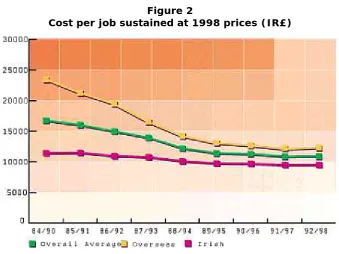
The average cost of each job created and sustained over a seven-year period for IDA Ireland and Enterprise Ireland-backed companies was maintained at last year's level of
Figure 2
Cost per job sustained at 1998 prices (IR£)
Source: Forfás
Note: The cost per job sustained is calculated by taking into account all Enterprise Ireland and IDA Ireland expenditure to all firms in the period of calculation.Only jobs created during, and sustained to the end of, each seven year period are credited in the calculation
The above graph relates to the following table.This shows values in Irish Pounds and euro equivalents.All Conversions to euro were made using the irrevocably fixed conversion rate (1 euro= 0.787564 Irish pounds).
Cost Per Job Sustained at 1998 Prices
Irish Overseas Overall Average
IR£ IR£ IR£
1984/1990 11,419 14,499.14 23,475 29,807.10 16,768 21,290.97 1985/1991 11,476 14,571.51 21,477 27,270.16 16,028 20,351.36 1986/1992 10,948 13,901.09 19,707 25,022.73 14,998 19,043.53 1987/1993 10,777 13,683.97 17,395 22,087.09 13,961 17,726.81 1988/1994 10,092 12,814.20 14,229 18,067.10 12,204 15,495.58 1989/1995 9,746 12,374.87 12,869 16,340.26 11,399 14,473.74 1990/1996 9,694 12,308.84 12,558 15,945.37 11,273 14,313.76 1991/1997 9,504 12,067.59 11,853 15,050.21 10,875 13,808.40 1992/1998 9,693 12,307.57 11,806 14,990.53 10,891 13,828.72
OECD figures show that many developed economies have experienced sharp declines in manufacturing employment over the ten-year period 1989/1998. For example, manufacturing employment declined by 3.7 per cent in the US since 1989 and manufacturing employment in Japan declined by 6.2 per cent since 1990. In contrast, full-time employment in manufacturing grew by 17.3 per cent in Ireland over the past decade. The growth recorded in 1998 was 2.4 per cent. See Figure 3 which contrasts the growth in manufacturing employment in Ireland with some major economies.
[image:16.595.110.484.446.642.2]International Trends in Manufacturing Employment 1989-1998
(Employment expressed as a percentage of 1989 level)1
Source: OECD Main Economic Indicators
1 Except Japan where employment is expressed as a percentage of the 1990 level
Part-time, Temporary and Short-term Contract Employment
[image:17.595.125.468.72.328.2]Part-time, temporary and short-term contract employment increased by 5.5 per cent to just over 33,000 in 1998. Employment in this area has grown by 152.6 per cent since 1989 with the most rapid growth being in foreign-owned companies.
Figure 4
Trends in Part-Time, Temporary and Short-Term Contract Employment 1989-19982
Source: Forfás Annual Employment Survey
2 These figures relate to IDA Ireland and Forbairt backed companies only.
Forfás reports annually on job losses in manufacturing and internationally traded services in all establishments on the database (Enterprise Ireland, IDA Ireland, Shannon Development and Údarás na Gaeltachta client firms). The results for 1998 can be summarised as follows:
• The rate of full-time jobs lost in 1998 amounted to 17,670, which is 20.8 per cent above the level of jobs lost in 1997.
• Seventy-five per cent of the full-time jobs were lost in firms which reduced
employment (but did not close). This is an increase of 29.4 per cent on the jobs lost through contraction in 1997;
• Twenty-five per cent of the full-time jobs were lost in firms which closed down, representing a marginal increase on the jobs lost through closures in 1997;
• The fact that the majority (75 per cent) of full-time jobs lost were due to contractions is in line with experience in the EU.
Firms which contracted and reduced permanent full-time staff in 1997 by 13,329 people increased part-time, temporary and short-term contract employment by 3,833, which
represents 28.8 per cent of the drop in permanent staff. This is the third highest ‘replacement’ rate over the six-year period, 1993/1998.
Over seventy-three per cent of all full-time job losses in 1998 arose in five sectors: Metals & Engineering, Food, Internationally Traded Services, Textiles and Clothing, Footwear and Leather. This highlights the difficulties continuing to be experienced by the labour intensive, low value-added sectors and also changing market/product conditions in, for example, the electronics industry.
Vacancy Survey
During 1998, Forfás and FÁS jointly commissioned the ESRI to conduct a second national survey of skill needs in the enterprise sector. The following sectors were surveyed: traditional manufacturing, high-technology manufacturing, construction, distributive services, finance, insurance and business services, and transport, personal and other services. The following key findings emerged from the study:
• Employment growth in 1997/1998 was especially high in finance, insurance and business services (9.5 per cent) and construction and distribution (8.75 per cent). Employment in high-tech manufacturing has displayed strong growth, increasing by almost 7.9 per cent, while employment in traditional manufacturing decreased marginally by 0.7 per cent;
• Twenty-seven per cent of firms in the surveyed sectors indicated current vacancies. The sectors most likely to be experiencing vacancies are high-technology (57.9 per cent of firms) and traditional manufacturing (52.6 per cent). In general, manufacturing firms are more likely to have current vacancies;
• High current vacancy rates are concentrated in technical areas such as engineering, computer and science occupations;
• Forty-seven per cent of firms believe that the skill levels required to ensure the day-to-day running of their businesses are rising;
• The most difficult-to-fill vacancies are in the skilled trades, clerical and retail sales occupations. The most often cited reason for these vacancies is a shortage of job applicants with relevant practical skills;
• Over 16 per cent of companies in the surveyed sectors indicated increasing difficulties in retaining staff. Most of the difficulties in retaining staff occur in the clerical and unskilled/semi-skilled staff. More than half the respondents (52.4 per cent) consider competition among employers for labour resources to be the major reason for higher staff turnover;
3. Expenditure
Manufacturing and Internationally Traded Services Firms
The latest Forfás Irish Economy Expenditure (IEE) Survey shows that manufacturing and internationally-traded services companies spent over IR£23 ( 29.20) billion in the Irish economy in 1997, up IR£2.5 ( 3.17) billion (11.8 per cent) on 1996 in real terms. This follows a 17.2 per cent rise in spending in 1996, and represents a rate of spending that does much to generate additional jobs throughout all sectors of the economy.
The services sector has benefited particularly from the increased level of spending.
Purchases of Irish services have increased by 66 per cent in total over the past three years (1995/1997). In percentage terms, the highest contributors to growth in spending on Irish services have been internationally-traded services firms. This highlights the growing importance of the services sector to economic growth and development.
Estimated Irish Economy Expenditure (IEEs) of Manufacturing and Internationally Traded Services Industry-1997 Prices
Irish owned
1997
Foreign Owned Total Change
%
over Constant 1997Prices IR£m m IR£m m IR£m m 1996
Total Sales 14,912 18,934.33 31,373 39,835.49 46,285 58,769.83 19.8
Total Irish Economy
Expenditures 11,686 14,839.16 11,819 15,007.03 23,505 29,845.19 11.8
2,344 2,976.27 2,830 3,593.36 5,174 6,569.62 13.1
6,358 8,073.99 3,421 4.343.77 9,779 12,416.77 9.1 of which:
Wages & salaries
Irish Raw Materials
Irish
Services 2,066 2,623.26 5,032 6,389.32 7,098 9,012.60 12.5
Profits (all Irish industry profits and corporation tax paid by overseas
firns 918 1,165.62 536 680.6 1,454 1,846.20 22.8
IEE % Sales 78.4 37.7 50.8 -6.8
Source: Forfás Irish Economy Expenditure Survey
Forfás undertakes an annual analysis of State investment relating to all costs of operating the development agencies including financial supports and the costs of marketing, promotion, client services and administration to promote the development of the enterprise sector and create employment in Ireland. The latest analysis indicates that:
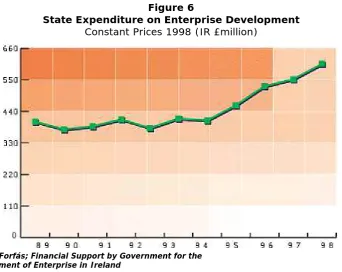
• The cost of State support to the enterprise sector in the form of direct expenditure (all costs of operating the development agencies, financial supports etc.) was
approximately IR£552 ( 700.89) million in constant prices in 1997, and is estimated at IR£606 ( 769.46) million for 1998. This represents a rise of 50 per cent in real terms (4.1 per cent per annum) over the period 1988 to 1998.
• Over the same period, 1988 to 1998, growth in Government expenditure of 46 per cent in real terms was recorded. The growth in GNP in real terms over this period was 81 per cent.
• There has been a swing from fixed asset- related supports to other forms of support such as R&D, equity investment, employment grants and the upgrading of the business capability of firms. In 1988 fixed asset supports accounted for 46.5 per cent of total direct expenditure. By 1997 the percentage had fallen to 35.7 per cent.
[image:20.595.126.469.311.583.2]• spending by the industrial development agencies in support of record job creation increased significantly from 1995 onwards, and this is reflected in Figure 6.
Figure 6
State Expenditure on Enterprise Development
Constant Prices 1998 (IR £million)
Source: Forfás; Financial Support by Government for the Development of Enterprise in Ireland
The previous graph relates to the table below.This shows values in Irish Pounds and euro equivalents.All Conversions to euro were made using the irrevocably fixed conversion rate (1 euro= 0.787564 Irish pounds).
State Expenditure on Enterprise Development
IR£million
million
1994 408.0 518.05 1995 461.0 585.35 1996 527.8 670.17 1997 551.8 700.64 1998 605.4 768.70
Corporate Tax
The cost to the State of fostering the development of enterprise has been offset by the rise in corporation tax payments, and in particular from corporation tax paid at the low (10 per cent) rate by manufacturing and internationally traded/financial services firms. This is evident from the following;
• The total corporation tax take amounted to IR£2,065 ( 2,622) million3 in 1998. This represents a rise of over 383 per cent in real terms in the period 1988 to 1998 (17 per cent per annum);
• Forfás surveys indicate that corporation tax paid at the 10 per cent rate by manufacturing, internationally traded and international financial services firms amounted to IR£924 ( 1,173.23) million in 1998, or almost 45 per cent of total corporation tax receipts.
Figure 7
Corporation Tax Payments
(Constant Prices £m.)
Source: Forfás; Corporation Tax Survey
The above graph relates to the table below.This shows values in Irish Pounds and euro equivalents.All Conversions to euro were made using the irrevocably fixed conversion rate (1 euro= 0.787564 Irish pounds).
Corporate Tax Payments
Total Manufacturing/Internationaly Traded Services IR£ million million IR£ million millon
1988 428 543.45 13 16.51
1989 381 483.77 25 31.74
1990 572 726.29 99 125.70
1991 692 878.66 200 253.95
1992 837 1,062.77 340 431.71
1993 1,048 1,330.69 464 589.16 1994 1,235 1,568,13 574 728,83 1995 1,213 1,540.19 522 662.80 1996 1,472 1,869.05 682 865.96 1997 1,722 2,186.49 774 982.76 1998 2,065 2,662.01 924 1,173.24
Technological Innovation and R&D in Industry
Forfás continued to monitor the innovation performance of industry during 1998 through its survey of R&D performing enterprises and through participation in the second pan-European Community Innovation Survey.
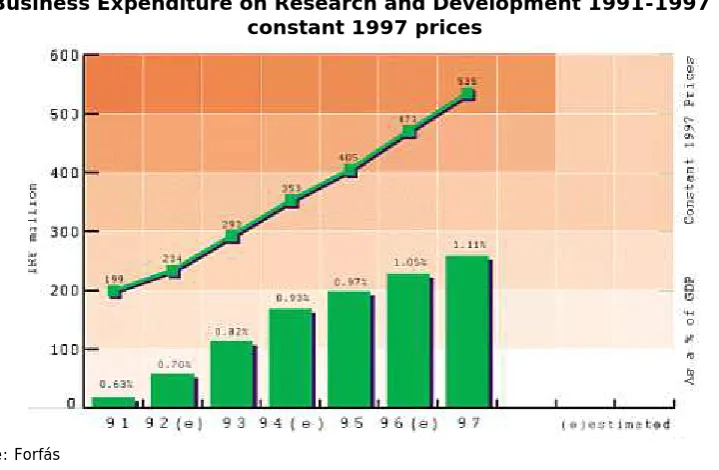
[image:22.595.107.476.411.657.2]The rate of growth in BERD was 15 per cent per annum in real terms between 1995 and 1997 and this represents a slight levelling-off in growth compared with the 20 per cent per annum growth that occurred between 1991 and 1995.
Figure 8
Business Expenditure on Research and Development 1991-1997 in constant 1997 prices
Source: Forfás
The above graph relates to the table below.This shows values in Irish Pounds and euro equivalents.All Conversions to euro were made using the irrevocably fixed conversion rate (1 euro= 0.787564 Irish pounds).
Business Expenditure on Research and Development,1991-1997
IR£million million
1991 199 252.68
1992(e) 234 297.12
1993 293 372.03
1994(e) 353 448.22
1995 405 514.24
1996(e) 471 548.05
1997 535 725.02
Behind the aggregate figure, it was found that indigenous firms accounted for IR£192 ( 243. 78) million (36 per cent of BERD) and foreign-owned firms accounted for IR£343 ( 435.52) million (64 per cent of BERD). The R&D intensity (R&D spend to gross output) of indigenous manufacturing was 1.1 per cent in 1997 (from 0.5 per cent in 1991) while in foreign-owned manufacturing, it was 1.2 per cent (from 1.0 per cent in 1991).
The R&D intensities of indigenous and foreign-owned manufacturing are a cause for concern because these represent half of the OECD average (2.4 per cent) and approximately one-third of that found in the top performing country (Sweden 3.5 per cent). The largest gaps in R&D intensity in manufacturing are in pharmaceuticals, electronics, instruments and
indicates that only 340 indigenous firms and 260 foreign-owned firms spent more than IR£100,000 ( 126,973.80) on R&D in 1997.
Other indicators of technological innovation in industry suggest that Ireland’s performance is at best average relative to other EU countries. The Second Community Innovation Survey, which was carried out in Ireland by Forfás, indicates that total expenditure on all innovation activities amounted to 3.3 per cent of sales in manufacturing compared to 3.8 per cent in the EU on average. The share of sales in 1996 from products that were introduced or subject to some change in the previous three years was 32 per cent in Ireland compared to 31 per cent for the EU generally.
The main message coming from these surveys is that, despite the generally positive trends that have emerged during the 1990s, there is considerable room for improvement if Ireland is to move from a somewhat ‘below average’ position in Europe to become one of Europe’s more innovative regions and a genuinely ‘high-tech’ economy.
State Investment in Science & Technology
The State Investment in Science & Technology report, published by Forfás, shows the total Government allocations to science and technology activities in 1998 at around IR£845 ( 1072.92) million, an increase of IR£113 ( 143.48) million (or 15.5 per cent) over 1997. The total appears quite large as the coverage of the S&T Budget is very wide. Sixty-four per cent of public funds go to third level education under the Department of Education & Science.
States Investment Allocation in Science & Technology - 1998 (Exchequer + EU Funds)
Total Public Funding
Departments IR£`000 `000 %Total
Taoiseach 374 748.88 0.05
Finance 1,658 2,105.23 0.24
Enviroment & local Goverment 9,595 12,183.14 1.37
Education & Science 448,146 569,028.04 63.98
Marine & Natural Resources 16,062 20,394.53 2.29
Arts Heritage, Gaeltacht & The
Islands 3,225 4,094.91 0.46
Agriculture & food 60,309 76,576.63 8.61
Enterprise, Trade & Employment 102,708 130,412.26 14.66
Puplic Enterprise 13,891 17,637.93 1.98
Social, Community & Family Affairs 6,716 8,527.56 0.96
Health & Children 10,689 13,572.23 1.53
Goverment Offices 27,024 34,313.40 3.86
Total 700,397 889,302.74 100.00
Of this total, IR£145 ( 184.11) million represents income earned by departments and their agencies. Figure 9 shows the breakdown across departments of the total public funds involved of IR£700.4 ( 889.32) million.
[image:25.595.126.476.196.461.2]The contribution of the EU, via the Community Support Framework (CSF), to public sector science and technology continues to increase, rising to IR£147 ( 186.65) million in 1998 from IR£123 ( 156.17) million in 1997 and representing 21 per cent of public funding of science and technology in Ireland. In the area of research and development, IR£64 ( 81.26) million out of a total of IR£187 ( 237.44) million (or 34 per cent) comes from Structural Funds.
Figure 10
Distribution of Government Supported S&T by sources of Funds
(1998 Prices IR£million)
Source: Forfás; State Investment in Science and Technology, 1998
The above graph relates to the table below.This shows values in Irish Pounds and euro equivalents.All Conversions to euro were made using the irrevocably fixed conversion rate (1 euro= 0.787564 Irish pounds).
1998 Prices
CSF Prices
Earned Income
Exchequer Funds
Sum of Total
IR£m m IR£m m IR£m m IR£m m
1987 2 2.54 103 130.78 316 401.24 421 534.56 1988 1 1.27 96 121.89 299 379.65 396 502.82 1989 20 25.39 101 128.24 275 349.18 396 502.82 1990 33 41.90 112 142.21 268 340.29 413 524.40 1991 43 54.60 122 154.91 297 377.11 463 587.89 1992 63 79.99 134 170.14 324 411.40 521 661.53 1993 89 113.01 162 205.70 333 422.82 584 741.53 1994 63 79.99 160 203.16 359 455.84 582 738.99 1995 76 96.50 159 201.89 396 502.82 631 801.20 1996 115 146.02 129 163.80 428 543.45 673 854.53 1997 125 158.72 148 187.92 470 596.78 743 943.42 1998 147 186.65 145 184.11 553 702.17 845 1,072.93
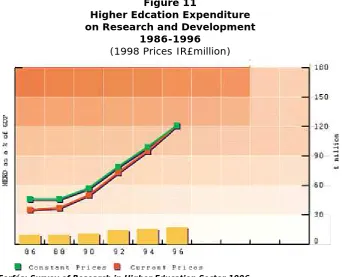
The latest Forfás survey shows that expenditure on research in the higher education sector (HE) amounted to IR£121 ( 153.63) million in 1996. 4This is a real increase of 164 per cent over the 1986 level of IR£35 ( 44.44) million and 21 per cent over the 1994 figure of IR£95 ( 120.62) million. Figure 11 illustrates the trend of expenditure on R&D between 1986 and 1996.
[image:26.595.127.470.182.459.2]4 The component of this expenditure funded by Goverment is included in the State Investment in Science & Technology 1998 report, published by Forfás
Figure 11
Higher Edcation Expenditure on Research and Development
1986-1996
(1998 Prices IR£million)
Source: Forfás; Survey of Research in Higher Education Sector,1996
The above graph relates to the table below.This shows values in Irish Pounds and euro equivalents. All Conversions to euro were made using the irrevocably fixed conversion rate (1 euro= 0.787564 Irish pounds).
Higher Education Expenditure on Research & Development 1986-1996
Constant Prices Current Prices
IR£ million million IR£ million millon
1986 46 58.41 35 44.44
1988 46 58.41 25 31.74
1990 57 72.38 50 63.49
1992 79 100.31 73 92.69
1994 99 125.70 95 120.63
1996 121 153.64 121 153.64
All HE research is classified into six broad fields of science and Figure 12 shows how the distribution of expenditure across each of these fields has changed between 1992 and 1996.
[image:27.595.126.467.171.423.2]All fields of science have recorded an overall real increase in expenditure in the four year period to 1996. Since 1992, while it has grown in real terms by 39 per cent (IR£21/ 26.66 million), the share of total expenditure attributable to natural science/engineering disciplines has decreased from 66 per cent to 61 per cent of the total.
Figure 12
Fields of Science Share of Total Research Expenditure
Source: Forfás; Survey of Research in Higher Education Sector,1996
Sources of Funds
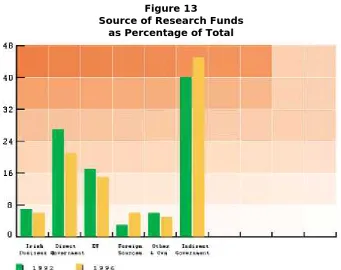
Figure 13 analyses the sources of funding for HE research. The government is the main provider of funds. It does so mainly through the block grant from the Department of Education & Science / HEA, which envisages that staff can and do spend a proportion of their time doing other things besides teaching, including research. This indirect Government funding is
Figure 13
Source of Research Funds as Percentage of Total
Source: Forfás; Survey of Research in Higher Education Sector,1996
Foreign sources have shown the largest real growth as a source of research funds since 1992, with the EU and direct government showing large growth. Six per cent of funding for HE expenditure on research comes from the business sector.
ACTIVITIES IN 1998
Introduction
In 1994, Forfás was established as the Advisory Board for Industrial Policy and Science and Technology. In this capacity Forfás:
• advises the Minister for Enterprise, Trade and Employment on the development of State policies designed to stimulate enterprise and employment;
• is responsible for co-ordinating key aspects of the activities of the promotional agencies;
• is responsible for evaluating and monitoring programmes which promote enterprise development, science and technology.
The Irish National Accreditation Board (NAB) operates as a division of Forfás.
1. Policy Introduction
Forfás continued to develop policy recommendations on a broad range of issues which impact on the development of the enterprise sector in Ireland in 1998. It worked closely with various bodies established by Government under the broad auspices of Forfás to consider specific issues critical to economic performance and job creation, including the National Competitiveness Council, the Irish Council for Science, Technology and Innovation and the Expert Group on Future Skills Needs. This section of the report describes briefly some of the work undertaken by Forfás during the year on the following areas:
• Competitiveness
• Skills
• Regional Development
• Telecommunications & E-Commerce
• Science, Technology and Innovation
• Technology Foresight Ireland
• Science and Technology After 1999
• Taxation and Public Expenditure
• Finance
• Transport
• Strategic Development Zones
• Electricity
• Greenhouse Gas Abatement
Competitiveness
Some of the activities undertaken by Forfás in this area in 1998 are set out below:
• A first Annual Competitiveness Report, reflecting the views of the National Competitiveness Council, was prepared, through a process involving extensive dialogue with Government Departments and other interested bodies. The report was submitted to the Taoiseach and published in March 1998.
• A Council Statement on Skills was prepared and published in December 1998. This document highlighted the role of skills in competitiveness and brought together a comprehensive set of recommendations on the actions required.
• A Statement on Telecommunications: A Key Factor in Electronic Commerce and Competitiveness was drawn up, making detailed recommendations on policy actions needed. This statement was prepared following extensive discussions with the principal actors involved, and was issued in November 1998.
• Studies of competitiveness performance and policy in other countries were
undertaken, including special studies of the UK and of Hungary, and a review of the Nordic countries.
• Forfás undertook a survey of enterprises in Ireland, in order to determine their competitiveness priorities and perceptions. The survey focused on the priorities of enterprises for future Structural Fund expenditures, the impact of Government policy in a number of areas related to competitiveness, and additional data in terms of the strategies and organisation of enterprises.
• As an input to the work of the Council, a study was undertaken of agriculture and its competitiveness in Ireland, focusing especially on the international trends that would alter the policy requirements for the future.
• Also as an input to the work of the Council, a special study was undertaken on inflation and the implications for competitiveness.
• Forfás continued to participate in EU pilot benchmarking exercises, including a project on information and communications technologies (ICT) and organisational change. This project examined the policy requirements for the diffusion of new technologies and the degree to which these affect operations at the enterprise level. Forfás’ contributions included case studies of enterprises in Ireland, together with a special survey of the diffusion of ICT in Irish enterprises at sectoral level.
• As an input to the work of the Council, Forfás undertook a synthesis of EU pilot benchmarking studies in the areas of information and communications technologies, logistics, the financing of innovation, and skills development. The implications of these Europe-wide studies for Ireland were examined in this context.
• In the preparation of the report, a major economic and statistical database that has been developed was maintained and updated.
• Forfás continued to provide extensive secretariat support to the National
Competitiveness Council. A second Annual Competitiveness Report was prepared. It compares the performance of Ireland with other countries using a wide range of indicators covering all the main fields of competitiveness policy. A particular focus was made on the policy implications of the findings, and Ireland’s performance since the first Annual Competitiveness Report was reviewed.
Skills
In November 1997 the work of the Business Education Partnership began. The three components of the partnership, which is supported with Forfás research and secretariat, are as follows:
• An Expert Group on Future Skills Needs;
• A Business Education Partnership Forum;
The Expert Group submitted its first report to the Tánaiste and Minister for Enterprise, Trade & Employment, Mary Harney, T.D. and to Micheál Martin, T.D. Minister for Education & Science. This report was published by Forfás in December 1998 and concentrated on the third-level requirements of the information technology industry. The main finding of the report was that Ireland faced a skill shortage of 2,200 engineering and computer science
professionals and technicians between 1998 and 2003 and that to address this 5,400 extra third-level places should be provided.
The first meeting of the Forum, organised by Forfás and the HEA, was held in June 1998, and participation included the Tánaiste and Minister for Enterprise, Trade & Employment, Ms Mary Harney, T.D. and the Minister for Education & Science, Mr. Michael Martin, T.D. The findings of the Expert Group in relation to the demand for technologists in Information Technology were discussed. A report on the proceedings of the Forum was published.
The Implementation Group has advanced the recommendations of the Expert Group and the following progress has been achieved:
• The Government approved, in April 1999, the allocation of an additional IR£75 ( 95.23) million to the Department of Education & Science for the provision of 5,400 places. This will ensure that Ireland has the human capital to meet the needs of the fast growing IT sector and respond to the opportunity presented by e-commerce;
• From September 1998, FÁS has increased its provision of training in the IT sector by an additional 737 places;
• The Department of Education & Science has created 650 new places on accelerated National Certificate in Technology courses. These courses commenced in January 1999 and 550 students are currently enrolled, about 300 in computing and around 250 in manufacturing technology.
In the latter half of 1998 the Expert Group began work on craft and other skills requirements in areas such as construction, transport and logistics, and call centres.
Regional Development
CSO and Eurostat data show that the economic development of some regions, particularly the Borders, Midlands, West and South-East, lags considerably behind the other
regions.There are also a number of areas of significant urban deprivation characterised by high levels of unemployment and poverty. The decision to divide the country into two primary development regions to help accelerate development in the under-developed Borders, Midlands and West regions is welcome in this context. However, it will be vital to have parallel development initiatives for the South-East and inner city areas. Forfás recommended that accelerating development in these areas will require:
• A deliberate effort to develop attractive alternative development centres to the Dublin-Belfast corridor, for example, the Waterford-Cork-Limerick triangle;
• Taking account of the special needs of areas of urban deprivation, for example, in terms of counselling and specialised education and training;
• Making the cities and major towns that are to be development centres in the regions attractive for both businesses to operate in and highly skilled for employees to live in;
• A determined and co-ordinated approach to advanced planning of investment in - transport infrastructure and services to facilitate access to air and seaports for both goods and people
- industrial development
- development of social, cultural and recreational infrastructure - local authority water and sewage service provision
- provision of broadband telecommunications and other utilities
- development of regional educational and training facilities to support ongoing life-long learning and continuing skills development
- improved zoning, planning procedures and implementation for infrastructure and commercial projects.
Forfás consulted widely with business firms, business associations and the development agencies in the regions to identify the infrastructure investments needed to promote regional development.
The consensus was that the critical priorities must be as follows:
• investment in transport systems, particularly roads;
• encouraging regional air service development;
• ensuring local availability of broadband telecommunications; and
• further streamlining of physical and infrastructural planning procedures.
Forfás has advocated that the new National Development Plan should incorporate a considerable acceleration of road investment and has set out proposals for IR£4.3 ( 5.46) billion in investment to be in place by 2006. Forfás also advocates that larger cities be connected by motorway starting with Cork-Dublin, working through Waterford-Cork-Limerick-Galway and Waterford-Cork-Limerick-Galway-Athlone-Dublin and, in the longer term, Sligo-Dublin and Sligo-Waterford-Cork-Limerick-Galway. The planning and reservations for these should be put in place immediately. Failing to plan for this standard of road will mean major disruption and cost in subsequent upgrading, probably within ten years in many cases. The Forfás proposals, with the addition of public-private-partnerships (PPP), can be carried out without significantly exceeding the investment levels anticipated by the ESRI in its report, National Investment Priorities for the period 2000-2006.
The use of Structural Funding to accelerate the provision of broadband telecommunications in areas where the market fails to provide the required services in advance of demand was also proposed by Forfás. A total of IR£18 ( 22.85) million of EU Structural Funds has been allocated for this purpose. When associated private sector investment is included, total investment should amount to more than IR£50 ( 63.49) million. This will increase the attractiveness of the regions as investment locations.
Forfás also proposed that funding be provided to support the establishment of a high capacity Internet link into Ireland to permit the speedy exchange of Internet traffic. A provision of IR£12 ( 15.23) million was made for this in the 1999 Budget on a public-private-partnership basis.
Telecommunications and E-Commerce
During 1998 Forfás continued to work with the development agencies and Government Departments to determine the required level of investment in broadband to meet the
expanding requirements of the enterprise sector, and how that investment could be secured. Forfás has long advocated that investment in broadband infrastructures ac