Performance Evaluation of Integrated EIGRP/IS-IS and
RIP/IS-IS Routing Protocols in Hybrid Networks
Nisha Pandey1 Dr. Dinesh Kumar2
M-Tech Student1, HOD. 2 & Department of CSE & Shri Ram College of Engg. & Mgmt Palwal, Haryana, India
Abstract— In modern internet period, communication networks are developing very quickly. To offer effective routing in the network, routers play a significant role. Routing is the mechanism of transporting data from source to destination node. Routing chooses suitable route in the network and propagate a packet over the network to a device on a different networks and it depends on routing protocols. Routing Information Protocol (RIP), Enhanced Interior Gateway Routing Protocol (EIGRP) and Intermediate System to Intermediate System (IS-IS) are the prevalent interior routing protocols for these type of networks. This paper shows a simulation based analysis of these kind of protocols. We employed the combination of RIP&IS-IS, EIGRP&IS-IS routing protocols on the Hybrid network for revealing the benefit of one protocol over the other as well as the robustness of every protocol combination and how this is evaluated. To conduct the network simulations, we employed Optimized Network Engineering Tool (OPNET) v16.0. The comparison analysis depends on various parameters that decide the robustness of these protocols. We utilized HTTP object response time, throughput, e-mail download response time and database response time parameters to evaluate the routing performance of the network.
Keywords:EIGRP, IS-IS, IGR, RIP, HTTP, OPNET
I. INTRODUCTION
Routing protocols offer necessary part in the Enhanced Interior Gateway Routing Protocol (EIGRP) in modern communication networks. A routing protocol based on Distance Vector Routing algorithm where finds how routers interact with each other and Intermediate Systems-Intermediate Systems (IS-IS) and route the packets over the optimum route to travel Open Shortest Path First (OSPF) depends on Link State from a source node to a destination node. All of the above Protocols has different topology in comparison with others, the interior gateway protocol (IGP) are utilized in a network with a particular structure, various Autonomous Systems (AS) [2] protocols based on their parameters establishes IS-IS can be expanded easily and employs Dijkstra for best performance. As we know, Routing protocol algorithm for discovering the best path Meantime, EIGRP works depending on routing algorithms. Static and
Dynamic OSPF use Diffusing Update Algorithm (DUA), routing algorithms are significant algorithms for modern which contains Distance Vector and Link State routing communication networks. Latest communication algorithms EIGRP has been CISCO devoted protocol networks i.e. internet network utilize dynamic in opposite to other normal protocols. The cost of routing algorithms rather of static algorithms, because static EIGRP protocol depends on delay and bandwidth[5] algorithms don’t uses network's current load in determining and also the cost of routing OSPF depends on just the best routes [1]. Dynamic routing algorithms have various types of bandwidth usage, but there are two necessary and significant Performance analyses of various routing protocols algorithms Link State and Distance Vector Routing has been performed based on several performance metrics like Routing algorithms which are applied in recent router convergence, network convergence, Adaptively and scalability delay, queuing communication networks, network bandwidth utilization, throughput in comparison with Vector Routing algorithm.
A. Routing Information Protocol (RIP)
The Routing Information Protocol (RIP), is a distance-vector based algorithm which is one of the first routing protocols conducted TCP/IP. Information is routed over the network utilizing UDP. Every router that utilizes this protocol has restricted knowledge of the network across it. This simple protocol utilizes a hop count process to discover an optimum route for packet routing. A highest number of 16 hops are used to avoid routing loops. However, this parameter restricts the size of the networks that this protocol can support. The popularity of this protocol is highly because of its easy configurability and its simplicity. However, its drawbacks involve slow convergence times, and its scalability restrictions. Thus, this protocol operates best for small scaled networks.
B. Enhanced Interior Gateway Routing Protocol (EIGRP):
EIGRP is a Cisco-developed advanced distance-vector routing protocol. Routers employing this protocol automatically disseminate path information to all neighboring nodes. The Diffusing Update Algorithm (DUA) is utilized for fast
convergence, routing optimization as well as to neglect routing loops. Full routing information is only interchanged once upon neighbor formation, after which only some updates are routed. When a router is not able to discover a route across the network, it sends out a query to its neighboring nodes, which routes until a proper route is discovered. This requirement-based update is a benefit over other protocols as it decreases traffic among routers and thus preserves bandwidth. The metric that is utilized to discover an optimum route is computed with variables load, bandwidth, reliability and delay. By incorporating several such variables, the protocol assures that the best route is discovered. Also, compared to other distance-vector algorithms, EIGRP has a larger highest hop restriction, which forms it compatible with large networks. The drawback of EIGRP is that it is a Cisco protected protocol, meaning it is only compatible with Cisco technology.
C. IS-IS (Intermediate System to Intermediate System Routing Protocol)
The IS-IS is also a link-state routing protocol with various similarities with OSPF protocol for example the usage of the same SPF algorithm. It was described by ISO (International Organization for Standardization) and tagged as ISO 10589, in an effort to implement DECnet Phase V of Digital Equipment Corporation for large networks. Though, initially it was designed to work with CLNP (Connectionless Network Layer Protocol), later it was modified in 1990 to route IP as described in RFC 1195 by the name Integrated IS-IS. Opposite to all other IGPs that were generated depending on the TCP/IP protocol stack, IS-IS depends on the primer OSI (Open System Interconnection) reference model. As a result initially, IS-IS was not made to provide support to the IP protocol but the OSI layer 3 CLNP protocol, which provides network services to the upper layers. More particularly, IS-IS, CLNP and ES-IS (End System to Intermediate System) routing protocol all lie on OSI’s network layer and are being encapsulated in various frames at the data-link layers. Exclude this difference, IS-IS also utilizes a different terminology. Routers are described as intermediate systems, hosts as end
systems, routing as routing and packets as PDUs. In present
time, it is a less popular protocol as compared to OSPF, still it is the favorite choice for various Internet Service supplier’s backbone networks. More than that, IS-IS doesn’t require to be upgraded to a new version in resistance to OSPF, because it can easily accommodate the carriage of IPv6 addresses. Normally, as a link-state protocol, IS-IS is assumed to be an IGP with fast stability and convergence time , as well as low resources usage.
II. PROBLEM STATEMENT
Interior networks primarily utilize the following four routing protocols: RIP, EIGRP, IS-IS and OSPF. Because of its scalability, OSPF is employed more frequently than EIGRP [1]. IS-IS and OSPF are link state routing protocols. These protocols use high bandwidth at the time of network
convergence. Both protocols are relatively difficult to establish on the network but they are the suitable protocols for larger networks. On the other side, EIGRP has a faster convergence time as compared to IS-IS and OSPF, it can be employed in various network layer protocols and it is relatively easy to establish on the network. However, EIGRP is a CISCO protected protocol, which means that it can only be employed on CISCO products.
In this paper, we will see at the benefits of utilizing IS-IS and RIP on hybrid network and IS-IS and EIGRP on other network. The comparison analysis of the routing protocols will be done by using OPNET.
III. SIMULATION STATISTICS
These scenario implements these protocols as a routing protocol on the chosen network configuration. As a first step, we generated the network configuration without a routing protocol and then, we repeated it to five scenarios so that we could simulate EIGRP, RIP, IS-IS, EIGRP/IS-IS and RIP/IS-IS on each of them. So, on one of the repeated scenarios these protocols are configured as a routing protocol for the all routers in the network. After configuring the routing protocol, we select the statistics that will be seen on the result. These statistics are: HTTP object response time, RIP Traffic received (bits/s), Database response time, E-mail download response time and point to point throughput.
IV. SIMULATION RESULT AND ANALYSIS
We have five simulation scenarios: RIP, EIGRP, IS-IS, RIP/IS-IS and EIGRP/IS-IS. This supports us to compare one protocol with the other. So, we choose a particular parameter and compare the results of all protocols on one graph depending on the chosen parameter. In all the scenarios, routers are established to fail at 250 s and 350 s.
4.1 RIP Traffic
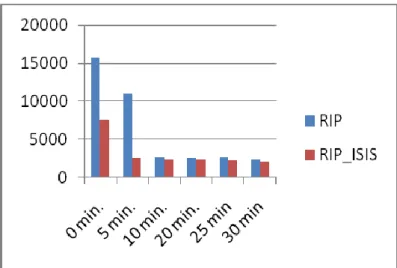
Fig 1 displays the RIP traffic routed in bits per Sec. On the graph RIP traffic is greater at the time of first convergence in RIP/IS-IS protocol as compared to RIP.
Figure 1: RIP Traffic.
At the time when router fails, there will be a network configuration update; thus the routers will interchange path information with the entire network. Again, the second time, when router fails, it will modify the network tables, so there will be other path information exchange. At the second and third convergence, the RIP traffic will be higher in RIP as compared to RIP/IS-IS.
4.2 EIGRP Traffic
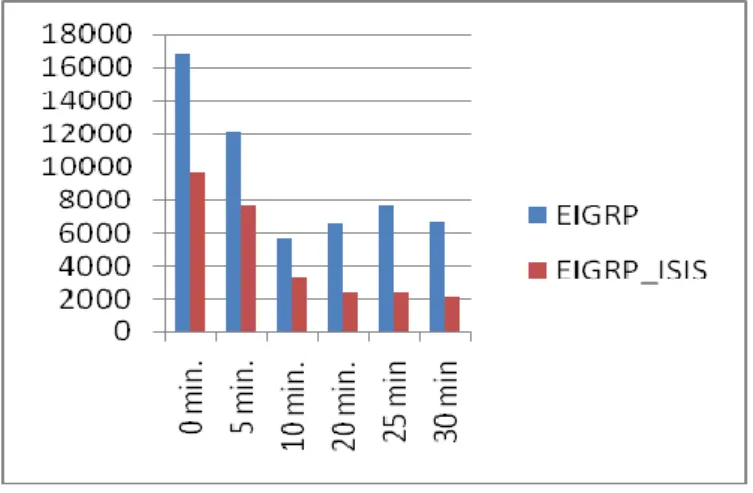
Fig 2 displays EIGRP traffic routed in bits/s. It is displayed that at the time of convergence, the EIGRP traffic is much greater in EIGRP network in comparison of EIGRP/IS-IS network. In EIGRP/IS-IS network, the EIGRP path information will be lower because the EIGRP traffic is interchanged inside the interface that employs EIGRP protocol. The network that employ EIGRP for the entire network will have more interfaces that utilize EIGRP, so there will be more EIGRP traffic than a network that employ IS-IS and EIGRP in the network.
Figure: 2 EIGRP Traffic. 4.3 EIGRP Convergence Time
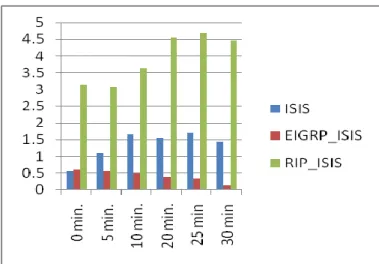
Fig 3 displays the convergence time of EIGRP in the network that utilizes EIGRP/IS-IS routing protocol and EIGRP routing protocol. As it’s displayed in Fig, the convergence time of EIGRP in EIGRP/IS-IS network is comparatively smaller than the network that utilizes only EIGRP. EIGRP path information update will be promoted within the interface that employ EIGRP routing protocol, since the interfaces enabled to utilize EIGRP are smaller in EIGRP/IS-IS than EIGRP, it will consider a smaller time to modify the routing table, topology table and neighbour table. The first convergence time of EIGRP/IS-IS is 0.8 s, while for EIGRP it is around 0.025 s. The second convergence time, it is 3.21 s for EIGRP, while for EIGRP/IS-IS it is 2.54 s. The third convergence time is 2.66 s for EIGRP, while for EIGRP/IS-IS it is nearly 2.5s.
Figure: 3 EIGRP Convergence Time 4.4 IS-IS Convergence Time
As it is displayed in Fig 4 the elapsed time to converge the network on IS-IS network is slower than EIGRP/IS-IS network and RIP/IS-IS network. On the other side, the network convergence time for EIGRP/IS-IS network is faster than the other networks. The first convergence time of IS-IS is 12 s, while for EIGRP/IS-IS is around 0.9 s and for RIP/IS-IS is 13 s. The second convergence time of IS-IS is 11 s, while for EIGRP/IS-IS it is around 0.9 s and for RIP/IS-IS it is 6 s. The third convergence time of IS-IS is 11 s, while for for RIP/IS-IS is 7 s and EIGRP/IS-IS is nearly 6 s.
Figure 4 IS-IS Convergence Time
4.5 Database Query Response Time
Figure 5 displays the database query response time in the second scenario. in this scenario we display how the protocols influence the performance to access the database from the server. In the comparison of these protocols in database query response time, EIGRP/IS-IS indicates a better response time as compared to of the other protocols at the entire time.
Figure: 5 Database Query Response Time
On the other side, RIP/IS-IS indicates a slower response time than of all the other protocols. Initially, the response time of IS-IS, RIP, RIP/IS-IS and EIGRP is almost same but as time increases, RIP/IS-IS becomes slower in response time. On the other side EIGRP displays better performance as compared to the other three protocols. IS-IS and RIP protocols indicate almost same database response time in the entire time.
4.6 E-mail Download Response Time
E-mail application is highly utilized by the subscribers in the LAN network, the E-mail access is performed from the mail server in the network. Figure 6 displays E-mail download response time in sec. The graph displays that the EIGRP/IS-IS protocol performs good for the complete simulation time. On the other side, RIP/IS-IS performs bad as compared to the other protocols. In the first 4 minutes, IS-IS displays better E-mail download response time than of EIGRP and RIP. After 4 minutes EIGRP, RIP and IS-IS show almost same performance for E-mail download response time.
Figure: 6 E-mail Download Response Time
4.7 HTTP Object Response Time
Figure 7 displays HTTP object response time in sec. Highly HTTP application is employed by the users in the network and the application service is endorsed by the server. The graph displays that EIGRP/IS-IS indicates a shortest object response time in the complete simulation time.
Figure: 7 HTTP Object Response Time
For the first 3 minutes, RIP/IS-IS has a better object response time as compared to IS-IS, RIP and EIGRP. But as time goes on, RIP/IS-IS object response time increases, and IS-IS become better than the other four protocols.
4.8 Throughput:
Figure 8 displays point to point throughput between the routers and Link router evaluated in packets/sec. The graph displays RIP/IS-IS has high throughput in this link. On the other side RIP, IS-IS, EIGRP/IS-IS and EIGRP have a lesser packet throughput in this link. EIGRP/IS-IS has are comparatively better performance on point to point packet throughput in comparison of the other three protocols.
CONCLUSION
The aim of this paper was to configure multiple routing protocols on a chosen network configuration and measure the performance of the network. We directed to configure IS-IS and RIP together in one network, then IS-IS and EIGRP together in another network. After configuring the protocols we examined the network performance enhancements in comparison of the network that utilize EIGRP alone, RIP alone or IS-IS alone. The RIP traffic in the network utilizing RIP/IS-IS is smaller than of network utilizing only RIP. This shows that the bandwidth usage of RIP is better and the link congestion possibility is smaller in RIP/IS-IS network than that of network utilizing only RIP. The EIGRP traffic in the network utilizing EIGRP/IS-IS is lower than of network utilizing only EIGRP. This shows that the bandwidth usage of EIGRP is better in the EIGRP/IS-IS network than that of network utilizing only EIGRP. Convergence time of EIGRP in the network employing EIGRP/IS-IS network is much faster than in the network employing only EIGRP. Thus the nodes in EIGRP/IS-IS network learn the configuration quicker than the nodes in the EIGRP network.
IS-IS convergence time in EIGRP/IS-IS network is much quicker than in IS-IS network or RIP/ISIS network. On the other side, IS-IS network indicates lower convergence time than the EIGRP/IS-IS network or the RIP/IS-IS network. Then we consider, EIGRP/IS-IS network learns all nodes in the entire network quicker than of RIP/IS-IS network or IS-IS network. And IS-IS network learns not quicker than of another two networks. Database response time is better in the network which employs EIGRP/IS-IS combination in comparison of other networks employing IS-IS, RIP, EIGRP, RIP/IS-IS. Network employing RIP/IS-IS combination indicates slower database response time. Thus database access is much quicker in EIGRP/IS-IS networks and very slow in RIP/IS-IS network. The network employing EIGRP/IS-IS shows quicker E-mail download response time and HTTP object response time in comparison of other networks employing EIGRP, RIP, IS-IS, RIP/IS-IS. On the other side network employing RIP/IS-IS combination indicates slow response in both the situations. Thus, EIGRP/IS-IS offers the end users access to the e-mails and HTTP applications quicker than networks employing EIGRP, RIP, IS-IS, RIP/IS-IS. Initially, the total throughput performance of whole networks is same of the simulation. But after few minutes, network employing RIP/IS-IS combination indicates much better throughput performance in comparison of all other networks.
FUTURE WORK
As a future work, we recommend any interested researcher to combine IS-IS and EIGRP routing protocols on mobile ad-hoc network (MANET) and Hybrid networks and construct one advanced routing protocol. This can be performed by examining the source code of every protocol and form a modification on the codes.
REFERENCES
[1] Vishal sharma, Rajneesh Narula and Sameer khullar “Performance Analysis of IEEE 802.3 using IGRP and EIGRP Routing Protocols” International Journal of Computer Applications Volume 44– No13, April 2012
[2] Ittiphon krinpayorm and Suwat Pattaramalai,"Link Recovery Comparison Between OSPF & EIGRP ", IEEE Journal on Selected Areas in Communications, vol. 20, no. 4, pp. 756–767, May 2009.
[3], Y. Navaneeth Krishnan Najam-Ul-Sahar, "Simulation of OSPF Routing Protocol Using OPNET Module" Communication Systems and Networks, 2011 Third International Conference on, 2011, pp. 120-125.
[4] Bernard Fortz,Jennifer Rexford and Mikkel Thorup., Traffic Engineering With Traditional IP Routing Protocols." IEEE Communications Magazine. October 2002, pp. 118-124. [5] Ahmad Karim, Minhaj Ahmad Khan "Behaviour of Routing Protocols for Medium to Large Scale Networks", Australian Journal of Basic and Applied Sciences, 5(6): 1605-1613, 2011
[6] E. Dahlman, S. Parkvall, J. Skold, P. Beming,3G Evolution - HSPA and LTE for Mobile Broadband. 2nd ed. Elsevier Ltd. 2008.
[7] Shen Yang, Dai Hao; Qi Qang-dong “Performance comparisons between OSPF and EIGRP in tactical IP networks” (Inst. of Command Autom, PLA Univ. of Sci. & Tech. Nanjing, China); Source: Journal of PLA University of Science and Technology (Natural Science Edition), v 6, n 3, p2 41-5, June 2000.
[8] Garcia-Luna-Aceves, J, J.; Zaumen, W.T “Area-based loop-free internet routing” Source: Proceedings IEEE INFOCOM 94. The Conference on Computer Communications. Networking for Global Communications, 1000-8 vol.3,1994.
[9] Kisten, S. Ping-Tsai Chung. ”Analysis and experimentation on dynamic routing protocols: EIGRP and OSPF”(Dept. of Computer Science, Long Island Univ., Brooklyn, NY, USA); Source: International Conference on Internet Computing - IC'03, p 591-3 Vol.2, 2003.
[10] Thorenoor, S.G.”Dynamic Routing Protocol Implementation Decision between EIGRP, OSPF and RIP Based on Technical Background Using OPNET Modeler” Source: Proceedings of the 2010 Second International Conference on Computer and Network Technology (ICCNT 2010), p 191-5, 2010.
[11] Yee, J.R. ”On the International routing protocol enhanced interior gateway routing protocols” International Transactions in Operational Research, v 13, n 3, p 177-94, May 2006 [12] Nohl, A.R, Molnar, G “The convergence of the OSPF routing protocol” (Ericsson Res., Ericsson Hungary Ltd., Budapest, Hungary). Source: Periodica Polytechnica Electrical Engineering, v 47, n 1-2, p 89-100, 2002
[13] Talal Mohamed Jaffar, “Simulation-Based Routing Protocols Analysis (Thesis)” Ph.D. Dept. Elect. Eng., Georgia Institute of Technology, 2007.
[14] A. Kulkarni, M. Heindlmaier, D. Traskov, M. Montpetit, and M. Medard, An Implementation of Network Coding with Association Policies in Heterogeneous Networks. in Proc. Networking Workshops, 2011, pp.110-118.
[15] G. A. Abed, M. Ismail, and K. Jumari, "Traffic Modeling of LTE Mobile Broadband Network Based on NS-2 Simulator," Computational Intelligence, Communication Systems and Networks, 2011 Third International Conference on, 2011, pp. 120-125.