ISSN: 2278 – 7798 All Rights Reserved © 2014 IJSETR
2100
Abstract—Representations for the surface area of natural clay in terms of the surface area have been developed using two different methods. The first method uses calculations that are based on the adsorption of methylene blue (MB) dye on the surface of the adsorbents. The second method uses computer-generated program based on BET method. The results of the second method compare reasonably well with the results of the first one, surface area estimates for the natural clay were combined with a study to the surface texture. The aim of this paper is to compare the two methods, the required methodology and their deviations. It was found that No experimental method provides the absolute value of parameters such as porosity, surface area, and pore size: each gives a characteristic value which depends on the principles involved.
Index Terms— BET method, Methylene blue method,
natural clay, surface area.
I. INTRODUCTION
Some authors investigated some structure surface properties of some adsorbents especially activated carbon, they tried to interpret, from the information they got, the mechanism of adsorption , a little attention has been given to the characterization of low cost adsorbents. In the present investigation, it was thought to extend the study of characterization of natural clay as low cost adsorbent. The focus is towards the surface characteristics of the novel adsorbent for wastewater treatment, these characteristic properties might allow more defining and understanding the nature of the adsorbents. Surface properties of the adsorbents have been reported in this investigation. Many methods have been proposed for determining specific surface area, e.g., the use of gas adsorption (Langmuir's equation for monolayer adsorption, BET equation for multi layer adsorption, Polanyi's theory for micropore adsorption, Dubinen-Radushkevich equation, Jovanovic equations, etc.), adsorption form solution (dyes, electrolyte, depostion of silver, adsorption of ρ-nitrophenol, etc.), heat of wetting, air permeability, particle shape, etc.
The objective of this investigation was to characterize natural clay in terms of its surface area (MB test and N2 adsorption), pore structure (total pore volume, pore size
Manuscript received July , 2014.
Mohammad S. El-Geundi, Eman A. Ashour, Reda M. A. Abobeah, Chemical Engineering Dep., Faculty of Engineering, Elminia, Egypt.
Nabila shehata, Environmental Research and Industrial Development
dep., Faculty of Postgraduate for Advanced Sciences, Beni-Suef, Egypt.
distribution, porosity). These properties are directly related to the effectiveness of this low-cost adsorbent.
II. MATERIALS
The natural clay is collected from El-Sheikh Fadl village (El-Minia governorate), it was crushed and sieved into various particle size ranges, it was not subjected to any form of treatment prior to use. Activated carbon prepared from oil palm fiber [1] was used as a standard adsorbent for comparison. Methylene blue or 3,7 bis (dimethylamino) phenothiazin-5-ium ion was chosen in this study because of its known strong adsorption onto solids and its recognized usefulness in characterizing adsorptive materials [2]. MB has a molecular weight of 355.89 mol-1, which corresponded to MB hydrochloride with two group of water (C16H18ClN3S2.2H2O).
III. METHODS
Analysis of the dye in aqueous solution was determined using spectrophotometer (Pharmacia LKB Novaspec II ) with light-path quartz cell for all determination, all the measurement were made at the wavelength that corresponded to the maximum absorbance, λmax. Adsorption capacity of MB determined by measuring adsorption isotherm, the adsorption isotherms were determined by the bottle-point method [3], by contacting a constant mass of the adsorbent (0.1 g) with 0.05 dm3 of the dye solution of different initial concentration range (50-750 mg/dm3) in a dark glass bottles, the bottles were sealed and placed in a shaker at constant temperatures (25±2°C) for a sufficient period time to ensure reaching the equilibrium, after settling and separating the clarified liquid, the equilibrium concentrations (Ce) of the clarified supernatant of the solution was determined by spectrophotometer.
Specific surface area by gas adsorption is a measure of the exposed surface of a material reported in term of square meters per gram. The method was performed using (NOVA 2200, Version 6.10, Quanta chrome corporation, Japan) Gas sorption analyzer. Pre-weighted Samples are prepared and degassed by applying a combination of heat, vaccum, this is removes previously adsorbed contaminants from the surface and from the pores. The samples then are cooled to cryogenic temperature and an adsorption gas (typically N2) is admitted to the sample tube in controlled increments. After each dose, the pressure is allowed to equilibrium and
Determination of Specific Surface Area of
Natural Clay by Comparative Methods
ISSN: 2278 – 7798 All Rights Reserved © 2014 IJSETR
2101 the quantity of gas adsorbed is calculated, the gas volume
adsorbed at each pressure defines an adsorption isotherm. The porous textures of the samples were characterized by conducting N2 adsorption isotherms at 77K. The total specific surface area was calculated using the multi-point BET equation in the relative pressure range (0.05-0.3 P/Po) and by adopting the value of 16.2 Å2 for the molecular surface area of nitrogen.
IV. RESULTS
A. Determination of Specific Surface Area using MB Method
The purpose of investigating adsorption isotherm is, firstly, to measure the adsorption capacity of basic dye (MB), from aqueous solution onto the adsorbents and secondly, to ascertain liquid-solid equilibrium distribution of the adsorbate concerned. When the experimental data points of the adsorption of MB onto adsorbents were plotted as qe against Ce using the size ranges dp1 (180-250 μm), dp2 (250-355 μm), dp3 (500-710 μm), the characteristic L-shape curve have been obtained according to Giles classification [4]. The adsorption capacities (qref) of adsorbents have been measured , the results showed that for decreasing the particle diameter from (500-710 μm) to (180-250 μm), adsorption capacity increased from (116.4 mg/g) to (190.5 mg/g) for natural clay, adsorption capacity of activated carbon from cotton stalks, ACS (dpACS 1.0-2.0 mm) was
278.3 mg/g. Analysis of such isotherm data is important in order to develop an equation, which both accurately represent the results and could be used for design purposes. Several isotherm equations are available for this analysis. In this study one has been selected, i.e. the Langmuir model. Linear plots of Ce/qe against Ce at the particle size ranges under study (not shown in this paper) suggested the applicability of the Langmuir isotherm for the present systems, and demonstrate monolayer coverage of the adsorbate at the outer surface of the adsorbent. Values of KL and aL at different particle size ranges have been calculated using the least-squares method and are tabulated in Table (1).
Table 1: Langmuir parameters for the adsorption of MB onto the adsorbents.
Particle diameter KL (L/g) aL (L/mg) qmax (mg/g) dp1 dp2 dp3 14.903 12.674 4.351 0.076 0.072 0.035 196.09 176.02 124.31
The specific surface area was calculated by the following equation [5].
SMB =
F.(qmax ) .(10−3).N. A (10−20)
𝑀 (1)
Where (SMB ) the specific surface area (m2/g), (F) the purity of the MB (–), qmax or (KL/aL) the maximum no. of molecules of MB adsorbed at the monolayer of adsorbent (mg/g), (A) the cross-section area of one molecule of MB (Å2), (N) Avogadro's number (6.023x10²³ mol-1), (M) the molecular weight of MB (355.89 g mol-1). The cross-section area of molecule of MB, (A), is difficult to access, the MB present in the form of monomer or dimer. If the dimer is lying flat on the surface it would occupy double area than monomer and the SMB should be the same independently of the aggregation. If the monomer unit are joined in sandwich structure, (molecular axes parallel) SMB would be a half of that calculated. A different value should obtain if it is considered that MB adsorbed perpendicular to the surface of adsorbent. Another reason is that MB has different adsorption center. Methylene blue is assumed to be adsorbed on pores of diameters larger than 1.5 nm [9]. This indicates that surface area of super micropores and mesopores can be measured by MB adsorption since surface area covered by MB is known. For the adsorption of MB onto the surface of activated carbon, L-shape usually suggest flat orientation, so If the molecule lies on its large surface area then A= 130 Å2 [6]. The surface area of bentonites can only be calculated with MB adsorption when the montmorillonite surface area per charge corresponds with the area of the MB cation of 130 Å2, i.e. the interlayer charge of the montmorillonites must amount to 0.28–0.33 charges per half unit cell [7]. By substitution in eq. (1) for F = 0.60, N = 6.023x10²³ mol-1, M = 355.89 gmol-1, A =130 Å2, then S
MB= 1.32 KL/aL. Specific surface areas of clay using MB method was 258, 232 and 164 m2/g for dp
1,dp2 and dp3 respectively, on the other hand the specific surface area of ACS was 367.37 m2/g.
B. Determination of Specific Surface Area using MB Method
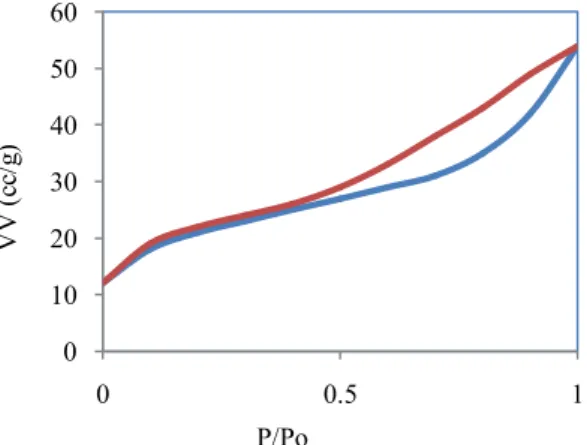
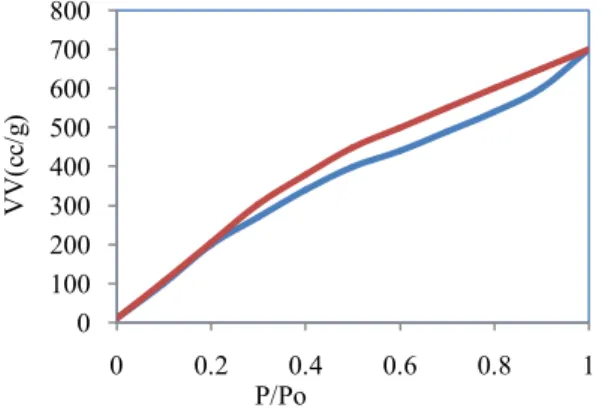
The Brunauer, Emmet and Teller (BET) gas adsorption theory is the foundation for the measurement of the surface area in high specific surface materials [10]. Typical results of N2 adsorption/desorption isotherms for the adsorbents are shown in Figures (1, 2). It was found that SBET for natural clay and ACS was 78.4 and 1650 m2/g, respectively.
Fig. 1: N2 adsorption/desorption isotherm for natural clay. 0 10 20 30 40 50 60 0 0.5 1 V V ( cc /g ) P/Po
ISSN: 2278 – 7798 All Rights Reserved © 2014 IJSETR
2102 Fig. 2: N2 adsorption/desorption isotherm for ACS.
According to (B.D.D.T) classification, the adsorption isotherms of natural clay and ACS are of type IV which is generally associated with capillary condensation in mesopore structures. Also it can be seen, that the hysteresis curves of adsorption isotherms of N2 of both of natural clay and activated carbon onto the surface of the adsorbents of type (b) [11], which is commonly interpreted as evidence for slit-shaped meso- or macropores [12].
The nitrogen adsorption method requires prior evacuation and heating of the sample which brings the pores closer. The quasi-contact of the adsorbent surface can extend over a significant portion of the surface that becomes inaccessible for nonpolar (nitrogen) molecules. If the adsorbent contains expansible or swelling material it can collapse on evacuation, giving the same effect. Multiple gas layers are formed at increased pressures, and pores are eventually filled with gas. BJH method [13] was used to calculate pore size distribution. The pore size distributions (PSD) of clay compared to ACS are listed below:
Table 2: PSD for various adsorbents.
Adsorbent Pore radius in: The predominant pores Micropore Mesopore
Natural clay 23.52 Mesopores
ACS 5.37 13.7 Micro-and mesopores .
A single-point total pore volume (TPV) was calculated, Pore volume was found from the amount of N2 adsorbed at a relative pressure of 0.99. Specific pore volume: is the sum of volumes of all pores in one gram of adsorbent, there is many models of pore shape existing: slit-like, ink-bottle, conical, globular etc. Total pore volume and the average pore radius of clay were 0.056 cc/g and 16.92 Ǻ, respectively. As mentioned before, The isotherms of adsorption/desorption of N2 at 77K on the adsorbents, show that natural clay is of type IV for physisorption of gases according to classification of [14] and IUPAC which show a hysteresis. (This hysteresis is due to the capillary condensation of the nitrogen in the pores causing an adsorption or desorption of the nitrogen at different partial pressures during the filling and empting of the mesopores. According to the classification of (IUPAC), the hysteresis shape of natural clay is of type H3 indicates that adsorption
doesn’t exhibit any limit at high relative pressure, which associated with slit shaped pores formed by aggregates of plate-like particle. Natural clay and activated carbon are of type H4 shape, which is corresponding to micropores material.
V. DISCUSSION
By comparing the results of the two methods, it is appearing that, for natural clay SMB is higher than that of SBET, For activated carbon, SBET is higher than that of SMB. The deviations between SMB and SBET for the materials under investigations and other materials with their authors are shown in table (3). The values of deviation are ranged from 5.7 % to 96.9 %.
Table 3: Comparison of the two methods under study.
Material Deviation% References
Florida Kaolinite 5.7 [15]
Kaolinite 6.6 [16]
Cotton fibers 96.9 [17]
Fe-montmorillonite 88.5 [7]
Georgia Fullers Earth 65.6 [18] Natural clay
ACS
28.6 77.7
This study
This deviation may be attributed to the following reasons: 1. The clay has acidic nature, so the cationic group of MB,
[C16H18N3S]+, will attract strongly and chemisorption may play an important role here.
2. The molecular sieving effect is believed to differentiate the entrance of various size gas molecules into narrow spaces [19] leading to differences in surface areas measured with various size adsorbates. The kinetic effects may diminish the adsorption of nitrogen to a great extent when entrances to larger spaces are of nitrogen molecule dimensions. To easily pass such narrow entrance, the thermal energy of the molecule should be similar to the energy barrier of the adsorption field among the entrance walls. At liquid nitrogen temperature the thermal energy is low and therefore the adsorption equilibrium may not be reached within a standard time of the measurement [20].
3. The clay has a specific nature, the charge density of clay play an important role in understanding the adsorption of MB; at lower charge density of clay molecules initially adsorbed as aggregates on the outer surface of the clay, deaggregate to form monomer that migrate to the inter layer of clay [21], SMB depend on that number of molecules. Even at higher layer charge there is may be strong aggregation and redistribution of the molecules due to the proximity of the negative sites in clay surface and different coverage of clay surface [22].
4. The clay consist mainly of kaolinite and montmorillinite, due to the isomorphic substitutions: Si4+ can be replaced by Al3+ or Fe3+ in tetrahedron sites and Al3+ by Mg2+, Fe2+, and Mn2+ in octahedron sites [23]. Montmorillinite has an excess of negative charge on its lattice, the 0 100 200 300 400 500 600 700 800 0 0.2 0.4 0.6 0.8 1 V V (c c/ g) P/Po
ISSN: 2278 – 7798 All Rights Reserved © 2014 IJSETR
2103 presence of this negative charge on the clay surface
enhance the adsorbent capacity to adsorb dye ions such that clay has an affinity for cationic species [24]. A second source of charge on the minerals is the broken bonds found at the mineral edges, the structure cannot extend infinitely, so at some point there will be oxygen without all charges satisfied by associating with cations. In these cases a hydrogen ion from solution will normally satisfy the requirement. Whether this can occur will, however, depend on the solution pH. Therefore, these charges are called either pH-dependent charge or variable charge [25].
5. Other reason that the major component of this clay is silica (58%), its pHzpc =2.5 [26], a negative charge will be developed above this value. The other constituent is alumina (42%), which develop a positive charge below pHzpc =8.2, consequently, a net negative charge on the clay surface pH of experiments. This explanation can be supported by the study of the effect of pH of the medium on zeta potential of natural clay ,which showed that zero point charge (IEP) of clay lay at pH=1.8 [27]. Also, pHzpc for kaolinite = 4.6 [26].
VI. CONCLUSION
The measurement procedure can have an important effect on measured values, yet such sensitivity is informative in itself. No experimental method provides the absolute value of parameters such as porosity, surface area, and pore size: each gives a characteristic value which depends on the principles involved and the nature of the probe used (MB, nitrogen). One cannot speak of the surface area of an adsorbent but, instead, of its ―BET-nitrogen surface area‖, ―equivalent BET-nitrogen surface area‖.
VII. ACKNOWLEDGEMENTS
One of the authors (Nabila Sh. Mohamed) is thankful to Prof. Dr. Mohammad E. Zaki for facilities support, Dr. Gamal Mekhemer and Dr. Merfat Hosny for supporting and Dr. Hussein Khalaf for helpful discussion.
REFERENCES
[1] I.A.W. Tan, B.H. Hameed, A.L. Ahmad, ―Equilibrium and kinetic studies on basic dye adsorption by oil palm fibre activated carbon‖, Chem. Eng. J.127 (2007) 111–119.
[2] Ardizzone S.; Gabrielli G.; Lazzari P. ―Adsorption of Methylene Blue at solid/liquid and water/air interfaces‖, Colloids Surf. A: Physicochem. Eng. Aspects, v. 76, p. 149–157, 1993.
[3] El-Geundi M. S., ―External mass transport processes during the adsorption of basic dyestuffs onto maize cob‖ Adsorp. Sci. & Technol., 7, 3, (1990), 124-132.
[4] Giles C. H., Macewan T. H., Nakhwa S. N., Smith D. ―Studies in adsorption‖. J. Chem. Soc., 4, (1960), 3973-3993.
[5] Gregg S. J., Sing K. S. W. (1982). ―Adsorption, surface area and porosity‖, Academic Press, London.
[6] Attia A. A., Girgis B. S, Khedr S. A., ―Capaity of activated carbon derived from pistachio sgells by H3PO4 in the removal of dyes and
phenol‖. j. chemical technol. and biotechnol., 78, 6, ( 2003).
[7] Chen G., Pan J., Han B., Yan H. ―Adsorption of methylene blue on montmorillonite‖. Journal of Dispersion Science and Technology, 20, 4, (1999), 1179-1187.
[8] Kahr G, F.T. Madsen, ―Determination of the cation exchange capacity and the surface area of bentonite, illite and kaolinite by methylene blue adsorption‖ Applied Clay Science., 9, 5, (1995), 327–336. [9] He L. M., Tebo B. M., ―Surface charge properties of and Cu(II)
adsorption by spores of the marine‖, Appl. Environ. Microbiol., 64, (1998), 1123.
[10] Brunauer S, Emmett P. H., Teller E., ―Adsorption of gases in multimolecular layers‖. Journal of the American Chemical Society 60,(1938), 309-19.
[11] De-Boer J. H., Everett D. H. & Stone F. S. ―Structure and Properties of Porous Materials‖, (1958).
[12] Lowell S., Shields J. E., ―Powder surface area and porosity‖, (3rd
Edition), Chapman and Hall, U.K., (1991), 245.
[13] Barrett, E. P., Joyner, L. G., Halenda P. P., ―The Determination of Pore Volume and Area Distributions in Porous Substances. I. Computations from Nitrogen Isotherms‖. J. Am. Chem. Soc., 73, (1951), 373- 380.
[14] Brunauer S. , Deming L. S. , Deming W. E. , and Teller E. , ―On a theory of the van der Waals adsorption of gases‖. J. Amer. Chem. Soc., 62, (1940), 1723.
[15] Hang P. T. and G. W. Brindley, ―Methylene blue absorption by clay minerals: determination of surface area and cations exchange capacity (clay-organic studies XVIII) ‖. Clays and Clay Minerals, 18,(1970), 203-212.
[16] Aringhieri R., Pardini G., Gispert M., Sole A., ―Testing a simple methylene blue method for surface area estimation in soils.Agrochimica, 3, (1992), 224-232.
[17] Kaewprasit C., E. Hequet, N. Abidi, and J. P. Gourlot, ―Application of methylene blue adsorption to cotton fiber specific surface area measurement: part 1 methodology‖. The Journal of Cotton Science 2, (1998), 164-173.
[18] Santamarina J. C., Klein K. A., Wang Y. H., Prencke E., ―Specific surface: determination and relevance‖. Canadian Geotechnical journal, 39, 1, (2002), 233-241.
[19] Volzone C., Thompson J. G., Melnitchenko A., Ortiga J., Palethorpe S. R. ―Selective gas adsorption by amorphous clay mineral derivatives‖, Clays and Clay Minerals, 47, 5, (1999), 647-657. [20] Szatanik-Kloc A., Physics, Chemistry and Biogeochemistry in Soil
and Plant Studies (2004), 141-144.
[21] Neumann M. G., Gessner F., Schmitt C. C., Sartori R., ―Influence of the layer charge and the particle size on the interaction between the cationic dye methylene blue and clay in aqueous suspensions‖. J. Colloid Int. Sci., 255, (2002), 254-259.
[22] Bujdák J., Komadel P. ―Interaction of methylene blue with reduced charge montmorillonite‖. J., Phys. Chem., B 101, (1997) , 9065. [23] Brindley G. M., Brown I. G., ―Crystal Structure of Clay Minerals and
their X-ray Identification‖. Mineralogical Society, (1980).
[24] Dawodu F. A. and G. K. Akpomie, ―Sorption Potential of a Nigerian Montmorilonite Clay for Lead(II) Ions from a Single Component Solution: Equilibrium, Kinetics, and Thermodynamics‖. The Pacific Journal of Science and Technology, 14, 2, (2013), 300-309.
[25] Cresser M, Killham K., Edwards T., ―Soil chemistry and its applications‖. Cambridge: Cambridge University Press, 1993. [26] Tshabalala, M. A., Karthikeyan, K. G., Wang, D., ―Cationized milled
pine bark as an adsorbent for orthophosphate anions‖ J. Appl. Polym. Sci. 93,(2004), 1577-1583.
[27] El-Geundi M. S., Ismail H. M., Attyia K. M. E., ―Activated clay as an adsorbent for cationic dyestuffs‖ Adsorp. Sci. & Technol., 12, 2, (1995), 109.
ISSN: 2278 – 7798 All Rights Reserved © 2014 IJSETR
2104
Mohammad S. El-Geundi is a Professor in the Department of Chemical
Engineering, Faculty of Engineering, Minia University, Egypt. He received his M.Sc. degree in adsorption from Minia University, Egypt. His current research includes adsorption.
Eman A. Ashour is a Professor in the Department of Chemical
Engineering, Faculty of Engineering, Minia University, Egypt. She received his M.Sc. degrees in cellulosic materials from Minia University, Egypt. His current research includes adsorption and inorganic industries.
Reda M. A. Abobeah is an Associate Professor in the Department of
Chemical Engineering, Faculty of Engineering, Minia University, Egypt. He received his M.Sc. degrees in adsorption from Minia University, England. His current research includes automatic control.
Nabila Shehata is a lecturer in the Environmental Research and Industrial
Development dep., Faculty of Postgraduate for Advanced Sciences, Beni-Suef, Egypt. She received his M.Sc. degrees in adsorption from Minia University, Egypt. She received her Ph.D. degrees in pollution control from Minia University, Egypt. Her current research includes adsorption, pollution control and sequencing batch reactor technology.