The Texas Medical Center Library
DigitalCommons@TMC
UT SBMI Dissertations (Open Access) School of Biomedical Informatics
2017
Improving Syntactic Parsing of Clinical Text Using
Domain Knowledge
Min Jiang
University of Texas Health Science Center at Houston School of Biomedical Informatics, [email protected]
Follow this and additional works at:https://digitalcommons.library.tmc.edu/uthshis_dissertations Part of theBioinformatics Commons, and theMedicine and Health Sciences Commons
This is brought to you for free and open access by the School of Biomedical Informatics at DigitalCommons@TMC. It has been accepted for inclusion in UT SBMI Dissertations (Open Access) by an authorized administrator of DigitalCommons@TMC. For more information, please contact [email protected].
Footer Logo Recommended Citation
Jiang, Min, "Improving Syntactic Parsing of Clinical Text Using Domain Knowledge" (2017).UT SBMI Dissertations (Open Access). 36.
Improving syntactic parsing on clinical corpus using domain
knowledge
By
Min Jiang, M.S.
APPROVED:
___________________Hua Xu, PhD, Chair
___________________
Trevor Cohen, PhD
___________________
Cui Tao, PhD
Improving syntactic parsing on clinical corpus using domain knowledge
A Dissertation
Presented to the Faculty of The University of Texas Health Science Center at Houston School of Biomedical Informatics
in Partial Fulfilment of the Requirements for the Degree of
Doctor of Philosophy
By
Min Jiang, M.S.
University of Texas Health Science Center at Houston
2017 Dissertation Committee: Hua Xu PhD1, Advisor Trevor Cohen, PhD1 Cui Tao, PhD1 ________________________________________________________________________ 1The School of Biomedical Informatics
Dedications
I dedicate my dissertation to my family. A special feeling of gratitude to my parents, Tingqi Jiang and Jindao Liu, who encouraged me and helped with housework so I could focus on my research. This dissertation is also dedicated to my loving and supportive wife, Fanhong Meng, and our sweet-hearted little boy, Allan Meng Jiang.
Acknowledgements
First, I would like to thank Professor Hua Xu for his mentorship during the past five years. Without his guidance and persistent help this dissertation would not have been possible. He continually and convincingly conveyed a spirit of rigorousness in regard to research and scholarship. I learned a lot from him on how to conduct research and become a professional researcher.
I also want to thank my other committee members for their advice on my dissertation research. Dr. Trevor Cohen shared with me his thoughts on the syntactic parsing, and Dr. Cui Tao also provided useful comments on the dissertation.
I would like to thank Dr. Heejin Lee and Dr. Yaoyun Zhang, who provided much help with my dissertation. Dr. Lee generated a portion of the codes to extract features using dependency trees in the temporal relation extraction system. Dr. Zhang helped me run the semantic role labeling system using improved parsed result. I could not have finished my dissertation in a timely fashion without them. Additionally, I would like to thank Dr. Yonghui Wu, who provided many comments on the writing and grammar. Moreover, I also would like to thank Dr. Jun Xu, who shared some great ideas with me about the dissertation.
The annotated datasets were obtained from the MiPACQ corpus and 2010 i2b2/VA NLP challenge and I would like to thank Mayo Clinic and the challenge organizers for sharing the datasets.
Abstract
Syntactic parsing is one of the fundamental tasks of Natural Language Processing (NLP). However, few studies have explored syntactic parsing in the medical domain. This dissertation systematically investigated different methods to improve the performance of syntactic parsing of clinical text, including (1) Constructing two clinical treebanks of discharge summaries and progress notes by developing annotation guidelines that handle missing elements in clinical sentences; (2) Retraining four state-of-the-art parsers, including the Stanford parser, Berkeley parser, Charniak parser, and Bikel parser, using clinical treebanks, and comparing their performance to identify better parsing approaches; and (3) Developing new methods to reduce syntactic ambiguity caused by Prepositional Phrase (PP) attachment and coordination using semantic information.
Our evaluation showed that clinical treebanks greatly improved the performance of existing parsers. The Berkeley parser achieved the best F-1 score of 86.39% on the MiPACQ treebank. For PP attachment, our proposed methods improved the accuracies of PP attachment by 2.35% on the MiPACQ corpus and 1.77% on the I2b2 corpus. For coordination, our method achieved a precision of 94.9% and a precision of 90.3% for the MiPACQ and i2b2 corpus, respectively. To further demonstrate the effectiveness of the improved parsing approaches, we applied outputs of our parsers to two external NLP tasks: semantic role labeling and temporal relation extraction. The experimental results showed that performance of both tasks’ was improved by using the parse tree information
from our optimized parsers, with an improvement of 3.26% in F-measure for semantic role labelling and an improvement of 1.5% in F-measure for temporal relation extraction.
Vita
2002………Bachelor of Science, Computer Science, Jianghan University 2005………Master of Science, Software Engineering, Zhejiang University 2008………Master of Science, Computer Engineering, University of Florida 2012 to present………..School of Biomedical Informatics, The University of Texas Health Science Center at Houston
Publications
• Jiang, M., Huang, Y., Fan, J. W., Tang, B., Denny, J., & Xu, H. (2015). Parsing clinical text: how good are the state-of-the-art parsers?. BMC Medical Informatics and Decision Making, 15(1), 1.
• Zhang, Y., Tang, B., Jiang, M., Wang, J., & Xu, H. (2015). Domain adaptation for semantic role labeling of clinical text. Journal of the American Medical Informatics Association, ocu048.
• Tang, B., Feng, Y., Wang, X., Wu, Y., Zhang, Y., Jiang, M., ... & Xu, H. (2015). A comparison of conditional random fields and structured support vector machines for chemical entity recognition in biomedical literature. Journal of Cheminformatics, 7(1), 1.
• Lei, J., Tang, B., Lu, X., Gao, K., Jiang, M., & Xu, H. (2014). A comprehensive study of named entity recognition in Chinese clinical text. Journal of the American Medical Informatics Association, 21(5), 808-814.
• Xu, H., Aldrich, M. C., Chen, Q., Liu, H., Peterson, N. B., Dai, Q., ... & Jiang, M. (2014). Validating drug repurposing signals using electronic health records: a case study of metformin associated with reduced cancer mortality. Journal of the American Medical Informatics Association, amiajnl-2014.
• Wei, W.Q., Feng, Q., Jiang, L., Waitara, M.S., Iwuchukwu, O.F., Roden, D.M., Jiang, M., Xu, H., Krauss, R.M., Rotter, J.I. and Nickerson, D.A., 2014. Characterization of statin dose response in electronic medical records. Clinical Pharmacology & Therapeutics, 95(3), pp.331-338.
• Fan, J. W., Yang, E. W., Jiang, M., Prasad, R., Loomis, R. M., Zisook, D. S., ... & Huang, Y. (2013). Syntactic parsing of clinical text: guideline and corpus development with handling ill-formed sentences. Journal of the American Medical Informatics Association, 20(6), 1168-1177.
• Tang, B., Cao, H., Wu, Y., Jiang, M., & Xu, H. (2013). Recognizing clinical entities in hospital discharge summaries using Structural Support Vector Machines with word representation features. BMC Medical Informatics and Decision Making, 13(1), 1. • Tang, B., Wu, Y., Jiang, M., Chen, Y., Denny, J. C., & Xu, H. (2013). A hybrid system for
temporal information extraction from clinical text. Journal of the American Medical Informatics Association, 20(5), 828-835.
• Ramirez, A.H., Shi, Y., Schildcrout, J.S., Delaney, J.T., Xu, H., Oetjens, M.T., Zuvich, R.L., Basford, M.A., Bowton, E., Jiang, M. and Speltz, P., 2012. Predicting warfarin dosage in European–Americans and African–Americans using DNA samples linked to an electronic health record. Pharmacogenomics, 13(4), pp.407-418.
• Feng, Q., Waitara, M. S., Jiang, L., Xu, H., Jiang, M., McCarty, C. A., ... & Rieder, M. (2012, March). Dose-response curves extracted from electronic medical records identify sort-1 as a novel genetic predictor of statin potency (ed50). In Clinical Pharmacology & Therapeutics (Vol. 91, pp. S48-S49). 75 Varick St, 9th Flr, New York, NY 10013-1917 USA: Nature Publishing Group.
• Birdwell, K.A., Grady, B., Choi, L., Xu, H., Bian, A., Denny, J.C., Jiang, M., Vranic, G., Basford, M., Cowan, J.D. and Richardson, D.M., 2012. Use of a DNA biobank linked to electronic medical records to characterize pharmacogenomic predictors of tacrolimus dose requirement in kidney transplant recipients. Pharmacogenetics and Genomics, 22(1), p.32.
• Jiang, M., Chen, Y., Liu, M., Rosenbloom, S. T., Mani, S., Denny, J. C., & Xu, H. (2011). A study of machine-learning-based approaches to extract clinical entities and their assertions from discharge summaries. Journal of the American Medical Informatics Association, 18(5), 601-606.
• Xu, H., Jiang, M., Oetjens, M., Bowton, E. A., Ramirez, A. H., Jeff, J. M., ... & Ritchie, M. D.
(2011). Facilitating pharmacogenetic studies using electronic health records and natural-language processing: a case study of warfarin. Journal of the American Medical Informatics Association, 18(4), 387-391.
• Tang, B., Chen, Q., Wang, X., Wu, Y., Zhang, Y., Jiang, M., ... & Xu, H. (2015). Recognizing disjoint clinical concepts in clinical text using machine learning-based methods. In AMIA Annual Symposium Proceedings (Vol. 2015, p. 1184). American Medical Informatics Association.
• Wu, Y., Xu, J., Jiang, M., Zhang, Y., & Xu, H. (2015). A Study of Neural Word Embeddings for Named Entity Recognition in Clinical Text. In AMIA Annual Symposium Proceedings (Vol. 2015, p. 1326). American Medical Informatics Association.
• Xu, J., Zhang, Y., Wang, J., Wu, Y., Jiang, M., Soysal, E., & Xu, H. (2015). UTH-CCB: The Participation of the SemEval 2015 Challenge–Task 14. Proceedings of SemEval-2015.
• Jiang, M., Wu, Y., Shah, A., Priyanka, P., Denny, J. C., & Xu, H. (2014). Extracting and standardizing medication information in clinical text–the MedEx-UIMA system. AMIA Summits on Translational Science Proceedings, 2014, 37.
• Wu, Y., Tang, B., Jiang, M., Moon, S., Denny, J. C., & Xu, H. (2013). Clinical
acronym/abbreviation normalization using a hybrid approach. In CLEF (Working Notes).
• Zhang, Y., Cohen, T., Jiang, M., Tang, B., & Xu, H. (2013). Evaluation of vector space models for medical disorders information retrieval. In CLEF (Working Notes). • Jiang, M., Denny, J. C., Tang, B., Cao, H., & Xu, H. (2012). Extracting semantic lexicons
from discharge summaries using machine learning and the C-Value method. American Medical Informatics Association.
• Tang, B., Cao, H., Wu, Y., Jiang, M., & Xu, H. (2012, October). Clinical entity recognition using structural support vector machines with rich features. In Proceedings of the ACM Sixth International Workshop On Data And Text Mining In
Biomedical Informatics (pp. 13-20). ACM.
• Liu, M., Jiang, M., Kawai, V. K., Stein, C. M., Roden, D. M., Denny, J. C., & Xu, H. (2011). Modeling drug exposure data in electronic medical records: an application to warfarin. In AMIA annual symposium proceedings (Vol. 2011, p. 815). American Medical Informatics Association.
• Xu, H., AbdelRahman, S., Jiang, M., Fan, J. W., & Huang, Y. (2011, November). An initial study of full parsing of clinical text using the Stanford Parser. In
Bioinformatics and Biomedicine Workshops (BIBMW), 2011 IEEE International Conference on (pp. 607-614). IEEE.
• Xu, H., Lu, Y., Jiang, M., Liu, M., Denny, J. C., Dai, Q., & Peterson, N. B. (2010). Mining biomedical literature for terms related to epidemiologic exposures. In AMIA Annual Symposium Proceedings (Vol. 2010, p. 897). American Medical Informatics
Association.
Field of Study
Table of Contents
Chapter 1: Introduction ... 12
1.1 Natural language processing in the medical domain ... 13
1.2 Syntactic parsing in the open domain ... 16
1.3 Syntactic parsing in the biomedical domain ... 20
1.4 Resolving ambiguity of Prepositional Phrase attachment ... 21
1.5 Resolving ambiguity of coordination ... 23
Chapter 2. Develop treebanks of the clinical text ... 26
2.1 Introduction ... 26
2.2 Methods ... 28
2.2.1 Develop a parse tree annotation guideline using progress notes ... 28
2.2 Results ... 31
2.2.1 Annotation guideline development ... 31
2.2.2 Annotation corpus ... 32
2.3 Discussion ... 34
2.4 Conclusion ... 36
Chapter 3. Leveraging clinical treebanks to improve state-of-the-art parsers performance on clinical corpora ... 37
3.1 Introduction ... 37
3.1.1 The Stanford parser ... 37
3.1.2 The Bikel parser ... 37
3.1.3 The Charniak parser ... 38
3.1.4 The Berkeley parser ... 38
3.1.5 Application of parsing in the medical domain ... 39
3.2. Methods ... 39
3.2.1 Choose state-of-the-art parsers ... 39
3.2.2 Choose clinical treebanks ... 40
3.2.3 Strategy of parsing ... 40
3.3 Results ... 40
3.4 Discussion ... 43
3.5 Conclusion ... 46
Chapter 4. Using semantic information to resolve ambiguities of PP attachment and coordination ... 47
4.1 Using semantic information to resolve PP attachment ambiguity ... 47
4.1.1 Introduction ... 47
4.1.2 Methods ... 48
4.1.3 Results ... 51
4.1.4 Discussion ... 52
4.1.5 Conclusion ... 53
4.2 Using semantic information to resolve coordination ambiguity ... 53
4.2.1 Introduction ... 53
4.2.2 Methods ... 55
4.2.3 Results ... 58
4.2.4 Discussion ... 59
4.2.5 Conclusion ... 62
Chapter 5. Uses of improved syntactic parsers on other NLP tasks ... 63
5.1.1 Introduction ... 63
5.1.2 Methods ... 67
5.1.3 Results ... 72
5.1.4 Discussion ... 74
5.1.5 Conclusion ... 76
5.2 Apply syntactic parsers to the temporal relation extraction task ... 77
5.2.1 Introduction ... 77 5.2.2 Methods ... 82 5.2.3 Results ... 86 5.2.4 Discussion ... 86 5.2.5 Conclusion ... 87 Chapter 6. Conclusion ... 88
6.1 Summary of key findings ... 88
6.2 Innovations and contributions ... 90
6.2.1 Innovations ... 90
6.2.2 Contributions ... 91
6.3 Future work ... 91
List of Tables
Table 1. Inter-annotator agreement rates in guideline tuning and final testing
Table 2. Constituent distribution in the annotated corpus with comparison to a general corpus
Table 3. Grammar rules involving restoration of missing elements in our annotated corpus
Table 4. Results for four parsers on the ProgressNotes treebank Table 5. Results for four parsers on the DischargeSummaries treebank Table 6. Results for four parsers on the MiPACQ treebank
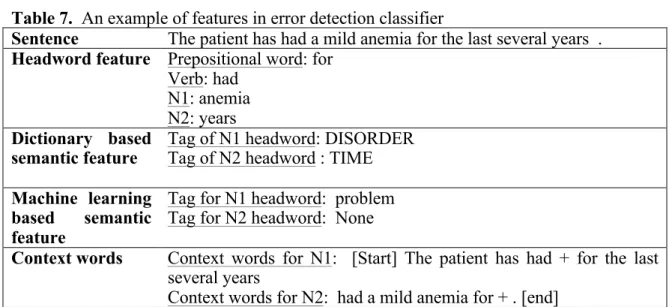
Table 7. An example of features in error detection classifier Table 8. Accuracy of PP attachment
Table 9. Result of error detection on coordination Table 10. Result of error fixing on coordination
Table 11. Statistics on coordination errors by semantic types Table 12. Feature list of semantic role labeling
Table 13. An example of features extracted for semantic role labeling
Table 14. Performance of semantic role labeling systems trained on the gold standard syntactic trees and tested on the parsed results of Stanford, Charniak and Berkley, and the gold standard syntactic trees, respectively (%)
Table 15. Semantic role labeling performance of testing on the gold standard syntactic trees and parsed results of retrained Berkley by adding one new feature each time (%) Table 16. Feature list of temporal relation extraction
Table 17. An example of features extracted for temporal relation extraction
Table 18. Two categories temporal relation classifier performance based on the Stanford parser and Berkeley parser
List of Figures
Figure 1. Example of parse tree
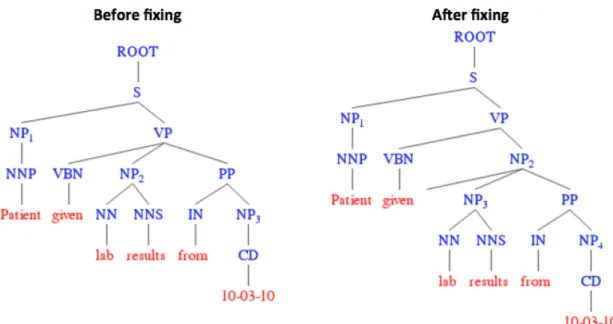
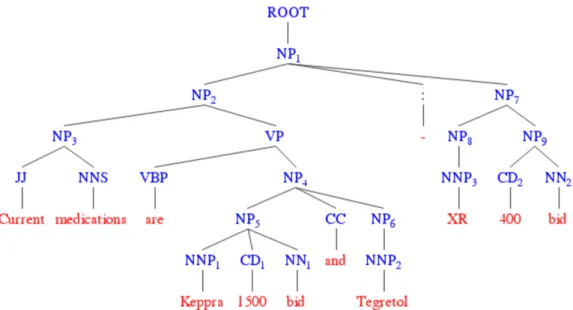
Figure 2. Stages of developing annotation guidelines Figure 3. Before and after fixing PP attachment error Figure 4. Wrong coordination structure in parsed result
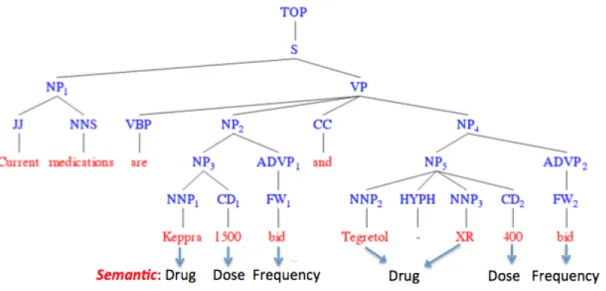
Figure 5. Semantic information example for coordination structure in the parsed result Figure 6. Example of demonstration on the rules to identify errors in coordination Figure 7. Example of error semantic type
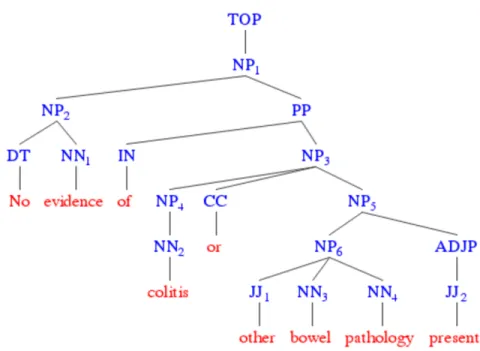
Figure 8. Example of sentence coordination
Figure 9. A syntactic parse tree with semantic roles added (ARGs) Figure 10. Study design for semantic role labeling of clinical text Figure 11. An example sentence of temporal relation annotation
Chapter 1: Introduction
Electronic Health Records (EHRs), an important source of observational data, have been widely used to facilitate clinical and translational research. EHRs often contain large amounts of unstructured textual data, which provide valuable information about patients and often serve as a good complement to structured data. To unlock useful information from the clinical narratives, many Natural Language Processing (NLP) methods and tools have been developed [1-4]. Recently, more research has focused on extracting comprehensive information from clinical text (e.g. temporal information of clinical events, relations between clinical events), in addition to simple identification of entities of interest[5-7]. This continues to drive the development of more sophisticated and advanced NLP methods in the medical domain.
Syntactic parsing that generates full syntactic structures of a sentence is a crucial NLP task mediating between linguistic expression and meaning. It is an effective way to generate relations among constituents in the sentence, which can be used for other NLP tasks such as relation extraction. Although syntactic parsing has been widely studied in the open domain, there are very limited studies focusing on parsing clinical text. Moreover, according to sub-language theory[8], clinical text has more restricted semantic patterns compared with general English. Therefore, it may be necessary to leverage clinical domain knowledge to improve syntactic parsing of clinical text.
This dissertation research investigated how to use clinical domain knowledge to improve syntactic parsing performance on clinical corpora. To the best of my knowledge, even
though there are many studies working on semantic parsing of clinical corpora[1-3], there is lack of research focussed on improving the performance of syntactic parsing on clinical corpora. In this dissertation, I systematically investigated four aspects of parsing clinical text: 1) Corpora development - I developed annotation guidelines for annotating parse trees of clinical sentences and built two clinical treebanks (Chapter 2); 2) Parser comparison – four state-of-the-art parsers from the open domain were retrained using clinical treebanks and their performance were evaluated carefully (Chapter 3); 3) Ambiguity resolution – semantic information was integrated to revolve syntactic ambiguity from prepositional phrases (PP) and coordinations (Chapter 4); and 4) External validation – to further demonstrate the effectiveness of our parsing approaches, I applied syntactic information generated by our parsers to two external NLP tasks: semantic role labeling and temporal relation extraction from clinical text (Chapter 5).
This chapter provides a review of relevant literature. The recent work of clinical NLP research and the existing work on syntactic parsing in the open and biomedical domains are introduced first. Then, existing research on resolving PP and coordination ambiguities in the open domain is also provided.
1.1 Natural language processing in the medical domain
NLP, as an effective way to convert free text to structure form, has been widely used in the open domain. In the medical domain, many clinical NLP application have been developed to unlock valuable information from clinical text to facilitate clinical studies such as disease phenotypes and patient cohort identification[9, 10], drug repurposing[11] and decision support[12]. Among all the NLP tasks, the most common tasks in the
medical domain include Named Entity Recognition (NER), clinical concept encoding and relation extraction.
Named Entity Recognition (NER) is a fundamental task for information extraction. In the medical domain, NER identifies clinical concepts in clinical text and assigns them to pre-defined categories (e.g. disease, medication, lab test, etc.). In the early stages, most of the NER systems in the medical domain used rule-based approaches [1]. However, the maintainability and scalability (human expertise is required to develop and maintain the rule base) of these approaches remain problematic. In 2010, i2b2, a NIH-funded National Center for Biomedical Computing based at Partners HealthCare System, organized a NER challenge to identify three types of named entities including “problem”, “treatment” and “test” on clinical notes from four different institutions. The challenge provided an annotated dataset which contain 837 notes including discharge summaries from Partners Healthcare, Beth Israel Deaconess Medical Center, and the University of Pittsburgh Medical Center and progress notes from the University of Pittsburgh Medical Center. Using this data set, many high-performance machine learning based NER systems have been developed and evaluated [13-15].
However, even once accurately identified, named entities in clinical text are still not easy to use in clinical studies due to high variability of the lexicon of entities. Therefore, some NLP systems, including MedLEE [1, 16], MetaMap [4], cTAKES [2], KnowledgeMap [17], and CLAMP map named entities to concepts in the controlled vocabularies of the Unified Medical Language System (UMLS) . MedLEE, developed by Friedman et al. in the 1990s at Columbia University, is mainly a semantic rule-based system. It was initially
designed to extract clinical attributes from radiological reports [18], and then extended to mammography [19], discharge summaries [20, 21] and pathology [22]. MetaMap implemented an algorithm of concept encoding which includes several steps such as partial parsing, variant generation, candidate retrieval, candidate evaluation, and mapping construction. It was developed initially for biomedical literature mining and has recently also been used for clinical note processing. cTAKES combines both rule-based and machine learning techniques under the IBM UIMA framework. The KnowledgeMap, developed by Denny et al. [17, 23] at Vanderbilt University, is another clinical NLP system built to extract clinical concepts with their section headers (by SecTag [24]) and negation status (by NegEx [25]) in documents and map them to UMLS concept unique identifiers. CLAMP is a graphical user interface (GUI) based NLP toolkit recently developed by Xu et al. at the University of Texas Health Science Center at Houston. CLAMP provides multiple existing NLP pipelines that build on a set of high performance NLP components proven in several clinical NLP challenges such as I2b2, ShARe/CLEF, and SemEVAL. Besides, users can easily customize their own pipelines and build annotation for machine learning algorithm by using the CLAMP interface.
Beyond concept normalization, the attributes of a named entity (e.g. assertion, anatomical location of a disease process, temporal information of clinical events, etc.) and the relation between them are also required for most of clinical research. Therefore, many existing NLP systems include such components [2, 26, 27]. For example, for each identified clinical concept, cTAKES also provides the functionality to identify multiple attributes of each identified clinical concept including negation, assertion etc. Aside from
the assertion related attributes, CLAMP includes a pipeline to generate clinically related attributes such as body location of disease, lab value of test etc. Moreover, CLAMP also provides a relation extraction module to generate the relation between clinical concepts (e.g. relation between diseases, relation between disease and medication etc.). Extracting relations between entities often requires deeper levels of information about the sentence, such as syntactic structure, to resolve ambiguities in the relations. Therefore, syntactic parsing is the subject of increasing attention from clinical NLP researchers.
1.2 Syntactic parsing in the open domain
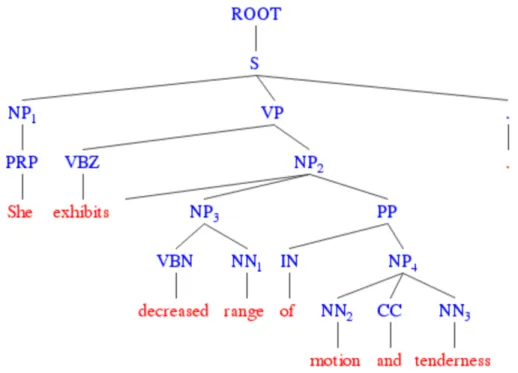
Parsing, or formal syntactic analysis, is a fundamental subject in the study of natural language. As an essential prerequisite step to truly understanding the sentential meaning, parsing is performed to represent the structure of a sentence by annotating the relations among its components. There are two major paradigms in syntactic analysis: constituency (phrase structure) parsing and dependency parsing. The paradigms are complementary in terms of expressiveness, and automated methods are available for conversion of one to the other [20]. The constituency paradigm is relatively popular in English, with a huge amount of annotations accumulated over more than a decade (e.g., the Penn Treebank). An example parse in the Treebank style is illustrated in Figure 1, following its latest guideline[28]. The innermost layer of brackets denotes the part-of-speech (POS) tags, which are lexical classes of the tokens and are usually obtained from a separate pre-processor before parsing. On top of the POS tags are the actual phrase-level constituent labels, which represent syntactic roles and imply the semantic scope of each role via the
nested bracketing. The rich information in such sentential structure empowers NLP to perform various useful relation-based information extraction and inference tasks.
Figure 1. Example of parse tree
Syntactic parsing is a central task in natural language processing because of its importance in mediating between linguistic expression and meaning. Much work has shown the usefulness of syntactic representations for subsequent NLP tasks [29] such as relation extraction, semantic role labeling and paraphrase detection [30]. In the general English domain, early studies of syntactic parsing often relied on symbolic parsing approaches that used manually created deterministic grammars to generate parse trees [31, 32]. Since 1990, statistical approaches have been widely used for syntactic parsing and have shown exceptional performance.
In 1995, Magerman [33] developed one of the first parsers which showed that high-performance parsing could be achieved using only the Treebank based corpora. In his
approach, he used the decision-tree learning technique to construct a parse tree of every sentence. In the evaluation, he divided the WSJ corpus from Penn Treebank into 25 sections, numbered 00-24. The parser was trained on sections 02-21 and tested on the 00 section. Moreover, most of subsequent parsers keep using the same data sets in the evaluation when they report the performance on WSJ corpus. The evaluation showed an F-measure of 84.7%. In 1999, Collins [34] demonstrated the use of generative models in syntactic parsing. He extended his probabilistic parser developed in 1996 with three generative models to calculate all probabilities of parse tree head nodes including adjunct/complement distinction and wh-movement. Evaluation showed that these models surpassed Megerman’s as well as his own previous parsers and achieved a highest F-measure of 87.8%. In 2004, Bikel [35] used an Expectation-Maximization Model to estimate some feature space parameters in the Collins model. The Bikel parser improved the performance of the Collins’ parser and achieved better F-measure on average with all the parameters that he used, demonstrating that his parser was robust and a reliable emulation of the Collins parser. Charniak and Johnson [36] presented a discriminative re-ranking method for constructing high-performance statistical parsers. Based on a coarse-to-fine generative parser, they constructed sets of 50-best parse trees and used them as input into a Maximum Entropy re-ranker, which then selected the best parse. Their parser outperformed all previous generative models and achieved an F-measure of 91.0%. More recently, McClosky et al. [37] presented a two-phase parser that consisted of the Charniak parser and a bootstrapping method for self-training on raw sentences. The McClosky parser boosted performance of the one-phase Charniak parser with an increase of 0.8% in F-measure.
Besides the lexicalized parsers described above, the Stanford parser [38], which was initially developed based on un-lexicalized probabilistic context-free grammar (PCFG) technology, has also shown strong performance and has been widely used across different domains. In addition, Petrov and Klein [39] developed the Berkeley parser, which also implements un-lexicalized technologies by introducing hierarchical coarse-to-fine parsing. It reached an F-measure of 90.1% on the Penn Treebank.
Recently, several studies have focused on using deep learning methods to implement high-performance and efficient syntactic parsers. In 2011, Collobert [40] proposed a new fast discriminative parser, which is based on a recurrent convolutional graph transformer network (GTN). Using only a few basic text features, the parser achieved results comparable to existing state-of-the-art parsers. In 2013, Socher [41] introduced Compositional Vector Grammar (CVG), which combined PCFG with a syntactically united recursive neural network (SU-RNN). The CVG combine the advantage of standard probabilistic context free grammars (PCFG) with those of recursive neural networks (RNNs). PCFG can categorize phrases into specific syntactic categories, while RNN can capture fine-grained syntactic and compositional-semantic information of phrases and words. Furthermore, the CVG approach generalizes the RNN that uses the same weight at all nodes to one with syntactically untied weights, resulting in weights at each node that are conditionally dependent on the categories of the child constituents. As a result, the CVG approach improved the PCFG of the Stanford parser by 3.8% to obtain the F-1 score of 90.4%.
1.3 Syntactic parsing in the biomedical domain
The state-of-the-art parsers have also been applied to the biological domain. For example, Lease and Charniak [42] extended the Charniak parser to process the GENIA corpus [43] generated from MEDLINE abstracts, by leveraging existing domain-specific lexical resources to augment training with the Penn Treebank. More recently, Clegg and Shepherd [44] developed an evaluation method using dependency graphs as an intermediate representation and compared four parsers (Collins parser [34], Bikel parser [35], Stanford parser [38], and Charniak-Lease parser [42]) on the GENIA corpus. Their results showed that the Bikel and Charniak-Lease parsers achieved better performance than the others; but the overall performance of all the parsers dropped when compared to results from the Penn Treebank.
However, few syntactic parsing studies have been done on clinical text from electronic health records (EHRs). Over the past two decades, there has been a growing interest in developing high performance NLP systems for the medical domain. Much detailed patient information is embedded in narratives in EHRs and NLP provides a means to unlock this information for other computerized clinical applications. Early clinical NLP systems such as the Linguistic String Project (LSP)[45, 46] and Medical Language Extraction and Encoding system (MedLEE) [1] are inspired by sublanguage theory, and rely on the relatively restricted semantic constraints of medical language to process text [47]. Despite the success of existing clinical NLP systems on various information extraction tasks [2-4, 17, 45, 46, 48-51], few of them have implemented full syntactic parsing functionality. Some studies extended the general English parsers such as the
Stanford Parser using a medical lexicon for clinical text processing [52], but no formal evaluation of syntactic parsing has been done for these parsers. Fortunately, recent initiatives in the clinical NLP community have led to generation of detailed annotation guidelines, as well as richly annotated corpora. For example, the MiPACQ corpus, which contains pathology and other clinical notes from the Mayo Clinic, has multiple layers of annotations, including named entities, syntactic parse trees, dependency parse trees, and semantic role labeling on 13,091 sentences [53]. It was used to retrain a dependency parser and achieved a highest labelled attachment score of 0.836. Additionally, in 2015, Yan [54] extended Stanford parser’s grammar with the SPECIALIST lexicon and statistics collected from an operative notes corpus to achieve the F-score of 89.90% of syntactic parsing on operation notes.
1.4 Resolving ambiguity of Prepositional Phrase attachment
The error of prepositional phrase (PP) attachment is one of the common issues in syntactic parsing. It refers to the problem of determining the correct attachment site for a PP, conventionally in structures such as “V NP PP” [55, 56]. For instance, in the sentence “I ate a pizza with a fork”, the PP “with a fork” could attach either to the verb “ate” or to the noun phrase “a pizza”. In this case, the verb is the correct attachment site (as the fork is involved in the act of eating). For the sentence “I ate a pizza with tomato sauce”, on the other hand, the noun phrase (“a pizza”) is the correct attachment site (as the tomato sauce is applied to the pizza). PP attachment is a structural ambiguity problem, which is a common issue when parsing a sentence.
In the general domain, many studies have been conducted to resolve the PP attachment ambiguity and they generally can be divided into two categories: supervised vs.
unsupervised approaches. Supervised approaches leverage thesauri to group words into semantic classes, to address the problem of data sparseness. Brill and Resnik (1994) [56] developed a supervised transformation-based learning method with lexical and conceptual classes derived from Word-Net, achieving a precision of 82% on 500 randomly selected ambiguous prepositional phrases examples. Ratnaparkhi et al. [56] created a benchmark dataset of 27,937 quadruples (v,n1,p,n2), extracted from the Wall Street Journal. Based on this dataset, they trained a maximum entropy model and a binary hierarchy of word classes derived by mutual information, achieving a precision of 81.6%. Collins and Brooks (1995) [56] used a supervised back-off model and reported a precision of 84.5% on the Ratnaparkhi test set. Stetina and Makoto (1997) [57] used a supervised method with a decision tree and WordNet classes to achieve a precision of 88.1% on the same test set. Toutanova et al. [58] adopted a supervised method that makes use of morphological and syntactic analysis and WordNet synsets, yielding 87.5% accuracy.
For unsupervised approaches, the attachment decision depends largely on co-occurrence statistics drawn from text collections. The pioneering work in this area was conducted by Hindle and Rooth (1993) [59]. Using a partially parsed corpus, they calculated and compared lexical associations over subsets of the tuple (v, n1, p), ignoring n2, and achieved 80% precision and 80% recall. Ratnaparkhi [60] developed an unsupervised method that collected statistics from text annotated with part-of-speech tags and morphological base forms and they achieve a precision of 81.9% on the Ratnaparkhi test set. Pantel and Lin [60] described an unsupervised method that used a collocation
database, a thesaurus, a dependency parser, and a large corpus (125M words), achieving a precision of 84.3% on the Ratnaparkhi test set. Using simple combinations of web-based n-grams, Lapata and Keller [60] achieved less impressive results, with precision in the low 70’s range.
Even though there are some studies aiming to resolve PP attachment ambiguities in the open domain, there is a lack of studies on resolving PP attachment in clinical text.
1.5 Resolving ambiguity of coordination
Coordination error is another common issue for syntactic parsing. Coordination is a procedure that links two sentence elements called conjuncts, and it is very common in language. Conjoined structures may be globally or temporarily ambiguous because it is grammatically permissible to conjoin any type of constituent as long as the conjuncts are from the same syntactic category. For example, the sentence of “She is not having any incontinence or suggestion of infection at this time.” can be interpreted into two ways: 1) “incontinence” and “suggestion” are conjoined phrases; 2) “incontinence” and “suggestion of infection” are conjoined phrases.
In the general English domain, most previous attempts to resolve coordination ambiguity have focused on a particular type of NP coordination. Both Resnik [61] and Nakov and Hearst [62] considered NP coordinations of the form “n1 and n2 n3” where two structural analyses are possible: ((n1 and n2) n3) and ((n1) and (n2 n3)). To resolve such ambiguity, Resnik combined number agreement information of candidate conjoined nouns, an information theoretic measure of semantic similarity, and a measure of the appropriateness of noun-noun modification. Nakov and Hearst’s [62] disambiguation
method is to combine Web-based statistics on headword co-occurrences with other mainly heuristic information sources. A probabilistic approach was presented in (Goldberg, 1999)[63], where an unsupervised maximum entropy statistical model was used to disambiguate coordinate noun phrases of the form n1 preposition n2 cc n3.
In the medical domain, as with PP attachment, there is no prior research work focused on resolving coordination ambiguities in clinical text.
1.6 Summary
In this chapter, relevant literature focussed on syntactic parsing in both open domain and the medical domain was reviewed. As discussed in the above sections, syntactic parsing is a critical task of NLP and has been extensively studied in open domain. However, limited work has been done regarding the methods of syntactic parsing in the medical domain. Moreover, few annotated clinical corpora of parse trees are available for developing and evaluating syntactic parsing methods in the medical domain. Therefore, there is a need for further research to create clinical treebanks and develop customized syntactic parsing approaches for clinical text, with the aim to improve other NLP tasks using extracted syntactic information. My hypothesis is that by leveraging clinical corpora and domain specific semantic knowledge, existing open-domain parsers’ performance on processing clinical text can be improved. To validate the hypothesis, I propose the following specific aims:
Aim 1 – Annotation of clinical treebanks
Aim 3 – Using semantic information to reduce PP attachment and coordination ambiguities in the parsed result
Chapter 2. Develop treebanks of the clinical text
2.1 IntroductionOne of the main reasons for the paucity of studies on syntactic parsing in the medical domain is the resource-intensive nature of establishing an infrastructure to support the development of clinical text parsers. Two challenges in particular are:
1) Limited availability of raw and annotated clinical texts and standards for annotation (Chapman [64] et al.), with the downstream effect of limiting reproducibility and collaboration. In contrast, general English parsers have achieved accuracies in the high 80’s, benefiting from abundantly annotated data and well-documented guidelines.
For example, the Penn Treebank project [65] syntactically annotated sentences in the over one million word Wall Street Journal (WSJ) corpus and released the annotation guidelines to the public. Both the corpus and the guidelines have subsequently served as the basis for an enormous amount of research in parser development as well as annotation of new corpora.
The clinical NLP community, while being aware of the benefits of high-accuracy parsers and moving generally in this direction, has focused mostly on semantic or even higher level annotation for specific applications [66-68]. One formal initiative that addresses this issue is the Strategic Health IT Advanced Research Projects (SHARP) by Mayo Clinic and its collaborating institutions[69], which have developed a MiPACQ (Multi-source Integrated Platform for Answering Clinical Questions) clinical corpus with layered annotations including syntactic parse trees and shared their guidelines [53, 70]. However, there does not appear to be any existing approach that has adequately addressed the
challenges in syntactic representation for ill-formed sentences, which are especially common in clinical text [64].
2) The intrinsic properties of medical sublanguage [47, 70] make linguistic annotation extremely knowledge-intensive, therefore, placing a high bar on the annotation. Many clinical sentences are telegraphic, with missing subjects and/or verbs. As a result, these sentences make interpretation difficult due to the frequent ambiguities found in clinical text and pose a challenge to existing parsers that are modelled on well-formed sentences. Filling in the gaps in such cases requires appropriate domain knowledge, without which the process of analysing the syntactic structure and interpreting the meaning would be highly error-prone. Therefore, it is difficult to apply a general annotation guideline to clinical corpus annotation.
Based on the challenges summarized above, it is clear that it is extremely valuable to develop syntactically annotated corpora for the medical domain, by following linguistically sound annotation guidelines. Ideally, the annotations/guidelines should be compatible with some commonly accepted style of syntactic annotation for general English (e.g., that of the Penn Treebank) so that a great number of existing methods/tools can be reused. At the same time, it should also address unique characteristics of the medical language itself.
2.2 Methods
2.2.1 Develop a parse tree annotation guideline using progress notes 2.2.1.1 Data selection and preprocess
First, we used progress notes from the University of Pittsburgh Medical Center (UPMC) distributed in the 2010 i2b2/VA Clinical NLP Challenge. A physician manually reviewed the progress notes and selected 25 of them by identifying those concerning general medicine and excluding those that apparently contained copy-pasted redundant information. To eliminate confounding errors in steps prior to parsing, a linguist performed manual tokenization and POS tagging for the 25 notes, consulting a physician on cases that required domain knowledge. Based on the gold standard tokenization, we automatically sampled sentences with at least 3 tokens of length for this study. Before distributing the notes for manual parsing, we pre-parsed them using the Stanford Parser with the general English PCFG model that was provided in the official package.
2.2.1.2 Annotation guideline and progress notes Treebank development
Four major stages were included in developing our annotation guidelines along with iterative refining of the deliverable corpus (see Figure 2 for flow chart):
Figure 2. Stages of developing annotation guidelines
Based on the manual analysis of institution-specific notes other than the 25 notes selected for this study, a linguist drafted a preliminary set of clinical parsing guidelines adapted
from the Penn Treebank [65]. We applied the error handling strategy introduced by Foster [71] and found that specifically inserting null elements for ignored (or missing) words was helpful in restoring the proper syntax of ungrammatical clinical sentences. The guideline creation was not only knowledge-driven but also involved annotating real clinical text. We used the application WordFreak [72] for performing our manual annotation. There were two teams involved in the development of the annotation guideline, including one from Kaiser Permanente and one from Vanderbilt University . In the initial batch, both teams annotated 6 of the 25 notes (with consulting physicians for domain-specific interpretation) and discussed/reconciled any disagreements. After each round, the draft guidelines were revised accordingly to address the issues discovered.
In the second stage, we performed three more rounds of annotation to train two human annotators and to fine-tune the guidelines. For each round, we randomly sampled 150 sentences from the remaining 19 notes (not used in the first stage) and had both the linguist and a non-linguist annotate them by following the guidelines and consulting physicians whenever needed. The Evalb program (the version that came with the Stanford Parser) was used to compute the inter-annotator agreement rate based on the F-1 measure. The annotators met after assessing the agreement rate to reconcile and discuss applicability of the guidelines. These three rounds with 450 sentences were meant to facilitate convergence among the annotators and the guidelines (by revising any instructions that were considered problematic).
To test the learnability/stability of our guidelines, we randomly sampled another 216 sentences (intended to round up the deliverable corpus to 1,100 sentences) from the 19 notes and had both annotators annotate them. An agreement rate was computed to evaluate whether the annotators could generate consistent annotations by following the latest guidelines. Additionally, to investigate the potential bias introduced by pre-parsing with the Stanford Parser, we had the linguist annotate two of the six stage-one notes (interrupted with a wash-out period of a half year) directly from the POS-tagged sentences. The linguist’s self-agreement rate (between her annotations using the pre-parsed vs. those using only the POS-tagged) was computed to evaluate whether the consistency can be achieved with/without the factor of pre-parsing.
After the agreement rates were assessed to be satisfactory in the last round, the annotators met to discuss/resolve any remaining disagreements and then the linguist applied the latest guidelines in preparing a final version of the deliverable corpus.
2.2.2. Extend the guideline to create a Treebank of discharge summaries
We applied the guideline to annotating discharge summaries contained in the 2010 I2b2 clinical NLP challenge, a total of 237 documents. Every sentence in these discharge summaries was pre-processed by the Stanford parser and a researcher in clinical NLP manually reviewed each parse tree generated by the Stanford parser and corrected it based on the annotation guideline. When there was any question about a parse tree, a linguist and a physician were consulted for correct annotation.
2.2 Results
2.2.1 Annotation guideline development
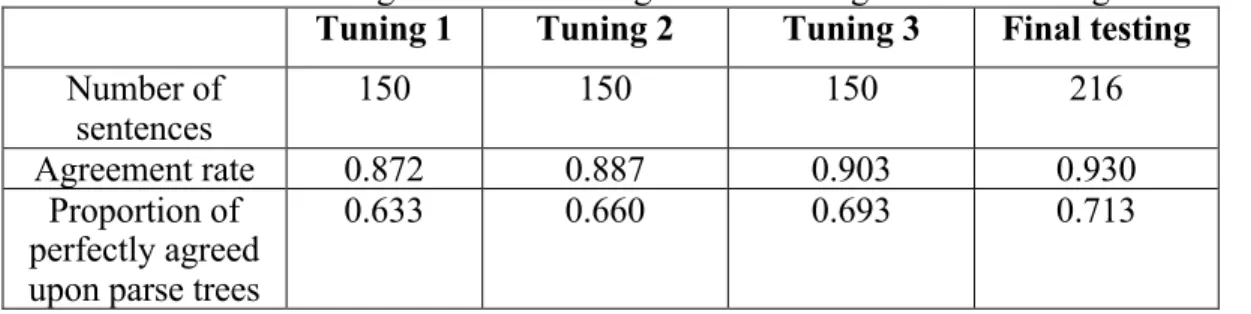
Inter-annotator agreement rates were computed to measure the consistency between institutions in following the guidelines. Table 1 shows the progressive rates from the three iterations of guideline tuning to the final independent testing. We can see the agreement rates climbed steadily over the tuning iterations and culminated at 0.930 in the final testing phase. The intra-annotator agreement rate of the linguist in annotating from Stanford Parser pre-parsed sentences versus from POS-tagged sentences only was 0.948, with 0.791 perfectly self-agreed parse trees. These results indicate that the annotators were able to perform syntactic parsing with acceptable consistency by following the guidelines.
Table 1. Inter-annotator agreement rates in guideline tuning and final testing
Tuning 1 Tuning 2 Tuning 3 Final testing
Number of
sentences 150 150 150 216
Agreement rate 0.872 0.887 0.903 0.930
Proportion of perfectly agreed upon parse trees
0.633 0.660 0.693 0.713
Our annotation guidelines are based on the original Bracketing Guidelines for Treebank II Style [12], with modifications to accommodate the properties of medical sublanguage. Several noteworthy adaptations are summarized in the following:
a) Insert missing elements: We adopted Foster’s[71] approach in annotating sentences with omitted words. We insert a null element 0-NONE- for the inferred missing word to restore the intended syntactic structure.
b) Mark superfluous and redundant elements: Superfluous and redundant elements that cannot be accommodated in a sentence or phrase structure are annotated with the constituent “X”, including some punctuation marks, symbols, and words.
c) Handle symbols with inferable syntactic roles: “Header: value” expressions occur frequently in clinical notes. Some of them can be legitimately annotated as complete sentences if the colon is interpreted as a verb. In such cases, the colon is allowed to precede a verb phrase while its POS tag should still remain “:”.
d) Interpret syntactic roles of Latin abbreviations: instead of using FW (foreign word) for Latin abbreviations, we try to infer their functioning POS tags and syntactic roles.
e) Respect domain-specific semantic structure of complex phrases. We try to accurately represent the internal semantic structure of medical expressions in annotating the constituents. When there are alternative grammatical parses, the one that better captures the intended meaning is preferred.
2.2.2 Annotation corpus
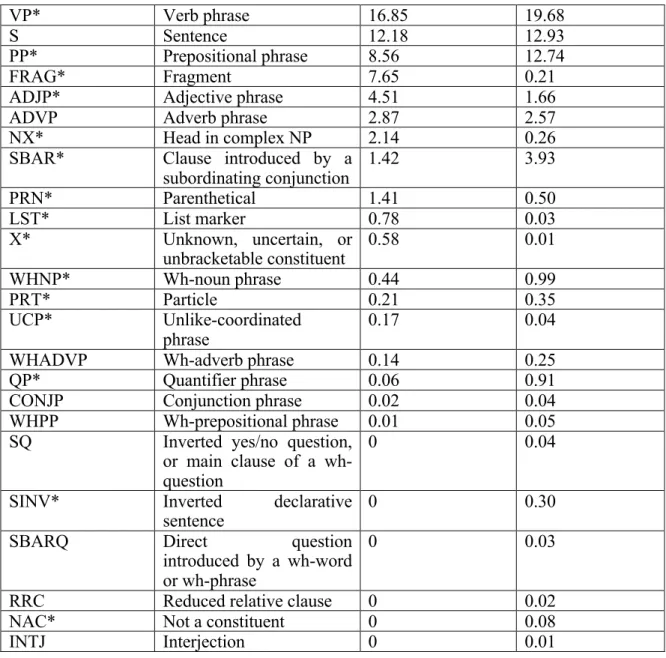
The annotated corpus contains 1,100 sentences, with a median length of 8 tokens per sentence. Table 2 shows the distribution of syntactic constructs (constituents) in our annotated corpus, aligned side by side with that in an arbitrarily selected WSJ sub-corpus (the 00 section) of 1,921 sentences. Table 3 shows a list of those rules that involve restoration of missing elements by inserting a 0-NONE- node. For example, we can see the most frequent rule involving element restoration is VP ! -NONE- NP.
Table 2. Constituent distribution in the annotated corpus with comparison to a general corpus
Constituent label Constituent description % in our
annotated clinical corpus
% in a subset of WSJ corpus
VP* Verb phrase 16.85 19.68
S Sentence 12.18 12.93
PP* Prepositional phrase 8.56 12.74
FRAG* Fragment 7.65 0.21
ADJP* Adjective phrase 4.51 1.66
ADVP Adverb phrase 2.87 2.57
NX* Head in complex NP 2.14 0.26
SBAR* Clause introduced by a
subordinating conjunction 1.42 3.93 PRN* Parenthetical 1.41 0.50 LST* List marker 0.78 0.03 X* Unknown, uncertain, or unbracketable constituent 0.58 0.01 WHNP* Wh-noun phrase 0.44 0.99 PRT* Particle 0.21 0.35 UCP* Unlike-coordinated phrase 0.17 0.04
WHADVP Wh-adverb phrase 0.14 0.25
QP* Quantifier phrase 0.06 0.91
CONJP Conjunction phrase 0.02 0.04
WHPP Wh-prepositional phrase 0.01 0.05
SQ Inverted yes/no question,
or main clause of a wh-question
0 0.04
SINV* Inverted declarative
sentence 0 0.30
SBARQ Direct question
introduced by a wh-word or wh-phrase
0 0.03
RRC Reduced relative clause 0 0.02
NAC* Not a constituent 0 0.08
INTJ Interjection 0 0.01
Table 3. Grammar rules involving restoration of missing elements in our annotated corpus
Frequency Grammar rule
159 VP ! -NONE- NP 52 NP ! -NONE- 41 VP ! -NONE- VP 25 PP ! -NONE- NP 21 VP ! -NONE- ADJP 6 VP ! -NONE- PP 3 VP ! -NONE- NP PP 2 NP ! JJ -NONE-
2 VP ! -NONE- SYM NP 1 VP ! -NONE- ADVP VP 1 VP ! -NONE- NP PRN 1 VP ! -NONE- NP , NP , NP 1 PP ! -NONE- NP ADVP 1 VP ! -NONE- NP NP
1 ADJP ! ADVP -NONE-
2.3 Discussion
The main purpose of this study was to develop/evaluate/share domain-customized parsing guidelines along with a real clinical corpus annotated accordingly. The promising inter-annotator agreement rate (0.930) indicated reliability of the guidelines, and the accuracy (0.811) of a statistical parser retrained with the corpus demonstrated reasonable usability of the annotations. To our knowledge, the current work was the first to introduce Foster’s error-handling approach to ill-formed clinical sentences. We do not claim it to be the most suitable and final solution to annotating ungrammatical clinical sentences. Rather, the rationale was merely to perform solid experiments and share the results. It is hoped that the community will gradually converge to a common consensus by combining the advantages of different proposals.
As mentioned in the Background section, the study was partly motivated towards addressing the limited interoperability in medical text parsers that involve proprietary semantic grammar. We believe our sharing of the standard-conforming corpus is critical in a data-driven, sustainable model that attracts constant pursuit of questions/solutions for research and development. However, it should be emphasized that a general syntactically annotated corpus is not contradictory to the value of any existing semantic approaches. If combined appropriately, syntax and semantics can in fact complement each other in
forming robust parsing solution to clinical narratives. Specifically, when superimposed with semantic annotations on the same corpus, the Treebank constituents can facilitate automated derivation of a semantic grammar in flexible ways.
As by-products, the study yielded interesting findings as well as research questions: 1) The simple comparison of constituent distribution between the annotated corpus and a WSJ subset served as proof of concept that clinical text does differ syntactically from non-clinical English. However, it is an open question whether the progress note sample in this study is representative of clinical text. In other words, could syntactic composition differ considerably even among different clinical genres and also between clinical text that was dictated and versus typed?
2) The number of iterations and amount of training notes provided a hint on the effort required to achieve reasonable annotation consistency. Our results suggest it would take at least three iterations of annotating/adjudicating on more than 500 sentences in total for the annotators to reach a higher than 0.9 agreement rate. However, there is a need for a larger scale comparative study to verify the generality of our findings.
3) Combining clinical text with a certain amount of Treebank training sentences resulted in the most accurate parser model. A purely general English model achieved an accuracy of only 0.656, but the mixture boosted the purely clinical parser model's accuracy from 0.769 to 0.811. One hypothesis is that the size of our corpus (1100 sentences) is still not sufficient to train a statistically robust parser, and therefore even off-domain annotations
can help with a smoothing effect. The research question here is: How large should the clinical corpus be in order to independently train a parser? And before the sufficiency of domain-specific training data is achieved, how can we reliably estimate the optimal ratio to mix the heterogeneous corpora?
2.4 Conclusion
With an iterative approach, we developed syntactic parsing guidelines for clinical text and annotated a set of 1100 sentences in progress notes accordingly. The guidelines are compatible with the standard Penn Treebank syntactic annotation style and include special adaptations to accommodate clinical sublanguage properties. Two annotators (a linguist and a computer scientist) reached an agreement rate of 0.930 in the final independent evaluation, which indicates consistency in following the guidelines. As simple validation of usefulness, retraining a statistical parser with the annotated corpus achieved a best accuracy of 0.811 (by involving also some off-domain training sentences).
Chapter 3. Leveraging clinical treebanks to improve
state-of-the-art parsers performance on clinical corpora
In the previous chapter, we developed an annotation guideline for clinical treebank and built two clinical corpora including a discharge summary treebank and a progress note treebank. Both Treebanks can be used to re-train existing parsers to recognize syntactic structures of sentences in clinical text. In this chapter, we re-trained several state-of-the-art parsers in the open domain and evaluated their performance on different types of clinical notes, by using Treebanks developed by us and others.
3.1 Introduction
In the general domain, there are several state-of-the-art parsers that have achieved great performance in English corpora such as the Penn Treebank etc.
3.1.1 The Stanford parser
In 2003, Klein proposed an un-lexicalized parser, the Stanford parser. It achieved the bracket F-measure of 86.36%, which was better than the early lexicalized PCFG models. In the study, Klein described several simple, linguistically motivated annotations on both non-terminal and POS tagging level, which do much to close the gap between basic PCFG and state-of-the-art lexicalized models. In 2013, Socher proposed a deep learning based solution for Stanford parsers, which used a syntactically united recurrent neural network (SU-RNN) to combine PCFG generated from the treebank and semantic information from the pre-trained word embeddings. As a result, it increased the F-measure to 90.4%.
3.1.2 The Bikel parser
In 1997, Collins proposed a new statistical parsing model, which is a generative model of lexicalized context-free grammar. Then he extended the model to include a probabilistic
treatment of both sub-categorization and wh-movement. The model achieved the 88.1/87.5% constituent precision/recall[34]. In 2004, Klein implemented the Bikel parser, which is based on the Collins parsing model. Additionally, Klein implemented a flexible constraint-satisfaction mechanism to build the model for unknown events in the training data. It used the Expectation-Maximization algorithm to estimate the feature space parameters in the Collins model [35].
3.1.3 The Charniak parser
In 2000, Charniak presented a new parser based on “maximum-entropy-inspired” model for conditioning and smoothing, which achieved a F-score of 90.1% for sentences of length 40 words and less, and a F-score of 89.5% for sentences of length 100 words and less. In 2005, Charniak used a simple yet novel method for constructing sets of 50-best parse trees based on a coarse-to-fine generative parser, then those 50-best parse trees were fed into a discriminative re-ranker which is based on Maximum Entropy model to select the best parse tree. As a result, it achieved an F-score of 91.0% on sentences of length 100 words or less [36].
3.1.4 The Berkeley parser
In 2007, Petrov introduced the Berkeley parser, which made several improvements to unlexicalized parsing with hierarchically state-split PCFGs. First, he presented a novel coarse-to-fine method in which a grammar’s own hierarchical projections are used for incremental pruning, including a method for efficiently computing projections of a grammar without a Treebank. Second, he compared various inference procedures for state-split PCFGs from the standpoint of risk minimization, paying particular attention to their practical tradeoffs. As a result, the Berkeley parser achieved F-score of 90.0% on an English corpus [39].
3.1.5 Application of parsing in the medical domain
Recently, the research community has started applying existing parsing algorithms to clinical text. In 2011, Xu randomly selected 50 sentences in the clinical corpus from the 2010 i2b2 NLP challenge and manually annotated them to create a gold standard of parse trees. In the study, the evaluation showed that the original Stanford Parser achieved a bracketing F-measure (BF) of 77% on the gold standard. Further, the study assessed the effect of part-of-speech (POS) tags on parsing and the results showed that manually corrected POS tags achieved a maximum BF of 81%. Also, it analysed parsing errors from the Stanford Parser and provided valuable insights for large-scale parse tree annotation for clinical text. In 2013, Daniel reported the performance of the OpenNLP constituency parser on a corpus combining general domain data and the MiPACQ data described in this manuscript., The parser achieved a labeled F1 score of 0.81 on a corpus consisting of clinical and pathology notes when tested on held-out data of clinical and pathology notes [53]. In 2015, Yan expanded Stanford parser’s grammar using the SPECIALIST lexicon and reported its performance on operative notes [54].
3.2. Methods
3.2.1 Choose state-of-the-art parsers
Basically we wanted to follow Clegg and Shepherd’s study [44], which compared four parsers. However, we excluded the Collins parser because it lacks a simple way to re-train the parser using a different corpus. Furthermore, the Berkeley parser, as a very popular parser in the English domain, has good potential for high performance on the cross domain. As a result, we included four parsers in the study: the Stanford parser [38], the Bikel parser [35], the Charniak parser [36] and the Berkeley parser [39]. In addition,
we also included a compositional vector grammar based parser [73] as a deep learning based Stanford parser.
3.2.2 Choose clinical treebanks
We evaluated the performance of existing parsers on three clinical treebanks including two that was built previously: 1> The ProgressNotes treebank originated from the clinical notes from the 2010 I2b2 NLP challenge; 2> The DischargeSummaries treebank and the MiPACQ treebank, which consists of annotated clinical and pathology notes related to colon cancer from Mayo Clinics. When retraining our developed treebank, we removed the annotation for missing elements in this experiment.
3.2.3 Strategy of parsing
The parsing experiment included three steps: firstly, we ran four State-of-the-Art parsers with the default settings. Then we used 5-fold cross validation mechanisms to retrain the parsers on both treebanks. Finally, to test if combining treebank from clinical and other domain could achieve better results, we ran the parsers with each treebank combining the WSJ corpus from Penn Treebank respectively. For the deep learning based Stanford parser, when retraining on clinical corpus, we generated new word embedding vectors from clinical text in the MIMIC-III dataset[74] using continuous bag-of-words (CBOW) (context window size of 5, threshold for downsampling the frequent words of 1e-3) in Word2vec model and fed them into the deep neural network.
3.3 Results
Table 4 shows the experimental results on the ProgressNotes treebank. The deep learning based Stanford parser achieved the best performance of 71.14% BF, with the default
settings. Compared to the default setting, re-training on the clinical treebank improved the performance for three parsers, with the biggest boost achieved by the deep learning based Stanford parser (from a F-score of 71.14% to 78.15%). When the combined corpora of both progress notes and WSJ articles were used for training, the BF of the Berkeley parser and Charniak parser increased by 3.9% (from 71.87% to 75.77%) and 3.52% (from 70.01% to 73.53%); however, both the Stanford and the Bikel parsers dropped slightly in their performance.
Table 5 shows the results obtained using the DischargeSummaries treebank. With the default setting, the Stanford parser again achieved the best performance among all the parsers. Upon re-training on the MiPACQ Treebank alone, all the four parsers had a big leap in performance with the Berkeley parser showing the maximum increase (increased from a BF of 69.55% to 86.39%). Re-training on the combined treebanks of MiPACQ and WSJ led to marginal increases in performance for all the parsers. Among all the parsers, the Berkeley parser achieved the best BF of 86.05% when both MiPACQ and WSJ treebanks were used.
Table 6 shows the results obtained using the MiPACQ treebank. With the default setting, the Berkeley parser again achieved the best performance among all the parsers. Upon re-training on the MiPACQ treebank alone, all the four parsers had a big leap in performance with the Stanford parser showing the maximum increase (increased from a BF of 69.55% to 86.39%). Re-training on the combined treebanks of MiPACQ and WSJ led to marginal increases in performance for all the parsers. Among all the parsers, the
Berkeley parser achieved the best BF of 86.05% when both MiPACQ and WSJ treebanks were used.
Table 4. Results for four parsers on the ProgressNotes treebank
Parser Training corpus BR (%) BP (%) BF (%)
Stanford Default 70.31 70.27 70.29
Clinical 76.22 71.31 73.68
Clinical + WSJ 74.27 71.16 72.68
Stanford
(deep learning) Default Clinical 70.61 79.91 71.68 76.47 71.14 78.15
Bikel Default 64.20 69.20 66.60 Clinical 71.85 73.05 72.45 Clinical + WSJ 70.85 73.92 72.35 Charniak Default 62.91 75.03 68.44 Clinical 65.82 74.78 70.01 Clinical + WSJ 75.89 71.31 73.53 Berkeley Default 66.63 65.08 65.85 Clinical 77.24 67.19 71.87 Clinical + WSJ 79.41 72.46 75.77
Table 5. Results for four parsers on the DischargeSummaries treebank
Parser Training corpus BR (%) BP (%) BF (%)
Stanford Default 68.37 72.06 70.17
Clinical 83.10 82.52 82.81
Clinical + WSJ 77.76 80.57 79.14
Stanford (deep
learning) Default Clinical 68.50 84.07 69.78 83.58 69.13 83.82
Bikel Default 65.14 72.48 68.61 Clinical 76.32 77.86 77.08 Clinical + WSJ 74.96 77.76 76.34 Charniak Default 62.14 75.75 68.27 Clinical 74.57 76.63 75.58 Clinical + WSJ 74.56 83.15 78.62 Berkeley Default 67.33 74.68 70.82 Clinical 85.03 83.89 84.45 Clinical + WSJ 82.41 84.56 83.47
Table 6. Results for four parsers on the MiPACQ treebank
Stanford Default 75.54 74.41 74.97
Clinical 84.35 85.45 84.90
Clinical + WSJ 84.89 85.24 85.06
Stanford (deep
learning) Default Clinical 75.78 85.83 73.45 84.80 74.59 85.31
Bikel Default 73.49 75.78 74.62 Clinical 77.59 78.09 77.84 Clinical + WSJ 77.43 78.63 78.03 Charniak Default 70.63 78.11 74.18 Clinical 80.88 86.39 83.54 Clinical + WSJ 80.65 86.76 83.59 Berkeley Default 66.30 73.14 69.55 Clinical 85.94 86.85 86.39 Clinical + WSJ 86.03 86.08 86.05 3.4 Discussion
Full syntactic parsing is an important area of clinical NLP research, but it has not been extensively explored so far. In this study, we conducted the first formal evaluation to compare the performance of four state-of-the-art English parsers on clinical notes using three clinical treebanks. When all three treebanks were retrained on the parsers, the highest average BFs of 86.39%, 84.45% and 78.15% were achieved by the Berkeley parser for the MiPACQ and DischargeSummaries corpus and the deep learning based Stanford parser for the ProgressNotes treebank respectively.
As expected, existing parsers achieved lower performance on clinical text than previously reported results on general English text, when they were directly applied to clinical text. For instance, on the MiPACQ corpus, the Stanford parser showed a decrease of 11.35% in BF (from 86.32% to 74.97% in this study). When the existing parsers were re-trained on the clinical treebanks, their performance increased. For the progress notes treebank, there were 3.39%, 7.01%, 5.85%, 1.57% and 6.02% increases in BF for the Stanford, deep learning based Stanford, Bikel, Charniak and Berkeley parser, respectively. For the