XtratuM for LEON3: an Open Source Hypervisor for High Integrity Systems
Miguel Masmano, Ismael Ripoll, Alfons Crespo and Salvador Peiro Instituto de Inform ´atica Industrial. Universidad Polit ´ecnica de Valencia.
Camino de Vera s/n, 46022 Valencia, Spain {mmasmano, iripoll, acrespo, speiro}@ai2.upv.es
Abstract: The growing complexity of the payload on-board satellite software experimented during the last years has raised the interest of the CNES and the ESA to explore the possibility of using a TSP-based architecture as base of the payload software of its new generation satellites. Such a solution can be implemented by using different approaches: virtu-alization,µ-kernels, separation kernels.
XtratuM is an open-source hypervisor targeted high-critical real-time systems which has been se-lected by ESA to be ported to the LEON3 processor in the frame of the Securely Partitioning Spacecraft Computing Resources project. This paper addresses the current status of the XtratuM open-source hyper-visor for LEON3. In addition an early evaluation of it is also sketched.
Keywords: TSP, virtualization, hypervisor, high-integrity systems, real-time.
1
Introduction
Both, the advances in the processing power and the increment in resources achieved during the last decade have raised two important consequences in the payload on-board satellite software. On the one hand, it has permitted to turn the payload on-board satellite software from simple data process-ing, mainly responsible for only formatting and trans-ferring the data to the ground into complex and au-tonomous data processing software. Despite of in-creasing notoriously the development and mainte-nance cost. On the other hand, multiple applica-tions are able to run in a single processor, reducing the quantity of hardware necessary to build a satel-lite, and as a consequence its final cost. To facili-tate such a model, the execution time and memory space of each application must be protected from the rest of the applications present in the system. Par-titioned software architecture have evolved to pro-vide such security. The separation kernel proposed in [1] established a combination of hardware and software to allow multiple functions to be performed on a common set of physical resources without in-terface. The MILS [2] initiative is a joint research ef-fort between academia, industry, and government to develop and implement a high assurance, real-time architecture for embedded systems. The technical
foundation adopted for the so-called MILS architec-ture is a separation kernel. Also, the ARINC-653 [3] standard specifies the baseline operating environ-ment for application software used within Integrated Modular Avionics (IMA), based on a partitioned ar-chitecture. Although not explicitly stated in the stan-dard, it was developed considering that the under-lying technology used to implement the partitions is the separation kernel.
A virtual machine (VM) is a software implemen-tation of an architecture that executes programs like a real machine. In addition, the low overhead, fairly closed to that of the native hardware, turns this solu-tion into a candidate to build partisolu-tioned systems.
The European space sector, CNES firstly with the LVCUGEN project, and later, ESA with the Se-curely Partitioning Spacecraft Computing Resources project are currently assessing the feasibility and benefits of a TSP-based solution for payload on-board satellite software based on virtualization or re-lated technologies (see for a description of the archi-tecture proposed by ESA [4]).
The LVCUGEN project started by the end of 2008 with the aim of developing a highly reusable and configurable TSP-based architecture for on-board payload software. As base of this architec-ture, the XtratuM hypervisor [5,6] was selected to be adapted to the AT697 (LEON2) processor, which lacks of a MMU. This feature forced XtratuM to im-plement inter-partition read-only protection instead of the desired full-spatial isolation.
The Securely Partitioning Spacecraft Computing Resources project started by the middle of 2009 to build a TSP-based architecture for on-board payload software to be tested on the ESA’s Eagle-Eye simu-lator. XtratuM was selected as the open source alter-native to be adapted to the GR-CPCI-XC4V (LEON3 processor) processor, with MMU.
This paper describes the experiences of adapt-ing XtratuM to the LEON3 processor. This processor, unlike its predecessor, includes a MMU enabling, thus, XtratuM to eventually implement full spatial iso-lation. Furthermore, it describes the XEF image for-mat, a partition image format introduced in this ver-sion of XtratuM to improve the management of parti-tions during the deployment phase. An initial evalua-tion of the most significant metrics is also provided.
2
XtratuM hypervisor
XtratuM 1.x was initially conceived as an improved replacement of RTLinux’s virtualization layer [7]. There was two design goal: avoid the legal problems related with the patent that protected the exact virtu-alization mechanism used by RTLinux, and avoid its technical limitations. XtratuM 1.x was designed as a Linux Kernel Module. Once loaded (as a Linux mod-ule), it takes over the essential hardware devices (ba-sically interrupts and timers) to enable the concurrent execution of two or more OSes1, being one of them a real-time OS. The other hardware devices, as well as the boot sequence, were left to be managed by Linux. This approach let us speed up the implemen-tation of a first working prototype, however, it was not completely satisfactory: XtratuM and Linux still shared the same memory area, and both run in su-pervisor mode (Ring level 0).
After this first experience, the second version (XtratuM 2.0) was redesigned to be independent of Linux. In the rest of this paper, the term XtratuM will refer to this second version or above. This version is being used in the project LVCUGEN [8], whose goal is to build a TSP-based solution for payload on-board software (for the aerospace industry), highly generic and reusable. The TSP-based architecture has been identified as the best solution to ease and secure reuse, enabling a strong decoupling of the generic features to be developed, validated and maintained in mission specific data processing.
XtratuM is, according to the IBM categorisa-tion [9], a type 1 (bare-metal) hypervisor that uses para-virtualization. The para-virtualized operations are as close to the native hardware as possible. Therefore, porting an operating system that already works on the native system is a simple task: just to replace some parts of the operating system HAL (Hardware Abstraction Layer) with the corresponding hypercalls2.
XtratuM was designed to meet high integrity sys-tem requirements. Its most relevant features are:
– Bare-metal hypervisor.
– Implements para-virtualisation techniques.
– Designed for embedded systems: low footprint, some devices can be directly managed by a des-ignated partition.
– Strong temporal isolation: fixed cyclic scheduler.
– Strong spatial isolation: all partitions are exe-cuted in processor user mode, and do not share memory.
– Fine grain hardware resource allocation via a XML configuration file.
– Robust communication mechanisms (ARINC 653-1 based sampling and queueing ports).
– Health monitoring capabilities.
– Two security levels: standard and system parti-tions.
2.1 Architecture and design
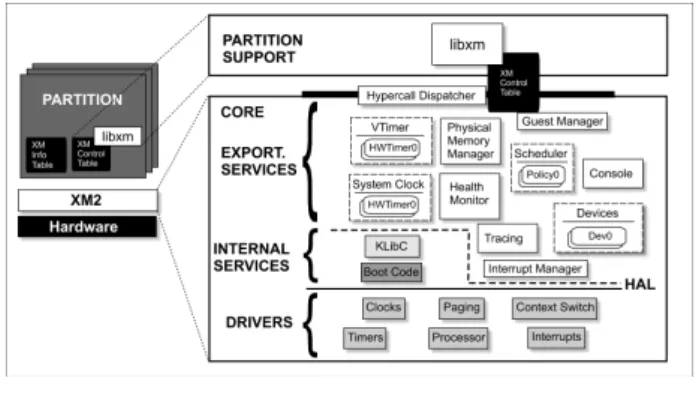
XtratuM has been implemented following a mono-lithic approach, running all its services in the proces-sor highest-privileged mode and in a single memory space; all the services are directly reachable from any part of the hypervisor.
Fig. 1.XtratuM architecture.
Figure 1 sketches the complete system architec-ture.
The main components of this architecture are: 1. Hypervisor: XtratuM is in charge of virtualization
services to partitions. It is executed in supervisor processor mode and virtualizes cpu, memory, terrupts and some specific peripherals. The in-ternal XtratuM architecture includes: physical/vir-tual memory management, scheduling (fixed cyclic scheduler), interrupt management, clock and timers management, inter-partition commu-nication (ARINC 653-1 based commucommu-nication model) and health monitoring.
2. Partitions: a partition is an execution environ-ment managed by the hypervisor which uses the virtualized services. Each partition consist of one or more concurrent processes (implemented by the operating system of each partition), sharing access to processor resources based on the re-quirements of the application. The partition code can be:
– An application compiled to be executed on a bare machine using directly the services of XtratuM. Note that XtratuM provides an execution environ-ment that is not exactly like the original hardware but somewhat more “friendly” (console services, easy to use timers, etc.)
– An operating system (and RTOS and a general purpose one) and its applications.
1
RTLinux virtualiser only is able to run Linux and one real-time OS.
2
Hypercall is the name of the hypervisor services. It is based on the termsystem callwhich refers to the services of an operating system
Partition code need to be virtualized to be ex-ecuted on top of the hypervisor. Depending on the type of execution environment, the virtualization im-plications in each case can be summarised as:
– Bare applications: the application has to be virtu-alized by using the services provided by XtratuM. The application is designed to run directly on the hardware and it has to be aware of it.
– Operating system application: when the applica-tion runs on top of a (real-time) operating sys-tem, it uses the services provided by the oper-ating system and does not need to be adapted. But the operating system has to deal with virtu-alization (ported to be XtratuM aware).
Two different type of partitions can be defined: system and user. A system partition is able to change the execution state of a user partition (sus-pend / resume / halt / reset) or the whole system.
2.2 LEON2 version limitations
The current version of XtratuM for LEON2 processor has a series of limitations: the SPARC architecture does not provide any kind of virtualisation support. It implements the classical two privilege levels: super-visor and user; in order to guarantee isolation, par-tition’s code has to be executed in user mode, only XtratuM can be executed in supervisor mode. This requirement imposes limitations to those operating systems which require both modes.
Additionally, the LEON2 processor lacks of a Memory Management Unit (MMU) which prevents XtratuM to implement:
– Full spatial isolation. Nevertheless, a kind of partial spatial isolation is provided (through the LEON2’s memory write protection registers: a partition cannot overwrite memory which be-longs to others, however, it is still able to read from any memory address. In addition, the trap raised by a partition when it is trying to write in write-protected area is received several cycles later (unlike MMU traps which is synchronous), being, thus,rather difficult to find out which was the offending instruction. And it is even still much more difficult to try to sort out the situation with-out killing the offending partition.
– Shared memory between partitions. The use of shared memory could be used to implement efficient, zero-copy inter-partition communica-tion mechanisms. Currently, XtratuM only imple-ments queuing and sampling ports, both of them requiring two copies of data (sender → Xtra-tuM → receiver). The use of shared memory should enable the implementation of more effi-cient inter-partition communication. Besides, the lack of shared memory also prevents XtratuM
from sharing sections between partitions. For ex-ample if two partitions run Linux, then two copies of the Linux code must be copied in memory. Furthermore, during the evaluation of XtratuM 2.2.x were raised several suggestions about the bi-nary format used by the image of XtratuM and the partitions:
1. A raw binary image could be corrupted without being detected by the bootloader.
2. An user payload embedded in the partition’s header is missed. This payload shall be used by the partition’s supplier to insert tracking informa-tion/versions/etc.
3. The binary image was not processed in any way, techniques such as compression, digestion, cryptography could be beneficially applied.
3
XtratuM for LEON3 processor
The LEON3, successor of the LEON2 processor, is a synthesisable VHDL model of a 32-bit processor compliant with the SPARC-v8 architecture. Designed by Aeroflex Gaisler, it has been released under the GNU GPL licence. In addition to all the features already presented on the LEON2 processor, this version of the processor includes support for SMP systems, and a Memory Management Unit (MMU) (SPARC reference MMU with configurable TLB).
By using this MMU, XtratuM is able to:
– Implement full spatial isolation. No partition is longer able to read from memory areas belong-ing to other partitions.
– Support inter-partition shared memory: two or more partitions are able to share memory ar-eas (specified in the XML configuration), per-mitting to design and implement more efficient inter-partition communication mechanisms. And, in addition, code sections could be shared by partitions avoiding duplicity of code.
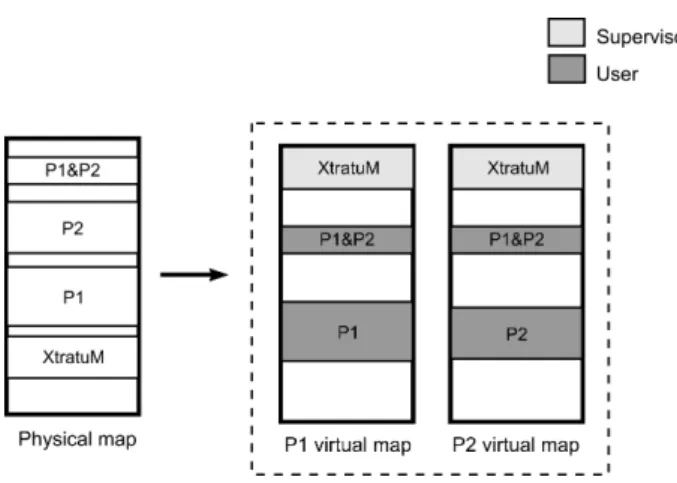
The adaptation of XtratuM to this processor has consisted in virtualizing the MMU: each partition has its own virtual memory map where the top area is re-served for XtratuM. XtratuM itself is mapped on this area with supervisor permissions. The rest is filled according to the definition of the partition (XML con-figuration file). In addition, a partition has the capabil-ity of defining new memory maps and updating them. In addition, a set of new hypercalls is provided, enabling a partition to manage its memory maps.
Fig. 2.Memory map of two partitions. Figure 2 shows the two virtual memory maps build by XtratuM as a result of the following XML con-figuration file:
<Partition name=P1 ...> <PhysicalMemoryAreas>
<Area start=0x10000 size=64KB mappedAt=0x8000/> <Area start=0x30000 size=32KB flags=shared/> </PhysicalMemoryAreas>
...
</Partition>
<Partition name=P2 ...> <PhysicalMemoryAreas>
<Area start=0x20000 size=64KB mappedAt=0x8000/> <Area start=0x30000 size=32KB flags=shared/> </PhysicalMemoryAreas>
</Partition>
This XML configuration file defines two partitions P1 and P2 and allocates two memory areas to each partition. One of them, the area starting at0x30000, shared. In addition, the configuration establishes that the areas non-shared, the area starting at 0x10000 and the area starting at0x20000, are mapped at the same virtual memory address, that is,0x8000.
3.1 Memory management virtualisation
Memory management is from far, one of the hard-est thing to be efficiently virtualized in a computer, both in terms of the mechanisms required in the hy-pervisor and modifications required to port an OS. In order to virtualize the memory XtratuM follows the XEN approach [10], that is:
1. Each partition is in charge of managing the page table (but the initial one, which is created by Xtra-tuM).
2. XtratuM is mapped in the top of every memory map, thus avoiding a TLB flush when entering and leaving the hypervisor.
The initial memory map of each partition is built by XtratuM following the description found in the XML configuration file, it cannot be updated by the parti-tion. If a partition requires a new memory map, then
it has to define the new memory map by registering a set of pages from its own memory. Once registered, these pages become read-only, so subsequent up-dates must be validated by XtratuM.
3.2 Changes in the XtratuM core
Three fundamental changes have been performed in the XtratuM core:
– XtratuM implements a new module calledvirtual memory managerwhich is in charge of manag-ing the virtual maps, and is able to create/release them and map/unmap physical pages.
– As mentioned above, XtratuM implements three new hypercalls: XM set page type()which per-mits a partition to register new memory maps, XM update page32()which allows a partition to update an entry in an already existing memory map, and XM write register32(PTD1 REG32,) which enables a partition to change the current memory map with a new one.
3.3 Changes in the XML configuration file
The XML configuration file did not consider any aspect related with the MMU management, being mandatory to modify it after the addition of MMU support. However, this file, as long as it has been possible, should be kept compatible backwards. We have included two new attributes to the defini-tion of the physical memory area element: @flags (/Partition/PhysicalMemoryAreas/Area/@flags) and@mappedAt ( /Partition/PhysicalMemoryAreas/-Area/@mappedAt).
The attribute@flagsenables the system integra-tor to give properties to each memory area. These properties are:
Uncacheable when this property is used, the mem-ory area remains as not cached in the virtual memory map. This provides a finer-grain control to define which memory areas should be cached or not. By default a memory area is cached.
Read-only when set, the memory area is always mapped as read-only. The partition is unable to modify its content. By default memory areas have read/write permissions.
Unmapped if specified, the memory area is not mapped on the initial memory map. Nonethe-less, this property does not prevent the partition to map the memory area. By default all memory areas are mapped on the initial memory map.
Shared this property enables the system integrator to allocate the same memory area to one or more partitions. By default memory areas are private and can be only allocated to one partition.
On the other hand, the attribute @mappedAt en-ables the system integrator to define the location of the memory area at the initial memory map. If this at-tribute is not specified, the memory area is mapped 1:1, that is, at its correspondent physical address.
3.4 Changes in the partitions
No special change has to be performed in partitions, allowing fully backward compatibility. A XtratuM 2.2 partition which already worked in a MMU-less sys-tem works correctly in this new version of XtratuM. However, the addition of MMU supports open the possibility of porting more complex OSes such as Linux which were not possible in a MMU-less sys-tem.
3.5 The XEF partition image format
This new format is designed with the aim of tak-ing into account all the suggestions given about the LEON2 partition image, enumerated in the section 2.2, while keeping binary compatibility with the pre-vious binary format. Its features are:
– It is a wrapper layer for the already existing bi-nary XtratuM/partition format.
– Includes a digest sum to verify integrity. As digest algorithm we have chosen the MD5 algorithm.
– Includes a partition supplier’s payload of 16 bytes. This spare space is left for the partition creator.
– (Optional) Implements compression. As com-pression algorithm XtratuM implements the LZSS one.
– Implements the concept of sections. An image can be integrated by several sections, each one located in a different memory address. This fea-ture shall reduce the size of a binary image since including padding in the image is not longer nec-essary.
MD5 digest algorithm: discussion As digest algo-rithm we have chosen the MD5 algoalgo-rithm, despite knowing it has already been compromised, because it has a reasonable trade-off between calculation time and the security level it offers. According to our tests, the time spent by more sophisticated options such as SHA-2, Tiger, Whirlpool in the LEON3 pro-cessor was not acceptable (as illustration, 100 KB took several seconds to be digested by a SHA-2 al-gorithm).
LZSS compression algorithm: discussion LZSS is a lossless data compression algorithm, a deriva-tive of LZ77, that was created in 1982 by James Storer and Thomas Szymanski [11]. When compres-sion is enabled, the partition binary image is com-pressed using a LZSS algorithm. The reasons be-cause this algorithm was selected are:
– Reasonable compression rate (up to 80% com-pression rate in our experiments).
– Fast decompression algorithm.
– Fairly acceptable trade-off between the previous two parameters.
– Implementation simplicity.
– Patent-free technology.
Aside from LZSS, other algorithms which were regarded were: Huffman coding, gzip, bzip2, LZ77, RLE and several combinations of them. Table 1 sketches the results of compressing core binary of XtratuM (78480 bytes) with some of these compres-sion algorithms.
Algorithm C. size C. rate
LZ77 43754 44,20% LZSS 36880 53,00% Huffman 59808 23,80% Rice 32bits 78421 0,10% RLE 74859 4,60% Shannon-Fano 60358 23,10% LZ77/Huffman 36296 53,76%
Table 1: Outcomes of compressing a xm core.bin (78480 bytes)
XEF tools In order to support this new format, Xtra-tuM includes two new utilities:
– LibXEF: a new library which allows, among other things, to create a XEF from an ELF file, compression and decompression algorithms, in-tegrity algorithm, etc.
– xmeformat: once invoked, allows to translate an partition into the XEF format. It also can check the integrity of a XEF file.
4
Assessment
This section provides the initial evaluation of Xtra-tuM for LEON3 processor. A development board GR-CPCI-XC4V (LEON3) processor at 50MHz with 16MB of flash PROM and 128MB of RAM has been used during this evaluation.
A set of performance indicators are initially de-fined. For each performance indicator, a set of sce-narios are built and evaluated.
Loss of performance due to scheduling. This indicator measures the performance loss when a partition is executed directly on the hardware with respect to its execution as partition in a par-titioned system on top of XtratuM.
Loss of performance due to the number of parti-tions.This indicator measures the performance lost when the number of partitions increases.
Partition context switch time (PCS). This is the time needed by XtratuM to stop the execution of a partition and to resume the next partition in the scheduling plan.
4.1 Scenario description
The scenario is composed by several bare partitions (Counter) that increase integer variable (counter) and a partition (Reader) that is able to read and print the counter values of the other partitions. This par-tition is scheduled once per MAF (last slot in the MAF) with enough duration to print all counter val-ues in the serial port. Table 2 shows the defined sce-narios. The MAF includes one or moreCounterslots and only oneReaderslot. (NPC: Number of Counter partitions; NSts: Number of slots per partition in the plan; SDur: Slot duration in milliseconds; MAF: total duration of the plan in microseconds).
Case NSpp SDur MAF Plan 1 1 1000 4000 P1;P2;P3;R 2 5 200 4000 5*(P1;P2;P3;);R 3 10 100 4000 10*(P1;P2;P3;);R 4 50 20 4000 50*(P1;P2;P3;);R
Table 2. Scenario definition
4.2 Evaluation results
Scenarios 1 to 4 are compared to evaluate the per-formance loss due to the partition context switch. Scenario 1 is used as a reference. Table 3 shows the results of Case 1 after 100 MAFs. The partition reader prints the counter increments performed in the slots of every partition in a MAF. At the end of the experiment, the results for each partition are the average number of increments per MAF, the maxi-mum and minimaxi-mum number of increments in a MAF, and a standard deviation.
Case 1 Counter 1 Counter 2 Counter 3 Summary Avg. 8331550 8331556 8331528 8331548 Max. 8331560 8331562 8331538 8331562 Min. 8331547 8331552 8331527 8331527 Stdev 3.27 4.02 5.22 3.22
Table 3. Case 1: 3 Partitions, 1 slot of 1 sec. To compare different cases, a summary of the case is calculated. The average is calculated as the average of the partition’s averages. The maximum is the maximum of all the maximums. The minimum is the minimum of all the minimums and the stdev is the maximum of the standard deviations.
Table 4 compares the summary results obtained in the first four cases. The average value is the av-erage of the case summary. The difference value is the number of counter increases that have not been completed when the slot of Case 1 was split up into smaller slots (Cases 2 to 4). The performance loss is the difference expressed in percentage with respect to Case 1. This table also provides the an estimation in microsecond a of the time spent in performing the PCS as result of the counter values.
Case 1 Case 2 Case 3 Case 4 Average 8331527 8325758 8317924 8259992 Difference 0 5769 13603 71535 Performance lost 0 0.069 0.163 0.859 PCS (estimation) - 138 162 171
Table 4. Comparison of Cases 1 .. 4
Scenarios 5 to 8 have defined to evaluate the impact of the performance loss due to the number of partitions. Table 5 compares the summary results obtained in four scenarios.
Summaries Case 5 Case 6 Case 7 Case 8 Avg. 831760 831606 831623 831684 Max. 831874 831760 831751 831773 Min. 831679 831581 831572 831523
Table 5. Comparison of Cases 5 .. 8
These results shows that the impact of the num-ber of partitions in the performance of the system is not relevant from the point of view of the partition. It has an impact in the memory required to execute the partitions but this depends on the code and data of the partition.
The partition context switch measured adding breakpoints at the start and end of the PCS in the kernel shows a average value of 110 microseconds. The maximum PPCS measured has been 116 mi-croseconds.
Still more measures to evaluate the impact when a partition contains an operating system are re-quired.
5
Conclusions and future work
XtratuM for LEON2 processor already proved that virtualization can be implemented over the SPARCv8 architecture. However, due to the constraints im-posed by this processor (mainly the lack of MMU), it was impossible to design and implement full spatial partitioning. A partial space isolation was provided instead. The use of the MMU provided by the LEON3 processor has enabled us to implement a real full spatial partitioning on XtratuM
Our main conclusion, after studying the LEON3 processor and because of our experience on the 32-bit Intel Architecture, is that it is feasible and rather beneficial to add the MMU support of the SPARCv8 architecture.
It is important to note that the use of a MMU in-crements the overhead impact with respect a MMU-less system. The reasons for this additional over-head are:
– Translation from virtual to physical space: it re-quires additional processor cycles. The TLB mit-igates this effect, however, due to its small size, the size of the pages must be selected carefully.
– Physical memory access: without MMU, all the physical memory is fully accessible, however, once the MMU, and due to space constraints, the whole physical memory map is not longer mapped. When XtratuM needs to access to an unmapped page, it has to be mapped on the cur-rent memory map.
– TLB faulting: as mentioned above, LEON3 imple-ments a small TLB with up to 32 entries. Us-ing 4KB pages allows us havUs-ing up to 128KB (4KB*32) of memory presents in TLB.
– TLB flushing: SPARCv8 implements the concept of context to avoid the necessity of flushing the TLB after each context switch, however, the over-head of context switch should be regarded.
– Page faulting is not really a problem, since should not be any.
6
Acknowledgement
This work has been partially funded by EADS-Astrium under an ESA contract and the Spanish Government Research Office under grant TIN2008-06766-C03-02/TIN.
We wish to thank Jean Jacques Metge and Paul Arberet from CNES for his support in the XtratuM ac-tivities.
7
References
[1] John Rushby. Design and verification of secure sys-tems. volume 15, pages 12–21, Pacific Grove, Cali-fornia, Dec 1981.
[2] Jim Alves-Foss, Paul W. Oman, Carol Taylor, and Scott Harrison. The mils architecture for high-assurance embedded systems. IJES, 2(3/4):239– 247, 2006.
[3] Avionics Application Software Standard Interface (ARINC-653), March 1996. Airlines Electronic Eng. Committee.
[4] J. Windsor and K. Hjortnaes. Time and space par-titioning in spacecraft avionics. InIEEE Conference on Space Mission Challenges for Information Tech-nology, July 19-23. Pasadena (USA) 2009.
[5] M. Masmano, I. Ripoll, and A. Crespo. An overview of the xtratum nanokernel. InWorkshop on Operating Systems Platforms for Embedded Real-Time applica-tions, 2005.
[6] M. Masmano, I. Ripoll, A. Crespo, J.J. Metge, and P. Arberet. Xtratum: An open source hypervisor for TSP embedded systems in aerospace. In DASIA 2009. DAta Systems In Aerospace., May. Istanbul 2009.
[7] M. Barabanov. A Linux-Based Real-Time Operat-ing System. Master’s thesis, New Mexico Institute of Mining and Technology, Socorro, New Mexico, June 1997.
[8] P. Arberet, J.-J. Metge, O. Gras, and A. Crespo. TSP-based generic payload on-board software. In DA-SIA 2009. DAta Systems In Aerospace., May. Istanbul 2009.
[9] IBM Corporation. IBM systems virtualization. Version 2 Release 1 (2005). http://publib.boulder.ibm.com/-infocenter/eserver/v1r2/topic/eicay/eicay.pdf.
[10] B. Dragovic, K. Fraser, S. Hand, T. Harris, A. Ho, I. Pratt, A. Warfield, P. Barham, and R. Neugebauer. Xen and the art of virtualization. In Proceedings of the ACM Symposium on Operating Systems Princi-ples, October 2003.
[11] James A. Storer and Thomas G. Szymanski. Data compression via textural substitution. J. ACM, 29(4):928–951, 1982.
8
Glossary
CNESCentre National d’ ´Etudes Spatiales ESA European Space Agency
IMA Integrated Modular Avionics LZSS Lempel-Ziv-Storer-Szymanski
MILS Multiple Independent Levels of Security and Safety
MMU Memory Management Unit TLB Table Look-aside Buffer TSP Time and Space Partitioning