165
Stewartias -
Small
Trees
and
Shrubs for
All Seasons
by
STEPHEN A. SPONGBERG and ALFRED J. FORDHAMCertainly
some of the mostinteresting
and unusual small trees and shrubs available for use in ornamentalplantings
are the deciduousspecies
of the genus Stewartia. Andalthough
the horticultural merits of theseplants
haveoccasionally
beenex-tolled,
we feeljustified
inbringing
them to your attentionagain,
particularly
since a newspecies,
already
in cultivation at the ArnoldArboretum,
hasrecently
been discovered and named.Moreover,
the methodsgiven
below ofpropagation
of Stewartiasfrom seed and
cuttings
willhopefully
encourage growers to in-crease the numbers of thesepest-free plants
so thatthey
canreceive the
widespread
use andpopularity
we feelthey
deserve. Stewartia is a member of the teafamily,
theTheaceae,
andplants
of the genus areeasily
recognized
in our cultivated floraby
their numerous creamy white flowers that areproduced
indi-vidually
on short tolong pedicels
in the axils of the leaves. Thesmall,
sometimesbushy
trees or shrubs havealternate,
simple,
dark green leaves that lack
stipules;
the leafmargins
areser-rated or
toothed,
and the under surfaces are oftenfinely
pubes-cent when young. In the Boston area Stewartias bloom
during
lateJune
andearly July,
aperiod
when most of thespring-flowering
woody
ornamentals havepast.
The flowers arepro-duced on the current season’s
growth,
and the flowerbuds,
enveloped by
thecalyx
and subtendedby
one orusually
twofloral
bracts,
are evidentearly
inspring
as the leavesexpand.
Thecalyx
iscomprised
of fivesepals
that areusually
similarin size and
shape
to the floralbracts,
and in somespecies
bothare
conspicuously
foliaceous. The five(or
sometimes up toeight) petals
of Stewartia flowers areessentially scallop-shaped
in outline and form and are
silky pubescent
on their outersur-faces ;
in onespecies
thepetals
are flushed with red on the outer surface near the base. The stamens are numerous, and theare
usually
attached to the base of thepetals
as well. Afterflowering,
thepetals
and stamens fall to theground
still at-tached to one another.The flowers of Stewartias are similar in
size,
general
structure,and appearance to a
single
Camellia flower. This fact is notsurprising
since these two genera,along
with Franklinia andGordonia,
belong
to the samesubfamily
of the Theaceae. Akey
to these genera and other genera of Theaceae in cultivation has
been
published previously
in Arnoldia(17:
1-12.1957)
in aninteresting
and informative articleby
Dr. C. E.Wood,
Jr.
Equally
intriguing
as theflowers,
therelatively large
fruitsare rounded or
conical,
usually
five-ribbed,
woody capsules
that aretapered
at their upper ends into beaklikeprojections.
Thecapsules develop
from thesuperior,
compound
ovaries found at the center of the flowers. When inbloom,
the ovaries of the flowers areusually
hidden from viewby
the numerous stamens. Green at first and subtendedby
thepersistent
sepals
and floralbracts,
thecapsules gradually
assume arich,
light
or dark browncolor at
maturity
whenthey
open to disclose the seeds in five internal locules orcompartments.
Thecapsules
of mostspecies
remain on the branchesduring
the wintermonths,
providing
anattractive accent to the delicate
tracery
of the branches.But
perhaps
the most notableaspect
of severalspecies
during
the winter months is the factthat,
once the colorful fallfoliage
drops,
the bark of trunks and limbs isexposed
to full view. Four of the deciduousspecies
develop
smooth,
mottledbark,
and onlarger
trunks and branches softfawn,
silvery
orpinkish-brown,
or buff colored areas alternate inirregular
patterns
with oneanother or with darker cinnamon or reddish-brown areas. The beautiful bark colors and
patterns
alone are reasonsenough
toplant
thesespecies
of Stewartia.As it is now
understood,
the genus Stewartia consists of both evergreen and deciduousspecies,
although
the latter areby
farthe most familiar horticultural
subjects. Only
one evergreenspecies,
Stewartiapteropetiolata
Cheng,
is known to be culti-vated in westerngardens,
and we have documentation of itscultivation in southern California and in
England.
While theexact number of evergreen
species
(sometimes
grouped
ascom-prising
theseparate
genusHartia)
remains indef.nite(probably
Flg. 1. Close-up photograph of the mottled bark pattern developed on the trunks of Stewartia pseudocamellia. Photo: P. Bruns
not
exceeding eight
ornine),
seven deciduousspecies
and onehybrid
arecurrently recognized,
and all have been introducedinto cultivation
(see
G. P.DeWolf,
Jr.,
The introduction of ourhardy
Stewartias. Arnoldia 29: 41-48.1969).
All of theever-green
species
and five of the deciduousspecies
are native to easternAsia,
but the two additional deciduousspecies
occurnaturally
in the southeastern United States.Thus,
Stewartiaexhibits one of the
fascinating
distributionpatterns
that illus-trates the floristicrelationships
between eastern North America and eastern Asia.The first
plants
of Stewartia on record were found inVirginia
by
the Reverend Mr.John
Clayton
in about 1687. Theplants
Clayton
described anddistinguished
from thedogwood
(Cornus
florida
L.)
were from apopulation
nearWilliamsburg
onArcher’s
Hope
Creek;
thatpopulation
is still in existencetoday.
Fifty-five
years after the Reverend Mr.Clayton
had discovered theseplants,
MarkCatesby,
theEnglish
traveler andnaturalist,
received a new shrub for his
garden
atFulham,
England,
from anotherJohn
Clayton,
anEnglish
naturalist inVirginia.
Theplants
flowered inMay
of1742,
and it issuspected
thatCatesby,
recognizing
their ornamental value and botanicalinterest,
gaveplants
of the new shrub toJohn Stuart,
the third Earl ofBute,
for the botanical
garden
he washelping
to establish at Kew.In addition to his
gift
ofliving
plants
toCatesby,
the youngerClayton
also sent dried herbariumspecimens
of the shrub toGronovius,
a Dutch botamst who forwarded one to Lmnaeus. The name Stewartia(sometimes
incorrectly spelled
Stuartia),
honoring
John Stuart,
wasgiven
to the new genus and firstpublished by
Linnaeus in 1746.An
interesting
and ironic historic note to the dualdiscovery
of Stewartiaby
the twoJohn
Claytons
lies in the fact that bothmen had discovered different
species
of the genus. All of thesubsequently
discoveredspecies
of Stewartia have been foundin eastern
Asia,
and like several other ornamental genera witheastern Asiatic and eastern American
distributions,
certainAsiatic Stewartias are the most
commonly
cultivated ones in westerngardens.
However thefollowing
key,
basedprimarily
on floral and fruit
characters,
will serve todistinguish
between all the deciduousspecies,
American and Asiatic.Following
thekey
are notes on the individualspecies
and the onehybrid,
anaccount of the rather
unexpected discovery
of S. rostrata from within the Arboretum’scollection,
and inconclusion,
notes onKEY
TO THEDECIDUOUS SPECIES
OFSTEWARTIA
1.
Styles
5, distinct,petioles widely winged, enclosing
the lateral and terminal buds, floral bract 1. S. ovata.1.
Styles
united, terminating in 5 or 6 stigmatic crests or arms;petioles narrowly winged,
notenclosing
the lateral and terminalbuds; floral bracts 2. 2.
2. Stamens with
purplish
filaments and bluish anthers,capsules
dehiscent
by
the outwardfolding
of the valve margins, theapices
of the valves ~ coherent; seedsangular.
. S. malacodendron.
2. Stamens with whitish filaments and
yellow
or orange anthers;capsules apically
dehiscent, the valvesspreading
apart from the apex, seedsplanoconvex.
3.3. Floral bracts about
equalling
orlonger
than thecalyx;
small orlarge
trees or shrubs with smooth or fissuredbark, young branches
usually
terete, notzigzagged.
4.4. Ovaries and/or
capsules subglobose, completely
glabrous
orpubescent only
at the very base. 5. 5. Ovaries and/orcapsules
completely glabrous;
2ovules or seeds per locule; bark on older branches smooth and mottled. S. serrata.
5. Ovaries and/or
capsules pubescent only
at the very base; 4 ovules or seeds per locule; bark onolder branches
finely
fissured. S. rostrata. 4. Ovaries and/orcapsules
conical,pilose
orappressed
pubescent
over the entire surface. 6. 6.Sepals oblong
or ovate with acuteapices.
7. 7. Floral bracts ovate,subequal
to thesepals;
styles
6-8 mm.long;
seeds 7-9 mm.long.
. S. sinensis.
7. Floral bracts
oblong, conspicuously longer
than thesepals; styles
3-4 mm.long;
seeds 5-6 mm.long.
S.monadelpha.
6.Sepals
ovoid with rounded, ciliate apices.S. X
henryae.
3. Floral bracts
conspicuously
shorter than thecalyx,
smalltrees with smooth, mottled bark; young branches
usually
compressed
andzigzagged, rarely
terete.... S. pseudocamellia.
Stewartia ovata
(Cavanilles)
Weatherby
Mountain Stewartia Stewartia pentagyna L’HeritierStewartia ovata occurs
naturally
in the mountains and on theadjacent
Piedmont of North and SouthCarolina,
Georgia,
Alabama,
Kentucky,
and Tennessee. It is also known from twoisolated stations on the
Virginia
Coastal Plain in thevicinity
ofWilliamsburg,
and it was at one of these localities that thespecies
was first discoveredby
the Reverend Mr.John
Clayton.
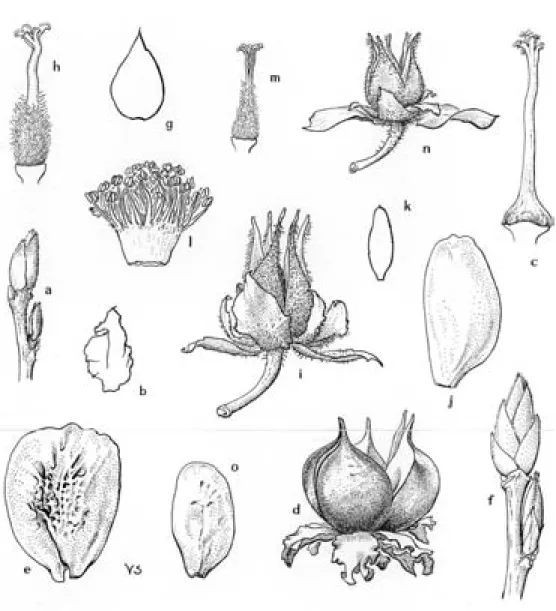
Fig. 2. Stewartia. a-e, S. rostrata: a, dormant winter buds, X 2; b, floral
bract, X
2; c, ovary and style X 2, note pubescence only at the base of the ovary; d, dehisced capsule with persistent floral bracts andsepals X
1 1/2; e, seed, X 4. f-j, S. sinensis: f, dormant winterbud, X
2; g, floral bract, X 2; h, pubescent ovary and style, X 2; i, dehisced capsule with persistent floral bracts and sepals, X 11/2; j, seed, X 4. k-o, S. monadelpha: k, floralbract, X 2; 1, stamens, X 2; m, pubescent ovary and style, X 2; n, dehisced capsule with persistent floral bracts and sepals, X 1 1 /2; o,
seed, X
4. Illustrations by Virginia Savage.This
species
iseasily distinguished
from other Stewartiasby
the
single
floral bract that subtends each of its flowers andby
its five distinct
styles.
Theflowers,
about 21/2 inches indiameter,
are among the
largest produced by
anyStewartia,
and f.grandi-flora
(Bean) Kobuski,
a form that occurssporadically throughout
the natural range, is of
particular
horticultural interest due to itsslightly larger
flowers(up
to 31/2 inchesacross)
with fiveto
eight petals.
Inaddition,
the stamen filaments in f.grandi-flora
may bepurplish
rather than the usual white oryellowish
color. At the Arnold
Arboretum,
oneplant
of f.grandiflora,
which came
originally
fromHighlands,
NorthCarolina,
pro-duces flowers with bothpurplish
andyellowish
stamen filaments.Although
the bark of Stewartia ovata does not exfoliate toproduce
asmooth,
mottledpattern,
theplants develop
into smallbushy
trees or shrubs to about 18 feet inheight.
Anddespite
itsnatural southern range, the
species
and f.grandiflora
arehardy
as far north as the Bostonregion.
Stewartia malacodendron Linnaeus
Silky
StewartiaStewartia
virginica
CavanillesNative to the Coastal Plain and Piedmont of the Southeastern
United States from
Virginia
south to northern Florida and west to Arkansas and easternTexas,
Stewartia malacodendron is thespecies
thatJohn
Clayton,
thenaturalist,
discoveredgrowing
inVirginia.
While theSilky
Stewartia is ratherinfrequently
en-countered in
cultivation,
itproduces,
in ouropinion,
the mostbeautiful of all Stewartia flowers. The five
large
whitepetals
form acontrasting,
saucer-shaped background,
3 to 31/2 inches across, for the erect boss of stamens that areentirely
purplish-blue. The color of the stamens alone is sufficient to
identify
thespecies
whenthey
are in flower. Unlike the otherspecies
of the genus, the reddish-browncapsules
of S. malacodendron openalong
the sides rather than from the apex.Furthermore,
the seeds are a
dark,
shining,
reddish-brown color and areun-winged
andangular
in outline. Other Stewartiasproduce
more or lessflat,
narrowly winged, pale
brown seeds.Although
we haveattempted
to grow Stewartia malacodendronseveral times at the Arnold
Arboretum,
it has notproved hardy.
However,
theplants,
whichdevelop
intolarge,
albeit ratherspindly
shrubs or small trees to about 20feet,
have beenStewartia serrata Maximowicz
Including
Stewartiaepitricha
NakaiWith the
exception
ofStewartia X henryae,
S. serrata isper-haps
the leastfrequently
encountered Stewartia in Americangardens.
Native toJapan,
where it inhabits mountainousregions
of
Honshu,
Shikoku,
andKyushu
Islands,
it isrepresented
inour herbarium of cultivated
plants by only
a few collections.It
is, however,
known to behardy
as far north as Connecticut.A small tree with horizontal branches and
smooth,
reddish-brown,
mottledbark,
Stewartia serrata will berecognized by
itspetals
that are flushed with red near the base on the outersur-faces,
as well asby
itscompletely
glabrous
ovaries. Thecap-sules,
like theovaries,
arecompletely
devoid of hairs and arestrongly
five-ribbed;
two seeds areproduced
in each locule. InEngland,
where it isapparently
morecommonly
cultivated,
S. serrata is
reported
tobegin flowering
before the otherspecies
in
early
June.
Stewartia rostrata
Spongberg
In
1939,
the Arnold Arboretum received seed of a Stewartiafrom the Lu Shan Arboretum in
Kiukiang,
China,
under thename S.
sinensis,
aspecies
Alfred Rehder and E. H. Wilson haddescribed in 1915.
Subsequently,
oneplant
grown from thatSPPIj-~tlY was
ll~antarl
in the Cto~ynrtin collection ~nR4~yj’
Hill---in the Arboretum.
Only recently,
however,
did the name andidentity
of ourplant
come intoquestion.
As one of us wascheck-ing
the identities of ourliving
specimens,
thisplant
did not seemto
correspond
to thepublished descriptions
of S. sinensis. Onconsulting
Dr. G. P.DeWolf, Jr.,
and Mr. R. S. Hebb of the Arboretumstaff,
it was found thatthey,
too, were awarethat
something
wasstrange
about ourplant
labeled Stewartiasinensis. Mr. Hebb’s recollection of S. sinensis grown at Kew in
England
was of anupright
tree withreddish-brown,
exfoliating,
smooth,
mottled bark. Our Arboretumplant,
now 38 yearsold,
is a small
bushy
tree with several limbs from near the base and withtight, non-exfoliating, finely
fissured gray bark.As a result of these
contradictions,
furtherstudy
wasunder-taken in the herbarium and
library.
Examination of theholo-type
specimen
of Stewartiasinensis,
aspecimen
collected ineastern Hunan
Province, China,
by
Wilson in1901,
showed thatMr. Hebb’s memory had served him well. The
specimen
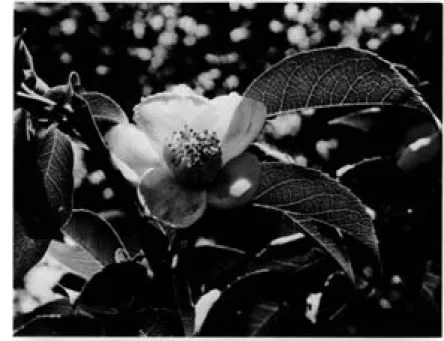
Fig. 3. Flowering branch of S. rostrata, the species recently described as
new, growing tn the Arboretum collections. Photo. P. Bruns
the ovaries in the center of the flowers are
finely pubescent.
Theovaries from flowers of the Arboretum tree have hairs
only
atthe very base.
Other herbarium
specimens
that Rehder and Wilson hadan-notated as Stewartia sinensis included some
plants
thatagreed
in bark and flower characters with theholotype specimen.
Addi-tionalspecimens,
however,
appeared
torepresent
the samespecies
as the Arboretum tree onBussey
Hill. Furtherstudy
revealed other differences between the two
species,
differences that are mostreadily
observed when theplants
are in fruit.Once it was determined that the
Bussey
Hillplant
was notStewartia
sinensis,
thequestion
remained whether itbelonged
to another
species
already
described,
or if it were,indeed,
a newundescribed
species.
In anattempt
to answer thisquestion,
thetaxonomy
of the entire genus was reviewed(see
theJournal of
the Arnold Arboretum 55: 182-214.
1974),
and all of thepub-lished names and as many
type
specimens
aspossible
wereexamined.
During
this process, S. gemmata, a nameby
whichOn
checking
type
herbariumspecimens
of this name it wasdis-covered that Chien and
Cheng,
the Chinese botanists who hadpublished
S. gemmata, had redescribed S. sinensis. Chien andCheng
hadobviously
realized that twospecies
werepassing
under the name S.
sinensis,
but in anattempt
toremedy
thissituation
they
chose togive
the name S. gemmata to thespecies
Rehder and Wilson had described and named in 1915. Thisaspect
of theconfusion,
incidentally, points
out thegreat
value oftype
herbariumspecimens
indetermining
the correctappli-cation of botanical names. Had Chien and
Cheng
studied thetype
of S.sinensis,
they,
too, would have realized that thespecies
that lacked a name was the tree with
non-exfoliating
bark and flowers with the ovariespubescent only
at the very base. Thename S. rostrata has been
proposed
for this newspecies
becauseof its distinctive rostrate or
beaked,
five-ribbedcapsules
thatremain on the branches over winter and sometimes into a
sec-ond or third
growing
season.It is of note that Stewartia rostrata is the
only
deciduousAsiatic
species
that,
like the two Americanspecies,
hastight,
non-exfoliating
fissured bark. And herbarium data indicate thatit is
apparently
confined in nature to mountainousregions
ofChekiang, Kiangsi,
and eastern Hunan Provinces in China. Incultivation,
it is included in the collections of the Bames andMorris Arboreta and at
Longwood
Gardens,
as well as at the Arnold Arboretum.Stewartia sinensis Rehder and Wilson
Stewartia gemmata Chien &
Cheng
Once it was realized that the Arboretum’s
plant
labeled asStewartia sinensis was not that
species,
we weremomentarily
disappointed
that our collection lacked aplant
of this ChineseStewartia. It had been discovered
by
E. H.Wilson,
and Alfred Rehder and Wilson had named and described it as new. How-ever,during
the taxonomic studies that were initiated becauseof the unknown
identity
of S. rostrata, it wasrecognized
thatplants
onBussey
Hill labeled as S.monadelpha,
aspecies
native toJapan,
wereactually plants
of S. sinensis. Theseplants
had been grown from seed obtained in 1934 from the Sun Yat SenMemorial Park in
Nanking,
China,
anddespite
themobility
of ornamentalplants,
it had seemedstrange
that we had received aJapanese
species
from a Chinese source.An erect tree or
ascending
shrub to about 60feet,
Stewartia sinensis is characterizedby
itsattractive,
smooth,
exfoliating,
mottled
bark,
itspubescent
ovaries,
and its foliaceous floral bracts that are about aslong
as, orslightly longer
than,
thesimilar
appearing
sepals.
Thecapsules
are conical anddensely
pubescent,
and two seeds areproduced
in each locule. Theflowers,
while smaller than those of some otherspecies
(about
2 inches
across),
areproduced
ingreat
numbers. In naturethis
species
occurs in mountainousregions
of eastern centralChina,
and its closestally,
with which ourplants
wereoriginally
confused,
appears to be theJapanese
S.monadelpha.
Stewartiamonadelpha
Siebold & ZuccariniIncluding
Stewartia sericea NakaiKnown to attain a
height
of 50 feet inJapan,
Stewartiamona-delpha
is native to mountainous areas of southernHonshu,
Kyushu,
and Shikoku Islands. In Americangardens,
however,
it is
usually
a smaller tree that is noted for its beautiful reddish-brown bark on both the trunk and delicate horizontal branches. Its flowers are the smallestproduced by
any deciduous Stewartia(a
little over an inch indiameter),
and it iseasily
identified inbud,
flower,
and fruitby
theoblong,
persistent
floral bracts thatare
conspicuously longer
than the fivesepals.
Stewartia
pseudocamellia
MaximowiczIncluding
Stewartia koreana RehderReadily distinguished
from other members of the genusby
itssmall,
kidney-shaped
or rounded floral bracts that arecon-siderably
smaller than thedensely silky-pubescent sepals,
andby
its branchlets that areusually compressed
or flattened andzigzagged,
Stewartiapseudocamellia
is the mostwidely
culti-vated
species
of the genus. The flowerbuds,
rounded beforeopening,
and the flowers which are up to 31/2 inches indiameter,
are borne on
long pedicels.
The boss of stamens with orange antherssuggest
those of asingle
Camellia flower. Theground
beneath the small trees or shrubs becomescarpeted
with thefallen corollas and the attached stamens as the
flowering
seasonprogresses.
Native to
Japan,
where it is alsocultivated,
Stewartiapseudo-camellia is also known to occur
naturally
in southernKorea,
andthe Korean
plants
grown at the Arnold Arboretum weregermi-nated from seed collected
by
E. H. Wilson in 1917.Originally
regarded
as a distinctspecies
(S.
koreanaRehder),
and then asthe Korean
plants
do not appear to bemorphologically
distinct from theplants
ofJapanese origin.
Koreanplants
at the Arnold Arboretumdo,
however,
differ fromJapanese
plants
in theirmore
saucer-shaped
flowers,
their extendedblooming period,
and in the coloration of the leaves in fall. Thefoliage
of theJapanese
plants
becomes adeep burgundy-red
infall,
while leaves of the Koreanplants
turn abright yellow-
orreddish-orange. As a result of these behavioral
differences,
differences that aresignificant
to nurserymen andhorticulturists,
wepro-pose here that the Korean
plants
henceforth bedesignated
as acultivar,
and wesuggest
the cultivar name ’KoreanSplendor’.
Observations made here at the Arboretum indicate that indi-vidual flowers of ’Korean
Splendor’ persist
on theplants
forslightly longer
than 24 hours once the buds haveopened
fully.
The
prolonged blooming
season(as
compared
with theJapanese
plants)
is not the result of thepersistence
of individualflowers,
but isapparently
the result of agreater
production
of flowerscoupled
with the lesssynchronous
maturation of the buds. WeFig. 4. The camellia-like flowers of S. pseudocamellia ’Korean Splendor’
are accented by the rich green foliage. Note the rounded, silky buds yet to open. Photo: P. Bruns
have also noted that small bumblebees are attracted to, and
force their way
into,
theunopened
buds of S.pseudocamellia
and ’KoreanSplendor’, apparently
in search ofpollen.
The value of S.pseudocamellia
and’KoreanSplendor’ as summer-flowering
trees is extended and enhanced
by
theirequal beauty
in winterwhen the mottled bark is viewed
against
snow-coveredground.
Stewartia X
henryae
LiStewartia
pseudocamellia
’KoreanSplendor’
X S.monadelpha
Thisputative
hybrid
between the two above listed Stewartiasoriginated spontaneously
in the collections of theHenry
Founda-tion for Botanical Research in
Gladwyne, Pennsylvania.
Itdiffers
only slightly
from S.pseudocamellia,
but can bedis-tinguished
from thatspecies
by
itsoblong
floral bracts that resemble those of S.monadelpha,
itsslightly
smaller flowersize,
and the presence of two seeds per
capsule
locule. Stewartiapseudocamellia
produces
four seeds perlocule,
although
two areoften abortive. From S.
monadelpha
thehybrid
can bedistin-guished by
its ovoidsepals
withrounded,
ciliateapices,
andby
its
larger
flower size.This small tree is known from several
specimens
at theHenry
Foundation where both of thepresumed parental
species
growin close association with the
hybrid,
and it is also known incul-tivation at Barnard’s Inn Farm on Martha’s
Vineyard. Cuttings
obtained from the latter source have been rooted in theArbo-retum
greenhouses,
and youngplants
of S. Xhenryae
will soonbe added to the Arboretum
collection;
to ourknowledge,
it doesnot occur elsewhere in American
gardens.
PROPAGATION
OFSTEWARTIAS
BYSEED
Stewartia seeds are
produced
within thefive-locular,
woody
capsules,
and eachlocule,
depending
upon thespecies,
con-tains two or four seeds. In some instances fewer seeds are
pro-duced in each locule due to the abortion of one or more of the
ovules;
abortion results because the egg within the ovule eitherwas not
fertilized,
or the egg failed todevelop
after fertilization. Naturaldispersal
of thenarrowly-winged,
flattened seeds ofmost
species
isby
wind,
and in the latitude of Boston thecap-sules open and the seeds are available for
dispersal
(or
collec-tion)
during
lateSeptember
andearly
October.A careful watch must be maintained if one intends to collect the seeds from the dehisced
capsules
on theplants,
sincetightly
closed
capsules
can openunexpectedly,
and the seeds may bescattered
quickly.
As aresult,
it is best to collectcapsules
beforethey
have dehisced.Maturity
of seeds is indicatedby
achange
in the appearance of the
capsules;
aboutmid-September
they
begin turning
from green tobrown,
and at thisstage
the seedsare
fully developed
andviable,
and thecapsules
can begathered.
Separation
of the seeds from thecapsules
is easy if the fruitsare
placed
in a paperbag,
tray,
or other container that is thenplaced
in adry
location. In a fewdays
the closedcapsules
will haveopened,
and when the container is shaken the seeds will fall out.Separation
of the seeds from thecapsules
can then beaccomplished by emptying
the contents into a screen ofsuit-able mesh size to retain the
capsules
but topermit
the passageand final collection of the seeds.
Difficulty
in theseparation
of seeds fromcapsules
may beexperienced
with the fruits of Stewartia malacodendron. Asmentioned
previously,
thecapsules
and seeds of thisspecies
differ from those of other
species.
Theangular
seeds are oftenheld
tightly
within thelocules,
and their removal mayrequire
the forceableopening
of thecapsule by
hand. Since the hardwoody capsules
of thisspecies
dehiscenaturally along
thesides,
a blow on the
top
of thecapsule
with a small hammer may benecessary to release the seeds.
When
~:Cpt
indry
itviugi.,
._Cr~i.uiulLtu ~cGUJ 1VJC L11C11VlQUlllly
-quickly.
As a resultthey
should be sown orplaced
inpretreat-ment without
delay
afterthey
have been harvested. All of thespecies
grown and tested at the Arnold Arboretum(S.
ovata, S.pseudocamellia
and ’KoreanSplendor’,
S. rostrata, and S.sinensis )
produce
seeds that aredoubly
dormant,
and in theirnatural habitats the seeds would
require
two years togerminate.
In otherwords,
seedsdispersed
in October of 1974 would bephysiologically
prepared
togerminate
by
natural seasonalchanges
in thespring
of 1976.However,
by
placing
the seeds in astratifying
medium andproviding
artificial seasons, the seeds can be induced togerminate
in about seven months. Thispretreatment
must be done in twostages,
and the container for the seeds andstratifying
mediumduring
the process should bea
polyethylene bag.
Polyethylene
film has theproperty
ofbeing
air
permeable
yet
vaporproof.
Twisting
thetop
of thebag
andbinding
it with a rubber band makes thestratifying
unitvapor-proof
for the entire treatment, and it should not beopened
until the treatment has beencompleted.
At the Arboretum
greenhouses,
astratifying
mediumcom-posed
ofequal
parts
sand andpeatmoss
has worked well with Stewartia seeds. This mixture isdampened
(moist
but notwet)
and,
inproportion,
the medium should be two or three times thevolume of the seeds. This factor is
important
since atsowing
time the seeds are notseparated
from the medium and the entire contents of thepolyethylne bag
are sown.Using
seeds of thosespecies
in cultivation at the ArnoldAr-boretum,
it has been determined that aperiod
of warmstratifica-tion for four months followed
by
cold stratification for three months satisfies therequirements
forgermination.
Seedsplaced
in warm stratification in
early
October are transferred to coldpretreatment
inearly February,
and the seeds areready
forsow-ing
in thegreenhouse
or out-of-doors inearly May.
Thistime-table is
excellent,
since theseedlings
willrespond favorably
tothe warm and
lengthening days
ofspring.
Warm stratification can be
accomplished by placing
the sealedbags
in a location where thetemperature
issubject
to normalday
andnight
fluctuations. Weplace
ourbags
in bins on agreenhouse
bench where thetemperature
hasranged
between60° and 100°F.
Any
location where theday
andnight
tempera-tures vary would be
satisfactory;
full sun,however,
should be avoided since itmight
lead tohigh
temperatures
within thebags
that would be detrimental to the seeds. When the
period
ofwarm stratification has been
completed,
thebag
issimply
trans-ferred to arefrigerator
tosatisfy
the need for cold treatment. At theArboretum,
coldpretreatment
isaccomplished
at about40°F.;
however thistemperature
isarbitrary,
and thetempera-ture maintained in the
storage compartment
of anyrefrigera-tor should suffice for the cold treatment.
PROPAGATION
OFSTEWARTIAS
BYCUTTINGS
As an alternative method ofpropagation,
soft-woodcuttings
may be taken from Stewartias to be
rooted,
anddepending
uponthe
availability
of donorplants, large
numbers of newplants
can beasexually
initiated. At theArboretum,
cuttings
ofStewartias have been taken as
early
asJune
23 and as late asAugust
20.Although
rooting
has beenpartially
successful in all ourattempts
over this timeperiod,
thegreatest
number ofcuttings
wassuccessfully
rooted when thecuttings
were taken and treated between June 23 andmid-July.
Although
a widevariety
ofroot-inducing
chemicals have beenused with success with Stewartia
cuttings,
we have found thatIndolebutyric
acid(IBA)
has proven to be the bestrooting
stim-ulant.
Normally,
the cut ends of thecuttings
are dusted witha 0.8% treatment of IBA in talc with the
fungicide
’Thiram’ added at the rate of 15percent.
High
percentages
ofrooting
have also occurredemploying
quick-dip
treatmentsusing
acombination of IBA
plus
NAA(Napthalene
aceticacid)
at therate of 2500
parts
per million of each in water.Quick-dip
treat-ment involves
immersing
the bases ofprepared
cuttings
inthe
liquid preparation
for five seconds.Rooted
cuttings
ofStewartia,
particularly
those made late inthe
growing
season, havepresented
a survivalproblem during
the
subsequent
winter. Whenpotted
or flatted afterrooting,
theplants
have gone intodormancy
and never recovered. Thisloss can be
averted, however,
if thecuttings
are not disturbed afterthey
have rooted. Theprocedure
we use is to fillplastic
flats with arooting
medium of half ’Perlite’ and half sandby
volume. The
cuttings
aremade,
treated,
and inserted in theflats which are then
placed
under intermittent mist. Whenroot-ing
hasoccurred,
thecuttings
are left in the flats and hardened off. In Novemberthey
are transferred to our coldstorage
unitwhere the
temperature
is maintained atapproximately
34°F.In
February
or March the flats are returned to a warmgreen-house,
and when newgrowth begins
to appear, theplants
aretransferred to ~nntainarc When h?ndlAd i.= this m,A""~ the rooted
cuttings
can beexpected
to survive and grow.When a Stewartia is
planted
in thegarden,
it is advisable toplace
theplant
in itspermanent
location where it will beexposed
to full sun or
high, only
partial,
shade. Theplants
appear togrow best in
moist,
acidsoils,
and it has beenreported
thatlarger plants transplant poorly.
However we have had nodif-ficulty transplanting plants upwards
of 7 or 8 feet if a sufficientball of soil is taken.
Ideally,
theplants
should be grown asspecimen
trees and shrubs so that the fullbeauty
ofform,
flowers,
and bark can beenjoyed
from all